Employed physians at Allina Health vote to unionize

https://mailchi.mp/59f0ab20e40d/the-weekly-gist-october-27-2023?e=d1e747d2d8
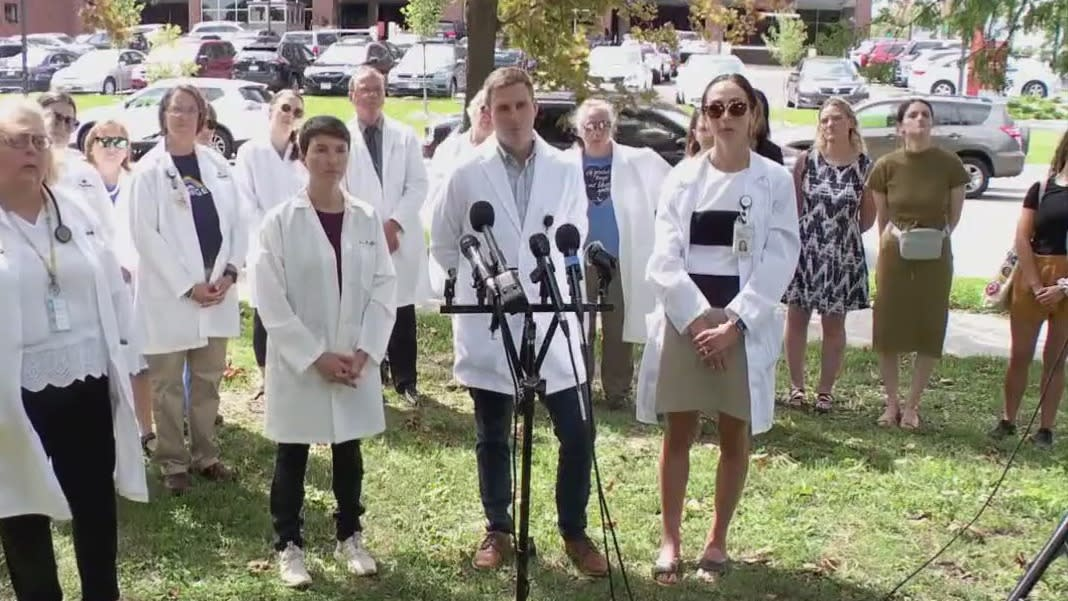
Around 400 primary and urgent care physicians, along with 150 nurse practitioners and physician assistants, employed by Minneapolis, MN-based Allina Health System have voted to unionize with the Service Employees International Union, forming the largest private-sector union of physicians in the country. 

Allina, which operates 12 hospitals across Minnesota and Wisconsin, already saw over 100 inpatient physicians at its Mercy Hospital vote to unionize earlier this year. While Mercy’s physicians organized against pressure to adhere to the hospital’s new length-of-stay guidelines, this larger group of clinic-based providers say they are motivated by chronic understaffing that they claim has caused burnout and threatened patient safety. Allina Health laid off 350 workers this summer after posting a nearly $200M operating loss in 2022.

The Gist: When health systems originally recruited physicians into their newly developed employed medical groupsmany pitched the arrangement as more of a partnership than traditional employment.

However, now that a majority of the nation’s physicians are employed by hospitals, some physicians are rethinking their relationships with their employers. 

Only six percent of doctors were unionized in 2021, but a recent spate of unionization efforts by residents and physicians suggest that number is on the rise.

Health systems hoping to address physicians’ concerns and unionization activity should note that the motivating factors cited by organizing physicians surround working conditions, including a lack of support staff and professional autonomy, rather than personal wage demands.
California passes law raising healthcare worker hourly minimum wage to $25

https://mailchi.mp/59f0ab20e40d/the-weekly-gist-october-27-2023?e=d1e747d2d8

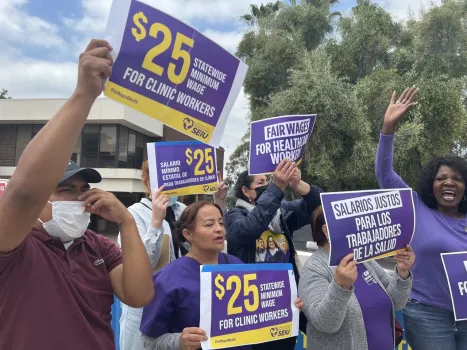
Earlier this month, Governor Gavin Newsom signed a bill that puts all full- and part-time California healthcare workers, including all ancillary support staff, on a path to earning $25 per hour.

While wage increases will begin phasing in next year, the timeline for implementation depends on facility type and other factors like payer mix. Large health systems and dialysis centers have until 2026 to fully implement the new wage, while rural, independent hospitals and those with high public payer mixes, as well as other clinical facilities, have more time to comply.

The law, which replaces the $15.50 state minimum wage for all workers, is projected to impact over 469K healthcare workers in the state, potentially including 50K who already earn more than $25 per hour but are forecasted to receive wage increases to maintain their pay premiums. Strongly backed by California healthcare unions, the law ultimately received the support of the California Hospital Association on the grounds that it will “create stability and predictability for hospitals” by preempting local wage and compensation measures active in many California cities. 

The Gist: On the heels of a tentatively successful labor negotiation with Kaiser Permanente—which would raise the system’s hourly minimum wage to $25—California healthcare unions have flexed their might for another win.

While this new law directly benefits healthcare workers earning less than $25 an hour, its knock-on effects will extend to those earning above that to avoid pay compression, as well as to workers in other industries that draw from the same labor pool. 

The mandated higher pay may provide California healthcare employers with a recruitment edge (and lure talent away from neighboring states), but higher costs will exacerbate the margin challenges plaguing many hospitals in the state.

Uneven operating margin recovery for national health systems

https://mailchi.mp/de5aeb581214/the-weekly-gist-october-13-2023?e=d1e747d2d8

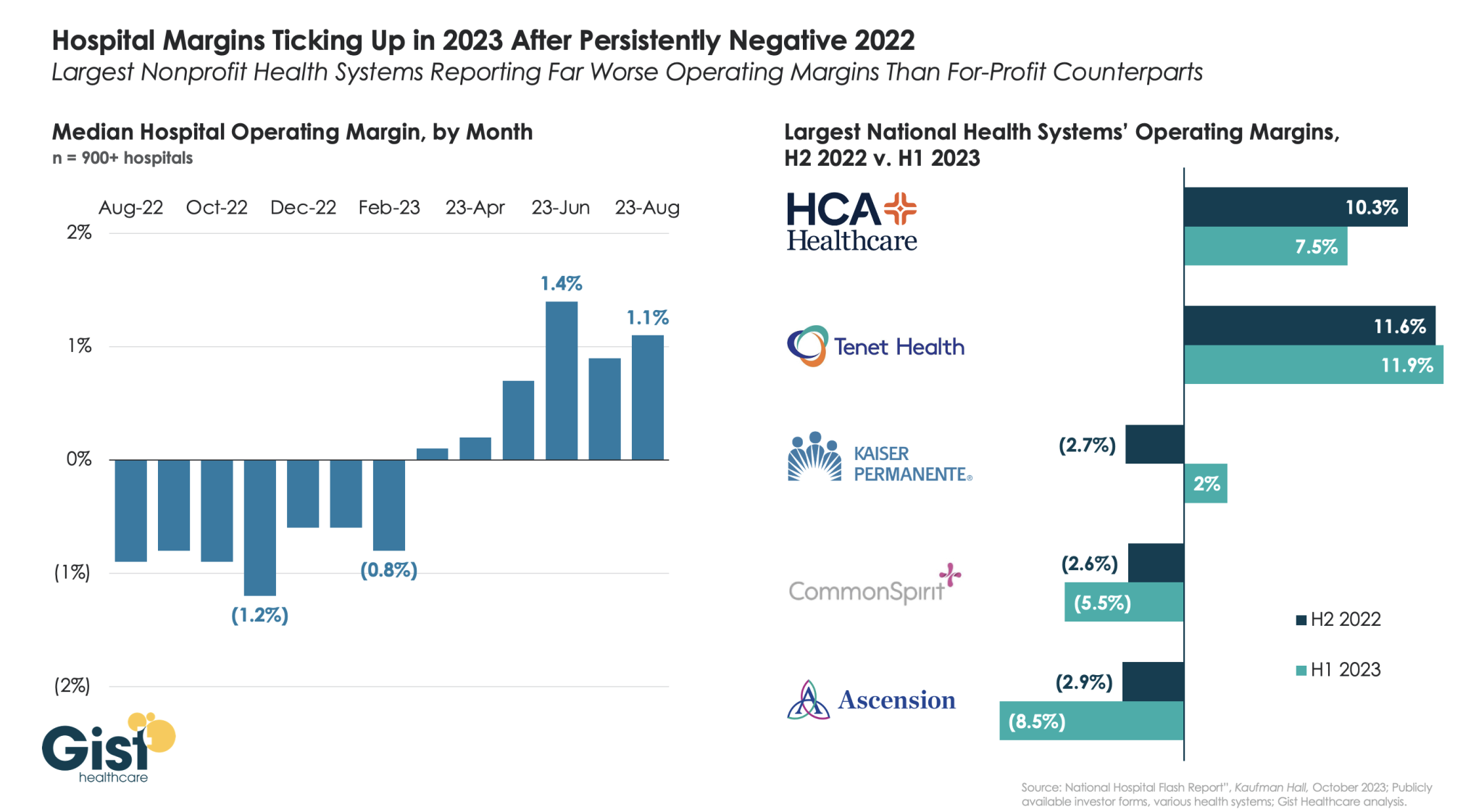
Using data from Kaufman Hall’s latest National Hospital Flash Report and publicly available investor reports for some of the nation’s largest health systems, the graphic below takes stock of the state of health system margins. 

After the median hospital delivered negative operating margins for twelve-straight months, 2023 has made for a positive but slim year so far, with margins hovering around one percent. Amid this breakeven environment, fortunes have diverged between nonprofit and for-profit health systems. 

The largest for-profit systems, HCA Healthcare and Tenet Healthcare, posted operating margins of around 10 percent between July 2022 and June 2023, while the three largest nonprofit systems, Kaiser Permanente, CommonSpirit Health, and Ascension, suffered net losses.

Although Kaiser Permanente’s margin bounced back in the first half of this year, CommonSpirit and Ascension’s margins continued to decline, more than doubling the operating losses of the prior six months.

 One key to the recent success of the largest for-profit systems is their diversification away from inpatient care. 

Case in point: almost half of Tenet’s profits in 2023 have come from its ambulatory division, driven by its United Surgical Partners International (USPI) ambulatory surgery center network, which has posted 40 percent margins over the past several quarters.

California takes a step toward establishing universal health coverage for residents

https://mailchi.mp/de5aeb581214/the-weekly-gist-october-13-2023?e=d1e747d2d8

California Governor Gavin Newsom signed a bill directing the state’s Health and Human Services Agency to work with the federal government to create a waiver allowing Medicare and Medicaid funding to be reallocated toward a universal health insurance system for its residents. 

The established timeline sets California on track to submit its final waiver for federal approval in 2026. The law does not specify whether universal coverage would be via a single-payer system, which is what Newsom favored in 2018. The California Nurses Association opposed the bill on the grounds that it does not commit to a single-payer outcome, while the California Association of Health Plans protested against its threat to end private coverage in the state.

The Gist: This is California’s 10th attempt at universal care, with all previous attempts having ended in failure because, despite both popular and political support in the state, there has not been consensus on how to pay for it. 

This most recent bill only passed because it was separated from a funding bill, since shelved, addressing the over $300B in tax revenue needed to pay for it. This process-first approach may be seen as a calculated appeasement of the Democratic Party’s left wing, as Governor Newsom clearly holds aspirations for higher office—but so far, 

healthcare has not ranked among the top issues for the current roster of candidates targeting the White House in 2024.

General Catalyst announces intent to buy a health system

https://mailchi.mp/de5aeb581214/the-weekly-gist-october-13-2023?e=d1e747d2d8

On Sunday, venture capital (VC) firm General Catalyst unveiled the Health Assurance Transformation Corporation (HATCo), a new subsidiary company which aims to acquire a health system to serve as a blueprint for the VC firm’s vision of healthcare transformation. 

Sharing this news on the first day of the HLTH 2023 conference in Las Vegas, General Catalyst declined to comment on which health systems are targets, or how much it is willing to spend, but CEO Hemant Taneja suggested that investment returns would be evaluated on a longer timeline than the typical 10-year venture capital horizon. 

Dr. Marc Harrison, the former CEO of Intermountain Health who joined General Catalyst in 2022, has been tapped to lead HATCo. The new company will build on General Catalyst’s previously announced partnerships with health systems, including Intermountain, HCA Healthcare, and Universal Health Services, with the goal of connecting healthcare startups with health systems in order to test and scale their technologies.  

The Gist: While private equity firms have backed health systems before, a VC firm expressing interest in health system ownership is a surprising development. 

Even on a longer timeframe than most venture plays get, it’s difficult to imagine a health system ever delivering the outsized returns VC investors usually demand. It’s possible HATCo’s true value will come from scaling and selling the services of tech startups in General Catalyst’s portfolio after vetting them at their health system “proving ground”. 

HATCo’s more ambitious aim to align payers and providers in a pivot to value-based care is a familiar one, but the new venture will find itself up against skepticism from insurers and other entrenched stakeholders, which has been difficult for even the most motivated health systems to overcome.