


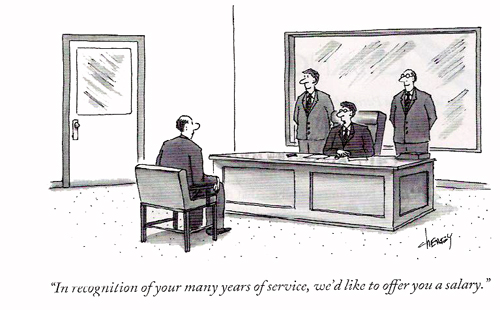
Cartoon – Keep Up the Good Work


It’s Thanksgiving Eve. Which for Health 202 begs this question: What is everyone thankful for this year when it comes to health policy?
We suspect that maybe – just maybe –you’d get vastly different answers from doctors versus insurers versus drugmakers versus consumers versus any other stakeholder in the $3.6 trillion U.S. health-care industry complex. Everyone has competing interests, which is a prime reason why the country’s besetting problems of ever-rising costs and subpar medical outcomes never quite seem to get solved.
So before you tune out the news cycle for Turkey Day, here’s our best guess at what’s giving each health-care stakeholder an attitude of gratitude.
—The White House and Republicans: Democrats are fixated on Medicare-for-all.
The GOP could hardly be more eager to focus on Medicare-for-all proposals from the Democratic presidential candidates. They view it as a way to veer the political conversation away from their own, unpopular actions on health-care policy and to depict Democrats as out-of-touch with voters.
President Trump and his top health officials have repeatedly decried Medicare-for-all, including during an October speech where the president announced an executive order boosting the role of private plans in the Medicare program.
“Every major Democrat in Washington has backed a massive government health care takeover that would totally obliterate Medicare,” the president said during that address. “These Democratic policy proposals … may go by different names, whether it’s single payer or the so-called public option, but they’re all based on the totally same terrible idea: They want to raid Medicare to fund a thing called socialism.”
—Democrats: The Trump administration is refusing to defend the Affordable Care Act.
Democrats are well aware that the refusal by Trump’s Justice Department to defend the Affordable Care Act from a challenge by GOP-led states is a political gift. They spent the 2018 election castigating the administration for not standing by the health-care law’s protections for patients with preexisting conditions – and it helped them win the House majority.
They plan to hammer that message again in 2020, as they seek the White House.
—The Department of Health and Human Services: Obamacare hasn’t been struck down (yet).
A federal appeals court is expected to rule any time now on the challenge to the ACA, which was upheld by a lower court last year. As The Health 202 has written, the decision against defending the law was a deeply controversial one inside the administration.
HHS Secretary Alex Azar and Seema Verma, administrator of the Centers for Medicare and Medicaid Services, tried to persuade the White House to defend the law. If the courts ultimately strike down the ACA, the administration will be on the hook to propose a replacement that would preserve health coverage for millions of Americans who gained it under the health-care law.
—Health-care advocates: Marketplace premiums are somewhat more affordable.
After several rough years for the ACA’s individual marketplaces, they got some good news this year. Average premiums for mid-level “silver” plans fell four percent for 2020 – a marked shift from the double-digit increases shoppers have typically seen.
That doesn’t mean plans are suddenly affordable for consumers ineligible for government subsidies. But it does mean insurers have found a sustainable way to keep participating in the marketplaces – and the marketplaces are here to stay for people without access to employer-sponsored coverage.
—Drugmakers: Chances for a major, bipartisan drug pricing deal this year are fading.
One of the pharmaceutical industry’s biggest fears is that Congress passes legislation allowing the federal government to directly negotiate lower prices in the Medicare program – a move the industry describes as government “price-fixing.”
Trump used to support allowing direct negotiations, and his staff was even in discussions with House Speaker Nancy Pelosi’s (D-Calif.) office earlier this fall over the potential for a bipartisan effort along these lines.
But the president and his aides have increasingly distanced themselves from Pelosi’s bill to allow direct negotiations. Now it looks like House Democrats will pass that measure as a messaging tactic, only to see it blocked in the GOP-led Senate. A bipartisan Senate bill capping how much drugmakers can annually raise prices has somewhat better prospects, but even that measure has made many Republicans suspicious.
In the end, only minor and less-controversial drug pricing measures may end up being attached to a longer-term spending bill.
—Doctors and hospitals: Any legislation protecting patients from “surprise” medical bills will almost certainly include arbitration – an approach that means higher payments for them.
Virtually every member of Congress agrees American patients should be protected from the surprise bills that can result when they visit an emergency department outside their health plan’s provider network or get care from an out-of-network provider at an in-network hospital.
But how to solve that has turned into an insurers-versus-doctors food fight.
Insurers and the Trump administration want to use a benchmarking approach to resolve out-of-network bills, in which the payments are tied to average prices in the same geographic area. That approach would save the government money, the Congressional Budget Office has said.
But doctors – and some dark-money groups that represent their interests – have been spending millions of dollars to push Congress toward adopting an approach called arbitration. In arbitration, which CBO has said would cost the government more money, the medical provider and the insurer each submit a bid to a third party arbiter, who then make a final decision.
Doctors believe arbitration would translate to beefier payments for them – and outcomes from New York’s arbitration system supports that notion. So if Congress passes surprise billing legislation, it will likely include some element of arbitration given the heavy influence by the doctor lobby.
—Regular Americans: Not much.
We hate to say it, readers, but there’s little for you to be thankful for this year when it comes to health-care policy. Costs for employer-sponsored coverage are going up and coverage plans are getting less generous. Congress appears unable to pass major reforms on the biggest consumer concerns. And the next election is likely to result in a government severely split over how to improve health-care – making it likely the status quo will prevail for some time.
But Happy Thanksgiving, anyway!

The healthcare sector seems to be entering a volatile period, although the chances for a major upheaval are far more remote, according to Fitch Ratings.
The biggest risk to healthcare is currently the uncertainty regarding the ACA, which as it nears its 10th anniversary remains embroiled in litigation, currently awaiting a decision from the U.S. Fifth Circuit Court of Appeals in New Orleans.
Fitch noted that if the law is struck down with no replacement waiting, “it may result in a disorderly wind down of the insurance expansion elements of the legislation, which could have negative ramifications for cash flow and profitability of segments most exposed to patient liabilities.”
While there are legal uncertainties surrounding the ACA, Fitch believes the gridlock in the nation’s capital remains a plus for the sector, noting that “progress on major pieces of healthcare legislation, due to political discord in Washington, will insulate issuers from the effects of any new policy measures on profitability during 2020.”
Meanwhile, those companies caught up in litigation over the opioid crisis will likely have to negotiate years of lawsuits, but Fitch believes it will be manageable over the long-term. “We expect investment-grade issuers to navigate the litigation with credit profiles intact, given the ability to redirect a portion of cash flow from operations from shareholder returns to litigation payments,” the rating firm noted. “Moreover, early indications are issuers will pay cash settlements over a period of years rather than in lump sums, which limits the effect on credit metrics.”
Healthcare ventures are also navigating the shift from volume to value. “A slow changing payment environment tying profits to high value, rather than high volume care, will continue to encourage gradual evolution of business models across the sector,” Fitch observed. “The convergence of business models via strategic M&A is viewed as constructive to credit profiles since it could help companies align value propositions with shifting consumer and payer preferences, despite its potential to reshape issuers’ balance sheets.”

Los Angeles-based Prospect Medical Holdings says it cannot consider a $50 million acquisition offer from Ontario, Calif.-based Prime Healthcare Services because it has already entered into another deal, according to the Journal Inquirer.
Prospect Medical Holdings is owned by certain funds of private equity firm Leonard Green & Partners and members of the company’s management team. In October, Prospect said its shareholders reached an agreement to purchase Leonard Green & Partners’ outstanding shares of the company, according to the report.
Leonard Green & Partners is considering selling its majority stake in Prospect for roughly $12 million, and Prime said it would pay $50 million for the company, according to an offer letter from Prime President and CEO Prem Reddy, MD, obtained by the Journal Inquirer.
In a Nov. 24 statement to the Journal Inquirer, Prospect said it cannot consider Prime’s offer or other proposals because it signed a “binding agreement” with Leonard Green & Partners “several months ago.” Prospect said it is required to close the transaction, which is expected to take three to six months to complete, according to the report.
Access the full Journal Inquirer article here.

Best Buy is known as the largest specialty electronics retailer in the U.S., and a key part of its growth strategy is centered on digital health initiatives.
In the past year, Best Buy has spent roughly $1 billion on acquisitions to expand its healthcare services, according to Forbes. The company’s expansion into healthcare has helped it overcome broader declines in consumer electronic sales, according to Bloomberg.
Senior care is Best Buy’s niche in the healthcare services market. One million seniors are using the company’s health offerings, and Best Buy’s goal is to expand its services to 5 million seniors by fiscal 2025, according to MarketWatch.
“Today, most of the seniors we serve are utilizing easy-to-use mobile phone products and connected devices that are tailored for seniors and come with a range of relevant services,” Best Buy CEO Corie Barry said during an earnings call Nov. 26, according to a transcript from Seeking Alpha.
Ms. Barry also shed light on how Best Buy plans to expand its healthcare business. She said the company plans to scale its “five-star service” that connects seniors with caregivers, dispatches emergency personnel and more.
“We also expect to advance our commercial business where the services we provide for seniors are paid for by insurance providers. This includes services such as remote monitoring based solutions that provide meaningful insights to improve timely care and reduce the cost to serve frail seniors,” she said.
The company could generate as much as $46 billion in revenue from its commercial health business over the next 10 to 20 years, according to Bloomberg, which cited Morgan Stanley estimates.
https://www.beckershospitalreview.com/strategy/hospitals-and-health-systems-6-trends-and-issues.html

This article discusses the current state and issues of hospitals and health systems for several different areas. First, this discusses types of hospitals and health systems. Second, it addresses what’s working and what’s not for health systems. Third, this discusses the mix of access, quality and cost as well as the shortages of different kinds of providers fourth. Fifth, this discusses policy issues and political issues. Sixth, we address threats and challenges.
1. 5,200+ acute-care hospitals. Currently, there are approximately 5,200 acute-care hospitals in the country. This number changes a little each year, with more closures than openings.
We view the landscape as one with seven core types of health systems.
First, there’s what we think of as the very elite health systems, which are often academic medical centers. This usually includes the top 20 to 30 systems as ranked by U.S. News & World Report. These are typically great research institutions that provide great care in some of the most critical, life-threatening areas. This category may include hospitals like NewYork-Presbyterian, UChicago Medicine, Cleveland Clinic, Mayo Clinic, Northwestern Medicine and a number of other institutions that typically comprise the top 20 to 30 in the U.S. News & World Report’s Best Hospitals.
Second are regionally dominant systems. These systems are so important to a given area that they are often the focus point of care in said area. There are also situations where it’s very hard for payers and patients to go around these institutions — even if they wanted to. This might be an institution like Carilion Clinic or Sentara Healthcare in Virginia, Northwell in New York, Ochsner in Louisiana or NorthShore University Health System in the north suburbs of Chicago. It may be Advocate Aurora Health in the Chicagoland area and Eastern Wisconsin, Hartford HealthCare in Connecticut, Intermountain Healthcare in Utah and Idaho, and a number of institutions regionally strong in their areas.
A third type of system is the community hospital, typically the single- or two-hospital system. This could be rural, urban or suburban. Here, this may be a health system that has served as the core of primary care — and at one time tertiary care — for a community, but more and more has to have a certain reason for being, something that its really great at to remain relevant and open.
A fourth type of hospital is what we think of as a specialty hospital, usually built around a certain specialty like pediatrics, behavioral health, oncology or some other area. It is a hospital that has a specific focus and is just great at what it does, much like Hospital for Special Surgery in New York, which U.S. News & World Report has ranked as the No. 1 hospital in the country for orthopedics for the past 10 years.
National chains of hospitals and health systems make up the fifth type of system. This can be for-profit or nonprofit, and they come in a couple different varieties. First, they can pursue a strategy of being in lots of different markets, but regionally dominant in the markets they’re in. This has typically been the strategy for success. Second, they can pursue the strategy of having the most hospitals possible. This has typically not been a strategy for success. Market strength or market dominance and excellence in certain areas is far more important than having lots of different hospitals.
The sixth type of hospital that we think of as Kaiser Permanente. Here, we put Oakland, Calif.-based Kaiser Permanente in its own category. It is a regionally dominant system in certain parts, but more importantly it is vertically integrated with its own insurance plan. This has allowed Kaiser to do things in the cost savings areas and the efficiency area that many other systems have not been able to do. We have also found over the last decade that it is much harder for other systems to replicate what Kaiser has done, in terms of fully integrating insurance, than expected.
The seventh category of hospital we think of as the safety-net hospital. The safety-net hospital can really be in any of the above categories. We largely think of safety-net hospitals as those that are serving a huge percentage of Medicare and Medicaid patients. The safety-net hospital is a very important part of the fabric of American healthcare and the delivery system, and at the same time they often struggle to ensure they have the finances to make the system go.
2. What has worked the last 10 years? The three types of categories that have really worked the past 10 years are as follows.
First, one prescription for success has been to be regionally dominant. Whether a Novant Health or an Atrium Health, both based in North Carolina, or a system like Advocate Aurora in Wisconsin or ProMedica in Ohio, being regionally strong has been a prescription for success. It allows one to stack resources, invest in talent, invest in systems and get better and better.
The second prescription for success the last decade and for a long time is being an elite health system. As much as the world changes, these elite systems — whether Stanford Medicine, Mayo Clinic, Cleveland Clinic or UCLA Health — continue to be sought out for care and continue to recruit great physicians, researchers and providers. This may also include being elite in certain areas like Rush University Medical Center in Chicago in orthopedics, MD Anderson in oncology or a number of other actors that are elite.
The third type of category that has worked is clearly the Kaiser Permanente category. This is a situation where Kaiser is almost its own vehicle, led famously by the late Bernard J. Tyson. Over the years, Kaiser grew into being a great integrated system and was able to do things on the value-based side and make major investments to address social determinants of health that really no one else was able to do.
3. Access, quality and cost. There is constant discussion of access, quality and cost. As we look as things evolve, we see things as follows.
On the quality side, the American healthcare system seems to do a pretty good job of delivering pretty good care to a huge percentage of people. In essence, compared to other countries, the U.S. is providing care to more than 325 million people. While imperfect, it is pretty good. There are pockets of care in other countries that are certainly better and more advanced than it is here, but often in pockets versus an entire system.
In terms of access, the American healthcare system seems to be challenged in numerous ways. As shortages evolve, particularly among specialties and subspecialties, it is harder and harder to find access to the right type of provider when one needs that provider. Access can also be a challenge in many different ways for poor communities in our country and, of course, there is no quality without access.
A third issue in terms of the American healthcare system is cost. As costs continue to grow at a percentage higher than inflation, particular pockets of costs remain very challenging, specifically on the pharmaceutical side, technology side and labor side.
4. Shortages of doctors and allied health professionals. As we look at access challenges in the country, there is a perspective that it is very hard to solve without the minting of a great deal more of physicians and allied health professionals. Even as the ways care is delivered evolve, the physician shortage remains. We will see a shortage of up to nearly 122,000 physicians by 2032 as the population grows and ages and demand continues to grow faster than supply, the Association of American Medical Colleges.
There are different structural elements in place that make it hard to add on providers at a fast clip. For example, medical school, residency and fellowship take many years. In efforts to modernize medical education, there is a question as to whether that much education is needed. The American Medical Association is one body that is working with major institutions for accelerated programs, like a six-year model at University of California, Davis School of Medicine. The school offers a six-year path to practice — three years each of medical school and residency — in partnership with Kaiser Permanente Northern California.
As we look at our society, we probably need more incentive for people to go to medical school and graduate with medical degrees than are currently in place. The more one tries to attack some of benefits of being a physician, the harder it is to encourage the next generation to become physicians. In response, we do see a growing number of medical schools being opened, including those at Kaiser Permanente and Hackensack Meridian. We think this is absolutely critical. It is also critical that we develop more and more allied health professionals and those allied health professionals are largely able to practice at the top of their license.
Finally, there is this concept in medical school and in premed of “weed out” classes. We believe this is somewhat overdone and overemphasized, and many bright, talented people are weeded out that would be perfectly great physicians. As one resident at Stanford University School of Medicine put it, “Today we ‘weed out’ potentially wonderful doctors through a demoralizing maze of basic sciences that more often resembles the Hunger Games than a sensible recruitment process.”
5. Political polarization. In healthcare, and the hospital sector specifically, we see a great deal of political polarization. There are largely three different types of systems that people think about in terms of reform.
First, there is the “Medicare for All” perspective. While this would provide adequate “access” at a certain level for everybody in terms of health insurance coverage, there is concern from providers that reimbursement would be so low it would not encourage people to pursue medicine, thus flattening or denting the supply of physicians needed to provide the care that is needed.
Second, there is the concept of the “free market.” Here, the concept of a total free market and free market alternatives is somewhat illusory. In reality nearly 30 to 50 percent of most providers’ revenue comes from Medicare and Medicaid. Thus, you are never really dealing with a free market in healthcare. There are free market incentives — like health savings plans and transparency — that can help, but one is not in total dealing with a free market.
Third, is the concept of a public option. One way to think about a public option is to think about it as akin to the post office. One can either go to the post office to mail something via the United States Postal Service, or one could use UPS or Federal Express. The idea of a public option is that you would not have to buy insurance from an insurance company. Rather, you could buy into the Medicare program through a public option. Washington signed a public option into law this past summer and will launch it in 2021, becoming the first state to test the policy.
Whatever the answer is for healthcare reform, it is clear that the general public prefers two things. First, they like the concept that you should be able to buy insurance regardless of whether or not you have a pre-existing condition. Second, a large percentage of the public seems to prefer that there be some sort of public option to access care.
6. Threats and challenges. Some the challenges healthcare systems face today are as follows.
First, the strength of payers and the power they hold, especially as they diversify and broaden their scope of business. Under the UnitedHealth Group umbrella, for instance, is Optum, the Advisory Board and Equian, among other arms. In 2018, Cigna acquired Express Scripts, CVS Health combined with Aetna, and Humana and private equity firms acquired Kindred Healthcare. Highmark, one of the largest insurers in the country, acquired the West Penn Allegheny Health System years ago. Each of these forays into technology, consulting, payment, pharmacy benefit management, post-acute care and provider spaces make health insurers more prevalent in the industry.
A second great concern is the growing number of access points that are providing threats to health systems and their margins and revenues. This may be things like the CVS’, Walgreens and Walmarts of the world, which are expanding the medical services and health hubs in their stores to provide consumers with an alternative access point for chronic conditions and routine care. This fall, Walmart even revealed plans to build its own healthcare workforce.
Third, powerful payers are developing provider networks and providing alternatives to health systems and their delivery systems. Blue Cross Blue Shield Association, for instance, will launch a national provider network in 2021 that spans across 55 markets to help large employers better control medical costs.
Fourth is the total costs of bricks and mortar and labor that hospitals and health systems carry.
Fifth is the development of new types of insurance programs by companies like Haven, which is JPMorgan, Berkshire Hathaway and Amazon’s effort to serve their combined 1.2 million employees. Currently, commercial insurance and payments from employed people ultimately subsidize what hospitals and health systems receive from Medicare and Medicaid. Thus, if these efforts like Haven are successful at peeling off good-paying patients, this will have a big negative impact on hospitals and health systems.
 HENRY KOTULA