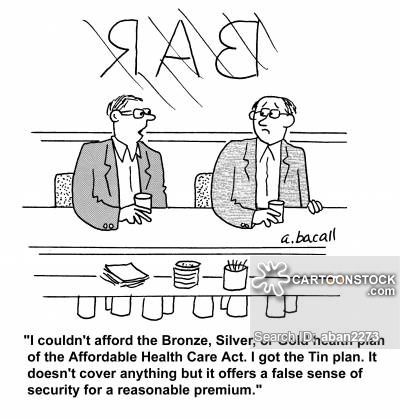
Cartoon – The Tin Plan

Image result for cartoon inadequate health insurance coverage

Cartoon – Acme Health Insurance

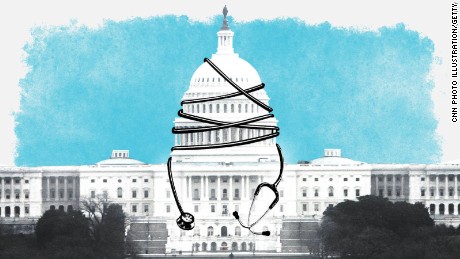
Image result for cartoon inadequate health insurance coverage

Trump Medicaid proposal sparks bipartisan warnings

Trump Medicaid proposal sparks bipartisan warnings

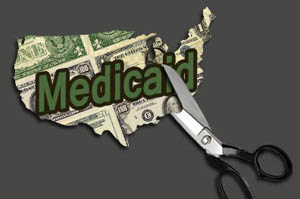
Image result for Medicaid cuts

Republicans and Democrats alike are warning that a recent proposal from the Trump administration could lead to billions of dollars in cuts to Medicaid, forcing states to eliminate benefits, reduce enrollment or cut payments to health providers.

In a rare sign of unity, hospitals, insurers, patient advocates and members of both political parties are on the same page in their opposition to the Trump administration’s plan, and most have urged the administration to withdraw a proposal they say would “cripple” Medicaid, the federal-state partnership that provides health care for the poor.

The proposal hasn’t received as much attention as the administration’s other efforts to reform Medicaid, such as implementing work requirements, but it could have the most damaging effect because of how far-reaching it is, experts argue.

“This is high stakes,” said Matt Salo, executive director of the National Association of Medicaid Directors, whose board urged the administration to completely withdraw the proposal.

Trump allies have also voiced their concerns.

“The Medicaid fiscal accountability rule is a concern to my governor, and the stakeholders are worried the rule as proposed could lead to hospital closures, problems with access to care and threaten the safety net,” Sen. John Cornyn (R-Texas) told Department of Health and Human Services Secretary Alex Azar last week during a hearing on the agency’s fiscal 2021 budget request.

Sen. Mark Warner (D-Va.) warned during the same hearing that the proposal could “dramatically affect Medicaid eligibility” and “wreak havoc on budgets in red states and blue states all across the country.”

The proposal would overhaul the complex payment arrangements states use to raise money for their Medicaid programs — funding that is then matched by the federal government.

The administration argues some states use questionable methods of raising funds so they can leverage more money from Washington. One approach used by states consists of taxing providers who stand to benefit from more Medicaid funds flowing into the state.

But governors and state Medicaid directors argue those long-standing arrangements are both legal and necessary as states look for ways to keep up with escalating health care costs.

The proposal would allow the Centers for Medicare and Medicaid Services (CMS) to limit the extra payments from states to providers serving high numbers of uninsured patients or Medicaid patients. Opponents say such changes could result in providers deciding not to accept Medicaid patients.

Dozens of states wrote public comments to CMS Administrator Seema Verma, urging her to withdraw the proposal, including conservative states that are typically supportive of her work.

“If the rule is finalized as proposed, it will immediately disrupt the Medicaid program in Alabama and we believe across the country,” wrote Stephanie McGee Azar, commissioner of the Alabama Medicaid Agency, who is not related to Alex Azar. She added that it would have “unintended consequences that will affect access to care in Alabama to our most vulnerable populations.”

Florida Gov. Ron DeSantis’s (R) administration warned the effect of the proposal would be “immediate and crippling.”

Meanwhile, a letter signed by state Medicaid officials in Michigan, Missouri, New York, Oregon, Pennsylvania, South Carolina, Tennessee, Illinois, Louisiana, Colorado, Pennsylvania and Washington argued the proposal would likely “force states to cut Medicaid eligibility, benefits and/or provider payments, which would have the effect of decreasing low-income individuals’ access to important health care services.”

The public comment period closed Jan. 31. CMS now needs to go through the 4,000 comments before deciding whether to finalize the rule.

Verma and her supporters argue the proposal is not intended to cut Medicaid but instead aims to improve transparency and accountability in the $600 billion a year program.

“It’s not surprising providers and the states are objecting when they are getting federal money for free,” argued Brian Blase, who previously served on President Trump’s National Economic Council, where he worked on health care issues. “They don’t want transparency and they don’t want their financing gimmicks checked.”

Blase predicted the rule, if implemented as proposed, would reduce Medicaid spending by a “very small amount.”

Verma also pushed back on opponents, criticizing a study commissioned by the American Hospital Association that estimated the rule could reduce Medicaid funding by as much as $49 billion annually.

“This proposed rule is not intended to reduce Medicaid payments, and alarmist estimates that this rule, if finalized, will suddenly remove billions of dollars from the program and threaten beneficiary access are overblown and without credibility,” she wrote in a blog post last week.

Some experts disagree with her, pointing to other actions the administration has taken on Medicaid, including work requirements.

“I think one should view this rule not in isolation, but in combination with the broader agenda of this administration on Medicaid,” said Edwin Park, a research professor at Georgetown University McCourt School of Public Policy. “Their ultimate agenda is about cutting the Medicaid program, changing the Medicaid program as it currently stands.”

State officials have complained that they were not asked for their input before the proposal was released, nor did CMS conduct a regulatory analysis of potential effects.

A nonpartisan agency that advises Congress on Medicaid policy wrote to Alex Azar advising he not implement the rule because CMS has not fully assessed the possible effects.

“The Commission is concerned that the proposed changes could reduce payments to providers in ways that could jeopardize access to care for Medicaid enrollees,” the advisory group wrote.

For example, Maine’s Department of Health and Human Services has planned to make $86 million in supplemental payments to hospitals in fiscal 2020, which began July 1.

The rule “would require significant changes to MaineCare and could force the State to cut back on eligibility or services,” Jeanne Lambrew wrote in the department’s public comment.

The administration hasn’t given any signals that it plans to back down from the proposal, despite considerable pushback from stakeholders, states and bipartisan members of Congress.

“We will work with states to help them recreate their practices in ways that are in conformity with the statute and try to be fair and equitable in all our dealings with states,” Alex Azar told lawmakers last week on Capitol Hill.


It’s Not Just Hospitals That Are Quick To Sue Patients Who Can’t Pay

https://www.npr.org/sections/health-shots/2020/02/19/798894062/its-not-just-hospitals-that-are-quick-to-sue-patients-who-cant-pay?utm_source=The+Fiscal+Times&utm_campaign=59b997dc59-EMAIL_CAMPAIGN_2020_02_19_10_03&utm_medium=email&utm_term=0_714147a9cf-59b997dc59-390702969
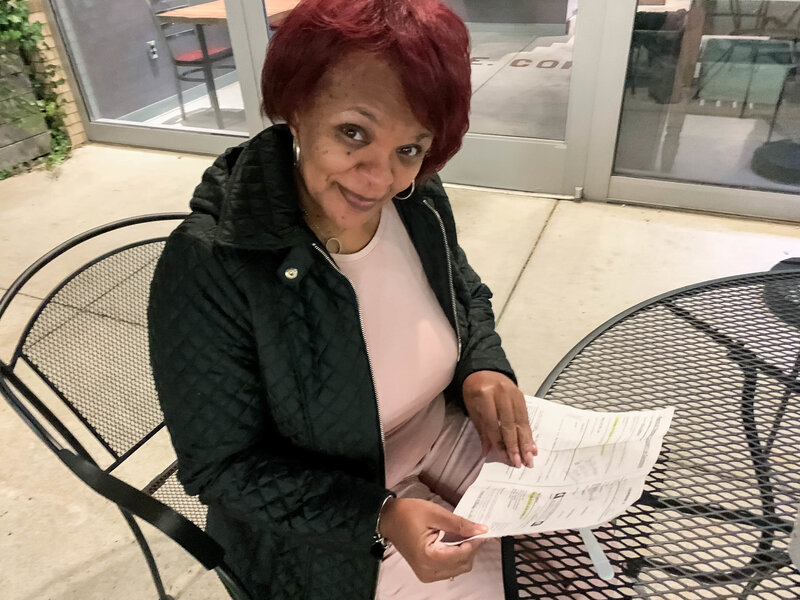
Social worker Sonya Johnson received a civil warrant to appear in court when the company that runs Nashville General Hospital’s emergency room threatened to sue her over a $2,700 ER bill — long after she’d already negotiated a reduced payment schedule for the rest of her hospital stay.

Nashville General Hospital is a safety net facility funded by the city. For a patient without insurance, this is supposed to be the best place to go in a city with many hospitals. But for those who are uninsured, it may have been the worst choice in 2019.

Its emergency room was taking more patients to court for unpaid medical bills than any other hospital or practice in town. A WPLN investigation finds the physician-staffing firm that runs the ER sued 700 patients in Davidson County during 2019.

They include patients such as Sonya Johnson, a 52-year-old social worker and single mother.

By juggling her care between a nonprofit clinic and Nashville General, Johnson had figured out how to manage her health problems, even though she was, until recently, uninsured. In 2018, she went in to see her doctor, who charges patients on a sliding scale. Her tongue was swollen and she was feeling weak. The diagnosis? She was severely anemic.

“He called me back that Halloween day and said, ‘I need you to get to the emergency [room], stat — and they’re waiting on you when you get there,’ ” she recalls.

Nashville General kept her overnight and gave her a blood transfusion. They wanted to keep her a second night — but she was worried about the mounting cost, so asked to be sent home.

Staying overnight even the one night meant she was admitted to the hospital itself, and the bill for that part of her care wasn’t so bad, Johnson says. The institution’s financial counselors offered a 75% discount, because of her strained finances and because her job didn’t offer health insurance at the time.

But emergency rooms are often run by an entirely separate entity. In Nashville General’s case, the proprietor was a company called Southeastern Emergency Physicians. And that’s the name on a bill that showed up in Johnson’s mailbox months later for $2,700.

“How in the world can I pay this company, when I couldn’t even pay for health care [insurance]?” Johnson asks.

Johnson didn’t recognize the name of the physician practice. A Google search doesn’t help much. There’s no particular website, though a list of Web pages that do turn up in such a search suggest the company staffs a number of emergency departments in the region.

Johnson says she tried calling the number listed on her bill to see if she could get the same charity-care discount the hospital gave her, but she could only leave messages.

And then came a knock at her apartment door over the summer. It was a Davidson County sheriff’s deputy with a summons requiring Johnson to appear in court.

“It’s very scary,” she says. “I mean, [I’m] thinking, what have I done? And for a medical bill?”

Nashville General Hospital was no longer suing patients

Being sued over medical debt can be a big deal because it means the business can get a court-ordered judgment to garnish the patient’s wages, taking money directly from their paycheck. The strategy is meant to make sure patients don’t blow off their medical debts. But this is not good for the health of people who are uninsured, says Bruce Naremore, the chief financial officer at Nashville General.

“When patients owe money, and they feel like they’re being dunned all the time, they don’t come back to the hospital to get what they might need,” he says.

Under Naremore’s direction in the past few years, Nashville General had stopped suing patients for hospital fees. He says it was rarely worth the court costs.

But Southeastern Emergency Physicians — which, since 2016, has been contracted by the hospital to run and staff its emergency department — went the other way, filing more lawsuits against patients than ever in 2019.

Naremore says the decision on whether to sue over emergency care falls to the company that staffs the ER, not Nashville General Hospital.

“It’s a private entity that runs the emergency room, and it’s the cost of doing business,” he says. “If I restrict them from collecting dollars, then my cost is going to very likely go up, or I’m going to have to find another provider to do it.”

This is a common refrain, says Robert Goff. He’s a retired hospital executive and board member of RIP Medical Debt. The nonprofit helps patients who are trapped under a mountain of medical bills, which are the No. 1 cause of personal bankruptcy.

“So the hospital sits there and says, ‘Not my problem.’ That’s irresponsible in every sense of the word,” Goff says.

The practice of suing patients isn’t new for Southeastern Emergency Physicians or its parent company, Knoxville-based TeamHealth. But such lawsuits have picked up in recent years, even as the company has stopped its practice of balance billing patients.

TeamHealth is one of the two dominant ER staffing firms in the nation, running nearly 1 in 10 emergency departments in the United States. And its strategy of taking patients to court ramped up after it was purchased by the private equity giant Blackstone, according to an investigation by the journalism project MLK50 in Memphis.

Under pressure from journalists, TeamHealth ultimately pledged to stop suing patients and to offer generous discounts to uninsured patients.

Officials from TeamHealth declined WPLN’s request for an interview to answer questions about how widespread its practice of suing patients for ER doctors’ services and fees has been.

“We will work with patients on a case by case basis to reach a resolution,” TeamHealth said in an email.

According to court records obtained by WPLN, the firm filed about 700 lawsuits against patients in Nashville in 2019. That’s up from 120 in 2018 and just seven in 2017. Its only contract in the city is with Nashville General’s ER, and the patients reached by WPLN say they were uninsured when they were sued.

What’s surprising to Mandy Pellegrinwho has been researching medical billing in Tennessee at the nonpartisan Sycamore Institute, is that it was all happening at Nashville General — where treating uninsured patients is part of the hospital’s mission.

“It is curious that a company that works for a hospital like that might resort to those sorts of actions,” Pellegrin says.

TeamHealth halts suits, pledges to drop cases

As for Sonya Johnson — she eventually went to court and worked out a payment plan of $70 a month over three years.

And now TeamHealth tells WPLN that its intent is to drop pending cases.

“We will not file additional cases naming patients as defendants and will not seek further judgments,” a TeamHealth spokesperson says in an emailed statement. “Our intent is not to have these pending cases proceed. We’re working as expeditiously as possible on resolving individual outstanding cases.”

Johnson says she’s been told that the lawsuit Southeastern Emergency Physicians filed against her will be dropped — but that she still owes the $2,700 bill.


Budget Cuts Target Medicaid, Medicare

https://www.healthcarefinancenews.com/news/president-trumps-budget-cuts-target-medicaid-medicare?mkt_tok=eyJpIjoiTW1JMFptSmhNR1F4WVRNeSIsInQiOiJOK3RWYTlrV0djQ1JEYWcyRlhqZDlHVGF2ejRRWXE3UDdHaGpcL2R5bVwvMHlHOUgyY0V0d1wvUE8rK3pMRlFFSXJsZGEzTVwvRVZRVHh3OGdLT0pOWG5LVDZaNFNadTVmYVFWdkFTamFcL2JhZUpPd3lia1hySCtzVlhROXpmWTh1Zm1mIn0%3D

Image result for medicare and medicaid budget cuts

Blueprint includes cuts for care in hospital outpatient departments, teaching hospitals and post-acute care providers, AHA says.

President Trump’s proposed $4.8 trillion budget slashes billions of dollars from Medicaid, food stamps and other safety net programs in an attempt to shrink the federal deficit.

Medicaid and the Affordable Care Act see about $1 trillion in cuts over the next decade, according to The Hill. The budget eliminates the enhanced federal match for Medicaid expansion enrollees. An additional $150 billion is expected to be shaved off of Medicaid from the implementation of work requirements, which is expected to result in people losing their healthcare coverage.

The “President’s health reform vision” to ax the Affordable Care Act takes $844 billion over 10 years from the ACA, the report said.

The decrease in federal spending on Medicare would total about $750 billion over 10 years, but that includes shifting two programs out of the budget. After accounting for those changes, the reduction is just over $500 billion, according to CNN. Much of that cut comes from reducing payments to providers.

The budget needs Congressional approval and is not expected to get past a Democratic-controlled House without changes.

House Speaker Nancy Pelosi tweeted: “The budget is a statement of values. Once again, the #TrumpBudget makes it painfully clear how little the President values the good health, financial security and well-being of America’s hard-working families.”

Ways and Means Committee Chairman Richard E. Neal, D-MA, said, “When I saw the President’s proposed budget today, I felt an immense sense of relief – relief that there is absolutely no chance of his ruthless cuts to critical programs ever becoming law. Slashing billions from Medicare and Medicaid will only make it harder for Americans to access the healthcare they need.

Cutting nutrition assistance and Social Security benefits for the disabled won’t enable people to get back on their feet financially.”

Senator Lamar Alexander, R-Tenn said, “Under the Constitution, it is Congress’ job to set spending priorities and pass appropriations bills, and as a member of the Senate Appropriations Committee, my priorities will continue to be making sure our national defense, national laboratories, the National Institutes of Health and national parks have the resources they need. I am encouraged to see the president is calling to end surprise medical billing.”

The budget adds money to the National Institutes of Health. The NIH will invest $50 million for new research on chronic diseases, using AI and related approaches, according to the White House briefing. It adds $7 billion over 10 years to fight opioid abuse and for mental health in the Medicaid program.

WHY THIS MATTERS

Cuts to Medicare and Medicaid mean uncompensated care to providers, or a reduction in the government payments.

The American Hospital Association said, “The budget request, which is not binding, proposes hundreds of billions of dollars in reductions to Medicare and Medicaid over 10 years.”

AHA President and CEO Rick Pollack said, “Every year, we adapt to a constantly changing environment, but every year, the Administration aims to gut our nation’s healthcare infrastructure. The proposals in this budget would result in hundreds of billions of dollars in cuts that sacrifice the health of seniors, the uninsured and low-income individuals. This includes the one in five Americans who depend on Medicaid, of which 43% of enrollees are children.

“In addition to the hundreds of billions in proposed reductions to Medicare, the blueprint includes cuts we strongly oppose for care in hospital outpatient departments, teaching hospitals and post-acute care providers.

These cuts fail to recognize the crucial role hospitals serve for their communities, such as providing 24/7 emergency services. Post-acute cuts threaten care for patients with the most medically complex conditions.”


President Trump releases his budget and suffers a loss in court

https://mailchi.mp/0ee433170414/the-weekly-gist-february-14-2020?e=d1e747d2d8

Image result for healthcare policy

This week, the Trump administration unveiled its $4.8T federal budget for the upcoming fiscal year, including major cuts to spending on healthcare programs.

Rather than proposing specific spending cuts, however, the President’s budget calls for Congress to put forward plans to “advance the President’s health reform vision”—which presumably includes the administration’s recent proposal to allow states to partially convert Medicaid to a block-grant structure—with promised savings of $844B over the coming decade.

Coupled with additional proposals targeting specific changes to Medicaid reimbursement (including further implementation of work requirements for Medicaid enrollees) and reductions in subsidies for Affordable Care Act (ACA) marketplace consumers, the budget envisions a total of $1T in healthcare cuts over the next 10 years.

Complicating the administration’s vision for Medicaid transformation, however, a federal appeals court on Friday unanimously ruled that the version of Medicaid work requirements proposed by Arkansas is unlawful, because it does not further the statutory purpose of the Medicaid program.

Although the ruling does not impact work requirements programs elsewhere, it does cast a shadow over the administration’s larger attempt to encourage states to implement such policies.

Like the broader fate of the ACA, the future of Medicaid work requirements will ultimately lie in the hands of the US Supreme Court.

The President’s budget, however, will face immediate opposition in Congress, where House Speaker Nancy Pelosi (D-CA) called it “a complete reversal of the promises [President Trump] made in the campaign and a contradiction of the statements he made in the State of the Union.”

As the general election approaches, voters will eventually have to choose between the conservative vision for healthcare underpinning the President’s budget, and progressive proposals being advanced by Democratic candidates. With healthcare being the number one issue on the mind of the electorate, that choice could not be more stark.


Learning to live on Medicare margins

https://mailchi.mp/0ee433170414/the-weekly-gist-february-14-2020?e=d1e747d2d8

Image result for Learning to live on Medicare margins

“If Democrats take back the Senate and win the White House, there’s a good chance they’ll implement some version of a public option or Medicare buy-in, and that would be devastating for the fragile economics of our health system.” That was the message delivered by the CEO of a system we were visiting recently, in her report to the board of directors.

That kind of alarmist message might seem career-limiting, but given the way the politics of healthcare are playing out at both the national and state levels (see Colorado and Washington State), it’s past time for executives to get beyond the rhetoric and begin to prepare for the real financial consequences of public option proposals.

That’s what this CEO had done—what followed the dire warning was a detailed analysis (which we helped assemble) of what would happen in various scenarios—what if one percent of our revenue shifted from commercial rates (around 250 percent of Medicare) to possible public option rates (somewhere between 140 and 180 percent of Medicare)? That’s a knowable number, and you can begin to make assumptions about how much business would shift under different scenarios, and how quickly.

The reality for health systems is that most of the margin comes from the 55-to-65-year-old population—who use more healthcare services but whose care is reimbursed at commercial rates. That cohort cross-subsidizes much of the rest of a typical hospital’s business.

The presentation to the board laid those economic realities out in concise detail—and provided a bracing wake-up call that the system needs to be prepared to live on a different level of margin than they enjoyed in the past.

That means radical cost controls, sharp reductions in “system bloat”, and a laser-like focus on shifting care to lower-cost settings. For years, hospital leaders have tossed around the notion that “we have to learn to live on Medicare margins”.

Given the rising popularity of public option policies (67 percent of Americans support the idea according to a recent poll, as do 42 percent of Republicans), that lesson may need to be learned sooner rather than later.


The attractive economics of Medicare Advantage

https://mailchi.mp/0ee433170414/the-weekly-gist-february-14-2020?e=d1e747d2d8


After years of subsidizing Medicare Advantage (MA) plans in an effort to attract more insurers and beneficiaries to the market, the government has succeeded in its goal: the average beneficiary can now choose from 28 plans in 2020, and recent studies have shown MA plans are outperforming fee-for-service (FFS) Medicare on several key quality measures.

As shown above, this subsidy has decreased in recent years—as mandated by the Affordable Care Act—and per-beneficiary MA payments are roughly equal to those of FFS Medicare. (These numbers may be underreported, however, due to aggressive risk adjustment measures on the part of MA plans.) However, risk-adjusted average Medicare cost per MA beneficiary is actually 13 percent lower than per Medicare FFS beneficiary, due mainly to lower utilization of high-cost services and other efficiencies.

Insurers offering MA plans are profiting from this lucrative “spread.” 

Growth in MA plans in recent years ensures that private insurers will continue to play an important role in the future of Medicare—the most recent projections estimate that 47 percent of Medicare beneficiaries will be in MA plans within a decade.

But inefficiencies in traditional Medicare may not make it the best standard on which to base MA payments. And ultimately, relative MA payment rates will have to continue to drop for the program to sustainably manage the healthcare costs of the gigantic Baby Boom generation.


Appeals court strikes down Trump approval of Medicaid work requirements

Appeals court strikes down Trump approval of Medicaid work requirements

Image result for Appeals court strikes down Trump approval of Medicaid work requirements

A federal appeals court on Friday struck down the Trump administration’s approval of Medicaid work requirements in Arkansas, the latest legal blow to one of President Trump‘s signature health initiatives. 

The U.S. Court of Appeals for the D.C. Circuit affirmed a lower court ruling that the approval of the work requirements was “arbitrary and capricious.

More than 18,000 people lost coverage in Arkansas due to the work requirements before they were halted by a lower court.

The court found that the Trump administration disregarded the statutory purpose of Medicaid — to provide health coverage — and did not adequately account for the coverage losses that would result from the work requirements. 

“Failure to consider whether the project will result in coverage loss is arbitrary and capricious,” Judge David Sentelle, an appointee of President Reagan, wrote in the opinion.

Requiring Medicaid recipients to work or else lose coverage is a top priority of Centers for Medicare and Medicaid Services Administrator Seema Verma. She argues that the policy helps lift people out of poverty by getting them jobs and out of Medicaid into employer-based insurance.

But Democrats and health care advocates have denounced the move, saying it imposes burdensome paperwork requirements on low-income people that cause them to lose coverage even if they are working.

The policy has also faced a string of legal losses, with courts ruling that Congress would need to act to authorize the work requirements. 

Arkansas was the only state where the requirements went into effect before being blocked by the courts. Several other states’ efforts were approved, but the initiatives have been halted as the issue works its way through the courts.

“The Court recognized the tragic harm that these work requirements have caused people in Arkansas doing their best to get ahead,” said Kevin De Liban, an attorney at Legal Aid of Arkansas, which helped challenge the requirements. “Now, more than two hundred thousand Arkansans on the program can rest easier knowing that they’ll have health care when they need it.”

Conservative changes to Medicaid have been a leading priority of the Trump administration, which also recently announced plans to let states block-grant their funding for the program. That move was also denounced by Democrats as inevitably leading to coverage losses and is also likely to be challenged in court.

Kentucky had originally also been part of the work requirement litigation, but a Democratic governor, Andy Beshear, was elected last year and ended the initiative.


President Trump’s budget cuts target Medicaid, Medicare

https://www.healthcarefinancenews.com/news/president-trumps-budget-cuts-target-medicaid-medicare?mkt_tok=eyJpIjoiWVRnM01UZzNaR0V6TTJFNSIsInQiOiJ6aXpsQnNCRjhHdCs4SnN0UytlZnJVUlZUeFdreEZyQ2V6RWE0YklvYmFMOGJnbWpXT3ZHeG0rOHMwNkJPcE9rMUlGb3NzVkpId3NrZHNkZmR2VlZISXZCVGgrbU94cFV3aVlNR1NYamlhazF1R1kzaXd3RXVISm9OSGJoYmVrVCJ9

Image result for medicaid cuts

Blueprint includes cuts for care in hospital outpatient departments, teaching hospitals and post-acute care providers, AHA says.

President Trump’s proposed $4.8 trillion budget slashes billions of dollars from Medicaid, food stamps and other safety net programs in an attempt to shrink the federal deficit.

Medicaid and the Affordable Care Act see about $1 trillion in cuts over the next decade, according to The Hill. The budget eliminates the enhanced federal match for Medicaid expansion enrollees. An additional $150 billion is expected to be shaved off of Medicaid from the implementation of work requirements, which is expected to result in people losing their healthcare coverage.

The “President’s health reform vision” to ax the Affordable Care Act takes $844 billion over 10 years from the ACA, the report said.

The decrease in federal spending on Medicare would total about $750 billion over 10 years, but that includes shifting two programs out of the budget. After accounting for those changes, the reduction is just over $500 billion, according to CNN. Much of that cut comes from reducing payments to providers.

The budget needs Congressional approval and is not expected to get past a Democratic-controlled House without changes.

House Speaker Nancy Pelosi tweeted: “The budget is a statement of values. Once again, the #TrumpBudget makes it painfully clear how little the President values the good health, financial security and well-being of America’s hard-working families.”

Ways and Means Committee Chairman Richard E. Neal, D-MA, said, “When I saw the President’s proposed budget today, I felt an immense sense of relief – relief that there is absolutely no chance of his ruthless cuts to critical programs ever becoming law. Slashing billions from Medicare and Medicaid will only make it harder for Americans to access the healthcare they need.

Cutting nutrition assistance and Social Security benefits for the disabled won’t enable people to get back on their feet financially.”

Senator Lamar Alexander, R-Tenn said, “Under the Constitution, it is Congress’ job to set spending priorities and pass appropriations bills, and as a member of the Senate Appropriations Committee, my priorities will continue to be making sure our national defense, national laboratories, the National Institutes of Health and national parks have the resources they need. I am encouraged to see the president is calling to end surprise medical billing.”

The budget adds money to the National Institutes of Health. The NIH will invest $50 million for new research on chronic diseases, using AI and related approaches, according to the White House briefing. It adds $7 billion over 10 years to fight opioid abuse and for mental health in the Medicaid program.

WHY THIS MATTERS

Cuts to Medicare and Medicaid mean uncompensated care to providers, or a reduction in the government payments.

The American Hospital Association said, “The budget request, which is not binding, proposes hundreds of billions of dollars in reductions to Medicare and Medicaid over 10 years.”

AHA President and CEO Rick Pollack said, “Every year, we adapt to a constantly changing environment, but every year, the Administration aims to gut our nation’s healthcare infrastructure. The proposals in this budget would result in hundreds of billions of dollars in cuts that sacrifice the health of seniors, the uninsured and low-income individuals. This includes the one in five Americans who depend on Medicaid, of which 43% of enrollees are children.

“In addition to the hundreds of billions in proposed reductions to Medicare, the blueprint includes cuts we strongly oppose for care in hospital outpatient departments, teaching hospitals and post-acute care providers. These cuts fail to recognize the crucial role hospitals serve for their communities, such as providing 24/7 emergency services. Post-acute cuts threaten care for patients with the most medically complex conditions.”