The Biden administration has proposed giving rehabilitation facilities a 2.2% payment increase for the 2022 federal fiscal year that starts in October.
The payment rate outlined in a proposed rule released late Thursday is slightly below the 2.4% that CMS gave rehab facilities for the 2021 federal fiscal year. CMS proposed in a separate rule a 2.3% increase for payments to inpatient psychiatric facilities as well.
Both payment rules also give updates on outlier payments, which help facilities deal with the costs of treating extremely costly beneficiaries.
For rehab facilities, CMS proposes to maintain outlier payments to 3% of the total facility payments for fiscal 2022, which begins on Oct. 1.
CMS also aims to keep the outlier payments for psychiatric facilities at 2% for 2022.
A major change for both rules is a new addition aimed to track coverage of COVID-19 vaccinations among healthcare personnel.
CMS also wants to add vaccination coverage among healthcare personnel as a measure to the quality reporting program for psychiatric facilities. The program outlines quality metrics that facilities need to meet.
“This measure would be reported using the COVID-19 modules on the [Centers for Disease Control and Prevention’s] National Healthcare Safety Network web portal,” a fact sheet on the psychiatric payment rule said.
The agency also is proposing a similar measure for rehab facilities to report any vaccinations of healthcare personnel for COVID-19.
“This proposed measure is designed to assess whether [IRFs] are taking steps to limit the spread of COVID-19 among their [healthcare personnel], reduce the risk of transmission within their facilities and help sustain the ability of [rehabilitation facilities] to continue serving their communities through the public health emergency and beyond,” a fact sheet on the rehab rule said.
In the rehab facility rule, CMS also asked for comments on how to improve health equity for all patients.
CMS is seeking comments on whether to add more measures that address patient equity in standardized patient assessment data elements, which must be collected by facilities after post-acute care.
The agency also wants comments on ways to attain health equity for psychiatric facilities as well.
“CMS is committed to addressing the significant and persistent inequities in health outcomes in the United States through improving data collection to better measure and analyze disparities across programs and policies,” the agency said in a fact sheet.
President Joe Biden proposed an ambitious budget for the next federal fiscal year that includes more money for fighting the opioid epidemic, bolstering public health and several other healthcare items.
The budget request to Congress, released Friday, acts as essentially a wish list of priorities for the administration for the next year.
It is doubtful how much would get approved by Congress but sends a message of what the administration prioritizes.
Here are three healthcare priorities outlined in the request:
The opioid epidemic:$10.7 billion was requested for fighting the opioid epidemic, $3.9 billion over the 2021 enacted level. The money will help support research, prevention and recovery services. The administration also is calling for targeted investments for “populations with unique needs, including Native Americans, older Americans and rural populations,” according to a release from the Office of Management and Budget on Friday.
Public health infrastructure:$8.7 billion was requested for the Centers for Disease Control and Prevention to boost public health capacity in states and territories. OMB calls the budget increase the largest in nearly two decades for the agency at the frontlines of combating COVID-19. The Biden administration hopes to use the new money to train new epidemiologists and public health experts and “build international capacity to detect, prepare for and respond to emerging global threats.” A letter sent Friday to congressional leaders from the White House said that CDC funding was 10% lower than the previous decade after adjusting for inflation.
Research funding boosts:$6.5 billion to launch a new agency called the Advanced Research Projects Agency for Health. The new agency would provide major increases in federal research and development spending on cancer and other diseases such as diabetes and Alzheimer’s. The goal of the investment is to “drive transformational innovation in health research and speed application and implementation of health breakthroughs,” OMB’s letter to Congress said. The funding is rolled into a $51 billion request for funding to the National Institutes of Health.
All the things that could prolong the COVID-19 pandemic — that could make this virus a part of our lives longer than anyone wants — are playing out right in front of our eyes.
Driving the news: The British variant is driving another surge in cases in Michigan, and Gov. Gretchen Whitmer has resisted reimposing any of the lockdown measures she embraced earlier in the pandemic.
Variants are beginning to infect more kids — “a brand new ball game,” as University of Minnesota epidemiologist Michael Osterholm recently put it.
New research confirms that our existing vaccines don’t work as well against the South African variant.
And some experts fear the pace of vaccinations in the U.S. is about to slow down.
Between the lines:The concern isn’t necessarily that the facts on the ground right now could end up being disastrous, but rather that we’re getting a preview of the longer, darker coronavirus future the U.S. may face without sufficient vaccinations.
If we don’t control the virus well enough, then even years into the future, we could be living through more new variants — some of which might be more deadly, some of which might be more resistant to vaccines, some of which might be more dangerous for certain specific populations.
That would translate into an ongoing risk of illness or potentially death for unvaccinated people and new races to reformulate vaccines as new variants keep emerging.
And it would lead to a world in which today’s vaccine-eager population would have to stay on top of those emerging risks, get booster shots when they’re available, and perhaps revive some of the pandemic’s social-distancing measures, in order to stay safe.
I got my first Pfizer vaccine in January. Is it too late to get the second injection now, more than two months later? What should I do?
The second dose of Pfizer-BioNTech’s vaccine should ideally be given three weeks after the first. (Moderna’s second dose is meant to be given four weeks after the first, while the Johnson & Johnson/Janssen shot is delivered in a single dose.) But, well, sometimes life gets in the way. So what happens if you don’t make it to that second appointment?
Schedule another one as soon as you can, says Dr. Adam Ratner, a pediatric infectious disease doctor at NYU Langone Health and a vaccine researcher.
While a three- or four-week gap between shots is ideal, the U.S. Centers for Disease Control and Prevention (CDC) saysyou can get your second shot within 42 days of the first one and still mount a full immune response. “Beyond that, we start to operate in an area where there’s simply less data,” Ratner says.
That doesn’t mean your second shot will be ineffective if it’s given more than six weeks after the first. It only means that studies have not specifically measured how much protection the two-dose vaccines offer when the shots are given more than 42 days apart. Still, the CDC says you don’t have to start over if you can’t get a second vaccine within 42 days. Countries including the U.K. are even purposely delaying second shots so they can get first doses out to more people, and some experts in the U.S. advocate for the same policy.
Ratner says if he were in your shoes, he wouldn’t worry too much. “I would say get the second dose now and consider yourself fully vaccinated,” he says. Just make sure you get a second dose of the same vaccine, since the CDC does not recommend mixing and matching with different shots.
It may be tempting to just stick with the one dose you’ve got—after all, one recent study showed that a single dose of the vaccine was about 80% effective at preventing COVID-19 infections, compared to 90% protection after two doses. But “it is somewhat of a tenuous 80%,” National Institute of Allergy and Infectious Diseases Director Dr. Anthony Fauci said at a recent press briefing. “When you leave it at one dose, the question is, ‘How long does it last?’”
To get the vaccine’s full benefits, and to make sure they last as long as possible, you’ll need a second shot.
Centers for Disease Control and Prevention (CDC) Director Rochelle Walensky finds herself in a delicate position as she seeks to balance the optimism of increasing vaccinations with the reality that the U.S. is still very much in the grip of a deadly pandemic.
Walensky started the CDC job with a reputation as a savvy communicator, tasked with salvaging the reputation of an agency that took a beating under the Trump administration.
“When I first started at CDC about two months ago, I made a promise to you: I would tell you the truth, even if it was not the news we wanted to hear,” Walensky told reporters recently.
Walensky’s expertise is in HIV research, like her predecessor Robert Redfield, and before being appointed to lead the CDC, she was head of infectious diseases at Massachusetts General Hospital.
While former colleagues say Walensky is the perfect fit for the CDC post, her skills are now being put to the test as she faces criticism for being both too negative and too hopeful.
“She is quite a compelling and clear communicator, but it’s a challenging set of messages to try and get out there,” said Chris Beyrer, a professor of epidemiology at Johns Hopkins Bloomberg School of Public Health.
Public health messaging during a global pandemic is complicated enough, but experts say this particular moment is especially difficult.
After weeks of decline and then stagnation, the rate of coronavirus infections has once again started to climb across much of the country. Cases are up about 12 percent nationally compared with the previous week, averaging around 62,000 cases per day, according to the CDC.
At the same time, nearly 100 million Americans have received at least one dose of a coronavirus vaccine. Many states are expanding vaccine eligibility, in some instances to all adults, and federal health officials say there will be enough supply for everyone to be vaccinated by the end of May.
Walensky tried to emphasize both aspects this week when she issued an emotional appeal to the public.
“We have so much to look forward to, so much promise and potential of where we are, and so much reason for hope. But right now I’m scared,” Walensky said, adding that she had a “sense of impending doom” if people continued to ignore public health precautions.
Yet almost in the next breath, she talked about a “tremendously encouraging” new study showing that vaccinated people were 90 percent protected from infection, meaning they pose an extremely low risk of spreading the virus.
While that may come across as mixed messaging, experts say it accurately reflects not only where things stand right now but also how the country has been reacting to the virus for the past year.
“Whiplash is a true reflection of how we’re all experiencing the epidemic and the response to it. So I’d rather she be honest about that and others be honest about that than give people something that they want … to make them feel better,” said Judith Auerbach, a professor in the University of California San Francisco School of Medicine.
Auerbach, who previously worked with Walensky on HIV research, praised the director’s openness, which she said had been missing from agency leadership during the Trump administration.
“She’s being really honest about her own emotions. That’s hard for a fed to do and get away with,” Auerbach said. “The science that says we all still need to be, in fact, quite scared because we’re in this race between the vaccines … versus the emergence of these variants, and she felt it at a visceral level, and she conveyed that in a way that I thought was quite telling.”
Glen Nowak, director of the Center for Health and Risk Communication at the University of Georgia and a former CDC media relations director, said Walensky’s candor helps establish credibility.
“She has embraced the fact that credibility comes from being transparent and honest and genuine about your fears and your concerns,” Nowak said.
The CDC declined to make Walensky available for an interview, but in a statement to The Hill, an agency spokesman said every communication reflects the latest science and epidemiology.
“At times, moments must balance hope that we will move out of the pandemic with the reality that we are not out of it yet,” the spokesman said.
“We acknowledge the challenge of conveying such hope and promise that vaccines offer with the reality that cases and deaths are rising. While we are sending the critical message that people cannot and should not let up on their prevention measures, we do remain very optimistic about what the future of a fully vaccinated public will offer,” the spokesman added.
On Friday, Walensky again came under criticism for her messaging. In updated guidance, the CDC said it is safe for people who have been fully vaccinated to travel.
But Walensky struck a cautionary tone by saying the CDC still recommends anyone, vaccinated or not, avoid nonessential travel because infection numbers are so high.
“We know that right now we have a surging number of cases,” Walensky said during a White House briefing. “I would advocate against general travel overall. Our guidance is silent on recommending or not recommending fully vaccinated people travel. Our guidance speaks to the safety of doing so.”
Nowak said part of what makes public health messaging so difficult is the fact that science doesn’t always deal in absolutes and that the public overall doesn’t do well with nuance.
“Often people don’t want to listen to the nuance; they want advice and guidance to be stable. They get frustrated with the changes or when it seems to be contradictory. They also get frustrated if it doesn’t match their everyday living experiences,” Nowak said.
With the travel guidance, Walensky attempted to spell out the balance she was trying to strike and asked the public for patience and understanding.
“I want to acknowledge today that providing guidance in the midst of a changing pandemic and its changing science is complex,” Walensky said.
“The science shows us that getting fully vaccinated allows you to do more things safely, and it’s important for us to provide that guidance, even in the context of rising cases.At the same time, we must balance the science with the fact that most Americans are not yet fully vaccinated, which is likely contributing to our rising cases,” she said.
Jen Kates, director for global health and HIV policy at the Kaiser Family Foundation, who has known Walensky for decades, said she thinks the CDC director is aware that she can’t escape criticism, especially when so many people have pandemic fatigue.
If the CDC is too strict and refuses to endorse relatively normal behavior, especially after people get vaccinated, it could risk others refusing to get the shot, Kates said.
But if the agency paints too rosy a picture, more people could act like the pandemic is over and risk further spread of the virus.
“It behooves public officials to always be cognizant that their words are being listened to and can be taken out of context or may be hard for people to grasp,” Kates said. “So I think Dr. Walensky is a great communicator, but that doesn’t mean that this is always easy to do and the balance is always straightforward.”
It seems pretty clear the path the United States is on. Within a few months, everyone who wants to be vaccinated against the coronavirus will be, save for those below the minimum age for which vaccines are available.For everyone else, the pandemic Wild West will continue, with the country hopefully somewhere near the level of immunity that will keep the virus from spreading wildly but with large parts of the population — again, including kids — susceptible to infection.
That really gets at one of the two outstanding questions: How many Americans won’t get the vaccine? If the figure is fairly low, the ability of the virus to spread will be far lower. If it’s high, we have a problem. And that’s the other outstanding question: How big of a problem will the virus be, moving forward?
We know that even as vaccines are being rolled out, cases are slowly climbing. While the number of new infections recorded each day is well off the highs seen in the winter, we’re still averaging more cases on a daily basis than we saw even a month into the third wave that began in September. A lot of people are still getting sick, and, even with most elderly Americans now protected with vaccine, a lot more people will probably die.
Data released by Gallup this week shows that both of the questions posed above share a common component. It is, as you probably suspected, those who are least willing to get vaccinated who are also least likely to take steps to contain the virus.
Gallup asked Americans about their vaccination status, finding that about a fifth had been fully vaccinated and an additional 13 percent partially vaccinated. More than a quarter of respondents, though, said they didn’t plan to get vaccinated. It was those in that latter group who were least likely to say that they were completely or mostly isolating in an effort to prevent the virus spreading.
It was also those skeptics who were least likely to say that, in the past seven days, they had avoided crowds, group gatherings or travel. If you’re not inclined to get vaccinated, it is at least consistent that you would be similarly disinclined to take other steps aimed at limiting the spread of the virus.
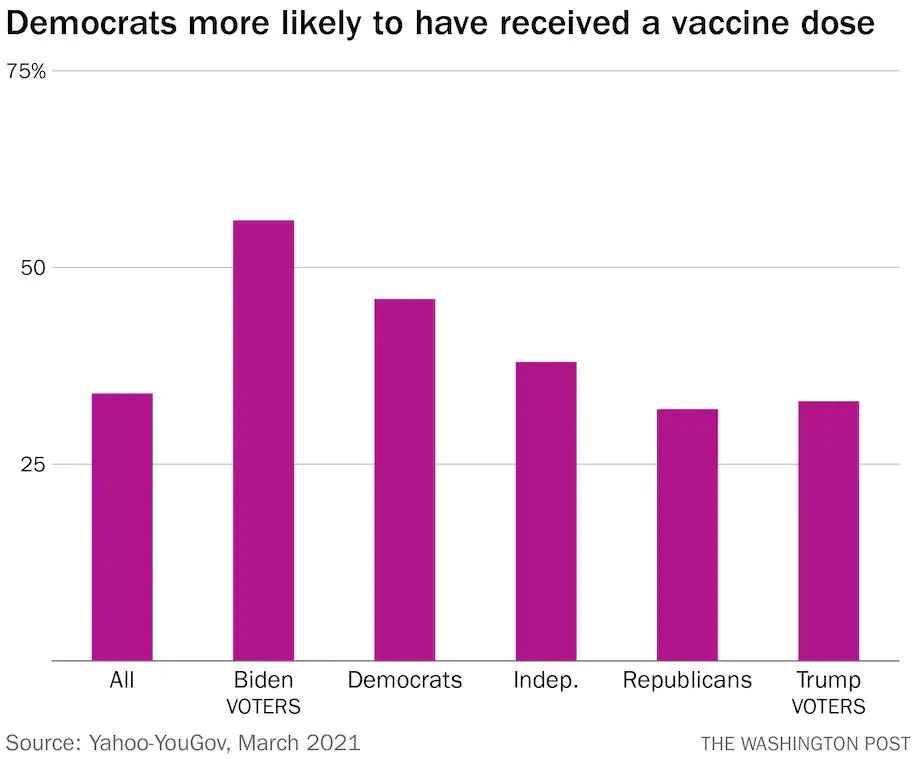
Gallup didn’t break out those groups by party, but it’s clear that few of them are Democrats. Data from YouGov, compiled on behalf of Yahoo News, shows that Democrats (and those who voted for Joe Biden in particular) are more likely to say that they have already received a vaccine dose.
Among those who hadn’t yet received a dose, Democrats were far more likely to indicate that they planned to do so as soon as possible. Among Republicans, half of those who haven’t been vaccinated say that they don’t have any plans to do so at all.
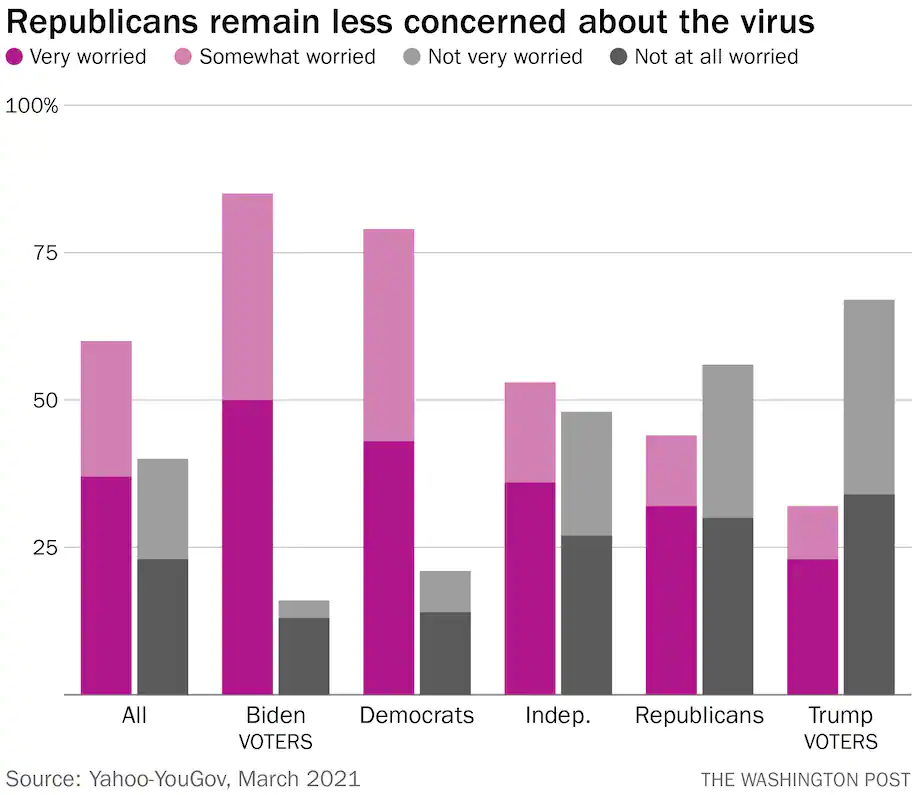
One reason is that Republicans are simply less worried about the virus. More than half say that they’re not very worried about it or not worried at all. Among those who voted for Donald Trump, the figure is over two-thirds. By contrast, more than three-quarters of Democrats say that they are at least somewhat worried about the virus.
In the YouGov polling, 60 percent of Republicans say that the worst of the pandemic is behind us. They’re also much more likely to say that restrictions aimed at preventing the spread of the virus — mask mandates, limits on indoor dining — should be lifted immediately.
As we mentioned Thursday, there are two ways to achieve herd immunity.One is fast and safe:widespread vaccinations. The other — people contracting the virus — is slow and dangerous. The path the United States is on will take us to a place where much of the country has opted for the first option and the rest, the latter.
So the question again becomes: How many people will die, both over the short term and the long term, as a result of those choices?
Coronavirus cases are on the rise again in several states, partially a result of variants of the virus becoming more widespread, experts say.
Why it matters:Even though a remarkable 72% of Americans 65 and older have received at least one dose of the vaccine, millions of Americans — particularly younger Americans with underlying conditions — remain vulnerable.
Driving the news: Coronavirus cases are rapidly rising in places including Michigan, New York, New Jersey and other Northeastern states.
In Michigan, the number of hospitalized younger adults has dramatically increased this month. Coronavirus hospitalizations increased by 633% for those aged 30 to 39 and by 800% for those aged 40 to 49, the Detroit Free Press reports.
The variant that originated in the U.K., which is partially driving the new surge, appears to be more transmissible and deadlier.
The big picture: “There are certainly many people who are not vaccinated who are still at severe risk themselves because of underlying medical issues,” said Leana Wen, a visiting professor at the Milken Institute School of Public Health at the George Washington University.
Because of vaccination demographics and who’s at highest risk of exposure, “the proportion of people who are hospitalized and who will die will likely skew toward a younger subset,” she said.
Between the lines: Those still vulnerable to the virus are disproportionately people of color.
That’s because prioritizing people for vaccines based on age disproportionately benefits white Americans, who tend to be older than people of color.
But younger people of color are tend to be at higher risk of severe infections because of underlying conditions.
What they’re saying: “To address areas of outbreak, we should allocate more of the increased vaccine supply coming into the market to places where penetration is low and infection rates high, like metro Detroit,” former FDA commissioner Scott Gottlieb tweeted.
Top public health experts and officials are developing new strategies to reach out to the conservatives most skeptical of or hesitant about receiving a coronavirus vaccine.
The efforts are targeting supporters of former President Trump, who have emerged as the most significant hurdle to widespread vaccination.
The officials and experts are making appearances on Fox News and Newsmax and taking part on panels with prominent conservative politicians to reach out to vaccine skeptics on the right.
And the public health experts are not taking an antagonistic approach either. They say many conservatives have legitimate questions about COVID-19 vaccinations that are worth listening to and answering.
“These are folks who really feel disrespected. They feel that COVID and the vaccines and the response has been politicized and weaponized, in their words,” said Tom Frieden, the former director of the Centers for Disease Control and Prevention under President Obama. “They feel deeply alienated from the government.”
Up to now, the main problem with increasing vaccinations has been one of supply and demand, but administration officials expect that to change shortly.
“We are approaching the point where we will have a sufficient supply of vaccines for everybody in the United States to have the chance to get immunized by the end of May,” Francis Collins, director of the National Institutes of Health (NIH), said in an interview with The Hill on Wednesday.
At that point, convincing skeptical conservatives to get a shot could mean the difference between the U.S. achieving herd immunity and resuming normal life or variants of COVID-19 getting second and third winds, leading to new lockdowns or restrictions on life.
As Collins puts it, “the hesitancy will begin to become the defining factor on whether we reach herd immunity or not.”
“I think that means this has to be the moment where we really pull into this conversation all of the trustworthy voices,” he added.
A recent CBS poll found a third of Republicans said they would not be vaccinated, compared to 10 percent of Democrats. A “PBS NewsHour” poll showed similar results: Nearly half of U.S. men who identify as Republicans said they have no plans to get vaccinated.
The underlying mistrust comes after a year in which Trump and his allies played down the severity of a virus that has killed more than half a million Americans already.
Circumstances have conspired to allow that skepticism to grow: The coronavirus arrived later in more rural, conservative enclaves than it did in liberal metropolitan areas like Seattle, New York and Detroit, giving some the sense that they had been locked out of the economy to protect against a virus that was not yet present in their community.
Julie Morita, executive vice president of the Robert Wood Johnson Foundation, who advised the Biden transition team on COVID-19 issues, said she has been surprised to see how political vaccine hesitancy has become.
In the past, Morita said, public health officials have focused on race and ethnicity. “We didn’t really look at politics or political affiliation,” she said.
Morita said her message remains the same, but that she has had to focus on where to deliver it. She recently co-wrote a Fox News op-ed answering some of the common questions about the available COVID-19 vaccines and urging people to get the shots when they’re available.
“Whether you’re a community of color, or whether you’re a conservative, these are the questions that people ask and want to have the answers to before they get vaccinated,” Morita said. “I don’t feel like that’s a shifted message as much as maybe we’re just able to get it into a more conservative news outlet.”
Convincing a group of people who did not vote for the president presents a challenge to a Democratic administration. So President Biden has been outsourcing the message.
Appearing on Hugh Hewitt’s radio show this week, Anthony Fauci, the director of the National Institute for Allergy and Infectious Diseases, said he doesn’t shy away from conservative outlets that may not be friendly.
“I say yes to a wide variety of requests. I’ve been on Fox multiple times, so I don’t shy away from that, no,” Fauci said.
Health officials are increasingly convinced that successful messaging is not going to come from politicians or government officials but from doctors, clergy and trusted community leaders.
Last month, Frieden participated in focus groups with vaccine-hesitant Republican voters led by veteran GOP pollster Frank Luntz.
The groups, first reported by The Washington Post, showed vaccine-hesitant conservatives were not swayed by Republican politicians like House Minority Leader Kevin McCarthy (Calif.) or former New Jersey Gov. Chris Christie — or even by Trump himself.
Instead, Frieden said, the message that moved the hesitant to the accepting hit closer to home: Their doctors took the vaccine when it was offered.
“You listen to the audience, you understand where they are and you address their concerns. And that’s the same thing we have to do for Trump voters who are reluctant to get vaccinated or African Americans or Latinx or vegans who don’t want to get vaccinated,” Frieden said.
Morita said she thinks the same efforts and resources that go into convincing communities of color should also be directed at conservatives.
“High-level government officials espousing the importance of vaccines and sharing their experiences with it is really important but it’s not sufficient,” Morita said.
Support for Trump and a distrust of the government is not the only reason conservatives might be reluctant to accept the vaccine. Many are concerned about how quickly the vaccines were developed.
Still others object on religious grounds, which is where Collins, the NIH director, comes in.
A devout Christian who is open about his faith, Collins has become an ambassador to the faith community. He spends hours a day talking to faith leaders, assuring them of the vaccine’s soundness and science.
Collins told The Hill he frames the decision to get vaccinated in religious terms.
“Is this a love your neighbor moment? Yes, it is,” Collins said. “And whatever faith you are, the Golden Rule seems to apply, and the Golden Rule would say, for your neighbor or for your family, for your neighbors down the street who may be vulnerable, this is something you can do for them.”
Some countries have stockpiles. Others have nothing. Getting a vaccine means living in the right place — or knowing the right people.
A 16-year-old in Israel can get a vaccine.
So can a 16-year-old in Mississippi.
And an 18-year-old in Shanghai.
But a 70-year-old in Shanghai can’t get one. Older people are at high risk for severe illness from Covid-19. But Chinese officials have been reluctant to vaccinate seniors, citing a lack of clinical trial data. Neither can an 80-year-old in Kenya. Low vaccine supply in many countries means only health care employees and other frontline workers are eligible, not the elderly.
Nor a 90-year-old in South Korea. Koreans 75 and older are not eligible until April 1. Only health care workers and nursing-home residents and staff are currently being vaccinated. The government initially said it was awaiting assurances that the AstraZeneca vaccine was safe and effective for older groups.
Anyone in Haiti.
Anyone in Papua New Guinea.
Anyone in these 67 countries. These countries have not reported any vaccinations, according to Our World in Data. Official figures can be incomplete, but many countries are still awaiting their first doses.
It wasn’t supposed to be like this: Covax, the global vaccine-sharing initiative, was meant to prevent unequal access by negotiating vaccine deals on behalf of all participating nations. Richer nations would purchase doses through Covax, and poorer nations would receive them for free.
But rich nations quickly undermined the program by securing their own deals directly with pharmaceutical companies. In many countries, they have reserved enough doses to immunize their own multiple times over.
Anyone who can afford a smartphone or an internet connection in India and is over 60 can get one. Mostly wealthy Indians are being inoculated in New Delhi and Mumbai, hospitals have reported, since vaccine appointments typically require registering online. Less than half of India’s population has access to the internet, and even fewer own smartphones.
And anyone who can pay $13,000 and travel to the U.A.E. for three weeks and is 65 or older or can prove they have a health condition.
A member of Congress in the United States. Friends of the mayor of Manaus, Brazil. Lawmakers in Lebanon. A top-ranking military leader in Spain. The extended family of the deputy health minister in Peru. The security detail to the president of the Philippines. Government allies with access to a so-called “V.I.P. Immunization Clinic” in Argentina. Around the world, those with power and connections have often been first in line to receive the vaccine — or have cut the line altogether.
A smoker in Illinois can get one.But not a smoker in Georgia.
A diabetic in the United Kingdom can. A diabetic in Connecticut can’t.
Countries have prioritized different underlying health conditions, with the majority focusing on illnesses that may increase the risk of severe Covid-19. In the U.S., health issues granted higher priority differ from state to state, prompting some people to travel across state borders.
A pregnant woman in New York.Not a pregnant woman in Germany. Up to two close contacts of a pregnant woman in Germany. Pregnant women were barred from participating in clinical trials, prompting many countries to exclude them from vaccine priority groups. But some experts say the risks to pregnant women from Covid-19 are greater than any theoretical harm from the vaccines.
A grocery worker in Texas, no. A grocery worker in Oklahoma, yes.
Many areas aim to stop the virus by vaccinating those working in frontline jobs, like public transit and grocery stores. But who counts as essential depends on where you live.
A police officer in the U.K. A police officer in Kenya. A postal worker in California. A postal worker in North Carolina. A teacher in Belgium. A teacher in Campeche, Mexico. Other jobs have been prioritized because of politics: Mexico’s president made all teachers in the southern state of Campeche eligible in a possible bid to gain favor with the teacher’s union.
Medical staff at jails and prisons in Colombia. A correctional officer in Tennessee. A prisoner in Tennessee. A prisoner in Florida. The virus spread rapidly through prisons and jails, which often have crowded conditions and little protective equipment. But few places have prioritized inoculating inmates.
An undocumented farm worker in Southern California. A refugee living in a shelter in Germany. An undocumented immigrant in the United Kingdom. Britain has said that everyone in the country is eligible for the vaccine, regardless of their legal status.
A Palestinian in the West Bank without a work permit. Despite leading the world in per-capita vaccinations, Israel has so far not vaccinated most Palestinians, unless they have permits to work in Israel or settlements in the occupied West Bank.
An adult in Bogotá, Colombia. An adult in the Amazonian regions of Colombia that border Brazil. In most of Colombia, the vaccine is only available to health care workers and those over 80.
But the government made all adults in Leticia, Puerto Nariño, Mitú and Inírida eligible, hoping to prevent the variant first detected in Brazil from arriving in other areas. A police officer in Mexico City. A teacher in rural Mexico.The government of populist president Andrés Manuel López Obrador has prioritized vaccinating the poor and those in rural communities, despite the country’s worst outbreaks occurring in major cities.
Native populations not federally recognized in the United States. The pandemic has been particularly deadly for Native Americans. But only tribes covered by the Indian Health Service have received vaccine doses directly, leaving about 245 tribes without a direct federal source of vaccines. Some states, including Montana, have prioritized all Native populations.
Indigenous people living on official indigenous land in Brazil.
These 43 countries, mostly high income, are on pace to be done in a year. These 148 countries, mostly low income, are on pace to take until next year or even longer. Countries like the U.S. continue to stockpile tens of millions of vaccine doses, while others await their first shipments.
“The vaccine rollout has been inequitable, unfair, and dangerous in leaving so many countries without any vaccine doses at all,” said Gavin Yamey, director of Duke University’s Center for Policy Impact in Global Health.
“It’s a situation in which I, a 52-year-old white man who can work from home and has no pre-existing medical conditions, will be vaccinated far ahead of health workers or a high-risk person in a middle- or low-income country.”
Xavier Becerra narrowly won confirmation Thursday to lead the Department of Health and Human Services, the agency pivotal to President Biden’s urgent goal of defeating the coronavirus pandemic and expanding access to health care.
Becerra, a congressman from Los Angeles for two dozen years and then California attorney general, squeaked by on a vote of 50 to 49, the closest margin for any of the Biden cabinet members the Senate has confirmed so far.
He becomes the first Latino secretary of HHS, the largest federal department in terms of spending. The department includes agencies at the core of the federal response to the pandemic that has infected more than 29.5 million people in the United States and killed more than 535,000. They include the National Institutes of Health, the Centers for Disease Control and Prevention, the vaccine-approving Food and Drug Administration, and the Centers for Medicare and Medicaid Services, which oversees the country’s vast public insurance programs.
Sen. Ron Wyden (D-Ore.), chairman of the Senate Finance Committee, which considered the nomination, said that “after four years of going in reverse,” Becerra will make it “possible to go to drive and actually make progress for the American people, progress in terms of lowering the cost of health care.”
Republican Sen. John Barrasso (Wyo.), countered that Becerra is “an aggressive culture warrior from the radical left,” who is “out of touch with the views of the American people.” Barrasso noted that, as state attorney general, Becerra sued the Trump administration more than 150 times over immigration, environmental and health policies.
“In this time of crisis, our secretary of Health and Human Services may be the single most important member of the president’s cabinet,” Barrasso said, contending that “the president has chosen a nominee, no public health experience, extremely partisan record.”
Sen. Susan Collins (R-Maine) was the only member of the GOP to vote for Becerra’s confirmation along with a solid wall of Senate Democrats.
During his confirmation hearing last month before the Senate Finance Committee, Becerra said, “The mission of HHS — to enhance the health and well-being of all Americans — is core to who I am.”
In keeping with Biden’s emphasis on portraying his administration’s top rung as diverse and having working-class roots like his own, Becerra told the senators his immigrant parents had insurance through his father’s laborers union, making his family more fortunate when he was a boy than many of their neighbors.
As a longtime member of the House Ways and Means Committee, Becerra testified, he worked on several major pieces of health-care legislation, including the Children’s Health Insurance Program created in the late 1990s and changes to the way Medicare is run and financed, as well as the Affordable Care Act.
He did not mention that he was a longtime advocate of a single-payer health-care system, akin to the Medicare-for-all proposals backed by several Democratic candidates in last year’s presidential election, but rejected by Biden. Becerra has renounced his previous support since his nomination, echoing the president’s view that affordable insurance coverage should be widened by building upon the ACA.
Becerra, 63, became a lightning rod for conservatives immediately after Biden announced his selection in early December.
Senate Republicans targeted his defense of abortion rights. They contended he is unqualified because he is not a physician, though few HHS secretaries have had medical training. And they have denounced his previous advocacy of a larger government role in health insurance.
An undercurrent running through opposition to his nomination was Becerra’s leadership in recent years of a coalition of Democratic attorneys general fighting to preserve the ACA. Republicans, including President Donald Trump, are seeking to overturn the 2010 law in a case now before the Supreme Court.
Sen. James Inhofe (R-Okla.) lambasted Becerra, saying he has “an appalling track record disrespecting the sanctity of life. . . . He has no shame when it comes to his pro-abortion beliefs.”
Inhofe also criticized Becerra’s support last year for California’s ban on indoor worship services as part of the state’s efforts to slow the cornavirus’s spread. And the senator criticized Becerra’s position that undocumented immigrants should be allowed public benefits, such as Medicaid.
Senate Majority Leader Charles E. Schumer (D-N.Y.) said Republicans’ arguments against Becerra “almost verge on the ridiculous.”
Schumer said Republicans challenging Becerra’s qualifications for the job had embraced the nomination of Alex Azar as Trump’s second HHS secretary, though he was a pharmaceutical executive who also was an attorney and had no medical training.
In addition to working to tame the pandemic, which Biden has identified as the government’s job number one for now, Becerra will face many major decisions at the helm of the sprawling department over whether to continue or reverse policies established by the Trump administration.
CMS has already announced it was rescinding a significant Medicaid policy of the Trump era that had allowed states to require some residents to hold a job or be preparing for work to qualify for the safety-net insurance program. HHS officials are reviewing other Trump-era Medicaid policies.
Another HHS agency, the Administration for Children and Families, oversees the nation’s policies regarding welfare and unaccompanied children coming across the country’s borders — a flashpoint during the Trump administration.
The CDC, the government’s public-health agency, has been working to regain its footing and scientific moorings after repeated intrusions into its advice to the public by the Trump White House. The agency has been involved in the largest mass vaccination campaign in U.S. history to immunize the public against the coronavirus. And it is developing guidance on aspects of American life — and ongoing public safety measures — as research findings evolve for the virus and vaccine’s effects.
The FDA is in the thick of decisions about coronavirus vaccines, developed in record time, as additional manufacturers, such as AstraZeneca, have devised them and tested their safety and effectiveness. The three vaccines being given to about 2 million Americans a day — by Pfizer-BioNTech, Moderna and Johnson & Johnson — are being allowed so far for emergency use and have not yet secured full FDA approval.
Becerra almost certainly will continue to face hostility from social conservatives after his swearing in, expected Friday.
Roger Severino, who led HHS’s Office for Civil Rights during the Trump administration and created a division to promote “conscience and religious freedom,” is building an “HHS Accountability Project” within the conservative Ethics and Public Policy Center.
While at HHS, Severino tangled directly with Becerra during his tenure as attorney general of the nation’s most populous state, twice citing him in violation of federal laws for upholding California statutes involving abortion rights.
Severino said this week he believes those on the right might find common ground with Biden health officials on disability rights. But on matters of abortion and deference to religion, Severino said, “We will be watching.”











 HENRY KOTULA