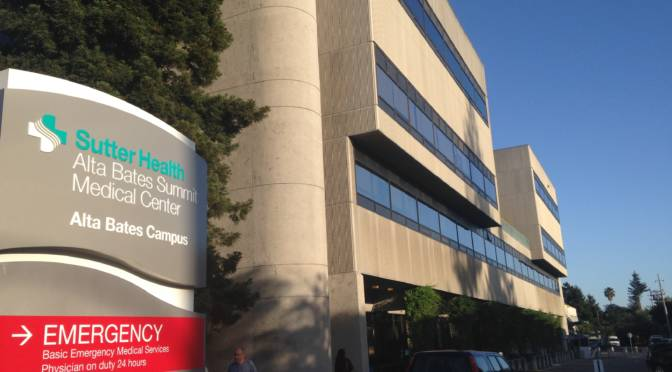
Oakland, Calif.-based Alta Bates Summit Medical Center, part of Sacramento, Calif.-based Sutter Health, could close by 2030.
“This closure would strain healthcare access in Berkely and send shockwaves across the region,” Jesse Arreguin, mayor of Berkeley, Calif., said in a Feb. 27 news release shared with Becker’s. “The impacts to EMS response times and service cuts for our most voluerable communities are simply unaccebtable.”
Amid the fear of closure, a spokesperson for Sutter Health told Becker’s in a statement that the health system is developing a comprehensive plan to meet the needs of the community.
“This includes thoroughly evaluating how our patients use our services, including outpatient clinics, specialty care, hospital care, and emergency services, with a focus on identifying and addressing unmet community needs,” the spokesperson said. “It’s a major undertaking that has taken longer than anticipated; however, it’s important to emphasize that no final decisions have been made.”
The Berkeley City Council voted on Feb. 27 to allocate $300,000 from the Berkeley General Fund to help explore current or potential opportunities to secure future healthcare and hospital access for the community.
“We cannot underestimate the repercussions of losing such a critical healthcare resource,” Sophie Hahn, a Berkeley City Council member, said in the release. “Beyond undermining our healthcare system, this closure would result in a profound loss of local jobs and impacts to our economy.”
The new year is always an ideal time for healthcare leaders to reflect on the state of our industry and their own organizations, as well as the challenges and opportunities ahead.
As the CEO of a large health system, I always like to reflect on one basic question at the end of each year: Are we staying true to our mission?
Certainly, maintaining an organization’s financial health must always be a priority but we should also never lose sight of our core purpose. In a business like ours that has confronted and endured a global pandemic and immense financial struggles over the past several years, I recognize it’s increasingly difficult to maintain our focus on mission while trying to find ways to pay for rising labor and supply costs, infrastructure improvements needed to remain competitive and other pressures on our day-to-day operations.
After all, the investments we need to make to promote community wellness, mental health, environmental sustainability and health equity receive little or no reimbursement, negatively impacting our financial bottom lines. During an era of unprecedented expansion of Medicaid and Medicare, we get less and less relief from commercial insurers, whose denial and delay tactics for reimbursing medical claims continue to erode the stability of many health systems and hospitals, especially those caring for low-income communities.
Despite those enormous pressures, it’s imperative that we continue to support underserved communities, military veterans struggling with post-traumatic stress, and intervention programs that help deter gun violence and addiction.
The list of other worthy investments goes on and on: charity care to uninsured or underinsured patients who can’t pay their medical bills, funding for emergency services that play such a critical role during public health emergencies, nutritional services for families struggling to put food on the table, programs that combat human trafficking and support women’s health, the LGBTQIA+ community and global health initiatives that aid Ukraine, the Middle East and other countries torn apart by war, famine and natural disasters.
We must also recognize the key role of healthcare providers as educators. School-based mental health programs are saving lives by identifying children exhibiting suicidal behaviors, anger management issues and other troublesome behaviors. School outreach efforts have the added benefit of helping health systems and hospitals address their own labor shortages by introducing young people to career paths that will help shape the future healthcare workforce.
Without a doubt, the “to-do” list of community health initiatives that support our mission is daunting. We can’t do it all alone, but as the largest employers in cities and towns across America, health systems and hospitals can serve as a catalyst to get all sectors of our society — government, businesses, schools, law enforcement, churches, social service groups and other community-based organizations — to recognize that “health” goes far beyond the delivery of medical care.
The health of individuals, families and communities hinges on the prevalence of good-paying jobs, decent and affordable housing, quality education, access to healthy foods, medical care, transportation, clean air and water, low prevalence of crime and illicit drugs, and numerous other variables that typically depend on the zip codes where we live. Those so-called social determinants of health are the driving factors that enable communities and the people who live there to either prosper or struggle, resulting in disparities that are the underlying cause of why so many cities and towns across the country fall into economic decay and become havens for crime and hotbeds for gun violence, which shamefully is now the leading cause of death for children and adolescents.
To revive these underserved communities, many of which are in our own backyards, we have to look at all of the socioeconomic issues they struggle with through the prism of health and use the collective resources of all stakeholders to bring about positive change.
Health is how we work together to build a sense of community. Having a healthy community also requires everyone doing what they can to tone down the political rhetoric and social media-fueled anger that is polarizing our society. Health is bringing back a sense of civility and respect in our public discourse, and promoting the values of honesty, decency and integrity.
As healthcare providers and respected business leaders, we should all make a New Year’s resolution to stay true to our mission and do what we can within our communities to bring oxygen to hope, optimism and a healthier future.
Prime will acquire St. Francis for a net of $350 million, with a $200 million base cash price and $60 million for accounts receivable.
California Attorney General Xavier Becerra has conditionally approved Verity Health’s application to transfer ownership of St. Francis Medical Center to Prime Healthcare. The Attorney General’s decision follows an earlier decision by the U.S. Bankruptcy Court of the Central District of California granting Verity’s request to reject the existing collective bargaining agreements which impose legacy cost structures that it said contributed to bankruptcy.
Becerra noted that his approval of the sale of St. Francis to Prime Healthcare “protect(s) access to care for the Los Angeles communities served” by St. Francis.
“The COVID-19 public health crisis has brought home the importance of having access to lifesaving hospital care nearby in our communities,” he said. “St. Francis Medical Center is not just an asset, it is an indispensable neighbor, it is the workers who serve the patients, and the doctors who save lives. We conditionally approve this sale to keep it that way.”
Prime Healthcare has built a reputation for saving financially distressed hospitals across the U.S., touting improved clinical quality.Healthgrades said Prime had hospitals named among the nation’s 100 best 53 times, and has been the recipient of several Patient Safety Excellence Awards.
The Attorney General’s office conducted an exhaustive review of the transaction for the past several months and carefully considered public input on the proposed transaction. The Attorney General’s approval includes conditions for the sale which Prime is currently reviewing. Pending a final ruling by the Bankruptcy Court, the transaction is expected to be completed this summer.
THE LARGER TREND
In early April, the U.S. Bankruptcy Court approved the Asset Purchase Agreement for the sale of St. Francis Medical Center to Prime. Under the agreement, Prime will acquire St. Francis for a net consideration of over $350 million, including a $200 million base cash price and $60 million for accounts receivable. In addition, Prime has committed to invest $47 million in capital improvements and extend offers of employment to nearly all staff.
The court also recently granted Verity’s request to reject the existing collective bargaining agreements with two unions that represent associates at St. Francis Medical Center, SEIU and UNAC. The court noted that Prime Healthcare was the only party to submit a qualifying bid for St. Francis and that without rejecting the existing CBAs, “St. Francis would not continue to operate as a going concern, and all of the UNAC (and SEIU) represented employees would lose their jobs.”
The court also noted that Prime and Verity had made multiple efforts to negotiate in good faith with the unions, and the parties devoted “hundreds of hours to negotiations,” but ultimately were unable to agree on new CBAs. Further, the court determined that one of the reasons for the hospital’s bankruptcy was the “legacy cost structure imposed by the existing CBAs.”
It then staid that the proposals were rejected “without good cause” by the unions. Prime said it negotiated in good faith and proposed increasingly generous offers to UNAC and SEIU with wages far above its existing agreements at its Los Angeles-area hospitals. Prime’s latest offer to SEIU maintained existing wages for roughly 90% of SEIU members, and increased wages for some of them. Prime said these wages would be substantially higher than those recently voted by SEIU members at three of Prime’s Los Angeles hospitals.
ON THE RECORD
“Receiving conditional approval is an important step in ensuring Prime is able to preserve the St. Francis mission for the benefit of associates, members of the medical staff and most importantly the patients and Southeast Los Angeles community that has relied on St. Francis for 75 years,” said Rich Adcock, CEO of Verity Health.
“We are honored to be selected to continue the St. Francis legacy and are working to review the conditions and finalize the sale as quickly as possible,” said Dr. Sunny Bhatia, CEO, Region I and chief medical officer of Prime Healthcare. “St. Francis’ mission is especially critical during this pandemic and we honor the service of all caregivers. Prime has already started investments at St. Francis that will enhance patient care as we commit to continue every service line, community benefit program, charity care and expand new services to the community.”
It’s easy to become numb to the numbers we’re bombarded with on a daily basis—case counts, deaths, financial losses, unemployment claims, bailout funding. An article from the Washington Post this week put a very human face on how the coronavirus crisis is playing out on the ground, profiling the experience of 115-bed Griffin Hospital in Derby, CT.
We first got to know Griffin, and its CEO Patrick Charmel, years ago in the course of work for our former employer. It’s a remarkable, fiercely independent organization—recognized as the flagship hospital of the “Planetree” patient-centered care model, and a decade-long fixture on Fortune’s list of Top 100 Best Companies to Work For. But the COVID-19 wave hit Griffin hard, as it did much of Connecticut.
With the high cost of caring for COVID patients, and lost revenue from cancelled procedures, Griffin has had to make hard decisions about furloughing and redeploying staff—incredibly difficult for a small facility that has been a pillar of the community for a century. Charmel has been able to secure some relief in the form of advance payment from Medicare, but his efforts to lobby for a share of the state’s allocation of CARES Act grant funding for hospitals proved unsuccessful, and so the future of the hospital—or at least its continued viability as an independent organization—is in jeopardy.
In the words of Griffin’s chief financial officer, “This could be devastating for us.” As the recovery begins, and questions begin to be asked about the billions of dollars of “bailouts” paid to “greedy hospitals”—an easy narrative for the media to latch onto—it’s worth remembering what’s happening to Griffin Hospital, and to hundreds of other similar organizations across the country.
Countless communities rely on these hospitals, and their survival is worth safeguarding.
After selling more than 80 hospitals in three years, leaders of the large for-profit hospital operator are suggesting the worst may be behind them.
KEY TAKEAWAYS
The troubled operator of rural hospitals is focusing now on growth-oriented markets.
The latest round of questions and accusations adds to the tumultuous past five years.
Some analysts say CHS isn’t poised for where the market is headed: outpatient services and value-based care.
Times have been tough for Community Health Systems Chairman and CEO Wayne T. Smith, who is voicing an optimistic message this year as the hospital operator continues to navigate choppy waters.
Smith and fellow CHS senior executives told investors this month that the company expects to complete its massive and long-running divestiture plan by the end of 2019, having already shed 81 hospitals from its portfolio in the three preceding years. The company, based in Franklin, Tennessee, operated 106 hospitals across 18 states as of the end of the first quarter.
While the divestitures give CHS cash to pay down its debt, they are also part of a strategic effort to align CHS operations with the geographic areas where the company sees the greatest growth potential, Smith said.
“This has allowed the company to shift more of our resources to more sustainable markets, ones with better population growth, better economic growth, and lower unemployment, which provides us an opportunity for sustainable growth,” Smith said during the first-quarter earnings call this month.
“As we complete additional divestitures, we expect our same-store metrics to further improve,” he added. “This will lead to not only additional debt reduction but also better cash flow performance and lower leverage ratios.”
Executive Vice President and Chief Financial Officer Thomas J. Aaron echoed that message at the Goldman Sachs Leveraged Finance Conference this month. While CHS was truly a rural hospital company 15 years ago, Aaron said the post-selloff organization is investing strategically in markets where it anticipates growth.
“We’d rather compete in a growing pie than have more market share in a pie that’s shrinking,” Aaron said.
“We feel like we’re well-positioned,” he said.
But the positive forecast is a bit of a tough sell, especially when you consider how bad the past five years have been:
Questionable HMA Acquisition: In 2014, CHS completed its $7.6 billion acquisition of Florida-based hospital operator Health Management Associates, Inc. (HMA), in what is widely viewed in hindsight as a bad move. In addition to a $260 million settlement with the U.S. Department of Justice, a subsidiary of HMA pleaded guilty to criminal fraud last year for alleged misconduct that predated the acquisition by CHS—allegations that Smith knew about before the deal was final. “We were aware of the issues they had,” Aaron said this month. “We went ahead and closed on the transaction, confident that we could get the cost synergy, and we felt like they had some great assets.”
Major Stock Market Woes: In 2015, the price of CHS shares peaked at nearly $53 apiece, according to New York Stock Exchange data. But by the end of that year, shares had lost more than half of that value. Share prices continued to slide the following year and haven’t made a meaningful recovery since. They have been trading below $5 so far this year.
Lackluster Quorum Spin-off: In 2016, CHS spun off 38 hospitals to form Quorum Health Corporation. The spin-off severely underperformed expectations, and investors began asking questions. Quorum formally responded to those investors with a letter that acknowledged several reasons to question the “operational competence” of CHS leaders who backed the spin-off. A related dispute between Quorum and CHS ended in arbitration earlier this year.
Ongoing Hospital Divestitures: In 2017, CHS sold 30 hospitals, followed by another 13 hospitals in 2018, Aaron said. So far this year, CHS has announced the sale of at least seven more: one in Tennessee, two in Florida, and four in South Carolina. A spokesperson for CHS did not respond to HealthLeaders‘ request for additional information and comment.
Recurring Bankruptcy Questions: Industry analysts have wondered for years whether bankruptcy may be on the horizon for CHS. Those questions were renewed again this month when Ryan Heslop, a portfolio manager for Firefly Value Partners LP, took a short position against the company and said a CHS bankruptcy is likely in the next few years, as Reuters reported. About that same time, Smith invested more than $3 million in CHS stock, according to two Securities and Exchange Commission filings. (Smith, 73, who has been CEO for 22 years, now directly and indirectly controls about 2.8% of the company, as the Nashville Post reported.)
Call for CEO’s Ouster: With the release of a report this month titled “Other People’s Money,” the National Nurses United (NNU) group accused Smith of squandering CHS’ assets and called for him to be removed. “The fact that Smith remains at CHS’ helm, given a series of fatal calculations that set the company on a downward spiral, is a real wonder,” the NNU report states. Shareholders, however, voted overwhelmingly in favor of keeping Smith as a director and significantly increasing his incentive plan compensation, according to SEC filings.
Despite the light-at-the-end-of-the-tunnel rhetoric coming from CHS executives, there’s still real concern the company could come undone. That’s because CHS’ problems run deeper than its balance sheets, says Mark Cherry, MFA, a principal analyst at Market Access Insights for Decision Resources Group.
“Given the national trend toward provider consolidation, CHS might not remain intact even if it were financially healthy,” Cherry tells HealthLeaders in an email, adding that CHS seems to be unsuited for the industry’s ongoing shifts toward value-based payments and outpatient care delivery.
“There are only a few markets, like Scranton, Knoxville, and Northwest Arkansas, where CHS has enough presence to act as a stand-alone health system that can influence physician and patient behaviors,” Cherry says.
The structural problem is rooted in a bad strategic bet a decade ago, Cherry says.
“As markets and regions were coalescing around large integrated delivery networks focused on value-based care, CHS continued to invest in suburban facilities and demand high fee-for-service reimbursement,” Cherry says.
“Whereas operating a couple of suburban hospitals within a larger market once gave CHS access to better insured patients and leverage against payers who wanted to offer broad provider networks, the post-ACA landscape does not have as wide a uninsured discrepancy between urban and suburban areas,” he adds, “and payers are shifting to high-performance narrow networks, allowing them to cut CHS facilities out entirely if they are unwilling to compromise.”





 HENRY KOTULA