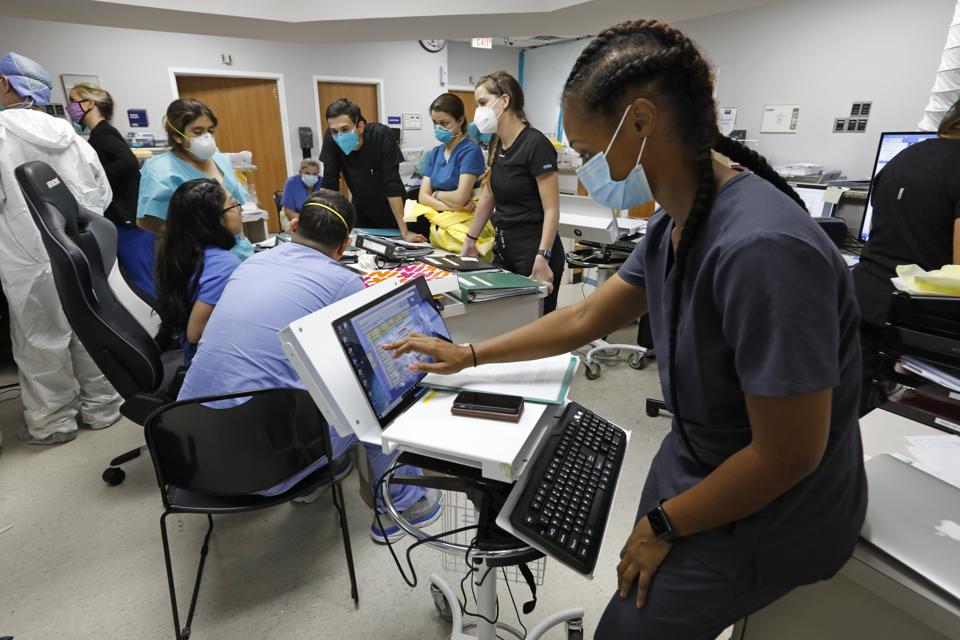
Over 224,000 COVID-19 deaths forecast in U.S. by November 1, says University of Washington’s IHME

https://www.reuters.com/article/us-health-coronavirus-usa-forecast/over-224000-covid-19-deaths-forecast-in-u-s-by-november-1-says-university-of-washingtons-ihme-idUSKCN24G1S9?fbclid=IwAR19qY7KM_P4bPIMnlP7ax1fB2xXu8Pf4GOxZoar-p2aey6elaVI_SXW4-Y

Over 224,000 COVID-19 deaths forecast in US by November 1, says ...

A newly revised University of Washington model projects the U.S. death toll from COVID-19 will climb to just above 224,000 by Nov. 1, up 16,000 from a prior forecast, due to rising infections and hospitalizations in many states.

But the latest forecast from the university’s Institute for Health Metrics and Evaluation (IHME), released late on Tuesday, also predicts the death toll could be reduced by 40,000 if nearly all Americans wore masks in public.

“Use of masks is up, but not as high as it should be. If 95% of Americans wore masks each time they left their homes, infection rates would drop, hospitalizations would drop, and forecast deaths would drop,” the IHME said in a statement.

The IHME’s new forecast came after Alabama, Florida and North Carolina on Tuesday reported record daily increases in deaths from COVID-19, marking grim new milestones of a second wave of infections surging across much of the U.S.

The new IHME forecast – 224,089 U.S. lives lost by Nov. 1 – was revised upward from the 208,254 deaths projected on July 7.

At least 136,052 Americans have died from COVID-19, the illness caused by the novel coronavirus, while reported U.S. infections have surpassed 3.4 million, according to a tally by Reuters.

The IHME’s projections have been cited in the past by the White House and are watched closely by public health officials.


Administration’s war on the public health experts

https://www.axios.com/trump-public-health-experts-cdc-fauci-e1509d14-0cf1-4b1c-b107-7753bf95395d.html

Trump's war on the public health experts - Axios

A pandemic would normally be a time when public health expertise and data are in urgent demand — yet President Trump and his administration have been going all out to undermine them.

Why it matters: There’s a new example almost every day of this administration trying to marginalize the experts and data that most administrations lean on and defer to in the middle of a global crisis.

Here’s how it has been happening just in the past few weeks:

  • The administration has repeatedly undermined the Centers for Disease Control and Prevention. Most recently, Trump has criticized the CDC’s school reopening guidelines, Education Secretary Betsy DeVos declared that “kids need to be in school,” and the administration has reportedly ordered hospitals to bypass the CDC in reporting coronavirus patient information.
  • It has repeatedly undermined Anthony Fauci. Trump distanced himself on Wednesday from an op-ed attack by White House trade adviser Peter Navarro, but longtime Trump aide Dan Scavino also called the infectious diseases specialist “Dr. Faucet” in a Facebook post accusing him of leaking his disagreements. And the White House gave a opposition research-style list of the times Fauci “has been wrong” to the Washington Post and other media outlets.
  • Trump himself undermined public health experts generally with his retweet of former game show host Chuck Woolery’s “everyone is lying” tweet — which blamed “The CDC, Media, Democrats, our Doctors, not all but most, that we are told to trust.”
  • Trump has made numerous statements suggesting, over and over again, that we wouldn’t have as many COVID cases if we just tested less. (From his Tuesday press conference at the White House: “If we did half the testing we would have half the cases.”)

The impact: The result is that the CDC — which is supposed to be the go-to agency in a public health crisis — is distracted by constant public critiques from the highest levels. And Fauci, “America’s Doctor,” is the subject of yet another round of stories about whether Trump is freezing him out.

  • “The way to make Americans safer is to build on, not bypass, our public health system,” Tom Frieden, a former CDC director under Barack Obama, said in a statement to Axios about the efforts to sideline the agency.
  • “Unfortunately, as with mask-up recommendations and schools reopening guidance, the administration has chosen to sideline and undermine our nation’s premier disease fighting agency in the middle of the worst pandemic in 100 years,” Frieden said.
  • And Fauci, in an interview with The Atlantic, said of the efforts to discredit him: “Ultimately, it hurts the president to do that … It doesn’t do anything but reflect poorly on them.”

The other side: The White House insists there’s no problem. “President Trump has always acted on the science and valued the input of public health experts throughout this crisis,” said White House deputy press secretary Sarah Matthews.

  • Trump campaign communications director Tim Murtaugh closed ranks with the experts as well. “President Trump has said repeatedly that he has a strong relationship with Dr. Fauci, and Dr. Fauci has always said that the President listens to his advice,” he said.
  • And Department of Health and Human Services spokesman Michael Caputo declared that “the scientists and doctors speak openly, they are listened to closely, and their advice and counsel helps guide the response.”
  • “Frankly, when it comes to this tempest in a teapot over Dr. Fauci, I blame the media and their unending search for a ‘Resistance’ hero, for turning half a century of a brilliant scientist’s hard work into a clickbait headline that helps reporters undermine the president’s coronavirus response,” Caputo said.

Between the lines: Murtaugh deflected several times when asked whether there was a deliberate strategy to marginalize the CDC and the experts: “The President and the White House have consistently advised Americans to follow CDC guidelines. The President also believes we can open schools safely on time and that we must do so.”

  • However, one administration official said there were parts of the CDC school reopening guidelines that were impractical, and noted that kids can also suffer long-term harm by staying out of school too long.

Our thought bubble, by Axios White House reporter Alayna Treene: The responses make it clear that the White House and the Trump campaign don’t want to advance the narrative that they’re deliberately battling with America’s health experts, or that there’s any kind of strategy behind it.

The bottom line: When the history of this pandemic is written, it will show that the public health experts who were trying to fight it also had to deal with political fights that made their jobs harder.


Public’s disconnect from COVID-19 reality worries experts

Public’s disconnect from COVID-19 reality worries experts

Public's disconnect from COVID-19 reality worries experts | TheHill

The United States is being ravaged by a deadly pandemic that is growing exponentially, overwhelming health care systems and costing thousands of lives, to say nothing of an economic recession that threatens to plague the nation for years to come.

But the American public seems to be over the pandemic, eager to get kids back in schools, ready to hit the bar scene and hungry for Major League Baseball to play its abbreviated season.


The startling divergence between the brutal reality of the SARS-CoV-2 virus and the fantasy land of a forthcoming return to normalcy has public health experts depressed and anxious about what is to come. The worst is not behind us, they say, by any stretch of the imagination.


“It’s an absolute disconnect between our perceived reality and our actual reality,” said Craig Spencer, a New York City emergency room doctor who directs global health in emergency medicine at New York Presbyterian/Columbia University Medical Center. “To look at the COVID case count and the surge in cases and to think that we can have these discussions as we have uncontrolled spread, to think we can have some national strategy for reopening schools when we don’t even have one for reopening the country, it’s just crazy.”

The number of dead from the virus in the United States alone, almost 136,000, is roughly equal to the populations of Charleston, S.C., or Gainesville, Fla. If everyone in America who had been infected lived in the same city, that city would be the third-largest in the country, behind only New York and Los Angeles. More people in the United States have tested positive for the coronavirus than live in the state of Utah. By the weekend, there are likely to be more confirmed coronavirus cases than there are residents of Connecticut.

There are signs that the outbreak is getting worse, not better. The 10 days with the highest number of new coronavirus infections in the United States have come in the past 11 days.

Case counts, hospitalizations and even deaths are on the rise across the nation, not only in Southern states that were slow to embrace lockdowns in March and April.

California, the first state to completely lock down, has reported more than 54,000 new cases over both of the last two weeks. Nevada, about one-thirteenth the size of California, reported 5,200 new cases last week. States where early lockdowns helped limit the initial peak like Pennsylvania, Illinois and Ohio are all seeing case counts grow and hospital beds fill up.

Only two states — Maine and New Jersey — have seen their case counts decline for two consecutive weeks.


“We are nearing the point where pretty much most of the gains we had achieved have been lost,” said Christine Petersen, an epidemiologist at the University of Iowa. “All of us are hoping we magically get our acts together and we can look like Europe in two months. But all the data shows we are not doing that right now.”

It is in that dismal context that schools are preparing some sort of return to learning, whether in person or remote. President Trump and Education Secretary Betsy DeVos have threatened schools that do not fully reopen.

But even though the coronavirus appears to have less severe consequences among children, sending them back to schools en masse does not carry zero risk. Children have died from the virus, and the more who are exposed mean more opportunities for the virus to kill again, even before considering the millions of teachers who may be vulnerable or the parents and grandparents asymptomatic children might be exposed to.

Already, school districts in Los Angeles and San Diego have delayed reopening plans as case counts rise.

“We do know that kids can get sick and they can even die. It’s definitely a much lower number,” Petersen said. “Even if they aren’t as infectious, if there are millions of them gathering in schools not having great hygiene, it’s a multiplier effect.”


The painful lockdowns that were supposed to reduce viral transmissions bought time to bolster testing and hospital capacity, to speed production of the equipment needed to test patients and protect front-line health care workers.

But that hasn’t happened; laboratories in the United States have tested as many as 823,000 people in a day, a record number but far shy of the millions a day necessary to wrestle the virus under control. Arizona and Los Angeles have canceled testing appointments for lack of supplies. Hospitals are reporting new shortages of protective gear and N95 masks.

The Trump administration used the Defense Production Act to order meat processing plants to stay open; it has only awarded contracts sufficient to produce 300 million N95 masks by the end of the year, far short of what health experts believe will be necessary to protect health care workers.


“A failure of national leadership has led us to a place where we are back where we were before, no national testing strategy, no national strategy for supply,” said Kelli Drenner, who teaches public health at the University of Houston. “States are still on their own to scramble for reagents and swabs and PPE and all of that, still competing against each other and against nations for those resources.”

There are troubling signs that the promise of a vaccine may not be the cure-all for which many had hoped. Early studies suggest that the immune system only retains coronavirus antibodies for a few months, or perhaps a year, raising the prospect that people could become reinfected even after they recover. A growing, if still fringe, movement of anti-vaccination activists may refuse a vaccine altogether, putting others at risk.

“A vaccine is not going to solve this. People die of vaccine-preventable diseases every day. All the failures with testing and diagnostics and all the inequities and access to care with those are going to be the same things that are going to be magnified with a vaccine,” said Nita Bharti, a biologist at Penn State’s Center for Infectious Disease Dynamics.


More than a dozen states hit hardest by the latest wave of disease have paused or reversed their reopening processes. But only 24 states and the District of Columbia have ordered residents to wear masks in public, and compliance varies widely by both geography and political affiliation.

“This is the critical time. If we are going to try to reverse this, we have to get back to the mental space and the resolute action we had in March. I’m not sure we have the energy and the wherewithal to do it,” Petersen said.


Without a dramatic recommitment to conquering the virus, health officials warn, the new normal in which the country exists will be one of serious and widespread illness, and a steady drumbeat of death.

“None of this was inevitable. None of this should be acceptable. There are ways we can do better,” Spencer said. “This will continue to be our reality for as long as we don’t take it seriously.”

But after months of repeating the same warnings — wear a mask, stay socially distant, stay home if possible, avoid places where people congregate in tight quarters — some health experts worry their message has been lost amid a sea of doubt, skepticism and mixed signals.

“It’s like a learned helplessness when we’re not helpless,” Drenner said. “There are some pretty effective strategies, but we don’t seem to have the political will to do it.”


Despite seeing great risk, Americans slow to make major changes to deal with COVID

https://www.ipsos.com/en-us/news-polls/axios-ipsos-coronavirus-index

Chart

New Axios-Ipsos Coronavirus Index study finds that social distancing continues to decline except for mask use.

Washington DC, July 14, 2020

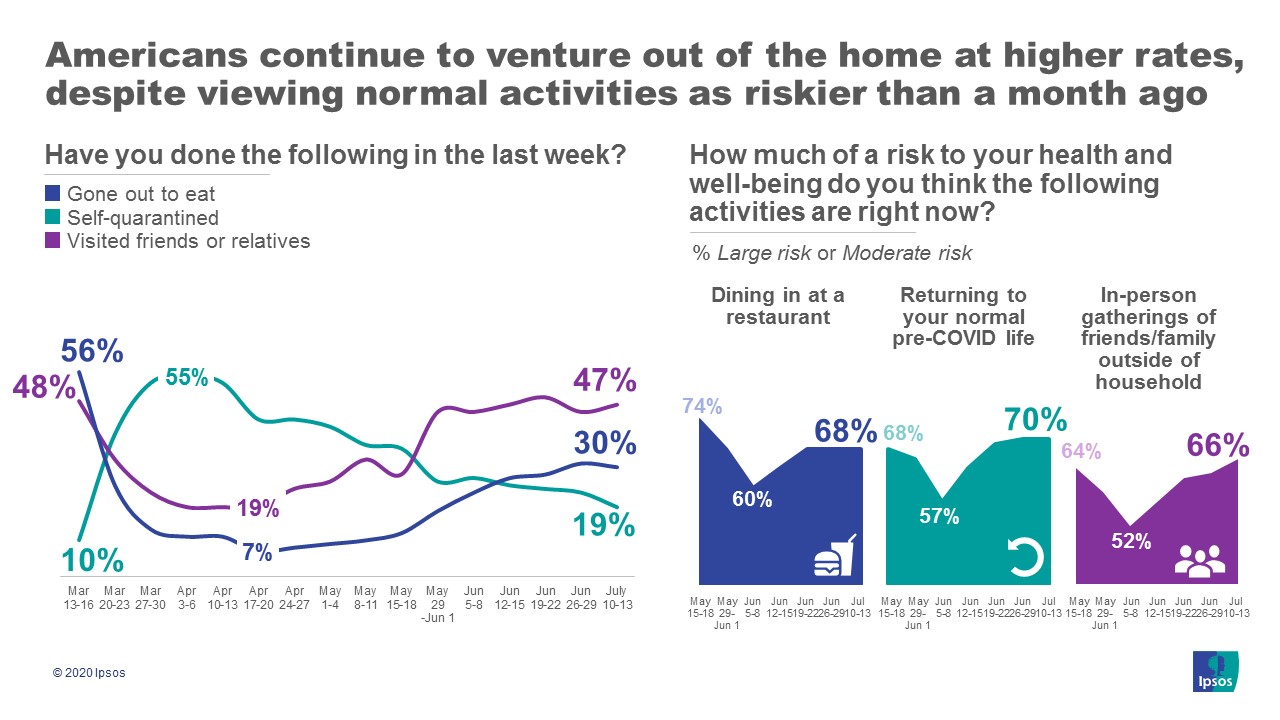
Fewer Americans report self-quarantining now than any point since the start of the pandemic according to our latest Axios-Ipsos Coronavirus Index. This corresponds with socializing and commercial activity remaining high, if not quite to pre-pandemic levels. However, more Americans see returning to a pre-coronavirus life as a large risk now than at any time since the high-point of the initial wave in mid-April.

Detailed findings:

1. Despite the surge in cases across the South and West, Americans continue to venture out of the home at higher rates and do not re-embrace major social distancing.

  • Fewer than one in five (19%) of Americans report self-quarantining the last week, the lowest level since tracking began at the eve of the outbreak in early March.
  • Just under half of Americans (47%) report visiting friends and relatives in the last week, a third (30%) report going out to eat, and about one in six (16%) visited elderly relatives in the last week – all essentially unchanged from levels in mid-June before the current spike in cases.

2. However, as cases surge, Americans are increasingly seeing normal activities as posing large risks.

  • A third of Americans (33%) see attending in-person gatherings of friends as a large risk to their health. Additionally, over a third (37%) say dining out, just under a third (30%) say going to a salon, and over a quarter (27%) of Americans working remote or temporarily not working say returning to their normal place of employment is a large risk. All are the highest levels since mid to late May.
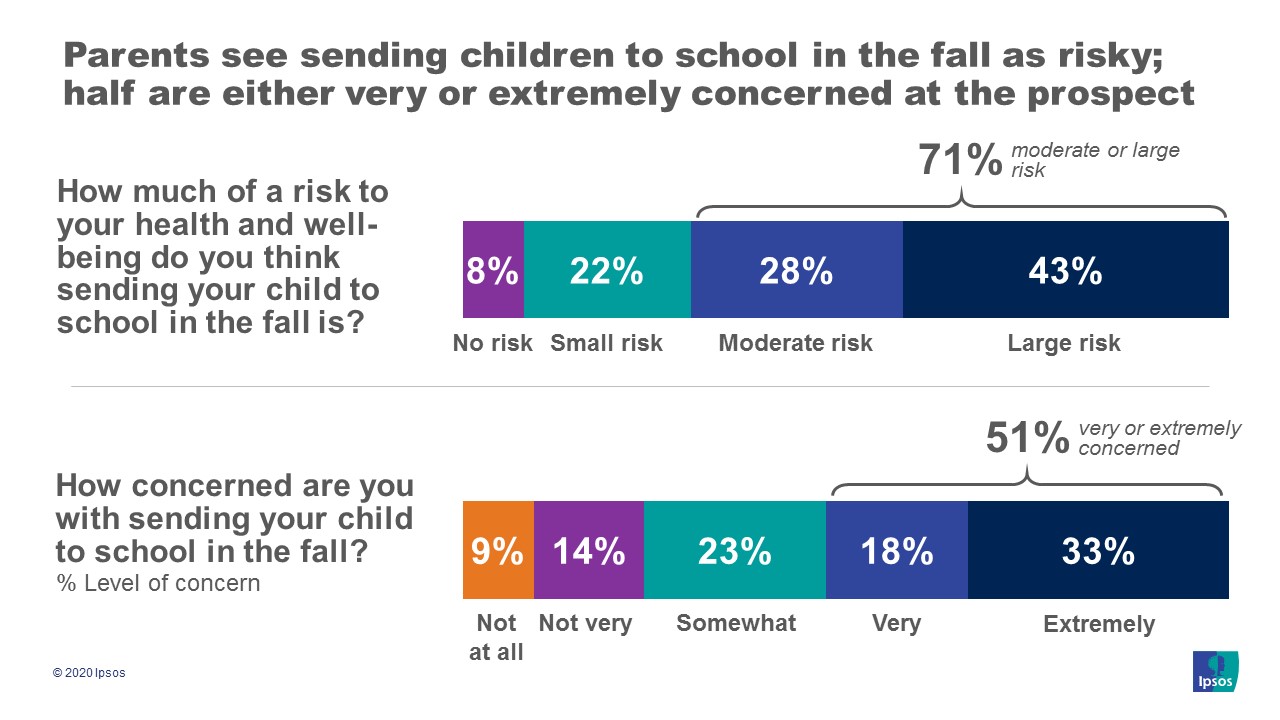
  • As debate about back-to-school rages, a large majority of parents (71%) say sending their child to school in the fall is a large or moderate risk.

Chart 2

3. Most Americans appear to be embracing mask use as a tool to cope with the coronavirus pandemic.

  • As of July, three in five Americans (62%) report wearing a mask at all times when leaving the home with an additional 23% reporting sometimes wearing a mask (85% total). This is the highest level of mask use since tracking began in April.
  • Among the approximately two in five (38%) Americans who do not wear a mask at all times when out of the home…
    • A third (32%) report not being allowed into an establishment without a mask (about 12% of the total population).
    • One in five (21%) report being told to wear a mask by another person (about 8% of the total population), up from 15% at the end of May.

4. As the pandemic continues, public trust in both the federal government and state governments has fallen to a low in this tracking.

  • A third of Americans (32%) have a fair amount or great deal of trust in the federal government to look out after the best interests of their family. This is down from 53% in mid-March.
  • Just over half (55%) trust their state governments, down from 71% in mid-March. Trust in the state government is lowest in the states currently hit the hardest (47% average cross AZ, FL, GA, and TX).

Washington DC, June 30, 2020

As June ends, the latest wave of the Axios-Ipsos Coronavirus Index finds that American fears of the coronavirus pandemic have resurged to levels last seen during the acute parts of the initial wave. This comes, however, as Americans continue to leave the home more frequently, albeit while taking protective measures.

Detailed Findings:

1. Levels of concerns have returned to levels last seen in early May as the pandemic spreads across the South and West.

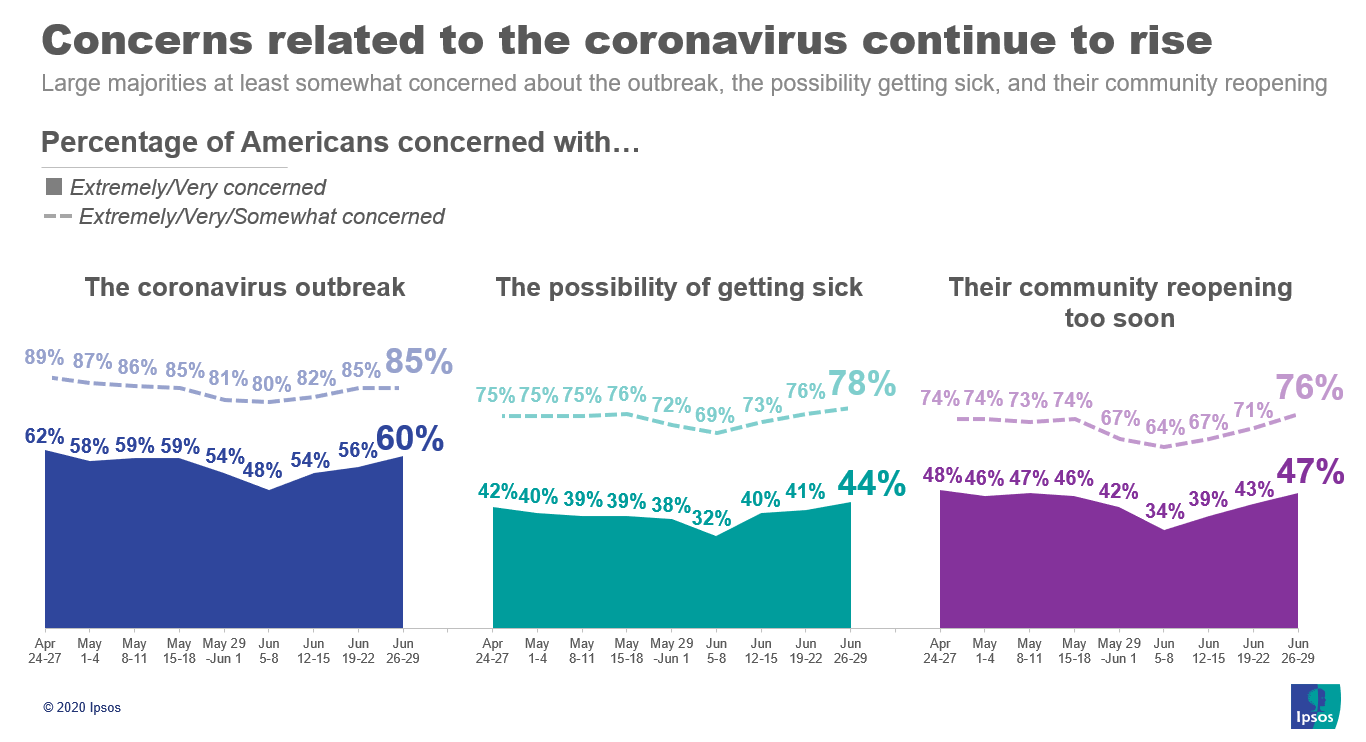
  • Almost two-thirds (60%) of Americans are very concerned about the coronavirus outbreak, with an additional quarter (24%) somewhat concerned.
  • Over three quarters (78%) are at least somewhat concerned about the possibility of getting sick, up 9 points from the beginning of June.
  • Three quarters (76%) are concerned about their community re-opening too soon, the highest level in our tracking.

corona concerns

2. Correspondingly, perceptions of risk also continue to increase, particularly views of activities that may bring the respondent into contact with large groups of people.

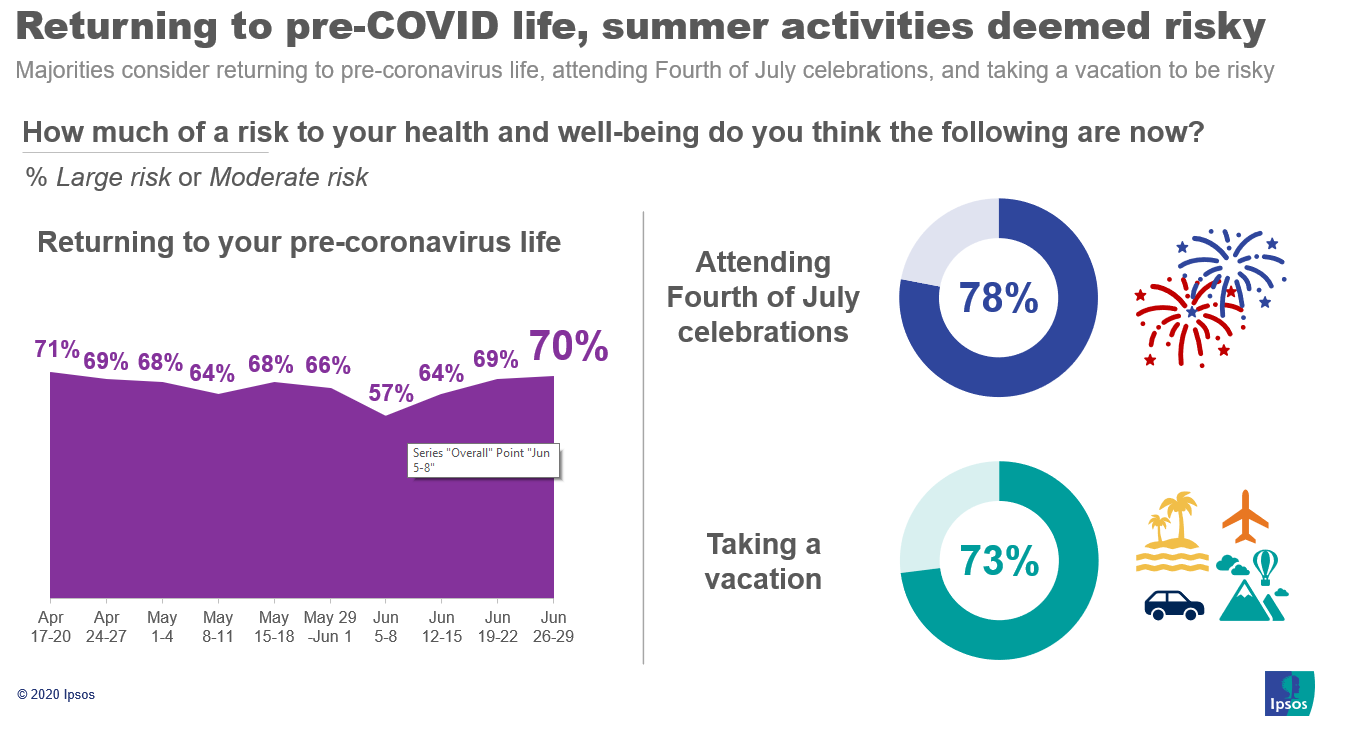
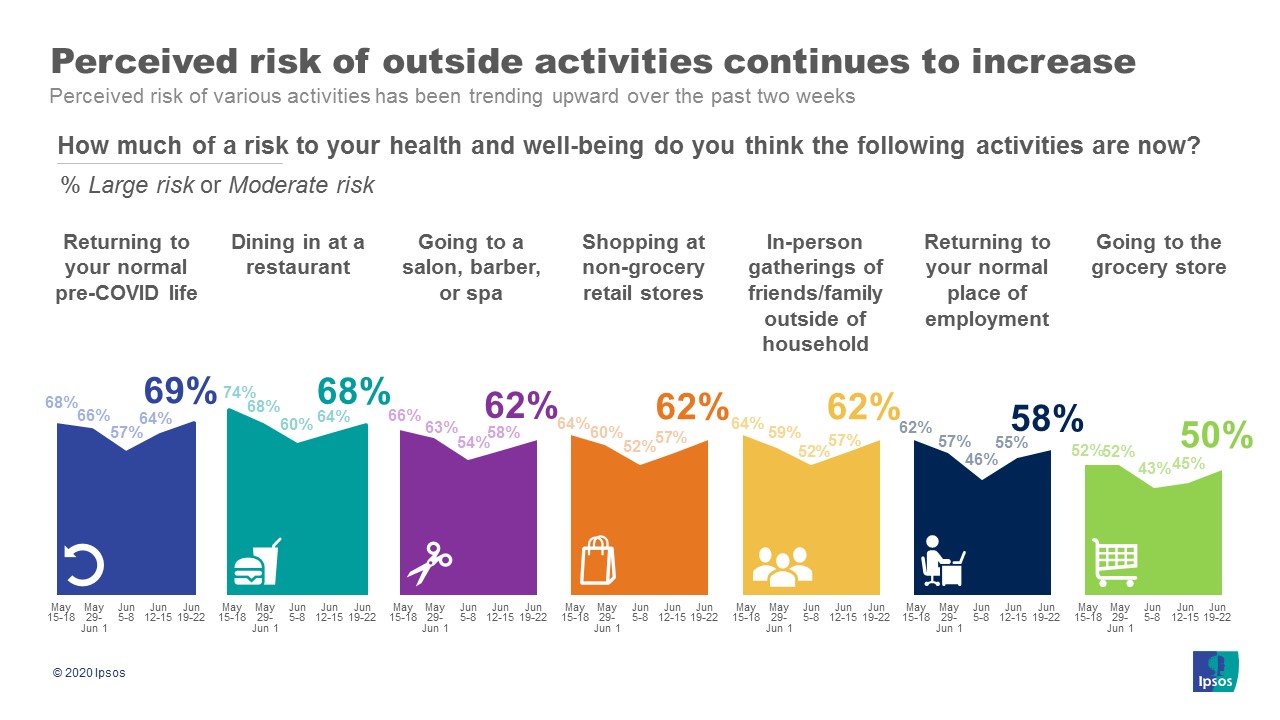
  • Over two-thirds (70%) currently say that returning to their pre-COVID life is a moderate or large risk.

3. Risk aversion may also put a damper on the upcoming Fourth of July holiday with 78% saying attending celebrations is a large or moderate risk.

Risky Business

4. Americans have started curtailing social engagement, however the number engaging in out of home commercial activities remains stable or continues to increase.

  • Less than half (45%) of Americans say they visited friends and family in the last week, down from the post-COVID high of 49% last week. Additionally, visiting elderly relatives is flat at 14%.
  • However, going out to eat continues to increase, now with 31% of Americans reporting having done so in the last week. Visiting a salon or retail store is flat from last week.

Washington DC, June 23, 2020

Our latest Axios-Ipsos Coronavirus Index finds that Americans are increasingly concerned about coronavirus and seeing ‘regular’ activities as increasingly risky after sentiment moderated earlier in June. This uptick in fears comes as Americans address a possible second wave and reflect on their potential to re-enter social distance quarantines if major warning thresholds are met.

Detailed Findings:

1. American concern with the coronavirus outbreak, while not as widespread as during early April, has increased notably over the past two weeks.

  • Currently, 85% of Americans are at least somewhat concerned with the outbreak, including 56% who are extremely or very concerned. This is up from 80% and 48% respectively in early June.
  • Concern with communities re-opening too soon (to 71% from 64%) and the possibility of getting sick (to 76% from 69%) are also up 7 percentage points over the last two weeks.
  • Eighty-five percent of Americans are concerned about a second wave of the coronavirus, including 59% who are extremely or very concerned.

2. “Normal” activities are seen as increasingly risky by many including doing their job, going to the grocery store, or socializing with friends after multiple weeks of minimizing concerns.

Chart

3. Americans continue to report that if a second wave hits their state, they will substantially withdraw to protect their health. They also express that they are watching for a wide range of signals of a second wave indicating it may not be official announcements that trigger a rebound in behavior.

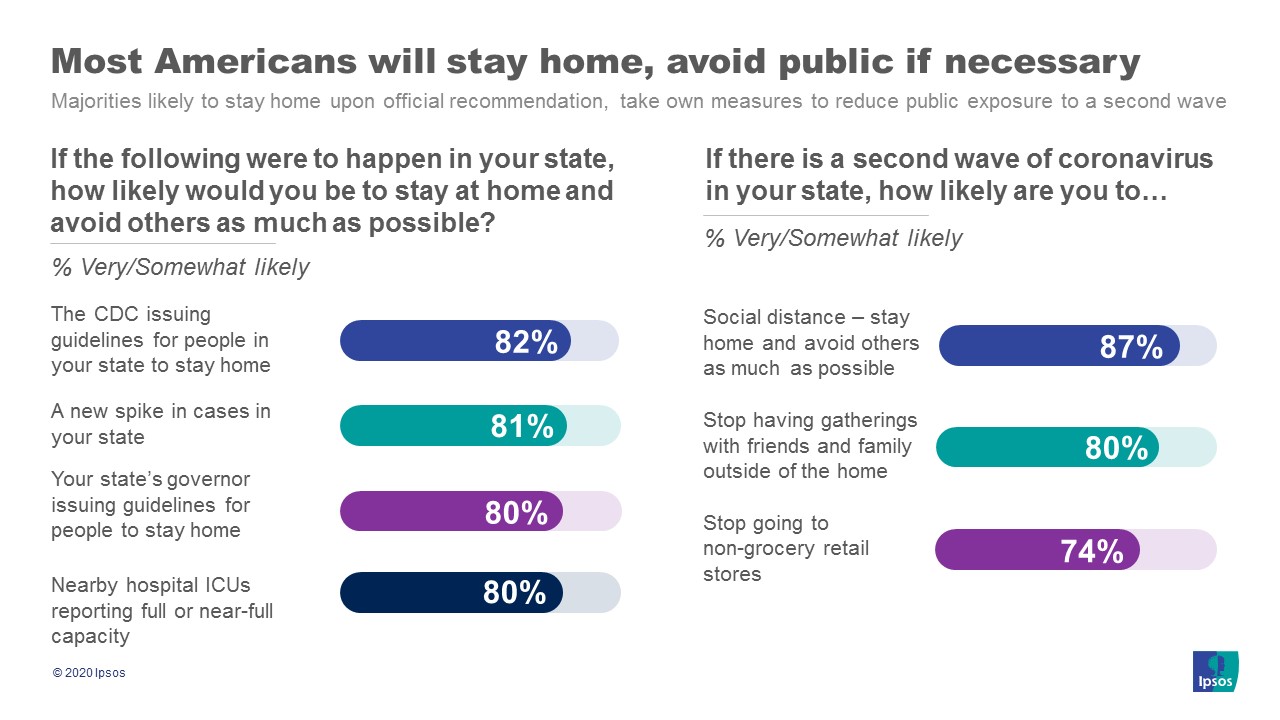
  • About four in five Americans say they are likely to stay home and avoid others as much as possible if…
    • The CDC issued guidelines for people in their state to stay home.
    • Their state’s governor issued guidelines for people to stay home.
    • There is a new spike in cases in their state.
    • Nearby hospital ICUs report full or near-full capacity.
    • Someone they know tests positive for the virus.
    • Someone they know is dying from the virus.

Chart

4. Social distancing behaviors continue to subside, but geographical differences remain in people’s experiences.

  • Half of Americans (49%) visited friends or relatives in the last week, up from 47% last week and 19% in early April. However, in the states with the greatest increase in cases (AZ, FL, SC) socializing with friends has declined from 52% to 44% in the last two weeks.
  • The number of Americans working remotely has also begun to decline, this week at 37% of all employed persons from 43% last week.

5. One percent of the U.S. population has tested positive for coronavirus at this point.

  • About one in ten Americans have been tested (11%) and about one in ten (9%) of those tested, tested positive, equal to about 1% of the overall population.

Washington DC, June 16, 2020

At the end of our third month of tracking America’s response to the coronavirus pandemic, the Axios-Ipsos Coronavirus Index finds that even while Americans are increasingly engaging with each other outside the home, concerns about a second wave and perceived risks of regular activities mount.

Detailed Findings:

1. More Americans are very concerned about the overall COVID-19 outbreak than last week as a majority express high levels of concern about a second wave of the coronavirus.

  • Fifty-four percent of Americans are extremely or very concerned about the outbreak, up from 48% last week, while 56% report being extremely or very concerned about a second wave.
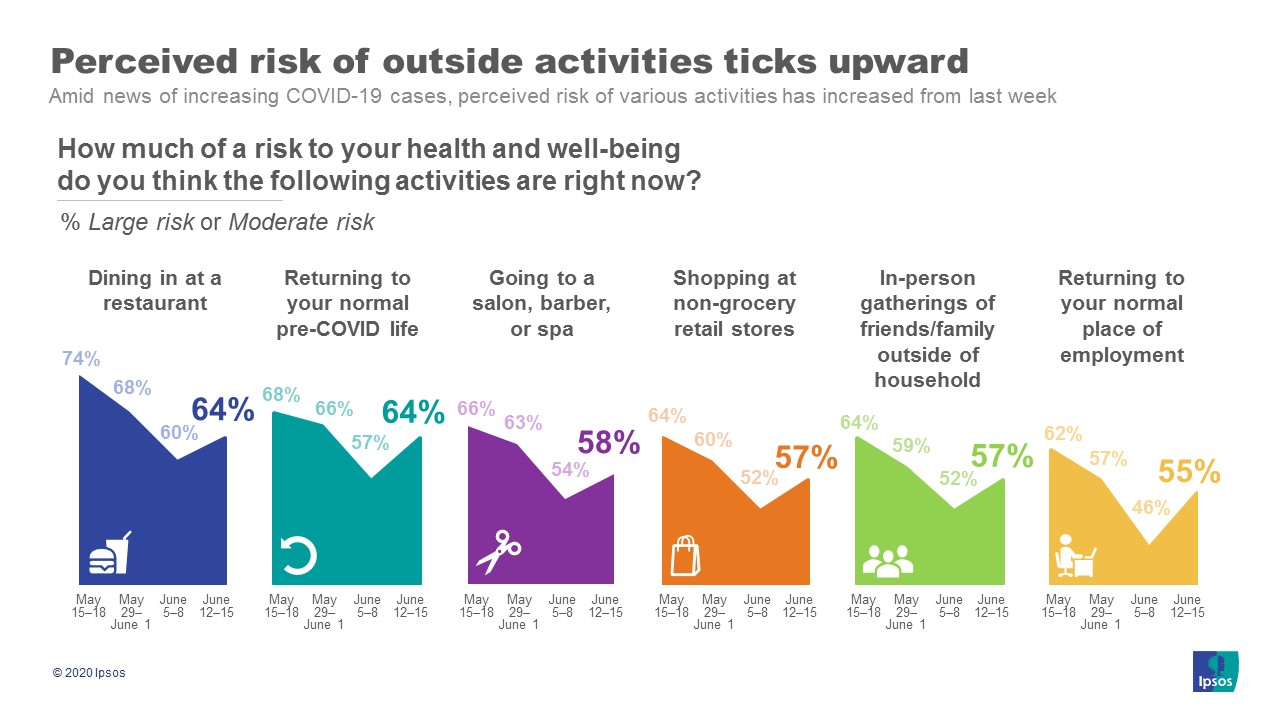
  • Sixty-four percent view returning to their pre-COVID life as risky right now, up from 57% last week.

2. If there is a second wave, large majorities of Americans report that they are likely to pull back into more socially distancing behaviors.

  • Two-thirds (65%) say they are somewhat or very likely to self-quarantine in the event of a second wave in their state and almost all (85%) report they will take steps to social distance.
  • This extends to social interactions – 79% report they are likely to stop gathering with friends or family – and commercial behavior – 73% report they would stop going to non-grocery retail stores.

3. As discussion of a second wave mounts, Americans report seeing many ‘normal’ activities as being more risky than just a week ago.

  • The number of Americans who report viewing gatherings of friends and family as risky has climbed 5 percentage points from last week (57% moderate or large risk from 52%).
  • Additionally, views of dining in at a restaurant (64% risky from 60%), shopping at a retail store (57% risky from 52%), or going to a barber or salon (58% risky from 54%) have all increased this week.
  • Large gatherings remain highly suspect with 89% viewing attending protests and 74% viewing attending Fourth of July celebrations as a risk to their health or well-being.

Visual

4. Over a third of Americans know someone who has tested positive for coronavirus.

  • While 35% know someone who has tested positive, it remains more prevalent in the Northeast (53%) than other parts of the country.
  • Nine percent of Americans report they have been tested for coronavirus in our latest survey. Of those, 6% say they tested positive. This represents about 0.6% of the U.S. population.


More young people are getting — and spreading — the coronavirus

https://www.axios.com/coronavirus-young-people-spread-5a0cd9e0-1b25-4c42-9ef9-da9d9ebce367.html

More young people are getting — and spreading — the coronavirus ...

More young people are being infected with the coronavirus, and even though they’re less likely to die from it, experts warn the virus’ spread among young adults may further fuel outbreaks across the United States.

Why it matters: Some people in their 20s and 30s face serious health complications from COVID-19, and a surge in cases among young people gives the virus a bigger foothold, increasing the risk of infection for more vulnerable people.

  • We may see a pattern of younger people being affected initially, but then, in a number of weeks from now, we’re going to see a more deadly pandemic spreading to elderly people,” says Alison Galvani, an epidemiologist at Yale University.

People can transmit the virus without knowing they have it, and younger people, in particular, could be unknowingly spreading the disease.

  • A study in Italy, yet to be peer reviewed, found the probability of having symptoms increased with age and that among 20–39-year-olds only about 22% had a fever or respiratory symptoms (compared to about 35% of 60–79-year-olds).
  • About half of the clusters in a study in Japan were traced back to people ages 20–39 at karaoke bars, offices and restaurants — and 41% of them did not have symptoms at the time.
  • “Younger people are at lower risk for serious COVID outcomes but are disproportionately responsible for asymptomatic transmission,” says Galvani, who published a study earlier this week that found the majority of COVID-19 transmission is from silent carriers who are pre-symptomatic or asymptomatic.

By the numbers: From Arizona to Allegheny County, Pa., young people increasingly account for COVID-19 cases.

  • In the county of Los Angeles, nearly 50% of cases are now in people under 40 (compared to about 30% in April), per the LA Times.
  • In Harris County, Texas, home to Houston, 43% of the 40,000 cases are in people ages 20–39, as of yesterday.
  • In Florida, the median age of confirmed cases is hovering in the mid- to late-30s, compared to age 65 in March.

And the proportion of young people hospitalized for COVID-19 has also grown.

  • 40% of hospitalizations for COVID-19 at the end of June were for people 18–49-years-old, compared to 26% at the end of March, according to the COVID-NET database of hospitalizations in 14 states that represent about 10% of the U.S. population.

Between the lines: Yes, young people are going to bars and parties — but also to work.

  • 42% of people ages 18–39 said they had socialized without social distancing compared to 26% of people over 40, in a survey last month from the Democracy Fund + UCLA Nationscape.
  • 64% of frontline workers (grocery store clerks, health care workers, delivery drivers and other essential workers) are under 50.
  • There’s a need for better education so that young people choose to take steps to prevent infection, says Lauren Ancel Meyers, a mathematical epidemiologist at UT Austin.
  • “But it also might come down to policies or regulations that get employers to ensure they are providing a safe workplace or resources to protect 20, 30 and other age groups that are working for them.”

Where it stands: Young people are still much less likely to be hospitalized or die from the virus than people older than 60.

  • Yes, but: They can and do get very sick with the disease — from dangerous blood clots in their lungs to inflammation of the heart, lungs and even brain.
  • And the long-term consequences are unknown.
  • The risk is higher for young people of color: For example, the majority of coronavirus hospitalizations among Latino/Hispanic Americans are in people ages 18–49, my Axios colleague Caitlin Owens reported.

“The death rate among the young is not zero, and it is particularly not zero for people who have at least one co-morbid condition. This is not a completely benign disease of the young.”

— Joshua Schiffer, of the Fred Hutchinson Cancer Center

What to watch: “If hospitals are strained now dealing with younger cases, they are going to be all the more taxed when the age distribution of infections shifts to the elderly,” Galvani says.


Our new default coronavirus strategy: herd immunity

https://www.axios.com/newsletters/axios-vitals-8f089110-bdd3-440e-9f8a-d8e431e2e18e.html?utm_source=newsletter&utm_medium=email&utm_campaign=newsletter_axiosvitals&stream=top

The U.S.'s new default coronavirus strategy: herd immunity - Axios

By letting the coronavirus surge through the population with only minimal social distancing measures in place, the U.S. has accidentally become the world’s largest experiment in herd immunity.

Why it matters: Letting the virus spread while minimizing human loss is doable, in theory. But it requires very strict protections for vulnerable people, almost none of which the U.S. has established.

The big picture: Cases are skyrocketing, with hospitalizations and deaths following suit in hotspots. Not a single state has ordered another lockdown, even though per capita cases in Florida and Arizona have reached levels similar to New York and New Jersey’s in April.

  • Most states never built up the testing, contact tracing and isolation systems it would take to prevent the virus from spreading widely.
  • The Trump administration is generally ignoring or downplaying soaring caseloads across the South and West, and is pushing schools to fully reopen in the fall.
  • In Florida, where infections, hospitalizations and deaths are surging, Gov. Ron DeSantis “has repeatedly ruled out a sweeping mask mandate or taking the state back into a lockdown to stem the virus, although local governments have acted on their own,” per Bloomberg.

Between the lines: Separating older, sicker people from younger, healthier ones while the virus burns through the latter group could be a way to achieve herd immunity — assuming immunity exists — without hundreds of thousands of people dying.

  • But the U.S. hasn’t adopted such a strategy with any planning or foresight. Although younger people make up a larger portion of coronavirus cases now than they did earlier in the pandemic, vulnerable people still go to work or live with non-vulnerable people.

Yes, but: Some cities and states, particularly in the Northeast, are focused on containing the virus rather than living with it.


IHME Model Projects 208,255 U.S. Deaths By November, But Estimate Falls Sharply If Mask Use Increases

https://www.forbes.com/sites/mattperez/2020/07/07/imhe-model-projects-208255-us-deaths-by-november-but-estimate-falls-sharply-if-mask-use-increases/?utm_source=newsletter&utm_medium=email&utm_campaign=dailydozen&cdlcid=5d2c97df953109375e4d8b68#453db3d56f2e

IHME Model Projects 208,255 U.S. Deaths By November, But Estimate ...

TOPLINE

The University of Washington’s influential Covid-19 model, extended out to November 1 for the first time, estimates that 208,255 Americans will die from the virus by then, though, the death toll could be reduced by nearly 22% if mask use were to become widespread, researchers said.

KEY FACTS

The university’s Institute for Health Metrics and Evaluation (IHME) forecasts 162,808 deaths by November if at least 95% of people were to wear face coverings in public.

A Gallup poll released Monday found that 86% of adults wore masks in the past week.

Masks have become a political issue, with only 66% of Republicans reporting mask use in the poll, while President Trump continues to refuse to wear one in public and his campaign has declared them optional at recent public campaign events and rallies.

“Mask mandates delay the need for re-imposing closures of businesses and have huge economic benefits,” said IHME Director Dr. Christopher Murray.

The model anticipates a surge in deaths in September and October, with the IHME noting Tuesday that, “Current data show a strong statistical relationship between Covid-19 transmission and pneumonia seasonality, which is included as a covariate in the model.”

While many of the people infected during the current surge in cases worldwide have been on the younger side, and therefore at lower risk of death, the university warns its current projection could increase if the virus is spread to at-risk populations.

The U.S. is currently experiencing a surge in cases following the easing of social distancing policies, particularly in Southern and Western states, a situation that Dr. Anthony Fauci, the country’s top infectious disease official, characterized as “really not good” during an interview Monday.

CHIEF CRITIC

President Trump, who pushed back against Fauci’s comments on Tuesday. “Well, I think we are in a good place. I disagree with him,”Trump said, according to CNN. “Dr. Fauci said don’t wear masks and now he says wear them. And he said numerous things. Don’t close off China. Don’t ban China. I did it anyway. I didn’t listen to my experts and I banned China. We would have been in much worse shape.”

BIG NUMBER

57,718. That’s the new daily record for confirmed cases of Covid-19 in the U.S., reached on July 2, according to the CDC. The toll has been broken several times since June, the previous high coming in early April with 43,438. The U.S. leads the world in cases of the coronavirus with 2,981,602, as well as reported deaths with 131,248.

TANGENT

Both Fauci and Murry at the IHME agree that the U.S. is still deep into its first wave, as exemplified by Texas, which broke its records for cases, hospitalizations and deaths on Tuesday. Because of the situation, Houston Mayor Sylvester Turner urged Texas’ GOP on Monday to cancel its in-person convention set for next week.


U.S. Tops Three Million Known Infections as Coronavirus Surges

https://www.usnews.com/news/top-news/articles/2020-07-07/us-coronavirus-cases-hit-3-million-stoking-fears-of-overwhelmed-hospitals

U.S. tops three million known infections as coronavirus surges ...

 The U.S. coronavirus outbreak crossed a grim new milestone of over 3 million confirmed cases on Tuesday as more states reported record numbers of new infections, and Florida faced an impending shortage of intensive care unit hospital beds.

Authorities have reported alarming upswings of daily caseloads in roughly two dozen states over the past two weeks, a sign that efforts to control transmission of the novel coronavirus have failed in large swaths of the country.

California, Hawaii, Missouri, Montana, Oklahoma and Texas on Tuesday shattered their previous daily record highs for new cases. About 24 states have also reported disturbingly high infection rates as a percentage of diagnostic tests conducted over the past week.

In Texas alone, the number of hospitalized patients more than doubled in just two weeks.

The trend has driven many more Americans to seek out COVID-19 screenings. The U.S. Department of Health and Human Services said on Tuesday it was adding short-term “surge” testing sites in three metropolitan areas in Florida, Louisiana and Texas.

In Houston, a line of more than 200 cars snaked around the United Memorial Medical Center as people waited for hours in sweltering heat to get tested. Some had arrived the night before to secure a place in line at the drive-through site.

“I got tested because my younger brother got positive,” said Fred Robles, 32, who spent the night in his car. “There’s so many people that need to get tested, there’s nothing you can do about it.”

Dean Davis, 32, who lost his job due to the pandemic, said he arrived at the testing site at 3 a.m. on Tuesday after he waited for hours on Monday but failed to make the cutoff.

“I was like, let me get here at three, maybe nobody will be here,” Davis said. “I got here, there was a line already.”

In Florida, more than four dozen hospitals across 25 of 67 counties reported their intensive care units had reached full capacity, according to the state’s Agency for Health Care Administration. Only 17% of the total 6,010 adult ICU beds statewide were available on Tuesday, down from 20% three days earlier.

Additional hospitalizations could strain healthcare systems in many areas, leading to an uptick in deaths from the respiratory illness that has killed more than 131,000 Americans to date.

A widely cited mortality model from the University of Washington’s Institute for Health Metrics and Evaluation (IHME) projected on Tuesday that U.S. deaths would reach 208,000 by Nov. 1, with the outbreak expected to gain new momentum heading into the fall.

A hoped-for summertime decline in transmission of the virus never materialized as previously predicted, the IHME said.

“The U.S. didn’t experience a true end of the first wave of the pandemic,” IHME Director Dr. Christopher Murray said in a statement. “This will not spare us from a second surge in the fall, which will hit particularly hard in states currently seeing high levels of infections.”

‘PRESSURE ON GOVERNORS’

U.S. President Donald Trump, who has pushed for restarting the U.S. economy and urged Americans to return to their normal routines, said on Tuesday he would lean on state governors to open schools in the fall.

Speaking at the White House, Trump said some people wanted to keep schools closed for political reasons. “No way, so we’re very much going to put pressure on governors and everybody else to open the schools.”

New COVID-19 infections are rising in 42 states, based on a Reuters analysis of the past two weeks. By Tuesday afternoon, the number of confirmed U.S. cases had surpassed 3 million, affecting nearly one of every 100 Americans and a population roughly equal to Nevada’s.

In Arizona, another hot spot, the rate of coronavirus tests coming back positive rose to 26% for the week ended July 5, leading two dozen states with positivity rates exceeding 5%. The World Heath Organization considers a rate over 5% to be troubling.

The surge has forced authorities to backpedal on moves to reopen businesses, such as restaurants and bars, after mandatory lockdowns in March and April reduced economic activity to a virtual standstill and put millions of Americans out of work.

The Texas state fair, which had been scheduled to open on Sept. 25, has been canceled for the first time since World War Two, organizers announced on Tuesday.

In Ohio, Governor Mike DeWine said the state was ordering people in seven counties to wear face coverings in public starting on Wednesday evening.


Daily New Confirmed Covid-19 Cases per Million People

New cases per capita have risen sharply in the US, compared to Europe, Canada, and Japan.


The emerging long-term complications of Covid-19, explained

https://www.vox.com/2020/5/8/21251899/coronavirus-long-term-effects-symptoms

Coronavirus long-term effects: Some Covid-19 survivors face lung ...

“It is a true roller coaster of symptoms and severities, with each new day offering many unknowns.”

At first, Lauren Nichols tried to explain away her symptoms. In early March, the healthy 32-year-old felt an intense burning sensation, like acid reflux, when she breathed. Embarrassed, she didn’t initially seek medical care. When her shortness of breath kept getting worse, her doctor tested her for Covid-19.

Her results came back positive. But for Nichols, that was just the beginning. Over the next eight weeks, she developed wide and varied symptoms, including extreme and chronic fatigue, diarrhea, nausea, tremors, headaches, difficulty concentrating, and short-term memory loss.

“The guidelines that were provided by the CDC [Centers for Disease Control and Prevention] were not appropriately capturing the symptoms that I was experiencing, which in turn meant that the medical community was unable to ‘validate’ my symptoms,” she says. “This became a vicious cycle of doubt, confusion, and loneliness.”

An estimated 40 to 45 percent of people with Covid-19 may be asymptomatic, and others will have a mild illness with no lasting symptoms. But Nichols is one of many Covid-19 patients who are finding their recovery takes far longer than the two weeks the World Health Organization says people with mild cases can expect. (The WHO says those with severe or critical cases can expect three to six weeks of recovery.)

Because Covid-19 is a new disease, there are no studies about its long-term trajectory for those with more severe symptoms; even the earliest patients to recover in China were only infected a few months ago. But doctors say the novel coronavirus can attach to human cells in many parts of the body and penetrate many major organs, including the heart, kidneys, brain, and even blood vessels.

“The difficulty is sorting out long-term consequences,” says Joseph Brennan, a cardiologist at the Yale School of Medicine. While some patients may fully recover, he and other experts worry others will suffer long-term damage, including lung scarring, heart damage, and neurological and mental health effects.

The UK National Health Service assumes that of Covid-19 patients who have required hospitalization, 45 percent will need ongoing medical care, 4 percent will require inpatient rehabilitation, and 1 percent will permanently require acute care. Other preliminary evidence, as well as historical research on other coronaviruses like severe acute respiratory syndrome (SARS) and Middle East respiratory syndrome (MERS), suggests that for some people, a full recovery might still be years off. For others, there may be no returning to normal.

There’s a lot we still don’t know, but here are a few of the most notable potential long-term impacts that are already showing up in some Covid-19 patients.


Lung scarring

Melanie Montano, 32, who tested positive for Covid-19 in March, says that more than seven weeks after she first got sick, she still experiences symptoms on and off, including burning in her lungs and a dry cough.

Brennan says symptoms like that occur because “this virus creates an incredibly aggressive immune response, so spaces [in the lungs] are filled with debris and pus, making your lungs less pliable.”

On CT scans, while normal lungs appear black, Covid-19 patients’ lungs frequently have lighter gray patches, called “ground-glass opacities” — which may not heal.

One study from China found that this ground-glass appearance showed up in scans of 77 percent of Covid-19 patients. In another study out of China, published in Radiology, 66 of 70 hospitalized patients had some amount of lung damage in CT scans, and more than half had the kind of lesions that are likely to develop into scars. (A third study from China suggests this is not just for critically ill patients; its authors found that of 58 asymptomatic patients, 95 percent also had evidence of these ground-glass opacities in their lungs. More than a quarter of these individuals went on to develop symptoms within a few days.)

“These kinds of tissue changes can cause permanent damage,” says Ali Gholamrezanezhad, a radiologist at the Keck School of Medicine at the University of Southern California.

Although it’s still too early to know if patients with ongoing lung symptoms like Montano will have permanent lung damage, doctors can learn more about what to expect from looking back to people who have recovered from SARS and MERS, other coronaviruses that resulted in similar lung tissue changes.

One small longitudinal study published in Nature followed 71 SARS patients from 2003 until 2018 and found that more than a third had reduced lung capacity. MERS is a little harder to extrapolate from, since fewer than 2,500 people were infected, and somewhere between 30 and 40 percent died. But one study found that about a third of 36 MERS survivors also had long-term lung damage.

Gholamrezanezhad has recently done a literature review of SARS and MERS and says that for this subset of people, “The pulmonary function never comes back; their ability to do normal activities never goes back to baseline.”

Additionally, Covid-19 scarring rates may end up being higher than SARS and MERS patients because those illnesses often attacked only one lung. But Covid-19 appears to often affect both lungs, which Gholamrezanezhad says escalates the risks of lung scarring.

He has already seen residual scarring in Covid-19 patients and is now designing a study to identify what factors might make some people at higher risk of permanent damage. He suspects having any type of underlying lung disease, like asthma, or other health conditions, like hypertension, might increase the risk of having longer-term lung issues. Additionally, “the older you are, probably the higher your chance of scarring,” he says.

For people with this kind of lung scarring, normal activities may become more challenging. “Routine things, like running up a flight of stairs, would leave these individuals gasping for air,” Brennan says.


Stroke, embolisms, and blood clotting

Many patients hospitalized for Covid-19 are experiencing unexpectedly high rates of blood clots, likely due to inflammatory responses to the infection. These can cause lung blockages, strokes, heart attacks, and other complications with serious, lasting effects.

Blood clots that form in or reach the brain can cause a stroke. Although strokes are more typically seen in older people, strokes are now being reported even in young Covid-19 patients. In Wuhan, China, about 5 percent of hospitalized Covid-19 patients had strokes, and a similar pattern was reported with SARS.

In younger people who have strokes, mortality rates are relatively low compared to those who are older, and many people recover. But studies show only between 42 and 53 percent are able to return to work.

Blood clots can also cut off circulation to part of the lungs, a condition known as a pulmonary embolism, which can be deadly. In France, two studies suggest that between 23 and 30 percent of people with severe Covid-19 are also having pulmonary embolisms.

One analysis found that after a pulmonary embolism, “symptoms and functional limitations are frequently reported by survivors.” These include fatigue, heart palpitations, shortness of breath, marked limitation of physical activity, and inability to do physical activity without discomfort.

Blood clots in other major organs can also cause serious problems. Renal failure has been a common challenge in many severe Covid-19 patients, and patients’ clotted blood has been clogging dialysis machines. Some of these acute kidney injuries may be permanent, requiring ongoing dialysis.

Clots outside organs can be serious, too. Deep vein thrombosis, for example, occurs when a blood clot forms in a vein, often the legs. Nick Cordero, a Tony-nominated Broadway and television actor, recently had to have his right leg amputated after Covid-related blood clots.

Abnormal blood clotting even seems to be happening in people after they’ve appeared to recover. One 32-year-old woman in Chicago, for example, had been discharged from the hospital for a week when she died suddenly with a severely swollen leg, a sign of deep vein thrombosis, according to local broadcaster WGN9. Or take Troy Randle, a 49-year-old cardiologist in New Jersey, who was declared safe to go back to work after recovering from Covid-19 when he developed a vicious headache. A CT scan confirmed he’d had a stroke.

Although there’s still a shortage of data, one study found that as many as 31 percent of ICU patients with Covid-19 infections had these kinds of clotting problems. In the meantime, the International Society on Thrombosis and Haemostasis has issued guidelines that recovered Covid-19 patients should continue taking anticoagulants even after being discharged from the hospital.


Heart damage

Being critically ill, especially with low oxygen levels, puts additional stress on the heart. But doctors now think that in Covid-19 patients, viral particles might also be specifically inflaming the heart muscle. (The heart has many ACE2 receptors, which scientists have identified as an entry point for the SARS-CoV-2 virus.)

“In China, doctors noted some people coming [in] with chest pain,” says Mitchell Elkind, president-elect of the American Heart Association and professor of neurology and epidemiology at Columbia University. “They had a heart attack, and then developed Covid symptoms or tested positive after.”

One study from Wuhan in January found 12 percent of Covid-19 patients had signs of cardiovascular damage. These patients had higher levels of troponin, a protein released in the blood by an injured heart muscle. Since then, other reports suggest the virus may directly cause acute myocarditis and heart failure. (Heart failure was also seen with MERS and is known to be correlated with even the seasonal flu.)

In March, another study looked at 416 hospitalized Covid-19 patients and found 19 percent showed signs of heart damage. University of Texas Health Science Center researchers warn that in survivors, Covid-19 may cause lingering cardiac damage, as well as making existing cardiovascular problems worse, further increasing the risk for heart attack and stroke.

A pulmonary critical care doctor at Mount Sinai Hospital in New York City, for example, recovered from Covid-19, only to learn she had developed cardiomyopathy, a condition in which your heart has trouble delivering blood around your body. Although previously healthy, when she returned to work, she told NBC, “I couldn’t run around like I always do.”

The specific consequences may vary depending on how the heart is affected. For example, Covid-19 has been linked to myocarditis, a condition where inflammation weakens the heart, creates scar tissue, and makes it work harder to circulate the body’s oxygen. The Myocarditis Foundation recommends these patients avoid cigarettes and alcohol, and stay away from rigorous exercise until approved by their doctor.


Neurocognitive and mental health impacts

Covid-19 also seems to affect the central nervous system, with potentially long-lasting consequences. In one study from China, more than a third of 214 people hospitalized with confirmed Covid-19 had neurological symptoms, including dizziness, headaches, impaired consciousness, vision, taste/smell impairment, and nerve pain while they were ill. These symptoms were more common in patients with severe cases, where the incidence increased to 46.5 percent. Another study in France found neurologic features in 58 of 64 critically ill Covid-19 patients.

As the pandemic goes on, Elkind says, “We need to be on the lookout for long-term neurocognitive problems.”

Looking back to SARS and MERS suggests that Covid-19 patients may have slightly delayed onset of neurological impacts. Andrew Josephson, a doctor at the University of California San Francisco, wrote in JAMA, “Although the SARS epidemic was limited to about 8,000 patients worldwide, there were some limited reports of neurologic complications of SARS that appeared in patients 2 to 3 weeks into the course of the illness.” These included muscular weakness, burning or prickling, and numbness, and the breakdown of muscle tissue into the blood. Neurological injuries, including impaired balance and coordination, confusion, and coma, were also found with MERS.

Long-term complications of Covid-19 — whether caused by the virus itself or the inflammation it triggers — could include decreased attention, concentration, and memory, as well as dysfunction in peripheral nerves, “the ones that go to your arms, legs, fingers, and toes,” Elkind says.

There are other cognitive implications for people who receive intensive treatment in hospitals. For example, delirium — an acutely disturbed state of mind that can result in confusion and seeing or hearing things that aren’t there — affects a third or more of ICU patients, and research suggests the presence of delirium during severe illness predicts future long-term cognitive decline.

Previous research on acute respiratory distress syndrome (ARDS) more generally may also provide clues to what neurological issues critically ill Covid-19 patients might see after leaving the hospital.

Research shows one in five ARDS survivors experiences long-term cognitive impairment, even five years after being discharged. Continuing impairments can include short-term memory problems and difficulty with learning and executive function. These can lead to challenges like difficulty working, impaired money management, or struggling to perform daily tasks.

ARDS survivors frequently have increased rates of depression and anxiety, and many experience post-traumatic stress. Although it’s still too early to have much data on Covid-19, during the SARS outbreak, former patients struggled with psychological distress and stress for at least a year after the outbreak.

“I felt imprisoned within my body, imprisoned within my home, and tremendously ignored and misunderstood by the general public, and even those closest to me,” Nichols says about her battle with Covid-19. “I feel incredibly alone.”

Jane, who prefers to use a pseudonym because she fears retribution at the hospital where she works, tested positive for Covid-19 more than a month ago. She’s still struggling with fevers, heart issues, and neurological issues, but the most difficult part, she says, is how tired she is of “being treated like I am a bomb that no one knows how to disarm.” Jane, a nurse who cared for AIDS patients during the ’90s, says, “This is exactly what those people went through. There is a terrible stigma.” In addition to the stigma, uncertainty has added to her mental health burden.

“People need to know this disease can linger and wreck your life and health,” she says. “And no one knows what to do for us.”


Childhood inflammation, male infertility, and other possible lasting effects

The novel coronavirus continues to frustrate scientists and patients alike with its mysteries. One of these is a small but growing number of children who recently began showing up at doctors’ offices in Britain, Italy, and Spain with strange symptoms, including a rash, a high fever, and heart inflammation.

On May 4, the New York City Health Department noted that at least 15 children with these symptoms had been hospitalized there, too. These cases present like a severe immune response called Kawasaki disease, where blood vessels can begin to leak, and fluid builds up in the lungs and other major organs. Although only some of these children have tested positive for Covid-19, Russell Viner, president of the Royal College of Pediatrics and Child Health, told the New York Times, “the working hypothesis is that it’s Covid-related.”

Children who survive Kawasaki-like conditions can suffer myocardial and vascular complications in adulthood. But it’s too early to know how Covid-related cases will develop. Many of the small number of reported cases appear to be responding well to treatment.

Other researchers are suggesting that Covid-19 may pose particular problems for men beyond their disproportionate mortality from the illness. The testicles contain a high number of ACE2 receptors, explained researcher Ali Raba, in a recent letter to the World Journal of Urology. “There is a theoretical possibility of testicular damage and subsequent infertility following COVID-19 infection,” he wrote.

Another study, looking at 38 patients in China who had been severely ill with Covid-19, found that during their illness, 15 had virus RNA in their semen samples, as did two of 23 recovering patients. (The presence of viral RNA doesn’t necessarily indicate infectious capacity.)

Another recent study also showed that in 81 men with Covid-19, male hormone ratios were off, which could signal trouble for fertility down the line. The authors called for more attention to be paid, particularly on “reproductive-aged men.” An April 20 paper published in Nature went so far as to suggest, “After recovery from COVID-19, young men who are interested in having children should receive a consultation regarding their fertility.”

And we are just at the beginning of figuring out what this complex infection means for other organ systems and their recovery. For example, a recent preprint from Chinese doctors looked at 34 Covid-19 survivors’ blood. While they saw a difference between severe and mild cases, the researchers found that regardless of the severity of the disease, after recovered patients were discharged from the hospital, many biological measures “failed to return to normal.” The most concerning measures suggested ongoing impaired liver function.


What all of this means for survivors and researchers

As all this preliminary research shows, we are still in the early days of understanding what this virus might mean for the growing number of Covid-19 survivors — what symptoms they might expect to have, how long it might take them to get back to feeling normal (if they ever will), and what other precautions they might need to be taking.

Many people aren’t even receiving adequate information about when it might be safe for them to stop self-isolating. Nichols and other survivors report feeling better one day and terrible the next.

But in the chaos Covid-19 has caused in the medical systems, survivors say it’s hard to get attention for their ongoing struggles. “The support and awareness is simply lacking,” Nichols says. “It is a true roller coaster of symptoms and severities, with each new day offering many unknowns: I may feel healthier one day but may feel utterly debilitated and in pain the next.”