If you were anything like my family over the July 4 holiday, there were bowls of potato salad, casseroles of baked beans and platters of hotdogs, hamburgers and chicken all pulled from the grill and served family-style. For a lot of us, it was the first time seeing a wide net of our family in more than a year and we took advantage of ditching the masks, probably wrongly assuming our circles were vaccinated at higher levels than they were and maybe even handing kids lighters for sparklers they shouldn’t be wielding.
Our increasing return to normal makes it easy to believe the pandemic is almost over. Sure, we still had to wear masks on the flights, trains and buses. Grocery markets and big-box stores in some communities still asked that we wear them, too. The staff at Nationals Park here in D.C. and Progressive Field in Cleveland wore theirs as I visited both for MLB games. But the worst of the pandemic feels behind us here in the U.S., as vaccinations are climbing, deaths and new cases are sinking and headlines seem to be shifting to more run-of-the-mill topics like tropical storms.
A new and unusually long report from Congress’ independent think-tank is a stark warning to the U.S. government that even COVID-19 seems over, it actually isn’t, particularly when it comes to Americans’ well being. Released on Friday, the wonks at the Congressional Research Service (CRS) urged officials going into the long holiday weekend to remember amid the celebrations that we still don’t know the final toll of the pandemic, especially when it comes to long-term consequences for behavioral and mental health. Its notes about substance-abuse challenges are particularly worrying, given that lawmakers cannot ignore the already troubling fight against opioids.
Anecdotally, we know the last 18-or-so-months have taken a toll on our friends, colleagues and neighbors. Those of us lucky enough to have been allowed to work from home adapted in fits and starts. My colleagues with children or dependents were stretched to the points of breaking, but most have made it to the other side. Those in complete isolation actually came to look forward to Zoom meetings and telemedicine appointments. And tech-slow people like my grandmother probably wouldn’t have made it through without the good folks at the local public library loading her loans into the trunk through a touch-free lending system.
But you cannot make public policy on anecdotes alone, which is why the CRS report offers a roadmap for lawmakers. Noting upfront that the data is still coming in and comparisons so quickly after—and during, really—a so-recent period are imprecise, there are still warning signs that America has not healed the way we’d like to believe. The share of Americans suffering simultaneously from depression and anxiety grew five-fold, year-over-year, in just the first three-months of the pandemic-mandated lockdown, from April to June 2020, when the death toll still hovered around 120,000. Fatal overdoses grew 11% between March and May last year, and non-fatal overdoses rose 19% during that same short window. In the three months that followed, there were almost equal levels of depression or anxiety among households that had lost jobs and those that had not. No one was spared, but the hit came hardest for less-educated, essential and lower-paid workers.
Why is this Washington’s problem? An estimated 10% to 20% of Americans who needed mental-health services during the pandemic received no treatment. Another survey cited in the report estimates that up to a quarter of adults with depression or anxiety went untreated. As many as 27,000 Americans who survived COVID-19 may end up dead over the next decade as a result of behavioral health-related challenges, and that number may ultimately reach more than 154,000. At the moment, federal law does not require mental health services to be treated on par with treatments for physical health. Not Medicare. Not CHIP. Not even fancy private insurance plans.
There were, believe it or not, a few upsides to the COVID-19 pandemic that the CRS report notes. Under emergency powers granted in one of the relief bills, the Department of Health and Human Services waived the in-person requirement for some treatments, including mental health and substance abuse counseling. For now doctors can be paid for that phone call consultation rather than requiring patients to make a brick-and-mortar visit to qualify for Medicare and Medicaid money. The Department of Veterans Affairs allowed taxpayer dollars to help with mental health services via tech platforms, too. In all, billions of dollars were included in the raft of COVID-19 stimulus plans to shore up mental health and substance abuse programs.
But those were the bright spots. Not all of Washington’s urgent changes were for the better. The Drug Enforcement Agency allowed doctors to prescribe medicine without a physical appointment, Health and Human Services’ civil rights unit turned a lot of blind eyes to patients’ privacy rights as public health data seemed ubiquitous, and the Small Business Administration shoved piles of cash out the door to health clinics and larger rafts of money to hospitals with minimal upfront scrutiny.
So as Washington turns slowly toward the post-pandemic policies of this country, lawmakers have plenty to consider, especially if it wants to return America to its Before Times footing. As much as it may feel like the United States is rounding a corner—and it’s tough not to when you see big crowds gathering maskless for fireworks and parades—the reality is this: there’s still a lot of trauma under the surface that is all too easy to miss unless D.C. is looking for it.
Exactly 300 years ago, in 1721, Benjamin Franklin and his fellow American colonists faced a deadly smallpox outbreak. Their varying responses constitute an eerily prescient object lesson for today’s world, similarly devastated by a virus and divided over vaccination three centuries later.
As a microbiologist and a Franklin scholar, we see some parallels between then and now that could help governments, journalists and the rest of us cope with the coronavirus pandemic and future threats.
Smallpox strikes Boston
Smallpox was nothing new in 1721. Known to have affected people for at least 3,000 years, it ran rampant in Boston, eventually striking more than half the city’s population. The virus killed about 1 in 13 residents – but the death toll was probably more, since the lack of sophisticated epidemiology made it impossible to identify the cause of all deaths.
What was new, at least to Boston, was a simple procedure that could protect people from the disease. It was known as “variolation” or “inoculation,” and involved deliberately exposing someone to the smallpox “matter” from a victim’s scabs or pus, injecting the material into the skin using a needle. This approach typically caused a mild disease and induced a state of “immunity” against smallpox.
Even today, the exact mechanism is poorly understood and not muchresearch on variolation has been done. Inoculation through the skin seems to activate an immune response that leads to milder symptoms and less transmission, possibly because of the route of infection and the lower dose. Since it relies on activating the immune response with live smallpox variola virus, inoculation is different from the modern vaccination that eradicated smallpox using the much less harmful but related vaccinia virus.
The inoculation treatment, which originated in Asia and Africa, came to be known in Boston thanks to a man named Onesimus. By 1721, Onesimus was enslaved, owned by the most influential man in all of Boston, the Rev. Cotton Mather.
Cotton Mather heard about variolation from an enslaved West African man in his household named Onesimus. Bettman via Getty Images
Known primarily as a Congregational minister, Mather was also a scientist with a special interest in biology. He paid attention when Onesimus told him “he had undergone an operation, which had given him something of the smallpox and would forever preserve him from it; adding that it was often used” in West Africa, where he was from.
Inspired by this information from Onesimus, Mather teamed up with a Boston physician, Zabdiel Boylston, to conduct a scientific study of inoculation’s effectiveness worthy of 21st-century praise. They found that of the approximately 300 people Boylston had inoculated, 2% had died, compared with almost 15% of those who contracted smallpox from nature.
The findings seemed clear: Inoculation could help in the fight against smallpox. Science won out in this clergyman’s mind. But others were not convinced.
Stirring up controversy
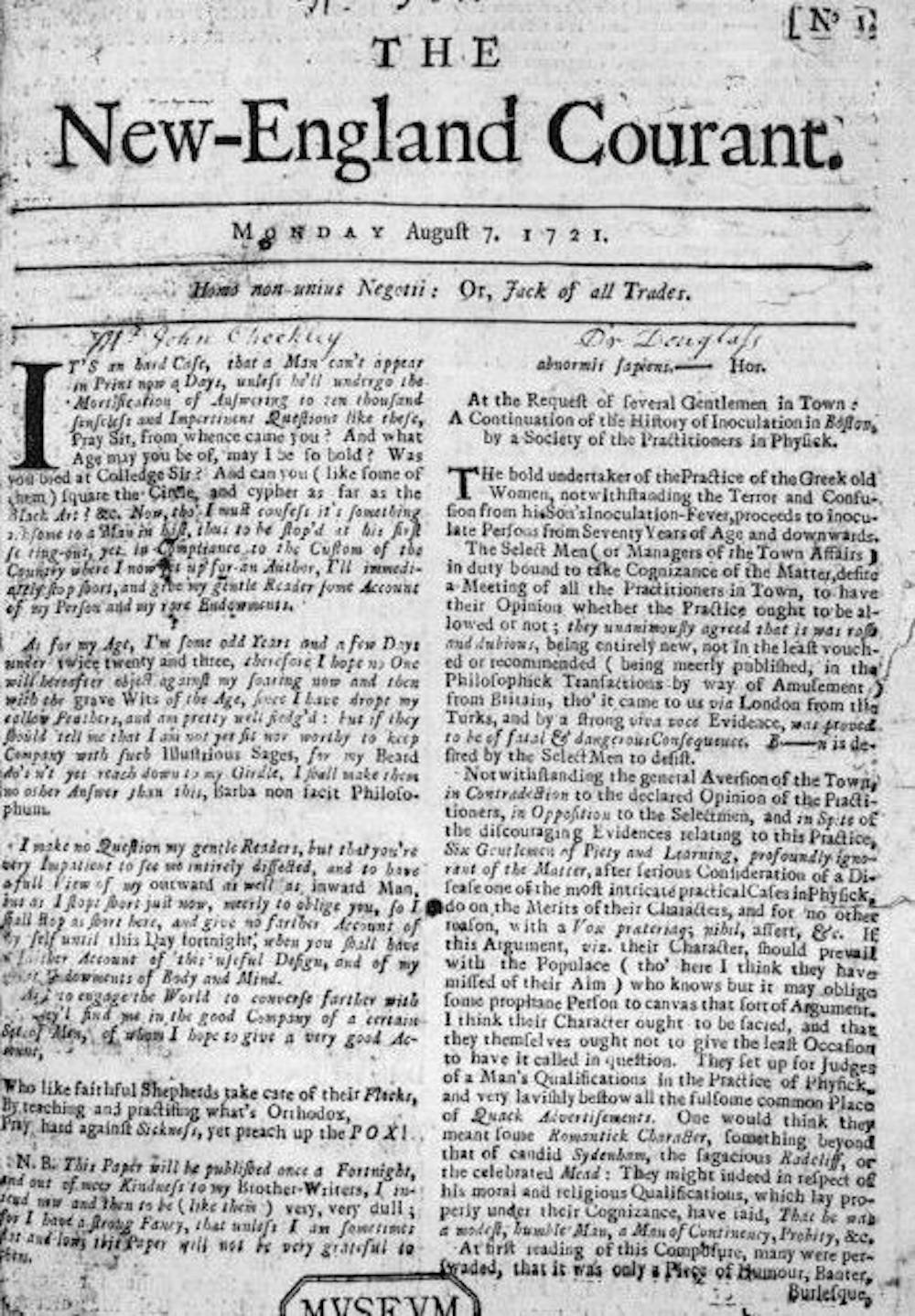
A local newspaper editor named James Franklin had his own affliction – namely an insatiable hunger for controversy. Franklin, who was no fan of Mather, set about attacking inoculation in his newspaper, The New-England Courant.
From its first edition, The New-England Courant covered inoculation. Wikimedia Commons
One article from August 1721 tried to guilt readers into resisting inoculation. If someone gets inoculated and then spreads the disease to someone else, who in turn dies of it, the article asked, “at whose hands shall their Blood be required?” The same article went on to say that “Epidemeal Distempers” such as smallpox come “as Judgments from an angry and displeased God.”
In contrast to Mather and Boylston’s research, the Courant’s articles were designed not to discover, but to sow doubt and distrust. The argument that inoculation might help to spread the disease posits something that was theoretically possible – at least if simple precautions were not taken – but it seems beside the point. If inoculation worked, wouldn’t it be worth this small risk, especially since widespread inoculations would dramatically decrease the likelihood that one person would infect another?
Franklin, the Courant’s editor, had a kid brother apprenticed to him at the time – a teenager by the name of Benjamin.
Historians don’t know which side the younger Franklin took in 1721 – or whether he took a side at all – but his subsequent approach to inoculation years later has lessons for the world’s current encounter with a deadly virus and a divided response to a vaccine.
That he was capable of overcoming this inclination shows Benjamin Franklin’s capacity for independent thought, an asset that would serve him well throughout his life as a writer, scientist and statesman. While sticking with social expectations confers certain advantages in certain settings, being able to shake off these norms when they are dangerous is also valuable. We believe the most successful people are the ones who, like Franklin, have the intellectual flexibility to choose between adherence and independence.
Perhaps the inoculation controversy of 1721 had helped him to understand an unfortunate phenomenon that continues to plague the U.S. in 2021: When people take sides, progress suffers. Tribes, whether long-standing or newly formed around an issue, can devote their energies to demonizing the other side and rallying their own. Instead of attacking the problem, they attack each other.
Franklin, in fact, became convinced that inoculation was a sound approach to preventing smallpox. Years later he intended to have his son Francis inoculated after recovering from a case of diarrhea. But before inoculation took place, the 4-year-old boy contracted smallpox and died in 1736. Citing a rumor that Francis had died because of inoculation and noting that such a rumor might deter parents from exposing their children to this procedure, Franklin made a point of setting the record straight, explaining that the child had “receiv’d the Distemper in the common Way of Infection.”
Writing his autobiography in 1771, Franklin reflected on the tragedy and used it to advocate for inoculation. He explained that he “regretted bitterly and still regret” not inoculating the boy, adding, “This I mention for the sake of parents who omit that operation, on the supposition that they should never forgive themselves if a child died under it; my example showing that the regret may be the same either way, and that, therefore, the safer should be chosen.”
A scientific perspective
A final lesson from 1721 has to do with the importance of a truly scientific perspective, one that embraces science, facts and objectivity.
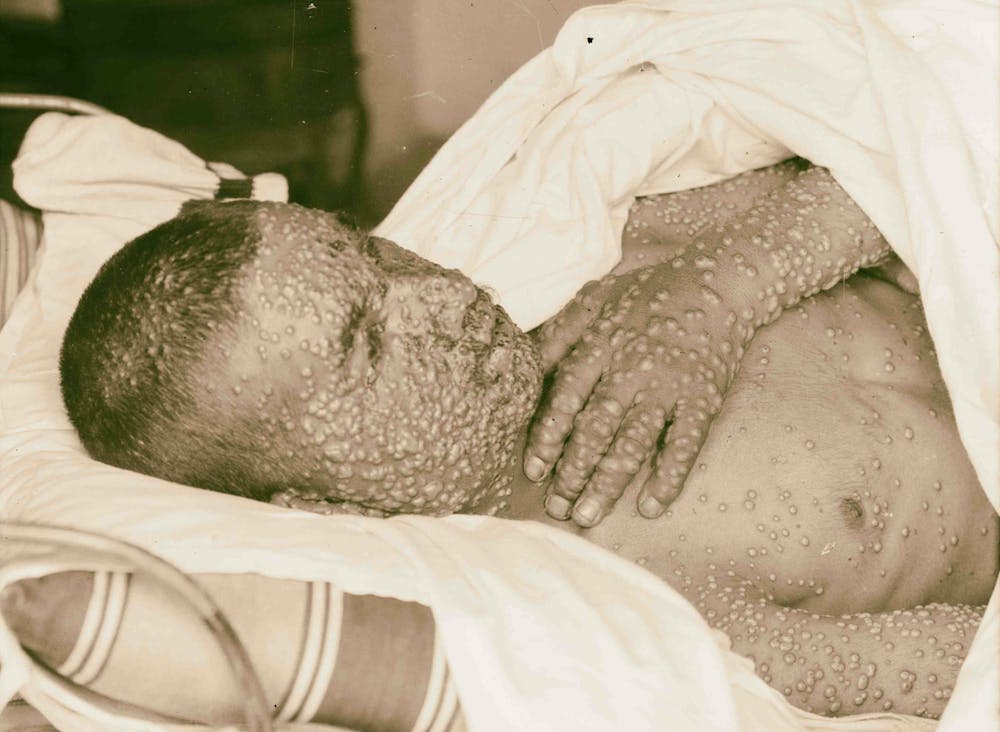
Smallpox was characterized by fever and aches and pustules all over the body. Before eradication, the virus killed about 30% of those it infected, according to the U.S. Centers for Disease Control and Prevention. Sepia Times/Universal Images Group via Getty Images
Inoculation was a relatively new procedure for Bostonians in 1721, and this lifesaving method was not without deadly risks. To address this paradox, several physicians meticulously collected data and compared the number of those who died because of natural smallpox with deaths after smallpox inoculation. Boylston essentially carried out what today’s researchers would call a clinical study on the efficacy of inoculation. Knowing he needed to demonstrate the usefulness of inoculation in a diverse population, he reported in a short book how he inoculated nearly 300 individuals and carefully noted their symptoms and conditions over days and weeks.
The recent emergency-use authorization of mRNA-based and viral-vector vaccines for COVID-19 has produced a vast array of hoaxes, false claims and conspiracy theories, especially in various social media. Like 18th-century inoculations, these vaccines represent new scientific approaches to vaccination, but ones that are based on decades of scientific research and clinical studies.
We suspect that if he were alive today, Benjamin Franklin would want his example to guide modern scientists, politicians, journalists and everyone else making personal health decisions.Like Mather and Boylston, Franklin was a scientist with a respect for evidence and ultimately for truth.
When it comes to a deadly virus and a divided response to a preventive treatment, Franklin was clear what he would do. It doesn’t take a visionary like Franklin to accept the evidence of medical science today.
Health officials are grappling with how to prevent potential COVID-19 outbreaks from the delta variant that is spreading rapidly across the U.S.
Concern over the highly transmissible delta strain prompted Los Angeles County this week to recommend that all people wear masks indoors, even if they’re vaccinated. The World Health Organization (WHO) has also encouraged fully vaccinated people to continue using masks.
But the Centers for Disease Control and Prevention (CDC) has not signaled any plans to revise its mask guidance, with Biden administration officials and some experts say that fully vaccinated Americans are safe from all existing COVID-19 variants.
“If you have been vaccinated, the message we’re conveying is you’re safe,” White House press secretary Jen Psaki said Wednesday. “Vaccines are effective, and that is something we want to be very clear with the public about.”
Still, the move by officials in Los Angeles County raises the prospect that mask recommendations and even mandates could make a return to certain parts of the country.
The CDC projected the delta variant made up more than a quarter of cases in the U.S. in the most recent two-week period, ending June 19 — a jump from 10 percent the previous two weeks.
Los Angeles County issued a statement Monday saying it “strongly recommends” all people wear masks in indoor settings where they don’t know everyone’s vaccination status.
Barbara Ferrer, director of the county’s Department of Public Health, told The Hill that officials want to take time to get more people vaccinated as research is conducted on delta variant transmission from the fully vaccinated.
“While we’re doing that work with building confidence, we’re going to go ahead and offer as much protection as possible for everyone,” she said.
Leana Wen, an emergency physician and public health professor at George Washington University, praised the county’s decision as the “right move,” saying she hopes other jurisdictions follow suit to protect both vaccinated and unvaccinated residents.
“People who are fully vaccinated are still at risk, albeit a low risk, from those who are unvaccinated,” Wen said.
“Fully vaccinated people can be around others who are fully vaccinated without any limitations,” she added. “However, if they’re going to be around unvaccinated people or vaccination status is not being checked, then those could be high-risk settings” where masks should be worn.
For now, Los Angeles County is an outlier as cities and states continue to loosen mask requirements. Washington’s King County, home to Seattle, and Pennsylvania were the latest jurisdictions to end their mandates, taking that step this week.
CDC Director Rochelle Walensky told NBC’s “Today” on Wednesday that the agency’s guidance that fully vaccinated people don’t need masks in most settings has not changed. She said the WHO has given conflicting instructions, saying the international organization is focused on the global community, which has a lower vaccination rate than the U.S.
“We have always said that local policymakers need to make policies for their local environment,” Walensky said. “But those masking policies are not to protect the vaccinated, they’re to protect the unvaccinated.”
So far, the delta strain has not led to any changes in masking policies at the White House or the Capitol.
The White House does not require masks if a person is vaccinated, although the administration is not checking to see whether all maskless people have gotten their COVID-19 shots.
In recent weeks, the House has ended its universal mask requirement, and few people in the Capitol continue to wear them. The overwhelming majority of lawmakers in both parties have shed masks and freely gather in large groups on the House floor.
The Senate, which never had a mask requirement since nearly all senators voluntarily wore facial coverings when it was recommended, has also relaxed its pandemic restrictions.
But the delta variant threat is influencing other activities in the House. Speaker Nancy Pelosi (D-Calif.) announced this week that proxy voting would be extended through Aug. 17, and House Majority Leader Steny Hoyer (D-Md.) said that was due to the global spread of the delta variant.
“As we know, there are some countries in the world that are seeing a virulent resurgence of this new variant of the COVID-19. Israel is a perfect example of that,” Hoyer told reporters, referring to Israel reimposing its indoor mask mandate despite having one of the world’s highest vaccination rates. “But even in Israel, where they have the vaccine available, they’re seeing a resurgence.”
“So, the Speaker correctly, along with the medical advice that she’s gotten, determined that there was still justification for staying on guard,” Hoyer said.
Recent studies have found that COVID-19 vaccines are effective against the strain. Both doses of Pfizer-BioNTech were found to be 88 percent effective against symptomatic disease.
There is “less data” on how Johnson & Johnson performs, Walensky said Wednesday, but “right now we have no information to suggest that you need a second shot after J&J, even with the delta variant.”
Jen Kates, senior vice president and director of global health & HIV policy at the Kaiser Family Foundation, said research shows the CDC guidance “still stands,” although she acknowledged the agency needs to be prepared to adjust.
Kates expressed concern that the resurgence of the mask debate could affect the vaccination effort, noting the variant is spreading mostly among unvaccinated people.
“The worst outcome, I think, is that people choose not to get vaccinated because they think the vaccines aren’t as effective against variants,” she said.
As most Americans have gotten vaccinated, COVID-19 cases, hospitalizations and deaths have declined significantly. But the U.S. is expected to fall short of President Biden’s goal to have 70 percent of adults receiving at least one vaccine dose by the Fourth of July.
The White House still plans to move forward with Independence Day festivities. The administration sent 1,000 invitations for people to gather at 1600 Pennsylvania Ave. on Sunday, with vaccinated people allowed to go without masks. All guests were instructed to get tested one to three days before arriving.
“We certainly feel comfortable and confident moving forward with our event here at the White House and individuals having barbecues in their backgrounds this week to celebrate the Fourth of July,” Psaki said on Wednesday.
It’s “a trickle that will become a torrent,” Ashish Jha, dean at Brown University’s School of Public Health, tweeted.
More hospitals are likely to require employees receive a COVID-19 vaccine, experts said, to further protect the sick and vulnerable patients who rely on them for care.
A Houston-area hospital captured headlines after taking a firm stance on requiring vaccines that prevent severe illness of the coronavirus, which has killed more than 600,000 in the U.S. and ravaged the economy.
Houston Methodist employees who refused the vaccine were either terminated or resigned. A judge earlier this month sided with the hospital and tossed out an employee lawsuit that was seeking to block the mandated inoculation. The ruling may give other hospitals the green light to require the jab, and as more facilities put a similar policy in place, others are likely to follow, experts said.
It’s “a trickle that will become a torrent,” Ashish Jha, professor and dean at Brown University’s School of Public Health, posted Thursday on Twitter.
3 large health systems in Massachusetts to require all workers to be vaccinated.
Given the critical need to protect vulnerable patients, its critical all hospitals do this.
Some of the nation’s largest health systems have yet to mandate the shot, including Kaiser Permanente and CommonSpirit Health.
“Vaccination will only be required for Kaiser Permanente employees if a state or county where we operate mandates the vaccine for health care workers,” the company said in an email.
The American Hospital Association continues to hear that a growing number of its members are requiring the vaccine, with some exemptions. However, many member hospitals are waiting until the FDA grants full approval, a time when more safety and efficacy data will be made available.
“Getting vaccinated is especially critical for health care professionals because they work with patients with underlying health conditions whose immune systems may be compromised,”AHA, which has not taken on stance on the requirement, said in a statement.
The mandates raise ethical questions, some say, pointing to the profession’s promise to “do no harm.”
Arthur Caplan, head of medical ethics at New York University School of Medicine, said the codes of ethics that doctors and nurses says to put patients first, do no harm and protect the vulnerable.
“Of course they should be vaccinated,” he said. “If they don’t want to get vaccinated, I think they’re in the wrong profession.”
The Equal Employment Opportunity Commission said employment law does not prohibit employers from requiring the jab, essentially giving the green light to employers to put incentives and requirements in place for their workers. The EEOC is the federal agency tasked with ensuring that workplaces do not discriminate.
Some states are going against the tide and signing legislation that bars vaccine mandates, including Florida. The city of San Francisco will require hospital employees and workers in high-risk settings to get the vaccine. San Francisco, like other employers and universities, will require all city workers get inoculated.
The differing policy stances across the country creates additional hurdles for corporations with a large footprint.
As the delta variant of the coronavirus spreads, especially among the unvaccinated, the Biden administration is gearing up for a new push to vaccinate the so-called “movable middle”—and some public health experts say FDA could advance that goal by fully approving Covid-19 vaccines.
Analysis reveals toll of US Covid-19 deaths among unvaccinated patients
According to an analysis by the Associated Press, nearly all recent Covid-19 deaths have occurred in unvaccinated individuals.
The AP analysis is based on data from CDC, although CDC has not itself released estimates of the share of Covid-19 deaths among unvaccinated patients.
According to the AP analysis, just 0.8% of Covid-19 deaths in May were among the fully vaccinated. Meanwhile, the share of hospitalized patients who were fully vaccinated was just 0.1% in May, with fewer than 1,200 fully vaccinated people hospitalized out of more than 853,000 hospitalizations.
Meanwhile, according to CDC, 54% of the U.S. population, including 66% of American adults, have received at least one dose of a Covid-19 vaccine, while 46.1% of the total population and 56.8% of American adults have received all required doses.
One half of America is protected. The other is approaching a perilous moment in the pandemic.
Lineage B.1.617.2, now known as the Delta variant, was first detected in India, in December, 2020. An evolved version of sars-CoV-2, Delta has at least a dozen mutations, including several on its spike protein that make it vastly more contagious and possibly more lethal and vaccine-resistant than other strains. In India,the Delta variant contributed to the most devastating coronavirus wave the world has seen so far; now, it has been detected in dozens of countries, including the United States. In the U.S., it accounts for a minority of cases—but it is rapidly outcompeting other variants, and will likely soon become our dominant lineage.
Much of what we know about Delta is preliminary, and based on reports from India and, more recently, the U.K., where it now accounts for more than ninety per cent of new cases. Four-fifths of British adults have received at least one shot of a covid-19 vaccine, and more than half are fully vaccinated—but the variant has spread widely enough among those who remain vulnerable to fuel a quadrupling of cases and a doubling of hospitalizations in the past month. The vast majority of Delta-variant cases seem to have occurred in adults under fifty, whose rates of vaccination remain lower than those of older people. Last week, Prime Minister Boris Johnson announced that the U.K.’s full reopening, originally scheduled for June 21st, would be postponed.
Earlier this year, scientists estimated that lineage B.1.1.7—the Alpha variant, first isolated in England—could be some sixty per cent more transmissible than the original version of sars-CoV-2.Now, experts believe that the Delta variant is sixty per cent more transmissible than Alpha—making it far more contagious than the virus that tore through the world in 2020. It hasn’t yet been conclusively shown that Delta is more lethal, but early evidence from the U.K. suggests that, compared to Alpha, it doubles the risk of a person’s being hospitalized. Even if the variant turns out to be no deadlier within any one person, its greater transmissibility means that it can inflict far more damage across a population, depending on how many people remain unvaccinated when it strikes.
In this regard, India’s apocalyptic surge is Exhibit A. In May, at the crest of the wave, the role of the Delta variant was still unclear. A number of factors—the return of large gatherings, a decline in mask-wearing, and a sluggish vaccination campaign—had made a disaster of some kind more or less unavoidable. But it now seems likely that the rise of Delta accelerated the crisis into a shockingly rapid and widespread viral catastrophe. In the course of weeks, millions of people were infected and tens of thousands died; the country’s medical system buckled under the weight of a mutated virus. One of the most disturbing aspects of India’s surge was that many children fell ill. And yet there is currently no data to suggest that Delta causes severe illness in a greater proportion of kids; instead, it seems likely that the sheer transmissibility of the variant simply resulted in a higher absolute number of infected children.
One vitally important finding to emerge from the U.K. and India is that the covid vaccines are still spectacularly effective against Delta. According to one study from the U.K., a full course of the Pfizer-BioNTech vaccine is ninety-six per cent effective at preventing hospitalizations due to the Delta variant; AstraZeneca’s vaccine is in the same ballpark, reducing the chance of hospitalization by ninety-two per cent. But these findings come with caveats. The first is that, with Delta, partial immunization appears to be less effective at preventing disease: a different study found that, for people who have received only the first shot, the vaccines were just thirty-three per cent effective at preventing symptomatic illness. (A first dose still appears to offer strong protection against hospitalization or death.) The second is that even full courses of the vaccines appear somewhat less effective at preventing infection from Delta. This may be especially true of the non-mRNA vaccines. A team of scientists in Scotland has found that both doses of AstraZeneca’s vaccine reduced the chance of infection with Delta by just sixty per cent—a respectable showing, but less impressive than what the same vaccine offers against other strains of the virus. (The Pfizer-BioNTech vaccine demonstrated seventy-nine per cent efficacy against Delta infection—a significant, but smaller, decrease.)
Taken together, these findings have led some experts to propose adjustments in vaccination strategy. Muge Cevik, an infectious-diseases expert at St. Andrews University and an adviser to the British government, told me that, given the arrival of Delta, it was important to ask “what our main aim of vaccination is.” She went on, “If our primary objective is to reduce hospitalizations and deaths, a first dose still gives very good protection. If it’s to stamp out transmission, then the second dose becomes quite important. I think that, especially in hot spots, we need to expedite second shots.” Others have proposed the idea of mRNA-vaccine booster shots for Americans who have received the Johnson & Johnson vaccine, which, like AstraZeneca’s, uses non-mRNA technology. The C.D.C.’s official guidelines tell Americans that “the best covid-19 vaccine is the first one that is available to you. Do not wait for a specific brand.” But that advice was minted when vaccine supply was constrained. The accumulated evidence has led many people to wonder whether the mRNA vaccines, from Moderna and Pfizer, are preferable to the one offered by Johnson & Johnson, and whether the Delta variant makes them even more so.
“It’s likely that J. & J. offers strong protection against severe disease, but because it’s a one-shot regimen it might not offer the same protection against infection for a highly transmissible variant like Delta,” Angela Rasmussen, a virologist at the Vaccine and Infectious Disease Organization, told me. “A second shot reëxposes the immune system to the vaccine, and allows the body to make even better antibodies.” Rasmussen received the J. & J. vaccine; she lives in Canada, where health authorities have encouraged people to mix and match the vaccines. “I’m considering topping off my immune system with a dose of Pfizer,” she said. “It’s something worth thinking about.”
To a significant degree, the emergence of a variant like Delta was predictable, and, with rapid and widespread immunization, the threat that it poses can be subdued. But its arrival is still incredibly consequential. Delta drives an even wider wedge between vaccinated and unvaccinated people. They have already been living in separate worlds, facing vastly different risks of illness and death; now, their risk levels will diverge further. People who’ve been fully vaccinated can, by and large, feel confident in the immunity that they’ve received. But those who remain susceptible should understand that, for them, this is probably the most dangerous moment of the pandemic.
“The good news is that we have vaccines that can squash the Delta variant,” Eric Topol, the director of the Scripps Research Translational Institute, told me. “The bad news is that not nearly enough people have been vaccinated. A substantial share of Americans are sitting ducks.” He went on, “We haven’t built a strong enough vaccination wall yet. We need a Delta wall”—a level of vaccination that will prevent the new variant from spreading. “There are still large unvaccinated pockets in the country where this could get ugly,” Topol added. Because about half of Americans are vaccinated, and millions more have some immunity from prior infection, the Delta variant “won’t cause monster spikes that overwhelm the health system,” Topol said. But Delta spreads so easily among the unvaccinated that some communities could experience meaningful increases in death and disease this summer and fall.
In America, the speed of vaccination is slowing. In some states, mainly in the South, only about a third of the population has been fully vaccinated. Big differences in the covid-19 toll are already visible: cases and hospitalizations have plummeted in some places with higher vaccination rates but are holding steady or rising in others. Fortunately, nearly ninety per cent of older Americans—the group most at risk for severe covid—have received at least one shot, and three-quarters are fully vaccinated. But, as is clear from the Indian and U.K. experiences, the Delta variant could still lead to major spikes in infection among younger, unvaccinated people.
In a recent piece, I likened a society that’s reopening while partially vaccinated to a ship approaching an iceberg. The ship is the return to normal life and the viral exposure that it brings; the iceberg is the population of unvaccinated people. Precautions such as social distancing can slow the speed of the ship, and vaccination can shrink the size of the iceberg. But, in any reopening society that’s failed to vaccinate everyone, a collision between the virus and the vulnerable is inevitable.
Because of its exceptional transmissibility, the Delta variant is almost certain to intensify the force of the collision. The U.K., by postponing a full reopening, is trying to soften the blow. But the U.S. is pressing ahead—perhaps out of hubris, or because officials hope that our vaccination campaign can outrun the spread of Delta. Last week, New York and California, among the pandemic’s hardest-hit states, did away with virtually all restrictions. Meanwhile, states with half the vaccination rates of New York or California have been open for weeks. A lot depends on where, and how fast, Delta is spreading.
Federal, state, and local officials are trying to accelerate vaccination. Governors have announced incentives such as lotteries, college scholarships, gift cards, and free beer for those who get immunized; California alone plans to spend more than a hundred million dollars on vaccine incentives. The Biden Administration has made immunizing seventy per cent of American adults by the Fourth of July a central priority, and has declared June a “national month of action.” The Administration has offered tax credits to employers that provide paid time off for people to get immunized, erected mass-vaccination sites, sent funds to community health centers, and partnered with local organizations, celebrities, and volunteers to get shots in arms. The White House recently announced that four of the nation’s largest child-care providers would offer free services to parents who want to get immunized before July 4th; Uber and Lyft have been offering free rides to vaccination sites for weeks.
And yet, the pace of vaccinations hasn’t picked back up. Topol, for his part, believes that a major impediment to wider vaccination is the fact that the F.D.A. has not yet fully approved the covid vaccines; right now, they’ve received only an emergency-use authorization, or E.U.A. About a third of unvaccinated Americans say that F.D.A. approval would make them more likely to get immunized. Full approval could also pave a clearer path for vaccine mandates in schools, businesses, and the military. Topol argues that mandates would allow us to build a Delta wall more quickly—along with walls for Epsilon, Zeta, and the rest of the Greek alphabet. Both Pfizer and Moderna have applied for F.D.A. approval, but it’s unclear how soon they will receive it; the usual process takes six to ten months. “Hundreds of millions of people have safely taken these vaccines, but there’s still a perception among some that they’re experimental,” Topol said. “E.U.A. versus full approval may sound like semantics, but it’s actually a B.F.D.”
Globally, more people died of the coronavirus in the first half of this year than in all of last year—an astounding fact, given the emergence of the vaccines. The tragic truth is that, for much of the world, the vaccines may as well not exist. On the one hand, the U.S. is vaccinating children as young as twelve; on the other hand, health-care workers, elderly people, and cancer patients in many other countries remain defenseless. Three-quarters of covid-vaccine shots have been administered in just ten countries, whereas the poorest nations have received less than one half of one per cent of the supply. Tedros Adhanom Ghebreyesus, the W.H.O. director-general, has called this a “scandalous inequity.”
The Biden Administration recently announced that the U.S. would donate half a billion doses to the global vaccination effort; it hopes to deliver two hundred million by the end of the year. The U.K. and other European countries have also committed hundreds of millions of doses to covax, the international initiative to distribute vaccines to low- and middle-income countries. These efforts are important, and they will help immensely—but not for months, and perhaps not until 2022. In the meantime, many countries will continue to grapple with the social and economic challenges created by variant-catalyzed surges and the public-health measures needed to thwart them. Even where the political will for continuing such measures exists, it’s not infinite; countries can’t remain in lockdown forever.
In a sense, Delta is the first post-vaccination variant. Pockets of the human race—perhaps five hundred million people out of 7.6 billion—are protected against it, despite its transmissibility; for them, the pandemic’s newest chapter is something of an epilogue, since the main story has, in effect, already concluded. But, for those who remain unvaccinated, by choice or by chance, Delta represents the latest installment in an ongoing series of horrors. It’s a threat more sinister than any other—one that imperils whatever precarious equilibrium has taken root. In a partially vaccinated world, Delta exposes the duality in which we now live and die.







 HENRY KOTULA
