In this last episode of our six-part series on vaccinations, supported by the National Institute for Health Care Management Foundation, we cover vaccine development – particularly in the context of the current global pandemic. We discuss the timeline of Covid-19 vaccine development and the mRNA vaccine approach.
— Study in U.S. Marines stresses importance of vaccination, author says
Young adult men who were previously infected with COVID-19 were not completely protected against reinfection, a study of U.S. marines found.
Among 189 Marines who were seropositive but free of current SARS-CoV-2 infection at baseline, 10% tested positive for SARS-CoV-2 via PCR during a 6-week follow-up period, reported Stuart Sealfon, MD, of Icahn School of Medicine at Mount Sinai in New York City, and colleagues.
Not surprisingly, viral loads were about 10 times lower compared with initially seronegative participants who tested positive, and those who tested positive again were more likely to have a weaker immune response, Sealfon and colleagues wrote in Lancet Respiratory Medicine.
Participants were nearly all men, and most were ages 18-20. Notably, only three of 19 seropositive Marines were symptomatic.
The question of natural infection conferring immunity has been central in the discussion over whether to vaccinate previously infected people. Sealfon’s group said most individuals do mount a “sustained serological response” after initial infection, but prior research found that about 10% of individuals with antibodies to SARS-CoV-2, with a weaker immune response, failed to develop measurable neutralizing activity.
They noted that a high proportion of young adults are infected asymptomatically and “can be an important source of transmission to more vulnerable populations.”
“As vaccine rollouts continue to gain momentum, it is important to remember that, despite a prior COVID-19 infection, young people can catch the virus again and may still transmit it to others,” Sealfon said in a statement. “Immunity is not guaranteed by past infection, and vaccinations that provide additional protection are still needed for those who have had COVID-19.”
Sealfon and colleagues examined data from the COVID-19 Health Action Response for Marines (CHARM) study, in which U.S. Marine recruits had a 2-week unsupervised home quarantine, followed by a Marine-supervised 2-week quarantine on a college campus or in a hotel. They were then assessed for baseline SARS-CoV-2 IgG seropositivity and completed a questionnaire that included demographic history, risk factors, medical history, and symptoms. Participants were tested via PCR at weeks 0, 1, and 2 of quarantine and completed follow-up questionnaires about symptoms since last visit.
After quarantine, those testing negative for current SARS-CoV-2 infection entered basic training, and were tested for new infections every 2 weeks for 6 weeks and completed a follow-up symptom questionnaire. Baseline neutralizing antibody titers were performed on all newly infected seropositive participants and selected seropositive uninfected participants.
From May 11 to Nov. 2, 2020, 3,076 participants were followed up after quarantine for 6 weeks. There was a higher proportion of Hispanic and Black participants in the seropositive group.
Nineteen of 189 seropositive participants had at least one positive PCR test for SARS-CoV-2 (1.1 cases per person-year), as did 1,079 seronegative participants (6.2 cases per person-year), for an incidence rate ratio of 0.18 (95% CI 0.11-0.28).
When examining immune response within the seropositive group, Sealfon’s group found a strong link between lower titers of IgG antibodies to full-length spike protein and a subsequent positive PCR test. They also found neutralizing activity above the limit of detection in 83% of seropositive participants who never tested positive again, and in 32% of participants who were reinfected.
“Overall, these results indicate that COVID-19 does not provide an almost universal and long-lasting protective immunity, unlike that seen in measles, for example,” wrote Marìa Velasco, MD, PhD, and Carlos Guijarro, MD, PhD, of Hospital Universitario Fundación Alcorcón in Madrid, in an accompanying editorial.
However, they offered some caveats to the study, namely that a positive PCR test is most likely a new infection, but could also be “viral persistence with reappearance of virus in mucosae, or non-viable viral debris.”
“In the absence of viral sequencing with phylogenetic analyses, viral cultures, or information regarding different SARS-CoV-2 variants, a positive PCR test cannot be assumed to represent new viral infections in all settings,” the editorialists wrote, though they added that strict scientific criteria may also be underestimating the real rate of reinfection, and suggested a “pragmatic approach” for classifying cases as either reinfection, relapse, or “PCR re-positivity.”
Sealfon’s group noted that despite the closed setting, the population is representative of U.S. men ages 18-20, though it is unclear how generalizable it is to young women or older adults.
Other limitations include potential missing data, such as infections occurring between sampling every 2 weeks. The authors added that the study is also likely underestimating risk of reinfection, as the seronegative group “included an unknown number of previously infected participants who did not have significant IgG [titers] in their baseline serum sample.”
We’re a year into the coronavirus pandemic, so the math that undergirds its risks should by now be familiar. We all should know, for example, that the ability of the virus to spread depends on it being able to find a host, someone who is not protected against infection. If you have a group of 10 people, one of whom is infected and nine of whom are immune to the virus, it’s not going to be able to spread anywhere.
That calculus is well known, but there is still some uncertainty at play. To achieve herd immunity — the state where the population of immune people is dense enough to stamp out new infections — how many people need to be protected against the virus? And how good is natural immunity, resistance to infection built through exposure to the virus and contracting covid-19, the disease it causes?
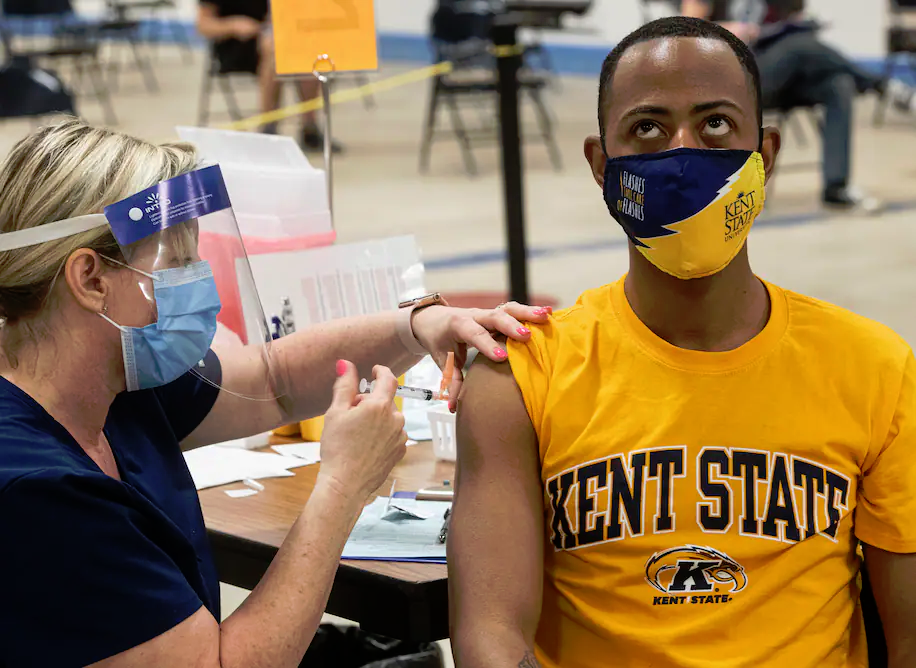
The safe way to increase the number of immune people, thereby probably protecting everyone by limiting the ability of the virus to spread, is through vaccination. More vaccinated people means fewer new infections and fewer infections needed to get close to herd immunity. The closer we get to herd immunity, the safer people are who can’t get vaccinated, such as young children (at least for now).
The challenge the world faces is that the rollout of vaccines has been slow, relatively speaking. The coronavirus vaccines were developed at a lightning pace, but many parts of the world are still waiting for supplies sufficient to broadly immunize their populations. In the United States, the challenge is different: About a quarter of adult Americans say they aren’t planning on getting vaccinated against the virus, according to Economist-YouGov polling released last week.
That’s problematic in part because it means we’re less likely to get to herd immunity without millions more Americans becoming infected. Again, it’s not clear how effective natural immunity will be over the long term as new variants of the virus emerge. So we might continue to see tens of thousands of new infections each day, keeping the population at risk broadly by delaying herd immunity and continuing to add to the pandemic’s death toll in this country.
But we also see from the Economist-YouGov poll the same thing we saw in Gallup polling earlier this month: The people who are least interested in being vaccinated are also the people who are least likely to be concerned about the virus and to take other steps aimed at preventing it from spreading.
In the Economist-YouGov poll, nearly three-quarters of those who say they don’t plan on being vaccinated when they’re eligible also say they’re not too or not at all worried about the virus.
That makes some perverse sense: If you don’t see the virus as a risk, you won’t see the need to get vaccinated. Unfortunately, it also means you’re going to be less likely to do things like wear a mask in public.
Or you might be more likely to view as unnecessary precautions such as avoiding close-quarter contact with friends and family or traveling out of state.
About a quarter of adults hold the view that they won’t be vaccinated when eligible. That’s equivalent to about 64 million Americans.
Who are they? As prior polls have shown, they’re disproportionately political conservatives. At the outset of the pandemic, there was concern that vaccine skepticism would heavily be centered in non-White populations. At the moment, though, the rate of skepticism among those who say they voted for Donald Trump in 2020 and among Republicans is substantially higher than skepticism overall.
That shows up in another way in the Economist poll. Respondents were asked whose medical advice they trusted. Among those who say they don’t plan to get the vaccine, half say they trust Trump’s advice a lot or somewhat — far more than the advice of the Centers for Disease Control and Prevention or the country’s top infectious-disease expert Anthony S. Fauci.
If we look only at Republican skeptics, the difference is much larger: Half of Republican skeptics say they have a lot of trust in Trump’s medical advice.
The irony, of course, is that Trump sees the vaccine as his positive legacy on the pandemic. He’s eager to seize credit for vaccine development and has — sporadically — advocated for Americans to get the vaccine. (He got it himself while still president, without advertising that fact.) It’s his supporters, though, who are most hostile to the idea.
Trump bears most of the responsibility for that, too. Over the course of 2020, worried about reelection, he undercut containment efforts and downplayed the danger of the virus. He undermined experts such as Fauci largely out of concern that continuing to limit economic activity would erode his main argument for his reelection. Over and over, he insisted that the virus was going away without the vaccine, that it was not terribly dangerous and that America should just go about its business as usual — and his supporters heard that message.
They’re still listening to it, as the Economist poll shows. One result may be that the United States doesn’t reach herd immunity through vaccinations and, instead, some large chunk of those tens of millions of skeptics end up being exposed to the virus. Some of them will die. Some may risk repeat infections from new variants against which a vaccine offers better protection. Some of those unable to get vaccinated may also become sick from the virus because we haven’t achieved herd immunity, suffering long-term complications from covid-19.
Trump wants his legacy to be the rollout of the vaccine. His legacy will also probably include fostering skepticism about the vaccine that limits its utility in containing the pandemic.
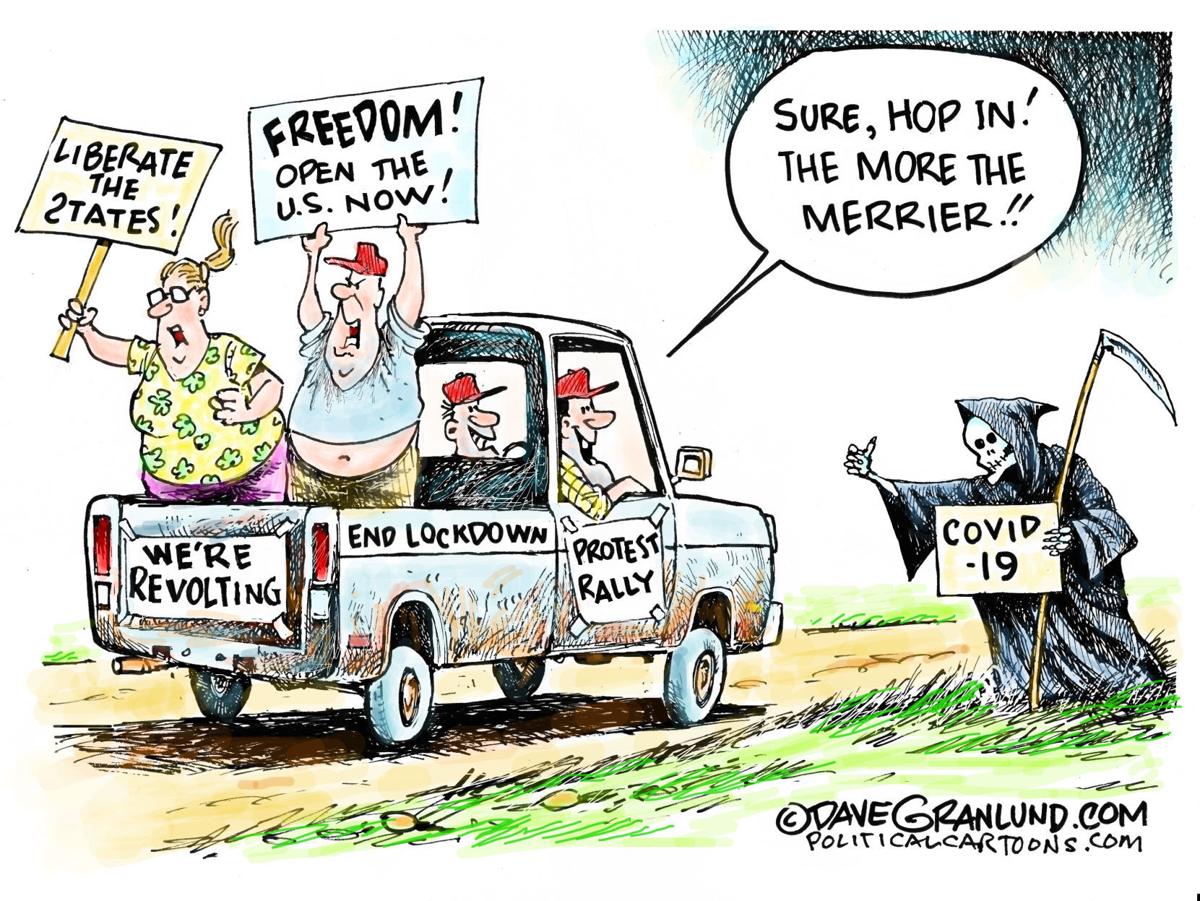
All the things that could prolong the COVID-19 pandemic — that could make this virus a part of our lives longer than anyone wants — are playing out right in front of our eyes.
Driving the news: The British variant is driving another surge in cases in Michigan, and Gov. Gretchen Whitmer has resisted reimposing any of the lockdown measures she embraced earlier in the pandemic.
Variants are beginning to infect more kids — “a brand new ball game,” as University of Minnesota epidemiologist Michael Osterholm recently put it.
New research confirms that our existing vaccines don’t work as well against the South African variant.
And some experts fear the pace of vaccinations in the U.S. is about to slow down.
Between the lines:The concern isn’t necessarily that the facts on the ground right now could end up being disastrous, but rather that we’re getting a preview of the longer, darker coronavirus future the U.S. may face without sufficient vaccinations.
If we don’t control the virus well enough, then even years into the future, we could be living through more new variants — some of which might be more deadly, some of which might be more resistant to vaccines, some of which might be more dangerous for certain specific populations.
That would translate into an ongoing risk of illness or potentially death for unvaccinated people and new races to reformulate vaccines as new variants keep emerging.
And it would lead to a world in which today’s vaccine-eager population would have to stay on top of those emerging risks, get booster shots when they’re available, and perhaps revive some of the pandemic’s social-distancing measures, in order to stay safe.
I got my first Pfizer vaccine in January. Is it too late to get the second injection now, more than two months later? What should I do?
The second dose of Pfizer-BioNTech’s vaccine should ideally be given three weeks after the first. (Moderna’s second dose is meant to be given four weeks after the first, while the Johnson & Johnson/Janssen shot is delivered in a single dose.) But, well, sometimes life gets in the way. So what happens if you don’t make it to that second appointment?
Schedule another one as soon as you can, says Dr. Adam Ratner, a pediatric infectious disease doctor at NYU Langone Health and a vaccine researcher.
While a three- or four-week gap between shots is ideal, the U.S. Centers for Disease Control and Prevention (CDC) saysyou can get your second shot within 42 days of the first one and still mount a full immune response. “Beyond that, we start to operate in an area where there’s simply less data,” Ratner says.
That doesn’t mean your second shot will be ineffective if it’s given more than six weeks after the first. It only means that studies have not specifically measured how much protection the two-dose vaccines offer when the shots are given more than 42 days apart. Still, the CDC says you don’t have to start over if you can’t get a second vaccine within 42 days. Countries including the U.K. are even purposely delaying second shots so they can get first doses out to more people, and some experts in the U.S. advocate for the same policy.
Ratner says if he were in your shoes, he wouldn’t worry too much. “I would say get the second dose now and consider yourself fully vaccinated,” he says. Just make sure you get a second dose of the same vaccine, since the CDC does not recommend mixing and matching with different shots.
It may be tempting to just stick with the one dose you’ve got—after all, one recent study showed that a single dose of the vaccine was about 80% effective at preventing COVID-19 infections, compared to 90% protection after two doses. But “it is somewhat of a tenuous 80%,” National Institute of Allergy and Infectious Diseases Director Dr. Anthony Fauci said at a recent press briefing. “When you leave it at one dose, the question is, ‘How long does it last?’”
To get the vaccine’s full benefits, and to make sure they last as long as possible, you’ll need a second shot.
Centers for Disease Control and Prevention (CDC) Director Rochelle Walensky finds herself in a delicate position as she seeks to balance the optimism of increasing vaccinations with the reality that the U.S. is still very much in the grip of a deadly pandemic.
Walensky started the CDC job with a reputation as a savvy communicator, tasked with salvaging the reputation of an agency that took a beating under the Trump administration.
“When I first started at CDC about two months ago, I made a promise to you: I would tell you the truth, even if it was not the news we wanted to hear,” Walensky told reporters recently.
Walensky’s expertise is in HIV research, like her predecessor Robert Redfield, and before being appointed to lead the CDC, she was head of infectious diseases at Massachusetts General Hospital.
While former colleagues say Walensky is the perfect fit for the CDC post, her skills are now being put to the test as she faces criticism for being both too negative and too hopeful.
“She is quite a compelling and clear communicator, but it’s a challenging set of messages to try and get out there,” said Chris Beyrer, a professor of epidemiology at Johns Hopkins Bloomberg School of Public Health.
Public health messaging during a global pandemic is complicated enough, but experts say this particular moment is especially difficult.
After weeks of decline and then stagnation, the rate of coronavirus infections has once again started to climb across much of the country. Cases are up about 12 percent nationally compared with the previous week, averaging around 62,000 cases per day, according to the CDC.
At the same time, nearly 100 million Americans have received at least one dose of a coronavirus vaccine. Many states are expanding vaccine eligibility, in some instances to all adults, and federal health officials say there will be enough supply for everyone to be vaccinated by the end of May.
Walensky tried to emphasize both aspects this week when she issued an emotional appeal to the public.
“We have so much to look forward to, so much promise and potential of where we are, and so much reason for hope. But right now I’m scared,” Walensky said, adding that she had a “sense of impending doom” if people continued to ignore public health precautions.
Yet almost in the next breath, she talked about a “tremendously encouraging” new study showing that vaccinated people were 90 percent protected from infection, meaning they pose an extremely low risk of spreading the virus.
While that may come across as mixed messaging, experts say it accurately reflects not only where things stand right now but also how the country has been reacting to the virus for the past year.
“Whiplash is a true reflection of how we’re all experiencing the epidemic and the response to it. So I’d rather she be honest about that and others be honest about that than give people something that they want … to make them feel better,” said Judith Auerbach, a professor in the University of California San Francisco School of Medicine.
Auerbach, who previously worked with Walensky on HIV research, praised the director’s openness, which she said had been missing from agency leadership during the Trump administration.
“She’s being really honest about her own emotions. That’s hard for a fed to do and get away with,” Auerbach said. “The science that says we all still need to be, in fact, quite scared because we’re in this race between the vaccines … versus the emergence of these variants, and she felt it at a visceral level, and she conveyed that in a way that I thought was quite telling.”
Glen Nowak, director of the Center for Health and Risk Communication at the University of Georgia and a former CDC media relations director, said Walensky’s candor helps establish credibility.
“She has embraced the fact that credibility comes from being transparent and honest and genuine about your fears and your concerns,” Nowak said.
The CDC declined to make Walensky available for an interview, but in a statement to The Hill, an agency spokesman said every communication reflects the latest science and epidemiology.
“At times, moments must balance hope that we will move out of the pandemic with the reality that we are not out of it yet,” the spokesman said.
“We acknowledge the challenge of conveying such hope and promise that vaccines offer with the reality that cases and deaths are rising. While we are sending the critical message that people cannot and should not let up on their prevention measures, we do remain very optimistic about what the future of a fully vaccinated public will offer,” the spokesman added.
On Friday, Walensky again came under criticism for her messaging. In updated guidance, the CDC said it is safe for people who have been fully vaccinated to travel.
But Walensky struck a cautionary tone by saying the CDC still recommends anyone, vaccinated or not, avoid nonessential travel because infection numbers are so high.
“We know that right now we have a surging number of cases,” Walensky said during a White House briefing. “I would advocate against general travel overall. Our guidance is silent on recommending or not recommending fully vaccinated people travel. Our guidance speaks to the safety of doing so.”
Nowak said part of what makes public health messaging so difficult is the fact that science doesn’t always deal in absolutes and that the public overall doesn’t do well with nuance.
“Often people don’t want to listen to the nuance; they want advice and guidance to be stable. They get frustrated with the changes or when it seems to be contradictory. They also get frustrated if it doesn’t match their everyday living experiences,” Nowak said.
With the travel guidance, Walensky attempted to spell out the balance she was trying to strike and asked the public for patience and understanding.
“I want to acknowledge today that providing guidance in the midst of a changing pandemic and its changing science is complex,” Walensky said.
“The science shows us that getting fully vaccinated allows you to do more things safely, and it’s important for us to provide that guidance, even in the context of rising cases.At the same time, we must balance the science with the fact that most Americans are not yet fully vaccinated, which is likely contributing to our rising cases,” she said.
Jen Kates, director for global health and HIV policy at the Kaiser Family Foundation, who has known Walensky for decades, said she thinks the CDC director is aware that she can’t escape criticism, especially when so many people have pandemic fatigue.
If the CDC is too strict and refuses to endorse relatively normal behavior, especially after people get vaccinated, it could risk others refusing to get the shot, Kates said.
But if the agency paints too rosy a picture, more people could act like the pandemic is over and risk further spread of the virus.
“It behooves public officials to always be cognizant that their words are being listened to and can be taken out of context or may be hard for people to grasp,” Kates said. “So I think Dr. Walensky is a great communicator, but that doesn’t mean that this is always easy to do and the balance is always straightforward.”







 HENRY KOTULA