

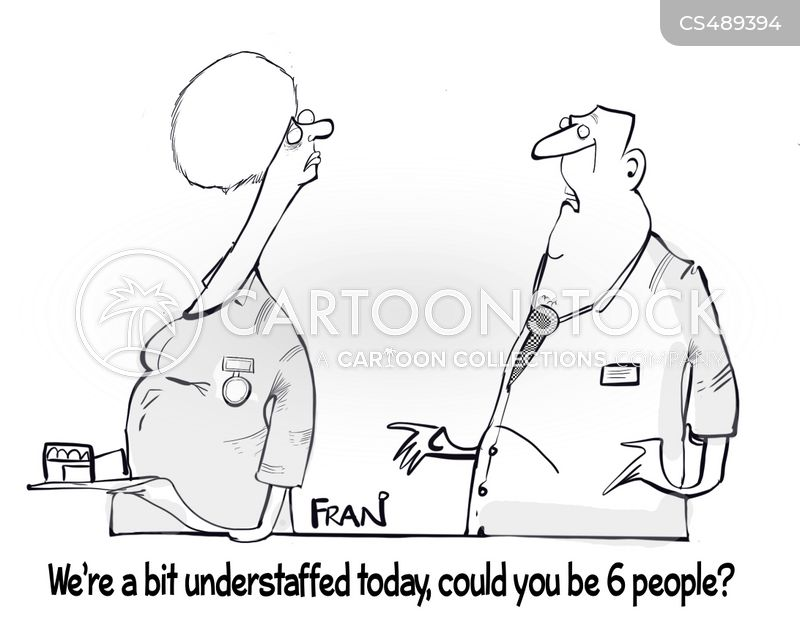
Cartoon – A Bit Understaffed Today
Citi, The American Hospital Association (AHA) and the Healthcare Financial Management Association (HFMA) recently hosted the 22nd annual Not-for-Profit Healthcare Investor Conference. The event was in person, after being virtual in 2021 and canceled in 2020 due to the pandemic. Leaders from over 25 diverse health systems, as well as private equity and fund managers, presented in panel discussions and traditional formats. The following summary attempts to synthesize key themes and particularly interesting work by leading health systems. The conference title was “Refining the Now, Reshaping What’s Next.”
Clearly the pandemic showed how essential and adaptive the US healthcare industry is, and especially how incredible healthcare workers continue to be. It also exposed and accelerated many underlying dynamics, such as impact of disparities, clinical labor shortages and supply chain challenges. On balance, at this year’s conference presenters remained quite optimistic about the future, and felt that despite enormous pain, the pandemic has helped to accelerate positive transformation across healthcare.
At the same time, almost all presenters referenced future headwinds from labor and supply inflation, concerns about increasing payment pressures, and the continued need to address disparities and social justice. That being said, there was not much disclosure at the conference about just how bad things could get in the future given accelerated operational and financial risks.
As usual at such a conference, there was much passion, creativity, sharing and celebration. While each organization and market differ somewhat, the following are common themes discussed.
Enormous Workforce Challenges – Every speaker referenced workforce as being THE key issue they are facing, specifically retirement, recruitment, retention, well-being and cost. We have talked for years about a future caregiver shortage, but this reality was accelerated by the pandemic. The majority of health systems saw single-digit turnover rates grow to 20-30%, and the cost of temporary labor such as traveling nurses, decimate operating margins. The many strategies discussed at the conference went beyond simply paying more to attract and retain staff. A key question is whether organization-specific strategies will be enough, or whether we need a broader societal and industry-wide collaborative effort to dramatically increase training slots for nurses and other allied health professionals.
Pandemic Stressed Organizations and Accelerated Transformation – At the 2021 virtual Citi/AHA/HFMA conference, many posited that the country was past the worst of the pandemic. (In fact this author’s summary of last year’s conference was titled “Sunrise After the Storm”). That was before the Omicron wave hit hard in Q1 2022. First-quarter 2022 operating margins were negative for most but not all healthcare systems due to cumulative impact of Omicron, temporary labor and supply costs, especially since the governmental support that partially offset those costs in 2020 ended. Organizations and their teams remain resilient, but highly stressed. Risks and challenges associated with future waves continue, as well as high reliance on foreign drug and supply manufacturing. While highly distracting and painful, many organizations discussed how the pandemic actually accelerated the pace of transformation. Necessity drives required action, and at least temporarily overcomes political and cultural barriers to change.
Growing Pursuit of Scale, Including through M&A and Partnerships – All health systems continue to be highly complex with multiple competing “big-dot” priorities. Multiple systems described their current M&A and growth strategies, pursuit of scale, as well as how these strategies were impacted by the pandemic. While the provider community remains highly unconsolidated on a national basis, mergers are more frequent, including between non-contiguous markets. Systems said that larger size, coupled with disciplined management, can reduce cost structure and improve quality and patient experience. While some pursue scale through organic growth initiatives or M&A, others described success in creating scale by leveraging partnerships with “best-in-class” niche organizations and other outside expertise.
Health Equity, Diversity and ESG as Core to Mission – Consistent with last year, most speakers discussed their efforts to address health equity, social justice, diversity, and Social Determinants of Health. Many health systems have developed robust strategies quickly as the pandemic spotlighted the impact of existing disparities. There is increasing interest in Environment, Social and Governance (ESG) initiatives, including environmental stewardship to improve the health of their communities and the world by reducing their carbon footprint and medical waste.
Patient-Centric Care Transformation Continues as a Priority – The pandemic significantly accelerated the shift to telehealth and virtual care. Many health systems are increasing their efforts to design care around the patient instead of the traditional provider centric focus. While the need for inpatient care will always continue, more care is taking place in settings closer to or at home, with digital enablement. Expansion of personalized medicine, genetic testing and therapies, and drug discovery are transforming how healthcare is provided.
Affordability and Value-Based Care – US healthcare costs as a percentage of GDP increased from 18% in 2019 to almost 20% in 2020, mainly driven by the pandemic. There remains a dichotomy between reliance on fee-for-service payment and commitment to value-based care. Although only 11% of commercial payment is currently through two-sided risk arrangements, almost all presenting health systems discussed their strategies to continue moving to value-based care and to improve affordability. Some systems are leveraging their integrated health plans and/or expanding risk-based contracts. Many are trying to reduce unnecessary care through adoption of evidence-based models and to shift care to less costly settings.
Inflation and Accelerating Financial Pressures – Health systems are facing unprecedented increases in labor and supply costs, that are likely to continue into the foreseeable future. At the same time, commercial payment rate adjustments are “sticky low” as insurers and employers push back on rate increases. Governmental payment rate increases are less than cost inflation. In addition to current cuts like the re-implementation of sequestration, longer-term cuts to provider assessment programs, provider-based billing, disproportionate share and Medicaid expansion may severely impact many organizations over time. Benefits like 340b discounts are also experiencing pressure. Post-pandemic clinical-volume trends remain unclear, and additional governmental support associated with future pandemic waves is unlikely. Adding to these challenges, declines in stock and bond prices are negatively impacting currently strong balance sheets.
Time will tell, in retrospect, if the next five years will be the best of times, worst of times, or both in healthcare. Optimists point to the resiliency of healthcare organizations; enormous opportunity to reduce unnecessary cost through adoption of evidence-based care and scale; pipeline of new cures and technology; and opportunities to address social and health equity. Pessimists point to likely unprecedented financial pressures and operational challenges due to endemic labor and supply shortages; high-cost inflation vs. constrained payment rates; and future uncertainty about the pandemic, the economy and investment markets.
The situation will undoubtedly vary by market and organization as reflected in conference presentations, but all systems will likely face substantial pressure. As one speaker noted “humans have a great ability to respond to pain,” so this may be the inflection point where more healthcare systems radically accelerate necessary change to improve health, make healthcare more equitable and affordable, with higher quality and better outcomes. Some health systems are clearly doing that, with pace, nimbleness and passion. Can the industry as a whole accomplish it successfully?


Boston-based Mass General Brigham submitted a cost-reduction plan to Massachusetts regulators May 16, which includes a promise to cut healthcare spending by $70 million a year.
The health system was ordered by the Massachusetts Health Policy Commission in January to develop a plan to reduce costs after the watchdog determined it had pushed healthcare spending above acceptable levels in the last few years. Specifically, the commission found that Mass General Brigham had substantially higher-than-average commercial spending from 2014 to 2019. The health system spent $293 million those years, more than any other provider in the state.
To achieve its spending reduction goal, Mass General Brigham said it would focus on four items: cutting prices, reducing utilization, shifting care to lower-cost sites and expanding value-based care.
A key savings driver in Mass General Brigham’s plan is to lower outpatient and ConnectorCare rates to improve affordability. ConnectorCare is a program of subsidized private health insurance plans for patients whose family income doesn’t exceed 300 percent of the federal poverty level and who are not eligible for MassHealth, Medicare or other affordable health coverage. The health system expects to save about $53.8 million in spending a year through reducing these rates.
“Mass General Brigham is committed to expanding access to consumers, particularly in ambulatory care. To achieve improved access, we are focused on decreasing the price variation between Mass General Brigham pricing and the marketplace,” Mass General Brigham said in the performance improvement plan.
The health system said it expects to save $10.8 million in spending a year by reducing unnecessary hospitalizations, emergency room visits and post-acute care and reducing use of high-cost outpatient imaging.
The health system said it expects to save $5.3 million in spending a year by shifting care to lower-cost settings, such as moving to “hospital at home,” expanding telehealth or using other ambulatory sites.
In addition to reducing utilization, shifting care to lower-cost sites and reducing price, Mass General Brigham said it is committed to expanding value-based care.





Several hospitals are trimming their workforces due to financial and operational challenges, and some are offering affected workers new positions.
1. MetroWest Medical Center in Framingham, Mass., eliminated live interpretation services in April and laid off an undisclosed number of employees, the MetroWest Daily News reported. Hospital leaders said a “minimal number of positions” were eliminated when the hospital ended the services. Workers affected by the layoffs can apply for open positions at the hospital, according to the Daily News.
2. Watsonville (Calif.) Community Hospital is preparing to lay off 658 workers, according to a notice filed with the state and shared with Becker’s Hospital Review. The hospital, which filed for Chapter 11 bankruptcy in December, expects the layoffs to occur between May 16 and May 23. Healthcare group Pajaro Valley Health Care District was approved by a bankruptcy judge to purchase the hospital in February after no other qualified bids were submitted. The group needs to gather at least $20 million by July to purchase the hospital, Santa Cruz Sentinel reported April 4.
3. Memorial Hospital at Gulfport (Miss.) laid off its chief medical officer and vice president of system development in April. Regarding the layoffs, Memorial Hospital at Gulfport CEO Kent Nicaud said the hospital is facing financial challenges, such as increased labor costs, and is aiming to return to an organizational structure it had three or four years ago.
4. Toledo, Ohio-based ProMedica’s health plan, Paramount, is laying off about 200 employees in July after losing a Medicaid contract. Anthem acquired Paramount’s Medicaid contract, and ProMedica and Anthem have been working to identify open roles for employees affected by the layoffs.
5. MarinHealth Medical Center laid off 104 revenue cycle and supply chain employees in April after entering into a contract with Optum to provide those services, according to a notice filed with state regulators in February. Greenbrae, Calif.-based MarinHealth said that as a result of the contract with Optum, all non-contractual revenue cycle and supply chain employees were terminated from employment with the hospital on April 9. Optum offered jobs to most workers affected by the layoffs. Employees who accepted an offer began employment with Optum on the first work day following separation from MarinHealth, a spokesperson for the hospital told Becker’s Hospital Review.
6. St. Mary’s Medical Center in West Palm Beach, Fla., laid off 49 employees, including 21 registered nurses, when it stopped providing mental health services in April, according to a notice filed with state regulators.
7. NYC Test & Trace Corps, the city’s initiative for COVID-19 testing and contact tracing, ended universal contact tracing in April. NYC Health + Hospitals, which led the program in collaboration with the city’s department of health and other agencies, is planning to lay off 874 workers as a result of the program scaling back, according to a notice filed with state regulators March 4. The health system said affected temporary employees would be laid off at the end of April. Managerial employees affected by the layoffs will have their employment terminated between May 13 and May 27, according to the notice.
 HENRY KOTULA