4 health systems retaining talent with perks beyond pay

As hospitals and health systems continue to grapple with staffing shortages, employers are using perks beyond pay to recruit and retain talent. 

Incentives beyond the norm are attractive to employees: They prove the employer values them personally, beyond their work performance. 

These four health systems offer perks beyond pay, like extra paid time off, well-being coaches, adoption assistance and local discounts. 

Food, entertainment and staycations

Nashville, Tenn.-based Vanderbilt Health said it will launch a new employee awards program in September that offers workers perks, discounts and a grand prize “staycation.”

The month-long Work Perks program will feature a website where employees can play games to earn perks in music and entertainment, health and wellness, dining and Nashville-area attractions, according to an Aug. 29 news release shared with Becker’s.  

Workers will also be able to enter a drawing for a staycation. Five employees will win grand prizes including a one-night stay at a downtown hotel, passes to Nashville attractions, dinner at a local restaurant and a gift basket with items from Nashville businesses, including a winery and chocolate company, Vanderbilt Health said.

“We’re excited to show appreciation for our dedicated workforce in this way, and we’re grateful to so many generous partners to help make it happen,” Amy Schoeny, PhD, chief human resources officer, said in a release. “This is just one of the many benefits and perks that we offer to those who choose to pursue careers in making healthcare personal for our patients today and in the future.”

Work Perks will launch Sept. 5.

“We Hours” program

Marlton, N.J.-based Virtua Health told Becker’s it has instituted a “We Hours” program “to give employees more time to do the things that are important to them — from self-care to community service.”

The program offers eight additional hours of scheduled, paid time off per year for most of Virtua’s 13,000 employees. 

“The ultimate goal is to encourage mindfulness and a healthy work-life balance,” Rhonda Jordan, Virtua’s executive vice president and chief human resources officer, told Becker’s. “We Hours are intended for colleagues to pursue something rewarding or fulfilling, such as volunteering, recognizing a religious or cultural event, or ‘recharging their battery’ with extra time away.”

Ms. Jordan said Virtua workers may also use the program for practical matters, such as a physician’s visit or attending to household repairs.

The program name stems from Virtua’s “Culture of We,” a set of guiding principles that include continuous learning and innovation, open communication and inclusive teamwork, among others. 

A colleague committee developed the tenets in 2019, and employees are encouraged to share how they spend their We Hours in a private Facebook group, according to Ms. Jordan. She cited examples including photos from a visit to a botanical garden, a description of volunteer work helping nonprofit organizations, and a photo of the day one worker spent with her son, who’d been away serving in the U.S. Marine Corps.

“One of my favorite outcomes of the We Hours is that they invite us to learn more about our colleagues and the people, causes and activities that are most important to them,” Ms. Jordan adds.

Walking trails and well-being coaching 

Charlotte, N.C.-based Atrium Health encourages all-around health through their LiveWell programs. 

“[LiveWell] exists to support teammates in working meaningfully, eating healthfully, learning continuously and living fully … living their best lives so that we can deliver on the mission of Atrium Health,” Scott Laws, vice president of enterprise total rewards at Atrium Health, told Becker’s. 

Physical health is encouraged through perks like discounted gym enrollment, tobacco cessation programs and on-site walking trails at Atrium Health facilities. Financial assistance is provided through free webinars and individual medication management consultations. One-on-one well-being coaches encourage employees to consider personal health.

Those that take advantage of the LiveWell resources are rewarded. 

“By completing certain physical, personal and financial well-being goals — which include participation in wellness exams and programs or financial education — teammates are eligible for financial incentives, paid into their HSAs,” Mr. Laws said. 

Adoption assistance

Springfield, Ill.-based Hospital Sisters Health System offers adoption assistance as part of its benefits package.

“HSHS provides financial support up to $7,500 per child for eligible adoption expenses to qualified colleagues,” Catie Sheehan, vice president of advocacy and communications at Hospital Sisters, told Becker’s

Alicia Corman, an occupational therapist in the health system, was first to receive the benefit. After the adoption decree was signed, the human resources department helped her submit a breakdown of what the financial support would cover, Ms. Corman said in a video shared with Becker’s. The funds she received aided Ms. Corman and her husband in adopting their son. 

“I’m very grateful because if you look across the U.S., adoption is not very supported in a workplace,” Ms. Corman said.

Amid competitive US labor market, employers are ramping up health benefits, survey finds 

As employers plan for 2023, attracting and retaining talent is top of mind amid a competitive U.S. labor market. That’s led to over two-thirds of companies planning to enhance employee health and benefit offerings next year, according to survey results from Mercer published July 6.

The survey was conducted April 26 to May 13. In total, 708 organizations participated, from all industries and of all sizes ranging from fewer than 500 employees to more than 5,000.

Nine things to know:

  1. Among large employers, 70 percent are planning to enhance health and benefit offerings in 2023.
  2. Among all employers, 61 percent are conducting surveys on employee benefit preferences.
  3. Among large employers, 41 percent currently provide a plan option with a low deductible or none at all, and 11 percent are considering it. 
  4. Over half of employees say no remote or hybrid work is a deal breaker when considering to join or stay with an organization. Among all employers, 78 percent now allow employees to work from home regularly, compared to 26 percent in 2021.
  5. Among large employers, 52 percent will offer virtual behavioral healthcare in 2023, and 40 percent will offer a virtual primary care physician network or service.
  6. Though 64 percent of employers are not prioritizing a single employee group for benefit enhancements, 35 percent say they are focusing on hourly and low-wage employees.
  7. Nearly one-third of employers will offer benefits such as fertility treatment coverage and adoption and surrogacy benefits by 2023, and almost another third are considering it.
  8. Among all employers, 70 percent currently offer or plan to offer paid parental leave in 2023.
  9. Among all employers, 75 percent offer or plan to offer tuition reimbursement in 2023.

Hospitals face increasing competition for lower-wage workers 

https://mailchi.mp/8e26a23da845/the-weekly-gist-june-17th-2022?e=d1e747d2d8

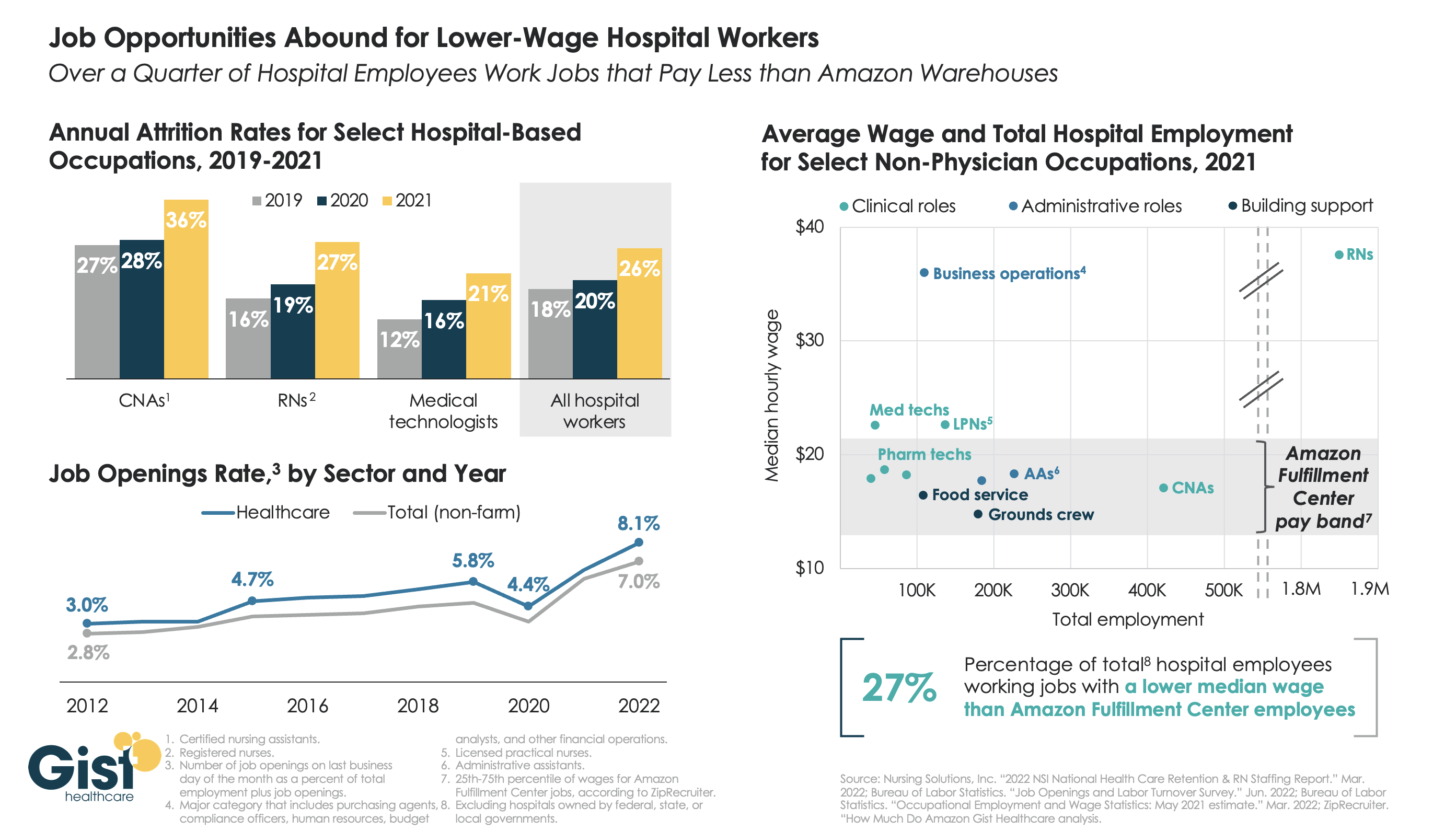
Although the nursing shortage has attracted much attention in recent months, the healthcare workforce crisis is hitting at all levels of the labor force. As the graphic above shows, the attrition rate for all hospital workers in 2021 was eight percentage points higher than in 2019. 

Among clinicians and allied health professionals, certified nursing assistants (CNAs) have the highest turnover levels. Given the demands of the job and relatively low pay, CNA openings have been consistently difficult to fill. But it’s become even harder to hire for the role in today’s labor market as job openings near an all-time high. 

Although labor force participation rates have rebounded to 2019 levels, pandemic-induced economic shifts have led to a boom in lower-wage jobs. In 2021 alone, Amazon opened over 250 new fulfillment centers and other delivery-related work sites. The company is competing directly with hospitals and nursing facilities for the same pool of workers at many of these new sites.

In fact, our analysis shows that more than a quarter of hospital employees currently work in jobs with a lower median wage than Amazon warehouses. Health systems have historically relied on rich benefits packages and strong career ladder opportunities to attract lower-wage employees, but that’s no longer enough—Amazon and other companies have ramped up their benefits, such that they now meet, or even surpass, what many hospitals are providing. 

The time has come for health systems to reevaluate their position in local labor markets, and better define and promote their employee value proposition. 

The 18 health systems Walmart sends its employees to for care in 2022

In an effort to rein in healthcare costs for its employees, Walmart sends them directly to health systems that demonstrate high-quality care outcomes, otherwise known as Centers of Excellence.

Through the COE program, Walmart will cover the travel and treatment costs for employees seeking a range of services, but only with providers the company is contracted with. Walmart then reimburses with bundled payments negotiated with the providers.

To determine which providers get access to its 1.6 million employees, Walmart starts by examining health systems. Lisa Woods, vice president of physical and emotional well-being at Walmart, and her team analyze public data, distribute requests for information and conduct detailed on-site visits.

Below are the 18 health systems or campuses to which Walmart will refer patients for defined episodes of care in 2022. (See how COE participants have evolved since 2019 or 2021.)

Cardiac

Cleveland Clinic 

Geisinger Medical Center (Danville, Pa.)

Virginia Mason Medical Center (Seattle)

Weight loss surgery

Emory University Hospital (Atlanta)

Geisinger Medical Center (Danville, Pa.)

Intermountain Healthcare (Salt Lake City)

Northeast Baptist Hospital (San Antonio)

Northwest Medical Center (Springdale, Ark.)

Ochsner Medical Center (New Orleans)

Scripps Mercy Hospital (San Diego)

University Hospital (Cleveland)

Spine surgery

Emory University Hospital (Atlanta)

Geisinger Medical Center (Danville, Pa.)

Carolina NeuroSurgery & Spine Associates (Charlotte, N.C.)

Mercy Hospital Springfield (Mo.)

Mayo Clinic Arizona (Phoenix)

Mayo Clinic Florida (Jacksonville)

Mayo Clinic Minnesota (Rochester)

Memorial Hermann-Texas Medical Center (Houston)

Ochsner Medical Center (New Orleans)

Virginia Mason Medical Center (Seattle)

Breast, lung, colorectal, prostate

or blood cancer

Mayo Clinic Arizona (Phoenix)

Mayo Clinic Florida (Jacksonville)

Mayo Clinic Minnesota (Rochester)

Hip and knee replacements

Emory University Hospital (Atlanta)

Geisinger Medical Center (Danville, Pa.)

Johns Hopkins Bayview Medical Center (Baltimore)

Kaiser Permanente Irvine (Calif.) Medical Center

Mayo Clinic Florida (Jacksonville)

Mayo Clinic Minnesota (Rochester)

Mercy Hospital Springfield (Mo.)

Northeast Baptist Hospital (San Antonio)

Ochsner Medical Center (New Orleans)

Scripps Mercy Hospital (San Diego)

University Hospital (Cleveland)

Virginia Mason Medical Center (Seattle)

Organ and tissue transplants

(except cornea and intestinal)

Mayo Clinic Arizona (Phoenix)

Mayo Clinic Florida (Jacksonville)

Mayo Clinic Minnesota (Rochester)

Searching for value in a sea of health apps

The explosion of apps, wearables, and other health tech solutions targeted at employers has overwhelmed and frustrated many HR executives who make decisions about employee health benefits. At a recent convening of health insurance brokers we participated in, several bemoaned the challenge of helping their clients understand which solutions might bring real value.

One shared, “For the past few years, it’s felt like ‘App-apalooza’ out there. CHROs [chief human resource officers] get pitches for new apps every day…there are literally thousands out there saying they’ll reduce costs and improve employee health, but it’s next to impossible to tell which ones of them actually work.”

Brokers expressed surprise at how little evidence, or in some cases, actual patient and client experience, some health tech companies brought to the table: “We have startups coming to our clients talking about their millions of dollars in funding, but when you dig into what they’re actually doing, not only can they not show outcomes data, you find out they’ve only worked with a few dozen patients!”

But among the sea of apps purporting to manage any and every employee health need, from chronic disease to fertility to sleep quality, brokers reported their clients were finding value in a few distinct areas. 

Technology-based mental health solutions received high marks for increasing access to care, with the prediction that “tele-behavioral health could become a standard part of most benefits packages very quickly”.

More surprisingly, employers shared positive feedback on the impact of virtual physical therapy solutions: “I was skeptical that it would work, but people like being able to rehab at home. And not only is it cheaper, we’re seeing higher adherence rates.”

But even the best apps are often challenged by a lack of connectivity to the rest of a patient’s healthcare. The technologies that will have the greatest staying power will be those that not only deliver results, but are able to move beyond point solutions to become part of an integrated care experience, meaningfully connected to other providers involved in a patient’s care.

Physician residents and fellows unionize at two major California health systems

Seeking stronger workplace protections, physician residents and fellows at both Stanford Health Care and the University of Southern California’s (USC) Keck School of Medicine have voted to join the Committee of Interns and Residents, a chapter of the Service Employees International Union (SEIU).

Despite being frontline healthcare workers, most Stanford residents were excluded from the first round of the health system’s COVID vaccine rollout in December 2020. The system ultimately revised its plan to include residents, but the delay damaged Stanford’s relationship with residents, adding momentum to the unionization movement. Meanwhile, Keck’s residents unanimously voted in favor of joining the union, aiming for higher compensation and greater workplace representation.

The Gist: While nurses and other healthcare workers in California, as in many other parts of the country, have been increasingly banding together for higher pay and better working conditions, physician residents and fellows contemplating unionization is a newer trend. 

Physicians-in-training have historically accepted long work hours and low pay as a rite of passage, and have shied away from organizing. But pandemic working conditions, the growing trend of physician employment, and generational shifts in the physician workforce have changed the profession in a multitude of ways. 

Health systems and training programs must actively engage in understanding and supporting the needs of younger doctors, who will soon comprise a majority of the physician workforce.

Businesses face major benefits questions amid Roe uncertainty

Corporate America is facing a flurry of questions about how it provides health benefits in the wake of a leaked U.S. Supreme Court draft that indicates the federal right to abortion could be overturned.

Why it matters: Businesses hoping to use reproductive health benefits as part of efforts to recruit and retain employees would have to be careful not to run afoul of laws should states be allowed to ban abortions.

  • The balancing act over the next several months could get messy, experts warn.

What they’re saying: “It’s a serious issue for employers,” said Candice Sherman, the CEO of the Northeast Business Group on Health. The group represents roughly 80 large companies such as American Express, Colgate, Moderna and Pfizer.

  • Limits on abortion coverage have the potential to impact the physical and mental health of the workforce and could come as many employers are addressing equity and inclusion for women, people of color and LGBTQ employees, Sherman said.
  • That is often communicated by companies through benefit design.

State of play: Some large companies like Amazon, Apple and Lyft have already announced plans to provide workarounds in those states with abortion restrictions.

  • But many others are still on the sidelines as they tease out employees’ priorities on abortion-related benefits, as well as the potential costs and legal risks.
  • Eleven states restrict insurance coverage of abortion in all private insurance plans written in the state, including those offered through Affordable Care Act markets, according to the Guttmacher Institute. Six other states require abortion coverage in private health insurance plans.

Zoom in: One of the most immediate questions is what kind of employer-sponsored abortion coverage — as well as enhanced benefits like travel stipends — might create legal liabilities for companies in states that ban abortion.

  • “There’s a question as to whether providing transportation benefits could be construed, or at least alleged by the states in enforcement, as aiding and abetting,” said Garrett Hohimer, director of policy and advocacy for the Business Group on Health. That group counts corporations like The Walt Disney Co., Walmart and General Motors among its members.
  • Companies like Citigroup that pay for out-of-state abortions have already been threatened with the loss of business.

Yes, but: In the case of a challenge, companies would have a strong argument that federal protections for providing abortion care benefits preempt state laws, Emily Dickens, the head of government affairs for the Society for Human Resource Management, told Axios.

  • Dickens pointed specifically to the Pregnancy Discrimination Act which specifically says an employer is permitted to provide health insurance coverage for abortion, as well as protections under ERISA law.

But, but, but: It’s not a sure thing. For instance: “ERISA is not a get out of jail free card,” Hohimer warned, saying there is some question about how the law would be interpreted.

  • While experts largely believe the Affordable Care Act would provide protections for birth control coverage, it’s unclear how fertility benefits such as egg freezing, surrogacy or in vitro fertilization might be affected, Sherman said.

What to watch: Many large companies already offer health benefits allowing workers to travel to Centers of Excellence for procedures like joint replacements or cancer care.

  • Those kinds of benefits will likely gain more attention because of the attention surrounding reproductive health, Hohimer said.
  • Sherman said this may also raise questions about whether there’s flexibility in the tax code to expand the scope of Flexible Spending Accounts or Health Savings Accounts to cover travel for any health care issues.

The bottom line: “Assuming this discussion comes down the way we think it may, organizations are going to have to work very hard,” Sherman said.

Stanford, nurses reach tentative labor deal

Stanford and Lucile Packard Children’s hospitals in Palo Alto, Calif., and the Committee for Recognition of Nursing Achievement reached a tentative agreement on a three-year contract for about 5,000 nurses represented by the union, according to hospital and union statements.

The sides reached the agreement April 29, the fifth day of a strike, and union members approved it May 1. 

“After extensive discussions, we were able to reach consensus on a contract that reflects our shared priorities and enhances existing benefits supporting our nurses’ health, well-being and ongoing professional development,” Stanford said in its latest negotiations update.

With the new agreement, striking nurses will return to work May 3. 

Meanwhile, in a news release shared with Becker’s, the union highlighted parts of the agreement, including improvements it said “ensure high patient acuity is reflected in staffing.”  

The agreement also includes a combined 7 percent base wage increase in 2022 (a 5 percent increase followed by a 2 percent increase) for nurses, 5 percent in 2023 and 5 percent in 2024, as well as funds specifically for mental healthcare of workers, according to the union.

As part of the labor deal, the hospitals also agreed to continue medical benefits for striking nurses without disruption, the union said.

“From day one of our contract negotiations, CRONA nurses have been unified in our goals of improving staffing and making our profession more sustainable,” Colleen Borges, president of CRONA and pediatric oncology nurse at Packard hospital, said in the release. “We stood strong behind our demands for fair contracts that give us the resources and support we need to take care of ourselves, our families and our patients. We are proud to provide world-class patient care — and are glad the hospitals have finally listened to us.”

Dale Beatty, DNP, RN, chief nurse executive and vice president of patient care services for Stanford Health Care, and Jesus Cepero, PhD, RN, senior vice president of patient care and chief nursing officer for Stanford Children’s Health, acknowledged on the Stanford negotiations page that reaching an agreement has been challenging.

Now “we can all take pride in this agreement. And we are proud of our team for maintaining continuity of care for our patients,” they said.

More information on negotiations is available here and here.