Cartoon – Acme Health Insurance

Image result for cartoon inadequate health insurance coverage

Health care is Iowa’s only winner right now

https://www.axios.com/newsletters/axios-vitals-ded63eb6-2431-48d0-a186-2f3b52417f2f.html?utm_source=newsletter&utm_medium=email&utm_campaign=newsletter_axiosvitals&stream=top

Image result for health policy"

Iowa Democrats reported last night that their biggest priorities were beating President Trump and health care — but the meltdown of their election reporting systems left their presidential choices unresolved.

Why it matters: We’ve been writing for months that Democrats have a major choice ahead, either picking an advocate of Medicare for All — and siding with the plan that’s less popular with the rest of the country — or a public option advocate.

  • The Iowa debacle means the path the party will take won’t be clear for a while longer.

By the numbers: Several polls — including ones by NBC News, the National Exit Poll and AP Votecast — found that around four in 10 caucus voters said health care was their top issue.

  • Previous polling has found that Medicare for All is less popular overall than a public option, but both were popular among Democratic caucus-goers last night.
  • Seven in 10 said they back a single-payer plan, and almost nine in 10 said they support a public option, per AP Votecast, which was conducted by NORC at the University of Chicago for The Associated Press and Fox News.

Yes, but: Caucus-goers said they prefer a Democratic candidate who can beat Trump over one that agrees with them on issues, CNN reports.

The big picture: Republicans are more than happy to talk about Medicare for All — and its subsequent tax increases and expanded government role in health care — instead of protecting and building on the Affordable Care Act.

  • Whereas the former gives them an opportunity to go on offense, the latter puts the GOP on defense against its 2017 repeal-and-replace efforts and ongoing lawsuit that would strike down the whole health care law, including its protections for pre-existing conditions.


Supreme Court denies blue states’ effort to expedite ObamaCare challenge

Supreme Court denies blue states’ effort to expedite ObamaCare challenge

Supreme Court denies blue states' effort to expedite ObamaCare challenge

The Supreme Court on Tuesday rejected an effort by Democrats to expedite a challenge to a lower court’s ruling striking down a key tenet of ObamaCare, narrowing the possibility that the court takes up the contentious case this year.

The House of Representatives and a group of blue states had asked the court to fast-track their appeal after the 5th Circuit Court of Appeals ruled that the Affordable Care Act’s individual mandate is unconstitutional.

“Under the current state of affairs, there is considerable doubt over whether millions of individuals will continue to be able to afford vitally important care,” the House wrote in a court filing earlier this month.

“Millions of individuals will live with the insecurity of not knowing that they have access to affordable health care, and will be forced to make important life decisions without knowing how those decisions will affect their continued access to such care.”

“If the Court does not hear the case this Term, that uncertainty will likely persist through next year’s open enrollment period,” the House wrote.

Tuesday’s order makes it unlikely that the high court will rule on the health care law before the November presidential election, where health insurance policy is sure to play a prominent role.

The 5th Circuit’s ruling delivered a victory for the coalition of conservative state attorneys general challenging the Obama administration’s signature achievement.

The Trump administration has declined to defend the Affordable Care Act in court, and the president has cheered on legal efforts to dismantle it.

“This decision will not alter the current healthcare system,” President Trump said in a statement last month. “My Administration continues to work to provide access to high-quality healthcare at a price you can afford, while strongly protecting those with pre-existing conditions. The radical healthcare changes being proposed by the far left would strip Americans of their current coverage. I will not let this happen.”

It’s still unclear whether the Supreme Court will decide to hear the challenge to the 5th Circuit ruling. Now that the justices have chosen to adhere to a normal briefing schedule, that decision will likely not come until March at the earliest.


Hospitals, insurers urge Supreme Court to hear ACA case to avert havoc

https://www.healthcaredive.com/news/hospitals-insurers-urge-supreme-court-to-hear-aca-case-to-avert-havoc/570525/

Dive Brief:

  • The main lobbying groups for both the hospital and insurance industries filed amicus briefs Wednesday urging the Supreme Court to take on the controversial case seeking to overturn the Affordable Care Act.
  • By sending the key question in the case back down to the lower court for a “do-over,” the appellate court’s ruling “casts a long shadow of uncertainty over ACA-based investments,” America’s Health Insurance Plans said in its brief.
  • Various hospital lobbying groups argued the case creates enormous uncertainty for industry, raising questions about whether they should continue to invest in the provisions that are so closely intertwined with the ACA, according to their brief.

Dive Insight:

Two courts have so far ruled against the landmark health law, finding that the individual mandate is unconstitutional because Congress stripped away the financial penalty for forgoing insurance coverage.

Without the financial penalty attached, the so-called individual mandate can no longer be considered a tax and is therefore unconstitutional, according to the courts. A lower court went even further than the appellate court and found that the entire law must fall because the mandate cannot be severed from the remainder of the ACA.

The appellate court avoided answering this key question regarding severability and sent it back to the lower court for additional analysis. The appellate court ruling generated outcry from industry, which argues the case will take years to wind its way through the courts leaving a cloud of uncertainty in its wake.

The ACA fundamentally reshaped the nation’s healthcare system and is credited with lowering the ranks of the uninsured by millions.

A coalition of blue states that stepped in to defend the law petitioned the Supreme Court to hear the case and asked for an expedited review. Meanwhile, a group of red states looking to overturn the law has argued the case does not merit intervention from the high court.

After failed attempts by Republicans in Congress to kill the law entirely, in 2017 Congress cut the penalty for not having insurance coverage to zero in a unrelated tax bill. The red states and two individual plaintiffs from Texas have argued the move renders the law unconstitutional.

AHIP argues that the ACA can stand without the penalty (and has) since Congress’ changes in 2017.

“Congress has unmistakably indicated through its actions: that the ACA should continue in operation even in the absence of the individual mandate,” AHIP said in its brief, arguing a repeal of the law would “wreak havoc” on the nation’s healthcare system.

Other advocacy groups, including AARP, American Cancer Society and Small Business Majority filed separate briefs urging the Supreme Court to take on the case. A group of bipartisan economic scholars also submitted a brief in support of the Supreme Court taking on the case.


New York State Investigates Christian Health Cost-Sharing Affiliate

Image result for New York State Investigates Christian Health Cost-Sharing Affiliate

Subpoenas have been issued to a company that solicits memberships for a health insurance alternative that offers no guarantees for covering medical bills.

New York State officials are investigating a business representing a major Christian group offering an alternative to health insurance, joining several states scrutinizing these cost-sharing programs that provide limited coverage.

On Wednesday, New York state insurance regulators issued a subpoena to Aliera, which markets the Christian ministry run by Trinity Healthshare, according to people who have seen the subpoena.

More than one million Americans have joined such groups, attracted by prices that are far lower than the cost of traditional insurance policies that must meet strict requirements established by the Affordable Care Act, like guaranteed coverage for pre-existing conditions.


These Christian nonprofit groups offer low rates because they are not classified as insurance and are under no legal obligation to pay medical claims. But state regulators are questioning some of the ministries’ aggressive marketing tactics, saying some consumers were misled or did not grasp the lack of comprehensive coverage in the case of a catastrophic illness.

Some members have paid hundreds of dollars a month, and then have been left with hundreds of thousands in unpaid medical bills in several states where the ministries, which are not subject to regulation as insurers, failed to follow through on pooling members’ expenses.

Numerous states are taking action against Aliera Healthcare, the for-profit company based in Georgia that was been the subject of an investigation by The Houston Chronicle. The Texas attorney general sued Aliera last summer to stop it from offering “unregulated insurance products to the public,” while Connecticut, Washington and New Hampshire are trying to stop Trinity and Aliera from doing business in those states.

Regulators say they are concerned that the ministry is, in fact, operating as an insurer. In New York, which has not previously investigated any ministries, there have been 15 to 20 complaints, including accusations that Aliera misrepresented the coverage being offered. It’s not clear how many customers Aliera has in New York.

“It’s deeply disappointing to see state regulators working to deny their residents access to more affordable alternatives offered by health care sharing ministries,” said Aliera in an emailed statement.

“We’re proud of the work we do to help ministries provide a more flexible method for securing affordable high-quality health care, and we will continue to vigorously defend against the false claims about our company, just as we expect the health care sharing ministries we serve to vigorously defend their members’ right to exercise their religious convictions in making health care choices,” it said.

Trinity, which was not subject to the subpoena, has said its website makes clear that the ministry does not offer health insurance.


Beyond the ACA: Healthcare legal fights to watch in 2020

https://www.healthcaredive.com/news/beyond-the-aca-healthcare-legal-fights-to-watch-in-2020/569793/

All eyes were on the legal drama over the Affordable Care Act as 2019 drew to a close — and while that case remains a focus for this year — a lot more is also at stake.

Payers and providers are fiercely contesting a price transparency push from the Trump administration that would force privately negotiated rates out into the open. The administration is also being challenged over regulations regarding risk corridor payments to payers and the expansion of association health plans.

Antitrust concerns are also front and center, as payers clash over exclusive broker policies in Florida.

As policy debates rage on this year through presidential debates and on Capitol Hill, courthouses will also be a key battleground for the industry in 2020.  Below are the big cases to watch.

ACA and the high court

The most consequential case still making its way through the court system is the challenge to the Affordable Care Act. At the end of last year, an appeals court notched a win for the red states fighting the law by declaring the individual mandate was no longer constitutional after the penalty was zeroed out by a Republican-controlled Congress.

The three-judge panel, however, stopped short of declaring the entire ACA void, instead asking the lower court that made the argument that the rest of the law is not severable from the individual mandate to revisit and clarify its ruling.

Supporters of the ACA are trying to speed up what is almost certainly the next major step for the court case by petitioning the Supreme Court on Friday to hear the case before the November presidential election.

“States, health insurers, and millions of Americans rely on those provisions when making important — indeed, life-changing — decisions. The remand proceedings contemplated by the panel majority would only prolong and exacerbate the uncertainty already caused by this litigation,” according to the Jan. 3 petition filed by California Attorney General Xavier Becerra and a coalition of 19 other states and D.C.

Five justices are needed to approve the suggested expedited timeline while four are needed to agree to hear the case at all. More will be clear in the next couple of months as justices make their decisions. The ultimate decision — whether it comes in months or years — will have huge ramifications across the healthcare landscape.

Price transparency pushback

The legal clash between hospitals and the administration over forcing providers to reveal negotiated rates is set to heat up quickly in the new year.

The federal judge overseeing the case recently released a timeline for how it is expected to proceed in the coming months. Hospitals are seeking a swift ruling and summary judgment. HHS faces a Feb. 4 deadline to file its opposition motion to the summary judgment, while deadlines for motions extend through March 10.

“That is an extremely accelerated schedule,” James Burns, a partner at Akerman, told Healthcare Dive. “My strong suspicion is that we’ll get a ruling from the judge late spring or earlier summer at the latest, which is obviously all before the election.”

Hospital groups including the American Hospital Association and health systems have alleged that the administration’s push to force negotiated rates out into the open exceeds the government’s authority and violates the First Amendment because it compels hospitals to reveal confidential and proprietary information. Legal experts say the principal argument will center around whether the government exceeded its authority, not the First Amendment.

Risk corridor payments

On last month’s Supreme Court docket was a case regarding an ACA risk adjustment program. At issue are $12 billion in payments insurers say they are owed from losses on state exchanges.

Early participants in the marketplaces were hit hard in some cases as they attempted to adjust to people gaining coverage under the ACA. A few nonprofit co-ops were driven to close when CMS declared the program had to be budget neutral and therefore only about one-eighth of the expected risk corridor amount could be paid out.

A number of justices seemed to lean toward ruling in favor of the insurers during arguments in front of the high court, Tim Jost, health law expert and professor emeritus at Washington and Lee University School of Law, told Healthcare Dive​. “Only a couple of the justices that spoke seemed inclined to support the government, but we’ll see what happens there,” he said.

If the payers do prevail, there’s still the question of exactly how much they are owed and how the money will be distributed. It could ultimately affect medical loss ratio rebates or premiums down the road, he said.

CSR fight in court this week

The legal fight over canceled payments to insurers​ under the ACA drags on as oral arguments begin this week in a federal appeals court.

A number of insurers including Maine Community Health Options and Sanford Health claim they’re owed millions in cost-sharing reduction payments that the government failed to pay out after the Trump administration said Congress failed to appropriate the funds. The payments were intended to repay insurers for lowering the cost of care to make coverage affordable for those with low incomes.

Health Options and Sanford both won in the lower courts after judges ruled they were entitled to the unpaid CSR payments. The cases have been consolidated within the appeals court and oral arguments start Thursday.

A ruling in favor of insurers in the risk corridor case could be a good sign for their fight to be reimbursed for CSRs as well, Jost said.

Oscar antitrust argument

Health insurer Oscar has alleged that Blue Cross Blue Shield of Florida is enforcing a broker policy that is impeding Oscar’s ability to sell individual exchange plans and undermines competition in Florida.

The key question in this case is whether Florida Blue, a dominant insurer in the sunshine state, can lawfully bar independent brokers from working with other carriers like Oscar by threatening to cut off their ability to sell all other Florida Blue plans if they sell Oscar’s individual plans.

A lower court ruled against Oscar and found that such arrangements are shielded from antitrust scrutiny. A federal law excludes the “business of insurance” from antitrust scrutiny in some cases, legal experts say this case shouldn’t be exempt from antitrust enforcement.

A group of 10 antitrust scholars called the ruling “dangerous” and “plainly incorrect,” in an amicus brief Dec. 23 to the U.S. Court of Appeals for the 11th District.

“The practice at issue here — forming exclusive deals with industry gatekeepers to box out potential entry by competitors — is a quotidian business strategy that appears across many industries and raises well-recognized antitrust concerns,” according to the amicus brief.

Oscar alleges that consumers are harmed if brokers are barred from discussing other plan options outside Florida Blue.

The Department of Justice also intends to file an amicus brief, according to a recent filing in the appeals case.

Association, short-term health plans

The federal court of appeals in D.C. heard arguments late last year to review a judge’s decision in March 2019 declaring association health plans an “end-run” around the ACA. AHPs are offered by business or professional associations and aren’t bound by ACA requirements protecting pre-existing conditions and mandating essential benefits.

U.S. District Judge John Bates had strong language in March for the Trump administration, which is being challenged for loosening restrictions on what groups can offer AHPs — and therefore expanding their presence in the marketplace.

The D.C. appeals court is expected to rule on the case in the coming months. Jost’s take from the oral arguments is that the court seem inclined to reverse Bates’ decision, though he warned the outcome is not certain. “It’s a technical case that really has more to do with interpreting ERISA than the Affordable Care Act, though both are relevant,” he said.

A similar challenge has risen on short-term health plans, which were originally meant as stopgap coverage but have been expanded by the Trump administration to offer up to three years worth of coverage.

U.S. District Judge Richard Leon ruled in favor of the administration in July, saying the plans did not undermine the ACA. The plaintiffs, including the Association for Community Affiliated Plans, the National Alliance on Mental Illness and AIDS United, quickly appealed to the U.S. Court of Appeals in D.C.

Briefs are due this month and argument is likely in the spring, Jost said.

If AHPs and short-term plans are allowed to continue as the Trump administration has pushed for, it presents a concern for the viability of ACA risk pools. Consumer warnings against short-term plans, however, may be working, he said.

“There’s been a lot of publicity about how risky these plans are and I think they probably have not been achieving the same market strength they were hoping for,” he said.


Obamacare Ruling May Spare Republicans Some Political Pain

Image result for Obamacare Ruling May Spare Republicans Some Political Pain

The practical effect of the decision is likely to be months of delays, pushing the final outcome of the case beyond the 2020 election.

A federal appeals court in New Orleans handed Republicans a Christmas present.

The court had been considering a case with the potential to dismantle the entire Affordable Care Act, an outcome that could have set off waves of chaos and disruption leading up to the November election, and for which there was very little contingency planning.


The court had two main options. It could have agreed with the Trump administration, along with a set of Republican state officials and a district court in Texas, and overturned all of the law. Or it could have upheld Obamacare, undermining the arguments of the White House and its allies.

The court found a third way. In a decision at the close of business Wednesday, two of the three judges signaled their support for a key part of the Republicans’ legal argument. The two agreed with a lower court that Obamacare’s individual mandate had been made unconstitutional by a 2017 law that eliminated the financial penalty for remaining uninsured. But the judges punted on the case’s key question of what that meant for the rest of the health law, asking a lower court to reconsider it. The effect is likely to be months of delays, pushing the final outcome of the case beyond the 2020 election.


Starting in 2017, the Republicans’ failed effort to repeal and replace large portions of the health law was deeply unpopular and became a central campaign theme of the 2018 election, in which Democrats won a House majority. Democrats cast themselves as the protectors of Obamacare’s most popular provisions, especially its protections for Americans with pre-existing health conditions.

While most Democrats would have favored a court ruling that upheld Obamacare, a reprise of those politics could have given them a lift in an election year. Voters tend to trust Democrats more than Republicans on health care, but much of the debate during the primary season has focused on ambitious new expansions of government coverage. Those proposals do not enjoy the widespread support attached to the preservation of Obamacare’s core consumer protections.

Those dynamics have allowed Republicans to focus on arguments that they will protect private insurance and oppose socialism, without forcing them to articulate their own detailed health plans. President Trump has periodically hinted at an imminent Obamacare replacement plan, but he has yet to produce one. Mitch McConnell, the Senate majority leader, has declined to produce or advance a major health care bill in the Senate.


But if a court had ruled that all of Obamacare had to be wiped off the books, it would have been far harder for Republicans to avoid articulating their vision for health care. The public did not like their previous attempts in 2017, and there has been little progress, even behind the scenes, to produce an alternative plan more palatable to the public. Two concepts have emerged since then, one from a group of conservative think tanks, and one from the House Republican Study Committee. Neither has received much public attention by party leaders, and both share the basic structure of an earlier legislative plan that divided Republican legislators so much that it never made it to a vote.

Meanwhile, Democrats could have retreated to safer ground, by promising to reinstate popular Obamacare provisions.


If the court had overturned all of Obamacare, it could have meant major disruptions to the health system. Such a ruling, if upheld by the Supreme Court, would have eliminated consumer protections for people with pre-existing health conditions, and wiped away financial assistance that have helped millions of middle-class Americans buy their own coverage.

It would have erased the Medicaid expansion, which provides health insurance to millions of low-income Americans in three dozen states. It would have reversed Medicare policies that make prescription drugs more affordable for seniors, and Food and Drug Administration rules that have allowed cheaper copies of expensive biologic drugs to enter the market.

It would have undone major experiments in the delivery of care, meant to improve health care quality. It would have rolled back enhanced punishments for Medicare fraud. It would have reduced requirements that workplaces provide space for lactating mothers to pump breast milk, and requirements that chain restaurants post calorie counts for their food.

Around 20 million more Americans would have become uninsured, according to an estimate from the Urban Institute. Experts on Medicare policy said they were not even sure how some of the changes could have been carried out now that they have been enshrined in complex regulations and built on in subsequent laws.


None of those effects would have happened immediately, even if the Fifth Circuit had agreed in full with the lower court; the Supreme Court would have probably weighed in. But the prospect of such huge changes had the potential to reset the political conversation about health care in both parties. By avoiding a decision on the case’s consequences, the Fifth Circuit has effectively postponed that shift.

In a statement Wednesday night, President Trump applauded the court’s ruling that the individual mandate was unconstitutional. But he emphasized that the decision would not result in any meaningful changes to voters’ health care.

“The radical health care changes being proposed by the far left would strip Americans of their current coverage,” he said. “I will not let this happen. Providing affordable, high-quality health care will always be my priority. They are trying to take away your health care, and I am trying to give the American people the best health care in the world.”


Such a statement would have been harder to issue if the court panel had agreed with the arguments made by Mr. Trump’s lawyers and called for the reversal of Obamacare’s coverage expansions.

Democrats’ frustration with the court’s indecision was palpable. Chuck Schumer, the Senate minority leader, described the judges’ move as “cowardly.” The decision is “obviously an attempt to shield Republicans from the massive blowback they would receive from the public if the highest court in the land were to strike down the A.C.A. before the upcoming election,” he said in a statement.

It’s possible, of course, that the case will reach a final disposition sooner anyway. California’s attorney general, Xavier Becerra, announced that he and other Democratic state officials involved in the case would be appealing the decision to the Supreme Court. Even though the appellate court sent the case back to Texas, the country’s highest court could still choose to take it, should four justices wish to. But the most likely path involves months or years of additional litigation, with lingering uncertainty over the fate of Obamacare.


Fifth Circuit Appeals Court Strikes Down the Affordable Care Act’s Individual Mandate

https://www.commonwealthfund.org/blog/2019/fifth-circuit-appeals-court-strikes-down-affordable-care-acts-individual-mandate

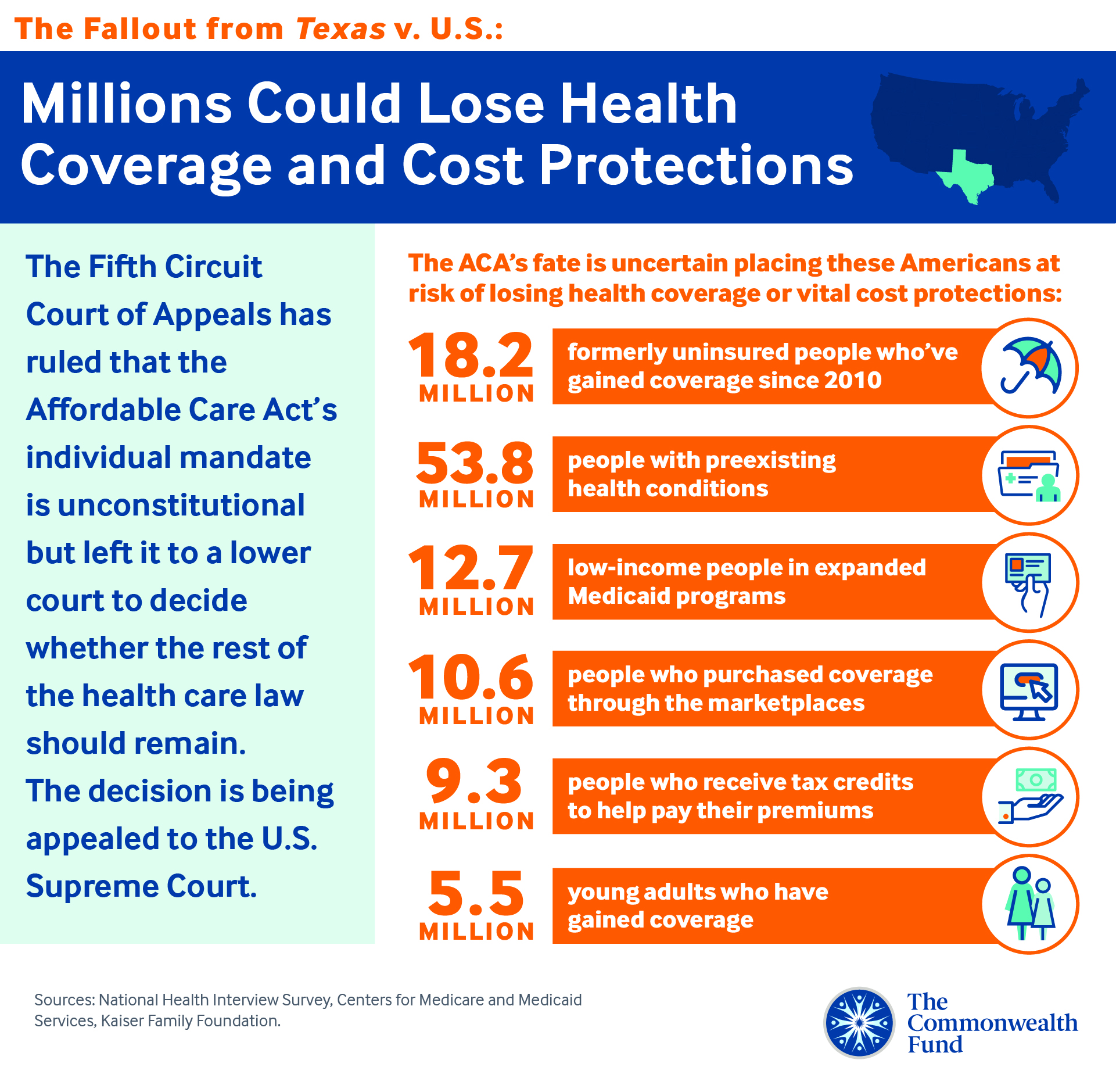
The Fallout from Texas v. U.S.:

Yesterday, a three-judge panel from the Fifth Circuit Court of Appeals struck down the Affordable Care Act (ACA)’s individual mandate. The judges agreed with a lower court decision issued in the case, Texas v. U.S., in December 2018 that the individual mandate is unconstitutional but, unlike the lower court, did not decide that the rest of the ACA is also unconstitutional. Instead, the judges remanded, or sent back, the decision to the same lower court judge to consider. California Attorney General Xavier Becerra, who is leading the 21 Democratic state attorneys general defending the law, along with the U.S. House of Representatives, immediately announced he would appeal the decision to the Supreme Court.

Whether the Supreme Court will decide to take the case now or wait for the decision of Judge O’Connor’s, of the lower court, is uncertain. If the Court decides to take the case now, they could expedite the briefing process and issue a decision in 2020. If it does not take the case now, a ruling will be delayed until after the 2020 presidential election.

No one knows how the Supreme Court will ultimately rule. But we do know that if the Court decides to strike down the ACA, the human toll will be immense and tragic. The law has granted unprecedented health security to millions:

  • 18.2 million formerly uninsured people have gained coverage since 2010
  • 53.8 million Americans with preexisting health conditions are now protected
  • 12.7 million low-income people are insured through expanded Medicaid
  • 10.6 million people have coverage through the ACA marketplaces, 9.3 million of whom receive tax credits to help them pay their premiums
  • 5.5 million young adults have gained coverage, many by staying on their parents’ plans
  • 45 million Medicare beneficiaries have much better drug coverage.

Such a decision will also trigger massive disruption throughout the U.S. health system. The health care industry represents nearly 20 percent of the nation’s economy; the ACA has touched every corner of it. The law restructured the individual and small-group health insurance markets, expanded and streamlined the Medicaid program, improved Medicare benefits, and reformed the way Medicare pays doctors, hospitals, and other providers. It was a catalyst for the movement toward value-based care and established a regulatory pathway for biosimilars — less expensive versions of biologic drugs. States have rewritten laws to incorporate the ACA’s provisions. Insurers, hospitals, physicians, and state and local governments have invested billions of dollars in adjusting to these changes.

The law’s popular preexisting health condition protections have made it possible for people with minor-to-serious health problems to apply for coverage in the same way healthier people have always done. These protections have given the estimated 53.8 million Americans with preexisting health conditions the peace of mind that they will never be denied health insurance because of their health.

More than 150 million people who get coverage through their employers now are eligible for free preventive care, and their children can stay on their policies to age 26.

The wide racial and income inequities in health insurance coverage that have been partly remedied by the ACA would return. Hospitals and providers, especially safety-net institutions, would struggle with mounting uncompensated care burdens and sicker and more costly patients who are not receiving the preventive care they need.

The ACA tore down financial barriers to health care for millions, many of whom were uninsured for most of their lives. It has demonstrably helped people get the health care they need in states across the country. Research indicates that Medicaid expansion has led to improved health status and lower mortality risk.

To date, neither the Trump administration, which has sided with the plaintiffs in the case, nor its Republican colleagues in Congress have offered a replacement plan in the event the law is struck down. The historic progress made by Americans, particularly those with middle and lower incomes and people of color, could unravel. Voters are already telling policymakers they are worried about their ability to afford health care. Yesterday’s decision and the uncertain path forward to the Supreme Court is certain to escalate those worries. With the nation entering the 2020 presidential election year, the Supreme Court may decide to take up the case this term.


Americans Still Favor Private Healthcare System

https://news.gallup.com/poll/268985/americans-favor-private-healthcare-system.aspx

Americans Still Favor Private Healthcare System

STORY HIGHLIGHTS

  • 54% prefer private system; 42% support government-run system
  • Two-thirds of Democrats favor a government-run system
  • Majority continue to see government responsibility for ensuring coverage

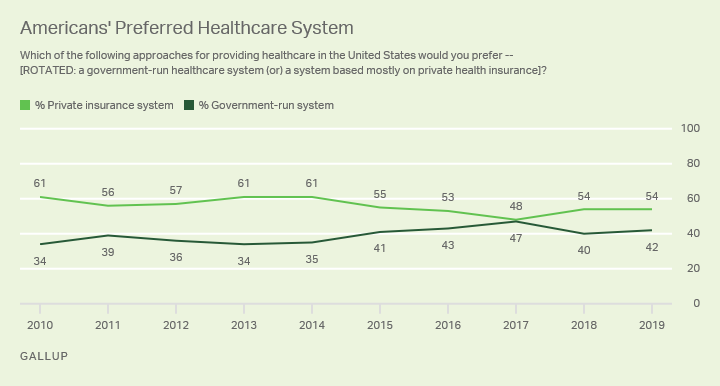
Americans continue to prefer a healthcare system based on private insurance (54%) over a government-run healthcare system (42%). Support for a government-run system averaged 36% from 2010 to 2014 but has been 40% or higher each of the past five years.

Line graph. Americans prefer a healthcare system based on private insurance to a government system by 54% to 42%.

These results are based on Gallup’s annual Health and Healthcare poll, conducted Nov. 1-14. Although more Americans have warmed to the idea of a greater government role in paying for healthcare, it remains the minority view in the U.S. This could create a challenge in a general election campaign for a Democratic presidential nominee advocating a “Medicare for All” or other healthcare plan that would greatly expand the government’s role in the healthcare system.

Democratic candidates’ plans for greater government involvement in healthcare are, however, consistent with the views of their party’s base. Since 2015, after most of the Affordable Care Act’s provisions had gone into effect, an average of 65% of Democrats have favored a government-run system.

Over the same period, Republicans have been overwhelmingly opposed to a government-run system, with an average of 13% preferring that approach while 84% have wanted to retain a private system.

Independents have been closely divided in recent years, but in 2019 tilt more toward a private (50%) than a government-run (45%) system.

Compared with the five-year period spanning the ACA’s passage and implementation from 2010 to 2014, support for a government-run system has increased among all party groups, with larger increases among independents (10 percentage points) and Democrats (seven points) than among Republicans (four points).


Changes in Preferences for Private vs. Government-Run Healthcare System, by Political Party
Figures are the average percentage holding each view in the five-year period
2010-2014 2015-2019
% %
Democrats
System based on private insurance 36 31
Government-run system 58 65
Independents
System based on private insurance 58 49
Government-run system 36 46
Republicans
System based on private insurance 88 84
Government-run system 9 13
GALLUP

Majority in U.S. Say Government Has Responsibility to Ensure Healthcare

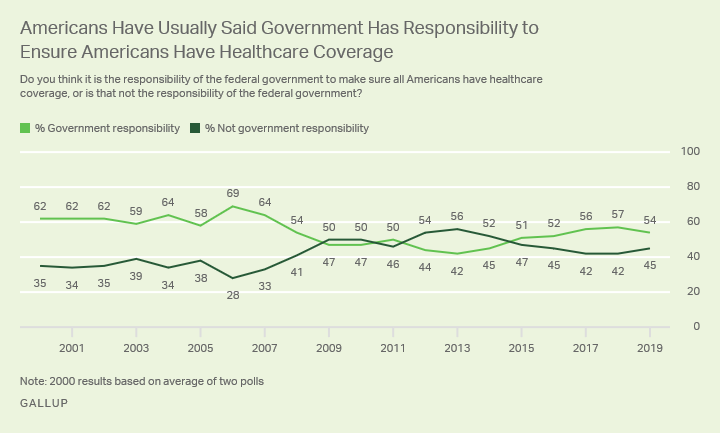
While Americans tend not to favor government-run healthcare, they do believe the federal government has a responsibility to ensure that all Americans have healthcare coverage. In the current survey, 54% hold this view, while 45% say it is not the government’s responsibility.

Recent support for the government having responsibility for ensuring healthcare coverage is not as high as it was from 2001 to 2007, when more than six in 10 Americans commonly expressed that opinion.

By contrast, from 2009 to 2014 — when the Obama administration and congressional Democrats developed, passed and implemented the Affordable Care Act — fewer Americans thought the government should ensure everyone has healthcare coverage. During that period, between 42% and 50% thought the government had that responsibility, the lowest measures in Gallup’s trend.

Line graph. Americans believe the federal government has a responsibility to ensure all in the U.S. have healthcare coverage.

Between 2009 and 2014, the percentages of Republicans and independents who thought the government should be responsible for ensuring healthcare coverage dropped at least 20 points, with a smaller eight-point drop among Democrats.

Democrats’ views are now back to where they were before 2009, while independents and especially Republicans have yet to return to prior levels, though independents are back above the majority level.

Changes in Belief That the Federal Government Has a Responsibility to Ensure All Americans Have Healthcare Coverage, by Political Party
Figures are the average percentage in each period
2001-2008 2009-2014 2015-2019
% % %
Democrats 80 72 80
Independents 64 44 56
Republicans 38 16 21
U.S. adults 62 46 54
GALLUP

Bottom Line

Americans have complex views on healthcare, with a majority saying the government should make sure everyone has coverage — but not necessarily pay for it through a government-run system. The Affordable Care Act was essentially an attempt to bridge these preferences by making coverage available to all through government-backed health insurance exchanges, but allowing those with insurance through an employer or other means to keep it.

Still, the law itself has been controversial, and Americans are currently as likely to disapprove of it as to approve. As such, it is fair to question to what extent Americans would embrace Democratic attempts to move to a healthcare system that goes further than the ACA does, or to support further Republican attempts to dismantle the law.

Healthcare is an issue that directly affects all Americans. Republican and Democratic political leaders have very different ideas about what healthcare policy should be. Additionally, the Democratic presidential campaign has revealed that even candidates in the same party can disagree on the best ways to address the U.S. healthcare system. With little consensus on the best way to approach healthcare policy, it promises to remain a key issue in U.S. politics and elections for the foreseeable future.


People hate shopping for health insurance

https://www.axios.com/newsletters/axios-vitals-02263384-8aa6-44eb-b170-b01d408fc1c7.html?utm_source=newsletter&utm_medium=email&utm_campaign=newsletter_axiosvitals&stream=top

Illustration of a plastic bag with "NO THANK YOU" printed multiple times on it alongside a health plus.

Americans rarely switch to new health plans when the annual insurance-shopping season comes around, even if they could have gotten a better deal, Axios’ Bob Herman reports.

The bottom line: People loathe shopping for health plans, and many are bad at it, for one major reason: “It’s just too hard,” Tricia Neuman, a Medicare expert at the Kaiser Family Foundation, told Bob last year.

Reality check: During any insurance program’s annual enrollment period, most people end up staying with the status quo, if it’s an option, instead of picking a new plan.

  • Fewer than one out of 10 seniors voluntarily switch from one private Medicare Advantage plan to another, according to new research from the Kaiser Family Foundation.
  • The same holds true for Medicare’s private prescription drug plans.
  • Most employers don’t usually change insurance carriers, often out of fear of angering workers, and keep plan options limited.
  • Employees, after several reminders from HR, usually default to what they had.
  • Fewer than half of people in the Affordable Care Act’s marketplaces actively re-enroll in new plans, even though the market was designed for comparison shopping.
  • Medicaid enrollees in some states have no say in the private plans they get.

Between the lines: Buying health insurance — $20,000 decision for the average family — is more complicated than buying furniture.

  • With consumer products, you pretty much know what you’re getting. With health insurance, you’re making an educated guess of how much health care you’ll use, hoping you’ll need none of it.
  • Health insurance terms and policies also are confusing, which turns people off from the shopping process.

The big picture: Shopping for insurance is difficult enough for most people. Shopping for actual doctors, tests and services is even more difficult and less widespread, and likely won’t change if prices are unlocked.