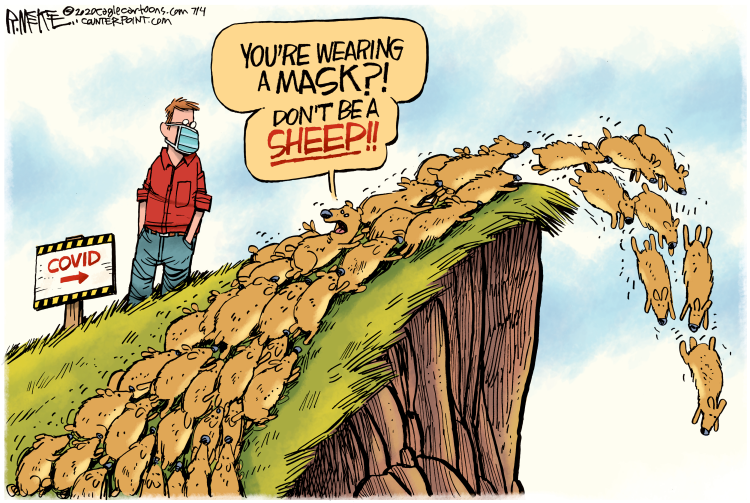
Cartoon – Sheep will be Sheep

Covid Lemmings

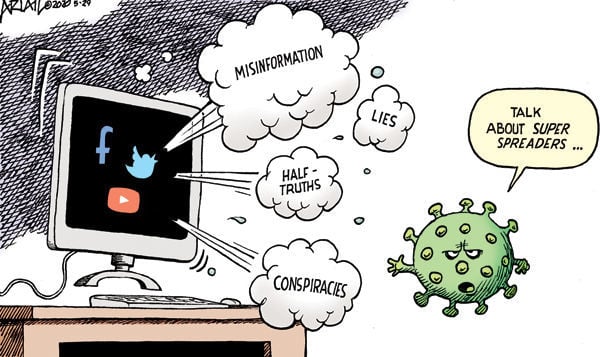
Cartoon – Talk About Super Spreaders

6-02 cartoon | Cartoons | heraldandnews.com

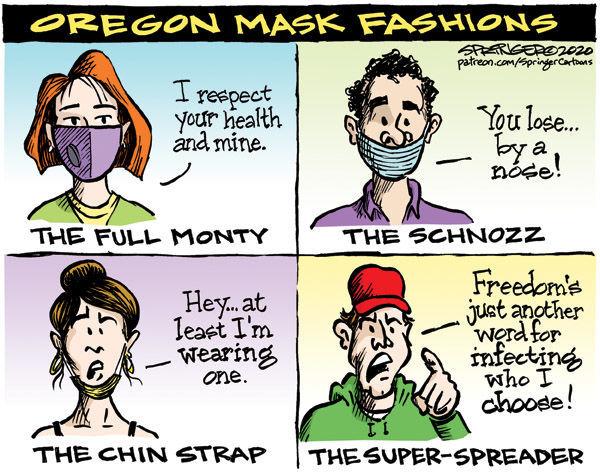
Cartoon – Coronavirus Mask Fashions

5-27 cartoon | Cartoons | heraldandnews.com

Convalescent Plasma: The Unanswered Questions

https://www.medpagetoday.com/infectiousdisease/covid19/88264?xid=fb_o&trw=no&fbclid=IwAR0F6xiRAQ7ngBz4pNozJ2VqWm0-UJqGdlQojfOeyXbPJjbAeYtGL8jbAiw

“The data don’t show anything useful”

Problems with the government’s rationale for authorizing use of convalescent plasma in COVID-19 patients go far beyond the dustup over the purported 35% survival benefit cited by top officials on Sunday, numerous researchers say.

That figure quickly came under fire, leading to an apology from Commissioner Stephen Hahn, MD — but that’s not the only criticism leveled at the FDA’s analysis of the available data.

Much of it came from the Mayo Clinic and FDA expanded access program (EAP), at this point published only as a preprint manuscript. Although a large number of patients were included, the study was observational only, with no untreated control group. That makes the findings merely hypothesis-generating, and can’t offer any firm conclusions.

That’s fine for issuing an emergency use authorization (EUA), but not so much for making claims about survival benefit, independent researchers said.

“It’s not even a question of overstating,” Adam Gaffney, MD, MPH, a critical care doctor and health policy researcher at Harvard Medical School, told MedPage Today. “You can’t state much at all when you don’t have a randomized controlled trial.”

“People have made a big deal of Hahn referring to relative versus absolute risk reduction, but I think that’s less of a big deal,” Gaffney said. “The biggest problem is that the data they are citing … is not randomized. That’s the source of all the problems.”

Hahn took heat for saying that a “35% improvement in survival is a pretty substantial clinical benefit” further explaining that of “100 people who are sick with COVID-19, 35 would have been saved because of the administration of plasma.”

Critics rapidly took to Twitter, stating that the interpretation was incorrect. Hahn was referring to relative risk reduction, not absolute risk reduction. Thus, calculating the number of lives saved — which isn’t something experts recommend doing based on observational data in the first place — would have translated to somewhere more in the ballpark of 5 out of 100.

Moreover, the “risk reduction” came from a comparison of patients treated with high-titer plasma versus those receiving lower-titer preparations. The study offered no basis for concluding how many patients may have been “saved” relative to standard care.

And the 35% reduction in that analysis was for 7-day mortality; the relative reduction at 30 days was only 23%.

Hahn’s recital of the 35% figure “was just PART of the error,” tweeted Vinay Prasad, MD, MPH, of the University of California San Francisco. “The entire comparison is flawed. It is not a suitable control. The data don’t show anything useful.”

“The much broader problem here is the lack of commitment to performing large, national randomized controlled trials,” Gaffney said. “We could have done it for convalescent plasma. Instead, we did the EAP. I understand why people wanted it, but now we don’t know [if convalescent plasma works]. We have a question mark instead of a period.”

Undermining Trust in FDA?

Critics have charged that serious mistakes like Hahn’s misstatement could undermine FDA’s credibility, especially as it faces challenging decisions about potentially approving a vaccine this fall.

“This is playing out in the context of a hyper-politicized moment,” Gaffney said. “It behooves everyone to be extremely cautious in speaking about these things to avoid the appearance of politicization.”

On CBS This Morning on Tuesday, Hahn addressed concerns about politicization by offering reassurance to the “American people that this decision was made based upon sound science and data.”

In response to questions about the timing of the EUA announcement — it came just a day after President Donald Trump tweeted allegations that the “deep state” was holding back access to COVID-19 treatments with Hahn’s Twitter handle cited, and a day before the Republican National Convention got underway — Hahn said the agency had been working on the application for 3 or 4 weeks and was waiting on additional validation data, which were received at the end of last week and over the weekend.

“We’re going to continue to get data and as we’ve done with any other authorization, we will update that decision as new data come,” Hahn said on the news program. His agency initially issued an EUA for hydroxychloroquine, for instance, but later revoked it when the negative randomized trial data became available.

Lack of Access to FDA’s Data Review

Whether the public will ever see the full convalescent plasma data underlying the EUA is another matter. The “Clinical Memorandum” issued as the evidence behind the FDA’s decision glossed over the statistical analysis conducted by the agency; in particular, it made no mention of the 35% relative reduction in deaths.

Another problem with that is the 35% figure’s source isn’t fully clear. Although the EAP preprint manuscript is the most obvious source, Gaffney noted that HHS Secretary Alex Azar said it referred to a subgroup of patients under age 80 who were not on a ventilator. That is not found in the publicly available data. He also pointed to a tweet by FDA spokesperson Emily Miller that contains an agency slide showing a 37% reduction in mortality for non-intubated patients age 80 or under treated within 72 hours who got high-titer convalescent plasma, compared with low-titer product. Neither of those figures is reflected in the EAP manuscript.

The FDA did not return a request by MedPage Today for the full summary of data reviewed by FDA and any independent statistical analysis done by the agency.

Shmuel Shoham, MD, of Johns Hopkins University in Baltimore, said during a press briefing organized by the Infectious Diseases Society of America that “enormous amounts of data have been generated” from the EAP, in which more than 70,000 patients have been treated.

“Some data have been reported in articles and at meetings, but that’s only part of what the FDA — this is their program — has access to,” he said. “The stuff in the public domain is only a fraction of the data they have collected.”

Shoham is on the scientific advisory board of the EAP and is involved in two convalescent plasma clinical trials at Johns Hopkins.

Gaffney said Mayo researchers and FDA reviewers have noted that physicians were blinded to the dose of antibody given in plasma infusions, which he described as a “pseudo-randomization effect. We could use that to make more causal inferences about the effectiveness of antibody titers.”

However, he said there were some significant differences between those who received high-titer versus low-titer antibody, including differences in P-to-F ratio (a measure of inhaled oxygen to blood oxygen) and in those with five or more severe risk factors, suggesting the low-titer group was sicker to begin with than the high-titer group.

Also, patients in the EAP received a variety of other treatments: about half got steroids and 40% were given remdesivir.

“This is why we do randomized controlled trials,” Gaffney said. “Without them it’s very difficult to ensure that the effect you see is the result of the drug, and not the result of patient characteristics.”

Is an Answer Forthcoming?

Several randomized controlled trials of convalescent plasma are underway in the U.S., but the big concern is that wider access to convalescent plasma will limit enrollment. Will clinicians recommend that their patients enroll in a trial in which they might receive placebo? Will patients agree?

For the Hopkins studies, the prevention trial has enrolled 25 people out of a goal of 500, and its outpatient trial has enrolled 50 people of its 600-patient goal.

Liise-anne Pirofski, MD, of Montefiore Medical Center in New York, started a study at the end of April, looking to enroll 300 people. She said the team enrolled the first 150 people quickly, but “then the pandemic began to wane in New York.” With subsequent funding from the NIH, the trial has managed to enroll 190 patients, and has now expanded to four additional sites: New York University, Yale, the University of Miami, and the University of Texas Houston.

Clifton Callaway, MD, PhD, of the University of Pittsburgh Medical Center and lead investigator on the C3PO trial looking at outpatient convalescent plasma, said he hopes the EUA doesn’t discourage participation.

“To the contrary, I believe it should reassure persons considering participation that the FDA feels that convalescent plasma is safe and potentially useful and that the FDA specifically comments: ‘Current data suggest the largest clinical benefit is associated with high-titer units of CCP administered early in the course of disease.’ Giving high-titer convalescent plasma earlier (before you are sick enough to be in the hospital) is exactly what C3PO is testing.”

In addition to determining whether earlier or prophylactic treatment works, Shoham said other unanswered questions include identifying whether other components in plasma are useful therapies and whether low-titer plasma can work at all.

“What everyone agrees on is that the gaps in knowledge that exist can best be addressed by high-quality randomized controlled trials,” he said.

Pirofski said the science and data should be the focus, “rather than the decision and what drove the decision…. I don’t think anyone knows what drove that decision other than the people in that room. Hopefully they know.”


Top U.S. Officials Told C.D.C. to Soften Coronavirus Testing Guidelines

The Centers for Disease Control and Prevention abruptly changed its recommendations, saying people without Covid-19 symptoms should not get tested.

 Trump administration officials on Wednesday defended a new recommendation that people without Covid-19 symptoms abstain from testing, even as scientists warned that the policy could hobble an already weak federal response as schools reopen and a potential autumn wave looms.

The day after the Centers for Disease Control and Prevention issued the revised guidance, there were conflicting reports on who was responsible. Two federal health officials said the shift came as a directive to the Atlanta-based C.D.C. from higher-ups in Washington at the White House and the Department of Health and Human Services.

Adm. Brett P. Giroir, the administration’s coronavirus testing czar, called it a “C.D.C. action,” written with input from the agency’s director, Dr. Robert R. Redfield. But he acknowledged that the revision came after a vigorous debate among members of the White House coronavirus task force — including its newest member, Dr. Scott W. Atlas, a frequent Fox News guest and a special adviser to President Trump.

“We all signed off on it, the docs, before it ever got to a place where the political leadership would have, you know, even seen it, and this document was approved by the task force by consensus,” Dr. Giroir said. “There was no weight on the scales by the president or the vice president or Secretary Azar,” he added, referring to Alex M. Azar II, the secretary of health and human services.

Regardless of who is responsible, the shift is highly significant, running counter to scientific evidence that people without symptoms could be the most prolific spreaders of the coronavirus. And it comes at a very precarious moment. Hundreds of thousands of college and K-12 students are heading back to campus, and broad testing regimens are central to many of their schools’ plans. Businesses are reopening, and scientists inside and outside the administration are growing concerned about political interference in scientific decisions.

Democratic governors who were weighing how to keep the virus contained as their economies and schools come to life said limiting testing for asymptomatic citizens would make the task impossible.

“The only plausible rationale,” Gov. Andrew M. Cuomo of New York told reporters in a conference call from Albany, N.Y., “is that they want fewer people taking tests, because as the president has said, if we don’t take tests, you won’t know the number of people who are Covid-positive.”

Over the weekend, the Food and Drug Administration, under pressure from Mr. Trump, gave emergency approval to expand the use of antibody-rich blood plasma to treat Covid-19 patients. The move came just days after scientists, including Dr. Anthony S. Fauci, the nation’s top infectious disease expert, and Dr. Francis S. Collins, the director of the National Institutes of Health, intervened to stop the practice because of lack of evidence that it worked.

The move echoed a decision by the Food and Drug Administration to grant an emergency use waiver for hydroxychloroquine, a malaria drug repeatedly sold by Mr. Trump as a treatment for Covid-19. The agency revoked the waiver in June, when clinical trials suggested the drug’s risks outweighed any possible benefits.

The testing shift, experts say, was a far more puzzling reversal. Dr. Giroir said the move was “discussed extensively by” members of the White House coronavirus task force, and he named Dr. Redfield, Dr. Atlas, Dr. Fauci and Dr. Stephen M. Hahn, the commissioner of food and drugs. Notably, he did not name Dr. Deborah L. Birx, the White House coronavirus response coordinator. But he said Dr. Fauci was among those who had “signed off.”

In a brief interview, Dr. Fauci said he had seen an early iteration of the guidelines and did not object. But the final debate over the revisions took place at a task force meeting on Thursday, when Dr. Fauci was having surgery under general anesthesia to remove a polyp on his vocal cord. In retrospect, he said, he now had “some concerns” about advising people against getting tested, because the virus could be spread through asymptomatic contact.

“My concern is that it will be misinterpreted,” Dr. Fauci said.

The newest version of the C.D.C. guidelines, posted on Monday, amended the agency’s guidance to say that people who had been in close contact with an infected individual — typically defined as being within six feet of a person with the coronavirus and for at least 15 minutes — “do not necessarily need a test” if they do not have symptoms.

Exceptions might be made for “vulnerable” individuals, the agency noted, or if health care providers or state or local public health officials recommended testing.

Dr. Giroir said the new recommendation matched existing guidance for hospital workers and others in frontline jobs who have “close exposures” to people infected with the coronavirus. Such workers are advised to take proper precautions, like wearing masks, socially distancing, washing their hands frequently and monitoring themselves for symptoms.

He argued that testing those exposed to the virus was of little utility, because tests capture only a single point in time, and that the results could give people a false sense of security.

“A negative test on Day 2 doesn’t mean you’re negative. So what is the value of that?” Dr. Giroir asked, adding, “It doesn’t mean on Day 4 you can go out and visit Grandma or on Day 6 go out without a mask on in school.”

The guidelines come amid growing concern that the C.D.C., the agency charged with tracking and fighting outbreaks of infectious disease, is being sidelined by its parent agency, the Department of Health and Human Services, and the White House. Under ordinary circumstances, administering public health advice to the nation would fall squarely within the C.D.C.’s portfolio.

Experts have called the revisions alarming and dangerous, noting that the United States needs more testing, not less. And they have expressed deep concern that the C.D.C. is posting guidelines that its own officials did not author. A former C.D.C. director, Dr. Thomas R. Frieden, railed against the move on Twitter on Wednesday:

Dr. Tom Frieden
@DrTomFrieden
Two unexplained, inexplicable, probably indefensible changes, likely imposed on CDC’s website. * Dammit, if you come from a place with lots of Covid, quarantine for 14 days * If you’re a contact, get tested. If +, we can trace your contacts and stop chains of spread. A sad day.

Later, in an interview, Dr. Frieden elaborated. He noted that the C.D.C. had recently dropped its recommendation that people quarantine for 14 days after traveling from an area with a high number of cases to one where the virus was less prevalent. And he reiterated that testing the contacts of those infected was an important means of curbing the spread of the virus.

“We don’t know the best protocol for testing of contacts: Should you test all contacts? That’s the kind of study that frankly needs to get done,” Dr. Frieden said. But absent the answer to that question, he added, “I certainly wouldn’t say, ‘Don’t test contacts.’”

Democrats, including Speaker Nancy Pelosi and two governors — Mr. Cuomo and Gavin Newsom of California — were outraged by the changes. Mr. Newsom said California would not follow the new guidelines, and Mr. Cuomo blamed Mr. Trump.

Representative Frank Pallone Jr. of New Jersey, a Democrat and the chairman of the House Energy and Commerce Committee, also chimed in on Twitter: “The Trump Admin has a lot of explaining to do. #COVID19 testing is essential to stopping the spread of the pandemic. I’m concerned that CDC is once again caving to political pressure. This simply cannot stand.”

Mr. Trump has suggested that the nation should do less testing, arguing that administering more tests was driving up case numbers and making the United States look bad. But experts say the true measure of the pandemic is not case numbers but test positivity rates — the percentage of tests coming back positive.

As Dr. Giroir denied that politics was involved, he encouraged the continued testing of asymptomatic people for surveillance purposes — to determine the prevalence of the virus in a given community — and said such “baseline surveillance testing” would still be appropriate in schools and on college campuses.

“We’re trying to do appropriate testing, not less testing,” he said.

Still, the revisions left many public health officials scratching their heads. They might have made sense when the United States was experiencing a shortage of tests, some experts said, but that no longer appears to be the case. Dr. Frieden, however, said it was possible the administration was trying to conserve testing in case of another surge.

“The problem is we have too many cases, so there is basically no way to keep up the testing if you have a huge outbreak,” he said.

Jennifer Nuzzo, an epidemiologist at Johns Hopkins Bloomberg School of Public Health, said she was “not as up in arms about the content of the guidelines” as she was about the idea that the C.D.C.’s own experts did not write them — and that C.D.C. officials were referring all questions about them to the health department in Washington.

“These guidelines are clearly controversial, and many are calling on C.D.C. to explain its rationale for them, but C.D.C. is unable to comment,” she said in an email. “This is really dangerous precedent, and I fear it will erode public trust in C.D.C.”


History tells us trying to stop diseases like COVID-19 at the border is a failed strategy

https://theconversation.com/history-tells-us-trying-to-stop-diseases-like-covid-19-at-the-border-is-a-failed-strategy-145016?utm_medium=email&utm_campaign=Latest%20from%20The%20Conversation%20for%20August%2028%202020%20-%201715916573&utm_content=Latest%20from%20The%20Conversation%20for%20August%2028%202020%20-%201715916573+Version+A+CID_8719e3ecf842bc9762e48ce42f2ba6ad&utm_source=campaign_monitor_us&utm_term=History%20tells%20us%20trying%20to%20stop%20diseases%20like%20COVID-19%20at%20the%20border%20is%20a%20failed%20strategy

History tells us trying to stop diseases like COVID-19 at the border is a failed  strategy

To explain why the coronavirus pandemic is much worse in the U.S. than anywhere else in the world, commentators have blamed the federal government’s mismanaged response and the lack of leadership from the Trump White House.

Others have pointed to our culture of individualism, the decentralized nature of our public health, and our polarized politics.

All valid explanations, but there’s another reason, much older, for the failed response: our approach to fighting infectious disease, inherited from the 19th century, has become overly focused on keeping disease out of the country through border controls.

As a professor of medical sociology, I’ve studied the response to infectious disease and public health policy. In my new book, “Diseased States,” I examine how the early experience of outbreaks in Britain and the United States shaped their current disease control systems. I believe that America’s preoccupation with border controls has hurt our nation’s ability to manage the devastation produced by a domestically occurring outbreak of disease.

Germ theory and the military

Though outbreaks of yellow fever, smallpox, and cholera occurred throughout the 19th century, the federal government didn’t take the fight against infectious disease seriously until the yellow fever outbreak of 1878. During that same year, President Rutherford B. Hayes signed the National Quarantine Act, the first federal disease control legislation.

By the early 20th century, a distinctly American approach to disease control had evolved: “New Public Health.” It was markedly different from the older European concept of public health, which emphasized sanitation and social conditions. Instead, U.S. health officials were fascinated by the newly popular “germ theory,” which theorized that microorganisms, too small to be seen by the naked eye, caused disease. The U.S. became focused on isolating the infectious. The typhoid carrier Mary Mallon, known as “Typhoid Mary,” was isolated on New York’s Brother Island for 23 years of her life.

Originally, the military managed disease control. After the yellow fever outbreak, the U.S. Marine Hospital Service (MHS) was charged with operating maritime quarantine stations countrywide. In 1912, the MHS became the U.S. Public Health Service; to this day, that includes the Public Health Service Commissioned Corps led by the surgeon general. Even the Centers for Disease Control and Prevention started as a military organization during World War II, as the Malaria Control in War Areas program. Connecting the military to disease control promoted the notion that an attack of infectious disease was like an invasion of a foreign enemy.

Germ theory and military management put the U.S. system of disease control down a path in which it prioritized border controls and quarantine throughout the 20th century. During the 1918 influenza pandemicNew York City held all incoming ships at quarantine stations and forcibly removed sick passengers into isolation to a local hospital. Other states followed suit. In Minnesota, the city of Minneapolis isolated all flu patients in a special ward of the city hospital and then denied them visitors. During the 1980s, the Immigration and Naturalization Service denied HIV-positive persons from entering the country and tested over three million potential immigrants for HIV.

Defending the nation from the external threat of disease generally meant stopping the potentially infectious from ever entering the country and isolating those who were able to gain entry.

Our mistakes

This continues to be our predominant strategy in the 21st century. One of President Trump’s first coronavirus actions was to enforce a travel ban on China and then to limit travel from Europe.

His actions were nothing new. In 2014, during the Ebola outbreakCaliforniaNew York and New Jersey created laws to forcibly quarantine health care workers returning from west Africa. New Jersey put this into practice when it isolated U.S. nurse Kaci Hickox after she returned from Sierra Leone, where she was treating Ebola patients.

In 2007, responding to pandemic influenza, the Department of Homeland Security and the CDC developed a “do not board” list to stop potentially infected people from traveling to the U.S.

When such actions stop outbreaks from occurring, they are obviously sound public policy. But when a global outbreak is so large that it’s impossible to keep out, then border controls and quarantine are no longer useful.

This is what has happened with the coronavirus. With today’s globalization, international travel, and an increasing number of pandemics, attempting to keep infectious disease from ever entering the country looks more and more like a futile effort.

Moreover, the U.S. preoccupation with border controls means we did not invest as much as we should have in limiting the internal spread of COVID-19. Unlike countries that mounted an effective response, the U.S. has lagged behind in testingcontact tracing, and the development of a robust health care system able to handle a surge of infected patients. The longstanding focus on stopping an outbreak from ever occurring left us more vulnerable when it inevitably did.

For decades, the U.S. has been underfunding public health. When “swine flu” struck the country in 2009, the CDC said 159 million doses of flu shots were needed to cover “high risk” groups, particularly health care workers and pregnant women. We only produced 32 million doses. And in a pronouncement that now looks prescient, a Robert Wood Johnson Foundation report said if the swine flu outbreak had been any worse, U.S. health departments would have been overwhelmed. By the time Ebola appeared in 2014, the situation was no better. Once again, multiple government reports slammed our response to the outbreak.

Many causes exist for the U.S.‘s failed response to this crisis. But part of the problem lies with our past battles with disease. By emphasizing border controls and quarantine, the U.S. has disregarded more practical strategies of disease control. We can’t change the past, but by learning from it, we can develop more effective ways of dealing with future outbreaks.


Six months ago, Trump said that coronavirus cases would soon go to zero. They … didn’t.

https://www.washingtonpost.com/politics/2020/08/26/six-months-ago-trump-said-that-coronavirus-cases-would-soon-go-zero-they-didnt/?utm_campaign=wp_main&utm_medium=social&utm_source=facebook&fbclid=IwAR2-yqYYel73YR3zJXfqtn25DXNEA8Yi1qc0L0RQ3PNP-NqUJ299PFNdeWc


But with new constraints on testing, Trump may get his wish eventually.

It was exactly six months ago Wednesday when the spread of the coronavirus in the United States had become too significant for President Trump to wave away. He and several members of the team planning the administration’s response held a news briefing designed to inform the public about the virus and, more important, to allay concerns.

This was the briefing in which Trump made one of his most wildly incorrect assertions about what the country could expect.

“The level that we’ve had in our country is very low,” Trump said, referring to new confirmed infections, “and those people are getting better, or we think that in almost all cases they’re better, or getting. We have a total of 15. We took in some from Japan — you heard about that — because they’re American citizens, and they’re in quarantine.”

That part was generally true. At the time, there had been only a smattering of confirmed cases, with the addition of passengers from the cruise ship Diamond Princess pushing the confirmed total to more than 50.

“So, again,” he added later, “when you have 15 people, and the 15 within a couple of days is going to be down to close to zero, that’s a pretty good job we’ve done.”

It was a brash prediction and seemingly an off-the-cuff one. Trump’s point was less about what was going to happen than arguing that his administration had done a good job. But by linking those two things, he made it simple for observers to use his assertion that the number of cases would fade as a baseline for measuring everything that followed.

Over time, more cases from the period before Feb. 26 would be discovered, including two early deaths in California from covid-19, the disease caused by the virus. There were actually almost 200 cases that would eventually be confirmed by the time Trump was saying the country would go from 15 to zero.

The experts standing behind Trump would have known that Trump’s claims were inaccurate. As the briefing was underway, The Washington Post reported a confirmed case of “community spread” — a documented infection that couldn’t be traced to international travel. In other words, it was uncontained: The virus was moving from person to person without impediment or detection.

Although about 200 cases in that period eventually would be confirmed, even that number was far lower than the reality. Researchers can use documented cases to estimate the number of cases that weren’t being detected and that also weren’t later confirmed through testing. For example, an estimate produced by data scientist Youyang Gu puts the likely number of new infections on Feb. 26 somewhere in the range of 13,000 to 25,000.

On that day alone.

Within a month, the country would go from Trump’s 15 cases to nearly 88,000 cases. By April 26, the total was nearly a million. By May 26, 1.7 million. The most recent total is north of 5.7 million.

That steady increase is in part a function of Trump repeating the same mistake over and over, portraying the pandemic as ending or functionally ended. As cases faded a bit in May and June, he pushed for a return to normal economic activity, triggering a new surge in confirmed cases. That second increase has been fading for about a month, happily, but the country is still adding 33 percent more confirmed new cases each day than it did at the peak in April.

That’s confirmed cases, a metric that relies on testing. Gu’s estimates of the actual spread of the virus put the country about 40 percent below the peak in daily new cases, which was reached in early July.

Trump, of course, blames testing for revealing the scale of the pandemic in the first place. He has a point, in a way: Had the United States never managed to solve its problems with testing, something that took weeks, there wouldn’t have been millions of confirmed cases. There would still have been millions of cases or, perhaps, tens of millions of cases. We just wouldn’t have known how many there were.

It has been about two months since Trump held a political rally in Tulsa, contributing to a new surge of cases in the city. There, he made a tongue-in-cheek reference to asking his team to slow down on testing, because it was pushing the number of confirmed cases higher. As they say, though, each joke contains a grain of truth, and it was clear that Trump, in fact, would be happy to see the number of tests drop so that the number of confirmed cases did as well.

Data compiled by the COVID Tracking Project show that he has gotten his wish, to a degree. Over the past month, the number of tests being completed each day in the United States has dropped by nearly one-fifth.

Part of this is a function of interference from natural disasters, with storms in Florida and fires in California limiting testing capacity. Part of it, too, is probably a function of the drop in the number of cases coming back positive. Fewer new cases means fewer people feeling sick and seeking tests to confirm an infection. The drop in the percent of tests coming back positive reinforces that trend.

But, increasingly, part of it will stem from the administration de-emphasizing testing. New guidance published by the Centers for Disease Control and Prevention suggested that those who had been in contact with an infected person no longer needed to be tested, particularly when asymptomatic.

This, too, has been something Trump has talked about a lot, complaining that people without symptoms were being tested and confirmed as positive — and added to the total number of infections.

“Many of those cases are young people that would heal in a day,” Trump said in an interview on July 19. “They have the sniffles and we put it down as a test.”

The reason it’s important to track asymptomatic cases, of course, is that those people can still infect others. To defeat the pandemic, we need to contain it, and the new CDC approach runs the significant risk of leaving large holes in that containment effort. But, with the presidential election only about 70 days away, it will mean fewer confirmed cases.

The irony of Trump’s complaints about the virus from the outset is that the United States’ confirmed infection totals already have been minimized because of limited testing. The reason Trump was able to claim that there were only 15 cases six months ago was that the administration had spent the month since the first confirmed case in the country unable to put together a robust testing regimen that would allow the virus to be constrained. South Korea, where such a regimen was quickly implemented, actually did see its virus numbers drop to near zero.

In other words, Trump’s prediction was not only wrong, it was wrong in large part because Trump’s team hadn’t done what would have been needed to make it come true. Trump portrays himself as an unwitting victim of the pandemic, but his comment six months ago Wednesday is a good reminder that he can put a lot of the blame for his position on himself.


Cartoon – The Vagueness Campaign

The Dilbert Strip for September 27, 2012: Social Media Expert This ...

Cartoon – Flashy Ad Campaigns

Being Yourself: The Importance Of Authenticity In Online Marketing ...

FDA chief apologizes for overstating plasma effect on virus

https://abcnews.go.com/Health/wireStory/fda-commissioner-overstated-effects-virus-therapy-72595122?fbclid=IwAR3Um3rVuom9rJNCOvccmmTBDOrrRePEu1BX1VgRvAzYbpL2NATGjY2-1IY

FDA chief apologizes for overstating plasma effect on virus

Food and Drug Administration Commissioner Stephen Hahn is apologizing for overstating the life-saving benefits of using convalescent plasma to treat COVID-19 patients.

Responding to an outcry from medical experts, Food and Drug Administration Commissioner Stephen Hahn on Tuesday apologized for overstating the life-saving benefits of treating COVID-19 patients with convalescent plasma.

Scientists and medical experts have been pushing back against the claims about the treatment since President Donald Trump’s announcement on Sunday that the FDA had decided to issue emergency authorization for convalescent plasma, taken from patients who have recovered from the coronavirus and rich in disease-fighting antibodies.

Trump hailed the decision as a historic breakthrough even though the treatment’s value has not been established. The announcement on the eve of Trump’s Republican National Convention raised suspicions that it was politically motivated to offset critics of the president’s handling of the pandemic.

Hahn had echoed Trump in saying that 35 more people out of 100 would survive the coronavirus if they were treated with the plasma. That claim vastly overstated preliminary findings of Mayo Clinic observations.

Hahn’s mea culpa comes at a critical moment for the FDA which, under intense pressure from the White House, is responsible for deciding whether upcoming vaccines are safe and effective in preventing COVID-19.

The 35% figure drew condemnation from other scientists and some former FDA officials, who called on Hahn to correct the record.

“I have been criticized for remarks I made Sunday night about the benefits of convalescent plasma. The criticism is entirely justified. What I should have said better is that the data show a relative risk reduction not an absolute risk reduction,” Hahn tweeted.

The FDA made the decision based on data the Mayo Clinic collected from hospitals around the country that were using plasma on patients in wildly varying ways — and there was no comparison group of untreated patients, meaning no conclusions can be drawn about overall survival. People who received plasma with the highest levels of antibodies fared better than those given plasma with fewer antibodies, and those treated sooner after diagnosis fared better than those treated later.

Hahn and other Trump administration officials presented the difference as an absolute survival benefit, rather than a relative difference between two treatment groups. Former FDA officials said the misstatement was inexcusable, particularly for a cancer specialist like Hahn.

“It’s extraordinary to me that a person involved in clinical trials could make that mistake,” said Dr. Peter Lurie, a former FDA official under the Obama administration who now leads the nonprofit Center for Science in the Public Interest. “It’s mind-boggling.”

The 35% benefit was repeated by Health and Human Services Secretary Alex Azar at Sunday’s briefing and promoted on Twitter by the FDA’s communication staff. The number did not appear in FDA’s official letter justifying the emergency authorization.

Hahn has been working to bolster confidence in the agency’s scientific process, stating in interviews and articles that the FDA will only approve a vaccine that meets preset standards for safety and efficacy.

Lawrence Gostin of Georgetown University said Hahn’s performance Sunday undermined those efforts.

“I think the integrity of the FDA took a hit, if I were Stephen Hahn I would not have appeared at such a political show,” said Gostin, a public health attorney.

Hahn pushed back Tuesday morning against suggestions that the plasma announcement was timed to boost Trump ahead of the Republican convention.

“The professionals and the scientists at FDA independently made this decision, and I completely support them,” Hahn said, appearing on “CBS This Morning.”

Trump has recently accused some FDA staff, without evidence, of deliberately holding up new treatments “for political reasons.” And Trump’s chief of staff, Mark Meadows, said over the weekend that FDA scientists “need to feel the heat.”

The administration has sunk vast resources into the race for a vaccine, and Trump aides have been hoping that swift progress could help the president ahead of November’s election.

At Sunday’s briefing Hahn did not correct Trump’s description of the regulatory move as a “breakthrough.” He also did not contradict Trump’s unsupported claim of a “deep state” effort at the agency working to slow down approvals.

Former FDA officials said the political pressure and attacks against the FDA carry enormous risk of undermining trust in the agency just when it’s needed most. A vaccine will only be effective against the virus if it is widely taken by the U.S. population.

“I think the constant pressure, the name-calling, the perception that decisions are made under pressure is damaging,” said Dr. Jesse Goodman of Georgetown University, who previously served as FDA’s chief scientist. “We need the American people to have full confidence that medicines and vaccines are safe.”

Convalescent plasma is a century-old approach to treating the flu, measles and other viruses. But the evidence so far has not been conclusive about whether it works, when to administer it and what dose is needed.

The FDA emergency authorization is expected to increase its availability to additional hospitals. But more than 70,000 Americans have already received the therapy under FDA’s “expanded access” program. That program tracks patients’ response, but cannot prove whether the plasma played a role in their recovery.

Some scientists worry the broadened FDA access to the treatment will make it harder to complete studies of whether the treatment actually works. Those studies require randomizing patients to either receive plasma or a dummy infusion.