The Velvet Rope Economy: How Inequality Became Big Business

https://mailchi.mp/9e118141a707/the-weekly-gist-march-6-2020?e=d1e747d2d8

Image result for Velvet Rope

FROM THE GIST BOOKSHELF

Feed your head—read this.

Income inequality has become a central topic in our national political debate in the wake of the financial crisis. The gap between the “haves” and “have nots” has grown steadily, and addressing that gap has become a key priority for a new generation of politicians, economists, and policymakers. But inequality has also become a lucrative business opportunity in many parts of the economy, a phenomenon that New York Times economics reporter Nelson Schwartz entertainingly (and unsettlingly) describes in his new book, The Velvet Rope Economy: How Inequality Became Big Business.

Based on a series of Times articles by Schwartz from the past several years, the book describes life on both sides of the “velvet rope”: how services have become faster, better, and higher quality for those with the ability to pay extra, and how the rest of us are getting left behind. He describes how the familiar amusement-park “Fast Pass” approach has pervaded other parts of our lives, from school sports to social services to travel, and yes, to healthcare.

Across the economy, businesses increasingly cater to the top tier of customers, providing privileged access, concierge services, and special perks. As Schwartz describes it, “This pattern—a Versailles-like world of pampering for a privileged few on one side of the velvet rope, a mad scramble for basic service for everyone else—is being repeated in one sphere of American society after another.”

It’s a phenomenon we see in healthcare every day, as rural hospitals are shuttered, access to care is restricted for Medicaid patients, and wait times for new primary care appointments soar to six weeks or more, while concierge physician practices and cash-based, on-demand services proliferate. Most troubling, in Schwartz’s view: this intentional, class-based separation causes those on one side of the “velvet rope” to misunderstand, and even denigrate, those on the other.

That aptly describes our current political dynamic—Schwartz provides a useful (and highly readable) window into how businesses seek to profit from that division. Worth a read.


Two candidates remain: Mr. Medicare for All and Mr. Public Option

https://mailchi.mp/9e118141a707/the-weekly-gist-march-6-2020?e=d1e747d2d8

Image result for Medicare for All and Public Option

The past week in Presidential politics has been momentous—but not clarifying—for determining both the eventual Democratic nominee and the healthcare platform of the party. Between the first ballots cast in South Carolina and the last votes counted in California, the field of viable candidates for the nomination has been winnowed to two: Vermont Sen. Bernie Sanders and former Vice President Joe Biden. The coming weeks will feature a knock-down, drag-out fight for delegates in the run-up to what is likely to be a contested convention in Milwaukee in mid-July, pitting Biden’s “establishment” wing of the party against Sanders’ “progressive” wing.

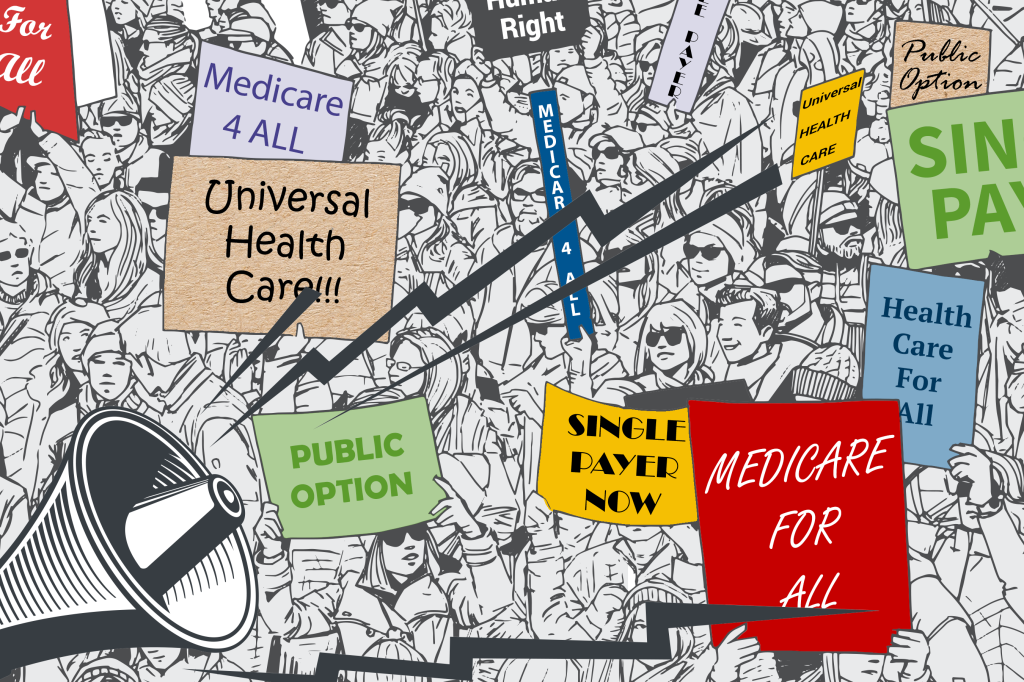
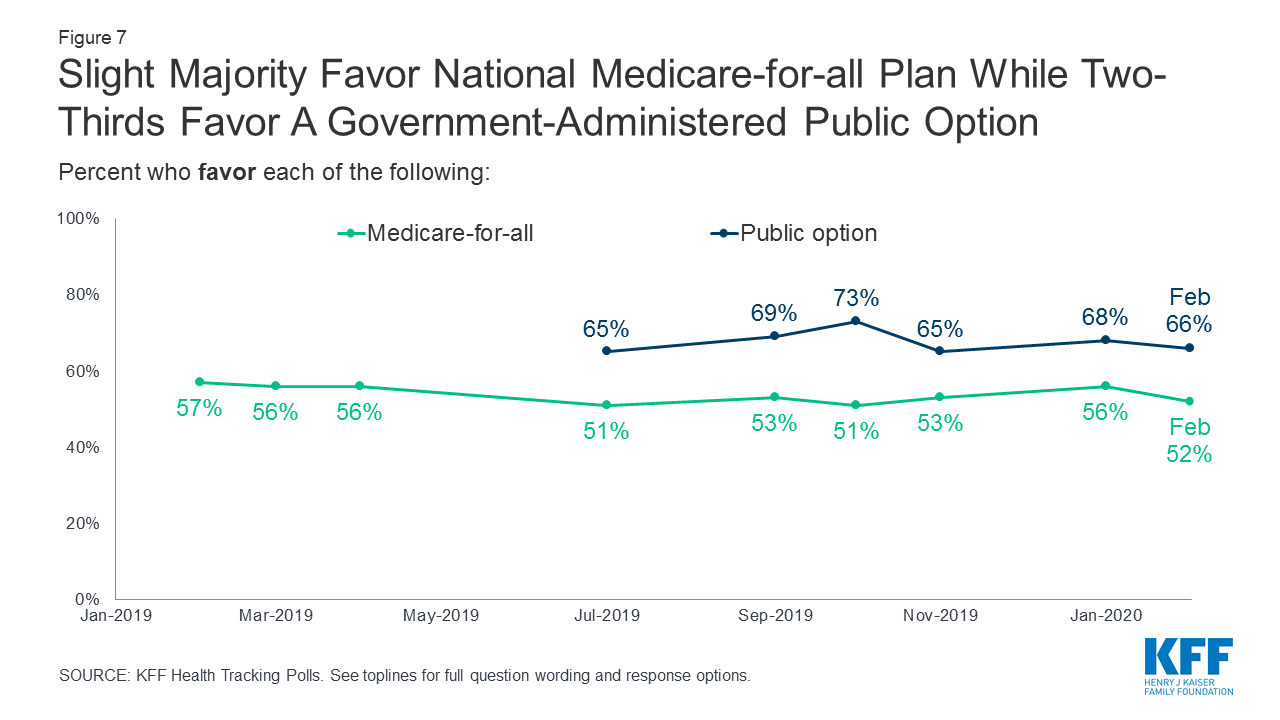
On the healthcare front, that means a continued debate between defenders of the Affordable Care Act (ACA), who want to extend coverage, as Biden does, using a government-run “public option” plan, and supporters of single-payer, “Medicare for All” (M4A) coveragewhich Sanders advocates. That’s the same argument Democrats have been having since the campaign started, and while healthcare remains the top issue of concern for primary voters, polls indicate that both plans are popular with the electorate.

We continue to believe that the public option plan is a far more likely outcome than M4A, but only if the Democrats win control of the Senate—a prospect which appears more possible given billionaire Mike Bloomberg’s post-Super Tuesday endorsement of Biden, and plans to devote his substantial campaign resources to support Democratic candidates across the ballot. Some of that money will surely be spent in Montana, where Gov. Steve Bullock is poised to announce plans to run against incumbent Sen. Steve Daines (R-MT), in a critical race that could be the most expensive Senate contest in history.

And for an indication of how the politics of a public option would play out, look no further than Colorado, where the Democratic legislature moved forward with its version of the plan this week, over the objections of the hospital and insurance lobbies.

Finally, looming over the general election campaign will be the pivotal Texas vs. California case, which the Supreme Court agreed to take up in this fall’s term. That case will ensure that healthcare will remain the centerpiece of American political debates regardless of who leads the Democratic ticket. Buckle up.


Settling in for a long fight against coronavirus

https://mailchi.mp/9e118141a707/the-weekly-gist-march-6-2020?e=d1e747d2d8

Image result for Settling in for a long fight against coronavirus

As of Friday, the number of confirmed cases of the novel coronavirus, or COVID-19, has surpassed 100,000 worldwide, with over 3,400 deaths. In the US, there have been 250 confirmed cases and 14 deaths reported so far—although the actual number of cases is certainly many times higher, with testing yet to be widely available and many patients exhibiting only mild to moderate symptoms.

Vice President Mike Pence, who was put in charge of federal response efforts last week, conceded Thursday that the country does not yet have enough coronavirus tests to meet demand, and the administration will not meet its goal of having 1M tests ready by the end of the week; perhaps the $8B emergency funding package approved by Congress will help expedite efforts.

Public worry and concern among officials hit new levels, with the Director-General of the World Health Organization warning that time to contain the virus may be running out, and expressing concern that countries may not be acting fast enough. New levels of containment effort have begun to take shape. Schools shut down in areas of the country most affected by the virus, including Seattle and some New York City suburbs. All told, the New York Times reports that 300M students are out of school around the world. Companies began to cancel conferences and other large gatherings—next week’s Health Information and Management Systems Society (HIMSS) conference was called off despite a planned appearance by President Trump, given rising cancellations and vendor exits.

Hospitals around the nation have rallied to prepare for a growing wave of patients that has yet to hit. Experts expressed concerns about whether hospitals have enough open capacity, but even more critical will be gaps in the supply of staff and equipment—especially the ICU beds and ventilators necessary for critically ill patients, and the nurses and respiratory therapists needed to care for them.

The vast majority of hospitals report having a coronavirus action plan in place; however, a recent survey of nurses suggests that critical information may not be making its way to frontline clinicians. Only 44 percent of nurses reported that their organization gave them information on how to identify patients with the virus, and just 29 percent said there is a plan in place to isolate potentially infected patients.

Worries about patient financial exposure to the costs of diagnosis and treatment intensified, with fears that individuals could be held accountable for the cost of government-mandated isolation. Most patients with high-deductible plans saw their deductibles “reset” at the beginning of the year, raising concerns that individuals might refrain from seeking treatment.

The heightened worry is palpable as we connect with hospital and physician leaders around the country, and we are deeply grateful for their around-the-clock efforts, and the willingness of doctors, nurses and other caregivers to put their own safety at risk to provide the best possible care to patients under increasingly difficult circumstances.


Why State Efforts to Mandate Coronavirus Testing Will Fall Short

Why State Efforts to Mandate Coronavirus Testing Will Fall Short

Image result for ERISA

To cope with incipient coronavirus outbreaks, Washington and New York have announced emergency directives requiring insurers to cover COVID-19 testing without cost-sharing. The states recognize that high deductibles and other out-of-pocket payments discourage people from getting tested, which in turn threatens public health.

Both states have acted pursuant to laws governing the regulation of insurance. In Washington, for example, the state insurance commissioner is empowered to issue orders addressing “medical coverage to ensure access to care” when the governor declares an emergency. Similarly, New York’s Superintendent of Financial Services says that it will issue an “emergency regulation” to require insurers to cover testing without cost-sharing (though the precise authority to issue that regulation is a little vague).

But the directives are more limited in scope than they appear, and will provide no help at all to the approximately 100 million people nationwide who receive coverage through self-insured employers. As with so many problems that arise in health law, the reason is the Employee Retirement Income Security Act of 1974 (ERISA).

When Congress adopted ERISA, it wasn’t thinking very hard about health insurance. It was thinking about pension plans, which many employers had chronically underfunded, leaving retired employees high and dry. So Congress adopted ERISA to offer some basic protections for employees. In exchange, Congress preempted any state laws that “relate to” employee benefit plans.

Congress carved out an exception to ERISA’s broad preemptive scope for laws regulating insurance. That’s a domain that’s traditionally been left to the states. Washington and New York can thus tell private insurers—including those that offer employer-sponsored coverage—to abide by their emergency rules.

But lots of firms don’t actually buy insurance for their employees. Instead, larger firms usually “self-insure,” meaning that they pay for their employees’ health expenses themselves. (Odds are that, if you’re employed, you work at a self-insured firm—61% of people with employer-sponsored coverage do.) And ERISA clarifies that employers, when they self-insure, aren’t to be treated as insurers.

The upshot of this convoluted scheme is that the states can’t regulate self-funded employer plans. They’re regulated, instead, by the U.S. Department of Labor under ERISA. But because Congress didn’t think of ERISA as a regulation of health insurance, it didn’t authorize the kind of emergency health regulations that Washington and New York are now drawing on.

That’s one reason the federal government has looked so feckless when it’s tried to say that it will guarantee access to testing. Vice President Pence, for example, said yesterday that testing is an “‘essential health benefit,’ which means the test will be covered by health insurance plans, Medicare and Medicaid.”

But the EHB rules don’t apply at all to large employers or to Medicare. Even if they did, insurers can (and do!) impose cost-sharing for EHBs, and could do so for a COVID-19 test. It’s a completely meaningless statement.

Nor can the federal government slide coronavirus testing into the part of the Affordable Care Act that requires coverage without cost-sharing for high-quality preventive services designated by the U.S. Preventive Services Task Force. Not only is that task force ill-equipped to move quickly, but the ACA says that its recommendations can only take effect after a “minimum interval” that “shall not be less than 1 year.” That’s much too late.

Unless I’m missing something, the federal government simply does not have the legal power to require employers to cover coronavirus testing without cost-sharing. The Association of Health Insurance Plans has said that its members may voluntarily waive cost-sharing, but they may not, and in any event AHIP doesn’t represent employers, who get to make the final call on what they do and don’t cover.

Congress will have to act—and it should act immediately to assure swift, reliable, and no-cost access to testing services. The broader lesson, though, is that Congress’s blunderbuss approach to preemption under ERISA has led to a situation in which neither the states nor the federal government is equipped to regulate the coverage practices of large, self-insured employers. That gap in legal authority could have pernicious consequences in the coming months.


Ever-Rising Health Costs Worsen California’s Coronavirus Threat

Ever-Rising Health Costs Worsen California’s Coronavirus Threat

Image result for Ever-Rising Health Costs Worsen California’s Coronavirus Threat

As California and the nation prepare for the spread of the new coronavirus disease known as COVID-19, it is important to be reminded of another significant threat to the health of our people: the high costs of health care.

It is striking that one of the first steps policymakers must consider in the wake of an outbreak is waiving consumer cost sharing such as copays and co-insurance for coronavirus testing and treatment. Why? We’ve known for decades that the use of patient cost sharing is a blunt instrument that leads people to skimp on necessary services. In an era when the average deductible facing a working family in California now exceeds $2,700, it’s not hard to imagine how many people missed detection and treatment opportunities because they could not afford to pay for them.

The discussion around COVID-19 cost sharing is a reminder that coronavirus testing and treatment is not the only thing Californians forgo because of cost. The latest CHCF health policy poll found that in the last year, more than half of California families delayed or skipped care due to cost, including avoiding recommended medical tests or treatments, cutting medication doses in half, or postponing physical or mental health care. These practices are spreading, and they are making us sicker. Forty-three percent of those who postponed care said it made their conditions worse.

A close look at the survey data (PDF) shows that many Californians experience these problems, regardless of their health insurance status, income, or residence in high- or low-cost regions. And worries over health care costs are even more widely shared. More than two-thirds of state residents are worried about medical bills and out-of-pocket costs, including almost 60% of those with employer-sponsored insurance. These concerns reflect two unfortunate realities: We are all vulnerable to disease, and no one is immune from ruinous medical bills because of it.

A key reason for the growth in cost-related problems and worries for California families is the rise in underlying expenses within our health care system. Economists point to several factors that drive systemwide expenses, including new medical technologies and Californians’ health status. But none of these factors explains away the overall rise and dramatic variation in prices for the same procedures in different parts of the state, even after controlling for the complexity of the procedure and underlying costs like physician wages.

CHCF surveys of employer-sponsored insurance over the last decade show how much of this rise is being shifted to working California families in the form of higher insurance premiums and deductibles. The chart below shows the cumulative increase of inflation and wages along with premiums and deductibles for the average California family covered by a preferred provider organization (PPO) in a workplace health plan. While wage growth has barely kept pace with inflation, family premiums increased at more than twice that rate. It is especially striking that deductibles increased almost four times as much as wages.

California will not be an affordable place to live and raise a family unless it confronts the problem of unjustified, underlying health care costs. Expanding health insurance coverage, increasing subsidies, and limiting out-of-pocket expenses solve immediate problems, but sustained progress demands that we reduce systemwide expenditures for services that are not making Californians any healthier. Evidence suggests the opportunity for savings is significant.

In his state budget (PDF) released in January, California Governor Gavin Newsom proposed establishing an Office of Health Care Affordability to address underlying health care cost trends and to develop strategies and cost targets for different sectors of the health care industry. Other states have established offices or cost commissions of this type. A recent CHCF publication examined how four states have structured and empowered their commissions to successfully do this work.

As we confront the public health threat of COVID-19, we must remember that widespread cost-related access problems and worries already afflict most families in the state. In ways that few people anticipated before this year, this cost issue isn’t just a problem for strapped families — it’s a threat to the well-being of every last one of us.


Is COVID-19 really any worse than normal seasonal flu?

https://bigthink.com/politics-current-affairs/covid-19-vs-flu

  • Many are suggesting coronavirus is just flu-season business as usual. It’s not.
  • No sensible comparison can be made anyway, for a few reasons.
  • The one that’s less bad — whichever that is — can still kill you.

A lot of people are trying to get a sense of whether COVID-19 is any more dangerous than normal seasonal flu strains. Unfortunately, making meaningful comparisons between them is just not possible yet. From a “what should I do/worry about?” point of view, though, it’s pretty pointless to compare the two.

Whichever one you select as the ultimate Big Bad, they’re both out there: You have a decent chance of contracting either illness, and they both can be fatal for certain demographic segments. Trying to choose which one is worse is like trying to choose whether you’d rather be hit by a bus or a truck.

At this point, the best advice remains the same for both: Start washing those hands well and frequently, and follow the CDC’s recommendations for avoiding infection.

Here’s why we can’t know which is worse

There are some fundamental differences between the statistics available on seasonal flu and COVID-19, and they make a direct comparison impossible.

  • Seasonal flu is an annual phenomenon (even though strains change). There’s lots of multi-year data on rates of infection and mortality in the hands of numerous national health authorities. COVID-19, on the other hand, has been around for only about two months, and most of the available data comes from just one country, China, where it first emerged.
  • Related to this is that it’s impossible to calculate the spread of COVID-19 from such a limited amount of data, both in terms of time and geography. The disease is now apparently racing around the globe outside China, but how fast will it circulate and what will be its final infection rate? It’s impossible to know.
  • There are remedies and vaccines for seasonal flu strains — neither exist for COVID-19. While existing therapies are being tested for their efficacy against coronavirus, no silver bullet has yet been found and there’s no way to know when/if one will. Hilary Marston, a medical officer and policy advisor at the National Institute of Allergy and Infectious Diseases says of a coronavirus vaccine, “If everything moves as quickly as possible, the soonest that it could possibly be is about one-and-a-half to two years. That still might be very optimistic.” This makes a comparison of the death rates between seasonal flu and COVID-19 unfair: One has a cure, the other doesn’t.

Things people are saying, and what’s real

You’re more likely to get the seasonal flu.

Um, maybe, at the moment. Be aware that COVID-19 is being found in new areas pretty much every day. Harvard epidemiologist Mark Lipstich says, “I think the likely outcome is that it will ultimately not be containable.”

On top of that, we don’t know how fast it will spread in the wild. If it continues to travel at the rate it has in the last two months, hoo boy. However, contagion doesn’t usually remain linear. So it could get better. Or worse. Will seasons affect it? Proper sanitation? Other factors? With only two months of data, we can’t possibly know, but Lipstich predicts 40% to 70% of us will get it.

COVID-19 is 20 times more deadly than seasonal flu.

Sorry. It’s likely a lot worse than that. Last week, COVID-19’s mortality rate was thought to be 2.3%. Now it’s considered to be 3.4%, or .034 of the total number of infections. The CDC estimates the seasonal flu mortality rate this year is .001% — the number of deaths divided by the number of total infections. So, as of March 4, the latest figure for COVID-19’s mortality rate is 34 times greater than seasonal flu, nearly double what you’ve been hearing.

Of course, the lack of effective treatment is a key factor in COVID-19’s mortality rate. When/if one is identified, that rate will go down.

Most people get through COVID-19 just fine.

This is true, However, while in one sense it’s great that the vast majority of people who contract COVID-19 get over it easily, it also means that a lot of people have the coronavirus without realizing it and are continuing to spread the infection. In stark — and tragic — contrast, one of the reasons Ebola eventually stopped infecting people was that most of its victims typically died before they could spread the disease. COVID-19, on the other hand, can travel quite invisibly far and wide before being recognized.

Epidemiologist Jennifer Nuzzo tells The Washington Post that the recent U.S. diagnoses confirm “what we have long suspected — that there is a good chance there already are people infected in this country and that the virus is circulating undetected. It points to the need for expanded surveillance so we know how many more are out there and how to respond. It’s also likely that person-to-person spread will continue to occur, including in the United States.”

So stop comparing and just be safe

Regardless of which disease is worse, they’re both potentially dangerous, so be safe and follow safety guidelines. Take hand-washing seriously: Rub your hands together with soap and water for at least 20 seconds. (Sing the alphabet at a moderate speed and you’ll be about right.)


Coronavirus Covid-19 Global Cases by Johns Hopkins CSSE

https://gisanddata.maps.arcgis.com/apps/opsdashboard/index.html#/bda7594740fd40299423467b48e9ecf6

Image result for coronavirus covid 19 global cases by johns hopkins csse

128 cases have been reported in the U.S., along with nine related deaths, all in Washington state, as of 9 a.m., March 4. Eight people have recovered from the disease.


Another new first for CRISPR

https://www.axios.com/newsletters/axios-vitals-38324a12-c0f6-4610-bbc9-675192c94df1.html?utm_source=newsletter&utm_medium=email&utm_campaign=newsletter_axiosvitals&stream=top

Image result for crispr gene editing

For the first time, scientists have used the gene-editing technique CRISPR inside the body of an adult patient, in an effort to cure congenital blindness, Bryan reports.

Why it matters: CRISPR has already been used to edit cells outside a human body, which are then reinfused into the patient.

  • But the new study could open the door to using gene editing to treat incurable conditions that involve cells that can’t be removed from the body, like Huntington’s disease and dementia.

Details: The research was sponsored by biotech companies Editas Medicine of Cambridge, Massachusetts, and Allergan of Dublin, Ireland, and was carried out at Oregon Health and Science University.

  • Scientists led by Eric Pierce of Harvard Medical School injected microscopic droplets carrying a benign virus into the eye of a nearly blind patient suffering from the genetic disorder Leber congenital amaurosis.
  • The virus had been engineered to instruct the cells to create CRISPR machinery. The hope is that CRISPR will edit out the genetic defects that cause blindness, restoring at least some vision.
  • “We literally have the potential to take people who are essentially blind and make them see,” Charles Albright, chief scientific officer at Editas, told AP.

“It gives us hope that we could extend that to lots of other diseases — if it works and if it’s safe,” National Institutes of Health director Francis Collins told NPR.


Congress releases $8.3B coronavirus funding package. Here’s what’s in it

https://www.fiercehealthcare.com/hospitals-health-systems/congress-releases-8-3b-coronavirus-funding-package-here-s-what-s-it?mkt_tok=eyJpIjoiWXpZek1tWm1NakprWTJaaSIsInQiOiJFYkFWWlwvYzc5c09JOWNiV1ZmSXlqclZsSU5RYnNBQ1NGd2EyQTdiYUdoa3BpV2ZwMTlyZ0xwcWNSNkthZ0pnbDRxR0IrWGNwZmFrcDhWQ3FjNkdzSUx6YTRKM3RHVWhPaitCXC8wRE5rRHM1a3dSRVBNTFdodnBiY0tkclQxSTVRIn0%3D&mrkid=959610

Image result for Congress releases $8.3B coronavirus funding package. Here's what's in it

Congress is expected to pass a major $8.3 billion spending package to help providers and local governments handle the spread of the coronavirus and to boost the development of vaccines and tests of the virus.

Here are key parts of the spending package released Wednesday:

  • $500 million for an emergency telehealth waiver. The bill would waive certain Medicare restrictions for telehealth, including that a Medicare beneficiary can use telehealth services even if they aren’t in a rural community. “This provision would also allow beneficiaries to receive care from physicians and other practitioners in their homes,” a summary of the package said;
  • $2.2 billion to the Centers for Disease Control and Prevention to help state and local health agencies. The funding would include a provision to reimburse state or local costs for coronavirus response and preparedness activities from Jan. 20 to the end of this supplemental;
  • Nearly $1 billion to buy drugs and medical supplies. This procurement will include $500 million for drugs, masks and personal protective equipment that can be distributed to state and local health agencies in areas that are in shortage. It also includes funding for increasing the supply of biocontainment beds, which are secured areas used for patients with highly contagious diseases; and
  • More than $3 billion to support the research and development of vaccines, diagnostics and other treatments for the coronavirus. Any vaccine or diagnostic developed via taxpayer funds must also “be available for purchase by the federal government at a fair and reasonable price,” the summary said. The bill also enables the Department of Health and Human Services to ensure any vaccine or diagnostic can be affordable in the commercial market, but doesn’t elaborate on how.

The package sailed through the House on Wednesday and could be taken up quickly by the Senate.

Provider groups bracing for a coronavirus outbreak praised the spending package.

“This bill will provide essential assistance to caregivers and communities on the front lines of this battle,” said Chip Kahn, president and CEO of the Federation of American Hospitals, in a statement.


Supreme Court Will Hear First Major Abortion Case Since Two Trump Appointees Joined

https://www.wsj.com/articles/supreme-court-will-hear-first-major-abortion-case-since-two-trump-appointees-joined-11583192925?mod=hp_lista_pos2

Image result for Supreme Court Will Hear First Major Abortion Case Since Two Trump Appointees Joined

Case will test new conservative makeup’s approach to precedent.

The Supreme Court hears its first major abortion case Wednesday since two Trump nominees joined the bench, potentially signalling whether—and how much——reproductive rights may change under a bolstered conservative majority.

“There’s a lot on the line in this case, and more than most people realize,” said Mary Ziegler, a law professor at Florida State University and author of the forthcoming book “Abortion and the Law in America.”

Most prominently, the case involves the Supreme Court’s approach to precedent, since it largely is a replay of an issue the court decided in 2016, when by a 5-3 vote it struck down a Texas law requiring that abortion providers obtain admitting privileges at a nearby hospital.

The case also tests the strategy for antiabortion forces, who have been divided over the best way to roll back court precedents recognizing women’s constitutional right to end pregnancy. While some advocates seek to reverse outright Roe v. Wade, the 1973 decision recognizing abortion rights, others believe a more prudent approach is to carve away at the precedent through increasingly restrictive regulations that would spare the Supreme Court the controversy of directly overruling a landmark case.

The law in question, known as the Louisiana Unsafe Abortion Protection Act, isn’t based on a state policy to protect potential life, an interest that the Supreme Court has recognized as valid justification for some abortion restrictions.

Instead, it is based on the argument that abortion itself can be harmful to women, and that restricting access to the procedure therefore is beneficial to women. For that reason, the state’s brief contends that abortion providers shouldn’t be permitted to challenge the law on behalf of their patients, arguing that “a serious conflict of interest” exists between them and Louisiana’s women.

In striking down the Texas law in 2016, the court found the admitting-privilege requirement provided no health benefits to women while forcing many of the state’s abortion clinics to close.

The opinion, by Justice Stephen Breyer, cited evidence that admitting privileges do little to ensure continuity of care, as the state maintained, because when abortion has complications, they generally arise not at the clinic but days after the procedure, when the patient would visit her regular physician or local hospital. The court also observed that hospital admitting privileges aren’t a general credential but are granted for other purposes, such a doctor’s ability to bring in patients for treatment.

Statistically, however, only a tiny number of women require hospitalization after abortion, the court said. “In a word, doctors would be unable to maintain admitting privileges or obtain those privileges for the future, because the fact that abortions are so safe meant that providers were unlikely to have any patients to admit,” Justice Breyer wrote.

But that decision, Whole Woman’s Health v. Hellerstedt, hinged on since-retired Justice Anthony Kennedy, a maverick conservative who joined more liberal justices in the majority. With the late Justice Antonin Scalia’s seat vacant, three conservatives dissented, contending that the majority skirted procedural rules to throw out the Texas law.

President Trump, who appointed Justice Brett Kavanaugh to the vacancy, had as a candidate predicted his Supreme Court picks would vote to overrule Roe v. Wade.

In September 2018, three months after Justice Kennedy’s retirement, the Fifth U.S. Circuit Court of Appeals, in New Orleans, upheld a Louisiana admitting-privileges law that critics argue is identical to the Texas measure struck down two years earlier. The appellate court found the Louisiana Unsafe Abortion Protection Act wouldn’t burden abortion rights in Louisiana to the degree the Texas law did in its state.

An abortion clinic in Shreveport, La., June Medical Services LLC, and three doctors who perform the procedure appealed to the Supreme Court.

That puts the spotlight particularly on Justice Kavanaugh, whose remarks and writings, which have praised the dissent in Roe and supported a Trump administration policy to prevent an underage illegal immigrant from obtaining an abortion, have given hope to abortion opponents.

However, the focus may equally fall on Chief Justice John Roberts, who typically has voted against abortion-rights positions in Supreme Court cases—but he also has stressed an institutional interest in distinguishing the courts from political bodies, where outcomes on legislation can swing wildly based on the latest election results. For that reason, he may be hesitant to overrule even a decision he opposed simply because Justice Kennedy’s retirement presents an opportunity.

In February 2019, he joined the court’s liberal wing to block implementation of the Louisiana law while the appeal proceeded; four other conservatives dissented, although Justice Kavanaugh appended a statement suggesting he was taking a middle ground. He said he wasn’t persuaded that the Louisiana doctors had fully explored opportunities to obtain hospital-admitting privileges.

Should a frontal assault on recent precedent alienate the chief justice or another conservative justice, it probably would end prospects for similar admitting-privilege laws.

But the door could remain open for other abortion restrictions that aren’t covered by existing precedent, particularly if the court signals a readiness to pare back the ability of abortion providers to challenge regulations, or suggests it is more inclined to defer to legislative judgments regarding the safety of abortions rather than evidence, such as scientific research or the views of the medical profession, presented at trial court.