Researchers double U.S. COVID-19 death forecast, citing eased restrictions

https://www.reuters.com/article/us-health-coronavirus-usa/researchers-double-u-s-covid-19-death-forecast-citing-eased-restrictions-idUSKBN22G1T3?mkt_tok=eyJpIjoiTkdRelpUWXlNV1k0TW1WaSIsInQiOiJXSHJqUW1UV042bmt0Q1A5TUhJQ2dZOWFucFNYbmxtdTRsZUV2c0ltYzJmZkl5aU43NGJqbDdCZnB4Y0sxK0hJaXRzWjZmajAxN3V5aGZCbGQrS1wvcm1id2dVaGRZdld1TFpXMEt0VUkrMWtrMGJ6cko3VW5jVUZwZlpKR1d0eHEifQ%3D%3D

Researchers double U.S. COVID-19 death forecast, citing eased ...

A newly revised coronavirus mortality model predicts nearly 135,000 Americans will die from COVID-19 by early August, almost double previous projections, as social-distancing measures for quelling the pandemic are increasingly relaxed, researchers said on Monday.

The ominous new forecast from the University of Washington’s Institute for Health Metrics and Evaluation (IHME) reflect “rising mobility in most U.S. states” with an easing of business closures and stay-at-home orders expected in 31 states by May 11, the institute said.

“We expect that the epidemic in many states will now extend through the summer,” the IHME director, Dr. Christopher Murray, said in a statement.

The projections reinforced warnings from public health experts that a rising clamor to lift restrictions on commerce and social activities – in hopes of healing a ravaged economy – could exact a staggering cost in terms of human lives.

The novel coronavirus is already known to have infected almost 1.2 million people in the United States, including 68,762 who have died from COVID-19, the respiratory illness it causes, according to Reuters’ own tally.

The institute’s predictive coronavirus model, periodically revised to account for changing circumstances and scientific insights surrounding the pandemic, has become an influential data point often cited by the White House and public health authorities in gauging the crisis.

The IHME projections are presented as a statistical range of outcomes. The latest forecast predicts the cumulative number of U.S. deaths from COVID-19 will run from as few as 95,092 to as many as 242,890 by Aug. 4 – with 134,475 lives lost representing the most likely, middle ground.

By comparison, the previous revision issued on April 29 put the middle-case figure at 72,400 deaths, within a range between 59,300 and 114,200 fatalities.

Researchers double U.S. COVID-19 death forecast, citing eased ...

EASED SOCIAL DISTANCING

The upward spike reflects increasing human interactions as more states begin to ease social-distancing requirements – the chief public health tool available to curb the spread of a highly contagious virus for which there is no vaccine and no cure.

The relaxation of social-distancing rules will more than offset any decline in transmissions that might come from warmer weather and stronger containment measures, such as more wide-scale testing and tracing the contacts of infected people so they too can be tested and isolated, Murray said.

The revised IHME projections coincided with disclosure of an internal Trump administration forecast predicting a surge in COVID-19 cases killing 3,000 Americans a day by the end of May, up from a current daily toll that a Reuters tally places at around 2,000.

That projection, first reported by the New York Times and confirmed by a Reuters source, also forecast about 200,000 new coronavirus cases each day by the end of the month, up from the current rate of about 25,000 cases every 24 hours.

TRUMP’S PREDICTIONS

Asked about the confidential forecast, White House spokesman Judd Deere said: “This is not a White House document, nor has it been presented to the Coronavirus Task Force or gone through interagency vetting.”

President Donald Trump has given varying predictions for the number of people in the United States who will succumb to COVID-19. As recently as Friday, he said he hoped fewer than 100,000 Americans would die, and had talked last week of 60,000 to 70,000 deaths.

But on Sunday night, the president acknowledged the death toll may climb much higher.

“We’re going to lose anywhere from 75, 80 to 100,000 people. That’s a horrible thing,” he told Fox News.

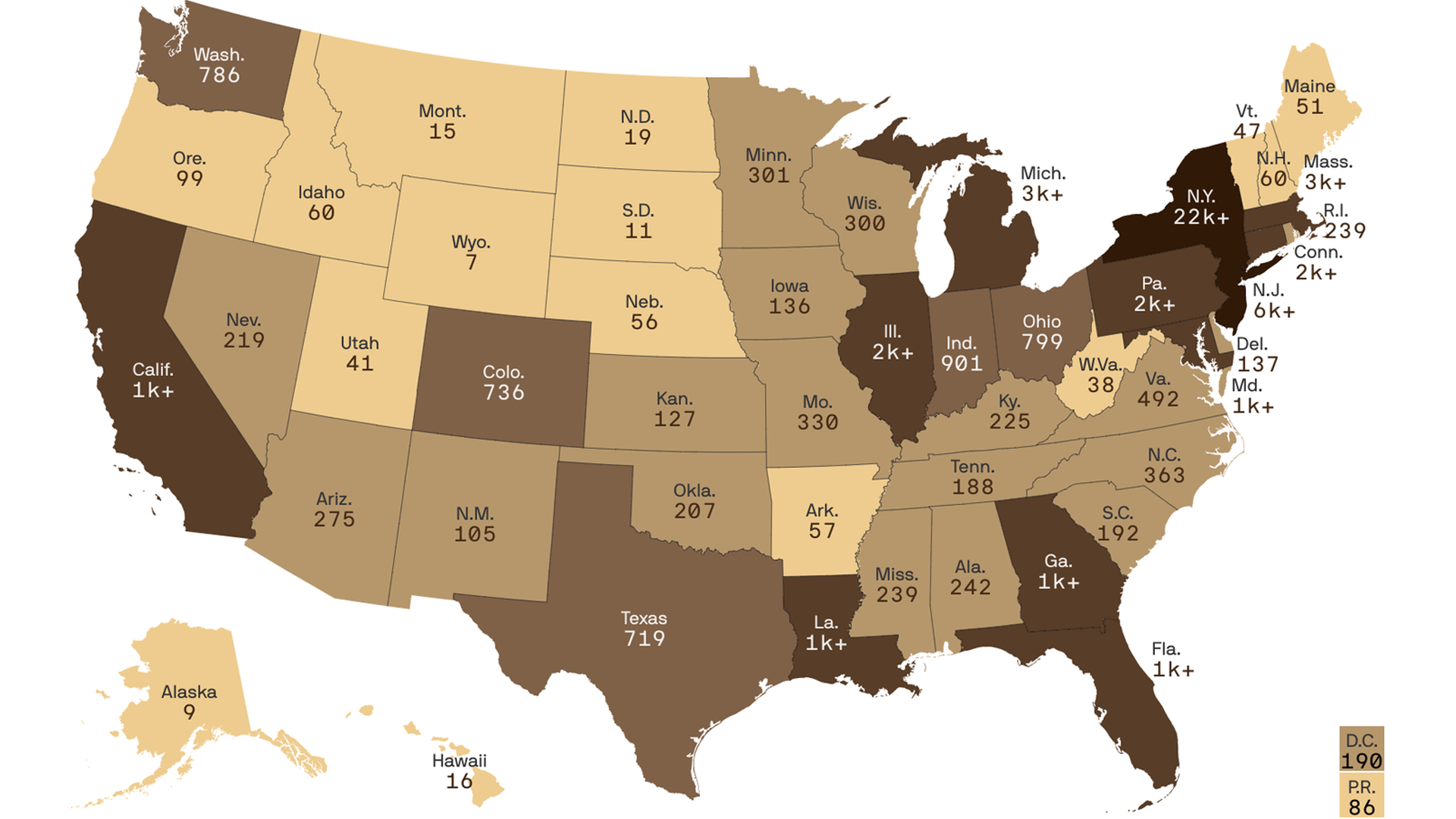
In New York, the state that accounts for about a third of all U.S. infections, Governor Andrew Cuomo on Monday outlined plans to ease restrictions on a regional basis.

Without giving a specific time frame, Cuomo told a daily briefing that construction, manufacturing and the wholesale supply chain would be allowed to start up under the first phase of a four-step return to normality.

A second phase would permit insurance, retail, administrative support and real estate businesses to open again, followed by restaurants, food services, hotels and accommodation businesses in the third stage, Cuomo said. In the final phase, arts, entertainment and recreation facilities and education would restart.

Cuomo suggested that rural parts of New York might be relaxed ahead of “higher-risk regions,” including New York City.

California Governor Gavin Newsom said on Monday he would ease the state’s stay-at-home orders by Thursday, expanding the number of retail businesses that can provide curbside services.

“This is an optimistic day, as we see a little bit of a ray of sunshine,” Newsom told a news conference.

Florida began a gradual restart of its economy on Monday. In the first phase, retail merchants and restaurants will open, with indoor patronage limited to 25% of capacity. Eateries are also allowed to open outdoor seating with social distancing, and medical practices can resume elective surgeries and procedures.

In Ohio, Governor Mike DeWine was allowing construction and manufacturing to reopen on Monday, and letting office workers return.


The Health 202: Social distancing hasn’t been as effective in stemming U.S. coronavirus deaths as policymakers had hoped.

https://www.washingtonpost.com/news/powerpost/paloma/the-health-202/2020/05/05/the-health-202-social-distancing-hasn-t-been-as-effective-in-stemming-u-s-coronavirus-deaths-as-policymakers-had-hoped/5eb04b6d88e0fa594778ea5e/

Social distancing isn’t having the effects many had hoped for.

Despite encouraging signs on the nation’s East and West coasts, daily diagnosed cases of the novel coronavirus appear to still be on the rise in about 20 states. A number of rural counties have become unexpected hot spots in recent weeks, including in the Black Belt region of Mississippi and Alabama and in communities throughout Iowa and northern Texas around the Oklahoma panhandle. The country’s overall daily figures of diagnoses and deaths have plateaued, worrying health policymakers as many states move to reopen parts of their economy.

That steep curve of covid-19 cases in March and April isn’t receding the way it rose.

Hot spots are shifting geographically from New York City to areas around the country. For the past month, the figures have hovered around 30,000 diagnosed cases and around 2,000 deaths every day, former Food and Drug Administration commissioner Scott Gottlieb noted in a Wall Street Journal op-ed.

“Everyone thought we’d be in a better place after weeks of sheltering in place and bringing the economy to a near standstill,” he wrote. “Mitigation hasn’t failed; social distancing and other measures have slowed the spread. But the halt hasn’t brought the number of new cases and deaths down as much as expected or stopped the epidemic from expanding.”

President Trump, who last week suggested the novel coronavirus would disappear even without a vaccine, has now upgraded his prediction of fatalities to as many as 100,000 people. Nonetheless, he said in a New York Post interview yesterday that Americans are “starting to to feel good now. The country’s opening again. We saved millions of lives, I think.”

A leaked government report, still in draft version, predicts a spike in cases and deaths beginning on May 14.

The report, which the Centers for Disease Control quickly disavowed as an unfinished projection, suggests new cases could surge to 200,000 per day and daily American deaths could number more than 3,000 by June 1. That’s far more than what other models predict, but the Johns Hopkins epidemiologist who prepared it told my colleagues William Wan, Lenny Bernstein, Laurie McGinley and Josh Dawsey that 100,000 new cases per day by the end of the month isn’t out of the realm of possibility.

Former FDA commissioner Scott Gottlieb:

University of Michigan professor Justin Wolfers:

That’s not the only model showing discouraging figures for the month of May. A model out of the University of Washington, relied upon heavily by the administration, yesterday upgraded its U.S. fatality predictions for the virus’s first wave from 72,433 deaths to 134,475 deaths by Aug. 4.

These aren’t the trends many policymakers had hoped to see, after most Americans spent seven weeks at home under an unprecedented lockdown that has torched the once-booming economy and thrust millions into economic uncertainty. Protests against extended lockdowns are starting to mount around the country, and many governors have assembled and even embarked upon gradual plans to reopen businesses, schools and other public areas.

Nonetheless, a new Washington Post-University of Maryland poll out this morning shows sizable majority of Americans oppose the reopening of restaurants, retail stores and businesses.

Executive producer of 7News WHDH in Boston:

Social distancing did accomplish some important objectives. It undoubtedly saved the health-care system from being crushed by an overwhelming caseload of sick patients all at once.

And the United States is still outranked by half a dozen European countries when it comes to deaths per capita. The U.S. death rate is about 206 deaths per million people. That figure is 538 in Spain, 372 in France, 481 in Italy, 432 in the United Kingdom and 207 in Switzerland, according to a tally by Mother Jones.

But distancing clearly hasn’t been enough — at least the way it’s been carried out — to halt the spread of the highly contagious virus in some places.

New cases and deaths across the whole U.S. are about where they were 20 days ago, my colleague Philip Bump reports. He created a graphic where you can view the three-day averages of cases, deaths and tests performed by state (check it out here).

“The back of the mountain doesn’t look the way the front did,” Philip writes. “We saw a steady, exponential rise in confirmed cases and deaths each day for several weeks. But particularly with daily case totals, the period after the peak nationally has looked more like a plateau than a downward slide.”

Daily cases appear to be rising significantly in Delaware, Illinois, Indiana, Minnesota and Virginia. They’re also trending upward in Arizona, Colorado, D.C., Iowa, Kansas, Maryland, Mississippi, Nebraska, New Hampshire, New Mexico, North Carolina, Tennessee, Texas, Utah and Wisconsin.

Andy Slavitt, former head of the Centers for Medicare and Medicaid Services:

“There are so many emerging areas still throughout the country that our group has been trying to wave our hands about,” Marynia Kolak, a health and spatial data science researcher at the University of Chicago, told me.

Kolak and her colleagues are tracking covid-19 cases and deaths at the county level. They’ve been increasingly spotting clusters of the disease in rural areas. Kaiser Family Foundation researchers have also found that rural areas are experiencing a faster growth in cases, even as their total numbers remain far below those seen in urban settings.

One example: Five counties in Minnesota with significant meat-processing plants. State officials said about a quarter of cases reported over the weekend came from those counties.

One is Nobles County, home to a JBS USA pork processing plant in Worthington, with a population of around 22,000. It is scheduled to partially reopen this week, under an order by Trump to keep meat plants open.

The outbreaks in counties with meat-processing plants “illustrates how powerfully situations can change at the community level,” said Jan Malcolm, commissioner of Minnesota’s Department of Health.

Malcolm stressed how hard it is to stem the spread of the virus in these types of facilities.

“These are particularly challenging investigations,” Malcolm said. “Many of the workers involved don’t have phones, don’t provide phone numbers, aren’t answering calls. It’s been a very labor-intensive, shoe-leather kind of an approach.”


White House prohibits coronavirus task force members from testifying before Congress in May

https://thehill.com/homenews/administration/496016-white-house-prohibits-coronavirus-task-force-members-from-testifying?userid=12325

White House prohibits coronavirus task force members from ...

White House coronavirus task force members are prohibited from testifying before Congress this month under new guidance issued by the Trump administration Monday.

Task force members and key deputies have been instructed not to accept invitations to participate in congressional hearings in May, while other agencies responding to the pandemic are being advised to limit the number of hearings they attend.

Top administration officials argue the coronavirus task force and the primary agencies responding to the pandemic need to focus their attention and resources on response efforts, and that having them testify could use up critical hours.

“We’re telling agencies that during this unprecedented time our resources need to be dedicated toward the coronavirus. At this stage we really need everybody manning their stations and prioritizing coronavirus response work,” a senior administration official told The Hill.

The move comes just days after the White House blocked Anthony Fauci, the nation’s top infectious disease expert and a task force member, from testifying before a House panel.

The White House shot back at allegations it was attempting to silence officials, arguing it will allow for testimony at a later date.

“While the Trump Administration continues its whole-of-government response to COVID-19, including safely opening up America again and expediting vaccine development, it is counter-productive to have the very individuals involved in those efforts appearing at Congressional hearings,” White House deputy press secretary Judd Deere said in a statement last week.

According to the new guidance, “no more than one COVID-related hearing should be agreed to with the department’s primary House and Senate authorizing committee and appropriations subcommittee for the Department of Health and Human Services, Department of Homeland Security and the State Department” with a cap of four coronavirus-related hearings departmentwide through the end of the month.

White House chief of staff Mark Meadows is authorized to approve exemptions to the new protocol, and administration officials noted the guidance will be revisited and could change depending on the circumstances.

The new guidance comes as the Senate comes back into session and the House grapples with how to best bring members back to Washington safely amid the pandemic.

Fauci is currently slated to appear before the Senate Health, Education, Labor and Pensions Committee for a coronavirus-related hearing on May 12.

Other agencies and departments are permitted to accept hearing invitations but have been advised that they should prioritize putting resources toward pandemic response efforts.

“The demands on agencies’ staff and resources are extraordinary in this current crisis. Agencies must maximize their resources for COVID-19 response efforts and treat hearing requests accordingly,” the guidance says.

“Given these competing demands in these unprecedented times, it is reasonable to expect that agencies will have to decline invitations to hearings to remain focused on implementing of COVID-19 response, including declining to participate in multiple hearings on the same or overlapping topics.”

The administration previously issued guidance pulling back on hearings related to COVID-19 in March.


The good and bad news about asymptomatic coronavirus cases

https://www.axios.com/asymptomatic-carrier-coronavirus-fauci-b7ccb7e4-b972-412e-b461-0e07f0689cb7.html

The good news and bad news about asymptomatic coronavirus cases ...

We don’t yet know what proportion of people infected with the coronavirus are asymptomatic, but it’s becoming clear that there’s a large number of them.

Why it matters: The more people that have been asymptomatic carriers of the coronavirus, the lower its fatality rate. But asymptomatic carriers also present unique problems for stopping the virus’s spread, as they likely don’t know they have it.

The big picture: Until we can do widespread, reliable antibody testing to determine how many people have had the virus, the best data we have to go off of are one-off studies — which have suggested widely varying rates of asymptomatic carriers.

  • A study earlier this month found that 13.9% of 3,000 New Yorkers tested had signs of the coronavirus, suggesting that about 10 times the number of people who have officially tested positive have had it, per Bloomberg. That means a lot of people either couldn’t get tested, or never knew anything was wrong.
  • Around half of the soldiers on the Theodore Roosevelt aircraft carrier who tested positive for the coronavirus were asymptomatic, per the LA Times. Another study found that about 18% of positive cases on the Diamond Princess cruise ship were asymptomatic.
  • “We don’t know the definitive answer, but it probably is a substantial proportion,” infectious disease expert Anthony Fauci told me. “That is a non-scientifically based estimate, based on these dribs and drabs of information that we get.”

Between the lines: If asymptomatic cases are common, that mathematically increases the likelihood (age and pre-existing conditions aside) that you or I could catch the virus and be completely fine.

  • It also means that a lower percentage of people who get the coronavirus will need hospitalization, which is good news for the health care system.
  • In the darkest of plausible scenarios, where we fail to contain the virus and it spreads relatively unencumbered throughout the U.S., a high asymptomatic rate would translate into a lower death rate — a small comfort.

Yes, but: It also is hugely problematic for efforts to keep the coronavirus from spreading.

  • It could then spread undetected, and if there’s already a high number of asymptomatic cases, that means the virus may be more widespread than we thought.
  • It also makes the virus hard to track. “If you have so many asymptomatic people around, it’s going to be much more difficult to get your arms around contact tracing, because you’re going to have so many people who get exposed to someone who is asymptomatic,” Fauci said. That puts extra emphasis on the need to do surveillance testing even among healthy-seeming populations, particularly in places like prisons and nursing homes.

The bottom line: A low number of asymptomatic cases would mean the virus is deadlier than we’d like it to be, while a high number of such cases means it most likely has been more widely transmitted. The uncertainty around that complicates how to manage its spread.


New report says coronavirus pandemic could last for two years – and may not subside until 70% of the population has immunity

https://www.cbsnews.com/news/coronavirus-pandemic-update-two-years-70-percent-immunity/

Coronavirus (COVID-19) Recovery Depends on Herd Immunity, Doctor Says

As coronavirus restrictions around the world are being lifted, a new report warns the pandemic that has already killed more than 230,000 people likely won’t be contained for two years. The modeling study from the Center for Infectious Disease Research and Policy (CIDRAP) at the University of Minnesota also says that about 70% of people need to be immune in order to bring the virus to a halt.

For the study, experts looked at eight major influenza pandemics dating back to the 1700s, as well as data about the new coronavirus, to help forecast how COVID-19 may spread over the coming months and years. Out of the eight past flu pandemics, scientists said seven had a second substantial peak about six months after the first one. Additionally, some had “smaller waves of cases over the course of 2 years” after the initial outbreak.

A key factor in their prediction for the current pandemic revolves around herd immunity, which refers to the community-wide resistance to the spread of a contagious disease that results when a high percentage of people are immune to it, either through vaccination or prior exposure. 

“The length of the pandemic will likely be 18 to 24 months, as herd immunity gradually develops in the human population,” the report says. “Given the transmissibility of SARS-CoV-2” — the virus that causes COVID-19 — “60% to 70% of the population may need to be immune to reach a critical threshold of herd immunity to halt the pandemic.”

It will take time to reach that point, since data from blood tests show only a small fraction of the overall population has been infected so far, and a possible vaccine is still months if not a year or more away. It is not yet clear whether people who’ve recovered from the infection will be immune or how long such protection would last.

The report lays out several possible scenarios, including one in which a larger wave of illnesses may happen in the fall or winter of 2020 and then subsequent smaller waves in 2021. The researchers say this model — similar to the pattern seen in the devastating 1918 Spanish flu pandemic — would “require the reinstitution of mitigation measures in the fall in an attempt to drive down spread of infection and prevent healthcare systems from being overwhelmed.” 

Two other scenarios in the report involve either recurring peaks and valleys of outbreaks, or smaller waves of illness over the next two years.

In any case, the researchers said people must be prepared for “at least another 18 to 24 months of significant COVID-19 activity, with hot spots popping up periodically” in different geographic areas.

As the virus continues to circulate among the human population and outbreaks finally start to wane, they say it will likely “synchronize to a seasonal pattern with diminished severity over time.”


8 states reporting spikes in COVID-19 cases, deaths

https://www.beckershospitalreview.com/public-health/8-states-reporting-spikes-in-covid-19-cases-deaths.html?utm_medium=email

The week began with sharp increase in prices :: CottonYarn

The following eight states have reported sharp increases in new coronavirus cases and deaths:

1. On May 2, for the third day in a row, Texas reported more than 1,000 new coronavirus cases, according to CNBC. The state’s health department reported 1,293 new positive cases of COVID-19, the first weekend of the state’s limited reopening.

2. On May 2, New York reported 831 new cases of the coronavirus and 299 deaths, according to The Hill. Gov. Andrew Cuomo called the number of new COVID-19 deaths in the state “obnoxiously and terrifyingly high.”

3. Nearly 13 percent of all tests for the new coronavirus came back positive May 1 in Wisconsin, indicating a spike in new cases, WISN-TV, an ABC affiliate reports.

4. Georgia reported two days of nearly 1,000 new coronavirus cases on April 30 and May 1, according to The Atlanta Journal-Constitution. The confirmed case count reached 28,332 May 2, and the death toll from the disease increased to 1,174.

5. With 516 more cases confirmed in Tennessee May 3, the total number of positive cases in the state has jumped to 13,177, according to News Channel 5 Nashville.

6. On May 3, Missouri reported more than 200 new coronavirus cases, for the third day in a row, bringing the state’s total to 8,386 cases, KSDK, an NBC affiliate reports. St. Louis alone reported nearly 100 new COVID-19 cases May 3, CBS affiliate KMOV reports.

7. Pennsylvania reported 49,267 confirmed COVID-19 cases, as of May 3, according to CBS Pittsburgh. The state reported 962 new positive cases of the new virus and 26 more deaths, bringing the statewide death toll to 2,444.

8. The number of coronavirus cases in Massachusetts rose by 1,824, officials reported May 3, and the death toll increased by 158, bringing the statewide total to 68,087 cases and 4,004 deaths, NBC Boston reports.


U.S. Coronavirus Updates

https://www.axios.com/coronavirus-west-virginia-first-case-ac32ce6d-5523-4310-a219-7d1d1dcb6b44.html

COVID-19 in the U.S.

As of May 3, 11pm EDT

Deaths     Confirmed cases

67,682         1,158,040

Kudlow defends claiming U.S. had coronavirus "contained" in ...


Former FDA commissioner Scott Gottlieb said on Sunday that despite widespread mitigation efforts, the coronavirus has exhibited “persistent spread” that could mean a “new normal” of 30,000 new cases and over 1,000 deaths a day through the summer.

The big picture: COVID-19 has killed over 66,000 Americans and infected over 1.1 million others in less than three months since the first known death in the U.S., Johns Hopkins data shows.

By the numbers: As states try to mitigate the spread of the coronavirus while easing restrictions, unemployment filings in the U.S. topped 30 million in six weeks, and the number of unemployed could be higher than the weekly figures suggest.

  • Over 175,000 Americans have recovered from the virus and over 6.8 million tests have been conducted in the U.S. as of Sunday.

Catch up quick: The number of deaths in states hit hardest by the coronavirus is well above the normal range, according the CDC.

Lockdown measures: Dozens of states have outlined plans to ease coronavirus restrictions, but the pandemic’s impact on our daily lives, politics, cities and health care will outlast stay-at-home orders.


Reopening is a risk for Republican governors

https://www.axios.com/coronavirus-reopening-republican-governors-cases-deaths-c0233fd4-8f92-448e-a11c-ec5bded1def1.html

Coronavirus reopening is a risk for Republican governors - Axios

Republican governors run a big risk — both to public health and their own political fortunes — if they open up their economies too soon, without adequate safeguards.

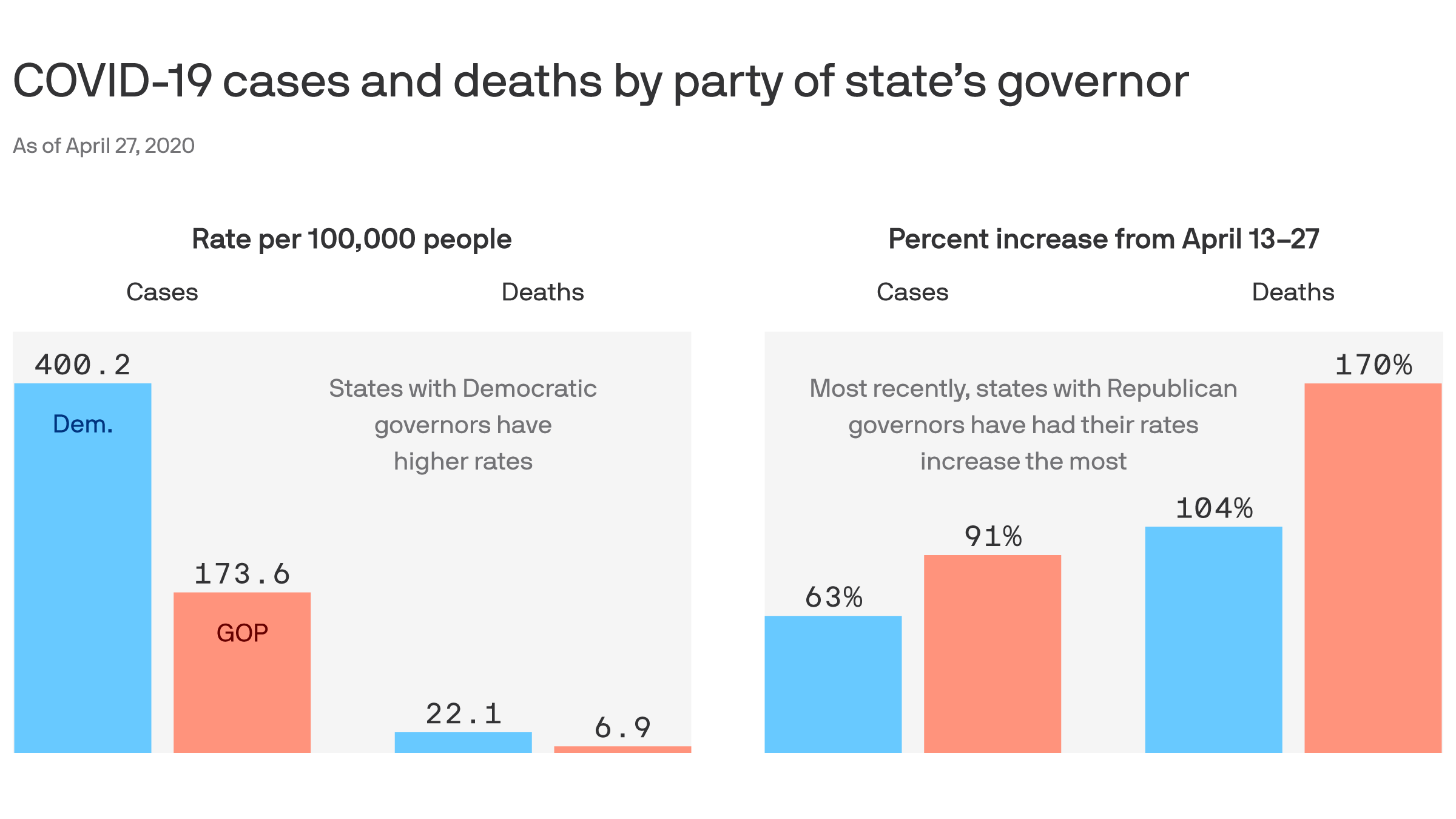
The big picture: The hardest-hit areas so far have mostly been in states with Democratic governors. But the number of coronavirus cases is now increasing more quickly in states with Republican governors.

By the numbers: Coronavirus cases and deaths are both higher in Democratic states than in Republican ones, even after adjusting for population.

  • However, over the last two weeks, reported infections have increased 91% in red states versus 63% in blue states.
  • We see the same pattern for COVID-19 deaths: 170% growth in red states vs. 104% in blue states.

Driving the news: Texas has begun easing its lockdown measures, and other red states are also moving quickly. Florida has reopened some beaches, and some southern states in particular never locked down as tightly as the Northeast and West coast.

  • Yes. but: Every governor wants to open up when they can to get the economy going, and there are some Democratic governors who are also taking steps to ease distancing measures.

Between the lines: The core of the Republican base in white, rural areas is at risk.

  • 20% of people living in non-metro areas are older than 65, compared with 15% in metro areas.
  • And rural residents under 65 are more likely to have pre-existing health conditions (26%), compared to their urban counterparts (20%).

The bottom line: Polls show that Republicans are far more likely than Democrats to think that the worst is behind us when it comes to COVID-19.

  • That may be partly because they, and the Republican governors, think this is largely someone else’s problem. It isn’t.


U.S. coronavirus caseload has held steady

https://www.axios.com/newsletters/axios-vitals-5da91be0-bb6c-44a4-8571-d723352e6ef9.html?utm_source=newsletter&utm_medium=email&utm_campaign=newsletter_axiosvitals&stream=top

The number of new coronavirus cases in the U.S. has held steady ...

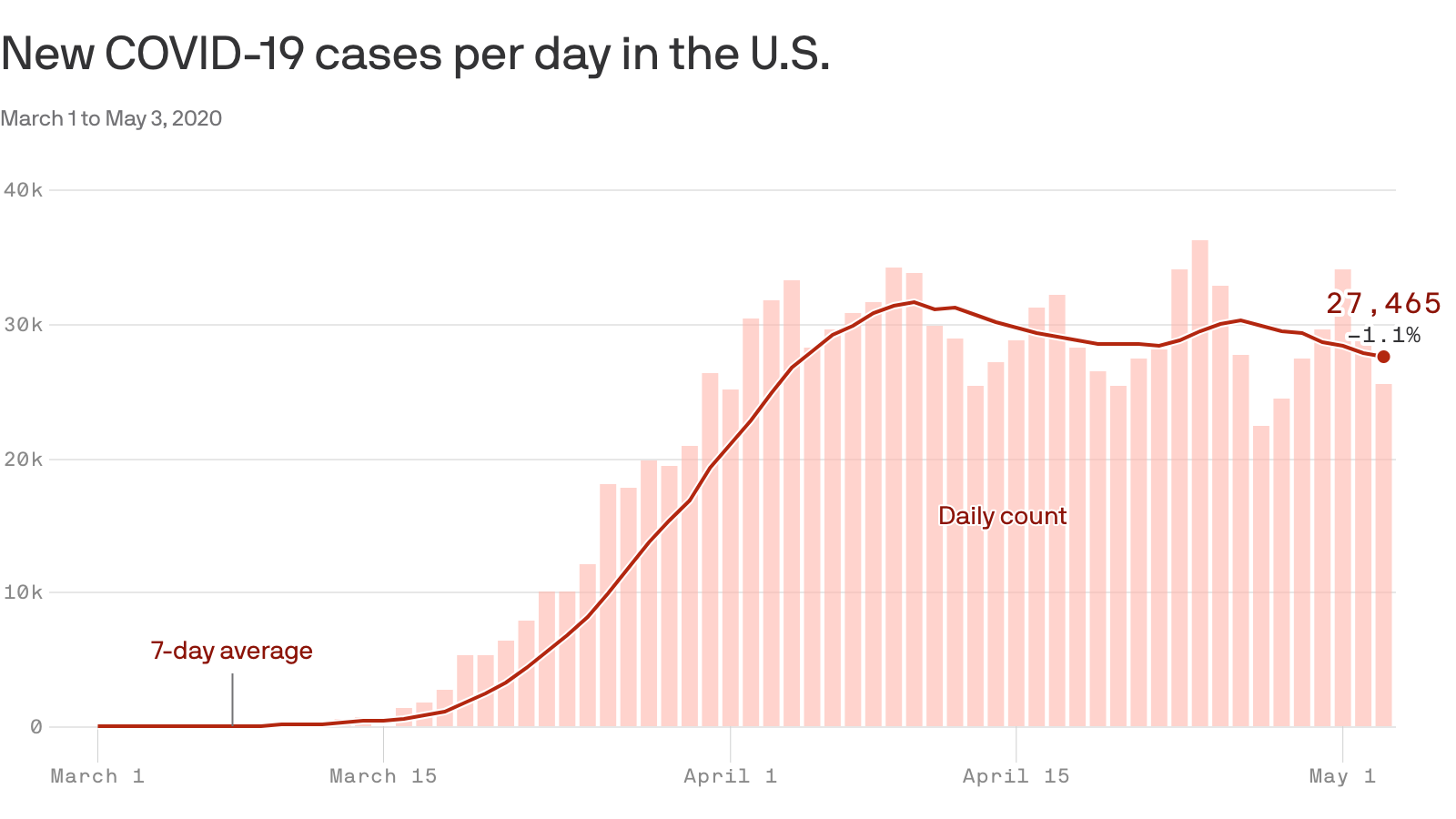
The number of new coronavirus cases nationally hovered around 30,000 a day during the entire month of April, meaning that the virus has managed to spread in spite of stringent social distancing measures.

Why it matters: Many states have already started to lift these measures, which will enable the virus to spread even faster.

Between the lines: Many Americans — like health care workers, grocery workers and emergency personnel — haven’t been able to stay home, as their jobs are considered essential. That’s enabled the virus to spread among these populations.

  • It has also been able to spread among people who live close together, like nursing home residents.

The big picture: The fewer people who have the virus once society reopens, the easier it will be to control. That’s part of why we shut down — the caseload had already outgrown our public health infrastructure’s ability to respond to it.

  • We’ve built up our testing capacity over the last several weeks and are starting to do the same with contact tracing, but these tools can only do so much against exponential spread — even when fully developed, which they’re not yet.
  • Even if we’re able to keep the caseload at current levels, that’s still an enormously challenging reality to live with.

What they’re saying: “Continuing spread at something near current levels may become the cruel ‘new normal.’ Hospitals and public-health systems will have to contend with persistent disease and death,” former FDA commissioner Scott Gottlieb wrote in a Wall Street Journal op-ed yesterday.

The bottom line: April was tough, but as states begin to reopen, we don’t yet know what lies ahead of us.

  • Things could get worse, or today’s status quo could be in place for a long time.
  • What happens will look different from one community to another.


How Long Will a Vaccine Really Take?

Health - Digg

A vaccine would be the ultimate weapon against the coronavirus and the best route back to normal life. Officials like Dr. Anthony S. Fauci, the top infectious disease expert on the Trump administration’s coronavirus task force, estimate a vaccine could arrive in at least 12 to 18 months.

The grim truth behind this rosy forecast is that a vaccine probably won’t arrive any time soon. Clinical trials almost never succeed. We’ve never released a coronavirus vaccine for humans before. Our record for developing an entirely new vaccine is at least four years — more time than the public or the economy can tolerate social-distancing orders.

But if there was any time to fast-track a vaccine, it is now. So Times Opinion asked vaccine experts how we could condense the timeline and get a vaccine in the next few months instead of years.

Here’s how we might achieve the impossible.

Normally, researchers need years to secure funding, get approvals and study results piece by piece. But these are not normal times.

There are already at least 254 therapies and 95 vaccines related to Covid-19 being explored.

“If you want to make that 18-month timeframe, one way to do that is put as many horses in the race as you can,” said Dr. Peter Hotez, dean of the National School of Tropical Medicine at Baylor College of Medicine.

Despite the unprecedented push for a vaccine, researchers caution that less than 10 percent of drugs that enter clinical trials are ever approved by the Food and Drug Administration.

The rest fail in one way or another: They are not effective, don’t perform better than existing drugs or have too many side effects.

Fortunately, we already have a head start on the first phase of vaccine development: research. The outbreaks of SARS and MERS, which are also caused by coronaviruses, spurred lots of research. SARS and SARS-CoV-2, the virus that causes Covid-19, are roughly 80 percent identical, and both use so-called spike proteins to grab onto a specific receptor found on cells in human lungs. This helps explain how scientists developed a test for Covid-19 so quickly.

There’s a cost to moving so quickly, however. The potential Covid-19 vaccines now in the pipeline might be more likely to fail because of the swift march through the research phase, said Robert van Exan, a cell biologist who has worked in the vaccine industry for decades. He predicts we won’t see a vaccine approved until at least 2021 or 2022, and even then, “this is very optimistic and of relatively low probability.”

And yet, he said, this kind of fast-tracking is “worth the try — maybe we will get lucky.”

The next step in the process is pre-clinical and preparation work, where a pilot factory is readied to produce enough vaccine for trials. Researchers relying on groundwork from the SARS and MERS outbreaks could theoretically move through planning steps swiftly.

Sanofi, a French biopharmaceutical company, expects to begin clinical trials late this year for a Covid-19 vaccine that it repurposed from work on a SARS vaccine. If successful, the vaccine could be ready by late 2021.

As a rule, researchers don’t begin jabbing people with experimental vaccines until after rigorous safety checks.

They test the vaccine first on small batches of people — a few dozen during Phase 1, then a few hundred in Phase 2, then thousands in Phase 3. Months normally pass between phases so that researchers can review the findings and get approvals for subsequent phases.

But “if we do it the conventional way, there’s no way we’re going to be reaching that timeline of 18 months,” said Akiko Iwasaki, a professor of immunobiology at Yale University School of Medicine and an investigator at the Howard Hughes Medical Institute.

There are ways to slash time off this process by combining several phases and testing vaccines on more people without as much waiting.

Last week the National Academy of Sciences showed an overlapping timeline, describing it as moving at “pandemic speed.”

It’s here that talk of fast-tracking the timeline meets the messiness of real life: What if a promising vaccine actually makes it easier to catch the virus, or makes the disease worse after someone’s infected?

That’s been the case for a few H.I.V. drugs and vaccines for dengue fever, because of a process called vaccine-induced enhancement, in which the body reacts unexpectedly and makes the disease more dangerous.

Researchers can’t easily infect vaccinated participants with the coronavirus to see how the body behaves. They normally wait until some volunteers contract the virus naturally. That means dosing people in regions hit hardest by the virus, like New York, or vaccinating family members of an infected person to see if they get the virus next. If the pandemic subsides, this step could be slowed.

“That’s why vaccines take such a long time,” said Dr. Iwasaki. “But we’re making everything very short. Hopefully we can evaluate these risks as they occur, as soon as possible.”

This is where the vaccine timelines start to diverge depending on who you are, and where some people might get left behind.

If a vaccine proves successful in early trials, regulators could issue an emergency-use provision so that doctors, nurses and other essential workers could get vaccinated right away — even before the end of the year. Researchers at Oxford announced this week that their coronavirus vaccine could be ready for emergency use by September if trials prove successful.

So researchers might produce a viable vaccine in just 12 to 18 months, but that doesn’t mean you’re going to get it. Millions of people could be in line before you. And that’s only if the United States finds a vaccine first. If another country, like China, beats us to it, we could wait even longer while it doses its citizens first.

You might be glad of that, though, if it turned out that the fast-tracked vaccine caused unexpected problems. Only after hundreds or thousands are vaccinated would researchers be able to see if a fast-tracked vaccine led to problems like vaccine-induced enhancement.

“It’s true that any new technology comes with a learning curve,” said Dr. Paul Offit, the director of the Vaccine Education Center at the Children’s Hospital of Philadelphia. “And sometimes that learning curve has a human price.”

Once we have a working vaccine in hand, companies will need to start producing millions — perhaps billions — of doses, in addition to the millions of vaccine doses that are already made each year for mumps, measles and other illnesses. It’s an undertaking almost unimaginable in scope.

Companies normally build new facilities perfectly tailored to any given vaccine because each vaccine requires different equipment. Some flu vaccines are produced using chicken eggs, using large facilities where a version of the virus is incubated and harvested. Other vaccines require vats in which a virus is cultured in a broth of animal cells and later inactivated and purified.

Those factories follow strict guidelines governing biological facilities and usually take around five years to build, costing at least three times more than conventional pharmaceutical factories. Manufacturers may be able to speed this up by creating or repurposing existing facilities in the middle of clinical trials, long before the vaccine in question receives F.D.A. approval.

“They just can’t wait,” said Dr. Iwasaki. “If it turns out to be a terrible vaccine, they won’t distribute it. But at least they’ll have the capability” to do so if the vaccine is successful.

The Bill and Melinda Gates Foundation says it will build factories for seven different vaccines. “Even though we’ll end up picking at most two of them, we’re going to fund factories for all seven, just so that we don’t waste time,” Bill Gates said during an appearance on “The Daily Show.”

In the end, the United States will have the capacity to mass-produce only two or three vaccines, said Vijay Samant, the former head of vaccine manufacturing at Merck.

“The manufacturing task is insurmountable,” Mr. Samant said. “I get sleepless nights thinking about it.”

Consider just one seemingly simple step: putting the vaccine into vials. Manufacturers need to procure billions of vials, and billions of stoppers to seal them. Sophisticated machines are needed to fill them precisely, and each vial is inspected on a high-speed line. Then vials are stored, shipped and released to the public using a chain of temperature-controlled facilities and trucks. At each of these stages, producers are already stretched to meet existing demands, Mr. Samant said.

It’s a bottleneck similar to the one that caused a dearth of ventilators, masks and other personal protective equipment just as Covid-19 surged across America.

If you talk about vaccines long enough, a new type of vaccine, called Messenger RNA (or mRNA for short), inevitably comes up. There are hopes it could be manufactured at a record clip. Mr. Gates even included it on his Time magazine list of six innovations that could change the world. Is it the miracle we’re waiting for?

Rather than injecting subjects with disease-specific antigens to stimulate antibody production, mRNA vaccines give the body instructions to create those antigens itself. Because mRNA vaccines don’t need to be cultured in large quantities and then purified, they are much faster to produce. They could change the course of the fight against Covid-19.

“On the other hand,” said Dr. van Exan, “no one has ever made an RNA vaccine for humans.”

Researchers conducting dozens of trials hope to change that, including one by the pharmaceutical company Moderna. Backed by investor capital and spurred by federal funding of up to $483 million to tackle Covid-19, Moderna has already fast-tracked an mRNA vaccine. It’s entering Phase 1 trials this year and the company says it could have a vaccine ready for front-line workers later this year.

“Could it work? Yeah, it could work,” said Dr. Fred Ledley, a professor of natural biology and applied sciences at Bentley University. “But in terms of the probability of success, what our data says is that there’s a lower chance of approval and the trials take longer.”

The technology is decades old, yet mRNA is not very stable and can break down inside the body.

“At this point, I’m hoping for anything to work,” said Dr. Iwasaki. “If it does work, wonderful, that’s great. We just don’t know.”

The fixation on mRNA shows the allure of new and untested treatments during a medical crisis. Faced with the unsatisfying reality that our standard arsenal takes years to progress, the mRNA vaccine offers an enticing story mixed with hope and a hint of mystery. But it’s riskier than other established approaches.

Imagine that the fateful day arrives. Scientists have created a successful vaccine. They’ve manufactured huge quantities of it. People are dying. The economy is crumbling. It’s time to start injecting people.

But first, the federal government wants to take a peek.

That might seem like a bureaucratic nightmare, a rubber stamp that could cost lives. There’s even a common gripe among researchers: For every scientist employed by the F.D.A., there are three lawyers. And all they care about is liability.

Yet F.D.A. approvals are no mere formality. Approvals typically take a full year, during which time scientists and advisory committees review the studies to make sure that the vaccine is as safe and effective as drug makers say it is.

While some steps in the vaccine timeline can be fast-tracked or skipped entirely, approvals aren’t one of them. There are horror stories from the past where vaccines were not properly tested. In the 1950s, for example, a poorly produced batch of a polio vaccine was approved in a few hours. It contained a version of the virus that wasn’t quite dead, so patients who got it actually contracted polio. Several children died.

The same scenario playing out today could be devastating for Covid-19, with the anti-vaccination movement and online conspiracy theorists eager to disrupt the public health response. So while the F.D.A. might do this as fast as possible, expect months to pass before any vaccine gets a green light for mass public use.

At this point you might be asking: Why are all these research teams announcing such optimistic forecasts when so many experts are skeptical about even an 18-month timeline? Perhaps because it’s not just the public listening — it’s investors, too.

“These biotechs are putting out all these press announcements,” said Dr. Hotez. “You just need to recognize they’re writing this for their shareholders, not for the purposes of public health.”

What if It Takes Even Longer Than the Pessimists Predict?

Covid-19 lives in the shadow of the most vexing virus we’ve ever faced: H.I.V. After nearly 40 years of work, here is what we have to show for our vaccine efforts: a few Phase 3 clinical trials, one of which actually made the disease worse, and another with a success rate of just 30 percent.

Researchers say they don’t expect a successful H.I.V. vaccine until 2030 or later, putting the timeline at around 50 years.

That’s unlikely to be the case for Covid-19, because, as opposed to H.I.V., it doesn’t appear to mutate significantly and exists within a family of familiar respiratory viruses. Even still, any delay will be difficult to bear.

But the history of H.I.V. offers a glimmer of hope for how life could continue even without a vaccine. Researchers developed a litany of antiviral drugs that lowered the death rate and improved health outcomes for people living with AIDS. Today’s drugs can lower the viral load in an H.I.V.-positive person so the virus can’t be transmitted through sex.

Therapeutic drugs, rather than vaccines, might likewise change the fight against Covid-19. The World Health Organization began a global search for drugs to treat Covid-19 patients in March. If successful, those drugs could lower the number of hospital admissions and help people recover faster from home while narrowing the infection window so fewer people catch the virus.

Combine that with rigorous testing and contact tracing — where infected patients are identified and their recent contacts notified and quarantined — and the future starts looking a little brighter. So far, the United States is conducting fewer than half the number of tests required and we need to recruit more than 300,000 contact-tracers. But other countries have started reopening following exactly these steps.

If all those things come together, life might return to normal long before a vaccine is ready to shoot into your arm.