‘We’re going to come out of this winning:’ Northwell CEO on labor challenges and the system’s biggest growth area

New Hyde Park, N.Y.-based Northwell Health began 2023 with a low, but positive operating margin, but labor costs are expected to increase again this year on the back of recent union activity in the state. 

To offset such increases that were not anticipated in the 2023 budget, Northwell is evaluating opportunities to reduce expenses and increase revenue across the health system, which includes 21 hospitals and about 83,000 employees.

Michael Dowling, CEO of Northwell, spoke to Becker’s Hospital Review about the health system’s biggest challenge this year, how it approaches cost-cutting and why outpatient care is its biggest growth area.

Editor’s note: Responses are lightly edited for length and clarity.

Question: Many health systems saw margins dip last year amid rising inflation, increased labor costs and declining patient volumes. How have you led Northwell through the challenges of last year? 

Michael Dowling: We ended 2022 with a low, but positive margin. We’ve been coming back from COVID quite successfully, and we’re back pretty much in all areas to where we were prior to the pandemic. Volumes have returned and we’re very busy. We came into 2023 with a positive budget and a positive margin. We anticipate that you’re always going to have challenges and disturbances, but it’s important to stay focused and deal with it. We have a very detailed strategic plan, which outlines our various goals, and we stick to it. 

Q: What is your top priority today?

MD: The biggest issue for us today is labor costs. We have lots of union activity in New York at the moment. There were various nurse strikes in New York City at the beginning of the year. None of our hospitals were involved in those deliberations, but some of those hospitals agreed to contracts that have increases that were not anticipated in anybody’s 2023 budget. That’s going to have an effect on us. We have negotiations ongoing with the nurses’ union, and have 10 unions overall. About 90 percent of Northwell’s facilities have unions, so the bottom line is we are going to have expenses as a result of these contracts that were not anticipated in the budget. I don’t know the final number on these contracts yet, but it’s definitely going to be more than what we anticipated. 

The unions in New York get a lot of government support and have become very empowered and quite aggressive. The bottom line is there’s more expense than we anticipated in our budget, so we need to figure out how to address that. We’re looking at everything across our health system to find expense reductions or revenue enhancements to be able to make up for the increased labor costs and be optimistic about ending the year with a positive margin. But we’re in a good place and are not like some other health systems that are struggling financially. 

Q: Where are the biggest opportunities to reduce expenses or increase revenue to offset the increased labor costs?

MD: It’s a combination of a lot of things. We have a detailed capital plan that we may slow down. We hire about 300 people a week, so maybe we’ll target that hiring into specific areas and not be as broad based as we thought we could be. We will examine if we have specific programs or initiatives we can curtail without doing any damage to our core mission. It will end up being a portfolio of items; it won’t be one big thing. On the revenue side, we’re working very hard to increase our neurosurgery, cardiac, cancer and orthopedic businesses. Over the next couple of months, all of those things will be taken into consideration. The bottom line is we are going to come out of this winning.

Q: Looking three or four years down the line, where do you see the biggest growth opportunities for Northwell?

MD: Our biggest growth is in outpatient care. A lot of surgeries are moving outpatient, so we have to get ahead of that. Some think we are only a hospital system, but only about 46 percent of our business is from our hospital sector today. Home care is going to grow phenomenally, especially given the new technology that’s available. Digital health will also dramatically expand. 

We’re also looking at expanding into new geographic areas and markets. It’s about positioning your offerings in places close to where people live, so you reduce the inconvenience of people having to travel long distances for care when it should be available to them closer to home. When you do that, you increase market share. We’re constantly increasing our market share by being very aggressive about going to where the customer is and providing the highest quality care that we can. Part of that is also being able to recruit top-line, quality physicians. When you do that, you attract new business because you have competencies that you didn’t have before. It’s a combination of all of these things, but there’s certainly no limit to the opportunities in front of us. We’re not in a world of challenges; we’re in a world of opportunity. The question is are we aggressive enough and do we have enough tolerance for some risk? We need to be as aggressive as we possibly can to take advantage of some of those opportunities. 

Q: What is the biggest challenge on the horizon for Northwell?

MD: The biggest challenge is the huge growth in government payer business — Medicare and Medicaid. The problem with Medicaid — especially in a union environment — is it doesn’t cover your costs. The government is a big part of a potential future issue there. By increasing Medicaid, the more of your business becomes Medicaid and the worse you end up doing, unless you can increase your commercial payer business to continue to cross-subsidize. We also have a lot of union negotiations over the next couple of months, which will put a strain on our 2023 budget, but we will resolve it.

Q: How do you see hospitals and health systems evolving as CMS, commercial payers and patients continue to push more services to outpatient settings, where they can arguably be performed at a higher quality and lower cost?

MD: I think it’s going to continue to grow. For example, Northwell has 23 hospitals — 21 of which it owns — yet it has 890 outpatient facilities. We’ve been ahead of this curve a long time. Our primary expansion is in ambulatory care, not in-hospital care. Like I said, only 46 percent of Northwell’s total business is its hospital business. If you’re relying on the hospital to be the core provider of the future, you’re going to lose. You’ve got to take a little bit of a hit by going out and expanding your ambulatory presence. But the more you expand ambulatory and grow in the right locations, the more you increase market share, which brings more of the necessary inpatient care back to your hospitals. Our hospitals are growing and getting busier in addition to our outpatient centers because we are growing market share. If we enter a new community and see 100 people, five of them will need to be hospitalized. That’s a new market. Ambulatory cannot be disassociated from its connection to the inpatient market. 

Q: Many financial experts are projecting a recession this year. How might that affect hospitals and health systems, and how can they best prepare? 

MD: Even if we do have a recession, it doesn’t mean that people don’t get sick. In fact, people’s problems increase. Our business does not slow down if we have a recession; our business will probably increase. On the revenue side, it won’t necessarily affect our government reimbursement, which we don’t do well on anyway. The things you worry about during a recession is if employers give up the coverage of their staff. Then those employees with no insurance may go on a state Medicaid program, and that might affect hospitals. 

In the healthcare sector, even in a recession, the need for hospital services actually increases. No recession could be as bad as what we experienced during COVID, yet we managed it. We had a problem that we didn’t even understand, and we worked through it. I think healthcare deserves an extraordinary credit for what was done during COVID. If there is a recession, we will deal with it. It’s just one of those things that happens, and we will respond to it in as comprehensive a way as we can. I can’t control it, but I can control our response. Leadership to me is about having a positive disposition; basically saying that whatever happens to you, you’re going to win. 

The 20% Medicare cut coming for hospitals

As the U.S. prepares to end the COVID-19 public health emergency, hospitals are facing a major cut in Medicare payments used to treat patients diagnosed with the disease.

Since January 2020, hospitals nationwide have received a 20 percent increase in the Medicare payment rate through the hospital inpatient prospective payment system to treat COVID-19 patients — that policy ends May 11.

The sunsetting of the three-year policy is a key concern for the AHA because of its financial implication for hospitals already struggling with increased labor costs and inflation. 

From January 2020 to November 2021, payments for the 1 million traditional Medicare patients hospitalized with COVID-19 totaled $23.4 billion, or more than $24,000 per patient, according to lobbying and law firm Brownstein.

The end of the policy also has the potential to increase medical costs for patients hospitalized with COVID-19. If patients must pay higher costs for COVID-19-related services, they may be less inclined to get tested or even seek treatment.

“It means there will be less testing in this country, and likely less treatment because not everyone can afford it,” Jose Figueroa, MD, assistant professor of health policy and management at the Harvard T.H. Chan School of Public Health, told Time Jan. 31. “Will this change the trajectory of the pandemic? It’s something we are going to have to watch.”

As of Feb. 8, the nation’s seven-day COVID-19 case average was 40,404, a 1 percent decrease from the previous week’s average. The rate of decrease has slowed in the last two weeks — the CDC’s last weekly report published Feb. 3 reported a 6.7 percent drop in cases.

The seven-day hospitalization average for Feb. 1-7 was 3,665, a 6.2 percent decrease from the previous week’s average and down from an 8.4 percent drop in cases a week prior.

An unprecedented mental health crisis for adolescent girls

https://mailchi.mp/89b749fe24b8/the-weekly-gist-february-17-2023?e=d1e747d2d8

Responding to the Centers for Disease Control and Prevention’s (CDC) latest Youth Risk Behavior Survey for 2011-2021, an article in The Atlantic attempts to make sense of the historic levels of anxiety and depression being reported by today’s teens, especially girls and those who identify as lesbian, gay, or bisexual (the survey does not track trans identity). 

The survey, which is the definitive measure of youth behavior and mental health in the country, found nearly 60 percent of teenage girls reported “persistent feelings of sadness or hopelessness”, and that the share contemplating suicide grew by 50 percent since 2011. The article explores several possible drivers, including a pandemic-induced effect that could subside, pervasive exposure to social media, the normalization of discussing mental distress, and the outcome of growing up with ongoing crises like school shootings and climate change. But none of the explanations fully accounts for the alarming crisis, nor do any of them present easily workable solutions.

The Gist: Echoing the drug overdose epidemic, the unfolding crisis in teen mental health is difficult for providers to address because many victims don’t access healthcare services until their conditions deteriorate to the point of requiring hospitalization, often from a suicide attempt or an overdose.

And when teenagers in mental health crisis present to emergency departments, hospitals are often forced to board them for days, as the number of psychiatric treatment facilities for teens has dropped by 30 percent from 2012 to 2020.

These data should be a call for providers to focus more upstream diagnosis and care, by partnering with children, families, schools, and other community organizations.

The shrinking book of “profitable” health system business 

https://mailchi.mp/89b749fe24b8/the-weekly-gist-february-17-2023?e=d1e747d2d8

This week, a health system CFO referenced the thoughts we shared last week about many hospitals rethinking physician employment models, and looking to pull back on employing more doctors, given current financial challenges. He said, “We’ve employed more and more doctors in the hope that we’re building a group that will allow us to pivot to total cost management.

But we can’t get risk, so we’ve justified the ‘losses’ on physician practices by thinking we’re making it up with the downstream volume the medical group delivers.

But the reality now is that we’re losing money on most of that downstream business. If we just keep adding doctors that refer us services that don’t make a margin, it’s not helping us.” 


While his comment has myriad implications for the physician organization, it also highlights a broader challenge we’ve heard from many health system executives: a smaller and smaller portion of the business is responsible for the overall system margin.

While the services that comprise the still-profitable book vary by organization (NICU, cardiac procedures, some cancer management, complex orthopedics, and neurosurgery are often noted), executives have been surprised how quickly some highly profitable service lines have shifted. One executive shared, “Orthopedics used to be our most profitable service line. But with rising labor costs and most of the commercial surgeries shifting outpatient, we’re losing money on at least half of it.”

These conversations highlight the flaws in the current cross-subsidy based business model. Rising costs, new competitors, and a challenging contracting environment have accelerated the need to find new and sustainable models to deliver care, plan for growth and footprint—and find a way to get paid that aligns with that future vision.

Consumers are skeptical of “hospitals”—just not their own

https://mailchi.mp/89b749fe24b8/the-weekly-gist-february-17-2023?e=d1e747d2d8

Health systems have recently been the subject of high-profile media accusations that they prioritize “profits over patients”, as an unflattering New York Times series has framed it.

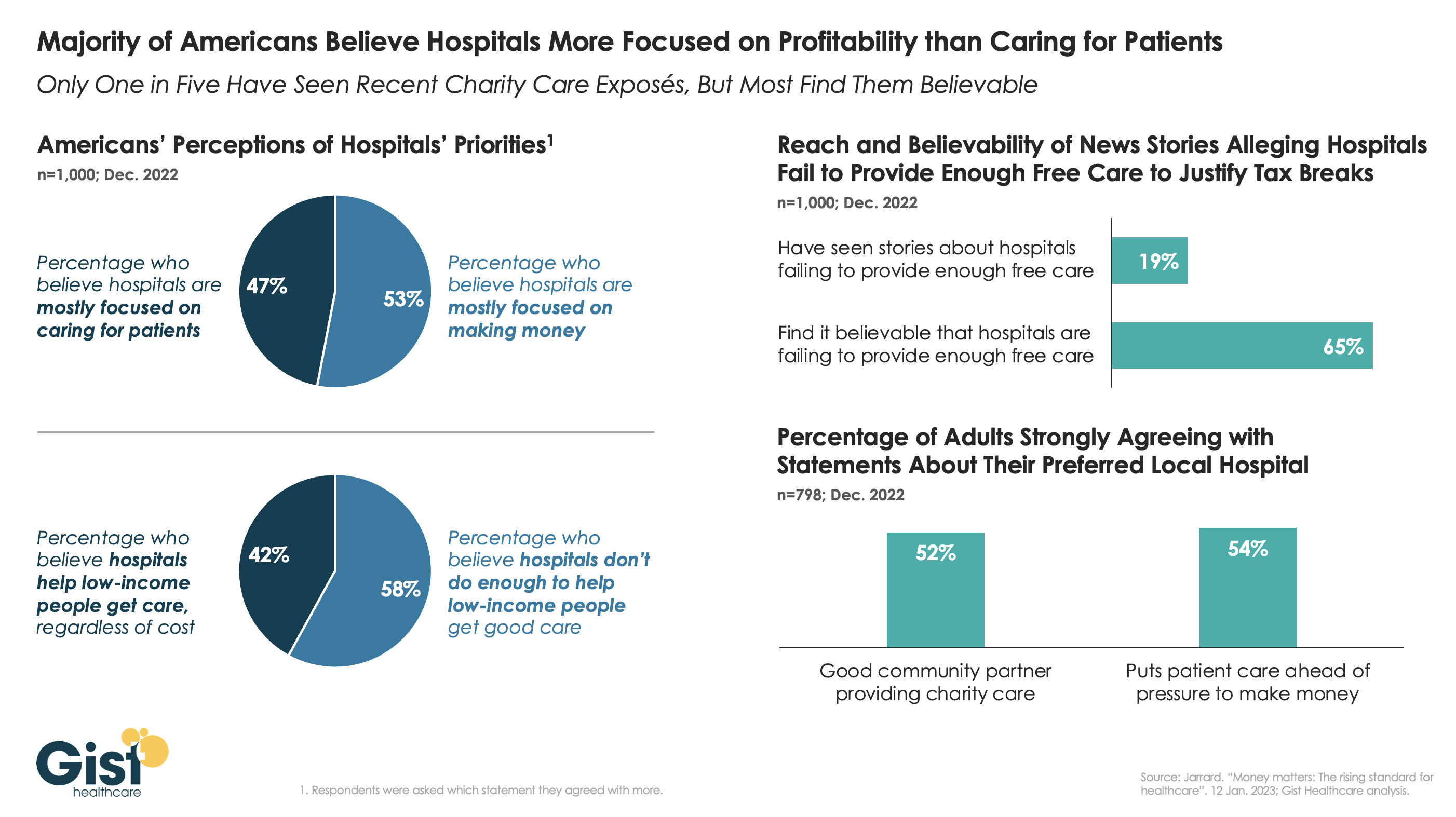
New consumer survey data from strategic healthcare communications consulting firm Jarrard Inc. shows that while consumers find some merit in these claims, they tend to see their local hospital in a better light. As shown in the graphic above, a majority of US adults believe that, on a national level, hospitals are more focused on making money than caring for patients, and that they don’t do enough to help low-income people access high quality care.

Despite only one in five survey participants having seen news stories alleging hospitals fail to provide enough charity care in exchange for tax breaks, 65 percent of survey respondents find those allegations believable.

But while the consumer perception of hospitals may be suffering nationally, the responses were quite different when consumers were asked about their preferred local hospital. More than half strongly agreed that their preferred local hospital is a good community partner—one that puts patient care ahead of making money.

(Just as with Congress: people love to criticize the institution, while continuing to return their own representatives to Washington.) While the negative national attention can be disheartening, at the end of the day, to consumers, healthcare is local, and health systems must continue to build direct consumer relationships to strengthen patient loyalty. 

Most board members at the nation’s top hospitals have no healthcare background: Study

Less than 15 percent of board members overseeing the nation’s top hospitals have a professional background in healthcare, while more than half have a background in finance or business services, according to a study published Feb. 8 in the Journal of General Internal Medicine.

The study’s authors represent Harvard Medical School and Brigham and Women’s Hospital in Boston and the University of Alabama at Birmingham. They wrote that they sought to understand which professions are represented most among hospital boards because they may influence the organization’s goals and overall strategy — there also had been little research done around the topic previously.

The study began in July by examining the 20 top-rated hospitals by US News & World Report in 2022, which are all nonprofit academic medical centers in urban areas. 

Only 15 of the 20 facilities publish board information online, and IRS filings for the remaining were incomplete or outdated.

For the 15 hospitals that provide information on their board members, the authors sorted their professional backgrounds across 11 industry sectors using the North American Industry Classification System, which is the federal standard. For board members with healthcare backgrounds, they were further categorized as trained physicians, nurses, or other workers. 

Four key takeaways:

1. At the 15 examined hospitals, there were 567 board members. The study was able to sort 529 into professional categories.

2. Among the 529 board members, 44 percent had a background in finance. Among them, more than 80 percent led private equity funds, wealth management firms, or multinational banks. The remainder were in real estate (14.7 percent) or insurance (5.2 percent).

3. The second and third most common sectors were health services (16.4 percent) and professional and business services (12.6 percent).

4. Across the 15 hospitals, 14.6 percent of board members were healthcare professionals — primarily physicians (13.3 percent) and followed by nurses (0.9 percent).

The study noted that its findings may not represent all hospitals because it only studied the highest-ranked, and some of those hospitals do not publicly report information on their board members. The study also did not examine “the community ties of board members to gauge local accountability of board decisions.”

The authors also noted that they did not examine the racial and gender makeup of boards, which they said merits further review — in 2018, 42 percent of U.S. hospital boards had all-white members and 70 percent of members were male.

4 health systems hit with rating downgrades

Here is a summary of recent credit rating downgrades, going back to the last Becker’s roundup on Jan. 17.

Operating concerns and a bleak financial outlook for some resulted in the following changes:

Geisinger Health System (Danville, Pa.): Moody’s Investors Service downgraded Geisinger Health System’s outstanding bonds from “A1” to “A2” Feb. 13 amid expectations of continued cash flow weakness. 

The outlook for the system, which has about $1.3 billion in debt, is stable. 

Marshfield (Wis.) Clinic Health System:  The system suffered a credit downgrade because of recent operating losses and amid expectations of no immediate financial improvement.

The S&P Global move Feb. 7 to downgrade the system to “BBB+” from “A-” follows a similar move from Fitch Jan. 18.

Marshfield signed a memorandum of understanding with Duluth, Minn.-based Essentia Health to discuss a potential merger Oct. 12 that would include 25 hospitals.

Tower Health (West Reading, Pa.): Troubled Tower Health, which is currently undergoing a strategic review and selling off several assets, suffered a rating downgrade on its bonds, S&P Global reported Feb. 6, adding that the outlook is negative.

“The downgrade reflects Tower Health’s significant ongoing operating losses that are expected to continue in fiscal 2023, and a steep decline in unrestricted reserves to a level that we view as highly vulnerable,” said S&P Global Ratings credit analyst Anne Cosgrove.

Fairview Health (Minneapolis): Moody’s Investors Service downgraded the revenue bond ratings of Fairview Health from “A3” to “Baa1.” 

The downgrade reflects Moody’s projection that weak operating performance will be challenging to overcome due to increased labor costs and lower inpatient volume. Inflation and annual transfers to the University of Minnesota in Minneapolis will also hamper margins, Moody’s said.

Adventist Health reorganizes; executive job cuts coming

Roseville, Calif.-based Adventist Health plans to go from seven networks of care to five systemwide to reduce costs and strengthen operations, according to a Feb. 15 news release shared with Becker’s.

Under the reorganization, Adventist Health will have separate networks for Northern California, Central California, Southern California, Oregon and Hawaii.

“Reducing the number of care networks strengthens our operational structure and broadens the meaning and purpose of our network model as well as the geographical span of one Adventist Health,” Todd Hofheins, COO of Adventist Health, said in the release. “This also reduces overhead and administrative costs.”

The reorganization will result in job cuts, including reducing administration by more than $100 million.

“Our commitment to rural and urban healthcare remains steadfast, and we are expanding to other locations to invest and transform the integrated delivery of care,” Kerry Heinrich, president and CEO of Adventist Health, said in the release.

Specifically, the health system has a recently approved affiliation agreement for Mid-Columbia Medical Center in The Dalles, Ore., to join Adventist Health, the health system said. The agreement is pending final regulatory and state approvals.

Meanwhile, Adventist Health filed a Worker Adjustment and Retraining Notification Act notice with California officials Feb. 15. 

Adventist Health will eliminate job functions and positions for employees at its corporate office campus along with some remote roles, the notice states.    

Layoffs from Adventist Health began Feb. 1 and will continue into April, according to the notice. 

Adventist Health said it has provided all affected employees 60 days’ written notice of the layoff. The health system expects about 59 employees to be separated from employment with Adventist Health. 

Employees affected by the layoffs include administrative directors, directors, managers and project managers, among others.

“We recognize that these changes impact people’s lives and want to respect each affected individual,” Joyce Newmyer, chief people officer for Adventist Health, said in the health system’s release. “We will make every effort to identify other opportunities for team members impacted.”

CommonSpirit records $451M operating loss in 2nd half of 2022

Chicago-based CommonSpirit Health, one of the largest healthcare systems in the country operating 138 hospitals in 21 states, has reported $451 million in operating losses for the six-month period ending Dec. 31.

Those figures compared with operating losses of $47 million for the same period in the prior year. Overall income for the second half of 2022 totaled a $213 million loss, but there was a gain of $200 million in the final quarter as stronger investment returns kicked in.

Staffing expenses continue to be a “major challenge,” CommonSpirit said. While salaries and benefits decreased $80 million in the final quarter, there was an overall increase of $140 million, or 1.7 percent, in such expenses over the second half of the year.

“We are meeting our challenges head on by scaling programs that drive growth, create a better experience for patients, and support our employees,” CFO Dan Morissette said in a statement. “At the same time we are working hard to reduce our costs so we can sustain these essential services in the long term.”

CommonSpirit estimated costs from its October cybersecurity event at approximately $150 million. The health system held $14.6 billion in debt as of Dec. 31.

4 health systems with recent credit rating upgrades

Here are four health systems that recently had their credit rating upgraded by Fitch Ratings, Moody’s Investors Service or S&P Global Ratings:

1. Cooper University Health Care received upgrades from both S&P and Moody’s. S&P upgraded the Camden, N.J.-based system from “BBB+” to “A-,” praising Cooper for its focus on cost containment, revenue improvement, expanding market share and developing key services to gain more tertiary referrals and limit outpatient migration to Philadelphia academic medical centers. 

Moody’s raised the system’s bond ratings from “Baa1” to “A3” and said it expects Cooper’s operating margins will be maintained through execution of its performance improvement plan and strong growth in key service lines. 

2. Loma Linda (Calif.) University Medical Center’s rating was raised to “BB+” from “BB” by Fitch. “The upgrade … incorporates LLUMC’s major new hospital, which is now open, and the system has been operating in their new environment for more than one year, removing a considerable risk factor,” Fitch said in a report. 

3. Mercy Health’s credit rating was upgraded from “A-” to “A” by Fitch. The rating agency said the Rockford, Ill.-based system’s operating profile is expected to remain strong in the longer term. 

4. Orlando (Fla.) Health’s rating was upgraded to “AA-” from “A+” by Fitch. The ratings agency said in a report the bump “reflects the continued strength of OHI’s operating performance, growth in unrestricted liquidity and excellent market position in a demographically favorable market.”