FDA chief apologizes for overstating plasma effect on virus

https://abcnews.go.com/Health/wireStory/fda-commissioner-overstated-effects-virus-therapy-72595122?fbclid=IwAR3Um3rVuom9rJNCOvccmmTBDOrrRePEu1BX1VgRvAzYbpL2NATGjY2-1IY

FDA chief apologizes for overstating plasma effect on virus

Food and Drug Administration Commissioner Stephen Hahn is apologizing for overstating the life-saving benefits of using convalescent plasma to treat COVID-19 patients.

Responding to an outcry from medical experts, Food and Drug Administration Commissioner Stephen Hahn on Tuesday apologized for overstating the life-saving benefits of treating COVID-19 patients with convalescent plasma.

Scientists and medical experts have been pushing back against the claims about the treatment since President Donald Trump’s announcement on Sunday that the FDA had decided to issue emergency authorization for convalescent plasma, taken from patients who have recovered from the coronavirus and rich in disease-fighting antibodies.

Trump hailed the decision as a historic breakthrough even though the treatment’s value has not been established. The announcement on the eve of Trump’s Republican National Convention raised suspicions that it was politically motivated to offset critics of the president’s handling of the pandemic.

Hahn had echoed Trump in saying that 35 more people out of 100 would survive the coronavirus if they were treated with the plasma. That claim vastly overstated preliminary findings of Mayo Clinic observations.

Hahn’s mea culpa comes at a critical moment for the FDA which, under intense pressure from the White House, is responsible for deciding whether upcoming vaccines are safe and effective in preventing COVID-19.

The 35% figure drew condemnation from other scientists and some former FDA officials, who called on Hahn to correct the record.

“I have been criticized for remarks I made Sunday night about the benefits of convalescent plasma. The criticism is entirely justified. What I should have said better is that the data show a relative risk reduction not an absolute risk reduction,” Hahn tweeted.

The FDA made the decision based on data the Mayo Clinic collected from hospitals around the country that were using plasma on patients in wildly varying ways — and there was no comparison group of untreated patients, meaning no conclusions can be drawn about overall survival. People who received plasma with the highest levels of antibodies fared better than those given plasma with fewer antibodies, and those treated sooner after diagnosis fared better than those treated later.

Hahn and other Trump administration officials presented the difference as an absolute survival benefit, rather than a relative difference between two treatment groups. Former FDA officials said the misstatement was inexcusable, particularly for a cancer specialist like Hahn.

“It’s extraordinary to me that a person involved in clinical trials could make that mistake,” said Dr. Peter Lurie, a former FDA official under the Obama administration who now leads the nonprofit Center for Science in the Public Interest. “It’s mind-boggling.”

The 35% benefit was repeated by Health and Human Services Secretary Alex Azar at Sunday’s briefing and promoted on Twitter by the FDA’s communication staff. The number did not appear in FDA’s official letter justifying the emergency authorization.

Hahn has been working to bolster confidence in the agency’s scientific process, stating in interviews and articles that the FDA will only approve a vaccine that meets preset standards for safety and efficacy.

Lawrence Gostin of Georgetown University said Hahn’s performance Sunday undermined those efforts.

“I think the integrity of the FDA took a hit, if I were Stephen Hahn I would not have appeared at such a political show,” said Gostin, a public health attorney.

Hahn pushed back Tuesday morning against suggestions that the plasma announcement was timed to boost Trump ahead of the Republican convention.

“The professionals and the scientists at FDA independently made this decision, and I completely support them,” Hahn said, appearing on “CBS This Morning.”

Trump has recently accused some FDA staff, without evidence, of deliberately holding up new treatments “for political reasons.” And Trump’s chief of staff, Mark Meadows, said over the weekend that FDA scientists “need to feel the heat.”

The administration has sunk vast resources into the race for a vaccine, and Trump aides have been hoping that swift progress could help the president ahead of November’s election.

At Sunday’s briefing Hahn did not correct Trump’s description of the regulatory move as a “breakthrough.” He also did not contradict Trump’s unsupported claim of a “deep state” effort at the agency working to slow down approvals.

Former FDA officials said the political pressure and attacks against the FDA carry enormous risk of undermining trust in the agency just when it’s needed most. A vaccine will only be effective against the virus if it is widely taken by the U.S. population.

“I think the constant pressure, the name-calling, the perception that decisions are made under pressure is damaging,” said Dr. Jesse Goodman of Georgetown University, who previously served as FDA’s chief scientist. “We need the American people to have full confidence that medicines and vaccines are safe.”

Convalescent plasma is a century-old approach to treating the flu, measles and other viruses. But the evidence so far has not been conclusive about whether it works, when to administer it and what dose is needed.

The FDA emergency authorization is expected to increase its availability to additional hospitals. But more than 70,000 Americans have already received the therapy under FDA’s “expanded access” program. That program tracks patients’ response, but cannot prove whether the plasma played a role in their recovery.

Some scientists worry the broadened FDA access to the treatment will make it harder to complete studies of whether the treatment actually works. Those studies require randomizing patients to either receive plasma or a dummy infusion.


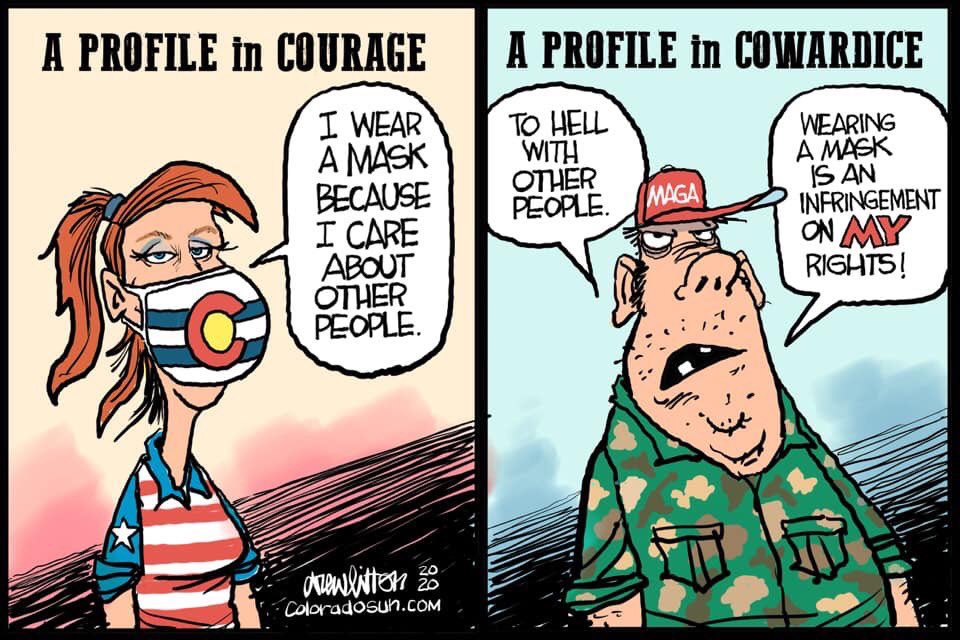
Cartoon – What does your mask say about you?

Jim Morrissey: What does your coronavirus mask say about you ...

Cartoon – Profile in Courage vs. Cowardice

COVID-19 News - Updated Daily

Rely on the science and avoid the politics, Fauci says

https://www.cnn.com/2020/08/12/health/us-coronavirus-wednesday/index.html?utm_source=nl&utm_brand=wired&utm_mailing=WIR_Science_081220&utm_campaign=aud-dev&utm_medium=email&utm_term=WIR_Science&bxid=5db707423f92a422eaeaf234&cndid=54318659&esrc=bounceX&source=EDT_WIR_NEWSLETTER_0_SCIENCE_ZZ

Science Day

Although practices like wearing face coverings have been politicized, Dr. Anthony Fauci said Tuesday he has learned that in order to be a good public health leader in a crisis, you have to divorce yourself from politics, rely on science and be as transparent as possible.

“Completely divorce yourself from the kind of political undertones that sometimes go into an important outbreak like this,” Fauci, director of the National Institute of Allergy and Infectious Diseases, said as he was honored with a 2020 Citizen Leadership Award on Tuesday night by the Aspen Institute.
“You’ve got to stay away from that, lead by example, be perfectly honest and don’t be afraid to say you don’t know something when you don’t know it. I find that to be a very good formula when you’re dealing in a crisis.”
Even with the polarization, every state in the US passed at least one physical distancing measure in March to slow the spread, researchers from Harvard University and University College London said. Those measures worked, a new study found.
Physical distancing resulted in a reduction of more than 600,000 cases within just three weeks, according to the study, published Tuesday in the journal PLOS. Had there not been preventative interventions, the models suggest up to 80% of Americans would have been infected with Covid-19.
“In short, these measures work, and policy makers should use them as an arrow in their quivers to get on top of local epidemics where they are not responding to containment measures,” said the study’s co-author Dr. Mark J. Siedner in a news release.


The Etiquette of Social Distancing During the COVID-19 Pandemic

https://emilypost.com/advice/the-etiquette-of-social-distancing-around-coronavirus/

STEVE ASHMORE: What is your social distancing etiquette? - Opinion ...

We are two months into life in the age of COVID-19 and it’s getting more complicated. Right as many of us were getting used to staying distanced, staying home, and staying in, some states and areas are relaxing restrictions. It isn’t life as it used to be, and it’s inconsistent across the nation. As we all try to figure out what relaxing measures means and what we are comfortable with, we’ve also embraced full on what life via video chat and living six feet apart can be like. Like normal humans, we all have questions, concerns, pet peeves, opinions and of course mute buttons that malfunction.


Before we dive into Etiquette in the Age of COVID-19 we would like to start by saying:

The threat of the novel coronavirus is still present. Until we have a vaccine or until we’ve gotten a handle on this virus’ impact on us, we are going to see requests, and requirements to physically distance ourselves and use personal protective measures like masks and hand washing regularly. It has changed our social behavior and it will continue to change our social behavior as communities find ways to interact safely. These new social measures can feel incredibly awkward and at times impolite, but you are not alone in feeling that way about them. Everyone is learning and figuring this out as we go.

Safety is the guideline right now and measures that we take to protect ourselves and others are right in line with the Emily Post principles of etiquette: consideration, respect, and honesty.

To find more information about the virus, it’s spread and what precautions and measures to take please visit:

The Center For Disease Control website   — https://www.cdc.gov/coronavirus/2019-nCoV/summary.html  

The World Health Organization website  — https://www.who.int/emergencies/diseases/novel-coronavirus-2019 

As well as your state or local department of health.

Safety First

When we think about what advice to give, we think first about safety and then about how to be kind and considerate and respectful when trying to be safe. Safety comes before etiquette. This doesn’t mean we toss consideration, respect, and honesty out the window. Far from it, we’ve seen how doing so can lead to tragically bad and completely unnecessary things happening. What it means is that how we interact and what is deemed “polite” or “acceptable” behavior will change during this time. Let’s look at some of the basics to consider here and for specific topics see these articles:

Zoom/Video Call Etiquette for Socializing (coming soon)

Zoom/Video Call Etiquette for Work (coming soon)

Weddings in the Age of COVID19

Navigating Hanging Out Together Apart (coming soon)


PHYSICAL DISTANCING

We are all familiar with the term “social distancing” by now. And many are encouraging the use of the phrase “physical distancing” instead which helps people to imagine a less isolated solution. Our goal for physical distancing is that when out and about in public or when socializing with those we don’t live with, we keep ourselves – or our family group – at least 6 feet away from others when possible.

It’s not as easy as it sounds. We’ve all navigated a tight aisle at a store, an elevator or stairwell, or a friend leaning in too closely despite feeling awkward. But what is the right thing to do?


Speak Up

We get asked, more than anything else through our podcast and media interviews, how do you speak up when something is wrong, or bothering you? It’s not an easy thing to do. How you do it makes a huge difference to how well it’s received, but it’s not a magic key. You can never predict someone else’s reaction, especially that of a stranger. So our first piece of advice is and always will be to seek the help of someone in charge if the scenario provides such a person. A manager, usher, flight attendant, host, or whomever is in charge, can have the authority to help you and can also ensure that you aren’t dealing with someone alone. That being said, you don’t do this as a way to punish someone else, it’s to make sure a concern is raised, or that help or safety can be achieved.

If someone at a store hasn’t given you enough space to pass or reach the item you’d like, then a friendly “Mind giving me just a little more space so I can pass [or grab that item] safely?” You want to have an upbeat tone to your delivery, no edge whatsoever (think that person you know who is always upbeat, or sounds cheerful and if no one comes to mind think: how would Glinda the Good Witch, Dr. Martin Luther King, Mother Teresa, the CW’s Superman say it?). If the person scoffs at you, you can either pass anyway keeping as much distance as possible, wait until they move farther away, or go get something else and come back later.


Other phrases that are being heard and used when out and about to manage distancing:

Excuse me Sir, the line starts back there, everyone’s just distanced.

(while stepping back) Sorry I’m trying to keep 6 feet away.

Excuse me, I was next.

I’ll wait and catch the next elevator.

After you, please. (said genuinely)

Do you mind giving us just a little bit more space please, (hopefully followed by a: thank you so much)

A little space please.

Flow of Traffic

While following the guidance of the arrows and directions through stores is always important, it’s not worth getting into an altercation over. Either pass, doing what you can keep your distance, or go back the other way if the aisle isn’t crowded. Don’t make a stand when there are other safe options.

Public Outdoor Spaces

When it comes to public outdoor spaces it’s important to respect any distancing guides that have been put in place whether it’s marked areas to lounge or workout in, or directions for flow of traffic. Remember that even though you’re spaced apart from others, covering your mouth when you cough or sneeze as well as not coughing, sneezing, singing, or yelling in the direction of others is helpful.

When trying to create physical distance on sidewalks, recreational paths and trails, you’re still trying to aim for six feet (about two adult arm lengths) apart. It’s really thoughtful if you’re a group or family out together to consider dropping to single file when passing others to help make room.

If it’s easy for you to be the person to step off the path or into the street (because you aren’t, using a walking or mobility aid, managing a frisky dog, balancing a toddler and a baby carriage or are on foot rather than wheels) to create space by all means make the move and do so early so that the other person doesn’t even have to guess at it.


Greetings

Greetings continue to feel lacking during this strange time. Despite wonderfully bright and cheery waves, mini dances, hops, and skips when we meet, we miss hugs and solid handshakes, high fives, and fist bumps. Greetings that involve touching are still not recommended at this time, so perfect your waves (you know your “professional wave”, your “zoom-meeting wave”, your “I-love-you-Grandma wave”, your “I-haven’t-seen-you-and-I’m-trying-so-hard-not-to-hug-you wave”) and use your tone of voice to match the occasion.


WEARING MASKS

While masks are causing a lot of divisiveness, when combined with physical distancing wearing a mask in public can greatly reduce the risk of spread. Wearing masks may be around for a while so it’s best to try and get used to what it’s like to interact with them on. Since most people are wearing cotton or medical masks and few have clear plastic ones allowing their full face to be seen we are more often than not without many facial cues.

Smiling (anyway), and using your eyes (cue acting skills from every medical show ever for inspiration) and hands to gesture will be the way to connect while wearing masks.

Masks unfortunately also muffle the sound of our voice and so it’s important to get comfortable speaking up, especially when in a noisy store or on a loud street. While you don’t want to shout to the point of sounding unnatural or making the listener uncomfortable, you do need to literally speak up to be heard. If you don’t, often the other person will lean in to hear you, and then you end up stepping back to recreate some space. It’s a odd dance but it happens often.

As we move into figuring out dining indoors and patio dining scenarios be prepared to see people storing their masks in a paper bag or envelope while eating. Some places may place plastic shields between tables or even at tables depending on the restaurant and local requirements.

Wearing masks outdoors is not a bad idea if you’re passing frequently while out on rec paths and trails or in the park or on the sidewalks of your neighborhood. Many choose to “mask when they pass” and let their mask down while on long stretches without others or when there’s more than enough room to pass without any worry. (According to this article in the New York Times, you’re more likely to encounter an issue for yourself if you have prolonged time indoors without masks on than if you pass someone outdoors without a mask on.)

If you’re uncomfortable when you encounter someone without a mask on resist the urge to glare or tsk at them. Do what you can to keep yourself physically distanced and avoid interacting instead. Remember you can only control yourself as best you can. There will be times when it doesn’t go perfectly and even though that can cause stress and anxiety, which often lead to rudeness, arming ourselves with kindness and avoiding judgement of others is good etiquette.

CONTACT TRACING

Contact tracing – tracing the virus’ spread through individuals who have tested positive or been around those who tested positive for COVID-19 – is happening at different rates throughout the country, but early indications show that contact tracing by businesses and through events that we attend may become commonplace. Many places already use your phone number or email address to contact you about tickets or a reservation or even a purchase so it’s not unfamiliar. But to have it be connected to our health when visiting a restaurant can feel very different. While we don’t know yet exactly how contact tracing will impact our personal social gatherings (birthday parties, showers, weddings…) or our public socializing (bars, sports, groups, restaurants…) we are considering the possibility that in the future a host’s to-do list list, or advice for making a restaurant reservation for a work lunch might involve contact info for potential contact tracing follow ups.


BE COMPASSIONATE

We cannot emphasize this enough right now. These are extraordinary times and there are so many ways this virus is impacting all of us. Especially when it comes to how we are mentally handling the longevity of this pandemic. You don’t know what is affecting someone’s life making the current threat even worse (financially, emotionally, physically). It’s important to respect people where they are at, and not blow off their concerns or drive fear where it doesn’t need to be.

Many of us are so fortunate to have so many ways to connect to help get us through this crisis together, but loneliness and anxiety are still huge concerns. Reaching out to one another. Being patient and kind with each other. Listening to one another. Respecting one another. Helping those in need. These are the kinds of attitudes and actions that will carry us through. They often cost us nothing, and yet they can make an impactful difference.