COVID-19 brings largest quarterly GDP drop since last recession

https://www.beckershospitalreview.com/finance/covid-19-brings-largest-quarterly-gdp-drop-since-last-recession.html?utm_medium=email

GDP sinks 4.8% in the first quarter, biggest drop since 2008 and ...

Gross domestic product in the U.S. fell 4.8 percent in the first quarter of 2020, the biggest drop the nation’s economy has seen since the last recession in 2008, according to The Wall Street Journal.

The downturn reflects how shutdowns of businesses and schools and social distancing, which started in the final three weeks of the first quarter, affected the U.S. economy. According to The Journal, many economists believe the U.S. is now in a recession, as layoffs and declines across industries hit unprecedented levels.

With the economy largely shut down in April, economists are expecting a bigger drop-off in economic activity in the second quarter of this year. A few states have started to slowly reopen their economies, but many still have social-distancing restrictions in place that extend through May.


US surpasses 1 million COVID-19 cases

https://thehill.com/policy/healthcare/494792-us-surpasses-1-million-covid-19-cases
Did the Trump Administration Overpromise 1 Million COVID-19 ...

More than a million people in the United States have tested positive for the coronavirus, a sobering milestone that experts say represents only the beginning of a months-long battle to end the pandemic.

The United States has now registered about a third of all confirmed cases of COVID-19 around the globe, according to data compiled by the Center for Systems Science and Engineering at Johns Hopkins University. More than 57,000 people have died in the United States, about a quarter of the known COVID-19 deaths around the globe.

The United States has now registered more confirmed cases than the next five countries suffering the largest outbreaks — Spain, Italy, France, Germany and the United Kingdom — combined.

Those numbers are partly a reflection of population, but there are troubling signs for the United States.

While those countries have reduced the pace of transmission and the growth in the number of new cases they are seeing on a daily basis, the United States has not similarly bent the curve.

Instead, it is stuck at a deadly plateau: In the last week, the U.S. has reported between 24,000 and 41,000 new cases a day, and between 1,200 and 2,600 deaths per day, according to The Covid Tracking Project, a group of researchers who keep tallies of case counts around the country.

Even as some states begin to relax orders that closed retail and service stores, experts warned the country is still at risk of a new rush of cases, and that the downslope of declining case counts will be much longer than the sudden surge the United States saw in April.

“We’re in the opening stages of this,” said Michael Osterholm, director of the Center for Infectious Disease Research and Prevention at the University of Minnesota. States “are not in the mountains, they’re in the foothills. The mountains are still to come.”

More than a quarter million residents of New York have tested positive for the virus, and commuter suburbs in New Jersey and Connecticut have reported tens of thousands of cases. More than 50,000 residents of Massachusetts have tested positive, and California, Illinois and Pennsylvania have all confirmed more than 40,000 cases.

There are growing signs that the virus is shifting into new, more rural territory. States like Arkansas, Kansas, Minnesota, Nebraska, New Mexico, Rhode Island, Tennessee and Virginia all recorded substantial growth in the number of new cases they had confirmed in the last few days.

That pattern of viral spread beginning in large urban cores and eventually making its way to rural areas is typical, experts said, given societal connections between urban areas, suburbs and more rural areas.

“Epidemiologists know that this pattern is a very expectable one, that rural areas are going to have lagged waves of cases. So we’ve been bracing for that,” said Nita Bharti, a biologist at the Center for Infectious Disease Dynamics at Penn State University. “What they’re experiencing now is what cities have been seeing. It’s the same, it’s just delayed, and we knew it would happen.”

About six months after the coronavirus outbreak was detected in Wuhan, China, and four months after the first case arrived on American shores, the United States still lags the world in testing capacity. States have bolstered their capacity in recent days, conducting more than 225,000 tests per day over four of the last five days, the capacity needed to ensure the virus can be brought under control lags substantially.

An analysis by Harvard researchers for the scientific publication STAT found more than half of states would have to significantly bolster their testing capacity in order to safely begin easing stay-at-home orders in May. The hardest-hit state, New York, will have to be able to test at least 100,000 more people every day than it is currently able to; New Jersey’s capacity would need to increase by 68,000 a day.

Smaller states and those that have yet to experience thousands of new cases — places like Mississippi, Idaho, Montana, Wyoming, Arizona and New Mexico — already have the testing capacity they need to identify and squelch any new viral hotspots. Even Washington state, the first state to confirm a positive case, has built its capacity to meet demand.

Public health experts say a robust testing program must be supplemented by armies of contact tracers who can track down those who are at risk of contracting the virus.

Already, Massachusetts has partnered with the nonprofit Partners In Health to deploy about 1,000 contact tracers across the state. Alaska has managed to trace the contacts of each of its 341 positive cases. New York City Mayor Bill de Blasio said Monday that the city would hire 1,000 contact tracers of its own, and former Mayor Mike Bloomberg has pledged $10 million to kick start a contact tracing program in the tri-state area.

On Monday, a bipartisan group of top public health experts led by President Trump‘s former FDA commissioner Scott Gottlieb and President Obama’s former Centers for Medicare and Medicaid Services administrator Andy Slavitt called on Congress to spend $46 billion to expand contact tracing capacity, including $12 billion to hire 180,000 new workers.

It is unclear how the outbreak in the United States compares with outbreaks in authoritarian countries like China, Russia and Iran, which do not report reliable numbers.

But even in the United States, where state and local governments are transparent about the data they collect, the actual number of cases and deaths are higher — likely significantly so. Early antibody tests in places like New York City and Miami show a significant number of people contract the virus without showing symptoms, and as studies show people who died inexplicably over the last several months tested positive for the virus.


COVID-19 vulnerability: A state-by-state analysis

https://www.beckershospitalreview.com/rankings-and-ratings/covid-19-vulnerability-a-state-by-state-analysis.html?utm_medium=email

To live and die in Dixie - Covid-19 is spreading to America's ...

Every state in the U.S. will be affected by COVID-19, but some are more vulnerable due to limited ability to mitigate and treat the virus, and to reduce its economic and social impacts, according to a COVID-19 vulnerability index created by the Surgo Foundation. 

The Surgo Foundation, a privately funded think tank, created an index that combines indicators specific to COVID-19 with the CDC’s social vulnerability index, which measures the expected negative impact of disasters of any type. The Surgo Foundation’s index takes into account factors that fall into one of several categories, including socioeconomic status, minority status, housing type, epidemiologic factors and health care system factors. Each state and the District of Columbia received a score in each category and an overall score, with a higher score indicating that the state is more vulnerable. Read more about the methodology here.

Here is each state’s ranking and composite score based on the vulnerability index: 

1. Mississippi: 1

2. Louisiana: 0.98

3. Arkansas: 0.96

4. Oklahoma: 0.94

5. Alabama: 0.92

6. West Virginia: 0.9

7. New Mexico: 0.88

8. Nevada: 0.86

9. North Carolina: 0.84

10. South Carolina: 0.82

11. Kentucky: 0.8

12. Hawaii: 0.78

13. Tennessee: 0.76

14. Missouri: 0.74

15. Kansas: 0.72

16. Indiana: 0.7

17. Georgia: 0.68

18. Oregon: 0.66

19. District of Columbia: 0.64

20. New York: 0.62

21. Alaska: 0.6

22. Delaware: 0.58

23. Michigan: 0.56

24. Arizona: 0.54

25. Illinois: 0.52

26. Iowa: 0.5

27. Texas: 0.48

28. New Jersey: 0.46

29. Idaho: 0.44

30. Maryland: 0.42

31. Ohio: 0.4

32. Massachusetts: 0.38

33. Nebraska: 0.36

34. Florida: 0.34

35. Washington: 0.32

36. Connecticut: 0.3

37. Pennsylvania: 0.28

38. Montana: 0.26

39. Rhode Island: 0.24

40. Virginia: 0.22

41. South Dakota: 0.2

42. Utah: 0.18

43. Wyoming: 0.16

44. California: 0.14

45. Minnesota: 0.12

46. Colorado: 0.1

47. Wisconsin: 0.08

48. North Dakota: 0.06

49. Maine: 0.04

50. Vermont: 0.02

51. New Hampshire: 0


The only way to get back to normal this summer is to test everyone in the United States, Nobel Prize-winning economist says

https://www.washingtonpost.com/business/2020/04/27/economy-coronavirus-romer-reopen/?fbclid=IwAR0AI-Cmf34bjZwphHNREngiy6CoKIbYHU2zb1QlnBg_jm7MXgWObMTVjZ4&utm_campaign=wp_main&utm_medium=social&utm_source=facebook

Coronavirus tests should be as cheap as a 'morning latte' to ...

Paul Romer estimates that testing every American would cost $100 billion, a hefty sum but less than the $2 trillion Congress has spent so far.

Nobel Prize-winning economist Paul Romer says a return to nearly normal life is possible this summer if the United States does wide-scale testing for the coronavirus.

Romer is calling on the U.S. government to test everyone in the nation once every two weeks and isolate people who test positive for the deadly coronavirus. He estimates that doing so would cost $100 billion, a hefty sum but far less than the $2 trillion Congress has spent so far and less than the cost of keeping the economy partly closed for months to come.

“I’m on the optimistic end of how quickly we can scale testing up,” said Romer, who won the 2018 Nobel Prize for economics. “I do think there’s a way most people could feel safe returning to what feels like normal life this summer if we do this wide-scale testing.”

So far, the nation has tested about 5 million people — or less than 2 percent of the population. Last week, Congress approved an additional $25 billion for testing as part of the latest funding bill, which Romer calls a good start but not enough.

Restarting the U.S. economy isn’t just about government officials clearing certain businesses to reopen. People have to feel safe enough to venture out. Romer says that will happen only when nearly everyone in the country is getting tested on a regular basis and people who are sick are being quarantined.

“It’s totally in our control to fix this,” Romer said in a phone interview. “We should be spending $100 billion on the testing. We should just get it going. It’s just not that hard.”

He advises starting with screening all health-care and front-line workers in the next month and then scaling up the testing to the rest of the nation this summer by using university labs to process tests.

Romer says massive testing is the only viable option for the nation. Otherwise, the economy will limp along, leaving millions of people unemployed and forcing small businesses to shut forever. It could take years to recover from that kind of pain. On the flip side, reopening much of the nation too soon could cause deaths to skyrocket again.

Top White House officials voiced support for more testing over the weekend. Treasury Secretary Steven Mnuchin said on Fox News Sunday that the Trump administration would “balance” reopening the economy with “more testing” to “monitor this very, very carefully.”

Deborah Birx, the White House’s coronavirus task force coordinator, said Sunday that more testing would be needed and that “social distancing will be with us through the summer.

As Congress and the White House debate another round of economic relief, it’s unclear how much more money will be allocated for testing. Evidence from China and Germany, which have begun to reopen much of their economies, shows that people remain reluctant to go out and spend again. Subways in China remain half full, big public spaces such as casinos remain nearly empty and economic activity is still way off from normal.

Although some have balked at the cost of testing every American, Romer points out that the United States is losing at least $500 billion a month from the Great Lockdown. His estimate is more modest than some other economists such as St. Louis Federal Reserve President Jim Bullard, who says the nation is losing $25 billion a day right now. Bullard has also endorsed universal testing as the only way to fix the nation’s health — and economic — problems.

“Every month of delay makes the recovery slower — and take longer,” Romer said.

Romer won the Nobel Prize for modeling the U.S. and global economies. A former chief economist at the World Bank, he has built a career thinking through big international problems and what to do about them. But the coronavirus fight is also personal for him. He has a daughter who is an intensive care physician in Philadelphia.


“Immunity passports” in the context of COVID-19

https://www.who.int/news-room/commentaries/detail/immunity-passports-in-the-context-of-covid-19

Charu Kaushic (@CKaushic) | Twitter

Scientific Brief

WHO has published guidance on adjusting public health and social measures for the next phase of the COVID-19 response.1 Some governments have suggested that the detection of antibodies to the SARS-CoV-2, the virus that causes COVID-19, could serve as the basis for an “immunity passport” or “risk-free certificate” that would enable individuals to travel or to return to work assuming that they are protected against re-infection. There is currently no evidence that people who have recovered from COVID-19 and have antibodies are protected from a second infection.


The measurement of antibodies specific to COVID-19

The development of immunity to a pathogen through natural infection is a multi-step process that typically takes place over 1-2 weeks. The body responds to a viral infection immediately with a non-specific innate response in which macrophages, neutrophils, and dendritic cells slow the progress of virus and may even prevent it from causing symptoms. This non-specific response is followed by an adaptive response where the body makes antibodies that specifically bind to the virus. These antibodies are proteins called immunoglobulins. The body also makes T-cells that recognize and eliminate other cells infected with the virus. This is called cellular immunity. This combined adaptive response may clear the virus from the body, and if the response is strong enough, may prevent progression to severe illness or re-infection by the same virus. This process is often measured by the presence of antibodies in blood.

WHO continues to review the evidence on antibody responses to SARS-CoV-2 infection.2-17 Most of these studies show that people who have recovered from infection have antibodies to the virus. However, some of these people have very low levels of neutralizing antibodies in their blood,4 suggesting that cellular immunity may also be critical for recovery. As of 24 April 2020, no study has evaluated whether the presence of antibodies to SARS-CoV-2 confers immunity to subsequent infection by this virus in humans.

Laboratory tests that detect antibodies to SARS-CoV-2 in people, including rapid immunodiagnostic tests, need further validation to determine their accuracy and reliability. Inaccurate immunodiagnostic tests may falsely categorize people in two ways. The first is that they may falsely label people who have been infected as negative, and the second is that people who have not been infected are falsely labelled as positive. Both errors have serious consequences and will affect control efforts. These tests also need to accurately distinguish between past infections from SARS-CoV-2 and those caused by the known set of six human coronaviruses. Four of these viruses cause the common cold and circulate widely. The remaining two are the viruses that cause Middle East Respiratory Syndrome and Severe Acute Respiratory Syndrome. People infected by any one of these viruses may produce antibodies that cross-react with antibodies produced in response to infection with SARS-CoV-2.

Many countries are now testing for SARS-CoV-2 antibodies at the population level or in specific groups, such as health workers, close contacts of known cases, or within households.21 WHO supports these studies, as they are critical for understanding the extent of – and risk factors associated with – infection.  These studies will provide data on the percentage of people with detectable COVID-19 antibodies, but most are not designed to determine whether those people are immune to secondary infections.


Other considerations

At this point in the pandemic, there is not enough evidence about the effectiveness of antibody-mediated immunity to guarantee the accuracy of an “immunity passport” or “risk-free certificate.” People who assume that they are immune to a second infection because they have received a positive test result may ignore public health advice. The use of such certificates may therefore increase the risks of continued transmission. As new evidence becomes available, WHO will update this scientific brief.


Covid-19 Testing is increasing, but still not good enough

https://www.axios.com/newsletters/axios-vitals-daff1b24-727d-44eb-adb9-9f33cd61bc16.html?utm_source=newsletter&utm_medium=email&utm_campaign=newsletter_axiosvitals&stream=top

The Daily Shot: So Far, About 5% of Small Businesses Received ...

The good news is that the number of daily coronavirus tests is going up again. The bad news is that it’s still not nearly enough for the country to safely reopen.

Why it matters: If we don’t know who has the virus, we can’t stop it from spreading without resorting to stringent social distancing measures.

Driving the news: On Saturday, Anthony Fauci said that the U.S. is testing roughly 1.5 million to 2 million people a week, but “we probably should get up to twice that as we get into the next several weeks, and I think we will.”

  • Deborah Birx, the White House coronavirus task force coordinator, said yesterday that “we have to realize that we have to have a breakthrough innovation in testing.” She said we’ll need tests that can detect antigen, or the part of a pathogen that triggers an immune response.

Between the lines: Testing has been hampered by shortages of supplies like swabs and test kits. There has also been a lack of coordination between labs with excess testing capacity and communities struggling to meet testing demand.

What we’re watching: Some major cities and states — including New York and California — have begun to expand testing beyond the sickest patients, which is a good sign.


Robots are playing many roles in the coronavirus crisis – and offering lessons for future disasters

https://theconversation.com/robots-are-playing-many-roles-in-the-coronavirus-crisis-and-offering-lessons-for-future-disasters-135527

Robots are playing many roles in the coronavirus crisis – and ...

A cylindrical robot rolls into a treatment room to allow health care workers to remotely take temperatures and measure blood pressure and oxygen saturation from patients hooked up to a ventilator. Another robot that looks like a pair of large fluorescent lights rotated vertically travels throughout a hospital disinfecting with ultraviolet light. Meanwhile a cart-like robot brings food to people quarantined in a 16-story hotel. Outside, quadcopter drones ferry test samples to laboratories and watch for violations of stay-at-home restrictions.

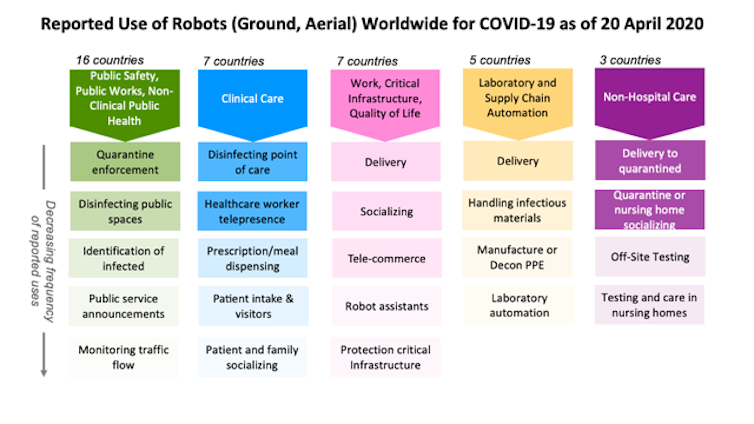
These are just a few of the two dozen ways robots have been used during the COVID-19 pandemic, from health care in and out of hospitals, automation of testing, supporting public safety and public works, to continuing daily work and life.

The lessons they’re teaching for the future are the same lessons learned at previous disasters but quickly forgotten as interest and funding faded. The best robots for a disaster are the robots, like those in these examples, that already exist in the health care and public safety sectors.

Research laboratories and startups are creating new robots, including one designed to allow health care workers to remotely take blood samples and perform mouth swabs. These prototypes are unlikely to make a difference now. However, the robots under development could make a difference in future disasters if momentum for robotics research continues.

Robots around the world

As roboticists at Texas A&M University and the Center for Robot-Assisted Search and Rescue, we examined over 120 press and social media reports from China, the U.S. and 19 other countries about how robots are being used during the COVID-19 pandemic. We found that ground and aerial robots are playing a notable role in almost every aspect of managing the crisis.

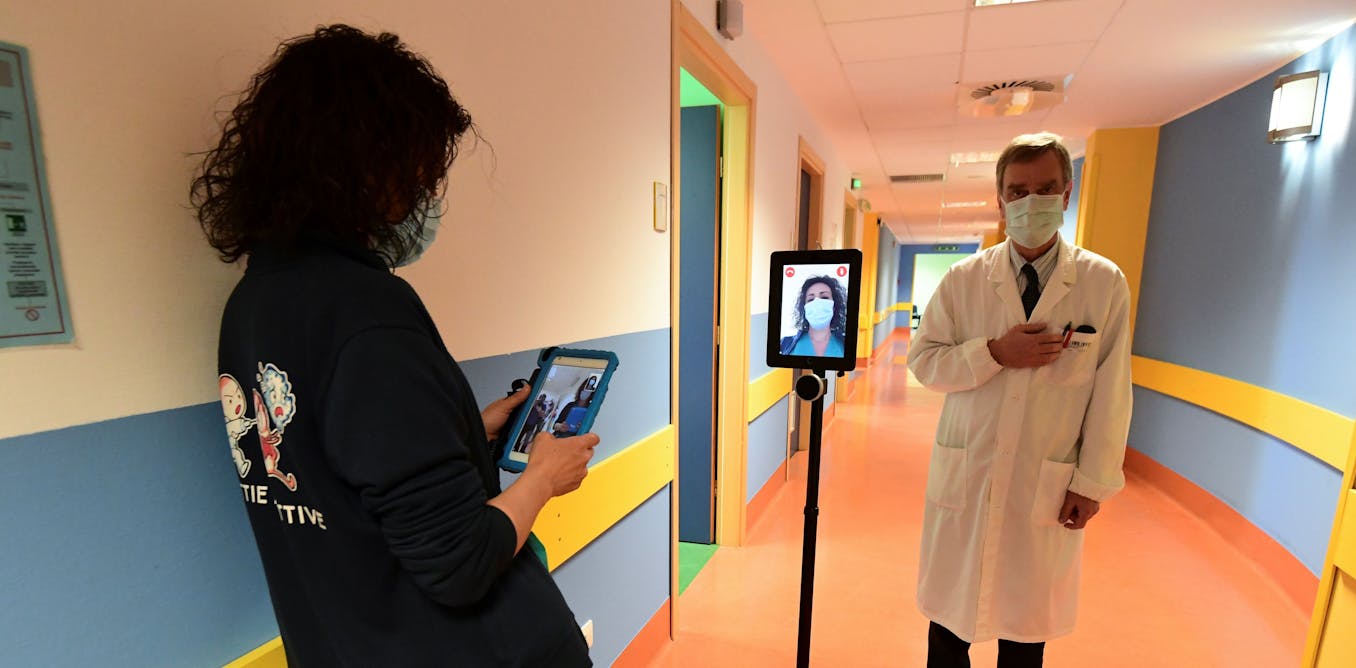
In hospitals, doctors and nursesfamily members and even receptionists are using robots to interact in real time with patients from a safe distance. Specialized robots are disinfecting rooms and delivering meals or prescriptions, handling the hidden extra work associated with a surge in patients. Delivery robots are transporting infectious samples to laboratories for testing.

Outside of hospitals, public works and public safety departments are using robots to spray disinfectant throughout public spaces. Drones are providing thermal imagery to help identify infected citizens and enforce quarantines and social distancing restrictions. Robots are even rolling through crowds, broadcasting public service messages about the virus and social distancing.

At work and home, robots are assisting in surprising ways. Realtors are teleoperating robots to show properties from the safety of their own homes. Workers building a new hospital in China were able work through the night because drones carried lighting. In Japan, students used robots to walk the stage for graduation, and in Cyprus, a person used a drone to walk his dog without violating stay-at-home restrictions.

Helping workers, not replacing them

Every disaster is different, but the experience of using robots for the COVID-19 pandemic presents an opportunity to finally learn three lessons documented over the past 20 years. One important lesson is that during a disaster robots do not replace people. They either perform tasks that a person could not do or do safely, or take on tasks that free up responders to handle the increased workload.

The majority of robots being used in hospitals treating COVID-19 patients have not replaced health care professionals. These robots are teleoperated, enabling the health care workers to apply their expertise and compassion to sick and isolated patients remotely.

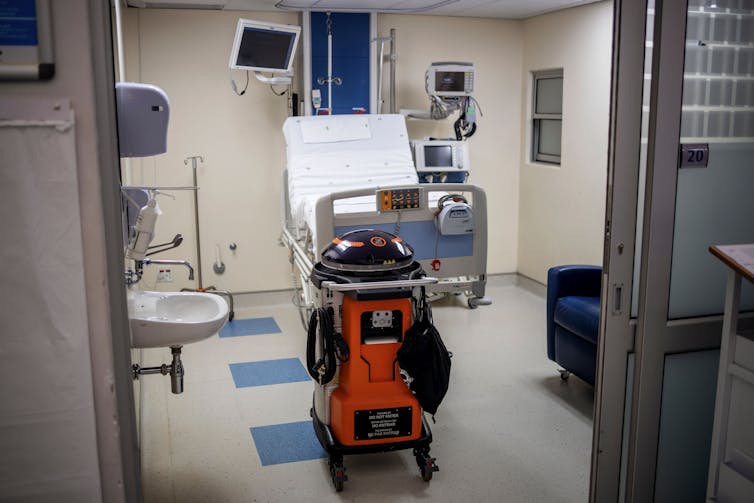
A robot uses pulses of ultraviolet light to disinfect a hospital room in Johannesburg, South Africa. MICHELE SPATARI/AFP via Getty Images

A small number of robots are autonomous, such as the popular UVD decontamination robots and meal and prescription carts. But the reports indicate that the robots are not displacing workers. Instead, the robots are helping the existing hospital staff cope with the surge in infectious patients. The decontamination robots disinfect better and faster than human cleaners, while the carts reduce the amount of time and personal protective equipment nurses and aides must spend on ancillary tasks.

Off-the-shelf over prototypes

The second lesson is the robots used during an emergency are usually already in common use before the disaster. Technologists often rush out well-intentioned prototypes, but during an emergency, responders – health care workers and search-and-rescue teams – are too busy and stressed to learn to use something new and unfamiliar. They typically can’t absorb the unanticipated tasks and procedures, like having to frequently reboot or change batteries, that usually accompany new technology.

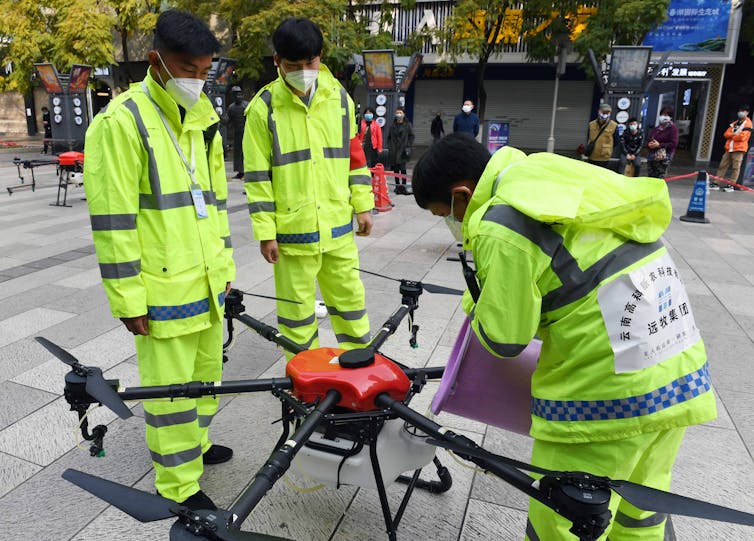
Fortunately, responders adopt technologies that their peers have used extensively and shown to work. For example, decontamination robots were already in daily use at many locations for preventing hospital-acquired infections. Sometimes responders also adapt existing robots. For example, agricultural drones designed for spraying pesticides in open fields are being adapted for spraying disinfectants in crowded urban cityscapes in China and India.

Workers in Kunming City, Yunnan Province, China refill a drone with disinfectant. The city is using drones to spray disinfectant in some public areas. Xinhua News Agency/Yang Zongyou via Getty Images

A third lesson follows from the second. Repurposing existing robots is generally more effective than building specialized prototypes. Building a new, specialized robot for a task takes years. Imagine trying to build a new kind of automobile from scratch. Even if such a car could be quickly designed and manufactured, only a few cars would be produced at first and they would likely lack the reliability, ease of use and safety that comes from months or years of feedback from continuous use.

Alternatively, a faster and more scalable approach is to modify existing cars or trucks. This is how robots are being configured for COVID-19 applications. For example, responders began using the thermal cameras already on bomb squad robots and drones – common in most large cities – to detect infected citizens running a high fever. While the jury is still out on whether thermal imaging is effective, the point is that existing public safety robots were rapidly repurposed for public health.

Don’t stockpile robots

The broad use of robots for COVID-19 is a strong indication that the health care system needed more robots, just like it needed more of everyday items such as personal protective equipment and ventilators. But while storing caches of hospital supplies makes sense, storing a cache of specialized robots for use in a future emergency does not.

This was the strategy of the nuclear power industry, and it failed during the Fukushima Daiichi nuclear accident. The robots stored by the Japanese Atomic Energy Agency for an emergency were outdated, and the operators were rusty or no longer employed. Instead, the Tokyo Electric Power Company lost valuable time acquiring and deploying commercial off-the-shelf bomb squad robots, which were in routine use throughout the world. While the commercial robots were not perfect for dealing with a radiological emergency, they were good enough and cheap enough for dozens of robots to be used throughout the facility.

Robots in future pandemics

Hopefully, COVID-19 will accelerate the adoption of existing robots and their adaptation to new niches, but it might also lead to new robots. Laboratory and supply chain automation is emerging as an overlooked opportunity. Automating the slow COVID-19 test processing that relies on a small set of labs and specially trained workers would eliminate some of the delays currently being experienced in many parts of the U.S.

Automation is not particularly exciting, but just like the unglamorous disinfecting robots in use now, it is a valuable application. If government and industry have finally learned the lessons from previous disasters, more mundane robots will be ready to work side by side with the health care workers on the front lines when the next pandemic arrives.


The pandemic didn’t come out of nowhere. The U.S. ignored the warnings.

https://www.washingtonpost.com/opinions/global-opinions/the-pandemic-didnt-come-out-of-nowhere-the-us-ignored-the-warnings/2020/04/21/3bf37566-7db3-11ea-a3ee-13e1ae0a3571_story.html?utm_campaign=wp_opinions&utm_medium=email&utm_source=newsletter&wpis

The pandemic didn't come out of nowhere. The U.S. ignored the ...

“CAME OUT of nowhere,” President Trump said March 6 of the coronavirus pandemic. “I just think this is something . . . that you can never really think is going to happen.” A few weeks later, he added, “I would view it as something that just surprised the whole world.” Mr. Trump also said, “Nobody knew there would be a pandemic or epidemic of this proportion.”

Of course, no one can pinpoint the exact moment that lightning will strike. But a global pandemic? Experts have predicted it, warned about the preparedness gaps and urged action. Again and again and again.

Just look at 2019. In January, the U.S. intelligence community issued its annual global threat assessment. It declared, “We assess that the United States and the world will remain vulnerable to the next flu pandemic or large-scale outbreak of a contagious disease that could lead to massive rates of death and disability, severely affect the world economy, strain international resources, and increase calls on the United States for support. . . . The growing proximity of humans and animals has increased the risk of disease transmission. The number of outbreaks has increased in part because pathogens originally found in animals have spread to human populations.”

In September, the Johns Hopkins Center for Health Security issued a report titled “Preparedness for a High-Impact Respiratory Pathogen Pandemic.” The report found that if such a pathogen emerged, “it would likely have significant public health, economic, social, and political consequences. . . . The combined possibilities of short incubation periods and asymptomatic spread can result in very small windows for interrupting transmission, making such an outbreak difficult to contain.” The report pointed to “large national and international readiness gaps.”

In October, the Nuclear Threat Initiative, working with the Johns Hopkins center and the Economist Intelligence Unit, published its latest Global Health Security Index, examining open-source information about the state of health security across 195 nations, and scoring them. The report warned, “No country is fully prepared for epidemics or pandemics, and every country has important gaps to address.” The report found that “Fewer than 5 percent of countries scored in the highest tier for their ability to rapidly respond to and mitigate the spread of an epidemic.”

In November, the Center for Strategic and International Studies published a study by its Commission on Strengthening America’s Health Security. It warned, “The American people are far from safe. To the contrary, the United States remains woefully ill-prepared to respond to global health security threats. This kind of vulnerability should not be acceptable to anyone. At the extreme, it is a matter of life and death. . . . Outbreaks proliferate that can spread swiftly across the globe and become pandemics, disrupting supply chains, trade, transport, and ultimately entire societies and economies.” The report recommended: “Restore health security leadership at the White House National Security Council.”

Came out of nowhere? Not even close. The question that must be addressed in future postmortems is why all this expertise and warning was ignored.


World coronavirus updates

https://www.axios.com/coronavirus-latest-developments-8b8990c4-6762-494a-8ee0-5091746bda9b.html

Coronavirus brings clearer skies but darker world to 50th Earth ...

Children in Spain were allowed to go outside on Sunday for the first time since a nationwide lockdown aimed at slowing the spread of the novel coronavirus began six weeks ago.

By the numbers: The coronavirus has infected over 2.9 million people and killed over 200,000, Johns Hopkins data shows. More than 829,000 people have recovered from COVID-19. The U.S. has reported the most cases in the world (more than 940,000 from 5.1 million tests), followed by Spain (over 223,000).

What’s happening: Australian Health Minister Greg Hunt announced a new coronavirus tracing app on Sunday that the government hopes at least 50 percent of the population will use. A top health official said the app is “only for one purpose, to help contact tracing,” as he sought to reassure Australians on privacy issues.

  • China reported 11 new cases and no deaths on Sunday. It’s been 10 days since the country reported any deaths. China’s reported infections and deaths have been treated with suspicion by foreign leaders and the CIA.
  • Argentina is extending a nationwide shelter-in-place order that was due to expire Sunday until May 10, President Alberto Fernandez said on Saturday, per Reuters. The country has confirmed over 3,700 cases, according to Johns Hopkins.
  • Spain will gradually ease nationwide stay-at-home restrictions starting May 2 if coronavirus cases continue to decline, Prime Minister Pedro Sánchez said Saturday.
  • British Prime Minister Boris Johnson plans to return to work on Monday after recovering from the coronavirus.
  • The World Health Organization said Saturday there is “no evidence” that people who recover from COVID-19 and have antibodies are protected from a second infection.
  • India announced it will be easing lockdown measures for its 1.3 billion people in the areas outside of hotspots — providing some relief for locally owned businesses and daily wage workers.
  • The director of Israel’s foreign intelligence agency, Mossad, said in a briefing to health care officials on Thursday that Iran and its regional allies are intentionally underreporting cases and deaths from the coronavirus.
  • Brazil and Ecuador are becoming coronavirus epicenters in Latin America, as prolonged lapses in tracking and testing have led to severely undercounted death tolls, the Washington Post and the N.Y. Times report.
  • New Zealand’s level 4 lockdown measures requiring non-essential workers to stay home have been extended to 11:59 p.m next Monday, when the country moves into a still-strict level 3. NZ reported just three cases on Thursday.
  • Pakistan has decided to keep mosques open during the fasting month of Ramadan, which began Thursday, as cases continue to climb, AP reports.

The big picture: The world faces its gravest challenge in decades, but geopolitical tensions won’t wait until it’s over. Trump’s threat on Wednesday to “destroy” Iranian boats that harass U.S. ships comes amid arrests of Hong Kong pro-democracy activists and clashes in Afghanistan that could further undermine peace there.

Between the lines: Policy responses to the crisis have been every-country-for-itself and — in the case of the U.S. and China — tinged with geopolitical rivalry.

  • But the scientific work under way to understand the virus and develop a vaccine has been globalized on an unprecedented scale.

Coronavirus symptoms: Fever, cough, shortness of breath.


U.S. with 1/3 of Confirmed Coronavirus Cases with Less Than 2% of Population Tested

https://coronavirus.jhu.edu/map.html

Coronavirus outbreak affecting some Durham high school students ...

By the numbers: The coronavirus has infected over 2.9 million people and killed over 200,000, Johns Hopkins data shows. More than 829,000 people have recovered from COVID-19. The U.S. has reported the most cases in the world (more than 940,000 from 5.1 million tests), followed by Spain (over 223,000).