69 hospitals, health systems cutting jobs

A number of hospitals and health systems are trimming their workforces or jobs due to financial and operational challenges. 

Below are workforce reduction efforts or job eliminations that were announced within the past year and/or take effect later in 2023. 

Editor’s Note: This webpage was updated June 30 and will continue to be updated. 

1. Coral Gables-based Baptist Health South Florida is offering its executives at the director level and above a “one-time opportunity” to apply for voluntary separation, according to a June 29 Miami Herald report. Decisions on  buyout applications will be made during the summer.

2. MultiCare Health System, a 12-hospital organization based in Tacoma, Wash., will lay off 229 employees, or about 1 percent of its 23,000 staff members, including about two dozen leaders, as part of cost-cutting efforts, the health system said June 29. The layoffs primarily affect support departments, such as marketing, IT and finance.

3. Greensburg, Pa.-based Independence Health System laid off 53 employees and has cut 226 positions — including resignations, retirements and elimination of vacant positions — since January, The Butler Eagle reported June 28. The 226 reductions began at the executive level, with 13 manager positions terminated in March. 

4. Billings (Mont.) Clinic will lay off workers as part of a restructuring plan to address financial and operational headwinds in today’s healthcare environment, the organization confirmed. The layoffs are expected to affect approximately 27 or fewer positions. 

5. Melbourne, Fla.-based Health First is eliminating some positions and leaving open ones vacant, Florida Today reported June 21. Seventeen jobs will be cut and 36 will be left unfilled, according to Paula Just, the health system’s chief experience officer. 

6. Pittsburgh-based Highmark Health laid off 118 employees on June 21, including two from  Allegheny Health Network, a spokesperson for the health system told Becker’s. The layoffs follow the health system’s cutbacks in March and April, according to the Pittsburgh Business Times. Highmark laid off 141 workers earlier this year.

7. Vibra Hospital of Western Massachusetts, a long-term-acute care hospital in Springfield, will lay off 87 employees by Aug. 15 ahead of the facility’s planned closure. About 30 patients will be relocated to Baystate Health’s Valley Springs Behavioral Health Hospital in Holyoke, Mass., which will open in August.

8. Cortez, Colo.-based Southwest Memorial Hospital laid off nine people to help ensure the hospital is staffed appropriately, and create financial stability for the future, a spokesperson confirmed to Becker’s. The spokesperson, Chuck Krupa, said the layoffs occurred June 14 and included administrative workers. No bedside care positions were affected. 

9. Henry Mayo Newhall Hospital in Valencia, Calif., is making “a little over 100” layoffs amid financial challenges, spokesperson Patrick Moody confirmed to Becker’s. Mr. Moody said the layoffs affect workers “in a wide range of hospital departments.” This includes some management-level employees. The hospital, which has about 1,800 employees total, is not providing specific numbers for specific job titles or departments.

10. Dartmouth Health is laying off 75 workers and eliminating 100 job vacancies. The layoffs came after the Lebanon, N.H.-based health system implemented a performance improvement plan in November. 

11. Seattle Children’s is eliminating 135 leader roles, citing financial challenges. The management restructuring and reduction affects 1.5 percent of employees across the organization.

12. White Rock (Texas) Medical Center laid off 30 workers across 28 departments. The layoffs include clinical and administrative roles. 

13. Jackson, Miss.-based St. Dominic Health Services is laying off 157 workers and ending behavioral health services. The reduction represents 5.5 percent of the hospital’s workforce.

14. Danville, Pa.-based Geisinger laid off 47 employees from its IT department. The reduction is part of a restructuring plan to offset high labor and supply costs.

15. Cascade Behavioral Health Hospital in Tukwila, Wash., is winding down operations and laying off 288 employees. The 137-bed psychiatric facility is slated to close by July 31.

16. Cambridge (Mass.) Health Alliance is laying off 69 employees, reducing the hours of 15 others and eliminating 170 open positions, according to The Boston Globe. The reductions are primarily in management, administrative and support areas, a health system spokesperson told Becker’s

17. Wenatchee, Wash.-based Confluence Health has eliminated its chief operating officer amid restructuring efforts and financial pressures, the health system confirmed to Becker’s May 16.

18. Conemaugh Memorial Medical Center, a Duke LifePoint hospital in Johnstown, Pa., has laid off less than 1 percent of its workforce, the hospital confirmed to Becker’s May 15.  

19. Community Health Network, a nonprofit health system based in Indianapolis, plans to cut an unspecified number of jobs as it restructures its workforce and makes organizational changes. The health system confirmed the job cuts in a statement shared with Becker’s on May 11. It did not say how many jobs would be cut or which positions would be affected. 

20. New Orleans-based Ochsner Health eliminated 770 positions, or about 2 percent of its workforce, on May 11. This is the largest layoff to date for the health system. 

21. Cedars-Sinai Medical Center eliminated the positions of 131 employees and cut about two dozen other jobs at related Cedars-Sinai facilities, a spokesperson confirmed via a statement shared with Becker’s May 7. The Los Angeles-based organization said reductions represent less than 1 percent of the workforce and apply to management and non-management roles primarily in non-patient care jobs.

22. Rochester (N.Y.) Regional Health is eliminating about 60 positions. A statement from RRH said the changes affect less than one-half percent of the system population, mostly in nonclinical and management positions.

23. Memorial Health System laid off fewer than 90 people, or less than 2 percent of its workforce.The Gulfport, Miss.-based health system said May 2 that most of the affected positions are nonclinical or management roles, and the majority do not involve direct patient care. 

24. Monument Health laid off at least 80 employees, or about 2 percent of its workforce. The Rapid City, S.D.-based system said positions are primarily corporate service roles and will not affect patient services. Unfilled corporate service positions were also eliminated. 

25. Habersham Medical Center in Demorest, Ga., laid off four executives. The layoffs are part of cost-cutting measures before the hospital joins Gainesville-based Northeast Georgia Health System in July, nowhaberbasham.com reported April 27. 

26. Scripps Health is eliminating 70 administrative roles, according to WARN documents filed by the San Diego-based health system in March. The layoffs take effect May 8 and affect corporate positions in San Diego and La Jolla, Calif.

27. Trinity Health Mid-Atlantic, part of Livonia, Mich.-based Trinity Health, eliminated fewer than 40 positions, a spokesperson confirmed to Becker’s April 24. The layoffs represent 0.5 percent of the health system’s approximately 7,000-person workforce.

28. PeaceHealth eliminated 251 caregiver roles across multiple locations. The Vancouver, Wash.-based health system said affected roles include 121 from Shared Services, which supports its 16,000 caregivers in Washington, Oregon and Alaska.

29. Toledo, Ohio-based ProMedica plans to lay off 26 skilled nursing support staff. The layoffs, effective in June, affect 20 employees who work remotely across the U.S, and six who work at the ProMedica Summit Center in Toledo, according to a Worker Adjustment and Retraining Notification filed April 18. Most affected positions support sales, marketing and administrative functions for the skilled nursing facilities, Promecia told Becker’s.

30. Northern Inyo Healthcare District, which operates a 25-bed critical access hospital in Bishop, Calif., anticipates eliminating about 15 positions, or less than 4 percent of its 460-member workforce, by April 21, a spokesperson confirmed to Becker’s. The layoffs include nonclinical roles within support and administration, according to a news release. No further details were provided about specific positions affected. 

31. West Reading, Pa.-based Tower Health is eliminating 100 full-time equivalent positions. The move will affect 45 individuals, according to an April 13 news release the health system shared with Becker’s. The other 55 positions are either recently vacated or involve individuals who plan to retire in the coming weeks and months.

32. Grand Forks, N.D.-based Altru Health is trimming its executive team as its new hospital project moves forward. The health system is trimming its executive team from nine to six and incentivizing 34 other employees to take early retirement.

33. Tacoma, Wash.-based Virginia Mason Franciscan Health laid off nearly 400 employees, most of whom are in non-patient-facing roles. The job cuts affected less than 2 percent of the health system’s 19,000-plus workforce.

34. Katherine Shaw Bethea Hospital in Dixon, Ill., will lay off 20 employees, citing financial headwinds affecting health organizations across the U.S. It will also leave other positions unfilled to reduce expenses amid rising labor and supply costs and reductions in payments by insurance plans. Affected employees largely work in administrative support areas and not direct patient care.

35. Danbury, Conn.-based Nuvance Health will close a 100-bed rehabilitation facility in Rhinebeck, N.Y., resulting in 102 layoffs. The layoffs are effective April 12, according to the Daily Freeman.

36. Charleston, S.C.-based MUSC Health University Medical Center laid off an unspecified number of employees from its Midlands hospitals in the Columbia, S.C. area. Division President Terry Gunn also resigned after the facilities missed budget expectations by $40 million in the first six months of the fiscal year, The Post and Courier reported March 30. 

37. Winston-Salem, N.C.-based Novant Health laid off about 50 workers, including C-level executives, the health system confirmed to Becker’s March 29. The layoffs affected Jesse Cureton, the health system’s executive vice president and chief consumer officer since 2013; Angela Yochem, its executive vice president and chief transformation and digital officer since 2020; and Paula Dean Kranz, vice president of innovation enablement and executive director of the Novant Health Innovation Labs. 

38. Penn Medicine Lancaster (Pa.) General Health eliminated fewer than 65 jobs, or less than 1 percent of its workforce of about 9,700, the health system confirmed to Becker’s March 30. The layoffs include support, administrative and executive roles, and COVID-19-related support staff, spokesperson John Lines said, according to lancasteronline.com. Mr. Lines did not provide a specific number of affected workers.

39. McLaren St. Luke’s Hospital in Maumee, Ohio, will lay off 743 workers, including 239 registered nurses, when it permanently closes this spring. Other affected roles include physical therapists, radiology technicians, respiratory therapists, pharmacists and pharmacy support staff, and nursing assistants. The hospital’s COO is also affected, and a spokesperson for McLaren Health Care told Becker’s other senior leadership roles are also affected.

40. Bellevue, Wash.-based Overlake Medical Center and Clinics laid off administrative staff, the health system confirmed to the Puget Sound Business Journal. The layoffs, which occurred earlier this year, included 30 workers across Overlake’s human resources, information technology and finance departments, a spokesperson said, according to the publication. This represents about 6 percent of the organization’s administrative workforce. Overlake’s website says it employs more than 3,000 people total.

41. Columbia-based University of Missouri Health Care is eliminating five hospital leadership positions across the organization, spokesperson Eric Maze confirmed to Becker’s March 20. Mr. Maze did not specify which roles are being eliminated saying that the organization won’t address individual personnel actions. According to MU Health Care, the move is a result of restructuring “to better support patients and the future healthcare needs of Missourians.”

42. Greensboro, N.C.-based Cone Health eliminated 68 senior-level jobs. The job eliminations occurred Feb. 21, Cone Health COO Mandy Eaton told The Alamance NewsOf the 68 positions eliminated, 21 were filled. Affected employees were offered severance packages. 

43. The newly merged Greensburg, Pa.-based organization made up of Excela Health and Butler Health System eliminated 13 filled managerial jobs. The affected employees and positions are from across both sides of the new organization, Tom Chakurda, spokesperson for the Excela-Butler enterprise, confirmed to Becker’s. The positions were in various support functions unrelated to direct patient care.

44. Crozer Health, a four-hospital system based in Upland, Pa., is laying off roughly 215 employees amid financial challenges. The system announced the layoffs March 15 as part of its “operational restructuring plan” that “focuses on removing duplication in administrative oversight and discontinuing underutilized services.” Affected employees represent about 4 percent of the organization’s workforce.

45. Philadelphia-based Penn Medicine is eliminating administrative positions. The change is part of a reorganization plan to save the health system $40 million annually, the Philadelphia Business Journal reported March 13. Kevin Mahoney, CEO of the University of Pennsylvania Health System, told Penn Medicine’s 49,000 employees last week that changes include the elimination of a “small number of administrative positions which no longer align with our key objectives,” according to the publication. The memo did not indicate the exact number of positions that were eliminated.

46. Sovah Health, part of Brentwood, Tenn.-based Lifepoint Health, eliminated the COO positions at its Danville and Martinsville, Va., campuses. The responsibilities of both COO roles will now be spread across members of the existing administrative team. 

47. Valley Health, a six-hospital health system based in Winchester, Va., eliminated 31 administrative positions. The job cuts are part of the consolidation of the organization’s leadership team and administrative roles. 

48. Marshfield (Wis.) Clinic Health System said it would lay off 346 employees, representing less than 3 percent of its employee base.

49. St. Mark’s Medical Center in La Grange, Texas, is cutting nearly 50 percent of its staff and various services amid financial challenges. 

50. Roseville, Calif.-based Adventist Health plans to go from seven networks of care to five systemwide to reduce costs and strengthen operations. The reorganization will result in job cuts, including reducing administration by more than $100 million.

51. Arcata, Calif.-based Mad River Community Hospital is cutting 27 jobs as it suspends home health services.

52. Hutchinson (Kan.) Regional Medical Center laid off 85 employees, a move tied to challenges in today’s healthcare environment. 

53. Oklahoma City-based OU Health eliminated about 100 positions as part of an organizational redesign to complete the integration from its 2021 merger.

54. Memorial Sloan Kettering Cancer Center announced it would lay off to reduce costs amid widespread hospital financial challenges. The layoffs are spread across 14 sites in New York City, and equate to about 1.8 percent of Memorial Sloan’s 22,500 workforce.

55. St. Louis-based Ascension completed layoffs in Texas, the health system confirmed in January. A statement shared with Becker’s says the layoffs primarily affected nonclinical support roles. The health system declined to specify to Becker’s the number of employees or positions affected.

56. Lebanon, N.H.-based Dartmouth Health is freezing hiring and reviewing all vacant jobs at its flagship hospital and clinics in an effort to close a $120 million budget gap. 

57. Chillicothe, Ohio-based Adena Health System announced it would eliminate 69 positions — 1.6 percent of its workforce — and send 340 revenue cycle department employees to Ensemble Health Partners’ payroll in a move aimed to help the health system’s financial stability.

58. Ascension St. Vincent’s Riverside in Jacksonville, Fla., will end maternity care at the hospital, affecting 68 jobs, according to a Workforce Adjustment and Retraining Notification filed with the state Jan. 17. The move will affect 62 registered nurses as well as six other positions.

59. Visalia, Calif.-based Kaweah Health said it aimed to eliminate 94 positions as part of a new strategy to reduce labor costs. The job cuts come in addition to previously announced workforce reductions; the health system already eliminated 90 unfilled positions and lowered its workforce by 106 employees. 

60. Oklahoma City-based Integris Health said it would eliminate 200 jobs to curb expenses. The eliminations include 140 caregiver roles and 60 vacant jobs.

61. Toledo, Ohio-based ProMedica announced plans to lay off 262 employees, a move tied to its exit from a skilled-nursing facility joint venture late last year. The layoffs will take effect between March 10 and April 1. 

62. Employees at Las Vegas-based Desert Springs Hospital Medical Center were notified of layoffs coming to the facility, which will transition to a freestanding emergency department. There are 970 employees affected. Desert Springs is part of the Valley Health System, a system owned and operated by King of Prussia, Pa.-based Universal Health Services.

63. Philadelphia-based Jefferson Health plans to go from five divisions to three in an effort to flatten management and become more efficient. The reorganization will result in an unspecified number of job cuts, primarily among executives.

64. Pikeville (Ky.) Medical Center said it would lay off 112 employees as it outsources its environmental services department. The 112 layoffs were effective Jan. 1, 2023.

65. Southern Illinois Healthcare, a four-hospital system based in Carbondale, announced it would eliminate or restructure 76 jobs in management and leadership. The 76 positions fall under senior leadership, management and corporate services. Included in that figure are 33 vacant positions, which will not be filled. No positions in patient care are affected. 

66. Citing a need to further reduce overhead expenses and support additional investments in patient care and wages, Traverse City, Mich.-based Munson Health said it would eliminate 31 positions and leave another 20 jobs unfilled. All affected positions are in corporate services or management. The layoffs represent less than 1 percent of the health system’s workforce of nearly 8,000. 

67. West Reading, Pa.-based Tower Health on Nov. 16 laid off 52 corporate employees as the health system shrinks from six hospitals to four. The layoffs, which are expected to save $15 million a year, account for 13 percent of Tower Health’s corporate management staff.

68. Sioux Falls, S.D.-based Sanford Health announced layoffs affecting an undisclosed number of staff in October, a decision its CEO said was made “to streamline leadership structure and simplify operations” in certain areas. The layoffs primarily affect nonclinical areas.

69. St. Vincent Charity Medical Center in Cleveland closed its inpatient and emergency room care Nov. 11, four days before originally planned — and laid off 978 workers in doing so. After the transition, the Sisters of Charity Health System will offer outpatient behavioral health, urgent care and primary care.
U.S. economy adds 339,000 jobs as labor market stays hot

https://www.axios.com/2023/06/02/may-jobs-report-employment

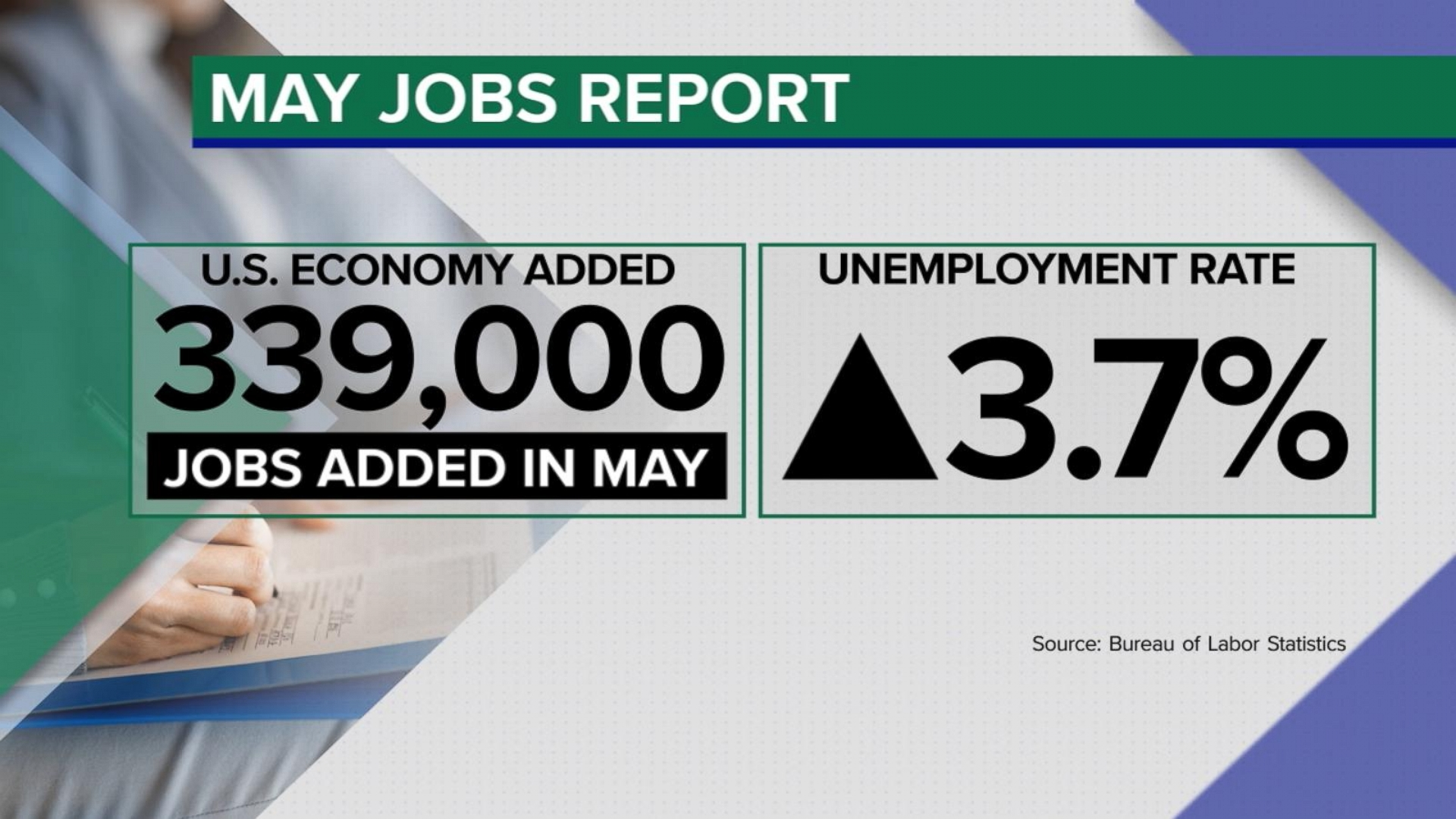
The U.S. economy added 339,000 jobs in May, while the unemployment rate jumped to 3.7% from 3.4%, the Labor Department said Friday.

Why it matters: 

Job gains came in well above forecasters’ expectations — the latest sign that the economy is still underpinned by a hot labor market.

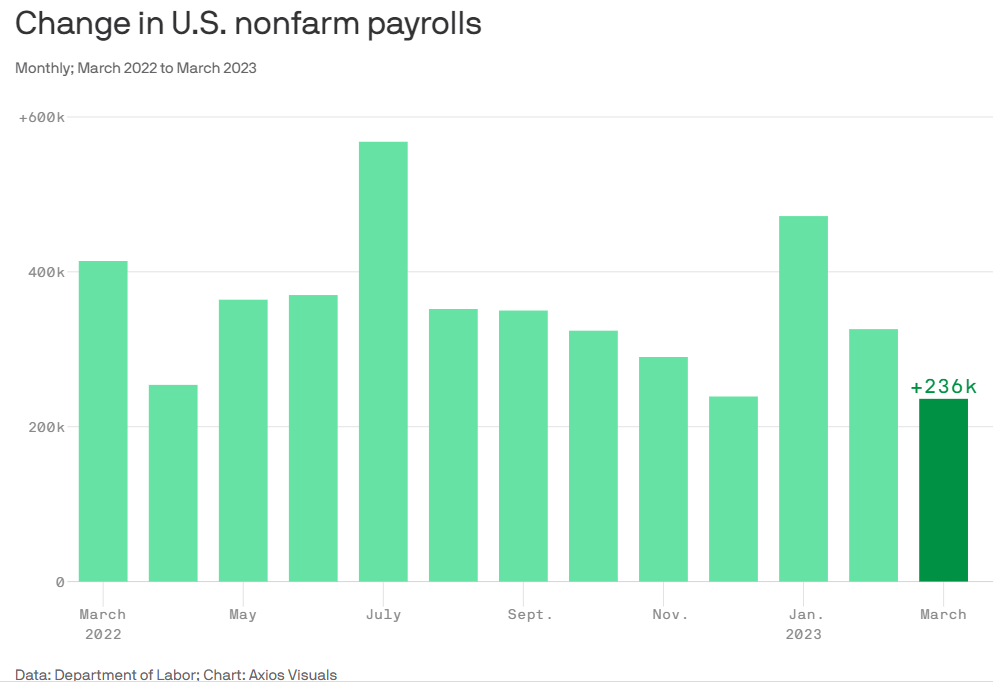
  • Economists expected a gain of 190,000 jobs last month. The May jobs figures are a pickup from the 294,000 added in April, which was revised up by 41,000. Job gains in March were revised up, too.

Details: 

Economic policymakers have kept a close eye on other details from the payrolls report — whether more Americans are joining the workforce and how quickly pay is rising.

  • The labor force participation rate — the share of workers with a job or hunting for one — held at 62.6% in May.
  • Meanwhile, average hourly earnings, a measure of pay, rose by 0.3% in May. Compared to the same period a year ago, wages are up 4.3%.

What we’re watching: 

The May jobs report is among the final data points Federal Reserve officials will consider before deciding whether to continue the interest rate hiking campaign that began more than a year ago.

  • Inflation remains too high, and there are concerns that rapid price gains are being fueled by the tight labor market and strong consumer demand.
  • Still, a top Fed official this week signaled the central bank may skip a rate hike at its meeting later this month.

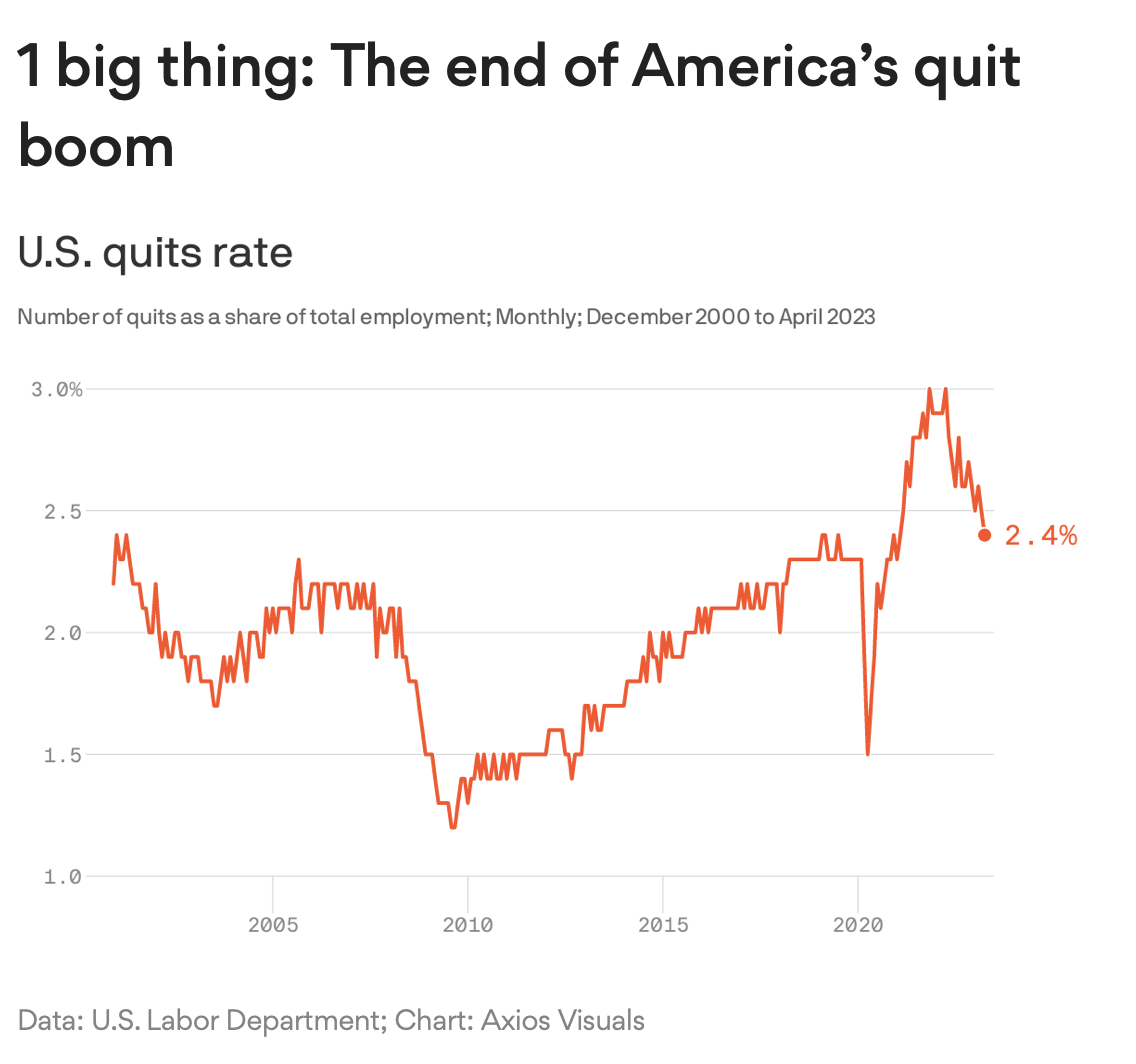
The Great Resignation is over, quit rates return to pre-pandemic levels

https://www.axios.com/2023/05/31/great-resignation-quitting-boom

A phenomenon that defined the pandemic-era labor market is over: the Great Resignation — workers furiously quitting for new, likely higher paying jobs — is a thing of the past.

Why it matters:

The historic surge of quitters was a symptom of an on-fire labor market, where demand for workers far outstripped supply of them.

  • Now the job market may be entering a different era — one that more closely resembles pre-pandemic times.

By the numbers:

The quits rate fell to 2.4% in April, according to the Job Openings and Labor Turnover Survey, released this morning.

  • That is just a tick (0.1 percentage point) higher than the quits rate in February 2020 — and roughly in line with the average quits rate in 2019.
  • Even leisure and hospitality workers, once the poster child for the quits boom, are returning to pre-pandemic norms: the quits rate in this segment hit 4.6% in April — very close to the January 2020 rate of 4.4%, and well-below the peak 5.8% recorded last summer.

What they’re saying:

“We are pretty much back to a strong, robust labor market, but one that is no longer overheating,” says Julia Pollak, an economist at ZipRecruiter.

  • “One that isn’t plagued by widespread labor shortages that are wreaking havoc across the economy, and causing firms to offer off-cycle wage increases and dispense of all hiring requirements. The deck isn’t totally stacked in jobseekers‘ favor anymore.”

Flashback:

At the height of the Great Resignation, the overall quits rate most recently peaked at 3% in April 2022, when there were roughly 4.5 million quits in a single month.

  • Turnover of that magnitude had never been seen before — at least not since the Labor Department started collecting the data in 2000.
  • Workers were in such high demand that they felt confident enough to ditch current gigs for new (likely higher paying) ones.

The bottom line:

Americans who did job hop over the past few years have seen heftier pay gains. But that phenomenon, too, is fading — another sign of some heat coming off the labor market.

  • Job-changers saw annual pay grow more than 13% in April, according to payroll professor ADP — more than double the annual rate of job-stayers.
  • Still that was the slowest pace of growth since November 2021.

U.S. labor market booms in April, adding 253,000 jobs

The labor market added 253,000 payrolls in April, while the unemployment rate dipped to 3.4% — a historically low level.

Why it matters:

Job growth continued to boom last month, the latest sign that economy has strong momentum despite recent bank failures.

  • Economists expected a gain of 185,000 jobs last month.

Details:

The April job figures are a pickup from the 165,000 jobs added the previous month, which were revised down by 71,000, the Labor Department said on Friday.

  • The Labor Department said that jobs growth in the previous two months was lower than first estimated: jobs growth was revised down by a combined 149,000 for February and March.

The big picture:

In recent months, more Americans have joined the workforce, helping to ease labor force shortages.

  • The labor force participation rate — or the share of workers employed or looking for work — held at 62.6% in April.
  • Average hourly earnings, a measure of wage growth, rose to 0.5% in March. Wages rose 4.4% from the same time last year.

Where it stands:

The Federal Reserve has been concerned about an out-of-balance labor market that it fears could stoke inflation that’s already running high.

  • But Fed Chair Jerome Powell said this week that there were signs that the workforce was “coming back into better balance,” though it remained “very tight.”

Rebound in Labor Supply

One of the most persistent economic narratives of 2021 and 2022 was that of missing workers. Many Americans seemed to have simply vanished from the labor force during the pandemic, leaving employers in a lurch.

  • That’s no longer the case, White House economists argue in a new post presenting evidence that labor supply has returned to its pre-pandemic trend.

Why it matters: 

It would be way less painful if the U.S. labor market were to come into a better, non-inflationary balance because labor supply increased, rather than labor demand decreased.

  • And contrary to a widespread economic narrative of the last couple of years, that seems to be happening — as the Biden team seeks to emphasize.

State of play: 

There has been ample speculation about why labor supply was depressed in the aftermath of the pandemic, the White House Council of Economic Advisers notes.

  • Maybe fear of COVID, or long COVID symptoms, kept people out of work. Maybe it was excess savings from the pandemic, or reassessment of life priorities, or a “collective loss of work ethic.”

Nah. It increasingly looks as if it just took some time for potential workers to match up with jobs and return to the labor force.

By the numbers: 

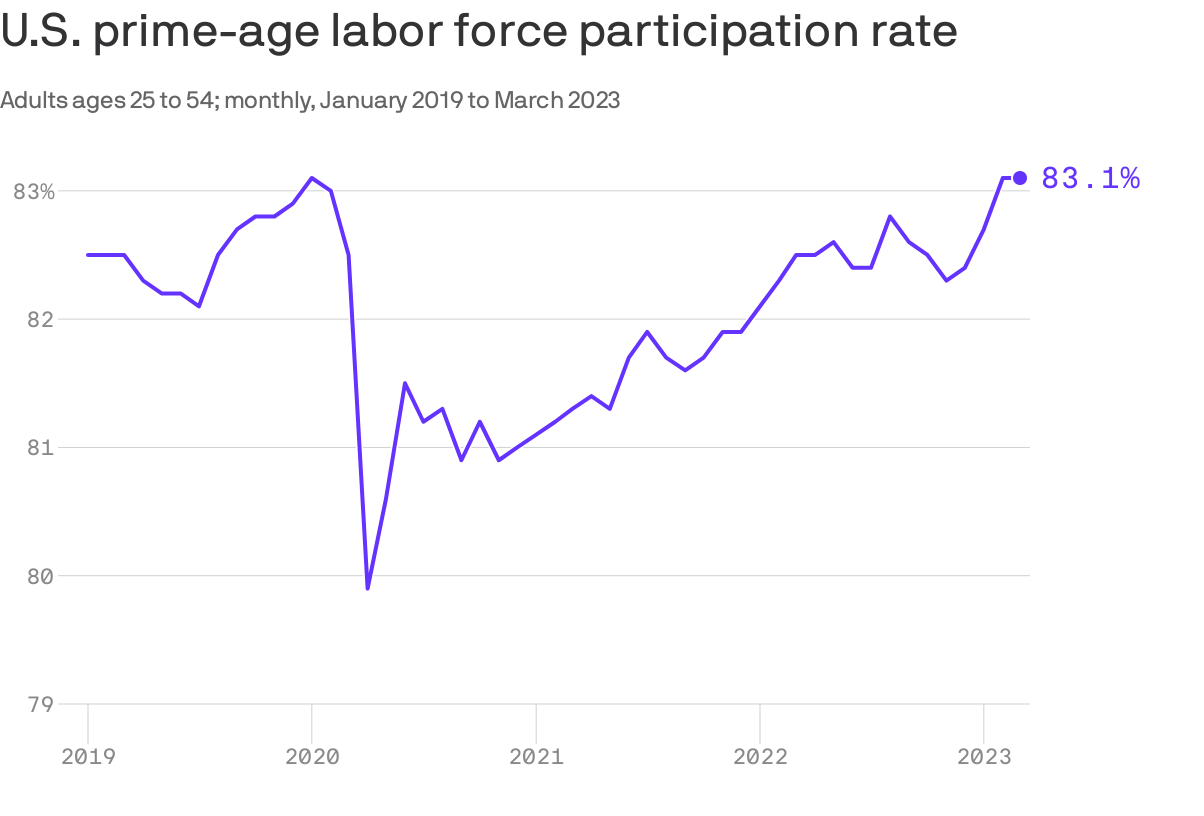
The share of prime-age workers — those between 25 and 54 — who are part of the workforce is now a tick higher than it was before the pandemic: 83.1%, compared with 83.0% in February 2020.

  • The overall participation rate is down (62.6%, from 63.3% in February 2020), but that is due to the Baby Boom generation retiring. It’s on track with what forecasters at the Congressional Budget Office anticipated before the pandemic.
  • Moreover, immigration rates surged in 2022 after a pandemic collapse, also adding to the supply of labor.

What they’re saying: 

“The swift but lagged response of labor supply to surging demand suggests that with time workers do respond to favorable economic conditions,” the White House economists write.

  • “There are many plausible reasons that explain why this response is lagged. Most obviously, the job search process itself is not frictionless; it may take workers some time to find a good job,” they wrote.
  • “Also, if households adapted to the pandemic in ways that can take a while to unwind (such as giving up formal child care), this would delay the labor supply response to growing demand.”

The bottom line: 

“There’s still an inaccurate view that prime-age labor supply is depressed,

that immigration is way down, and that labor force participation rates aren’t back on trend following the pandemic shock to our economy,” Ernie Tedeschi, the chief economist at the CEA, tells Axios.

  • In fact, he said, tight labor markets “pull folks back into the workforce and, while we have more to do to break down barriers to entry, the ‘missing worker’ story doesn’t quite apply anymore.”

Healthcare added 34K jobs in March as temp nursing demand wanes

Dive Brief:

  • Healthcare job growth continued to climb in March with the industry adding 34,000 jobs last month, according to a report released from the Bureau of Labor Statistics on April 7. 
  • The job growth is lower than the six-month average monthly job gain of 54,000 in healthcare. Home health services and hospitals recorded the most gains, adding 15,000 and 11,000 jobs, respectively. 
  • The BLS report comes as demand for temporary nurses declines with median rates of temp staff billing down, according to a report out last week from Jefferies.

Dive Insight:

Labor shortages have been a continuing obstacle for hospitals and health systems, after the coronavirus pandemic spurred industry job reductions and clinicians left the field due to burnout. Temporary nurse staffing agencies swooped in to ease labor shortages, with hospital systems paying higher rates to temp agencies to staff their floors. 

Hospitals ended last year with negative margins, driven by labor expenses that rose as much as 36% compared with pre-pandemic levels. The average weekly rate for travel nurses reached $3,900 in January 2022, according to staffing platform Vivian Health, prompting lawmakers and industry groups to ask the White House to investigate nurse staffing agencies.

But hospitals may be catching a break from labor and temporary staffing pressures. Data from private healthcare staffers, including Aya Healthcare and Fastaff, show that demand for temporary nurses declined by 2.2%, with median bill rates dropping 2.9% week over week, according to the Jefferies report.

The accelerated decline in demand and bill rates could be a sign of labor woes easing, especially for nurse-dependent hospital operators like HCA Healthcare, according to the report.

“As we see order and bill rate data for temp nurses decline, we are gaining optimism that nurse-dependent healthcare providers such as hospitals [HCA Healthcare, Community Health Systems, Tenent Healthcare] and post-acute players [Amedisys, Encompass Health, Enhabit] will begin to see labor headwinds ease, which should help these companies achieve or exceed earnings goals this year,” the report said.

While labor shortages have battered HCA Healthcare and CHS, both operators suggested in recent earnings reports that labor pains could be easing. HCA reported in January that it was decreasing its nursing turnover and CHS reported in October that it had made progress in reducing its contract labor expenses.

Hospitals continue gaining jobs

Reports have showed that labor shortages appear to be easing this year, with a December report from Fitch Ratings noting that staffing shortages at nonprofit hospitals appeared to be incrementally waning.

Healthcare employment rebounds to pre-pandemic levels

Contrary to widespread reports of staffing shortages, healthcare employment reached pre-pandemic levels with the addition of 44,200 jobs in February, according to a recent report from Altarum. 

A recent survey of hospital CEOs found that healthcare staffing was their top concern. Nurses nationwide have reported unsafe staffing levels, leading health systems to restructure and lawmakers to consider safe-staffing laws. 

Yet, healthcare currently has 1.3 percent more jobs than it did in February 2020, according to the monthly Health Sector Economic Indicators brief from Altarum. The nonprofit, healthcare-focused research and consulting organization analyzes available data on spending, prices, employment and utilization to craft the monthly report. 

The data holds that this isn’t a new occurence. The sector has been adding — on average — 49,100 jobs per month for the past year, according to the brief. In February, hospitals led that growth, tapping 19,400 workers. Nursing and residential care facilities added 13,700 jobs, and ambulatory care settings added 11,100. 

However, as healthcare employment rises, its wage growth continues to decline and now lags behind economywide growth. Healthcare wage growth has been declining since mid-2022; in January, pay grew 4.2 percent year over year, while total private sector wage growth grew 4.4 percent. 

This statistic also defies industry narratives, as recent labor negotiations between unions and health systems have scored big raises for workers and clinicians. 

SOTU: Biden’s biggest healthcare priorities

President Joe Biden last night highlighted several healthcare priorities during his State of the Union address, including efforts to reduce drug costs, a universal cap on insulin prices, healthcare coverage, and more.

COVID-19

In his speech, Biden acknowledged the progress the country has made with COVID-19 over the last few years.

“Two years ago, COVID had shut down our businesses, closed our schools, and robbed us of so much,” he said. “Today, COVID no longer controls our lives.”

Although Biden noted that the COVID-19 public health emergency (PHE) will come to an end soon, he said the country should remain vigilant and called for more funds from Congress to “monitor dozens of variants and support new vaccines and treatments.”

The Inflation Reduction Act

Biden highlighted several provisions of the Inflation Reduction Act (IRA), which passed last year, that aim to reduce healthcare costs for millions of Americans.

“You know, we pay more for prescription drugs than any major country on earth,” he said. “Big Pharma has been unfairly charging people hundreds of dollars — and making record profits.”

Under the IRA, Medicare is now allowed to negotiate the prices of certain prescription drugs, and out-of-pocket drug costs for Medicare beneficiaries are capped at $2,000 per year. Insulin costs for Medicare beneficiaries are also capped at $35 a month.

“Bringing down prescription drug costs doesn’t just save seniors money,” Biden said.  “It will cut the federal deficit, saving tax payers hundreds of billions of dollars on the prescription drugs the government buys for Medicare.”

Caps on insulin costs for all Americans

Although the IRA limits costs for seniors on Medicare, Biden called for the policy to be made universal for all Americans. According to a 2022 study, over 1.3 million Americans skip, delay purchasing, or ration their insulin supply due to costs.

“[T]here are millions of other Americans who are not on Medicare, including 200,000 young people with Type I diabetes who need insulin to save their lives,” Biden said. “… Let’s cap the cost of insulin at $35 a month for every American who needs it.”

With the end of the COVID-19 PHE, HHS estimates that around 15 million people will lose health benefits as states begin the process to redetermine eligibility.

The opioid crisis

Biden also addressed the ongoing opioid crisis in the United States and noted the impact of fentanyl, in particular.

“Fentanyl is killing more than 70,000 Americans a year,” he said. “Let’s launch a major surge to stop fentanyl production, sale, and trafficking, with more drug detection machines to inspect cargo and stop pills and powder at the border.”

He also highlighted efforts by to expand access to effective opioid treatments. According to a White House fact sheet, some initiatives include expanding access to naloxone and other harm reduction interventions at public health departments, removing barriers to prescribing treatments for opioid addiction, and allowing buprenorphine and methadone to be prescribed through telehealth.

Access to abortion

In his speech, Biden called on Congress to “restore” abortion rights after the U.S. Supreme Court overturned Roe v. Wade last year.

“The Vice President and I are doing everything we can to protect access to reproductive healthcare and safeguard patient privacy. But already, more than a dozen states are enforcing extreme abortion bans,” Biden said.

He also added that he will veto a national abortion ban if it happens to pass through Congress.

Progress on cancer

Biden also highlighted the Cancer Moonshot, an initiative launched last year aimed at advancing cancer treatment and prevention.

“Our goal is to cut the cancer death rate by at least 50% over the next 25 years,” Biden said. “Turn more cancers from death sentences into treatable diseases. And provide more support for patients and families.”

According to a White House fact sheet, the Cancer Moonshot has created almost 30 new federal programs, policies, and resources to help increase screening rates, reduce preventable cancers, support patients and caregivers and more.

“For the lives we can save and for the lives we have lost, let this be a truly American moment that rallies the country and the world together and proves that we can do big things,” Biden said. “… Let’s end cancer as we know it and cure some cancers once and for all.”

Healthcare coverage

Biden commended the fact that “more American have health insurance now than ever in history,” noting that 16 million people signed up for plans in the Affordable Care Act marketplace this past enrollment period.

In addition, Biden noted that a law he signed last year helped millions of Americans save $800 a year on their health insurance premiums. Currently, this benefit will only run through 2025, but Biden said that we should “make those savings permanent, and expand coverage to those left off Medicaid.”

Advisory Board’s take

Our questions about the Medicaid cliff

President Biden extolled economic optimism in the State of the Union address, touting the lowest unemployment rate in five decades. With job creation on the rise following the incredible job losses at the beginning of the COVID-19 pandemic, there is still a question of whether the economy will continue to work for those who face losing Medicaid coverage at some point in the next year.

The public health emergency (PHE) is scheduled to end on May 11. During the PHE, millions of Americans were forced into Medicaid enrollment because of job losses. Federal legislation prevented those new enrollees from losing medical insurance. As a result, the percentage of uninsured Americans remained around 8%. The safety net worked.

Starting April 1, state Medicaid plans will begin to end coverage for those who are no longer eligible. We call that the Medicaid Cliff, although operationally, it will look more like a landslide. Currently, state Medicaid regulators and health plans are still trying to figure out exactly how to manage the administrative burden of processing millions of financial eligibility records. The likely outcome is that Medicaid rolls will decrease exponentially over the course of six months to a year as eligibility is redetermined on a rolling basis.

In the marketplace, there is a false presumption that all 15 million Medicaid members will seamlessly transition to commercial or exchange health plans. However, families with a single head of household, women with children under the age of six, and families in both very rural and impoverished urban areas will be less likely to have access to commercial insurance or be able to afford federal exchange plans. Low unemployment and higher wages could put these families in the position of making too much to qualify for Medicaid, but still not making enough to afford the health plans offered by their employers (if their employer offers health insurance). Even with the expansion of Medicaid and exchange subsidies, it, is possible that the rate of uninsured families could rise.

For providers, this means the payer mix in their market will likely not return to the pre-pandemic levels. For managed care organizations with state Medicaid contracts, a loss of members means a loss of revenue. A loss of Medicaid revenue could have a negative impact on programs built to address health equity and social determinants of health (SDOH), which will ultimately impact public health indicators.

For those of us who have worked in the public health and Medicaid space, the pandemic exposed the cracks in the healthcare ecosystem to a broader audience. Discussions regarding how to address SDOH, health equity, and behavioral health gaps are now critical, commonplace components of strategic business planning for all stakeholders across our industry’s infrastructure.

But what happens when Medicaid enrollment drops, and revenues decrease? Will these discussions creep back to the “nice to have” back burners of strategic plans?

Or will we, as an industry, finish the job?

U.S. economy adds whopping 517,000 jobs in January

The U.S. economy added 517,000 jobs in January, and the unemployment rate fell to 3.4% — the lowest level in over a half-century, the government said on Friday.

Why it matters: 

Employers added jobs at an unexpectedly rapid pace, the latest sign of a hot labor market despite aggressive moves by the Federal Reserve to cool it down.

  • The numbers are more than double the 190,000 forecasters anticipated.

Details:

The extraordinary report comes as the Fed continues to dial back its pace of interest rates and prepares to raise rates further to restrain the economy and chill still-high inflation.

  • Fed chair Jerome Powell has acknowledged progress on slowing inflation in recent months while noting risks lie ahead. Among them is wage growth, which is rising at a pace still too swift for the Fed’s comfort.
  • In January, average hourly earnings rose 0.3% — or 4.4% over the previous year, according to Friday’s data.

The big picture:

The data also showed that employment in 2023 was even stronger than initially thought, with roughly 568,000 more jobs than previously reported.

  • The update was part of the Labor Department’s annual revisions, which incorporate more complete data from insurance records and updated seasonal adjustments.

America’s inflation turnaround

It may be time to update your inflation narrative.

The ultra-hot readings that defined the first half of 2022 appear to be firmly in the rearview mirror, improving the odds that price pressures can dissipate further without excessive economic pain.

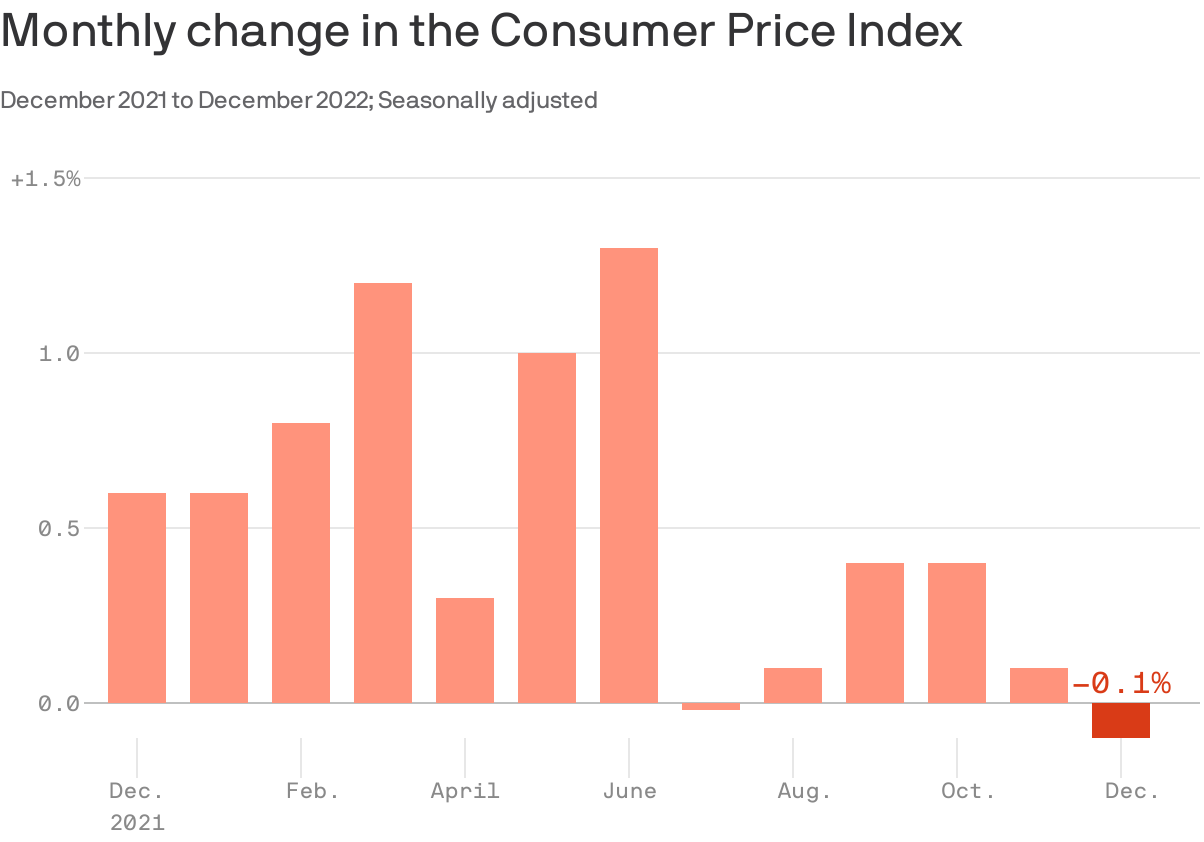
  • That’s the key takeaway from the December Consumer Price Index released this morning, which confirmed notably cooler inflation as the year came to a close.

Why it matters: 

The nation’s inflation problem isn’t over, but so far inflation is slowing while the job market is still healthy, an enviable combination.

  • As Princeton economist Alan Blinder put it in an op-ed last week, inflation was “vastly lower” in the second half of 2022 than the first; yet, “hardly anyone seems to have noticed.”

By the numbers: 

In the final three months of 2022, core inflation (which excludes food and fuel costs) came in at an annualized 3.1% — higher than the Fed aims for, but hardly crisis levels. In the second quarter of the year, that number was 7.9%.

  • It’s a stunning decline, occurring alongside a labor market that by nearly all measures is still flourishing. Just this morning, the Labor Department announced that jobless claims fell to an ultra-low 205,000 last week.

State of play: 

Grocery prices rose 1.1% in the final three months of the year, an uncomfortably high rate, but not as extreme as the rates seen earlier in 2022.

  • Gasoline prices, pushed up by Russia’s invasion of Ukraine, were once the crucial reason why inflation was rising. In recent months, the opposite has been true: December pump prices slid 9.4%, helping drag the overall index into negative territory.
  • Disinflation was at work for many other goods, including used cars (-2.5%) and new vehicles (-0.1%) where prices have reversed, helped by easing supply chain bottlenecks.
  • Shelter costs pushed inflation upward, surging 0.8% in December. But private-sector data points to rents on new leases falling in recent months, which would only filter into the CPI data over time. That makes for a more benign inflation outlook in 2023.

What to watch: 

That’s not to say there aren’t risks ahead. The war in Ukraine is ongoing, and another energy price shock could occur.

  • The Fed has also focused in on the services sector, where price increases have slowed from last summer but remain frothy. The risk is that business costs associated with the still-tight labor market (like higher wages) will pass through to prices for consumers.

The bottom line: 

Inflation will still be a worry in 2023, but much less so than it seemed a few months ago.