Financial Literacy: A Leadership Prerequisite

https://www.kaufmanhall.com/insights/blog/financial-literacy-leadership-prerequisite

In last month’s blog, we discussed the importance of financial planning, both for internal audiences—including the leadership team and the board of trustees—and for external audiences—including prospective students and their families, rating agencies, alumni and other stakeholders. This month, in the first of a series of blogs focused on key finance-related issues, we’re turning our attention to a broader and deeper internal audience, asking the question, “What is your institution’s financial literacy?”

The terms described in this blog will be very familiar to members of college and university finance teams and to many institutional leaders as well.

The point is that these terms should be familiar to as many individuals as possible throughout the institution: they form the foundation of a basic financial literacy that every college and university should foster across its faculty and staff.

What is financial literacy?

Financial literacy is the ability to understand where an institution stands at any given time with respect to key elements of its balance sheet and income statement. To state it simply, financial literacy means an understanding of the vital signs that describe the financial health of the institution. In medicine, the basic vital signs are body temperature, pulse rate, respiration rate, and blood pressure. In finance, the vital signs include measures of unrestricted cash, revenue, expenses, debt, and risk.

In medicine, there are professionals whose job is to dig deeper if any of the body’s vital signs are deteriorating. Similarly in finance, it is the job of the CFO and finance team to monitor the vital signs of the institution’s financial health and to seek causes and solutions of current troubles or to use changes in the vital signs to address potential future issues. For most of us—in medicine or finance—the goal should be a basic understanding of what the vital signs measure and whether they point to good health.

There are some key considerations for each financial vital sign:

  • Unrestricted Cash. The critical question related to unrestricted cash (also termed liquidity) is whether the institution has enough accessible liquidity to meet its daily expenses if its cash flow was unexpectedly interrupted. Days cash on hand is a balance sheet metric that is typically used to assess this issue: days cash on hand literally measures how long unrestricted cash reserves could cover the institution’s operating costs if its cash flow suddenly stopped. 

    The emphasis on “accessible liquidity” is an important element of this financial vital sign: it speaks to the ability to distinguish between institutional wealth versus liquidity. In higher education, an endowment can be an important source of the institution’s wealth, but many of the funds within an endowment cannot be easily accessed—they are, by and large, not liquid funds or are highly restricted as to their use. Readily available, unrestricted cash reserves are what an institution must rely on to meet its day-to-day expenses should cash flow be interrupted or reduced.
     
  • Revenue. Because an institution needs to maintain or grow its cash reserves and allocate them sparingly, the amount of revenue coming in—from tuition and fees and from other sources of additional income (see below)—is also an important vital sign. An institution should obviously be taking in enough revenue to cover its expenses without drawing on its cash reserves. 

    Additionally, however, given continued growth in expenses, revenue growth (through enrollment growth, student mix, and/or program mix) is a significant measure of ongoing vitality.

    Financial health is also enhanced if an institution does not rely too heavily on a single revenue source. For schools with an endowment, for example, the amount of income the endowment can generate to support operations is an important source of additional income. More generally, additional income can come from such auxiliary revenue sources as residential fees, fundraising, special events, concessions, and a host of other sources. These additional revenue sources, while potentially small on an individual basis, can be material on a cumulative basis.
     
  • Expenses. How much does it cost to produce the education that a college or university provides to its students? If that cost is approaching—or worse, surpassing—the net tuition revenue and additional income that the institution brings in, what is being done—or could be done—to reduce those costs? Expenses are perhaps most similar to body temperature in medical vital signs; if they get too high, they must be brought down before the health of the institution begins to decline. And the measure of expenses should be viewed overall for the institution as well as on a per student basis to communicate the “value” of different student types to the organization.
     
  • Debt. Debt is an essential component of the funding of significant capital projects that colleges and universities must undertake to maintain updated and competitive facilities. Just as most people need to take out a mortgage to afford a home purchase—spreading the cost of the home over a multiyear payment period—so too do institutions often need debt to finance large capital expenditures. But the amount of debt (also termed “leverage”) can also be an indicator of the institution’s financial health. That health begins to decline if the amount of debt relative to an institution’s assets or annual income grows too large, or if the amount required to pay for the debt (i.e., to meet the scheduled principal and interest payments—the debt service) puts too much of a burden on the cash flow generated from the institution’s day-to-day operations. If the debt service becomes too high relative to cash flow, the institution may face onerous legal requirements, or even default, which may severely constrain its ability to provide the range of programs desired and expected by its student population.
     
  • Risk. Risk is an indicator that identifies potential weaknesses in any of the preceding indicators that could jeopardize the institution’s financial health. For basic financial literacy, only the most significant risks need to be identified: over-reliance on tuition revenue in a market with declining enrollments, for example, or over-reliance on endowment income in the event of market instability. Once an institution consistently measures its risks, it can begin to determine what level of risk is appropriate and address strategies to manage that risk.

Why does financial literacy matter?

Promoting financial literacy throughout an institution cultivates a common understanding of financial health that provides context for leadership’s decisions and a common language to address issues. If tuition revenue is declining, for example, financially literate faculty members should better understand the need to prioritize academic programs that not only meet the academic needs of their students, but also can draw more students or produce healthier margins. If cost-cutting measures are required to reduce expenses, financially literate staff should understand the genesis of the need for reductions and why the institution cannot simply draw on its endowment to close the gap. Furthermore, acknowledging and describing the most significant risks an institution faces using a common language makes clear the need for action if one or more of those risks begins to materialize.

Financial literacy is also an important tool for cultivating the next generation of faculty leaders. When faculty members rise to leadership positions, it is essential that they understand that academic growth and strategic initiatives cannot succeed without sufficient resources to support them, or if they cannot generate the revenue needed to cover—or exceed—their costs.

By promoting financial literacy across the institution, the institution can help ensure that future leaders are acquiring the foundation needed for them to grow into informed decision-makers who understand the need to maintain the institution’s financial health.

The aftermath of a C-suite slimdown

Saint Peter’s Healthcare System in New Brunswick, N.J., was six years ahead of the C-suite streamlining curve.

The health system slimmed down its leadership structure in 2017, President and CEO Les Hirsch told Becker’s. A top-heavy executive team grew unsustainable as the system struggled financially, operating at a loss. Saint Peter’s board decided to combine the president and CEO positions — which were previously split in two. Then, as president and CEO, Mr. Hirsch cut five vice presidents’ positions, including the consolidation of the chief information officer and chief medical information officer roles. More than  20 middle-manager positions were also cut or consolidated.

The streamlining of senior leadership positions alone at the time eliminated over $4 million in salaries and benefits, according to Mr. Hirsch. With the old leadership structure, Saint Peter’s spent about 2.4% of its revenue on senior leaders’ compensation. Last year, that percentage sank to 1.34%.

But finances shouldn’t be the only consideration for a health system planning to whittle down its structure.

“The good news is, we’re lean,” Mr. Hirsch said. “The bad news is, we’re lean.”

Since consolidating the president and CEO roles — and not having a chief operating officer — succession planning is more complicated, per Mr. Hirsch.

“There’s no designated No. 2,” he said. “Our senior leadership team structure is very flat.”

A condensed C-suite also means more work for some members of the leadership team — which is taken in stride, Mr. Hirsch said. There’s no specific “planning” department, so executives put their heads together on strategy, growth and development initiatives.  There is no government relations officer, but Mr. Hirsch, as CEO, takes primary responsibility for this function and is very active in advocacy. 

Anyone who works on a lean team like this also “has to be a generalist,” Mr. Hirsch said. He stays up to date on the literature and sends relevant articles to other executives.

“Considering our size as one of the few remaining single-hospital health systems in New Jersey, we don’t have the luxury of having somebody specifically responsible for artificial intelligence or other niche responsibilities as these are functions that are absorbed within people’s roles,” Mr. Hirsch said. “And we all develop the knowledge needed so that we can understand how new ideas or resources may apply to us. When you’re smaller and don’t have the scale of these mega-organizations, you have to do more yourself. You roll up your sleeves.”

Despite these challenges, a little can go a long way; three departmental administrators now split the job once shared by seven people at Saint Peter’s. There’s been no hit to efficiency; “they’re more effective in their roles as departmental administrators than anybody that I’ve ever seen,” Mr. Hirsch said.

The changes to streamline management were also well-received by the workforce. Often layoffs affect front-line workers more than management or senior leadership — which may have contributed to the lack of outcry, per Mr. Hirsch. But he primarily attributes the positive reception to intentional transparency.

“Most importantly, I’m a very active communicator. So, I communicated about it. It wasn’t that there was some intrigue and mystery in the organization that people were hearing by rumor,” Mr. Hirsch said.

Rumors — like fear — are two things that equate to being like a cancer in an organization,” he continued. “I always want to do everything I possibly can to set the facts straight and communicate with people. If it’s not confidential and I can communicate it, I will. In fact, I’ll err more on the side of communicating than keeping information close to the vest.”

Regardless of who is affected by layoffs, executives should always handle them with sensitivity, Mr. Hirsch emphasized; the right choice for an organization is not always the easy choice for its people.

“It’s always painful when you’re making these kinds of changes because they affect people, and you always have to go about those changes in a very thoughtful, considerate, and compassionate way,” Mr. Hirsch said. “You’re eliminating roles and impacting people’s lives, their careers and their family. So, I always keep that top of mind.”

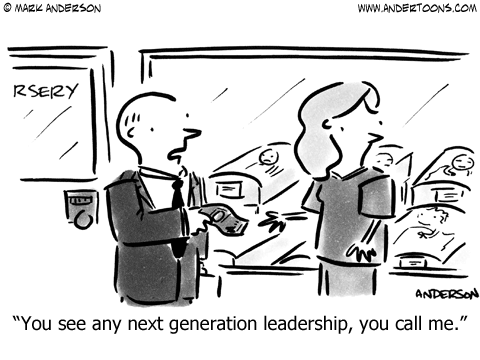
Cartoon – Next Generation Leadership

The wave of CEO retirements is upon us

https://mailchi.mp/11f2d4aad100/the-weekly-gist-august-12-2022?e=d1e747d2d8

 In just the first half of this year, more than 60 hospital CEOs have retired or left their roles, according to search firm Challenger, Gray and Christmas. Retirements are up 48 percent from the same time last year. Part of this is generational, as many Baby Boomer leaders are at retirement age, but the latest wave comes after many delayed planned exits during the pandemic to guide their organizations through the crisis. 2

Now, after two-plus grueling years of leading through COVID, executives are ready to pass the baton. The latest high-profile announcement came this week, with Salt Lake City-based Intermountain Healthcare’s CEO Marc Harrison announcing his plans to leave the system for a role at venture firm General Catalyst. 

The Gist: As a recent piece from Modern Healthcare points out, many systems have known their CEOs were exiting well in advance, but the significant cultural and financial consequences associated with choosing a new leader, especially during a period of industry-wide change, are presenting boards with hiring decisions as difficult as they are important.

Astute organizations have been planning ahead for these transitions, developing a bench of next-generation leaders, and providing them exposure to the board. COVID also served as a helpful stress test to identify talent who rose to the occasion to lead confidently and calmly through the crisis, while simultaneously weeding others out who floundered under uncertainty. 

The next generation of leaders will need different skills to navigate current and future challenges, including rethinking the role of the health system in response to a new class of disruptors, and managing through a workforce crisis that will require evolving the labor model while meeting new demands for workforce diversity and engagement.   

Hospitals feel the brain drain

Hospitals are feeling an enduring consequence of experienced employees’ early retirements and resignations: collective knowledge loss. 

“Even when missing people can be replaced, missing knowledge cannot,” Ed Yong wrote for The Atlantic May 18. 

Beyond hospitals’ challenges in recruiting and retaining employees are the stubborn and sometimes subtle problems resulting from decreasing median tenure within their organizations. The ripple effects of losing older, seasoned employees to resignations or early retirements can be harder to quantify, but are nonetheless felt by colleagues who stay, newcomers to the organization, and patients and their families.  

Team tenure is a significant determinant to the cost and quality of hospital care. For example, a one-year increase in the average tenure of registered nurses on a hospital unit was associated with a 1.3 percent decrease in length of stay, a 2014 study from researchers at Columbia University School of Nursing and Columbia Business School found. 

“I don’t think the public really understands how great the loss of this generational knowledge is,” Kelley Cabrera, a nurse based in New York, told Mr. Yong. She described the six-week orientation for her current job, led by some people who had been in the ER for less than a year, as “shockingly short.” 

“When inexperienced recruits are trained by inexperienced staff, the knowledge deficit deepens, and not just in terms of medical procedures,” Mr. Yong wrote. “The system has also lost indispensable social savvy — how to question an inappropriate decision, or recognize when you’re out of your depth — that acts as a safeguard against medical mistakes. And with established teams now ruptured by resignations, many healthcare workers no longer know — or trust — the people at their side.”

National data on average tenure in healthcare has not yet caught up to compare with pre-pandemic longevity numbers. The median years of tenure with current employers for healthcare practitioners and technical occupations was 4.7 years in 2020, according to the most recent data from the U.S. Bureau of Labor Statistics, ticking up to five years for workers in hospitals.

The benefits of lengthy tenures are felt at the front lines as well as hospitals’ most senior levels. Marc Boom, MD, CEO of Houston Methodist, told Becker’s this year the cumulative tenure of the health system’s executive team was a game changer throughout the pandemic. At the start of the pandemic, Dr. Boom had been CEO for more than eight years and at the institution for almost 22. The executive team of nine leaders, including him, collectively shared more than 150 years of tenure with Houston Methodist. The team had worked together without any changes for about seven years, when the most recent person joined. 

This longevity lends itself to major systemwide decisions almost feeling instinctive due to their familiarity working together. “I had a team that was very tenured,” Dr. Boom said. “To work with people who you’ve known for a long period of time — you know the ins and outs, the strengths and weaknesses. You have almost an understood language. You can talk in five-word sentences, move on and everyone goes and does their thing. There are a lot of advantages to that.”

Decentralized leadership raises questions about Trump coronavirus response

https://thehill.com/homenews/administration/491093-decentralized-leadership-raises-questions-about-trump-coronavirus

The rotating cast of officials appearing behind President Trump to detail the government’s response to the coronavirus are leading to new criticisms that they reflect a scattered approach from the White House that too often leaves states fending for themselves.

Top Trump administration officials say the appearances by a broad range of administration officials shows the “all of government” undertaken to combat the coronavirus.

But some current and former government officials see a disconnected strategy where it can be unclear who’s in charge of what or whether there is a coordinated long-term plan.


EVERY HOSPITAL BOARD NEEDS A CEO SUCCESSION PLAN. HALF ARE FAILING.

https://www.healthleadersmedia.com/strategy/every-hospital-board-needs-ceo-succession-plan-half-are-failing

The organization needs to have a strong sense for who will lead next. That’s ultimately the responsibility of the board, not the incumbent. This article appears in the July/August 2019 edition of HealthLeaders magazine.

The departure of a CEO can severely disrupt an organization’s progress, especially when the leader leaves suddenly without a clear successor. Despite the well-known need for succession planning, an alarming number of healthcare provider organizations are chugging along without a plan in place, just hoping that their top executives stick around for the foreseeable future.

Forty-nine percent of hospital and health system boards lack a formal CEO succession plan, according to the American Hospital Association Trustee Services 2019 national healthcare governance survey report. That leaves them vulnerable to the disruptive gusts of a CEO’s sudden departure, and it can inhibit their ability to pursue longer-term strategies by leaving them overly dependent on one leader’s vision.

The failure of these boards to formalize CEO succession plans is outrageous and unacceptable, says Jamie Orlikoff, president of the Chicago-based healthcare governance and leadership consulting firm Orlikoff & Associates Inc. and board member of St. Charles Health System in Bend, Oregon. “Whatever the reasons are, it’s just a fundamental and inexcusable abrogation of a basic governance responsibility, so I am nothing less than shocked that the figure is almost 50%,” Orlikoff says.

Why Plans Aren’t Made There are typically a few basic reasons why an organization may be slow to finalize a CEO succession plan. Perhaps the current CEO just doesn’t want to talk about it, Orlikoff says. Some executives are more comfortable talking to their families about their own life insurance plans than they are talking to the board about what to do in the event of their sudden departure, he says. Or perhaps it’s the board members who don’t want to talk about it. Orlikoff says at least four board chairpersons for various organizations have told him in the past seven years that they don’t want their current CEOs to leave and that they don’t want to think about succession planning because the recruitment process is too burdensome. Or there could be an unhealthy power dynamic between the CEO and the board, with the CEO asserting control over tasks that should be handled by the board members, Orlikoff says.

What makes the relationship between the CEO and the board so tricky is how it ties together two distinct relationships. On the one hand, the CEO and the board are strategic partners defining and executing a shared vision. On the other, they are an employee and an employer. “Those are two very, very different and very important functions,” Orlikoff says.

“Some boards have great difficulty envisioning the distinction between those two roles.” A board should lean on the CEO as a strategic partner because the CEO is likely to know more about the industry and more about the local market than the board members do, Orlikoff says. But when the board neglects to assert its proper place in the employer-employee relationship, the CEO may be given free rein over a broader scope of issues than is appropriate, and that can impede the CEO succession planning process, he adds.

In other words, while it’s perfectly appropriate for a CEO to groom a potential successor, the board should not defer to the CEO’s selection, and the CEO should not insist that the board do so. How to Fix This The existence or nonexistence of a formal CEO succession plan is often a symptom of whether the relationship between a CEO and the board is healthy, Orlikoff says.

Notably, the task of devising a succession plan is one exercise that can improve that relationship, he adds. While the detailed steps each organization should take will vary from one situation to another, there are two specific items that Orlikoff recommends: 1. Ask about the mundane threat of a bus.

Whether you’re a CEO or board member for an organization without a formal succession plan in place, there’s one straightforward question you can ask to kickstart productive dialogue on the topic: What do we do if our CEO gets hit by a bus tonight? The question is nonthreatening. It doesn’t signal a CEO’s possible intent to resign or retire. It doesn’t suggest the board members are thinking about giving him or her the boot.

It simply asks, as a matter of fact, how the organization will maintain continuity in the event of an unplanned CEO departure, just as parents would speak with their families about life insurance, Orlikoff says. The CEO should tell the board, without any other senior leaders present, whom the CEO would pick to step into the interim CEO role, Orlikoff says. That will inevitably prompt follow-up questions: Would the interim CEO be a good permanent replacement? Which of the requisite skills do they lack? How well do they align with our long-term needs and vision?

The conversations about an unplanned CEO departure will flow naturally into questions about a planned departure. Where are we in the current CEO’s contract cycle? When does the CEO want to retire? What skills and traits will our next CEO need to lead the organization into the future of healthcare?

Conversations about an unplanned departure should begin on the very first day of a new CEO’s contract, Orlikoff says. Conversations about a planned departure should begin at the end of the CEO’s first year, he says. For a CEO with a five-year contract, the board should start asking halfway through contract whether the CEO wishes to renew a contract or leave the organization, and the board should know three years into the five-year contract whether the CEO wants to stay, he says.

Hold executive sessions without the CEO present. An increasing number of hospital and health system boards are routinely listing executive sessions on their meeting agendas, and that’s a good thing, according to the AHA Trustee Services survey. A slight majority, 52%, of all respondents routinely included an executive session in the agenda of every board meeting, according to the survey report. But 26% of system boards, 59% of subsidiary boards, and 48% of freestanding boards still don’t.

Even if a board has an executive session, though, that doesn’t mean members are able to fully discuss the topics in their purview. The survey found that CEOs participate in the entire executive session for a majority, 54%, of all boards. That includes 41% of system boards and 57% for both subsidiary and freestanding boards. That deprives trustees of an opportunity to discuss the CEO in his or her absence and might impede the CEO succession planning process, Orlikoff says.

Related: 4 Steps for Planning CEO Succession Boards should think of their meetings in three stages, Orlikoff says. The first stage includes everyone in the room, including board members, the CEO, senior executives, and invited guests. The second stage is a modified executive session that includes the board members and CEO only, which is where the majority of the meeting should take place. The third stage should be an executive session with the board members only. “Confident, secure CEOs know that their boards need to go into executive session without them present occasionally in order to perform certain governance functions. They encourage it,” Orlikoff says. “Insecure CEOs or those who are attempting to control and manipulate the board are very uncomfortable with executive sessions and don’t want the board going into an executive session.”

It’s Mutually Beneficial While it may be difficult to prompt board members to think about a future under different leadership, CEOs who do so are not only investing in the organization’s long-term success but also signaling that they are the sort of leader willing to make investments in the organization’s long-term success. “When a CEO goes to the board and says, ‘You guys need to do this,’ … it demonstrates an incredibly high degree of confidence.

It also demonstrates an incredibly high degree of commitment to the organization,” Orlikoff says. “It shows that you’re thinking beyond yourself,” he adds. “You’re thinking about the best interests of the organization, that you’re willing to have difficult conversations for the good of the organization.”

“INSECURE CEOS OR THOSE WHO ARE ATTEMPTING TO CONTROL AND MANIPULATE THE BOARD ARE VERY UNCOMFORTABLE WITH EXECUTIVE SESSIONS AND DON’T WANT THE BOARD GOING INTO AN EXECUTIVE SESSION.”

KEY TAKEAWAYS

Not having a formal succession plan may be a symptom of an unhealthy relationship between the CEO and the board.

When CEOs prompt the board to think about who will lead next, it demonstrates self-confidence and commitment to the organization.