Opinion: ‘Medicare for all’ won’t fix soaring healthcare costs

https://www.latimes.com/opinion/story/2019-11-15/medicare-for-all-health-care-costs?fbclid=IwAR0uMTlEMcPuefoVjeuSvyIa69AIRk8v4N0d4ux6f1HMg1k4wMbM_SRElh8

Medical bill

The idea of “Medicare for all” advanced another step with the recent release of Sen. Elizabeth Warren’s more detailed health proposal. It is expansive and bold, and has brought some excitement to the progressive core of the Democratic Party. While policy mavens can delight in the details, the enormity of the proposal is a sign that this debate has clearly gone off the rails.

There is no question that healthcare cost is a pocketbook challenge for all of us. Employer and employee premiums for private health insurance for a household now average $20,576, before deductibles and copayments, and before payroll and state and local taxes to pay for healthcare for the elderly and the poor.

National health expenditures increased 179% between 2000 and 2019 to $3.8 trillion, and 50% of this increase was directly due to increases in unit prices and service intensity by hospital systems and physicians. In the U.S., healthcare is 28% more expensive than the next highest cost system, Switzerland, and 78% more expensive than in Germany. For a primary care doctor in the U.S., submitting invoices to insurers and collecting payments costs almost $100,000 per year.

What we should be debating — instead of the politics around Medicare for all — is how this market evolved in such a malignant direction, and whether anything can be done to change these trends.

Hospital consolidation has been shown to drive up healthcare costs, and yet 90% of U.S. hospital markets are highly consolidated. Physician employment by hospitals and health systems has increased from 26% to 44% of the market from 2012 to 2018, increasing the pricing leverage of consolidated systems even further.

These changes directly result in higher prices for commercial health insurance as hospitals use their exaggerated hospital “charges,” often many multiples of their costs or of the market price, to drive up their reimbursement rates for in-network care and especially for out-of-network care, where there is no price negotiation. Further, even at most not-for-profit healthcare systems, hospital leaders are compensated based on the profits they generate, not premiums they reduce, as is the case with leaders of for-profit hospital systems.

The pharmaceutical market has also come under scrutiny for the enormous prices of newly approved medications, and for price increases of existing medicines such as insulin. Behind the scenes are layers of businesses that further exploit this market. For example, one pharmaceutical benefit manager (a company hired by a health plan or employer to oversee prescription drug benefits) reported profits of $1.8 billion in 2013 that rose to $4.5 billion in 2017 despite a 4% reduction in revenue reported over this period.

It’s easy to see that consumers need relief from this market. One might imagine that politicians from both political parties would band together in a search for actionable solutions. Yet the debate has migrated from a discussion of why costs are spiraling out of control to a simple and unrealistic answer — Medicare for all. Here are some ideas on how to frame a meaningful discussion about costs.

Reducing administrative costs has been a stated policy goal of the federal government since the passage of the Health Insurance Portability and Accountability Act (HIPAA) in 1996, yet these costs continue to increase. To reduce these costs, we have to simplify the complexity of the billing process for hospitals and physicians across the multiple different health plans in the market, and we need to transform the expensive set of public data reporting mandates into a model in which we are assured these data are used by providers internally to improve the quality of care they provide.

We need to rebalance negotiating power between hospitals and physicians and insurers. Hospitals and other providers have been allowed to set their list prices without any relationship to the cost of care they provide. These inflated prices are then imposed on out-of-network patients, most egregiously in the practice of surprise medical billing in which patients encounter deliberately out-of-network air ambulances and independent anesthesiologists. In billing disputes, state law should offer these patients a default of a market price closer to Medicare payments than to hospital charges.

Finally, it’s time to stop the practices that are driving up prescription drug costs for all of us. Secret payments between pharmaceutical manufacturers and pharmaceutical benefit managers and distributors totaled over $100 billion in 2016. This business model needlessly inflates drug prices for the benefit of intermediaries in the market. We need laws requiring price transparency at the pharmacy for brand and generic drugs, and price competition for medications at the retail level.

The problem with focusing on Medicare for all is that rather than developing practical approaches, the debate is heading down a path likely to leave us without any tenable solutions to address healthcare costs — the issue that ignited the public’s interest in the first place.


Oregon insurer sues, says 3 health systems have locked it out of Portland market

https://www.beckershospitalreview.com/legal-regulatory-issues/oregon-insurer-sues-says-3-health-systems-have-locked-it-out-of-portland-market.html?oly_enc_id=2893H2397267F7G

Image result for locked out

Trillium Community Health Plan has filed a federal antitrust suit against three of the largest hospital systems in Portland, Ore., claiming they colluded to block the insurer from operating in the area, according to The Oreonian. 

The Eugene, Ore.-based health plan filed the suit against Legacy Health, Providence Health and Services and OHSU Health System, all based in Portland. 

Trillium alleges that the Portland health systems have engaged in a “group boycott” that if left unchecked, “would have a significant negative impact on Oregon Health Plan members, limiting the healthcare choices of some of the most vulnerable members of Oregon’s community,” according to The Portland Business Journal. 

In July, the Oregon Health Authority named Trillium a “next generation” coordinated care organization and awarded it the contract to serve Medicaid patients in the Portland area. CCOs, as they are known as, work together to provide healthcare services and benefits to patients enrolled in the state’s Medicaid program.

Since then, Trillium claims that it “pursued every avenue” to work with the three health systems without success, and without them, it is unable to break into the metro area Medicaid market.

Legacy, Providence and OHSU are all founding members of Health Share, the existing CCO in the area that will compete against Trillium.

“The hospitals’ anticompetitive behavior leaves Trillium no choice but to file an antitrust action in the hopes that the collusion will stop and that Trillium will be granted the ability to work with the Portland area hospitals,” the suit reads, according to the Business Journal. 


Assessing Responses to Increased Provider Consolidation in Six Markets: Final Report

https://georgetown.app.box.com/s/65qfhbzz7fabx9oypsteg6d1aghz4fsj

INTRODUCTION

Few communities in the United States have been exempt from the recent wave of consolidation among health care providers, whether it is hospital-to-hospital mergers and acquisitions (horizontal consolidation) or hospital acquisitions of physician groups and other ambulatory service providers (vertical consolidation). Increased provider concentration has been demonstrated to lead to higher provider reimbursement rates and thus higher premiums for people with private insurance, although outcomes vary, market to market.

To examine the strategies that private insurance companies and employer-purchasers use to constrain health care cost growth and how they are affected by increased provider consolidation, we conducted six market level, qualitative case studies, focusing on mid-sized health care markets in which there had been recent consolidation activity

These are: Detroit, Michigan; Syracuse, New York; Northern Virginia; Indianapolis, Indiana; Asheville, North Carolina; and Colorado Springs, Colorado.

BACKGROUND

Hospital and hospital-physician consolidation has accelerated in recent years, creating dominant local and regional health care systems. In nine out of ten metropolitan areas, the provider market is considered highly concentrated. Although merging hospitals and health systems claim they can achieve greater efficiencies and better care coordination through their consolidation, the economic literature almost universally finds that hospitals that merge charge prices above those of surrounding hospitals. Indeed, hospital mergers have been found to increase the average price of hospital services by 6 to 40 percent.  Another study found that hospital acquisition of physician practices increased outpatient prices by 14 percent. At the same time, increased market concentration is strongly associated with lower quality care. There is also evidence that the prices of independent, non-acquired hospitals also increase in the wake of a rival’s acquisition.

Increases in provider prices have been a key factor driving the growth of commercial health insurance costs over the past decade. Annual family premiums have now surpassed $20,000, and the average annual deductible has increased 100 percent over the last 10 years. While policymakers have focused attention on rising health insurance premiums and out-of-pocket costs (for employers and employees alike), provider consolidation—and its role as a major health care cost driver—has received less attention in the media and among policymakers.

APPROACH

In a series of six market-level, qualitative case studies, we assessed the impact of recent provider consolidations, the resulting provider concentration, the ability of market participants (and, where relevant, regulators) to respond to those consolidations, and strategies for constraining cost growth while maintaining high-quality care. Our case studies focus on the employer-sponsored group insurance market, though we recognize that providers and insurers are often operating across multiple sources of insurance, including Medicare Advantage, Medicaid managed care, and the Affordable Care Act (ACA) marketplaces.  We do not attempt to quantify the effect of provider consolidation in these markets, such as through provider rate or premium changes.

For each case study, we conducted an environmental scan of local media and published literature about market conditions and structured interviews with insurer, provider, and employer representatives, as well as other experts on the health care market. We also interviewed 10 national experts on provider consolidation and payer-provider network negotiations. Over the six case studies, we conducted 77 interviews with local respondents. Each case study, as well as an interim cross-cutting report, can be found at https://chir georgetown edu/provider-consolidation-case-studies/ .

We focused on mid-sized markets that had experienced recent horizontal or vertical consolidation. We identified these through an environmental scan of local media and research literature and a review of trends in market concentration indices, primarily via the Herfindahl-Hirschman Index (HHI). The six study markets were chosen to reflect geographic diversity as well as a range of market dynamics (see Table).

In markets such as Asheville, for instance, hospital mergers and acquisitions over the last decade have left the Mission Health System virtually without competition.

Observers describe other markets, such as Colorado Springs and Detroit, as relatively competitive even with recent provider consolidation. Across all six markets, hospitals purchased or entered into clinical affiliations with physician group practices. In some markets, such as Northern Virginia and Colorado Springs, hospital systems faced competition for physician practices from outside private equity firms and practice management companies.

In four out of our six markets, the Blue Cross Blue Shield affiliate was the dominant insurer in the commercial group market, with well over half the market share. Their dominance extended to all types of employers, including for third-party administrator contracts with self-funded employer plans. In two of our markets, the local health care system or systems were the largest private employers. In the other four, the health systems were among the top three or four employers. The states in our case studies were evenly split in having Certificate of Need laws, the lack of which some stakeholders suggested contributed to significant health system construction and concomitant increases in utilization and, less intuitively, prices (explained further, below).

FINDINGS

1. Hospitals are in various phases of empire-building

Across the six markets, the hospitals’ motivations for consolidation are similar, with stakeholders reporting a pursuit of greater market share and a desire to increase their negotiating leverage with payers to demand higher reimbursement. These observations run counter to the justifications often cited by hospital systems that consolidation is needed to create efficiencies and improve care coordination. Following consolidation, the hospitals and hospital systems in our studied markets have engaged in various phases of empire building.

While approaches varied, providers had similar goals in expanding their empire: to increase their geographic footprint, acquire points of referral (such as free-standing emergency departments and physician practices), or build new facilities in areas with a higher proportion of commercially insured residents. In all study markets except Indianapolis, a larger multi-state health system acquired or merged with a local independent provider to gain new entry or additional market share in a particular region Hospital system expansion was also not limited only to study markets: many hospital systems were expanding their footprint across the state.

In addition to consolidation, hospitals have pursued other strategies to gain greater leverage in negotiations with payers. For example, the Syracuse hospital systems have developed clinical niches, so that they are perceived by local residents as the best facility for certain services, such as orthopedics or cancer care In Indianapolis, each of the four health systems carved out “mini-monopolies” within geographic boundaries that have historically been respected by the other systems. For many years, systems largely did not compete directly, although this de facto arrangement has broken down recently.

2. Providers are exercising their increased market clout

Consolidation appears to be having the providers’ desired effect in our study markets: hospital systems reportedly use their market clout to seek higher reimbursement from payers. For example, a payer representative in Colorado noted that when an independent hospital is acquired by one of the major health systems: “the next thing I know, I see a 100 percent increase [in prices] ”. Similarly, payers in Detroit noted a “toughened stance” from a local hospital system following a recent consolidation.  They, along with payers in other markets, also noted that when independent local hospitals are acquired by large national systems, negotiations shift from the local provider to the central corporate office, where there are fewer long-standing relationships, less understanding of local needs, and often a demand to take all or none of the hospitals in the system.

Even non-dominant hospitals appear to benefit from the consolidation of their rivals. For example, a small hospital in Northern Virginia was able leverage its position as an alternative to the dominant Inova Health System, effectively telling insurers: “If you think it’s healthy to have independent health systems in this market, then give us [higher prices] ”. In other cases, hospitals appear to use their market power to build more market power. For example, Asheville’s Mission hospital reportedly used its dominance to pressure physician groups to join their accountable care organization (ACO).

At the same time, our case studies provide examples of constraints on market power. The local nature of health care delivery sometimes demands that providers “play nice” in the sandbox. In Syracuse, executives of the providers and payers have longstanding personal and professional relationships. “Everyone knows each other and we all go to the same meetings,” said one observer, who believed the tight-knit nature of the community contributed to less-than-hardball tactics in the negotiating room. In Northern Virginia, some thought Inova, based just outside of D C , had been relatively restrained in its demands for increased reimbursement in part to avoid raising red flags with federal regulators.

3. Payers have tools to constrain cost growth, but lack the incentive and ability to deploy them effectively

As third-party administrators for self-insured employer-sponsored group health plans, insurers are typically paid a percentage of the overall cost of the plan. As a result, these insurers have a perverse incentive to keep costs high and growing, limiting their motivation to pursue aggressive strategies to reduce provider prices, a phenomenon one respondent called “middleman economics.” This incentive for payers is compounded by the fact that some of the more obvious strategies to contain costs (cutting or threatening to cut a high-cost hospital from their plan networks, for example) are likely to result in negative publicity and resistance from employers and their employees. The result is a strong incentive for commercial insurers to agree to providers’ demands for price increases each year, which employers and their employees will feel more gradually over time than a provider termination. The result is that employers and employees become the proverbial “frogs in the pot of water.”

Payers identify several cost containment strategies, but all come with downsides. Payers in our study markets do negotiate to limit price increases and are pursuing some cost containment strategies, but none identified a “magic bullet” approach that would moderate price growth while minimizing negative feedback from employers and employees.

Network design

One obvious strategy for insurers in response to a provider’s demand for a price increase would be to decline to contract with that provider and terminate them from their network. However, most payers and purchasers described this as a non-viable “nuclear option.” In addition to concerns about bad publicity, unhappy employer customers, and lost competitive advantage over other payers, quite often the provider at issue is essential to an adequate network, either because it is the sole provider within a reasonable geographic distance or because of its dominance in a particular clinical specialty.

Payers in several markets also noted that, more often than not, employers “don’t have their back” during provider negotiations, taking away their ability to credibly threaten to drop the provider from the network. Many large employers were loath to limit their employees’ choice of providers. Without the ability to credibly cite demand for lower prices from employers, insurers have less leverage in their negotiations with providers.

There are exceptions to this rule, but they were quite rare in the study markets. The only exception we observed was when Blue Cross Blue Shield of North Carolina (BCBSNC) terminated Mission Health System, Asheville’s only hospital system, from its network for two months in 2018. When BCBSNC, the dominant insurer in North Carolina, did so, it reportedly faced little public backlash. Rather, the public largely took BCBSNC’s side in the dispute Mission was forced to rejoin the network without the hoped-for price increases.

Designing “narrow” network product is another option for payers. By offering to drive more patient volume to a limited set of providers, payers can, in theory, extract greater price concessions. But payers across our study markets have found little interest among employer customers in narrow network products. As with the “nuclear option,” employers were typically not willing to restrict their employees’ choice, with several noting that the savings rarely outweigh the perceived limits on employees’ choices.  At the same time, several payers are successfully marketing narrow network products in the individual market, where consumers may be more price sensitive and appear more willing to accept a constraint on their choice of providers in exchange for a lower premium.

Provider tiering and centers of excellence

A few payers in our markets offer plans that tier providers based on cost and quality, so that enrollees who choose lower cost providers will pay lower cost-sharing. However, the strategy is limited to markets in which there is sufficient competition so that lower-cost options are available. Payers and purchasers also noted that they often lacked the necessary data to effectively tier providers, and that patients lacked access to real-time pricing tools to enable them to make cost-effective choices.

In Asheville, a tiering strategy is difficult because the Mission Health System is so dominant. However, at least one large, self-funded employer in Asheville has designated out-of-state “centers of excellence” hospital systems that can offer lower prices and high quality for certain elective procedures. Even after reimbursing enrollees’ travel costs, this employer said, it is still more cost effective than receiving the care at Mission. However, there is a small set of elective procedures that can be performed at these facilities, and the bulk of enrollees’ care must be delivered locally.

Risk-sharing arrangements

Payers in Detroit and Northern Virginia suggested they were pinning at least some cost-containment hopes on risk-sharing arrangements with providers. In this they are following the Medicare program, and several hospital systems in our study markets participate in Medicare risk-sharing programs. However, most payers acknowledged that risk-sharing arrangements they have implemented to date have had only a limited impact. Current arrangements have largely involved only upside risk for providers, with the aim of having the provider take on more downside financial risk at a future date. Payers reported deploying risk-sharing arrangements with physician group practices more than hospitals, likely because they have greater leverage with physicians in most of the studied markets. For example, while hospital executives in Northern Virginia told us they had been presented with possible risk-sharing payment models, they declined to participate due to their lack of “economic incentive.”

Provider-payer partnerships

In some cases, payers have taken a “if you can’t beat ‘em, join ‘em” tactic, by entering into partnerships or joint ventures with health systems. For example, in 2012 Aetna entered into a joint venture with Inova in Northern Virginia to create Innovation Health. More recently, the self-insured General Motors plan entered into an exclusive partnership with the Henry Ford Health System in Detroit. While it is too early to say what the impact of the GM-Henry Ford partnership will have, observers in Northern Virginia largely dismissed Innovation Health’s impact on the market, noting that Aetna had obtained no discernible competitive advantage from the venture.

4. Employers’ tools to help control costs are limited

Unable (or unwilling) to push back on high and rising provider prices, employers have historically looked elsewhere to contain costs. Across our six markets, the most widespread strategy among employers to constrain their health plan costs has been to shift them to employees, largely through higher deductibles Increasing deductibles and other enrollee cost-sharing has been an attractive strategy because it can be ratcheted up slowly over time, limiting employee pushback. At the same time, several employer respondents in our study markets observed that this cost-shifting strategy may have been tapped out, noting that many of their employees can no longer afford the deductibles. One also observed that, because of high provider prices, employees often exceed their deductible after just one imaging service or ER visit, limiting its utility as a cost-containment tactic.

Employers reported investing in employee wellness programs. However, they were unable to document whether these programs generated savings. This is not surprising given that the weight of the evidence to date suggests minimal, if any, return on investment. Employers also touted on-site primary care as a promising strategy in Indianapolis, in part because they offer a subscription-based (capitated) model for the delivery of primary care services. However, not all employers have the requisite size or centralized location to offer this service.

Another strategy, direct contracting, is similarly limited to employers with sufficient size and human resources capacity to bypass payers and negotiate with providers. But this trend may be catching on among some Large employers in both Detroit and Indianapolis are actively considering direct contracting, and as noted above, General Motors directly contracted with the Henry Ford system in 2018. In 2019, the Peak Health Alliance, a coalition of employers and citizens of Summit County, Colorado, successfully negotiated price discounts from local providers, lowering 2020 premiums an estimated 11 percent. It remains to be seen whether such efforts are replicable outside of Summit County and if employers will, over the long term, be able to strike better bargains than private payers.

Employers also differ dramatically in their level of engagement and willingness to push insurers to deliver lower prices. One significant impediment is the lack of access to claims data, which would enable them to identify and address cost drivers.  Indeed, in Indiana, a coalition of large, self-funded employers was forced to take Anthem to court in order to obtain access to their claims data, even though they bear the financial risk of their plans. For many other employers, the expertise and knowledge needed to negotiate effectively with sophisticated provider systems are well outside their core competency; they have delegated that responsibility to their third-party administrators and will continue to do so.

5. Public policy strategies have had limited effectiveness

Across our six markets, anti-trust and other public policy strategies have been deployed to constrain the ill-effects of market concentration, but they have had limited effectiveness.

Anti-trust enforcement

Stakeholders in Northern Virginia suggested that the Federal Trade Commission’s (FTC’s) intervention in Inova’s attempted acquisition of a smaller independent hospital in Prince William County has had a dampening effect on what had been a region-wide buying spree. However, respondents suggested perhaps the FTC intervention was too little, too late, noting that it would be hard for the “super concentrated” region to become any more concentrated. Nationwide, a lack of resources, a narrow focus on horizontal consolidation within local markets, and some negative court decisions have limited the FTC’s ability to be more than a speed bump to the consolidation boom of the past 10 years.

State attorneys general (AGs) have also played a role in our markets. When the for-profit hospital chain HCA acquired Mission Health System in Asheville, the state AG demanded a 10-year commitment that HCA will not close rural hospitals or require major cuts to services. Similarly, in the wake of Optum’s acquisition of the DaVita Medical Group, which owned many of the largest primary care practices in Colorado Springs, that state’s AG imposed time-limited restrictions on Optum and its owner UnitedHealthCare to mitigate anti-trust concerns in the Colorado Springs market. Specifically, UnitedHealthCare had to lift its exclusive Medicare Advantage contract with one of the two major hospital systems for at least 3.5 years and honor DaVita’s prior agreement with Humana (the main Medicare Advantage competitor in Colorado Springs) through at least 2020.

The “Certificate of Public Advantage” or COPA, has been another tool used by states to limit anti-competitive behavior, post-merger. A COPA allows a state, rather than the FTC, to oversee antitrust issues after a consolidation among providers. In North Carolina, the state legislature granted a COPA to Mission after it merged with the competing hospital system in Asheville in 1998. However, COPAs can be subject to “regulatory capture,” where regulators become overly influenced by the industry they are meant to police At least in North Carolina, the COPA appeared to do little to limit Mission’s acquisition of other nearby hospitals or physician groups. In 2015, Mission lobbyists convinced the legislature to repeal the COPA, paving the way for its purchase by the for-profit HCA system.

Certificate of Need laws

Stakeholders offered competing views on the value of state certificate of need (CON) laws. These laws generally require the state’s review and approval of new hospital facilities. Some observers argued that lifting these laws would encourage competing hospitals to enter the market, potentially putting pressure on the dominant hospital system to lower prices However, while Indianapolis experienced a hospital building boom after it repealed its CON law, payers and purchasers alike report that the increase in capacity not only led to a spike in utilization, it also, somewhat counterintuitively, drove hospitals to hike their unit prices. With more competition, hospitals had fewer patients but the same (or higher) overhead costs, leading them to demand higher prices from commercial insurers.

Rate setting and purchasing alliances

Market and public policy failure to adequately counter rising costs has prompted policymakers in some states to consider using the power of the government to set provider payment rates or to encourage the formation of multi-purchaser alliances to demand price concessions from providers. For example, a bill promoted by the Colorado insurance department would have linked some hospital reimbursement to the amount reimbursed by Medicare, while the administrator of North Carolina’s state employee health plan has proposed setting rates via reference to the Medicare program. Although Maryland was not part of our market case study, stakeholders in Northern Virginia attributed that state’s lower hospital prices to its all-payer rate setting program.

As noted above, Colorado leaders have also encouraged the formation of locally based purchasing alliances—built on the Peak Health Alliance model—that could combine the purchasing power of multiple employers to directly negotiate with hospitals.  Although a payer would be sought to administer the plan, their role in contracting with providers would be greatly diminished.  The concept of employer purchasing pools is not new: past efforts, such as California’s PacAdvantage program, ultimately floundered But it is too soon to tell if these nascent efforts to harness government—or employers’—purchasing power will generate significant cost savings or the type of political support needed to initiate and sustain them.

LOOKING AHEAD

As the literature and our case studies show, consolidation leads to higher provider prices and ultimately higher premiums for consumers. Any policy discussion about improving health care affordability will need to confront the limits of the market to constrain provider monopolies and their resulting increased negotiation leverage.

Misaligned incentives among commercial payers and the “must have” status of many hospital systems mean that market-based tools to hold health care costs down have been largely ineffective or difficult to replicate. And, with 90 percent of markets in the country already highly consolidated, the prospect of greater anti-trust enforcement is “too little, too late.”

In addition to the public policies discussed above, states have implemented or are considering requiring providers to work within cost growth targets and leveraging the power of state agencies to demand price concessions from providers. For example, Delaware and Massachusetts have set targets for annual increases in health care spending, while Montana’s state employee plan recently began setting a Medicare-based “reference price” for covered hospitalizations. In California, state agencies are consolidating their pharmacy purchasing authorities to negotiate lower drug prices, pursuant to a 2019 executive order by Governor Newsom. Also, in litigation that has been closely watched because it could embolden more post-consolidation anti-trust lawsuits nationwide, the California AG and a coalition of roughly 1,500 self-funded employers reached a settlement agreement with one of that state’s largest health systems, Sutter Health, over allegations that Sutter used its market power to drive up prices.

Policymakers can also do more to activate or assist employers in demanding lower prices. The first step is to help inform employers about the true drivers of health care costs by banning clauses in payer-provider contracts that prohibit the sharing of data on reimbursement rates. Employers, particularly those that self-fund their plans, should not have to sue their third-party administrator (as they did in Indiana) to gain access to their own data. Being able to clearly see the data on hospital prices has sparked a number of Indiana employers to demand change. However, if incremental steps such as data sharing don’t ultimately reduce provider prices, it could increase the support for more dramatic steps, such as rate-setting, in response to provider consolidation. “The status quo isn’t an option anymore,” one large employer told us. Indeed, the status quo is no longer an option for most employers, and certainly not for their employees, who are bearing an ever greater burden of the cost of care.


PBGH CEO ON SUTTER HEALTH ANTITRUST SETTLEMENT: ‘I DON’T THINK THIS ISSUE WILL GO AWAY’

https://www.healthleadersmedia.com/finance/pbgh-ceo-sutter-health-antitrust-settlement-i-dont-think-issue-will-go-away

Elizabeth Mitchell, CEO of the Pacific Business Group on Health, weighs in on the recent settlement between Sutter Health and the California Attorney General’s office.

Despite a recent settlement between Sutter Health and a group of self-funded employers along with the California Attorney General’s office, the issue of high healthcare costs and pricing concerns is likely to continue in the Golden State, according to an industry observer.

The Sutter Health antitrust case was settled in mid-October, bringing a sudden end to a healthcare trial that garnered widespread attention from provider organizations.

Sutter Health was accused of violating state antitrust laws by wielding its massive market power in Northern California to drive up prices. The Sacramento-based nonprofit health system, which reported an operating revenue of $13 billion in 2018, was expected to face up to $2.7 billion in damages before a settlement was reached just ahead of when opening arguments were slated to begin.

While the final details of the case have not been released yet, there is still interest in the healthcare industry about what concessions were made by each side in the case and how the settlement may impact the industry at large. 

Elizabeth Mitchell, CEO of the Pacific Business Group on Health (PBGH), told HealthLeaders that the case was another example of how important it is for employers to review pricing practices, especially for hospital services.

“We think that there will be a lot to be learned from this case when we understand what the injunctive release will include,” Mitchell said. “There is a need to ensure a functional marketplace for healthcare purchasing and this could create that opportunity for California and potentially the rest of the country.”

Provider consolidation has become a focus of California’s healthcare market in recent years, with several reports pointing to significant market concentrations in counties across the state.

A September 2018 study conducted by RAND Corporation and the Nicholas C. Petris Center on Health Care Markets and Consumer Welfare School of Public Health at the University of California, Berkeley found that more than a dozen California counties were deemed “hot spots,” or markets that deserve additional regulatory review.

Researchers urged state legislators to pass additional oversight measures to address the potential negative consequences of healthcare M&A activity.

As it relates to large employers, Mitchell said that businesses are continually looking for innovative arrangements that prioritize quality care options and affordability, which may require providers who have been “seeking to maximize prices” to rethink that approach.

She pointed to PBGH’s Employers Centers of Excellence Network, which has allowed businesses to contract with certain providers for affordable care options that improve health outcomes.

However, Mitchell said that some contracting practices from large integrated systems prohibit such approaches by employers to identify and discern quality variation, which ultimately impacts patients.

Despite the ruling in the Sutter case, Mitchell said that the larger issue around pricing for medical care in California is not fully resolved.  

“I don’t think this issue will go away, it will remain front and center for a lot of folks paying for medical care,” Mitchell said. “There’s a lot of interest in partnering with clinicians for high value care, but these anti-competitive practices really inhibit that.”


FTC to probe impacts of state antitrust protections for local hospital mergers

https://www.fiercehealthcare.com/hospitals-health-systems/ftc-to-probe-impacts-state-antitrust-protections-for-local-hospital?mkt_tok=eyJpIjoiT0RZNE4yTm1PV1psTmpNeSIsInQiOiJ5R3gxMEwrdUhPWUdZVlBTZ3NWWkdMV08xOCtObDdFaGdHaE1hN0o4Z2p5WnBaN3hjd2lDVm5ybnBhWUtUNFdlTW1LcndtaTN1WUtNVzg1NmUrQjJmWEhqTWpJR3BkUmVuZmVNS2FzdmRWdENuMEtNT0tJMXozUW93N0lVQmZ5WSJ9&mrkid=959610

The Federal Trade Commission (FTC) issued orders to five health insurance companies and two health systems seeking data to study the effects of state-level regulatory approvals known as certificates of public advantage (COPAs) that protect local hospital mergers from antitrust scrutiny.

Federal officials said they want to study the impact of COPAs and hospital consolidation on prices, quality, access, the innovation of healthcare services and employee wages.

The FTC issued orders to Aetna, Anthem, BlueCross BlueShield of Tennessee, Cigna and United Healthcare for patient-level commerical claims data. 

Orders were also issued to Ballad Health in Tennessee and Virginia as well as Cabell Huntington Hospital in West Virginia for aggregated patient billing and discharge data, along with health system employee wage data and other information relevant for analyzing the health systems’ prices, quality, access and innovation. Both health systems were approved for COPAs last year.

Ballad Health was formed in 2018 through the merger of Mountain States Health Alliance and Wellmont Health System. Under a COPA in Tennessee and a similar agreement in Virginia, officials said they agreed to serve oversight and enforceable commitments that include investing $308 million over 10 years to improve population health, expanding access to care and supporting health research and medical education.

Cabell Huntington Hospital was allowed to acquire nearby St. Mary’s Medical Center under a similar cooperative agreement with the state that was initially challenged by federal regulators.

Tennessee regulators describe COPAs as written approvals governing mergers among two or more hospitals that provide “state action immunity to the hospitals from state and federal antitrust laws by replacing competition with state regulation and active supervision. The goal of the COPA process is to protect the interests of the public in the region affected and the state.”

However, the feds say while COPAs “purport to immunize mergers and collaborations from antitrust scrutiny under the state action doctrine,” the approvals are in need of further study. As Kaiser Health News reported, the federal antitrust exemption dates back to a Supreme Court ruling in the 1940s and has been rarely used to allow hospital mergers. There has been little research (PDF) on the impacts of COPAs.

In June, the FTC held a public workshop examining research on the price effects of three COPAs approved in the 1990s—including Benefis Health System in Montana, Palmetto Health in South Carolina and Mission Health in North Carolina—to inform the current study design. Officials said they intend to collect information over the next several years to conduct retrospective analyses of the Ballad Health and Cabell COPAs.

Once the study is complete, the FTC intends to report publicly the study’s findings and will use them to help in future advocacy and enforcement by the agency and to better inform stakeholders about COPAs. 


RWJBarnabas to acquire Trinitas

https://www.beckershospitalreview.com/hospital-transactions-and-valuation/rwjbarnabas-to-acquire-trinitas.html

Image result for RWJBarnabas to acquire Trinitas

After months of negotiations, Elizabeth, N.J.-based Trinitas Regional Health Network has signed a letter of intent to join Robert Wood Johnson Barnabas Health System in West Orange, N.J.

Under the agreement, RWJBarnabas will become the parent company of Trinitas, a 554-bed Catholic acute care teaching facility. Trinitas will remain a Catholic institution, and its board will maintain oversight of the day-to-day operations of the facility.

According to the letter of intent, RWJBarnabas plans to invest money into the medical center and its affiliates for expansion.

The two parties expect to reach a definitive agreement before the end of the year. 

RWJBarnabas is an academic medical system comprising 11 acute care hospitals, three acute care children’s hospitals and a pediatric rehabilitation hospital, among other physician practices and outpatient clinics. 


CommonSpirit ends fiscal year with $582M operating loss, lays out plan for improvement

https://www.beckershospitalreview.com/finance/commonspirit-ends-fiscal-year-582m-operating-loss-lays-out-plan-for-improvement.html?em=&oly_enc_id=2893H2397267F7G

Image result for commonspirit health headquarters

CommonSpirit Health, which operates 142 hospitals in 21 states, reported an operating loss in the fiscal year ended June 30, but top executives say they expect the system’s performance to improve. 

Chicago-based CommonSpirit was formed through the Feb. 1 merger of San Francisco-based Dignity Health and Englewood, Colo.-based Catholic Health Initiatives. Since the merger occurred less than a year ago, financial and operating results were presented on a pro forma basis, using accounting records of CHI and Dignity Health as if they had been combined for the full fiscal 2019.

CommonSpirit reported operating revenues of $28.8 billion in fiscal 2019, down from $29.2 billion in the year prior. The health system said the year-over-year decline in revenue was largely attributable to California provider-fee program income recognized in fiscal 2018. Last year’s results also included income from the operations of U.S. HealthWorks and the gain on its sale.

After factoring in a year-over-year increase in operating expenses, CommonSpirit posted an operating loss of $582 million in fiscal 2019. That’s compared to operating income of $244 million a year earlier. The system’s nonoperating income dropped from $966 million in fiscal 2018 to $328 million.

CommonSpirit CFO Daniel Morissette told Becker’s Hospital Review the results were expected given the scope and complexity of the merger. 

“We’re simply not where we need to be in terms of performance,” he said. “The whole organization is motivated and is aware of the work that needs to be done to improve these results.”

Over the past eight months, CommonSpirit has centralized key functions, such as IT and contracting, and established 11 geographic divisions across 21 states. It has also begun to scale successful service lines and executed a $6.5 billion debt restructuring, which drew demand from investors and support from financial analysts.

Looking ahead, Mr. Morissette said a strong operating model and a systemwide performance plan will help CommonSpirit achieve an 8 percent EBIDA margin within the next four years. The plan will also help the system build healthier communities, which is the real purpose behind the merger, he said.

CommonSpirit’s CEOs Kevin E. Lofton and Lloyd H. Dean reiterated those goals.

“CommonSpirit has made huge strides toward creating a bold new health organization that will deliver care for many years to come and improve the health of communities across the country,” Mr. Dean said in an earnings release. “We know this is not an easy task and that we face challenges in the near term, which is why we are investing in a strong, disciplined business model that will help the organization evolve to meet the changing health care needs of our communities.”


Market Consolidation on Trial

Market Consolidation on Trial

Image result for Market Consolidation on Trial

California Attorney General Xavier Becerra alleges that Sutter Health used its pre-eminent market power to artificially inflate prices. Photo: Rich Pedroncelli/Associated Press

As a jury trial draws near in a major class-action lawsuit alleging anticompetitive practices by Northern California’s largest health system (PDF), a new CHCF study shows the correlation between the prices consumers pay and the extensive consolidation in the state’s health care markets. Importantly, the researchers estimated the independent effect of several types of industry consolidation in California — such as health insurers buying other insurers and hospitals buying physician practices. The report, prepared by UC Berkeley researchers, also examines potential policy responses.

While other states have initiated antitrust complaints against large hospital systems and medical groups in the past, the case against Sutter Health is unique in both the expansive nature of the alleged conduct and in the scale of the potential monetary damages. The complaint goes beyond claims of explicit anticompetitive contract terms and argues that by virtue of its very size and structure, the Northern California system imposed implicit or “de facto” terms that led to artificially inflated prices. Sutter Health vigorously denies the allegations.

The formation of large health systems like Sutter is neither new (PDF) nor unique to California (PDF). Several factors seem to be encouraging their growth, including payment models that place health care providers at financial risk for the cost of care, increased expectations from policymakers and payers around the continuum of patient needs that must be managed, and economies of scale for investments in information technology and administrative services. Some market participants also point to consolidation in other parts of the health care system, such as health plans and physician groups, as encouragement for their own mergers.

Economic Consolidation in California

In general, economists study two major categories of market consolidation:

  • Horizontal consolidation: Entities of the same type merge, such as the merger of two hospitals or insurance companies, or the merger of providers into a physician network.
  • Vertical consolidation: Entities of different types merge, such as when a hospital purchases a physician practice or when a pharmacy buys an insurance company.

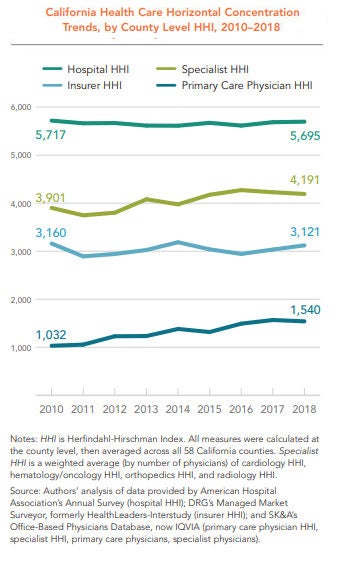
To measure market consolidation, the CHCF study relied on the Herfindahl-Hirschman Index (HHI), a metric used by the US Department of Justice and the Federal Trade Commission. An HHI of between 1,500 and 2,500 is considered moderately concentrated, and 2,500 or above is considered highly concentrated. According to this measure, horizontal concentration is high in California among hospitals, insurance companies, and specialist providers (and moderately high among primary care physicians), even though the level of concentration in all but primary care has remained relatively flat from 2010 to 2018.

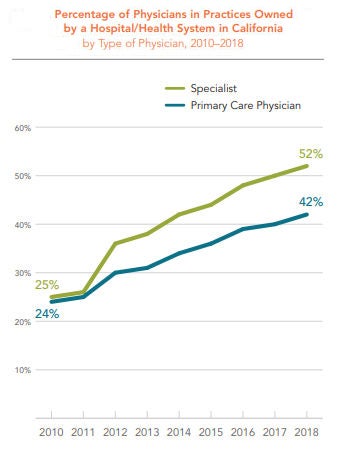
The percentage of physicians in practices owned by a hospital or health system increased dramatically in California between 2010 and 2018 — from 24% in 2010 to 42% in 2018. The percentage of specialists in practices owned by a hospital or health system rose even faster, from 25% in 2010 to 52% in 2018.
Consolidation Is Not Clinical Integration

While this study defined and quantified the extent of consolidation across several industry segments in California, it is important to note that it did not define, quantify, or evaluate clinical integration within the state. Clinical integration has been defined by others in many ways, but generally involves arrangements for coordinating and delivering a wide range of medical services across multiple settings.

As the CHCF study authors point out, other analysis has shown that various types of clinical integration can lead to broader adoption of health information technology and evidence-based care management processes. Data from the Integrated Healthcare Association suggests that certain patient benefit designs and provider risk-sharing arrangements associated with clinical integration can lead to higher quality and lower costs.

Crucially, an emerging body of law (PDF) suggests that clinical integration does not require formal ownership and joint bargaining with payers.

Relationship Between Consolidation and Health Insurance Premiums

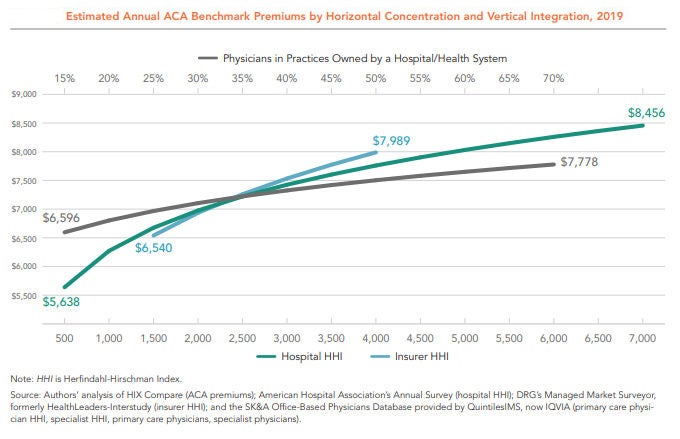
Among the six variables analyzed in the CHCF study, three showed a positive and statistically significant association with higher premiums: insurance company mergers, hospital mergers, and the percentage of primary care physicians in practices owned by hospitals and health systems. The remaining three variables studied — specialist provider mergers, primary care provider mergers, and the percentage of specialists in practices owned by a hospital and health system — were statistically insignificant.

The figure below shows the independent relationship between market concentration and premiums for these three variables. As the lines move left to right, concentration increases — that is, fewer individual insurers, hospitals, or providers occupy the market. The vertical axis shows the average premiums associated with each level of market concentration. In short, regardless of the industry structure represented by the other variables, insurer consolidation, hospital consolidation, and hospital-physician mergers each lead to higher premiums.

Unexplained Price Variation and Growth

Health insurance premiums rise when the underlying cost of medical care increases. California ranks as the 16th most expensive state on average in terms of the seven common services the researchers studied, after adjusting for wage differences across states. Among all states, California has the eighth-highest prices for normal childbirth, defined as vaginal delivery without complications. Childbirth is the most common type of hospital admission, and the relatively standardized procedure is comparable across states.

Even within California, prices vary widely and are growing rapidly. For example, the 2016 average wage-adjusted price for a vaginal delivery was twice as high in Rating Area 9 (which has Monterey as its largest county) as it was in Rating Area 19 (San Diego) — $22,751 versus $11,387. (See next figure.) Prices for the service are increasing rapidly across counties — rising anywhere from 29% in San Francisco from 2012 to 2016 to 40% in Orange County over the same period.

The authors of the CHCF report investigated the impact of various types of consolidation on the prices of individual medical services in California. For cesarean births without complications, a 10% rise in hospital HHI is associated with a 1.3% increase in price.

Potential Policy Responses to Consolidation

While the study shows significant associations between various types of market concentration and the prices consumers pay, policymakers should carefully consider implementing steps that restrain the inflationary impact of consolidation while allowing the benefits of clinical integration to proliferate. To that end, the authors of the CHCF report offered a series of recommendations, which include:

Enforce antitrust laws. Federal and state governments should scrutinize proposed mergers and acquisitions to evaluate whether the net result is procompetitive or anticompetitive.

Restrict anticompetitive behaviors. Anticompetitive behaviors, such as all-or-nothing and anti-incentive contract terms, should be addressed through legislation or the courts in markets where providers are highly concentrated.

Revise anticompetitive reimbursement incentives. Reimbursement policies that reduce competition, such as Medicare rules that implicitly reward hospital-owned physician groups, should be adjusted.

Reduce barriers to market entry. Policies that restrict who can participate in the health care market, such as laws prohibiting nurse practitioners from practicing independently from a physician, should be changed when markets are concentrated.

Regulate provider and insurer rates. If antitrust enforcement is not successful and significant barriers to market entry exist — including those in small markets unable to support a competitive number of hospitals and specialists — regulating provider and insurer rates should be considered.

Encouraging meaningful competition in health care markets is an exceedingly difficult task for policymakers. It is no easier to promote the benefits of clinical integration while restraining the inflationary aspects of economic consolidation through public policy. Despite these challenges, the rapid rise in health care premiums and prices in the state require a fresh look at the consequences of widespread horizontal and vertical consolidation in California.


New Hampshire AG rebuffs Partners acquisition

https://www.modernhealthcare.com/mergers-acquisitions/new-hampshire-ag-rebuffs-partners-acquisition?utm_source=modern-healthcare-daily-dose-tuesday&utm_medium=email&utm_campaign=20190924&utm_content=article6-readmore

New Hampshire officials opposed Partners HealthCare‘s continued expansion into the state, claiming that the health system’s proposed acquisition of Exeter Health Resources would diminish competition.

Partners’ Massachusetts General Hospital’s plans to acquire Exeter (N.H.) Health Resources, an independent system that includes a hospital, a physician group, home health and hospice agency, and a real estate management subsidiary. Exeter would merge with Dover, N.H.-based Wentworth-Douglass Hospital, which Mass General acquired in 2017, to create NewCo, a New Hampshire not-for-profit entity. NewCo was also the name used for the first iteration of what is now Beth Israel Lahey Health.

After a year-long review by the Consumer Protection and Antitrust Bureau, Attorney General Gordon MacDonald said the combination would violate state law requiring free and fair competition.

“New Hampshire patients already pay some of the highest prices for health care in the country,” he said in prepared remarks. “Based on our investigation, we have concluded that this transaction implicates our laws protecting free and fair competition and therefore threatens even higher health care costs to be borne by New Hampshire consumers.”

The AG’s Charitable Trusts Unit report followed a notice of intent to take civil enforcement action issued on Sept. 13 by the Consumer Protection and Antitrust Bureau.

Partners officials said they look to continue talks with the attorney general to allay antitrust concerns.

“We remain fully committed to seeing this transaction through and are confident that the Attorney General’s Office will ultimately determine that our affiliation will pass antitrust review based on the thorough review that the expert economists have completed on this proposal,” Dr. Peter Slavin, Massachusetts General Hospital president, said in prepared remarks.

In a public forum last year, Exeter officials said that the new regional health system would bolster their electronic health record capabilities and streamline care, offer scale to grow services, and enhance care quality.

Economists counter that hospital consolidation often inflates prices thanks to reduced competition and that so-called efficiencies don’t often reach expectations.

Under the deal, NewCo would be substituted as the sole member of Exeter Health Resources and Wentworth-Douglass Hospital. Mass General would become the sole member of NewCo, giving it significant control over the governance and operations, which is a matter of “considerable interest to this state,” the report said.

Exeter Hospital, a 100-bed hospital with outpatient programs in surgery, radiation, oncology and cardiac catheterization, and Wentworth-Douglass Hospital are within 18 miles of each other and provide similar inpatient and outpatient services, according to the report. Both Exeter and Wentworth-Douglass own a significant number of physician practices, such as Exeter’s 140-doctor group that offers primary care, pediatrics, orthopedics, gastroenterology and other specialties. Within the seacoast region, there are a limited number of healthcare entities of size and breadth similar to Exeter and Wentworth-Douglass that also own physician practices, the report said.

“Should EHR, WDH and MGH take further steps to consummate the transaction despite the objection set forth in this report, the Charitable Trusts Unit will bring judicial proceedings and seek injunctive relief,” New Hampshire authorities said in the report.

Partners has continued to try to expand into neighboring states, with varying success. The Boston-based integrated health system was targeting an entry point into the Rhode Island market through a deal with Care New England, adding Lifespan to the proposed talks early last year. It later dropped Lifespan and ultimately nixed the entire deal in June.

Establishing a presence in Rhode Island was an emphasis of Dr. David Torchiana, former president and CEO of Partners. Torchiana retired in April, making way for Dr. Anne Klibanski, who took on the interim CEO role in February and officially became the system’s first female chief executive in June.

Partners has been criticized for its high prices stemming from higher than average inpatient and academic medical center utilization. Beth Israel Deaconess Medical Center and Lahey Health said that a significant driver behind their merger late last year was to keep Partners in check.

Partners reported operating income of $309.9 million on operating revenue of $13.31 billion in 2018, up from $52.6 million in operating income on $13.37 billion of operating revenue in 2017, according to Modern Healthcare’s Health System Financials database.

Through three quarters of its fiscal 2019, Partners reported operating income of $450 million on total operating revenue of to $10.4 billion. That was up from $275 million of operating income on $10 billion of total operating revenue over the same period the year prior.


Sutter Antitrust Class Action Could Upend Industry Consolidation

https://news.bloomberglaw.com/health-law-and-business/sutter-antitrust-class-action-could-upend-industry-consolidation

Health-care consolidation and antitrust allegations are the focus of litigation that alleges Sutter Health Systems uses its Northern California dominance to force higher fees out of employer-funded health plans and consumers.

Jury selection begins Sept. 23 in San Francisco in a case that could translate into more than a billion-dollar liability for California’s third-largest hospital system. Sutter denies the allegations.

Employers, payors, and the health-care industry are closely watching the case. Success in California could spill into other states and undermine consolidation efforts by other health-care providers, observers said.

“If I’m a system somewhere else and these guys lose, these class-action lawyers I assume are going to start putting pins in the map around the country and say, ‘OK let’s go look at Utah, Florida, other parts of California’” that have dominant players, said Glenn Melnick, a health-care economist at the University of Southern California. “They have a template now.”

Total Revenue Hit $13 Billion in 2018

Sutter Health is a California behemoth, consisting of 24 acute care hospital facilities, 36 ambulatory surgery centers, nine cancer centers, six specialty care centers, nine major physician organizations, with 12,000 physicians and 53,000 employees located in 19 counties in Northern California. The system reported $13 billion in revenue in 2018.

“There is no evidence that Sutter has hurt competition, as demonstrated by the fact that new hospitals continue to open and existing facilities continue to expand in markets that Sutter Health serves, including in the San Francisco Bay Area and the greater Sacramento region,” Sutter said in a statement.

Northern California has experienced more rapid consolidation of hospital, physician, and insurance markets from 2010 to 2016 than Southern California, University of California Berkeley researchers found. And inpatient prices were 70% higher, outpatient prices 17%-55% higher depending on physician specialty, and Affordable Care Act premiums 35% higher in the northern part of the state.

Sutter inflated prices by an average 15.5% between 2003 and 2016, a United Food & Commercial Workers & Employers Benefit Trust expert analysis said. The UFCW trust sued Sutter first, followed by the state. For trial purposes, the court joined California’s lawsuit with the UFCW class action.

The inflated prices translated into $756 million in overcharges, the state and class members allege. More than 90% of class members for which measurements were available paid higher average prices at Sutter than class members paid for services at other California hospitals, they said.

Patients Protected, Sutter Says

The hospital system says its offerings shield patients from unforeseen expenses.

“Our broad provider network gives patients greater choice and predictability and protects patients from surprise billing. It also prevents patients from paying more in co-pays and deductibles for out-of-network doctor and hospital visits,” Sutter’s statement said.

Treble damages and attorneys’ fees are available if the UFCW and state win under the Cartwright Act, California’s antitrust law. The union trust fund, representing a class of large California employers who self insure their health-care costs, seeks damages from the jury while the California Attorney General wants to stop the practices alleged.

Jury selection is set for Sept. 23-24 with a two-week break while the parties argue over issues including sealing contracts negotiated with third parties including Anthem Inc., Blue Shield of California Inc., United Healthcare Services Inc., Teamsters Benefit Trust, Apple Inc., and HealthNet of California Inc. The trial is expected to last 60-90 days.

Consolidation Concerns

Health-care costs are one of the most important concerns in the U.S., said Jaime King, associate dean of the University of California Hastings School of Law and director of the Concentration on Law and Health Sciences.

“I know that attorneys general in other states are paying very close attention to what’s happening because concentration is not something that is just happening in California—it’s happening all over the country. If successful we will start to see a rollout of lots of similar cases across country,” King said.

“I think we will see ripple effects that go well into the future,” she said.

The case has implications especially in Northern California and could have legs elsewhere, Attorney General Xavier Becerra (D) said.

“Does this have an impact outside California? I would say that most everything that California does has an impact on this country and dare say the world. We hope that in our effort to pursue lower costs and higher quality of care in health care that the beneficiaries are not just Californians but people throughout the country,” Becerra said.