Opinion: ‘Medicare for all’ won’t fix soaring healthcare costs

https://www.latimes.com/opinion/story/2019-11-15/medicare-for-all-health-care-costs?fbclid=IwAR0uMTlEMcPuefoVjeuSvyIa69AIRk8v4N0d4ux6f1HMg1k4wMbM_SRElh8

Medical bill

The idea of “Medicare for all” advanced another step with the recent release of Sen. Elizabeth Warren’s more detailed health proposal. It is expansive and bold, and has brought some excitement to the progressive core of the Democratic Party. While policy mavens can delight in the details, the enormity of the proposal is a sign that this debate has clearly gone off the rails.

There is no question that healthcare cost is a pocketbook challenge for all of us. Employer and employee premiums for private health insurance for a household now average $20,576, before deductibles and copayments, and before payroll and state and local taxes to pay for healthcare for the elderly and the poor.

National health expenditures increased 179% between 2000 and 2019 to $3.8 trillion, and 50% of this increase was directly due to increases in unit prices and service intensity by hospital systems and physicians. In the U.S., healthcare is 28% more expensive than the next highest cost system, Switzerland, and 78% more expensive than in Germany. For a primary care doctor in the U.S., submitting invoices to insurers and collecting payments costs almost $100,000 per year.

What we should be debating — instead of the politics around Medicare for all — is how this market evolved in such a malignant direction, and whether anything can be done to change these trends.

Hospital consolidation has been shown to drive up healthcare costs, and yet 90% of U.S. hospital markets are highly consolidated. Physician employment by hospitals and health systems has increased from 26% to 44% of the market from 2012 to 2018, increasing the pricing leverage of consolidated systems even further.

These changes directly result in higher prices for commercial health insurance as hospitals use their exaggerated hospital “charges,” often many multiples of their costs or of the market price, to drive up their reimbursement rates for in-network care and especially for out-of-network care, where there is no price negotiation. Further, even at most not-for-profit healthcare systems, hospital leaders are compensated based on the profits they generate, not premiums they reduce, as is the case with leaders of for-profit hospital systems.

The pharmaceutical market has also come under scrutiny for the enormous prices of newly approved medications, and for price increases of existing medicines such as insulin. Behind the scenes are layers of businesses that further exploit this market. For example, one pharmaceutical benefit manager (a company hired by a health plan or employer to oversee prescription drug benefits) reported profits of $1.8 billion in 2013 that rose to $4.5 billion in 2017 despite a 4% reduction in revenue reported over this period.

It’s easy to see that consumers need relief from this market. One might imagine that politicians from both political parties would band together in a search for actionable solutions. Yet the debate has migrated from a discussion of why costs are spiraling out of control to a simple and unrealistic answer — Medicare for all. Here are some ideas on how to frame a meaningful discussion about costs.

Reducing administrative costs has been a stated policy goal of the federal government since the passage of the Health Insurance Portability and Accountability Act (HIPAA) in 1996, yet these costs continue to increase. To reduce these costs, we have to simplify the complexity of the billing process for hospitals and physicians across the multiple different health plans in the market, and we need to transform the expensive set of public data reporting mandates into a model in which we are assured these data are used by providers internally to improve the quality of care they provide.

We need to rebalance negotiating power between hospitals and physicians and insurers. Hospitals and other providers have been allowed to set their list prices without any relationship to the cost of care they provide. These inflated prices are then imposed on out-of-network patients, most egregiously in the practice of surprise medical billing in which patients encounter deliberately out-of-network air ambulances and independent anesthesiologists. In billing disputes, state law should offer these patients a default of a market price closer to Medicare payments than to hospital charges.

Finally, it’s time to stop the practices that are driving up prescription drug costs for all of us. Secret payments between pharmaceutical manufacturers and pharmaceutical benefit managers and distributors totaled over $100 billion in 2016. This business model needlessly inflates drug prices for the benefit of intermediaries in the market. We need laws requiring price transparency at the pharmacy for brand and generic drugs, and price competition for medications at the retail level.

The problem with focusing on Medicare for all is that rather than developing practical approaches, the debate is heading down a path likely to leave us without any tenable solutions to address healthcare costs — the issue that ignited the public’s interest in the first place.


Oregon insurer sues, says 3 health systems have locked it out of Portland market

https://www.beckershospitalreview.com/legal-regulatory-issues/oregon-insurer-sues-says-3-health-systems-have-locked-it-out-of-portland-market.html?oly_enc_id=2893H2397267F7G

Image result for locked out

Trillium Community Health Plan has filed a federal antitrust suit against three of the largest hospital systems in Portland, Ore., claiming they colluded to block the insurer from operating in the area, according to The Oreonian. 

The Eugene, Ore.-based health plan filed the suit against Legacy Health, Providence Health and Services and OHSU Health System, all based in Portland. 

Trillium alleges that the Portland health systems have engaged in a “group boycott” that if left unchecked, “would have a significant negative impact on Oregon Health Plan members, limiting the healthcare choices of some of the most vulnerable members of Oregon’s community,” according to The Portland Business Journal. 

In July, the Oregon Health Authority named Trillium a “next generation” coordinated care organization and awarded it the contract to serve Medicaid patients in the Portland area. CCOs, as they are known as, work together to provide healthcare services and benefits to patients enrolled in the state’s Medicaid program.

Since then, Trillium claims that it “pursued every avenue” to work with the three health systems without success, and without them, it is unable to break into the metro area Medicaid market.

Legacy, Providence and OHSU are all founding members of Health Share, the existing CCO in the area that will compete against Trillium.

“The hospitals’ anticompetitive behavior leaves Trillium no choice but to file an antitrust action in the hopes that the collusion will stop and that Trillium will be granted the ability to work with the Portland area hospitals,” the suit reads, according to the Business Journal. 


PBGH CEO ON SUTTER HEALTH ANTITRUST SETTLEMENT: ‘I DON’T THINK THIS ISSUE WILL GO AWAY’

https://www.healthleadersmedia.com/finance/pbgh-ceo-sutter-health-antitrust-settlement-i-dont-think-issue-will-go-away

Elizabeth Mitchell, CEO of the Pacific Business Group on Health, weighs in on the recent settlement between Sutter Health and the California Attorney General’s office.

Despite a recent settlement between Sutter Health and a group of self-funded employers along with the California Attorney General’s office, the issue of high healthcare costs and pricing concerns is likely to continue in the Golden State, according to an industry observer.

The Sutter Health antitrust case was settled in mid-October, bringing a sudden end to a healthcare trial that garnered widespread attention from provider organizations.

Sutter Health was accused of violating state antitrust laws by wielding its massive market power in Northern California to drive up prices. The Sacramento-based nonprofit health system, which reported an operating revenue of $13 billion in 2018, was expected to face up to $2.7 billion in damages before a settlement was reached just ahead of when opening arguments were slated to begin.

While the final details of the case have not been released yet, there is still interest in the healthcare industry about what concessions were made by each side in the case and how the settlement may impact the industry at large. 

Elizabeth Mitchell, CEO of the Pacific Business Group on Health (PBGH), told HealthLeaders that the case was another example of how important it is for employers to review pricing practices, especially for hospital services.

“We think that there will be a lot to be learned from this case when we understand what the injunctive release will include,” Mitchell said. “There is a need to ensure a functional marketplace for healthcare purchasing and this could create that opportunity for California and potentially the rest of the country.”

Provider consolidation has become a focus of California’s healthcare market in recent years, with several reports pointing to significant market concentrations in counties across the state.

A September 2018 study conducted by RAND Corporation and the Nicholas C. Petris Center on Health Care Markets and Consumer Welfare School of Public Health at the University of California, Berkeley found that more than a dozen California counties were deemed “hot spots,” or markets that deserve additional regulatory review.

Researchers urged state legislators to pass additional oversight measures to address the potential negative consequences of healthcare M&A activity.

As it relates to large employers, Mitchell said that businesses are continually looking for innovative arrangements that prioritize quality care options and affordability, which may require providers who have been “seeking to maximize prices” to rethink that approach.

She pointed to PBGH’s Employers Centers of Excellence Network, which has allowed businesses to contract with certain providers for affordable care options that improve health outcomes.

However, Mitchell said that some contracting practices from large integrated systems prohibit such approaches by employers to identify and discern quality variation, which ultimately impacts patients.

Despite the ruling in the Sutter case, Mitchell said that the larger issue around pricing for medical care in California is not fully resolved.  

“I don’t think this issue will go away, it will remain front and center for a lot of folks paying for medical care,” Mitchell said. “There’s a lot of interest in partnering with clinicians for high value care, but these anti-competitive practices really inhibit that.”


FTC to probe impacts of state antitrust protections for local hospital mergers

https://www.fiercehealthcare.com/hospitals-health-systems/ftc-to-probe-impacts-state-antitrust-protections-for-local-hospital?mkt_tok=eyJpIjoiT0RZNE4yTm1PV1psTmpNeSIsInQiOiJ5R3gxMEwrdUhPWUdZVlBTZ3NWWkdMV08xOCtObDdFaGdHaE1hN0o4Z2p5WnBaN3hjd2lDVm5ybnBhWUtUNFdlTW1LcndtaTN1WUtNVzg1NmUrQjJmWEhqTWpJR3BkUmVuZmVNS2FzdmRWdENuMEtNT0tJMXozUW93N0lVQmZ5WSJ9&mrkid=959610

The Federal Trade Commission (FTC) issued orders to five health insurance companies and two health systems seeking data to study the effects of state-level regulatory approvals known as certificates of public advantage (COPAs) that protect local hospital mergers from antitrust scrutiny.

Federal officials said they want to study the impact of COPAs and hospital consolidation on prices, quality, access, the innovation of healthcare services and employee wages.

The FTC issued orders to Aetna, Anthem, BlueCross BlueShield of Tennessee, Cigna and United Healthcare for patient-level commerical claims data. 

Orders were also issued to Ballad Health in Tennessee and Virginia as well as Cabell Huntington Hospital in West Virginia for aggregated patient billing and discharge data, along with health system employee wage data and other information relevant for analyzing the health systems’ prices, quality, access and innovation. Both health systems were approved for COPAs last year.

Ballad Health was formed in 2018 through the merger of Mountain States Health Alliance and Wellmont Health System. Under a COPA in Tennessee and a similar agreement in Virginia, officials said they agreed to serve oversight and enforceable commitments that include investing $308 million over 10 years to improve population health, expanding access to care and supporting health research and medical education.

Cabell Huntington Hospital was allowed to acquire nearby St. Mary’s Medical Center under a similar cooperative agreement with the state that was initially challenged by federal regulators.

Tennessee regulators describe COPAs as written approvals governing mergers among two or more hospitals that provide “state action immunity to the hospitals from state and federal antitrust laws by replacing competition with state regulation and active supervision. The goal of the COPA process is to protect the interests of the public in the region affected and the state.”

However, the feds say while COPAs “purport to immunize mergers and collaborations from antitrust scrutiny under the state action doctrine,” the approvals are in need of further study. As Kaiser Health News reported, the federal antitrust exemption dates back to a Supreme Court ruling in the 1940s and has been rarely used to allow hospital mergers. There has been little research (PDF) on the impacts of COPAs.

In June, the FTC held a public workshop examining research on the price effects of three COPAs approved in the 1990s—including Benefis Health System in Montana, Palmetto Health in South Carolina and Mission Health in North Carolina—to inform the current study design. Officials said they intend to collect information over the next several years to conduct retrospective analyses of the Ballad Health and Cabell COPAs.

Once the study is complete, the FTC intends to report publicly the study’s findings and will use them to help in future advocacy and enforcement by the agency and to better inform stakeholders about COPAs. 


RWJBarnabas to acquire Trinitas

https://www.beckershospitalreview.com/hospital-transactions-and-valuation/rwjbarnabas-to-acquire-trinitas.html

Image result for RWJBarnabas to acquire Trinitas

After months of negotiations, Elizabeth, N.J.-based Trinitas Regional Health Network has signed a letter of intent to join Robert Wood Johnson Barnabas Health System in West Orange, N.J.

Under the agreement, RWJBarnabas will become the parent company of Trinitas, a 554-bed Catholic acute care teaching facility. Trinitas will remain a Catholic institution, and its board will maintain oversight of the day-to-day operations of the facility.

According to the letter of intent, RWJBarnabas plans to invest money into the medical center and its affiliates for expansion.

The two parties expect to reach a definitive agreement before the end of the year. 

RWJBarnabas is an academic medical system comprising 11 acute care hospitals, three acute care children’s hospitals and a pediatric rehabilitation hospital, among other physician practices and outpatient clinics. 


CommonSpirit ends fiscal year with $582M operating loss, lays out plan for improvement

https://www.beckershospitalreview.com/finance/commonspirit-ends-fiscal-year-582m-operating-loss-lays-out-plan-for-improvement.html?em=&oly_enc_id=2893H2397267F7G

Image result for commonspirit health headquarters

CommonSpirit Health, which operates 142 hospitals in 21 states, reported an operating loss in the fiscal year ended June 30, but top executives say they expect the system’s performance to improve. 

Chicago-based CommonSpirit was formed through the Feb. 1 merger of San Francisco-based Dignity Health and Englewood, Colo.-based Catholic Health Initiatives. Since the merger occurred less than a year ago, financial and operating results were presented on a pro forma basis, using accounting records of CHI and Dignity Health as if they had been combined for the full fiscal 2019.

CommonSpirit reported operating revenues of $28.8 billion in fiscal 2019, down from $29.2 billion in the year prior. The health system said the year-over-year decline in revenue was largely attributable to California provider-fee program income recognized in fiscal 2018. Last year’s results also included income from the operations of U.S. HealthWorks and the gain on its sale.

After factoring in a year-over-year increase in operating expenses, CommonSpirit posted an operating loss of $582 million in fiscal 2019. That’s compared to operating income of $244 million a year earlier. The system’s nonoperating income dropped from $966 million in fiscal 2018 to $328 million.

CommonSpirit CFO Daniel Morissette told Becker’s Hospital Review the results were expected given the scope and complexity of the merger. 

“We’re simply not where we need to be in terms of performance,” he said. “The whole organization is motivated and is aware of the work that needs to be done to improve these results.”

Over the past eight months, CommonSpirit has centralized key functions, such as IT and contracting, and established 11 geographic divisions across 21 states. It has also begun to scale successful service lines and executed a $6.5 billion debt restructuring, which drew demand from investors and support from financial analysts.

Looking ahead, Mr. Morissette said a strong operating model and a systemwide performance plan will help CommonSpirit achieve an 8 percent EBIDA margin within the next four years. The plan will also help the system build healthier communities, which is the real purpose behind the merger, he said.

CommonSpirit’s CEOs Kevin E. Lofton and Lloyd H. Dean reiterated those goals.

“CommonSpirit has made huge strides toward creating a bold new health organization that will deliver care for many years to come and improve the health of communities across the country,” Mr. Dean said in an earnings release. “We know this is not an easy task and that we face challenges in the near term, which is why we are investing in a strong, disciplined business model that will help the organization evolve to meet the changing health care needs of our communities.”


Market Consolidation on Trial

Market Consolidation on Trial

Image result for Market Consolidation on Trial

California Attorney General Xavier Becerra alleges that Sutter Health used its pre-eminent market power to artificially inflate prices. Photo: Rich Pedroncelli/Associated Press

As a jury trial draws near in a major class-action lawsuit alleging anticompetitive practices by Northern California’s largest health system (PDF), a new CHCF study shows the correlation between the prices consumers pay and the extensive consolidation in the state’s health care markets. Importantly, the researchers estimated the independent effect of several types of industry consolidation in California — such as health insurers buying other insurers and hospitals buying physician practices. The report, prepared by UC Berkeley researchers, also examines potential policy responses.

While other states have initiated antitrust complaints against large hospital systems and medical groups in the past, the case against Sutter Health is unique in both the expansive nature of the alleged conduct and in the scale of the potential monetary damages. The complaint goes beyond claims of explicit anticompetitive contract terms and argues that by virtue of its very size and structure, the Northern California system imposed implicit or “de facto” terms that led to artificially inflated prices. Sutter Health vigorously denies the allegations.

The formation of large health systems like Sutter is neither new (PDF) nor unique to California (PDF). Several factors seem to be encouraging their growth, including payment models that place health care providers at financial risk for the cost of care, increased expectations from policymakers and payers around the continuum of patient needs that must be managed, and economies of scale for investments in information technology and administrative services. Some market participants also point to consolidation in other parts of the health care system, such as health plans and physician groups, as encouragement for their own mergers.

Economic Consolidation in California

In general, economists study two major categories of market consolidation:

  • Horizontal consolidation: Entities of the same type merge, such as the merger of two hospitals or insurance companies, or the merger of providers into a physician network.
  • Vertical consolidation: Entities of different types merge, such as when a hospital purchases a physician practice or when a pharmacy buys an insurance company.

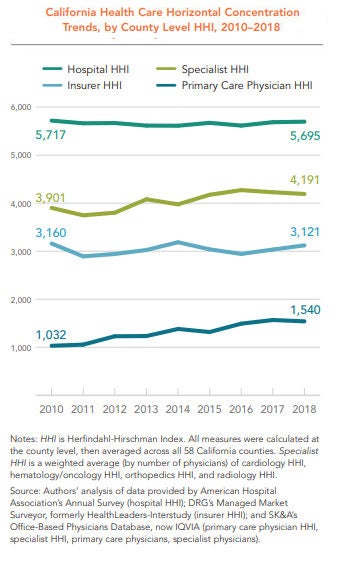
To measure market consolidation, the CHCF study relied on the Herfindahl-Hirschman Index (HHI), a metric used by the US Department of Justice and the Federal Trade Commission. An HHI of between 1,500 and 2,500 is considered moderately concentrated, and 2,500 or above is considered highly concentrated. According to this measure, horizontal concentration is high in California among hospitals, insurance companies, and specialist providers (and moderately high among primary care physicians), even though the level of concentration in all but primary care has remained relatively flat from 2010 to 2018.

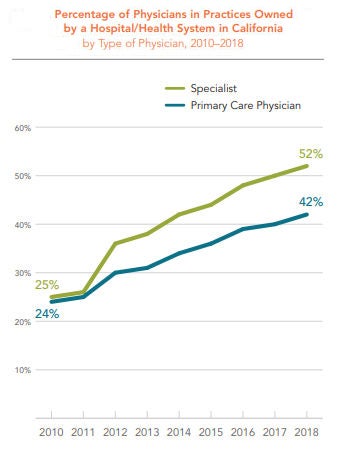
The percentage of physicians in practices owned by a hospital or health system increased dramatically in California between 2010 and 2018 — from 24% in 2010 to 42% in 2018. The percentage of specialists in practices owned by a hospital or health system rose even faster, from 25% in 2010 to 52% in 2018.
Consolidation Is Not Clinical Integration

While this study defined and quantified the extent of consolidation across several industry segments in California, it is important to note that it did not define, quantify, or evaluate clinical integration within the state. Clinical integration has been defined by others in many ways, but generally involves arrangements for coordinating and delivering a wide range of medical services across multiple settings.

As the CHCF study authors point out, other analysis has shown that various types of clinical integration can lead to broader adoption of health information technology and evidence-based care management processes. Data from the Integrated Healthcare Association suggests that certain patient benefit designs and provider risk-sharing arrangements associated with clinical integration can lead to higher quality and lower costs.

Crucially, an emerging body of law (PDF) suggests that clinical integration does not require formal ownership and joint bargaining with payers.

Relationship Between Consolidation and Health Insurance Premiums

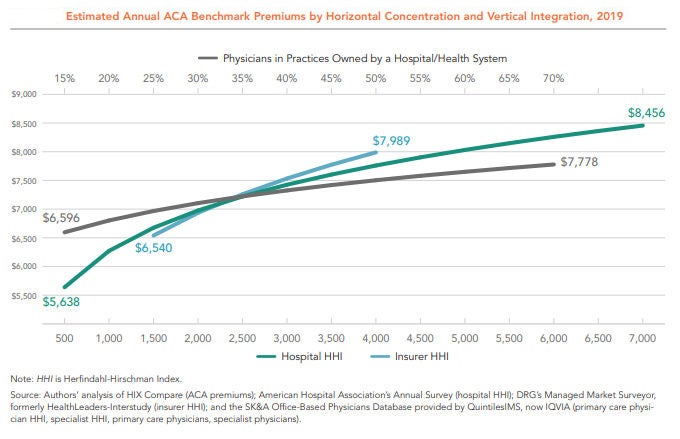
Among the six variables analyzed in the CHCF study, three showed a positive and statistically significant association with higher premiums: insurance company mergers, hospital mergers, and the percentage of primary care physicians in practices owned by hospitals and health systems. The remaining three variables studied — specialist provider mergers, primary care provider mergers, and the percentage of specialists in practices owned by a hospital and health system — were statistically insignificant.

The figure below shows the independent relationship between market concentration and premiums for these three variables. As the lines move left to right, concentration increases — that is, fewer individual insurers, hospitals, or providers occupy the market. The vertical axis shows the average premiums associated with each level of market concentration. In short, regardless of the industry structure represented by the other variables, insurer consolidation, hospital consolidation, and hospital-physician mergers each lead to higher premiums.

Unexplained Price Variation and Growth

Health insurance premiums rise when the underlying cost of medical care increases. California ranks as the 16th most expensive state on average in terms of the seven common services the researchers studied, after adjusting for wage differences across states. Among all states, California has the eighth-highest prices for normal childbirth, defined as vaginal delivery without complications. Childbirth is the most common type of hospital admission, and the relatively standardized procedure is comparable across states.

Even within California, prices vary widely and are growing rapidly. For example, the 2016 average wage-adjusted price for a vaginal delivery was twice as high in Rating Area 9 (which has Monterey as its largest county) as it was in Rating Area 19 (San Diego) — $22,751 versus $11,387. (See next figure.) Prices for the service are increasing rapidly across counties — rising anywhere from 29% in San Francisco from 2012 to 2016 to 40% in Orange County over the same period.

The authors of the CHCF report investigated the impact of various types of consolidation on the prices of individual medical services in California. For cesarean births without complications, a 10% rise in hospital HHI is associated with a 1.3% increase in price.

Potential Policy Responses to Consolidation

While the study shows significant associations between various types of market concentration and the prices consumers pay, policymakers should carefully consider implementing steps that restrain the inflationary impact of consolidation while allowing the benefits of clinical integration to proliferate. To that end, the authors of the CHCF report offered a series of recommendations, which include:

Enforce antitrust laws. Federal and state governments should scrutinize proposed mergers and acquisitions to evaluate whether the net result is procompetitive or anticompetitive.

Restrict anticompetitive behaviors. Anticompetitive behaviors, such as all-or-nothing and anti-incentive contract terms, should be addressed through legislation or the courts in markets where providers are highly concentrated.

Revise anticompetitive reimbursement incentives. Reimbursement policies that reduce competition, such as Medicare rules that implicitly reward hospital-owned physician groups, should be adjusted.

Reduce barriers to market entry. Policies that restrict who can participate in the health care market, such as laws prohibiting nurse practitioners from practicing independently from a physician, should be changed when markets are concentrated.

Regulate provider and insurer rates. If antitrust enforcement is not successful and significant barriers to market entry exist — including those in small markets unable to support a competitive number of hospitals and specialists — regulating provider and insurer rates should be considered.

Encouraging meaningful competition in health care markets is an exceedingly difficult task for policymakers. It is no easier to promote the benefits of clinical integration while restraining the inflationary aspects of economic consolidation through public policy. Despite these challenges, the rapid rise in health care premiums and prices in the state require a fresh look at the consequences of widespread horizontal and vertical consolidation in California.


New Hampshire AG rebuffs Partners acquisition

https://www.modernhealthcare.com/mergers-acquisitions/new-hampshire-ag-rebuffs-partners-acquisition?utm_source=modern-healthcare-daily-dose-tuesday&utm_medium=email&utm_campaign=20190924&utm_content=article6-readmore

New Hampshire officials opposed Partners HealthCare‘s continued expansion into the state, claiming that the health system’s proposed acquisition of Exeter Health Resources would diminish competition.

Partners’ Massachusetts General Hospital’s plans to acquire Exeter (N.H.) Health Resources, an independent system that includes a hospital, a physician group, home health and hospice agency, and a real estate management subsidiary. Exeter would merge with Dover, N.H.-based Wentworth-Douglass Hospital, which Mass General acquired in 2017, to create NewCo, a New Hampshire not-for-profit entity. NewCo was also the name used for the first iteration of what is now Beth Israel Lahey Health.

After a year-long review by the Consumer Protection and Antitrust Bureau, Attorney General Gordon MacDonald said the combination would violate state law requiring free and fair competition.

“New Hampshire patients already pay some of the highest prices for health care in the country,” he said in prepared remarks. “Based on our investigation, we have concluded that this transaction implicates our laws protecting free and fair competition and therefore threatens even higher health care costs to be borne by New Hampshire consumers.”

The AG’s Charitable Trusts Unit report followed a notice of intent to take civil enforcement action issued on Sept. 13 by the Consumer Protection and Antitrust Bureau.

Partners officials said they look to continue talks with the attorney general to allay antitrust concerns.

“We remain fully committed to seeing this transaction through and are confident that the Attorney General’s Office will ultimately determine that our affiliation will pass antitrust review based on the thorough review that the expert economists have completed on this proposal,” Dr. Peter Slavin, Massachusetts General Hospital president, said in prepared remarks.

In a public forum last year, Exeter officials said that the new regional health system would bolster their electronic health record capabilities and streamline care, offer scale to grow services, and enhance care quality.

Economists counter that hospital consolidation often inflates prices thanks to reduced competition and that so-called efficiencies don’t often reach expectations.

Under the deal, NewCo would be substituted as the sole member of Exeter Health Resources and Wentworth-Douglass Hospital. Mass General would become the sole member of NewCo, giving it significant control over the governance and operations, which is a matter of “considerable interest to this state,” the report said.

Exeter Hospital, a 100-bed hospital with outpatient programs in surgery, radiation, oncology and cardiac catheterization, and Wentworth-Douglass Hospital are within 18 miles of each other and provide similar inpatient and outpatient services, according to the report. Both Exeter and Wentworth-Douglass own a significant number of physician practices, such as Exeter’s 140-doctor group that offers primary care, pediatrics, orthopedics, gastroenterology and other specialties. Within the seacoast region, there are a limited number of healthcare entities of size and breadth similar to Exeter and Wentworth-Douglass that also own physician practices, the report said.

“Should EHR, WDH and MGH take further steps to consummate the transaction despite the objection set forth in this report, the Charitable Trusts Unit will bring judicial proceedings and seek injunctive relief,” New Hampshire authorities said in the report.

Partners has continued to try to expand into neighboring states, with varying success. The Boston-based integrated health system was targeting an entry point into the Rhode Island market through a deal with Care New England, adding Lifespan to the proposed talks early last year. It later dropped Lifespan and ultimately nixed the entire deal in June.

Establishing a presence in Rhode Island was an emphasis of Dr. David Torchiana, former president and CEO of Partners. Torchiana retired in April, making way for Dr. Anne Klibanski, who took on the interim CEO role in February and officially became the system’s first female chief executive in June.

Partners has been criticized for its high prices stemming from higher than average inpatient and academic medical center utilization. Beth Israel Deaconess Medical Center and Lahey Health said that a significant driver behind their merger late last year was to keep Partners in check.

Partners reported operating income of $309.9 million on operating revenue of $13.31 billion in 2018, up from $52.6 million in operating income on $13.37 billion of operating revenue in 2017, according to Modern Healthcare’s Health System Financials database.

Through three quarters of its fiscal 2019, Partners reported operating income of $450 million on total operating revenue of to $10.4 billion. That was up from $275 million of operating income on $10 billion of total operating revenue over the same period the year prior.


Sutter Antitrust Class Action Could Upend Industry Consolidation

https://news.bloomberglaw.com/health-law-and-business/sutter-antitrust-class-action-could-upend-industry-consolidation

Health-care consolidation and antitrust allegations are the focus of litigation that alleges Sutter Health Systems uses its Northern California dominance to force higher fees out of employer-funded health plans and consumers.

Jury selection begins Sept. 23 in San Francisco in a case that could translate into more than a billion-dollar liability for California’s third-largest hospital system. Sutter denies the allegations.

Employers, payors, and the health-care industry are closely watching the case. Success in California could spill into other states and undermine consolidation efforts by other health-care providers, observers said.

“If I’m a system somewhere else and these guys lose, these class-action lawyers I assume are going to start putting pins in the map around the country and say, ‘OK let’s go look at Utah, Florida, other parts of California’” that have dominant players, said Glenn Melnick, a health-care economist at the University of Southern California. “They have a template now.”

Total Revenue Hit $13 Billion in 2018

Sutter Health is a California behemoth, consisting of 24 acute care hospital facilities, 36 ambulatory surgery centers, nine cancer centers, six specialty care centers, nine major physician organizations, with 12,000 physicians and 53,000 employees located in 19 counties in Northern California. The system reported $13 billion in revenue in 2018.

“There is no evidence that Sutter has hurt competition, as demonstrated by the fact that new hospitals continue to open and existing facilities continue to expand in markets that Sutter Health serves, including in the San Francisco Bay Area and the greater Sacramento region,” Sutter said in a statement.

Northern California has experienced more rapid consolidation of hospital, physician, and insurance markets from 2010 to 2016 than Southern California, University of California Berkeley researchers found. And inpatient prices were 70% higher, outpatient prices 17%-55% higher depending on physician specialty, and Affordable Care Act premiums 35% higher in the northern part of the state.

Sutter inflated prices by an average 15.5% between 2003 and 2016, a United Food & Commercial Workers & Employers Benefit Trust expert analysis said. The UFCW trust sued Sutter first, followed by the state. For trial purposes, the court joined California’s lawsuit with the UFCW class action.

The inflated prices translated into $756 million in overcharges, the state and class members allege. More than 90% of class members for which measurements were available paid higher average prices at Sutter than class members paid for services at other California hospitals, they said.

Patients Protected, Sutter Says

The hospital system says its offerings shield patients from unforeseen expenses.

“Our broad provider network gives patients greater choice and predictability and protects patients from surprise billing. It also prevents patients from paying more in co-pays and deductibles for out-of-network doctor and hospital visits,” Sutter’s statement said.

Treble damages and attorneys’ fees are available if the UFCW and state win under the Cartwright Act, California’s antitrust law. The union trust fund, representing a class of large California employers who self insure their health-care costs, seeks damages from the jury while the California Attorney General wants to stop the practices alleged.

Jury selection is set for Sept. 23-24 with a two-week break while the parties argue over issues including sealing contracts negotiated with third parties including Anthem Inc., Blue Shield of California Inc., United Healthcare Services Inc., Teamsters Benefit Trust, Apple Inc., and HealthNet of California Inc. The trial is expected to last 60-90 days.

Consolidation Concerns

Health-care costs are one of the most important concerns in the U.S., said Jaime King, associate dean of the University of California Hastings School of Law and director of the Concentration on Law and Health Sciences.

“I know that attorneys general in other states are paying very close attention to what’s happening because concentration is not something that is just happening in California—it’s happening all over the country. If successful we will start to see a rollout of lots of similar cases across country,” King said.

“I think we will see ripple effects that go well into the future,” she said.

The case has implications especially in Northern California and could have legs elsewhere, Attorney General Xavier Becerra (D) said.

“Does this have an impact outside California? I would say that most everything that California does has an impact on this country and dare say the world. We hope that in our effort to pursue lower costs and higher quality of care in health care that the beneficiaries are not just Californians but people throughout the country,” Becerra said.


Hospital Giant Sutter Health Faces Legal Reckoning Over Medical Pricing

https://khn.org/news/sutter-health-antitrust-lawsuit-hospital-consolidation-medical-pricing/?fbclid=IwAR25Fe5xyq6Ne2lq_tuTo-r5ft4mUaLBLN7TLaMIo_cl5gJ59lMBNXwB33A

Economists and researchers long have blamed the high cost of health care in Northern California on the giant medical systems that have gobbled up hospitals and physician practices — most notably Sutter Health, a nonprofit chain with 24 hospitals, 34 surgery centers and 5,000 physicians across the region.

Now, those arguments will have their day in court: A long-awaited class-action lawsuit against Sutter is set to open Sept. 23 in San Francisco Superior Court.

The hospital giant, with $13 billion in operating revenue in 2018, stands accused of violating California’s antitrust laws by leveraging its market power to drive out competition and overcharge patients. Health care costs in Northern California, where Sutter is dominant, are 20% to 30% higher than in Southern California, even after adjusting for cost of living, according to a 2018 study from the Nicholas C. Petris Center at the University of California-Berkeley cited in the complaint.

The case was initiated in 2014 by self-funded employers and union trusts that pay for worker health care. It since has been joined with a similar case brought last year by California Attorney General Xavier Becerra. The plaintiffs seek up to $900 million in damages for overpayments that they attribute to Sutter; under California’s antitrust law, the award can be tripled, leaving Sutter liable for up to $2.7 billion.

The case is being followed closely by industry leaders and academics alike.

“This case could be huge. It could be existential,” said Glenn Melnick, a health care economist at the University of Southern California. If the case is successful, he predicted, health care prices could drop significantly in Northern California. It also could have a “chilling effect” nationally for large health systems that have adopted similar negotiating tactics, he said.

The case already has proved controversial: In November 2017, San Francisco County Superior Court Judge Curtis E.A. Karnow sanctioned Sutter after finding it had intentionally destroyed 192 boxes of documents sought by plaintiffs, “knowing that the evidence was relevant to antitrust issues.” He wrote: “There is no good explanation for the specific and unusual destruction here.”

Antitrust enforcement is more commonly within the purview of the Federal Trade Commission and U.S. Department of Justice. “One of the reasons we have such a big problem [with consolidation] is that they’ve done very little. Enforcement has been very weak,” said Richard Scheffler, director of the Nicholas C. Petris Center. From 2010 to 2017, there were more than 800 hospital mergers, and the federal government has challenged just a handful.

“We feel very confident,” said Richard Grossman, lead counsel for the plaintiffs. “Sutter has been able to elevate their prices above market to the tune of many hundreds of millions of dollars.”

Or, as Attorney General Becerra put it at a news conference unveiling his 2018 lawsuit: “This is a big ‘F’ deal.”

Sutter vigorously denies the allegations, saying its large, integrated health system offers tangible benefits for patients, including more consistent high-quality care. Sutter also disputes that its prices are higher than other major health care providers in California, saying its internal analyses tell a different story.

“This lawsuit irresponsibly targets Sutter’s integrated system of hospitals, clinics, urgent care centers and affiliated doctors serving millions of patients throughout Northern California,” spokeswoman Amy Thoma Tan wrote in an emailed statement. “While insurance companies want to sell narrow networks to employers, integrated networks like Sutter’s benefit patient care and experience, which leads to greater patient choice and reduces surprise out-of-network bills to our patients.”

There’s no dispute that for years Sutter has worked aggressively to buy up hospitals and doctor practices in communities throughout Northern California. At issue in the case is how it has used that market dominance.

According to the lawsuit, Sutter has exploited its market power by using an “all-or-none” approach to contracting with insurance companies. The tactic — known as the “Sutter Model” — involves sitting down at the negotiating table with a demand: If an insurer wants to include any one of the Sutter hospitals or clinics in its network, it must include all of them. In Sutter’s case, several of its 24 hospitals are “must-haves,” meaning it would be almost impossible for an insurer to sell an insurance plan in a given community without including those facilities in the network.

“All-or-none” contracting allows hospital systems to demand higher prices from an insurer with little choice but to acquiesce, even if it might be cheaper to exclude some of the system’s hospitals that are more expensive than a competitor’s. Those higher prices trickle down to consumers in the form of higher premiums.

The California Hospital Association contends such negotiations are crucial for hospitals struggling financially. “It can be a great benefit to small hospitals and rural hospitals that don’t have a lot of bargaining power to have a larger group that can negotiate on their behalf,” said Jackie Garman, the CHA’s legal counsel.

Sutter also is accused of preventing insurers and employers from tiering benefits, a technique used to steer patients to more cost-effective options. For example, an insurer might charge $100 out-of-pocket for a procedure at a preferred surgery center, but $200 at a more expensive facility. In addition, the lawsuit alleges that for years Sutter restricted insurers from sharing information about its prices with employers and workers, making it nearly impossible to compare prices when selecting a provider.

Altogether, the plaintiffs allege, such tactics are anti-competitive and have allowed Sutter to drive up the cost of care in Northern California.

Hospitals in California and other regions across the country have watched the success of such tactics and taken note. “All the other hospitals want to emulate [Sutter] to get those rates,” said Anthony Wright, executive director of the advocacy group Health Access.

A verdict that finds such tactics illegal would “send a signal to the market that the way to compete is not to be the next Sutter,” said Wright. “You want them to compete instead by providing better quality service at a lower price, not just by who can get bigger and thus leverage a higher price.”

Along with damages, Becerra’s complaint calls for dismantling the Sutter Model. It asks that Sutter be required to negotiate prices separately for each of its hospitals — and prohibit officials at different hospitals from sharing details of their negotiations. While leaving Sutter intact, the approach would give insurers more negotiating room, particularly in communities with competing providers.

Consolidation in the health care industry is likely here to stay: Two-thirds of hospitals across the nation are part of larger medical systems. “It’s very hard to unscramble the egg,” said Melnick.

California legislators have attempted to limit the “all or nothing” contracting terms several times, but the legislation has stalled amid opposition from the hospital industry.

Now the courts will weigh in.