30% of hospital healthcare workers remained unvaccinated as of September

Dive Brief:

  • Some 30% of U.S. healthcare workers employed at hospitals remained unvaccinated as of Sept. 15, according to an analysis of Centers for Disease Control and Prevention data published Thursday by the Association for Professionals in Infection Control and Epidemiology.
  • The findings include data from 3.3 million healthcare workers at more than 2,000 hospitals, collected between Jan. 20 and Sept. 15.
  • Healthcare personnel working in children’s hospitals had the highest vaccination rates, along with those working in metropolitan counties.

Dive Insight:

The vaccination rate for healthcare workers is roughly in line with that of the general population, though the risk of exposure and transmission can be higher in settings where infected COVID-19 patients are treated, Hannah Reses, CDC epidemiologist and lead author of the analysis, said.

When the shots were initially rolled out, vaccination rates climbed among healthcare workers, rising from 36% to 60% between January and April of 2021, the analysis found. But a major slowdown occurred shortly after.

From April to August, vaccination rates rose just 5%. They then rose 5% again in just one month — from August to September — likely due to the delta variant and more systems implementing their own mandates, the report said.

Researchers also found discrepancies in vaccination rates based on the type of hospitals and their geographic locations.

By September, workers at children’s hospitals had the highest vaccination rates (77%), followed by those at short-term acute care hospitals (70%), long-term care facilities (68.8%), and critical access hospitals (64%).

Among healthcare workers at facilities in metropolitan areas, about 71% were vaccinated by September, compared to 65% of workers at rural facilities.

The findings come as health systems work to comply with new vaccination mandates from the Biden administration.

Healthcare facilities must follow the CMS rule, which stipulates employees must be fully vaccinated by Jan. 4 or risk losing Medicare and Medicaid funding. Unlike the Occupational Safety and Health Administration’s rule that applies to businesses with 100 employees or more but excludes healthcare providers, the CMS rule does not allow for a testing exception.

Both agencies’ rules were met with pushback. The attorneys general of 10 mostly rural states — Missouri, Nebraska, Arkansas, Kansas, Iowa, Wyoming, Alaska, South Dakota, North Dakota and New Hampshire — filed a lawsuit on Oct. 10 against CMS for its rule and said the mandates would exacerbate existing staffing shortages.

“Requiring healthcare workers to get a vaccination or face termination is unconstitutional and unlawful, and could exacerbate healthcare staffing shortages to the point of collapse, especially in Missouri’s rural areas,” the state’s attorney general, Eric Schmitt, said in a statement.

But some regional systems that implemented their own mandates have seen positive results.

After UNC Health and Novant Health in North Carolina required the shots, staff vaccination rates rose to 97% and 99%, respectively, according to a White House report.

Among Novant Health’s 35,000 employees, about 375 were suspended for not complying, and about 200 of those suspended employees did end up getting vaccinated so they could return to work, according to the report.

And some major hospital chains across the country are joining suit with the looming deadline, including HCA with its 183 hospitals and more than 275,000 employees.

The chain is requiring employees be fully vaccinated by the CMS deadline on Jan. 4, a spokesperson said in an email statement.

At the same time, this year’s flu season is difficult to predict, though, “the number of influenza virus detection reported by public health labs has increased in recent weeks,” Reses said.

“The CDC is preparing for flu and COVID to circulate along with other respiratory viruses, and so flu vaccination therefore will be really important to reduce the risk of flu and potentially serious complications, particularly in combination with COVID-19 circulating,” Reses said.

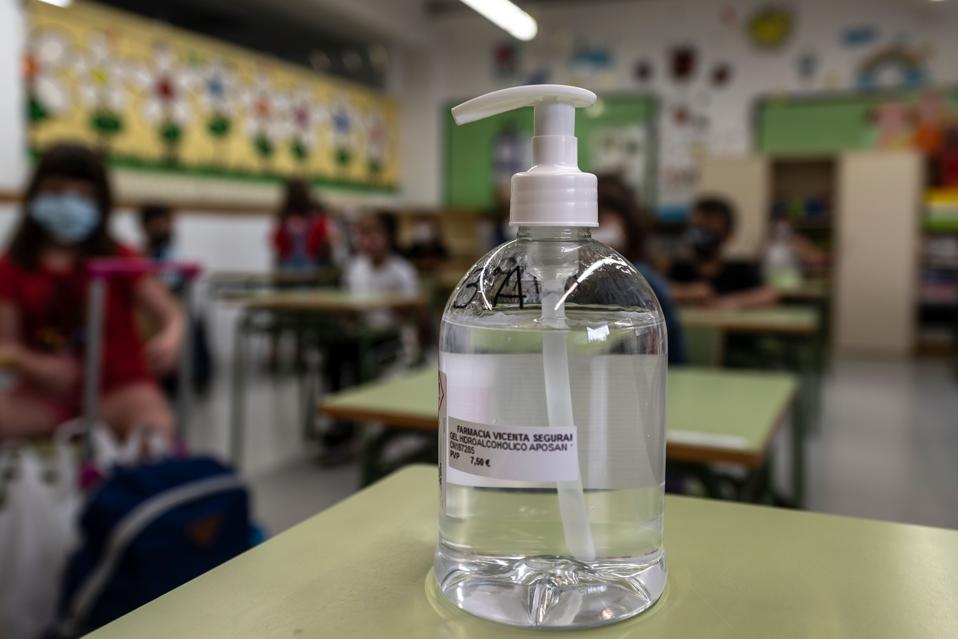
Why Your Hand Sanitizer May Be Ineffective Or Tainted By Cancer-Causing Chemicals

https://www.forbes.com/sites/ericmack/2020/09/10/why-your-hand-sanitizer-may-be-ineffective-or-tainted-by-cancer-causing-chemicals/?utm_source=newsletter&utm_medium=email&utm_campaign=coronavirus&cdlcid=5d2c97df953109375e4d8b68#115d2e346241

Since the start of the coronavirus pandemic, hand sanitizers have become a sought-after staple of life in a Covid-19-afflicted world. But supply chains have been turned upside down in our new normal, and some sketchy suppliers have at times stepped in to fill the vacuum. The result for consumers could be hand sanitizer that doesn’t work as advertised and might even be filled with impurities that can cause cancer.

When the pandemic set in during the spring, New Mexico’s Rolling Still Distillery began switching gears from making its trademark green chile vodka and other spirits to producing hand sanitizer for sale and free distribution during the early days of lockdown.

In the middle of May, Rolling Still founder Dan Irion (disclosure: Irion and I have lived in the same small town for years and occasionally hang out socially) began to receive a number of emails from bulk ethanol producers, offering up the alcohol for sanitizer production at prices as low as $1.60 a gallon, quite a deal over the $9 per gallon or more Rolling Still normally pays for its key ingredient.

To take advantage of the steep discount, Rolling Still would need to come up with $60,000 and take possession of a huge tank of the stuff.

Irion balked at the offer after he couldn’t get a straight answer about the quality of the ethanol. He asked one of the suppliers if organic alcohol was available and was told simply: “It’s all good. Don’t worry about it.”

He called Brian Coutu from Rolling Still’s regular alcohol supplier, Greenfield Global, who warned him away from what he says is fuel-grade ethanol potentially loaded with chemicals that are known to cause cancer.

Coutu knew this because Greenfield was getting the same cold calls Irion received, but as a large corporation, it could easily test samples.

“They send us a sample and it’s just God awful…it’s got acetaldehyde and benzene and all kind of nasty stuff in it; it’s not pure,” Coutu told me over the phone. “What (fuel producers) are trying to do is dump it off to these companies that run it through charcoal and try to do a million other things to make it USP grade (safe for food, drug or medicinal use), which it’s still not.”

Irion and Coutu both told me that the cold calls had largely stopped by the end of June. The price of ethanol cratered at the end of March as the pandemic took hold and fuel demand dropped. It stayed low through May before edging back near pre-pandemic levels at the end of June.

“Because of the fast and furious nature of the hand sanitizer industry at that time, we might have done it,” Irion says. “I’m sure there are others who saw this as a way to do something good and make money.”

And this is the big question for right now. How much of the sanitizer that made it to warehouses, store shelves and ultimately into our homes, cars and hands was produced from industrial fuel-grade ingredients rather than safe medical or food grade alcohol?

“You’re seeing less pure forms get into the market because there is a shortage of ethanol,” says Mike Sandoval, President and Chief Operating Officer of Santé Laboratories. “We see tert-butyl impurities, we see methanol, we see benzene in many of the hand sanitizers we test… We’ve seen some tequila grade ethanol that when you open the bottle it smells terrible, unless you like tequila… we’re seeing a lack of transparency in this space.”


Not just distilleries

Santé Labs works primarily in the hemp and CBD markets, providing quality testing and other services. CBD manufacturers can work with large amounts of ethanol and also turned to making hand sanitizers in the spring.

Sandoval says he began seeing CBD manufacturers and related companies using “untraditional sources” of ethanol from places like Mexico, Guatemala, South America and the fuel industry. The raw alcohol often came with a certificate of authenticity claiming 100 percent purity, but in reality it might actually contain chemical impurities and a significant amount of water.

“They come from a price sensitive market where no one wants to pay for high quality tests… They’re not used to operating in sophisticated manufacturing where you are required to test incoming raw material. For example the ethanol or isopropyl alcohol that goes in a hand sanitizer. You’re supposed to test (according to Food and Drug Administration rules) the purity of that ingredient before you formulate it, and that’s just not happening.”

For its part, the FDA has recently made public guidance on a testing method to detect impurities in hand sanitizers like those seen by Greenfield and Sante Labs.

“The agency’s investigation of contaminated hand sanitizers is ongoing,” the FDA said in an email. “Producing, importing and distributing toxic hand sanitizers poses a serious threat to the public and will not be tolerated.”

The takeaway from all this is that the ethanol market for manufacturers new to the production of hand sanitizer was flooded with sketchy raw alcohol that could be diluted or tainted with carcinogens. If that raw material isn’t tested on the front end, the resulting final product can come out with those impurities and an alcohol concentration that doesn’t meet the claims stated on the label.

The FDA maintains a list of hand sanitizers to avoid because they’ve been found to contain dangerous amounts of methanol, or an insufficient amount of its actual sanitizing ingredient, such as ethanol or isopropyl alcohol. However, the FDA’s enforcement powers are limited. A new waiver program created in response to the pandemic makes it easier for manufacturers to get around substantiating their label claims.

“Nine out of ten people are not meeting the label claim,” Sandoval says. “So most of the hand sanitizer you’re using from stores – and I even saw one from Wal-Mart that was a big brand… their hand sanitizers were crystallizing and turning green. I guarantee that they’re at 50 percent ethanol when they need to be at 70 percent.”

This brings up yet another concern, which is the shortage of proper plastic bottles and containers for sanitizer. Sandoval suspects that some manufacturers may have resorted to using the wrong type of containers, which then react with the alcohol, leaching chemicals into the sanitizer and turning its color.

“This entire supply chain is upside down because there’s a shortage of everything.”


Covering the stink of subpar sanitizer

Coutu at Greenfield Global says he’s aware of companies that have purchased their alcohol from unconventional sources, lured by prices as much as 90 percent lower than what Greenfield would charge.

The FDA relaxed the allowable limit of impurities like acetaldehyde and benzene that can make it into hand sanitizer, but Coutu says the limits still only allow a very small amount, whereas the samples Greenfield was testing had levels of contamination ten to 100 times higher than the new limits.

“And the odor on it is just not acceptable. It smells like burnt tequila… there’s some pretty nasty stuff out there and it’s dangerous.”

New services have even popped up this year, with fragrance manufacturers offering up products to help reduce the bad odor of some ethanol-based hand sanitizers.

Irion feels like he dodged a bullet by not jumping at the deeply discounted supply of ethanol others may not have been able to resist.

Rolling Still continued buying the organic alcohol it uses in both its spirits and sanitizer. It’s now ramping up production of sanitizer, which Irion says has no need for added fragrances to mask any ethanol odors, but some local osha and sage is infused to lighten the scent.

The alcohol used is also distilled five times just to make sure all impurities are removed.


Many workers don’t get new paid sick leave, because of ‘broad’ exemption for providers, report finds

https://www.washingtonpost.com/business/2020/08/11/paid-sick-leave/?utm_source=Sailthru&utm_medium=email&utm_campaign=Issue:%202020-08-12%20Healthcare%20Dive%20%5Bissue:29035%5D

Many health-care workers don't get new paid sick leave, because of ...

The New York attorney general sued the Labor Department in April over the agency’s interpretation of ‘health care provider’.

A government watchdog said in a report out Tuesday that the Labor Department “significantly broadened” an exemption allowing millions of health-care workers to be denied paid sick leave as part of the law Congress passed in March to help workers during the coronavirus pandemic.

Congress passed the Families First Coronavirus Response Act in March to ensure workers at small- and medium-size companies were able to take paid leave if they or a family member became sick with the coronavirus. The law exempts health-care providers as well as companies with more than 500 employees.

But an Office of the Inspector General report noted that a move by the Labor Department to more broadly expand how they categorize health-care providers ended up leaving far more workers without a guarantee of paid sick leave than the agency’s estimate of 9 million.

While existing federal statutes define health-care workers as doctors, someone practicing medicine or providing health-care services, the Labor Department’s exemption from paid sick leave included anyone employed at a doctor’s office, clinic, testing facility or hospital, including temporary sites. The report also found the agency also exempted companies that contract with clinics and hospitals, such as those that produce medical equipment or tests related to the coronavirus, the OIG found.

The report also suggested the Labor Department is not doing enough to enforce the paid-sick-leave provisions, as well as its existing laws on pay and overtime issues.

In an effort to be socially distant, the federal agency acknowledged it has been forgoing fact-finding, on-site investigations, where an investigator examines all aspects of whether an employer is complying with federal labor laws. Instead, the agency has been using conciliations, which are telephone-only reviews limited to looking into a single issue affecting one or a few employees, with no fact-finding.

Critics of the Labor Department’s more hands-off approach to the pandemic have seized on the report as another indication of the ways in which the Trump administration has abandoned its commitments to worker safety.

“The Inspector General’s report makes clear that the Department of Labor went out of its way to limit the number of workers who could take emergency paid leave,” Rep. Robert C. “Bobby” Scott (D-Va.), the chairman of the House Education Committee, said in a statement. “This absence of meaningful enforcement of our nation’s basic workplace laws creates a major risk to workers who are already vulnerable to exploitation amid record unemployment.”

Before the pandemic, limited or full on-site investigations, a more robust way the agency looked into pay and overtime issues, made up about 53 percent of its inquiries. But since March 18, only 19 percent of those inquiries have been on-site investigations.

Actions taken to enforce the sick-leave provisions in the Families First Coronavirus Response Act have skewed even further away from investigations: 85 percent have been resolved through conciliations.

The agency’s Wage and Hour Division responded to the OIG’s findings, noting that they were “developing and sharing models for conducting virtual investigations,” and that they also pledged to maintain a backlog of delayed on-site investigations to be tackled when it was safer to conduct those reviews.

But critics suggest the pandemic alone is not a sufficient excuse for the drop-off in investigations, some aspects of which could be done remotely.

“These numbers just look so different than the numbers that I’m used to seeing in terms of conciliations versus investigations,” said Sharon Block, a senior Obama administration labor department official. “It really does jump out. That 85 percent is just a really big number.”

The issue about expanding who gets to opt out of offering paid sick leave has been the subject of complaints, according to the OIG report, as well as a federal lawsuit filed by New York Attorney General Letitia James. That lawsuit argued that the Labor Department overstepped its authority by defining health-care providers in such broad terms, saying it could be skewed to include workers such as teaching assistants or librarians at universities, employees who work in food services or tech support at medical schools, and cashiers at hospital gift shops and cafeterias.

Judge J. Paul Oetken, of New York’s Southern District, struck down the Labor Department’s definition, as well as three other provisions last week — but confusion remains about whether his ruling applies only to employers in New York.

In an internal response to the OIG report, which predates the New York ruling, the Labor Department said that it agreed with many of the OIG’s recommendations and that it would continue to use its definition of health-care providers until the resolution of the federal lawsuit.

The Labor Department did not reply to requests for comment about whether it planned to contest the judge’s ruling, or the other findings in the report.

The inspector general pointed to other ways the department is not doing enough to adjust to the challenges of the post-outbreak world.

The OIG report said that while the agency’s Wage and Hour Division referenced the coronavirus in an operating plan in late May, it pointed out that the division “focuses more on what the agency has already accomplished rather than thinking proactively and describing how it will continue to ensure FFCRA compliance while still maintaining enforcement coverage,” the report noted.

The department did not provide any goals about the enforcement or provide any requirements for tracking and reporting the new violations created by the FFCRA.

“With the predicted surge of covid-19 cases nationwide in upcoming months as more Americans return to work and as a consequence, an anticipated increase in complaint call volume to WHD, it would be expedient of the agency to devise a detailed plan as to how it intends to address this issue,” the OIG noted.

The report is the latest to spotlight the Trump administration’s employer-friendly approach to worker safety and protections.

The Occupational Safety and Health Administration, the part of the Labor Department that investigates and is charged with upholding worker safety, has been criticized by workers and advocates for failing to issue citations for worker safety issues during the pandemic in significant numbers. It had only issued four citations out of more than 7,900 coronavirus-related complaints, according to figures from July 21.


Administration Killed Rule Designed To Protect Health Workers From Pandemic Like COVID-19

https://www.npr.org/2020/05/26/862018484/trump-team-killed-rule-designed-to-protect-health-workers-from-pandemic-like-cov?utm_source=Sailthru&utm_medium=email&utm_campaign=Issue:%202020-05-27%20Healthcare%20Dive%20%5Bissue:27567%5D&utm_term=Healthcare%20Dive

Trump Team Killed Rule Designed To Protect Health Workers From ...

When President Trump took office in 2017, his team stopped work on new federal regulations that would have forced the health care industry to prepare for an airborne infectious disease pandemic such as COVID-19. That decision is documented in federal records reviewed by NPR.

“If that rule had gone into effect, then every hospital, every nursing home would essentially have to have a plan where they made sure they had enough respirators and they were prepared for this sort of pandemic,” said David Michaels, who was head of the Occupational Safety and Health Administration until January 2017.

There are still no specific federal regulations protecting health care workers from deadly airborne pathogens such as influenza, tuberculosis or the coronavirus. This fact hit home during the last respiratory pandemic, the H1N1 outbreak in 2009. Thousands of Americans died and dozens of health care workers got sick. At least four nurses died.

Studies conducted after the H1N1 crisis found voluntary federal safety guidelines designed to limit the spread of airborne pathogens in medical facilities often weren’t being followed. There were also shortages of personal protective equipment.

“H1N1 made it very clear OSHA did not have adequate standards for airborne transmission and contact transmission, and so we began writing a standard to do that,” Michaels said.

HIV/AIDS rule set the standard for protecting workers

OSHA experts were confident new airborne infectious disease regulations would make hospitals and nursing homes safer when future pandemics hit. That’s because similar rules had already been created for bloodborne pathogens such as Ebola and hepatitis.

Those rules, implemented during the HIV/AIDS epidemic, forced the health care industry to adopt safety plans and buy more equipment designed to protect staff and patients.

But making a new infectious disease regulation, affecting much of the American health care system, is time-consuming and contentious. It requires lengthy consultation with scientists, doctors and other state and federal regulatory agencies as well as the nursing home and hospital industries that would be forced to implement the standard.

Federal records reviewed by NPR show OSHA went step by step through that process for six years, and by early 2016 the new infectious disease rule was ready. The Obama White House formally added it to a list of regulations scheduled to be implemented in 2017.

Then came the presidential election.

An emphasis on deregulation

In the spring of 2017, the Trump team formally stripped OSHA’s airborne infectious disease rule from the regulatory agenda. NPR could find no indication the new administration had specific policy concerns about the infectious disease rules.

Instead, the decision appeared to be part of a wider effort to cut regulations and bureaucratic oversight.

“Earlier this year we set a target of adding zero new regulatory costs onto the American economy,” Trump said in December 2017. “As a result, the never-ending growth of red tape in America has come to a sudden, screeching and beautiful halt.”

The impact on the federal effort to protect health care workers from diseases such as COVID-19 was immediate.

“The infectious disease standard was put on the back burner. Work stopped,” said Michaels, now a professor at George Washington University.

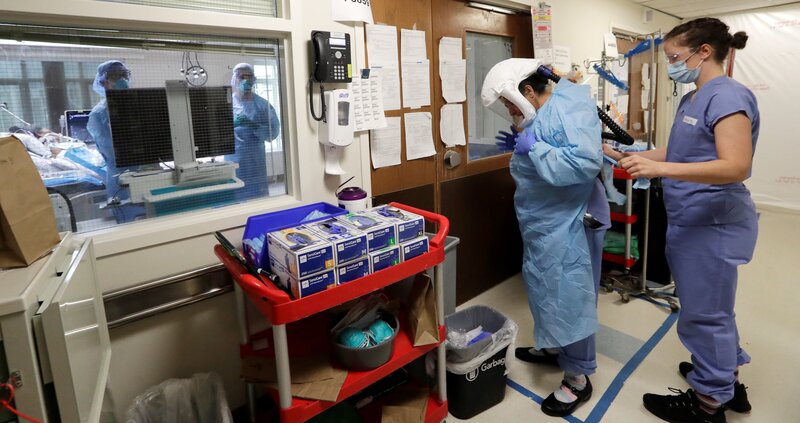
A medical worker is assisted into personal protective equipment on May 8 before stepping into a patient’s room in the COVID-19 intensive care unit at Harborview Medical Center in Seattle.

Elaine Thompson/AP

A deadly escalation of the H1N1 crisis

This spring, hospitals and nursing homes found themselves facing much of the same crisis they experienced during the H1N1 outbreak, with many facilities unprepared and unequipped. Only this time the scale was larger and deadlier.

The federal government reports that at least 43,000 front-line health care workers have gotten sick, many infected, while caring for COVID-19 patients in facilities where personal protective equipment was being rationed.

“Even just a few months ago, I couldn’t have imagined that I would have been on a Zoom call reading out the names of registered nurses who have died on the front lines of a pandemic,” said Bonnie Castillo, who heads the National Nurses United union.

“The memorial was not only about grief. It was also about anger.”

OSHA’s infectious disease rule debated in Washington

Castillo said Congress should immediately implement the infectious disease regulations shelved by the Trump administration as an emergency rule before a second wave of the coronavirus hits.

“Which obviously would mandate that employers have the highest level of PPE, not the lowest,” she said.

Democrats in the House of Representatives passed a bill in mid-May that would do so, but the Republican-controlled Senate has blocked the measure, and the White House still opposes the rules.

The Trump administration hasn’t responded to NPR’s repeated inquiries about the infectious disease rule. But in a briefing call with lawmakers this month, the current head of OSHA, Loren Sweatt, argued enough rules are already in place to protect workers.

“We have mandatory standards related to personal protective equipment and bloodborne pathogens and sanitation standards,” Sweatt said in a recording provided to NPR. “We have existing standards that can address this area.”

The hospital industry also opposes the new safety rules. Nancy Foster with the American Hospital Association said voluntary guidelines for airborne pandemics are adequate.

“You’re right; they’re not regulations, but they are the guidance that we want to follow,” Foster said. “They set forth the expectation for infection control, so in a sense they’re just like regulations.”

But the infectious disease standard would have required the health care industry to do far more. It sets out specific standards for planning and training. It would also have forced facilities to stockpile personal protective equipment to handle “surges” of sick patients such as the ones seen with COVID-19.

NPR also found the lack of fixed regulations allowed the Trump administration to relax worker safety guidelines. Federal agencies did so repeatedly this spring as COVID-19 spread and shortages of personal protective equipment worsened.

As a consequence, hospitals could say they were meeting federal guidelines while requiring doctors and nurses to reuse masks and protective gowns after exposure to sick patients.


OSHA Probing Health Worker Deaths But Urges Inspectors To Spare The Penalties

https://khn.org/news/osha-probing-health-worker-deaths-but-urges-inspectors-to-spare-the-penalties/

OSHA Probing Health Worker Deaths But Urges Inspectors To Spare ...

The Occupational Safety and Health Administration has in recent weeks launched investigations into deaths of workers at 34 health care employers across the U.S., federal records show, but former agency officials warn that the agency has already signaled it will only cite and fine the most flagrant violators.

The investigations come as health care workers have aired complaints on social media and to lawmakers about a lack of personal protective equipment, pressure to work while sick, and retaliation for voicing safety concerns as they have cared for more than 826,000 patients stricken by the coronavirus.

Despite those concerns, the nation’s top worker safety agency is not viewed as an advocate likely to rush to workers’ aid. President Donald Trump tapped a Labor Department leader who has represented corporations railing against the very agency he leads.

“It’s a worker safety crisis of monstrous proportions and OSHA is nowhere to be found,” said David Michaels, an epidemiologist and George Washington University professor who was assistant secretary of Labor and ran OSHA from 2009 to 2017.

Employers are required to report a work-related death to OSHA or face fines for failing to do so. Yet former OSHA leaders say the agency has not openly reminded hospitals and nursing homes to file such reports in recent weeks.

Last week, the Centers for Disease Control and Prevention reported that more than 9,200 health workers had been infected with the coronavirus, a number the agency concedes is a vast undercount. The estimate was based on a set of lab-generated reports in which only 16% included the patient’s profession. The agency said the true number is probably closer to 11% of all known cases.

Federal records show the OSHA fatality investigations ― searchable here — involve hospitals, an emergency medical service agency, a jail health department and nursing homes. Its investigations can be prompted by the complaint of a worker, a former worker or even an OSHA official who sees a news report about a workplace death. They can be conducted by phone and fax or involve an on-site inspection.

One fatality investigation launched April 7 focuses on Marion Regional Nursing home in Hamilton, Alabama, where nurse Rose Harrison, 60, worked before she died of COVID-19, her daughter Amanda Williams said.

Williams said her mother was not given a mask when caring for a patient on March 25 ― 10 days after the county’s first coronavirus case — who later tested positive for the virus. Williams said her mother felt pressured to keep going to work even as she was coughing, fatigued and running a low-grade fever.

“She kept telling me ‘Amanda, I have to work, I have to get my house paid off,’” Williams said, noting her mother said she was urged to work unless her temperature reached 100.4.

Williams said that she drove her mother to the hospital on April 3 and that Harrison was unhappy she’d spent the week working. Harrison went on a ventilator the following day, fully expecting to recover. She died April 6.

“When your mother dies mad, you’re pretty much mad,” Williams, one of Harrison’s three daughters, said. “I think if proper steps were taken from the beginning, this would have been different.”

North Mississippi Health Services, which owns the nursing home, and the home’s administrator did not reply to calls or emails.

An April 13 OSHA memo said the agency would prioritize death investigations involving health care workers and first responders. It said “formal complaints alleging unprotected exposures to COVID-19 … may warrant an on-site inspection.”

Michaels, the former Labor Department official, said a subsequent OSHA memo suggested that officials are unlikely to penalize all but the most careless employers.

The memo about employers’ “good faith” efforts said a citation may be issued “where the employer cannot demonstrate any efforts to comply.”

Michaels said that “any efforts” to comply with work safety rules could amount to making even one phone call to try to buy masks for workers.

Federal OSHA officials did not respond to a request for comment.

Democrats criticized Trump last year when he tapped Eugene Scalia, who spent years of his legal career defending major corporations, to head the Labor Department.

Scalia fought OSHA on behalf of SeaWorld after it was cited over the death of a woman training killer whales, The New York Times reported. Scalia’s team argued the work-safety agency was not meant to regulate the training of killer whales. He also argued that SeaWorld had adequate safety measures in place, but ultimately lost the case.

Sen. Bernie Sanders, alluding to Scalia’s record of defending firms like Chevron and Goldman Sachs, called the appointment “obscene.”

Since March 27, the ongoing fatality investigations have been mostly categorized as “partial” investigations, which initially focus on one area of noncompliance. Four are labeled “complete,” meaning they cover a wide range of hospital operations.

One of the “complete” investigations is listed at Coral Gables Hospital in South Florida, where respiratory therapist Jorge Mateo, 82, worked before he died of coronavirus complications, his daughter said.

The hospital reported the death, according to a statement from Shelly Weiss Friedberg of Tenet Healthcare, which owns the hospital. She said Mateo was with the hospital for four decades and “the loss of Jorge Mateo is felt throughout our entire community.”

A subsequent investigation — also labeled as “complete” ― was opened April 10 at Palmetto General Hospital, in South Florida.

There, 33-year-old Danielle Dicenso worked for a staffing agency as an ICU nurse, treating coronavirus patients. Dicenso died after developing COVID-19 symptoms, including fever and a cough, according to reports in the Miami Herald. The Palm Beach County medical examiner has not yet determined a cause of death, a spokesperson told Kaiser Health News.

Her husband, David Dicenso, told local news station WSVN she had not been given a protective mask and was “very scared of going to work.”

Weiss Friedberg, of Tenet, which also owns Palmetto, said in an email that “nurses are provided appropriate personal protective equipment (PPE) in compliance with Centers for Disease Control (CDC) guidelines.”

The latest guidelines say staff can wear a face mask if no N95 respirator is available when performing routine care with COVID-19 patients. For higher-risk procedures, such as intubation, workers must receive N95 masks.

OSHA opened an inspection at St. Catherine of Siena Medical Center, a Long Island hospital, on April 11. Federal officials had learned from a local news story about a patient care assistant dying of COVID-19, hospital leadership confirmed.

The hospital has no record of that employee having any interaction with COVID patients, said James O’Connor, its executive vice president. The hospital tests employees for COVID-19 only if they have had confirmed exposure to someone who tested positive and if they develop symptoms.

O’Connor said all employees who are in contact with suspected COVID-19 patients get the full suite of PPE; they are told to clean their N95 masks after each shift, he said, and to change masks entirely every three shifts.

That can mean workers wear the same equipment for multiple days.

Early research suggests that N95s can be sanitized and reused up to three times. But that paper has not yet undergone peer review. In an affidavit the New York State Nurses Association filed regarding another state hospital, the union argued that it has “yet to be adequately proven that disposable respirators can be effectively decontaminated” without putting the wearer at risk.

As recently as April 16, the local nurses union told Newsday that St. Catherine workers on Long Island are being told to share PPE.

While OSHA does have a “general duty” clause urging employers to keep workers safe and a standard for respiratory protection, it has no written rule on protecting workers from airborne disease, said Debbie Berkowitz, a former OSHA chief of staff and director of the National Employment Law Project’s worker safety and health program.

As OSHA and the Centers for Disease Control and Prevention downgrade their requirements week by week, workers are left with the choice in some places to wear a bandana in situations that had called for a properly fitted N95 mask, which can filter out particles as small as 0.1 microns.

“OSHA has really completely abandoned their mandate to protect workers,” Berkowitz said, “and every worker is on their own.”


AFL-CIO sues feds over coronavirus workplace safety

https://www.axios.com/afl-cio-sues-feds-over-coronavirus-workplace-safety-6de76122-2c75-4f84-92e5-21048c08b44b.html

AFL-CIO sues feds over coronavirus workplace safety - Axios

With states reopening for business and millions of people heading back to work, the nation’s largest labor organization is demanding the federal government do more to protect workers from contracting the coronavirus on the job.

What’s happening: The AFL-CIO, a collection of 55 unions representing 12.5 million workers, says it is suing the federal agency in charge of workplace safety to compel them to create a set of emergency temporary standards for infectious diseases.

Driving the news: The lawsuit against the U.S. Labor Department’s Occupational Safety and Health Administration (OSHA) is expected to be filed on Monday in the U.S. Court of Appeals in Washington, D.C.

  • Citing an urgent threat to “essential” workers and those being called back to work as government-imposed lockdowns are lifted, the AFL-CIO is asking the court to force OSHA to act within 30 days.
  • It wants a rule that would require each employer to evaluate its workplace for the risk of airborne disease transmission and to develop a comprehensive infection control plan that could include social distancing measures, masks and other personal protective equipment and employee training.

The agency has issued guidance, in collaboration with the Centers for Disease Control and Prevention, to protect workers in multiple industries — including dentist offices, nursing homes, manufacturing, meat processing, airlines and retail.

  • But the unions complain these are only recommendations, not requirements, and that mandatory rules should be imposed.
  • OSHA has been considering an infectious disease standard for more than a decade, they note, and has drafted a proposed standard.

U.S. Labor Secretary Eugene Scalia, in a letter to AFL-CIO President Richard Trumka, said employers are already taking steps to protect workers, and that OSHA’s industry-tailored guidelines provide more flexibility than a formal rule for all employers.

Yes, but: OSHA has received more than 3,800 safety complaints related to COVID-19 as of May 4, but it had already close to about 2,200 of them without issuing a single citation, according to the AFL-CIO.

What they’re saying: “It’s truly a sad day in America when working people must sue the organization tasked with protecting our health and safety,” Trumka said.

  • “But we’ve been left no choice. Millions are infected and nearly 90,000 have died, so it’s beyond urgent that action is taken to protect workers who risk our lives daily to respond to this public health emergency.
  • “If the Trump administration refuses to act, we must compel them to.”
  • OSHA could not immediately be reached for comment on the lawsuit.


In front of White House, nurses read names of colleagues killed by coronavirus

https://www.washingtonpost.com/local/nurses-read-names-of-colleagues-who-died-of-the-coronavirus-in-front-of-the-white-house/2020/04/21/fc93184c-83e6-11ea-878a-86477a724bdb_story.html?fbclid=IwAR3uHwtfPR-JqZaeFCfIrwmVEzDRSN574QocAt932Pa2pyUt6oL9KC3Kka8&fbclid=IwAR2VQF-oNTrPWkrGFODp9d_WMPOzIUW-imvhPWPGZlU2SN32I6W7trHrjEA&fbclid=IwAR2vXZ6AGvzXd9kZp1naBhLYA8Z2MzWVpYi2zbfXUNM9ybmRZ6FhW1hASEU&utm_campaign=wp_main&utm_medium=social&utm_source=facebook

Coronavirus deaths: Nurses read names at White House of colleagues ...

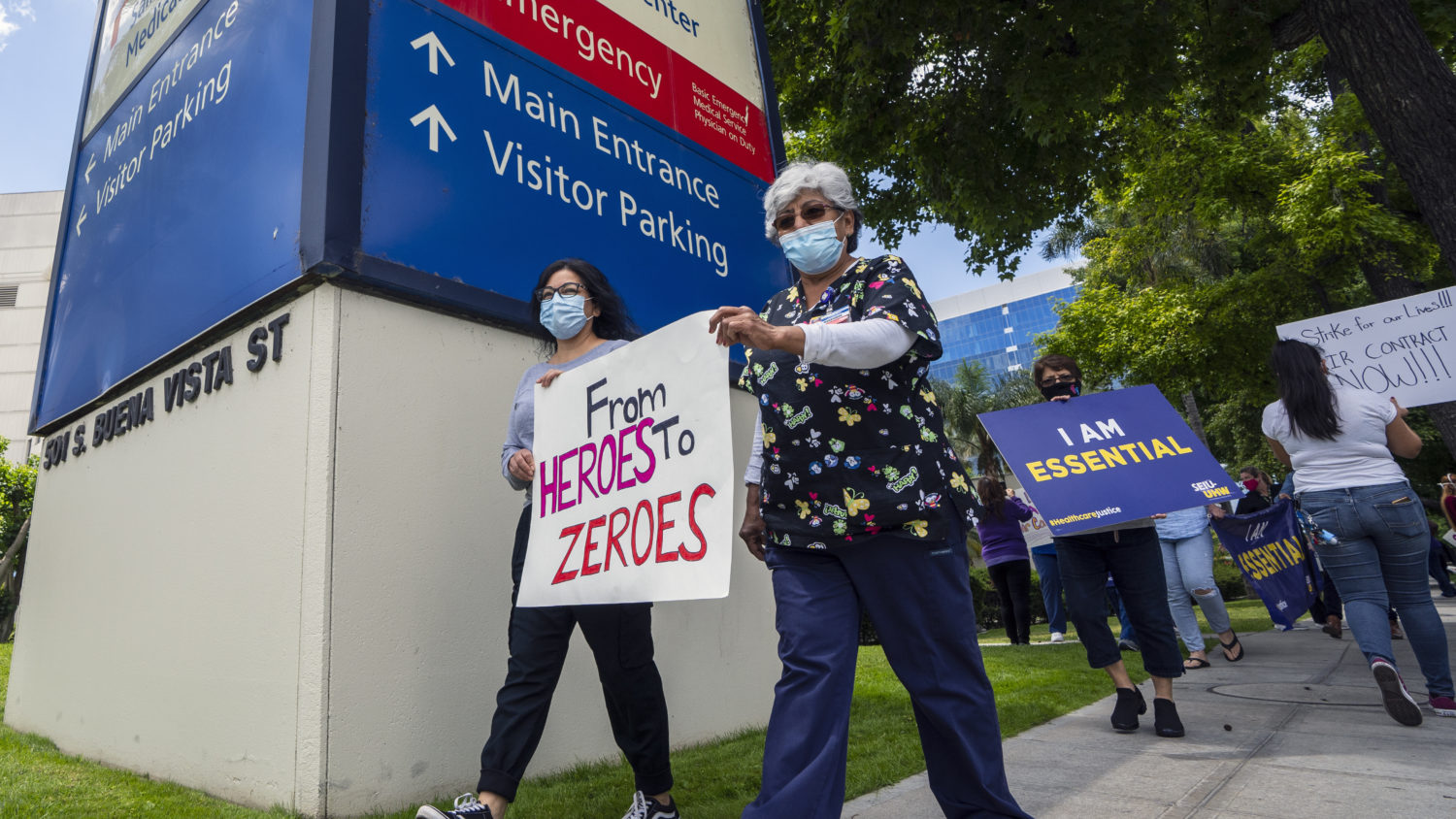
Registered nurses gathered Tuesday in front of the White House to read the names of health-care workers who have died fighting the coronavirus pandemic.

Wearing masks and standing six feet apart, the nurses held up photographs of the deceased as Melody Jones, a member of the National Nurses United union, addressed the news media in an otherwise empty Lafayette Square.

The names came from all over the country — New York and Alabama, Puerto Rico and Nevada, California and Michigan, Florida and Maryland, New Jersey and the District.

A man in blue scrubs stood behind Jones as she read, holding a metallic gold sign painted with the message: “20 seconds won’t scrub ‘hero’ blood off your hands.”

“Let us remember and honor the ultimate sacrifice these nurses paid,” Jones said. “We commit ourselves to fight like hell for the living.”

The protest stood in stark contrast to demonstrations in recent days in some parts of the country in which protesters have demanded the reopening of nonessential businesses. Nurses have been spotted at those gatherings, too, standing arms crossed, in opposition to demonstrators, many of whom are unmasked and milling in crowds.

More than 9,000 health-care workers in the United States have tested positive for the novel coronavirus, according to figures from the Centers for Disease Control and Prevention. Those numbers are believed to be an undercount of infections due to a lack of tests in many areas.

The nurses said Tuesday that they wanted to bring their demands for more personal protective equipment directly to President Trump’s doorstep.

Health-care providers in hospitals, clinics, nursing homes, assisted-living facilities and rehabilitation centers have for weeks asked lawmakers and government agencies for more protective equipment to shield themselves and their vulnerable patients from the spread of covid-19.

National Nurses United last month petitioned the Occupational Safety and Health Administration to institute an emergency safety standard that would provide nurses with more protective gear, including N95 respirator masks, face shields, gowns, gloves and shoe coverings.

Health-care workers, governors and other officials have for weeks demanded that Trump enforce the Defense Production Act to order mass production of those materials. Many have also petitioned Congress to mandate Trump use his authority to help boost the production of such gear.

Last week, a protest in the shadow of the Capitol displayed the faces of health-care workers demanding better protection on 1,000 signs. The sign represented protesters that organizers said would not have been safe if gathered together on the Capitol lawn.


Trump Administration Tells Employers Not To Worry About Recording COVID-19 Cases

https://www.yahoo.com/huffpost/osha-labor-department-coronavirus-cases-at-work-155001164.html

Know your rights: Michigan workers have new website for ...

The Trump administration announced Friday afternoon that employers outside of the health care industry generally won’t be required to record coronavirus cases among their workers, a decision that left some workplace safety advocates incredulous.

COVID-19, the disease caused by the coronavirus, is classified as a recordable illness, meaning employers would have to notify the Occupational Safety and Health Administration when an employee gets sick from an exposure at work. But the nation’s top workplace safety agency now says the majority of U.S. employers won’t have to try to determine whether employees’ infections happened in the workplace unless it’s obvious.

“OSHA is kidding, right?” tweeted David Michaels, who helmed OSHA throughout the presidency of Barack Obama.

It is not a joke. OSHA, which is part of the Labor Department, released an enforcement memo Friday spelling out the recording rules.

Employers in health care, emergency response and corrections would have to inform the agency when they become aware of a COVID-19 case that probably resulted from work. But other entities would not have to do so unless there was “objective evidence” that the transmission was work-related, or there was evidence “reasonably available to the employer” ― for example, if a whole slew of people who work right next to each other got sick.

The rationale: Those employers outside of health care “may have difficulty making determinations about whether workers who contracted COVID-19 did so due to exposures at work,” the memo stated.

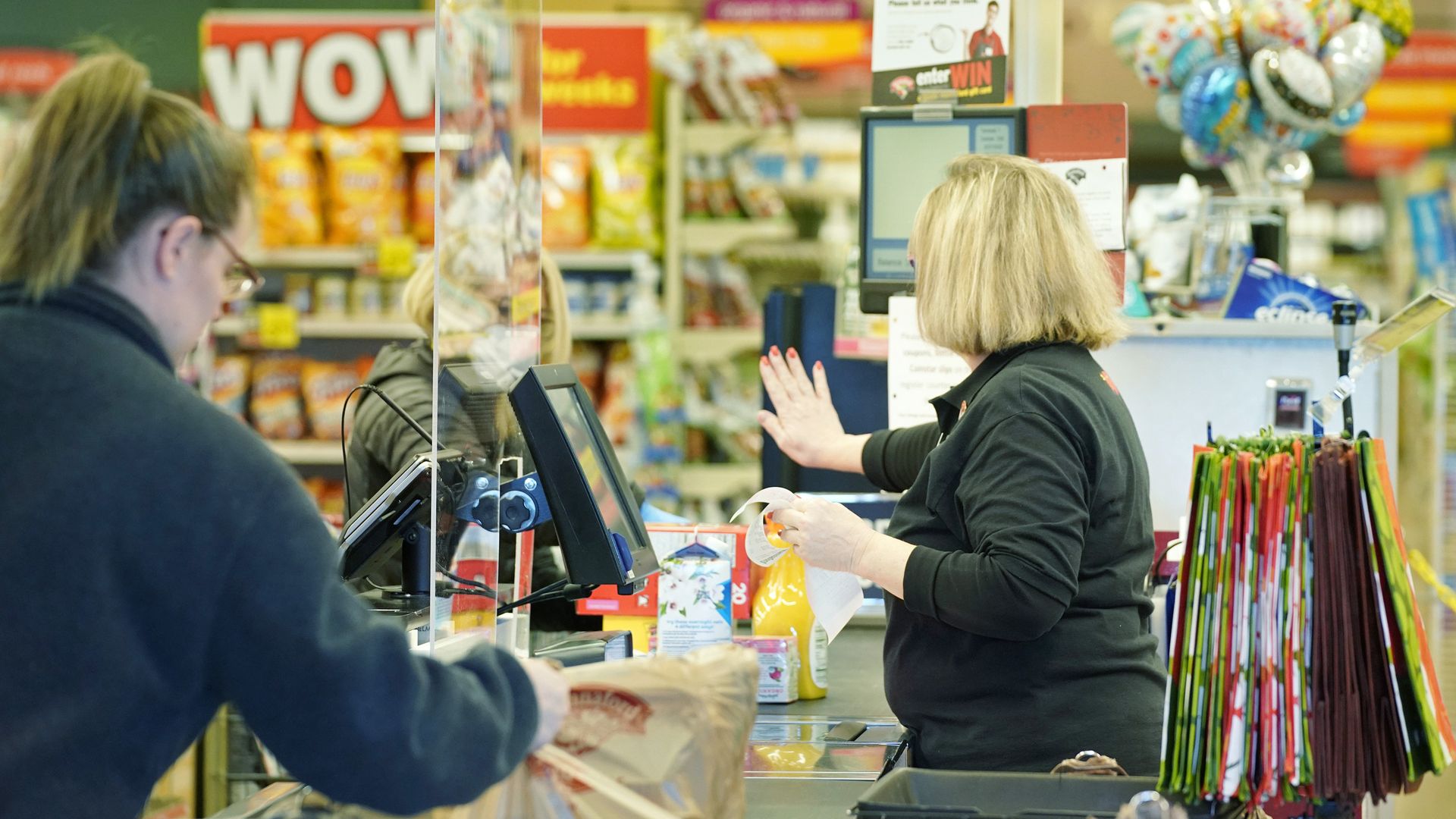
But if employers don’t have to try to figure out whether a transmission happened in the workplace, it could leave both them and the government in the dark about emerging hotspots in places like retail stores or meatpacking plants.

“So all you infected bus drivers, grocery store clerks, poultry processors ― you didn’t get it at work,” tweeted Jordan Barab, a former OSHA official now with the House Committee on Education and Labor.

The announcement is part of an ongoing fight between the Trump administration and occupational safety experts who say OSHA is failing to fulfill its obligations under the president. Employer record keeping has been a key issue in that spat. Early in his presidency, Donald Trump loosened the recording requirements employers must follow, a move critics said would make it easier for companies to fudge their data and hide their injuries.

Safety advocates say recording injuries and illnesses like COVID-19 helps officials discover growing hazards and shape sound public policy to address them. The Labor Department, under Trump and Labor Secretary Eugene Scalia, has portrayed those kinds of employer obligations as burdensome red tape.

In its memo on COVID-19 recording, OSHA said that by not enforcing the requirement on most employers, the agency would “help employers focus their response efforts on implementing good hygiene practices in their workplaces, and otherwise mitigating COVID-19’s effects, rather than on making difficult [work-related] decisions in circumstances where there is community transmission.”

The Labor Department and OSHA in particular have drawn a lot of heat for their response to the coronavirus pandemic. Labor unions have been asking Scalia to issue an emergency standard for infectious disease, which would would give health care facilities clear, enforceable standards to protect their workers during the pandemic. 

Scalia hasn’t done that. Instead, OSHA has created a new poster for employers with tips on preventing infections, and tweaked the rules around respirators to help employers deal with a shortage.

A Labor Department spokesperson defended the agency’s work responding to the outbreak, saying in an email to HuffPost Friday that it had taken “swift and direct action to protect America’s workers.”


Labor Secretary Eugene Scalia faces blowback as he curtails scope of worker relief in unemployment crisis

https://www.washingtonpost.com/business/2020/04/10/labor-secretary-eugene-scalia-faces-blowback-he-curtails-scope-worker-relief-unemployment-crisis/?fbclid=IwAR3mYk7W0Jvxu0lJ9vo7FXufkVsy1OVsg-VqmUztG1hi5PJAneL7PzcKDtI

Eugene Scalia, rising in Trump orbit, becomes key force in ...

Labor Department comes under fire over handling of worker protection, unemployment program.

The Labor Department is facing growing criticism over its response to the coronavirus pandemic as the agency plays a central role in ensuring that the tens of millions of workers affected by the crisis get assistance.

The criticism ranges from direct actions that the agency has taken to limit the scope of worker assistance programs to concerns that it has not been aggressive enough about protecting workers from health risks or supporting states scrambling to deliver billions in new aid.

In recent days, Labor Secretary Eugene Scalia, who has expressed concerns about unemployment insurance being too generous, has used his department’s authority over new laws enacted by Congress to limit who qualifies for joblessness assistance and to make it easier for small businesses not to pay family leave benefits. The new rules make it more difficult for gig workers such as Uber and Lyft drivers to get benefits, while making it easier for some companies to avoid paying their workers coronavirus-related sick and family leave.

“The Labor Department chose the narrowest possible definition of who qualifies for pandemic unemployment assistance,” said Andrew Stettner, a senior fellow at the Century Foundation who has spent two decades working on unemployment programs.

At the same time, frustrations have built among career staff at the Labor Department that the agency hasn’t ordered employers to follow safeguards, including the wearing of masks, recommended by the Centers for Disease Control and Prevention to protect workers. Two draft guidance documents written by officials at the Occupational Safety and Health Administration, part of the Labor Department, to strengthen protections for health-care workers have also not been advanced, according to two people with knowledge of the regulations granted anonymity to discuss the internal deliberations.

Scalia, a longtime corporate lawyer who is the son of the late Supreme Court justice Antonin Scalia, has emerged as a critical player in the government’s economic response to the pandemic. Nearly 17 million Americans have applied for unemployment insurance since President Trump declared a national emergency on March 13, and states are struggling to get their systems working to deliver $260 billion in new aid approved by Congress.

Democrats and some Republicans argue that the Labor Department needs to be more aggressive about disbursing money and technical assistance to states to shore up the unemployment insurance system. The department has released only half of $1 billion in administrative support for states that Congress approved almost a month ago.

Sen. Lindsay O. Graham (R-S.C.) said Thursday in an interview that he has talked to Scalia about the need to speed things up.

“You could have massive civil unrest if these systems cannot get checks out the door. We’re talking about 20 percent unemployment, maybe even more,” Graham said. “The application process is a nightmare. The state systems are failing.”

Graham said that Scalia has been responsive, but, “I don’t see any action being taken.”

Labor Department officials said Scalia is moving rapidly to help U.S. workers in an unprecedented time. They pointed to a poster and guidebook that OSHA released with steps companies “can take” to reduce worker risk of coronavirus exposure.

“Under Secretary Scalia’s leadership, in the last two weeks, the department has quickly released new rules and guidance for states, businesses, and individual Americans to help those in need of relief,” said Patrick Pizzella, deputy labor secretary. “The department has already distributed nearly $500 million in additional administrative funding to 39 states.”

Still, Scalia has made clear he is wary of taking an excessively lax approach to disbursing aid, an argument that he used to help win GOP support for recent legislation. Writing on Fox Business Network’s website on Monday, he warned that he does not want unemployed people to become addicted to government aid.

“We want workers to work, not to become dependent on the unemployment system,” Scalia wrote with Small Business Administration chief Jovita Carranza. “Unemployment is not the preferred outcome when government stay-at-home orders force temporary business shutdowns.”

On the day the $2 trillion package passed the Senate, Scalia spoke with Sens. Rob Portman (R-Ohio), Ben Sasse (R-Neb.) and Tim Scott (R-S.C.), who had raised concerns the law’s new unemployment benefits were too large and would deter workers from returning to jobs.

Scalia told conservative senators that once enacted, his agency would ensure the provisions his agency oversees would not hurt U.S. companies, according to three congressional officials aware of the conversations and granted anonymity to discuss the call.

Narrowing rules

Two recent laws passed by Congress expanded paid and sick leave policies as well as the size and scope of unemployment benefits for Americans. But worker advocates argue that as Scalia begins to implement these measures, his department is being much less generous toward workers than toward companies.

New Labor Department guidance says unemployment benefits apply to gig workers only if they are “forced to suspend operations,” which could dramatically limit options for those workers if their apps are still operating. Other workers also face a high hurdle to qualify for benefits.

The guidance says a worker “may be able to return to his or her place of employment within two weeks” of quarantining, and parents forced to stop work to care for kids after schools closed are not eligible for unemployment after the school year is over. Workers who stay home because they are older or in another high-risk group are also ineligible unless they can prove a medical professional advised them to stop working.

Some states are also having a difficult time figuring out how to verify how much money self-employed workers typically earn. It might require looking at tax documents, which unemployment offices don’t usually have access to.

“Some of the requirements, the standards that we’re being held to, are going to be incredibly difficult to adhere to,” Maine Labor Commissioner Laura Fortman said.

A Labor Department spokesperson said the agency is “providing as much technical assistance and IT support as possible” to states, some of which are using computer systems that are several decades old.

Scalia’s agency is also in charge of overseeing the new paid sick and family leave regulations, which apply to companies with fewer than 500 employees during the pandemic. The law gave the Labor Department authority to exempt businesses with under 50 employees from providing 12 weeks of paid family leave to care for a child out of school if the leave policy threatens to bankrupt the company.

Businesses that deny workers paid leave don’t have to send the government any paperwork justifying why. The Labor Department’s guidance asks companies to “retain such records for its own files,” a contrast with the heavy documentation required from gig workers who must prove they were affected by the coronavirus outbreak to get aid.

A Labor Department spokesperson said its rules on paid sick and family leave follow Congress’ direction.

“The department’s new rule balances allowing workers to take paid leave to care for their children with keeping small businesses open — as instructed by Congress,” a spokesperson said.

Tension at OSHA

Some Labor Department staffers and outside critics have also faulted Scalia for his handling of OSHA, which falls under his jurisdiction.

The CDC has issued recommendations for the public and businesses to follow practices such as social distancing and sanitizing workstations. OSHA could make those guidelines mandatory for all employers or for all essential employees but has not done so.

“Some of the OSHA staff is frustrated they can’t do more to protect workers. They want an emergency standard that would require employers to follow CDC guidelines,” said David Michaels, a George Washington University School of Public Health professor who served as assistant secretary of labor for occupational safety and health in the Obama administration.

Under Scalia, OSHA has also decided against issuing safety requirements to protect hospital and health-care workers, including rules that would mandate nurses and other providers be given masks and protective gear recommended by the CDC when at risk of exposure.

The union National Nurses United petitioned Scalia to increase the requirements during the pandemic, but a union spokeswoman said the Labor Department has not even acknowledged receipt of the letter.

Hospitals have resisted these rules for years. Tom Nickels, the chief lobbyist for the American Hospital Association, said that he hadn’t spoken to Scalia but that his group has opposed these actions in conversations with OSHA staff because widening the use of N95 respirator masks would be impractical. “The equipment is in short supply,” he said. “We can’t get it.”

OSHA also has not taken significant action to protect workers from retaliation when they speak out about dangerous conditions that expose them to coronavirus, Michaels said.

When workers at a manufacturing plant in northern Illinois tried alerting government officials about their concerns about working shoulder to shoulder, the regional OSHA official responded that “all OSHA can do is contact an employer and send an advisory letter outlining the recommended protective measures,” according to an email reviewed by The Washington Post. “This isn’t very helpful for you or your labor group, but it is the best I have to offer,” the email said.

On Wednesday, OSHA sent out a news release reminding companies that it is “illegal to retaliate against workers because they report unsafe and unhealthful working conditions during the coronavirus pandemic.”

“OSHA has completely abandoned their responsibility to protect workers on the job,” said Debbie Berkowitz, who worked at OSHA in the Obama administration and is now director of the worker safety and health program at the National Employment Law Project. “I have never felt this way, that every worker is at the mercy at their boss of whether they get protected. People are going to get sick and die, and they don’t have to.”

This week, Scalia said OSHA would take all worker safety concerns seriously.

“We are fielding calls from workers worried about their health and from workers who believe they have been illegally disciplined by their employer for expressing health concerns,” he said. “We will not tolerate retaliation.”