Health Care Workers Stand Up To People Protesting Stay-At-Home Orders

https://nowthisnews.com/news/health-care-workers-stand-up-to-people-protesting-stay-at-home-orders

View image on Twitter

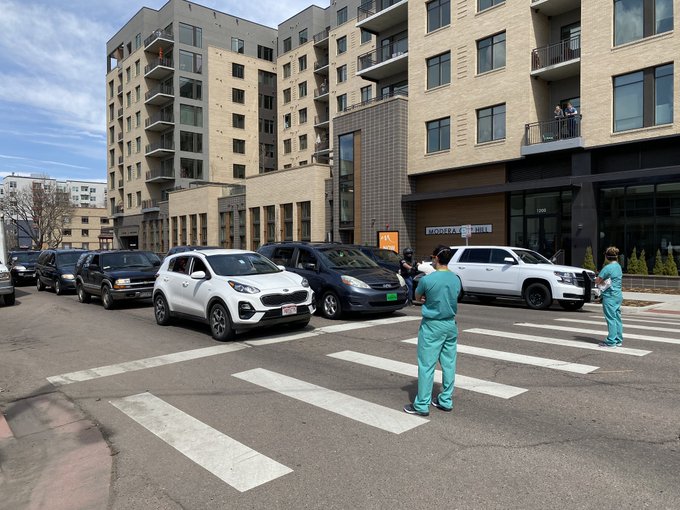
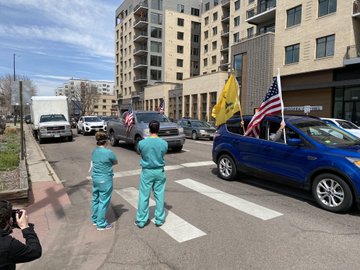
Remarkable scene at 12th and Grant, where two healthcare workers from a Denver-area hospital — they declined to say which or give their names — are standing in the crosswalk during red lights as a “reminder,” they say, of why shutdown measures are in place.

Two health care workers blocked a parade of protesters in Denver, Colorado on Sunday, who were storming the capitol to protest the state’s stay-at-home order.

Powerful images and videos of the standoff were widely shared on social media of the two unidentified people wearing scrubs and N95 masks, standing in a crosswalk blocking protesters’ vehicles. The two were identified as health care workers by photographers on the scene. 

One video shared by Twitter user Marc Zenn, captured cars lined up and beeping their horns at the two medical workers, with a woman hanging out of her vehicle’s window shouting “Go to China if you want communism. Go to China,” and “You get to go to work, why can’t we?”

View image on Twitter

They say they’ve been treating COVID patients for weeks. Today most of the people driving by have been “very aggressive,” they say. I’ve been standing here for a few minutes and already seen two people get in their faces.

Hundreds of people showed up on foot and in their vehicles for two separate protests in Colorado’s capitol on Sunday. The protests were reportedly planned by ReOpen Colorado and “various Libertarian parties,” according to a local Denver news outlet. People attending the march were shown carrying American flags, “Don’t Tread on Me” flags, and signs about reopening businesses and schools.

“Coloradans have a first amendment right to protest and to free speech, and the Governor hopes that they are using social distancing and staying safe,” Colorado Gov. Jared Polis’ office said in a statement. “No one wants to reopen Colorado businesses and lift these restrictions more than the Governor, but in order to do that, Coloradans have to stay home as much as possible during this critical period, wear masks and wash their hands regularly to slow the spread of this deadly virus.”

As of Monday morning, Colorado has more than 9,700 cases of COVID-19, leading to at least 420 deaths, according to the Johns Hopkins coronavirus tracker. The state of Colorado is set to continue its stay-at-home order until at least April 26, to slow the transmission of the virus.  

Colorado isn’t the only state where protesters are demonstrating against their government’s stay-at-home orders—Several other states held protests over the weekend including Utah, Idaho, and Washington state. Last week, parts of Michigan, New York, Ohio, Virginia, North Carolina, and others also saw a wave of demonstrators

President Trump encouraged the protesters last week during his Friday press briefing and in tweets which said to “liberate” multiple states holding protests.

In a Politico poll, 81% of Americans agreed we “should continue to social distance for as long as is needed to curb the spread of coronavirus, even if it means continued damage to the economy.” An NBC News poll found that 60% of responders agreed with keeping at-home restrictions.


Current State of the Union

https://www.buzzfeednews.com/article/gabrielsanchez/huge-crowds-protest-coronavirus-trump-coronavirus-pandemic?fbclid=IwAR0abgB9Wpv2WAOhNgdYhQgNU6W6h1NnqoVcxxye4QTRBwQaSEsxzeIXyho

These Pictures Show Crowds Protesting Against Coronavirus Lockdowns At State Capitols

Conservative demonstrators gathered at the capitol buildings of Michigan, Kentucky, and North Carolina to protest against stay-at-home orders during a pandemic that has already left more than 26,000 Americans dead.


Trump, Head of Government, Leans Into Antigovernment Message

Trump, Head of Government, Leans Into Antigovernment Message

With his poll numbers fading after a rally-around-the-leader bump, the president is stoking protests against stay-at-home orders.

First he was the self-described “wartime president.” Then he trumpeted the “total” authority of the federal government. But in the past few days, President Trump has nurtured protests against state-issued stay-at-home orders aimed at curtailing the spread of the coronavirus.

Hurtling from one position to another is consistent with Mr. Trump’s approach to the presidency over the past three years. Even when external pressures and stresses appear to change the dynamics that the country is facing, Mr. Trump remains unbowed, altering his approach for a day or two, only to return to nursing grievances.

Not even the president’s re-election campaign can harness him: His team is often reactive to his moods and whims, trying but not always succeeding in steering him in a particular direction. Now, with Mr. Trump’s poll numbers falling after a rally-around-the-leader bump, he is road-testing a new turn on a familiar theme — veering into messages aimed at appealing to Americans whose lives have been disrupted by the legally enforceable stay-at-home orders.

Whether his latest theme will be effective for him is an open question: In an NBC/Wall Street Journal poll released on Sunday, just 36 percent of voters said they generally trusted what Mr. Trump says about the coronavirus.

But the president, who ran as an insurgent in 2016, is most comfortable raging against the machine of government, even when he is the one running the country. And while the coronavirus is in every state in the union, it is heavily affecting minority and low-income communities.

So when Mr. Trump on Friday tweeted “LIBERATE,” his all-capitalized exhortations against strict orders in specific states — including Michigan — were in keeping with how he ran in 2016: saying things that seem contradictory, like pledging to work with governors and then urging people to “liberate” their states, and leaving it to his audiences to hear what they want to hear in his words.

For instance, Mr. Trump did not take the opportunity to more forcefully encourage the protesters when he spoke with reporters on Friday.

“These are people expressing their views,” Mr. Trump said. “They seem to be very responsible people to me.” But he said he thought the protesters had been treated “rough.”

In a webcast with Students for Trump on Friday, a conservative activist and Trump ally, Charlie Kirk, echoed the message, encouraging a “peaceful rebellion against governors” in states like Michigan, according to ABC News.

On Fox News, where many of the opinion hosts are aligned with Mr. Trump and which he watches closely, there have also been discussions of such protests. And Mr. Trump has heard from conservative allies who have said they think he is straying from his base of supporters in recent weeks.

So far, the protests have been relatively small and scattershot, organized by conservative-leaning groups with some organic attendance. It remains to be seen if they will be durable.

But Mr. Trump’s show of affinity for such actions is in keeping with his fomenting of voter anger at the establishment in 2016, a key to his success then — and his fallback position during uncertain moments ever since.

In the case of the state-issued orders, Mr. Trump’s advisers say his criticism of certain places is appropriate.

Stephen Moore, a former adviser to Mr. Trump and an economist with FreedomWorks, an organization that promotes limited government, said he thought protesters ought to be wearing masks and protecting themselves. But, he added, “the people who are doing the protest, for the most part, these are the ‘deplorables,’ they’re largely Trump supporters, but not only Trump supporters.”

On Sunday, Mr. Trump again praised the protesters. “I have never seen so many American flags,” he said.

But Mr. Trump’s advisers are divided about the wisdom of encouraging the protests. At some of them, Gov. Gretchen Whitmer of Michigan, a Democrat, has been compared to Adolf Hitler. At least one protester had a sign featuring a swastika.

One adviser said privately that if someone were to be injured at the protests — or if anyone contracted the coronavirus at large events where people were not wearing masks — there would be potential political risk for the president.

But two other people close to the president, who asked for anonymity in order to speak candidly, said they thought the protests could be politically helpful to Mr. Trump, while acknowledging there might be public health risks.

One of those people said that in much of the country, where the numbers of coronavirus cases and deaths are not as high as in places like New York, New Jersey, California and Washington State, anger is growing over the economic losses that have come with the stringent social-distancing restrictions.

And some states are already preparing to restart their economies. Ohio, where Gov. Mike DeWine, a Republican, took early actions against the spread of the virus, is planning a staged reopening beginning on May 1.

Still, as Mr. Trump did throughout 2016, as when he said “torture works” and then walked back that statement a short time later, or when he advocated bombing the Middle East while denouncing lengthy foreign engagements, he has long taken various sides of the same issue.

Mobilizing anger and mistrust toward the government was a crucial factor for Mr. Trump in the last presidential election. And for many months he has been looking for ways to contrast himself with former Vice President Joseph R. Biden Jr., the presumptive Democratic presidential nominee and a Washington lifer.

The problem? Mr. Trump is now president, and disowning responsibility for his administration’s slow and problem-plagued response to the coronavirus could prove difficult. And protests can be an unpredictable factor, particularly at a moment of economic unrest.

Vice President Mike Pence, asked on NBC’s “Meet the Press” about the president’s tweets urging people to “liberate” states, demurred.

“The American people know that no one in America wants to reopen this country more than President Donald Trump,” Mr. Pence said, “and on Thursday the president directed us to lay out guidelines for when and how states could responsibly do that.”

“And in the president’s tweets and public statements, I can assure you, he’s going to continue to encourage governors to find ways to safely and responsibly let America go back to work,” he said.

With the political campaign halted, Mr. Trump’s advisers have seen an advantage in the frozen-in-time state of the race. Mr. Biden has struggled to fund-raise or even to get daily attention in the news cycle.

But Mr. Trump himself has seemed at sea, according to people close to him, uncertain of how to proceed. His approval numbers in his campaign polling have settled back to a level consistent with before the coronavirus, according to multiple people familiar with the data.

His campaign polling has shown that focusing on criticizing China, in contrast with Mr. Biden, moves voters toward Mr. Trump, according to a Republican who has seen it.

“Trump finally fired the first shot” with his more aggressive stance toward the Chinese government and its leader, Xi Jinping, said Stephen K. Bannon, Mr. Trump’s former chief strategist. “Xi is put on notice that the death, economic carnage and agony is his and his alone,” Mr. Bannon said. “Only question now: What is America’s president prepared to do about it?”

Mr. Trump’s campaign manager, Brad Parscale, has advocated messages that contrast Mr. Trump with Mr. Biden on a number of fronts, including China.

But inside and outside the White House, other advisers to Mr. Trump see an advantage in focusing attention on the presidency.

Kellyanne Conway, the White House counselor, has argued in West Wing discussions that there is a time to focus on China, but that for now, the president should embrace commander-in-chief moments amid the crisis.

Chris Christie, the former governor of New Jersey and a friend of Mr. Trump’s, said on ABC’s “This Week” that he did not think ads criticizing Mr. Biden on China were the right approach for now.

Ultimately, Mr. Trump’s advisers said, most of his team is aware that it can try to drive down Mr. Biden’s poll numbers, but that no matter what tactics it deploys now, the president’s future will most likely depend on whether the economy is improving in the fall and whether the virus’s spread has been mitigated. Those things will remain unknown for months.

“This is going to be a referendum,” Mr. Christie said, “on whether people think, when we get to October, whether or not he handled this crisis in a way that helped the American people, protected lives and moved us forward.”


Pro-gun activists using Facebook groups to push anti-quarantine protests

https://www.washingtonpost.com/technology/2020/04/19/pro-gun-activists-using-facebook-groups-push-anti-quarantine-protests/?fbclid=IwAR3FTssf8nkcPHuqyVFyxpT17Zd3PwRnL6xSxL-Njeou_AQ4osiGmUK5FyI&utm_campaign=wp_main&utm_medium=social&utm_source=facebook

Pro-gun activists using Facebook groups to push anti-quarantine ...

A trio of far-right, pro-gun provocateurs is behind some of the largest Facebook groups calling for anti-quarantine protests around the country, offering the latest illustration that some seemingly organic demonstrations are being engineered by a network of conservative activists.

The Facebook groups target Wisconsin, Ohio, Pennsylvania and New York, and they appear to be the work of Ben Dorr, the political director of a group called “Minnesota Gun Rights,” and his siblings, Christopher and Aaron. By Sunday, the groups had roughly 200,000 members combined, and they continued to expand quickly, days after President Trump endorsed such protests by suggesting citizens should “liberate” their states.

The online activity helps cement the impression that opposition to the restrictions is more widespread than polling suggests. Nearly 70 percent of Republicans said they supported a national stay-at-home order, according to a recent Quinnipiac poll. Ninety-five percent of Democrats backed such a measure in the survey.

Still, the Facebook groups have become digital hubs for the same sort of misinformation spouted in recent days at state capitol buildings — from comparing the virus to the flu to questioning the intentions of scientists working on a vaccine.

Public-health experts say stay-at-home orders are necessary to slow the spread of the new coronavirus, which has already killed more than 40,000 in the United States. The Trump administration last week outlined three phases for states to reopen safely — guidelines contradicted by the president when he urged citizens to rise up against the rules that heed the recommendations of his own public-health advisers.

“If people feel that way, you’re allowed to protest,” Trump said Sunday. “Some governors have gone too far, some of the things that happened are maybe not so appropriate.”

Facebook said Sunday it did not plan to take action to remove the groups or events, partly because states have not outlawed them. Organizers also have called for “drive-in” protests, in keeping with recommendations that people keep a short distance between each other. In other cases, involving protests planned for states like New Jersey and California, the company has removed that content, Facebook said.

“Unless government prohibits the event during this time, we allow it to be organized on Facebook. For this same reason, events that defy government’s guidance on social distancing aren’t allowed on Facebook,” said Andy Stone, a spokesman for the company.

None of the Dorr brothers responded to calls and emails on Sunday.

“Wisconsinites Against Excessive Quarantine” was created on Wednesday by Ben Dorr. His brother Christopher is the creator of “Pennsylvanians Against Excessive Quarantine,” as well as “Ohioans Against Excessive Quarantine.” A third brother, Aaron, is the creator of “New Yorkers Against Excessive Quarantine.”

The online coordination offered additional clues about how the protest activity is spreading nationwide, capturing the imagination of the president and of Fox News even though it represents the views of a small minority of Americans. Trump himself tied the protests to gun rights — a primary cause for the Dorr brothers — in telling Virginians that the Second Amendment was “under siege” as he urged them to liberate the state.

On the ground, pro-Trump figures — including some who act as surrogates for his campaign — as well as groups affiliated with prominent conservative donors have helped organize and promote the demonstrations.

Some of the most vehement protest activity, in Michigan, has been organized by the Michigan Conservative Coalition. Its founders are a Republican state lawmaker and his wife, Meshawn Maddock, who sits on the Trump campaign’s advisory board and is a prominent figure in the “Women for Trump” coalition. Jeanine Pirro, a Fox News host and avid Trump supporter, interviewed Maddock on her show Saturday, telling her, “Keep going. Thank you.”

Also promoting the demonstrations — including spending several hundred dollars to advertise the event on Facebook — was the Michigan Freedom Fund, which is headed by Greg McNeilly, a longtime adviser to the DeVos family. He served as campaign manager for Dick DeVos, the husband of Education Secretary Betsy DeVos, when he ran unsuccessfully for governor of Michigan in 2006.

The state’s Democratic governor, Gretchen Whitmer, who has become a target for Trump and his conservative allies, last week criticized the nonprofit, noting that it was “funded in large part by the DeVos family,” and saying it was “really inappropriate for a sitting member of the United States president’s cabinet to be waging political attacks on any governor, but obviously, on me here at home.”

McNeilly said the funds used to promote the event were “not dedicated program funds” but instead came from “our grassroots fundraising efforts,” and so had “nothing to do with any DeVos work.”

The Dorr brothers manage a slew of pro-gun groups across a wide range of states, from Iowa to Minnesota to New York, and seek primarily to discredit organizations like the National Rifle Association as being too compromising on gun safety. Minnesota Gun Rights, for which Ben Dorr serves as political director, describes itself as the state’s “no-compromise gun rights organization.”

In numerous states, they have bypassed rules requiring them to register as lobbyists by arguing that they are instead involved in “pro-gun grassroots mobilization,” as “Ohio Gun Owners,” whose board Chris Dorr directs, describes its work.

A now-retired state legislator in Iowa, who in 2017 sought to close a loophole allowing the brothers to skirt lobbying rules, said he was not surprised the Dorr brothers were involved in fomenting resistance to the public-health precautions.

“The brothers will do anything to fan the flames of a controversial issue, and maybe make a quick nickel,” said the former state legislator, Republican Clel Baudler.

Nearly 97,000 people had joined “Wisconsinites Against Excessive Quarantine” by Sunday afternoon, a Facebook group whose posts are visible only to members that asserted Gov. Tony Evers has been on a “power trip, controlling our lives, destroying our businesses” and “forcing us to hand over our freedoms and our livelihood!” In the group, some members speculated that Evers closed most state businesses and shuttered schools to appease pharmaceutical giants — not because of data showing the novel coronavirus is highly contagious and deadly, infecting more than 4,300 in the state and killing 220.

The group, along with Ben Dorr, created an event on Facebook for a “drive-in rally” at the capital next Friday that has attracted hundreds of pledged participants. They also seek to steer visitors to a website for the “Wisconsin Firearms Coalition,” where people can enter their names, email addresses and other contact information and share their views with the state’s governor. In doing so, they encourage visitors who are not “already a member of the Wisconsin Firearms Coalition” to “join us.” A page asking users to join the Minnesota group offered several rates for membership, from $35 to $1,000.

Another private Facebook group focused on Pennsylvania, gaining more than 63,000 members by Sunday. Many questioned the wisdom of wearing masks publicly, contrary to recommendations by state and federal officials, and linked to a similar website catering to Pennsylvania gun owners. Still another targeting New York had become a forum for roughly 23,000 members to question whether the coronavirus is really that bad — despite the fact New York City has become the epicenter of the U.S. outbreak.

“While seizing power at a breathtaking pace,” the group’s description began, “Andrew Cuomo is sending NY’s economy into a death spiral!”


Cartoon – The Wisdom of Pandemic Protests

Kevin it's Necessary everyone stay home on Twitter: "Looks like ...

Healthcare Front Line Workers Counter-protest in Denver

https://www.trendsmap.com/twitter/tweet/1251984156998975492

Image may contain: 1 person, outdoor

🇯🇲Black🇭🇹Aziz🇳🇬aNANsi🇹🇹's tweet - "Health care workers ...

Scott Loy on Twitter: "Nurses blocking cars in Downtown Denver to ...

keyvan (کیوان) 🌹's tweet - "More below. Photos by Alyson McClaran ...


This says it all from a Nurse in Michigan

Image may contain: 1 person

“I am posting, for once, about something other than my dog.

I have seen 4 patients die, 5 get intubated, 2 re-intubated, witnessed family consent to make 2 more patients DNRs, sweat my butt off during CPR, titrated so many drips to no avail, watched vent settings increase to no avail. We are exhausted and at a total loss.

All of this in two shifts in a row.

Some of you people have never done EVERYTHING you could to save someone, and watched them die anyway, and it shows.

I would have no problem if you fools worried about your “freedom” all went out and got COVID. If only you could sign a form stating that you revoke your right to have medical treatment based on your cavalier antics and refusal to abide by CDC and medical professionals’ advice. If you were the only people who got infected during your escapades to protest tyranny, great. But that’s sadly not how this works.

You wanna complain because the garden aisle is closed? If you knew a thing about gardening, you’d know it’s too early to plant in Michigan. Your garden doesn’t matter. If killing your plants would bring back my patients, I would pillage the shit out of your “essential” garden beds.

Upset because you can’t go boating…in Michigan…in April…in the cold-ass water? You wanna tell my patient’s daughter (who was sobbing as she said goodbye to her father over the phone) about your first-world problems?

Upset because you can’t go to your cottage up north? Your cottage…your second property…used for leisure. My coworkers can’t even stay in their regular homes. Most have been staying in hotels and dorms, not able to see their spouses or babies.

All of these posts, petitions online to evade “tyranny”, it’s all such bullshit. I’m sorry you’re bored and have nothing to do but bitch and moan. You wanna pick up a couple hours for me? Yeah, didn’t think so. I wouldn’t trust most of you with patient care, anyway. Not just because of the selfish lack of humanity your posts exude, but because most of those posts and petitions are so riddled with misspellings and grammatical errors, that it makes me question your cognitive capacity.

Shoutout to my coworkers, the real MVPs.”


Scattered protests push back on U.S. coronavirus stay-at-home orders

https://www.reuters.com/article/us-health-coronavirus-usa-protests/scattered-protests-push-back-on-us-coronavirus-stay-at-home-orders-idUSKBN21Y34A

Scattered protests push back on U.S. coronavirus stay-at-home ...

As sweeping stay-at-home orders in 42 U.S. states to combat the new coronavirus have shuttered businesses, disrupted lives and decimated the economy, some protesters have begun taking to the streets to urge governors to rethink the restrictions.

A few dozen protesters, many with young children, gathered in Virginia’s state capital of Richmond on Thursday in defiance of Democratic Governor Ralph Northam’s mandate, the latest in a series of demonstrations this week around the country.

The protests have taken on a partisan tone, often featuring supporters of President Donald Trump, and critiquing governors whose shelter-at-home directives are intended to slow the spread of a pandemic that has killed more than 31,000 across the United States.

On Wednesday, thousands of Michigan residents blocked traffic in Lansing, the state capital, while protesters in Kentucky disrupted Democratic Governor Andy Beshear’s afternoon news briefing on the pandemic, chanting “We want to work!”

States including Utah, North Carolina and Ohio also saw demonstrations this week, and more are planned for the coming days, including in Oregon, Idaho and Texas.

The United States has seen the highest death toll of any country in the pandemic, and public health officials have warned that a premature easing of social distancing orders could exacerbate it.

Trump has repeatedly said he wants to “reopen” the economy as soon as possible and has clashed with governors over whether he can overrule their stay-at-home orders.

In Michigan, where Democratic Governor Gretchen Whitmer has imposed some of the country’s toughest limits on travel and business, some protesters at “Operation Gridlock” wore campaign hats and waved signs supporting Trump.

Whitmer is considered a top contender to be the running mate of Democratic presidential nominee Joe Biden when he takes on Trump in November’s general election.

One of the organizers of the demonstration in Lansing, Meshawn Maddock, said she was frustrated that much of the media focused on a handful of protesters who gathered on the steps of the capitol, including militia group members and a man holding a Confederate flag who she said were not part of the rally.

She faulted Whitmer for dismissing the event as a partisan rally instead of engaging with the thousands of residents who Maddock said have legitimate questions about the governor’s stay-at-home order.

“When I’m fighting to (help) a guy who cleans pools or mows lawns, or a women who wants to sell her onion sets or geraniums, I don’t care whether they vote Republican, Democrat, or never vote at all,” Maddock said.

Maddock, 52, is among seven board members of the Republican-aligned Michigan Conservative Coalition who organized the protest. She is also a board member of the pro-Trump political action committee Women for Trump, but said the Trump campaign had no involvement in organizing the protest.

“The Trump campaign has given me no messaging,” she said. “All I know is that I care about Michigan. I’ve lived here my whole life and I want to help workers get back to work.”

She said she had received calls from people in Wisconsin, Pennsylvania, Virginia and other states asking for advice on planning similar protests.

The political wrangling over the COVID-19 crisis has begun to take on familiar partisan battle lines. Democratic strongholds in dense urban centers such as Seattle and Detroit have been hard hit by the virus, while more Republican-leaning rural communities are struggling with the shuttered economy but have seen fewer cases.

Kenny Clevenger, 30, a realtor in western Michigan’s Allegan County, where only 25 coronavirus cases have been identified, said the shutdown had put him out of business.

“Yes, this needs to be taken seriously, but it’s being taken advantage of,” Clevenger said. “People believe Democrats are attempting to use this to undermine the economy, once again just attacking the president.”

Increasingly, Republican state lawmakers, including some in Texas, Oklahoma and Wisconsin, have begun putting pressure on governors to reopen businesses. Pennsylvania’s Republican-led legislature passed a bill that would loosen restrictions, which Democratic Governor Tom Wolf was expected to veto.

Both Democratic and Republican governors have resisted calls to abandon distancing too quickly. On Thursday, five Democratic governors and two Republican governors in the Midwest, including Whitmer in Michigan, said they would coordinate efforts.

Stephen LaSpina, one of the organizers of a “Stand Up to End the Shutdown” protest set for April 20 at Pennsylvania’s capitol in Harrisburg said that its sole goal was to get the economy running again by May 1.

“We are really welcoming groups of all different backgrounds and demographics,” said LaSpina, who lives near Scranton, and like many others who work in retail, said he had personally been affected by the shutdown. “Anyone who has been impacted by this shutdown in a negative way is welcome and we want them to be heard regardless of their party affiliation.”


Pandemic spurs court fights over mail-in voting

https://thehill.com/regulation/court-battles/492135-pandemic-spurs-court-fights-over-mail-in-voting?userid=12325

Pandemic spurs court fights over mail-in voting | TheHill

Election officials are scrambling ahead of the November vote to ramp up alternative methods like mail-in voting as the coronavirus pandemic raises concerns about the safety of in-person voting.

That dash to expand polling options could bring a new wave of court fights around the 2020 election, legal experts say. As states move to bolster balloting options — or face challenges to such plans — both sides in the debate are likely to take those decisions to court.

And when Election Day arrives, questions over the handling of mail-in ballots could lead to more court fights.

“We do not want the election resolved in the courts and so I hope it does not come to that,” said Richard Pildes, a law professor at New York University.

Legal experts say the nightmare scenario would be a situation resembling the Supreme Court’s decision on Bush v. Gore, which was seen as an ideological one that undermined both the legitimacy of the court and the 2000 presidential election results among critics of the decision.

“We know that the current partisan divide over the legitimacy of the U.S. Supreme Court can be timed to the release of the Bush v. Gore decision,” said Charles Stewart, a political science professor and election expert at MIT. “So, we have to be worried both about the legitimacy of the result and the legitimacy of the courts.”

States are hoping to avoid the situation Wisconsin faced this week where widespread in-person voting took place, despite last-minute efforts to avoid that outcome amid a virus that had infected some 2,500 and killed nearly 80 in the state by the Tuesday vote.

“There’s nonstop work being done by election officials to plan for November,” Stewart said.

The hope is that the pandemic will have abated enough to allow for in-person voting, which could be done more safely if early voting is expanded to reduce crowding on Voting Day. But given the fears over inciting a second wave of infections, that may not be advisable by the fall.

All states allow at least some mail-in balloting for select voters. While some states have relatively expansive mail voting systems, others have few provisions.

The fight over expanding voting options has already sparked legal battles. Texas is one of the states that has cases pending in court over efforts to expand mail-in balloting.

Under the current state election rules in Texas, only voters with a “qualifying reason” — advanced age, disability, incarceration or planned travel — can mail in ballots, despite public health guidance to avoid public gatherings. But a lawsuit filed by Texas Democrats ahead of the July primary runoff seeks to have that criteria expanded by including social distancing as a qualifying disability.

Progress toward developing a voting failsafe by November is likely to be uneven among the states given that not all are beginning from the same starting point, and because the push has increasingly become riven by partisan politics.

States that have a head start will be better off, though, experts said.

“States that already have a well-developed vote-by-mail program may well have the capacity to supersize it, and states that don’t may well have the capacity to provide some incremental vote-by-mail capacity,” said Justin Levitt, a professor at Loyola Law School.

“But it will be a herculean task for a state without much vote-by-mail capacity to get to almost everyone voting by mail by November. That takes expertise and systems, equipment and personnel, and the capacity to print a lot more ballots. And it is not easy to get any of those quickly.”

Lorraine Minnite, a political science professor at Rutgers University-Camden, put it even more starkly.

“A large-scale change in procedure hastily administered will likely not run smoothly even under the best of conditions,” she said.

Experts warn that expanded mail-in voting could lead to more voter errors and omissions, create more opportunities for fraud or coercion, and pose special challenges for those who move frequently or lack a permanent address. 

Edward Foley, a law professor at Ohio State University, said that if states are too slow to mail out ballots, litigation could arise from those issues.

“The most likely problem to trigger litigation would be if voters request absentee ballots on time, but election officials because they are overwhelmed with the high volume of absentee ballot requests fail to send the ballots to voters in time for voters to return them by the legally specified deadline,” Foley said.

“This, then, creates a problem of wrongful disenfranchisement of eligible voters, through no fault of the voters but because of the government’s own problems, and requires a court to come up with an appropriate remedy,” he added.

Rick Hasen, a professor of law and political science at the University of California Irvine, said that more courts may be drawn into a battle similar to the one playing out in Texas over whether voting by mail should require a valid excuse.

“There are a number of issues courts may address related to the vote by mail and the coronavirus,” he said. “Do states have to expand ballot deadlines to deal with a flood of absentee ballots? Do voters have a right to be told their absentee ballots have been rejected and given the opportunity to ‘cure’ a problem for rejecting a ballot like a purported signature mismatch?”

According to Levitt, one common thread among states is the urgent need for money to ramp up mail-in operations.

“The single most important piece is funding,” he said. “There are a lot of logistics between here and there, including space and machinery and people to process mail ballots, and that takes money.”  

The more than $2 trillion coronavirus stimulus package included $400 million for states to expand early voting, election by mail and for other election matters.

“The recent funding from Congress is an extremely welcome start, but only barely a start,” he added. “There needs to be much more, and quickly: it does little good to get more funding for this in October.”