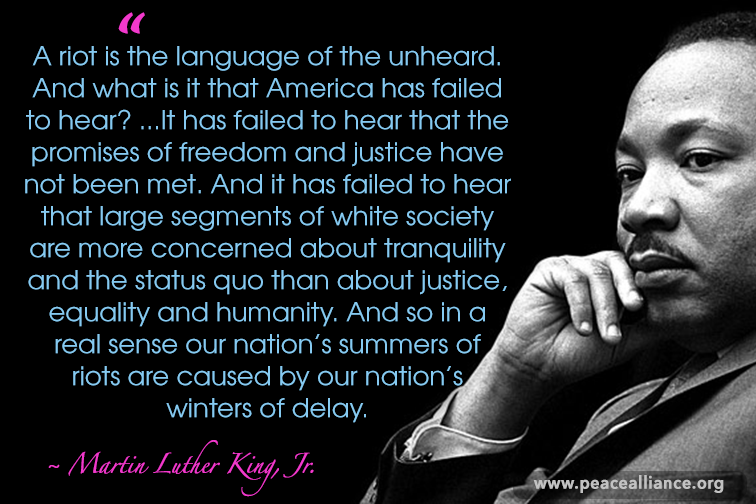
“What is it that America has failed to hear?”

https://mailchi.mp/9f24c0f1da9a/the-weekly-gist-june-5-2020?e=d1e747d2d8

The Peace Alliance's tweet - ""A riot is the language of the ...

“What is it that America has failed to hear?” asked Dr. Martin Luther King, Jr. in March of 1968, calling riots the “language of the unheard”. “It has failed to hear that the promises of freedom and justice have not been met.” Stubbornly, shamefully, we continue to turn a deaf ear: to structural racism; to institutionalized inequality; to a pandemic of police brutality and bigotry that chokes off the breath of black Americans as surely as a virus in the lungs or a boot on the neck. But the sound in the streets is thunderous.

We in healthcare must listen. We must hear that what killed George Floyd, and Breonna Taylor, and Eric Garner, and Tamir Rice, and Philando Castile, and Trayvon Martin, and Ahmaud Arbery, and countless others, as surely as the terrible actions of any single person, was the pervasive, insidious virus of racism, long since grown endemic in our country.

This week’s protests are a kind of ventilator, providing emergency breath for a national body in crisis. We must work—urgently—on the therapeutics of structural change and the vaccines of education and understanding.

At Gist Healthcare we are listening, and learning. As a team, we’ve committed to each other to be attentive, invested, empathetic allies, and to dedicate our individual and collective time, talents and treasure to antiracist work, in healthcare and beyond. Our contribution may not be large, and it will never be enough, but at least we hope it will be positive. We’d like to hear your thoughts and suggestions as well. For the moment, and for our colleagues, friends, and families, we stand with the protestors.

Black Lives Matter.


Providers show support amid unrest: #WhiteCoatsForBlackLives

https://www.healthcaredive.com/news/providers-show-support-amid-unrest-whitecoatsforblacklives/579020/

Dive Brief:

  • The American Hospital Association on Monday condemned what they called the “senseless killing of an unarmed black man in Minneapolis,” referring to George Floyd, who died more than a week ago after a police officer held his knee on Floyd’s neck for more than eight minutes. AHA said the group’s vision is a “society of healthy communities, where ALL individuals reach their highest potential for health.”
  • Medical societies, providers and other healthcare organizations weighed in to support peaceful protests, especially as the COVID-19 pandemic shines a light on racial inequities in access to healthcare and job security in America.
  • Health officials also expressed worry that the protest gatherings could further spread of the novel coronavirus. Minnesota Gov. Tim Walz said hospitals in the state could be overwhelmed. And some COVID-19 testing sites have been shut down for safety reasons, further exacerbating concerns.

Dive Insight:

Since protests and occasionally violent police confrontations in recent days were sparked by Floyd’s death, providers have taken to social media with notes of support and pictures of themselves taking a knee in their scrubs under the hashtag #WhiteCoatsForBlackLives.

The American Medical Association responded to ongoing unrest Friday, saying the harm of police violence is “elevated amidst the remarkable stress people are facing amidst the COVID-19 pandemic.”

Board Chair Jesse Ehrenfeld and Patrice Harris, AMA’s first African American woman to be president, continued: “This violence not only contributes to the distrust of law enforcement by marginalized communities but distrust in the larger structure of government including for our critically important public health infrastructure. The disparate racial impact of police violence against Black and Brown people and their communities is insidiously viral-like in its frequency, and also deeply demoralizing, irrespective of race/ethnicity, age, LGBTQ or gender.”

Other organizations weighed in, including CommonSpirit Health, the American Psychiatric Association, the American College of Physicians and several medical colleges.

The nascent research and data from the pandemic in the U.S. have shown people of color are more likely to die from COVID-19 than white people. The reasons behind that are myriad and complex, but many can be traced back to systemic inequality in social services and the healthcare system.

Payers, providers and other healthcare organizations have attempted to address these issues through programs targeting social determinants of health like stable housing, food security and access to transportation.

But despite these efforts over several years to recognize and document the disparities, they have persisted and in some cases widened, Samantha Artiga, director of the Disparities Policy Project at the Kaiser Family Foundation, noted in a blog post Monday.

Health disparities, including disparities related to COVID-19, are symptoms of broader underlying social and economic inequities that reflect structural and systemic barriers and biases across sectors,” she wrote.

Providers have waded into political issues affecting them before, including gun violence. Several organizations also objected to the Trump administration’s decision to cut ties with the World Health Organization in the midst of the pandemic.

The American Public Health Association in late 2018 called law enforcement violence a public health issue.


Guns in Michigan Capitol: Defense of liberty or intimidation?

https://www.csmonitor.com/USA/Politics/2020/0504/Guns-in-Michigan-Capitol-Defense-of-liberty-or-intimidation

Guns in coronavirus protests: Defense of liberty or intimidation ...

WHY WE WROTE THIS

Bringing assault weapons to the Michigan Legislature for a protest against coronavirus restrictions? To one group, it’s why the Second Amendment exists. To many others, it’s unfathomable.

It was a first for Michigan state Sen. Sylvia Santana. Before heading to the statehouse in Lansing last Thursday, she slipped into a bulletproof vest.

Ms. Santana’s husband, a sheriff’s deputy, warned her about potential trouble at a rally to protest the decision to extend a coronavirus lockdown.

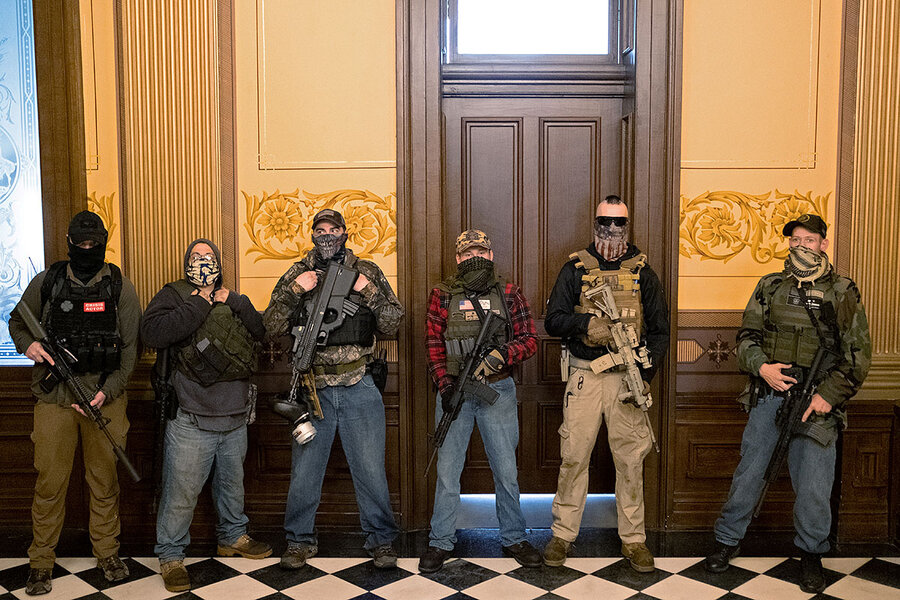
A group of armed white men entered the Capitol and shouted at lawmakers. To Ms. Santana, some were dressed like they were “going to war.” Several Confederate flags, a swastika, and a misogynistic sign aimed at Gov. Gretchen Whitmer could be seen outside.

“I thought that was very scary,” says Ms. Santana, an African American who represents parts of Detroit and all of neighboring Dearborn. “We’re there to do a job, and it’s not to dodge bullets as we try to do our jobs in a bipartisan fashion to make sure we’re keeping all Michiganders safe.”

Four days on from the protest, her concern lingers. The pandemic has intensified many societal fault lines – from health care inequities to political polarization – and gun control is no exception. Feeling that state officials are overreaching, a tiny minority of protesters are flexing their Second Amendment rights in Michigan and beyond.

But at a time of crisis, their crusade against the perceived tyranny of government is seen by many as tyrannical in its own right – recklessly using their liberties to intimidate others.

The core question is: Where should the line be drawn? For protesters, guns in statehouses is one of the purest expressions of the power the Second Amendment invests in citizens. But no constitutional right is absolute.

“Where do people who see no problem with guns downtown or near a hospital or in the legislature, where do they draw the line?” Sanford Levinson, co-author of “Fault Lines in the Constitution.” “That’s an interesting question both politically and legally, because courts are really receptive to line drawing. I don’t think you’d find any judge who says, ‘Yeah, I welcome guns in my courtroom.’”

In that way, the struggle over whether to allow firearms in legislatures “is part of the culture war,” he adds.

Are hard-line tactics effective?

Today, 21 state capitols allow guns in some form, according to a Wall Street Journal report. But only a few, including Michigan, allow citizens to openly carry under the rotunda. Many Republican-led states balk at open carry in the people’s hall for personal safety reasons, and courts have upheld bans in places like legislatures and polling places, holding that guns can chill other people’s rights.

Elements of race have long played a role. The modern gun control movement is linked to the signing of the Mulford Act in 1967, which banned open carry in California. The bill gained momentum after two dozen Black Panthers legally brought firearms to the state capitol to protest against it. The National Rifle Association backed the bill.

Incidents like the one in Michigan, however, could do more to damage gun rights than advance them. “It’s really now an open question to what extent hard-line pro-gun policies are politically advantageous,” says Mr. Levinson, also a visiting professor at Harvard Law School in Cambridge, Massachusetts.

Ms. Santana was certainly not persuaded. “I, as a state lawmaker, want to hear your concerns and your position on the issue. But I don’t feel that bringing assault weapons to the capitol and using symbols of hatred will make me understand your issue better.”

The scenes in Michigan, which has been hit hard by COVID-19, only make it harder to have already difficult conversations, others say. Part of self-defense is respecting the preferences other people have for their own security, which might mean leaving guns at home when overtones of intimidation are possible.

“When your eyes look at these pictures of groups of people … in a public building that is supposed to be a center of democratic exchange and debate, and you see a group of people carrying military weapons, that is not a vision of democracy,” says Hannah Friedman, a staff attorney at Giffords Law Center to Prevent Gun Violence in San Francisco. “That’s a vision of intimidation by a minority of people.”

Such concerns were heightened further this weekend, when employees at businesses in Stillwater, Oklahoma, faced a threat of violence with a gun while trying to force customers to wear masks, as mandated by the local government.

“I think we were heard”

But Ashley Phibbs has a different view.

Ms. Phibbs, a project manager and mother who helped organize the Michigan rally, acknowledged with regret that many in attendance didn’t abide by social distancing rules. She also confirmed the display of hate symbols. But she insisted those were agitators and not part of her group, Michigan United for Liberty, which has sprung up to oppose what members see as repressive COVID-19 restrictions.

“I know how it can seem to people who aren’t active in rallies and who are looking at it from the outside in, and I try to be very understanding of that,” says Ms. Phibbs. “But … I don’t think that anyone was there to really make anyone fearful. I didn’t see anything that would have really caused fear, aside from loud noises from the people yelling. But a lot of people are also sometimes afraid of guns in general.”

In the end, she says, “I think we were heard. I think overall [the rally] was positive.”

Knowing your audience

Other gun-rights advocates saw problems with the optics.

As he watched news from Michigan Thursday, Caleb Q. Dyer saw some familiar faces. The New Hampshire barista and former state legislator had been a keynote speaker at a Michigan Libertarian Party event last year.

But he worried that his friends in Michigan were sending “mixed messages” by failing to abide by public health rules.

In fact, he usually brings witty protest gear – such as a sign that says “arm the homeless” – to disarm fear. It’s a fine line, he says, between free speech and armed intimidation.

“People aren’t ready to have the discussion that a lot of these gun-carrying protesters want to have, which is that none of these laws are even remotely effective or just,” says Mr. Dyer. “But they’re not going to have that discussion if they cannot carry themselves in such a way that the opposition won’t think … that they’re murderous and violent.”


Home of the Brave

Image may contain: 8 peopleImage may contain: 8 people

How Epidemics of the Past Changed the Way Americans Lived

https://www.smithsonianmag.com/history/how-epidemics-past-forced-americans-promote-health-ended-up-improving-life-this-country-180974555/?fbclid=IwAR1_2pHlIidRC01Bjxr7IFOpUBq1ShM8xXXGBkPFT8J6ZK1PtGgtNh9NJ0s

How Epidemics of the Past Changed the Way Americans Lived ...

Past public health crises inspired innovations in infrastructure, education, fundraising and civic debate.

At the end of the 19th century, one in seven people around the world had died of tuberculosis, and the disease ranked as the third leading cause of death in the United States. While physicians had begun to accept German physician Robert Koch’s scientific confirmation that TB was caused by bacteria, this understanding was slow to catch on among the general public, and most people gave little attention to the behaviors that contributed to disease transmission. They didn’t understand that things they did could make them sick. In his book, Pulmonary Tuberculosis: Its Modern Prophylaxis and the Treatment in Special Institutions and at Home, S. Adolphus Knopf, an early TB specialist who practiced medicine in New York, wrote that he had once observed several of his patients sipping from the same glass as other passengers on a train, even as “they coughed and expectorated a good deal.” It was common for family members, or even strangers, to share a drinking cup.

With Knopf’s guidance, in the 1890s the New York City Health Department launched a massive campaign to educate the public and reduce transmission. The “War on Tuberculosis” public health campaign discouraged cup-sharing and prompted states to ban spitting inside public buildings and transit and on sidewalks and other outdoor spaces—instead encouraging the use of special spittoons, to be carefully cleaned on a regular basis. Before long, spitting in public spaces came to be considered uncouth, and swigging from shared bottles was frowned upon as well. These changes in public behavior helped successfully reduce the prevalence of tuberculosis.

As we are seeing with the coronavirus today, disease can profoundly impact a community—upending routines and rattling nerves as it spreads from person to person. But the effects of epidemics extend beyond the moments in which they occur. Disease can permanently alter society, and often for the best by creating better practices and habits. Crisis sparks action and response. Many infrastructure improvements and healthy behaviors we consider normal today are the result of past health campaigns that responded to devastating outbreaks.

In the 19th century, city streets in the U.S. overflowed with filth. People tossed their discarded newspapers, food scraps, and other trash out their windows onto the streets below. The plentiful horses pulling streetcars and delivery carts contributed to the squalor, as each one dropped over a quart of urine and pounds of manure every day. When a horse died, it became a different kind of hazard. In Portrait of an Unhealthy City,” Columbia University professor David Rosner writes that since horses are so heavy, when one died in New York City, “its carcass would be left to rot until it had disintegrated enough for someone to pick up the pieces. Children would play with dead horses lying on the streets.” More than 15,000 horse carcasses were collected and removed from New York streets in 1880. Human waste was a problem, too. Many people emptied chamber pots out their windows. Those in tenement housing did not have their own facilities, but had 25 to 30 people sharing a single outhouse. These privies frequently overflowed until workers known as “night soil men” arrived to haul away the dripping barrels of feces, only to dump them into the nearby harbor.

As civic and health leaders began to understand that the frequent outbreaks of tuberculosis, typhoid and cholera that ravaged their cities were connected to the garbage, cities began setting up organized systems for disposing of human urine and feces. Improvements in technology helped the process along. Officials began introducing sand filtration and chlorination systems to clean up municipal water supplies. Indoor toilets were slow to catch on, due to cost, issues with controlling the stench, and the need for a plumbing system. Following Thomas Crapper’s improved model in 1891, water closets became popular, first among the wealthy, and then among the middle-class. Plumbing and sewage systems, paired with tenement house reform, helped remove excrement from the public streets.

Disease radically improved aspects of American culture, too. As physicians came to believe that good ventilation and fresh air could combat illness, builders started adding porches and windows to houses. Real estate investors used the trend to market migration to the West, prompting Eastern physicians to convince consumptives and their families to move thousands of miles from crowded, muggy Eastern cities to the dry air and sunshine in places like Los Angeles and Colorado Springs. The ploy was so influential that in 1872, approximately one-third of Colorado’s population had tuberculosis, having moved to the territory seeking better health.

Some of this sentiment continues today. While we know that sunshine doesn’t kill bacteria, good ventilation and time spent outside does benefit children and adults by promoting physical activity and improving spirits—and access to outdoor spaces and parks still entices homebuyers. This fresh-air “cure” also eventually incited the study of climate as a formal science, as people began to chart temperature, barometric pressure and other weather patterns in hopes of identifying the “ideal” conditions for treating disease.

Epidemics of the past established an ethos of altruism in the U.S. During the 1793 yellow fever epidemic, Philadelphians selflessly stepped up to save their city. With no formal crisis plan, Mayor Matthew Clarkson turned to volunteers collect clothing, food and monetary donations; to pitch a makeshift hospital; and to build a home for 191 children temporarily or permanently orphaned by the epidemic. Members of the Free African Society, an institution run by and for the city’s black population, were particularly altruistic, providing two-thirds of the hospital staff, transporting and burying the dead and performing numerous other medical tasks.

A 20th-century diphtheria outbreak in a small region in the Alaska Territory inspired a national rally of support—and created the Iditarod, the famous dog sled race. When cases of “the children’s disease” began to mount in Nome, Alaska, in January 1925, the town was in trouble. Diphtheria bacteria produces a toxin, making it especially deadly, unless the antitoxin serum is administered. This serum had been readily available for decades, but Nome’s supply had run short, and the town was inaccessible by road or sea in the winter. Leaping into action, 20 of the area’s finest dogsled teams and mushers carried a supply of the serum all the way from Fairbanks—674 miles—in record time, facing temperatures of more than 60 degrees below zero. Their delivery on February 2nd, plus a second shipment a week later, successfully halted the epidemic, saving Nome’s children from suffocation. Newspapers across the country covered the rescue. It was also memorialized in movies (including the animated Balto), with a Central Park statue—and, most notably, with the annual Iditarod race. The significant challenges of delivery by dogsled also sparked investigation into the possibilities of medical transport by airplane, which takes place all the time in remote areas today but was still in its infancy at the time.

Diseases fueled the growth of fundraising strategies. The polio epidemic of 1952 sickened more than 57,000 people across the United States, causing 21,269 cases of paralysis. The situation became so dire that at one point, the Sister Kenny Institute in Minneapolis, a premier polio treatment facility, temporarily ran out of cribs for babies with the disease. In response, the National Foundation of Infantile Paralysis (NFIP), which had been founded in 1938 by President Franklin D. Roosevelt and later came to be known as the March of Dimes, distributed around $25 million through its local chapters. It provided iron lungs, rocking chairs, beds and other equipment to medical facilities, and assigned physicians, nurses, physical therapists, and medical social workers where they were needed. The March of Dimes success has served as the gold standard in public health education and fundraising since its heyday in the 1940s and 1950s.

Public health emergencies have inspired innovations in education. Starting in 1910, Thomas Edison’s lab, which had invented one of the first motion picture devices in the 1890s, partnered with anti-TB activists to produce short films on tuberculosis prevention and transmission—some of the first educational movies. Screened in public places in rural areas, the TB movies were also the first films—of any type—that viewers had ever seen. The anti-tuberculosis crusade was also a model for later NFIP efforts to combat polio that relentlessly put that disease at the front of public agenda until an effective vaccination was developed and implemented, and set a standard for future public health campaigns.

Past epidemics fueled the growth of civic debate and journalism in the U.S., too. As far back as colonial times, newspapers built their audiences by providing an outlet for debate on controversial issues, including disease. Founders of the New England Courant—the first paper in Colonial America to print the voices and perspectives of the colonists—launched their paper as a vehicle to oppose smallpox inoculation during the 1721 Boston epidemic. As smallpox ravaged the city, a Boston doctor named Zabdiel Boylston began using inoculation, a practice in which people are intentionally infected with a disease, to produce milder cases and reduce mortality risk. Backed by those opposed to the practice, James Franklin started the Courant to serve as a tool to fight it. Inoculation’s success was demonstrated in 1721 and later smallpox epidemics, eventually convincing even staunch opponents of its value—but by inspiring an outlet to air their concerns, the anti-inoculation camp had made an important contribution to public discourse.

Since colonial times, newspapers, pamphlets, and a host of other outlets have continued to thrive and evolve during outbreaks—updating the public on believed transmission and remedies, announcing store closing and quarantine restrictions, advertising outbreak-related job openings (florists, nurses, grave diggers, coffin makers, to name a few), and serving as spaces for public debate. The cycle continues today, as media powers and regular citizens flock to social media to discuss COVID-19—disseminating information, speculating on its origins, expressing fear of its unknowns.