Health Care Workers Stand Up To People Protesting Stay-At-Home Orders

https://nowthisnews.com/news/health-care-workers-stand-up-to-people-protesting-stay-at-home-orders

View image on Twitter

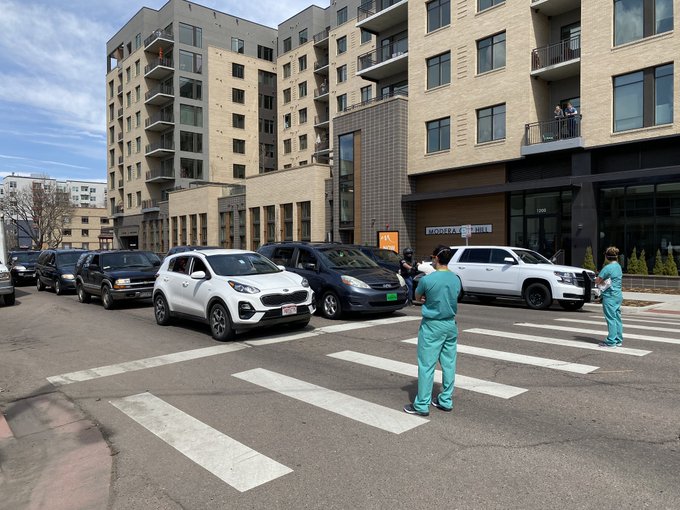
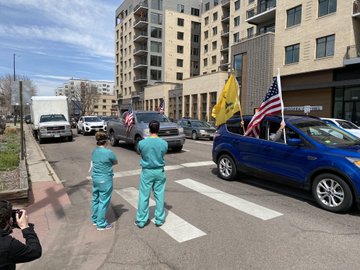
Remarkable scene at 12th and Grant, where two healthcare workers from a Denver-area hospital — they declined to say which or give their names — are standing in the crosswalk during red lights as a “reminder,” they say, of why shutdown measures are in place.

Two health care workers blocked a parade of protesters in Denver, Colorado on Sunday, who were storming the capitol to protest the state’s stay-at-home order.

Powerful images and videos of the standoff were widely shared on social media of the two unidentified people wearing scrubs and N95 masks, standing in a crosswalk blocking protesters’ vehicles. The two were identified as health care workers by photographers on the scene. 

One video shared by Twitter user Marc Zenn, captured cars lined up and beeping their horns at the two medical workers, with a woman hanging out of her vehicle’s window shouting “Go to China if you want communism. Go to China,” and “You get to go to work, why can’t we?”

View image on Twitter

They say they’ve been treating COVID patients for weeks. Today most of the people driving by have been “very aggressive,” they say. I’ve been standing here for a few minutes and already seen two people get in their faces.

Hundreds of people showed up on foot and in their vehicles for two separate protests in Colorado’s capitol on Sunday. The protests were reportedly planned by ReOpen Colorado and “various Libertarian parties,” according to a local Denver news outlet. People attending the march were shown carrying American flags, “Don’t Tread on Me” flags, and signs about reopening businesses and schools.

“Coloradans have a first amendment right to protest and to free speech, and the Governor hopes that they are using social distancing and staying safe,” Colorado Gov. Jared Polis’ office said in a statement. “No one wants to reopen Colorado businesses and lift these restrictions more than the Governor, but in order to do that, Coloradans have to stay home as much as possible during this critical period, wear masks and wash their hands regularly to slow the spread of this deadly virus.”

As of Monday morning, Colorado has more than 9,700 cases of COVID-19, leading to at least 420 deaths, according to the Johns Hopkins coronavirus tracker. The state of Colorado is set to continue its stay-at-home order until at least April 26, to slow the transmission of the virus.  

Colorado isn’t the only state where protesters are demonstrating against their government’s stay-at-home orders—Several other states held protests over the weekend including Utah, Idaho, and Washington state. Last week, parts of Michigan, New York, Ohio, Virginia, North Carolina, and others also saw a wave of demonstrators

President Trump encouraged the protesters last week during his Friday press briefing and in tweets which said to “liberate” multiple states holding protests.

In a Politico poll, 81% of Americans agreed we “should continue to social distance for as long as is needed to curb the spread of coronavirus, even if it means continued damage to the economy.” An NBC News poll found that 60% of responders agreed with keeping at-home restrictions.


Current State of the Union

https://www.buzzfeednews.com/article/gabrielsanchez/huge-crowds-protest-coronavirus-trump-coronavirus-pandemic?fbclid=IwAR0abgB9Wpv2WAOhNgdYhQgNU6W6h1NnqoVcxxye4QTRBwQaSEsxzeIXyho

These Pictures Show Crowds Protesting Against Coronavirus Lockdowns At State Capitols

Conservative demonstrators gathered at the capitol buildings of Michigan, Kentucky, and North Carolina to protest against stay-at-home orders during a pandemic that has already left more than 26,000 Americans dead.


Trump, Head of Government, Leans Into Antigovernment Message

Trump, Head of Government, Leans Into Antigovernment Message

With his poll numbers fading after a rally-around-the-leader bump, the president is stoking protests against stay-at-home orders.

First he was the self-described “wartime president.” Then he trumpeted the “total” authority of the federal government. But in the past few days, President Trump has nurtured protests against state-issued stay-at-home orders aimed at curtailing the spread of the coronavirus.

Hurtling from one position to another is consistent with Mr. Trump’s approach to the presidency over the past three years. Even when external pressures and stresses appear to change the dynamics that the country is facing, Mr. Trump remains unbowed, altering his approach for a day or two, only to return to nursing grievances.

Not even the president’s re-election campaign can harness him: His team is often reactive to his moods and whims, trying but not always succeeding in steering him in a particular direction. Now, with Mr. Trump’s poll numbers falling after a rally-around-the-leader bump, he is road-testing a new turn on a familiar theme — veering into messages aimed at appealing to Americans whose lives have been disrupted by the legally enforceable stay-at-home orders.

Whether his latest theme will be effective for him is an open question: In an NBC/Wall Street Journal poll released on Sunday, just 36 percent of voters said they generally trusted what Mr. Trump says about the coronavirus.

But the president, who ran as an insurgent in 2016, is most comfortable raging against the machine of government, even when he is the one running the country. And while the coronavirus is in every state in the union, it is heavily affecting minority and low-income communities.

So when Mr. Trump on Friday tweeted “LIBERATE,” his all-capitalized exhortations against strict orders in specific states — including Michigan — were in keeping with how he ran in 2016: saying things that seem contradictory, like pledging to work with governors and then urging people to “liberate” their states, and leaving it to his audiences to hear what they want to hear in his words.

For instance, Mr. Trump did not take the opportunity to more forcefully encourage the protesters when he spoke with reporters on Friday.

“These are people expressing their views,” Mr. Trump said. “They seem to be very responsible people to me.” But he said he thought the protesters had been treated “rough.”

In a webcast with Students for Trump on Friday, a conservative activist and Trump ally, Charlie Kirk, echoed the message, encouraging a “peaceful rebellion against governors” in states like Michigan, according to ABC News.

On Fox News, where many of the opinion hosts are aligned with Mr. Trump and which he watches closely, there have also been discussions of such protests. And Mr. Trump has heard from conservative allies who have said they think he is straying from his base of supporters in recent weeks.

So far, the protests have been relatively small and scattershot, organized by conservative-leaning groups with some organic attendance. It remains to be seen if they will be durable.

But Mr. Trump’s show of affinity for such actions is in keeping with his fomenting of voter anger at the establishment in 2016, a key to his success then — and his fallback position during uncertain moments ever since.

In the case of the state-issued orders, Mr. Trump’s advisers say his criticism of certain places is appropriate.

Stephen Moore, a former adviser to Mr. Trump and an economist with FreedomWorks, an organization that promotes limited government, said he thought protesters ought to be wearing masks and protecting themselves. But, he added, “the people who are doing the protest, for the most part, these are the ‘deplorables,’ they’re largely Trump supporters, but not only Trump supporters.”

On Sunday, Mr. Trump again praised the protesters. “I have never seen so many American flags,” he said.

But Mr. Trump’s advisers are divided about the wisdom of encouraging the protests. At some of them, Gov. Gretchen Whitmer of Michigan, a Democrat, has been compared to Adolf Hitler. At least one protester had a sign featuring a swastika.

One adviser said privately that if someone were to be injured at the protests — or if anyone contracted the coronavirus at large events where people were not wearing masks — there would be potential political risk for the president.

But two other people close to the president, who asked for anonymity in order to speak candidly, said they thought the protests could be politically helpful to Mr. Trump, while acknowledging there might be public health risks.

One of those people said that in much of the country, where the numbers of coronavirus cases and deaths are not as high as in places like New York, New Jersey, California and Washington State, anger is growing over the economic losses that have come with the stringent social-distancing restrictions.

And some states are already preparing to restart their economies. Ohio, where Gov. Mike DeWine, a Republican, took early actions against the spread of the virus, is planning a staged reopening beginning on May 1.

Still, as Mr. Trump did throughout 2016, as when he said “torture works” and then walked back that statement a short time later, or when he advocated bombing the Middle East while denouncing lengthy foreign engagements, he has long taken various sides of the same issue.

Mobilizing anger and mistrust toward the government was a crucial factor for Mr. Trump in the last presidential election. And for many months he has been looking for ways to contrast himself with former Vice President Joseph R. Biden Jr., the presumptive Democratic presidential nominee and a Washington lifer.

The problem? Mr. Trump is now president, and disowning responsibility for his administration’s slow and problem-plagued response to the coronavirus could prove difficult. And protests can be an unpredictable factor, particularly at a moment of economic unrest.

Vice President Mike Pence, asked on NBC’s “Meet the Press” about the president’s tweets urging people to “liberate” states, demurred.

“The American people know that no one in America wants to reopen this country more than President Donald Trump,” Mr. Pence said, “and on Thursday the president directed us to lay out guidelines for when and how states could responsibly do that.”

“And in the president’s tweets and public statements, I can assure you, he’s going to continue to encourage governors to find ways to safely and responsibly let America go back to work,” he said.

With the political campaign halted, Mr. Trump’s advisers have seen an advantage in the frozen-in-time state of the race. Mr. Biden has struggled to fund-raise or even to get daily attention in the news cycle.

But Mr. Trump himself has seemed at sea, according to people close to him, uncertain of how to proceed. His approval numbers in his campaign polling have settled back to a level consistent with before the coronavirus, according to multiple people familiar with the data.

His campaign polling has shown that focusing on criticizing China, in contrast with Mr. Biden, moves voters toward Mr. Trump, according to a Republican who has seen it.

“Trump finally fired the first shot” with his more aggressive stance toward the Chinese government and its leader, Xi Jinping, said Stephen K. Bannon, Mr. Trump’s former chief strategist. “Xi is put on notice that the death, economic carnage and agony is his and his alone,” Mr. Bannon said. “Only question now: What is America’s president prepared to do about it?”

Mr. Trump’s campaign manager, Brad Parscale, has advocated messages that contrast Mr. Trump with Mr. Biden on a number of fronts, including China.

But inside and outside the White House, other advisers to Mr. Trump see an advantage in focusing attention on the presidency.

Kellyanne Conway, the White House counselor, has argued in West Wing discussions that there is a time to focus on China, but that for now, the president should embrace commander-in-chief moments amid the crisis.

Chris Christie, the former governor of New Jersey and a friend of Mr. Trump’s, said on ABC’s “This Week” that he did not think ads criticizing Mr. Biden on China were the right approach for now.

Ultimately, Mr. Trump’s advisers said, most of his team is aware that it can try to drive down Mr. Biden’s poll numbers, but that no matter what tactics it deploys now, the president’s future will most likely depend on whether the economy is improving in the fall and whether the virus’s spread has been mitigated. Those things will remain unknown for months.

“This is going to be a referendum,” Mr. Christie said, “on whether people think, when we get to October, whether or not he handled this crisis in a way that helped the American people, protected lives and moved us forward.”


Governors Reject Pence’s Claim on Virus Testing

Coronavirus and Reopening: Governors Say They Lack Tests as Trump ...

Democratic and Republican governors bristled at claims from the Trump administration that the supply of tests was adequate to move firmly toward reopening the country.

Governors facing growing pressure to revive economies decimated by the coronavirus said on Sunday that a shortage of tests was among the most significant hurdles in the way of lifting restrictions in their states.

“We are fighting a biological war,” Gov. Ralph Northam of Virginia said on “State of the Union” on CNN. “We have been asked as governors to fight that war without the supplies we need.”

In interviews on Sunday morning talk shows, Mr. Northam was among the governors who said they needed the swabs and reagents required for the test, and urged federal officials to help them get those supplies.

The governors bristled at claims from the Trump administration that the supply of tests was adequate. On NBC’s “Meet the Press,” Vice President Mike Pence said “there is a sufficient capacity of testing across the country today for any state in America” to go to the first of three phases that the administration says are needed for the country to emerge from the coronavirus shutdown.

Mr. Northam, a Democrat, called Mr. Pence’s claim “delusional.” In Michigan, Gov. Gretchen ​Whitmer, also a Democrat, said the state could perform “double or triple” the number of tests it is doing now “if we had the swabs or reagents.” ​Gov. Larry Hogan​ of Maryland, a Republican, said that it was “absolutely false” to claim that governors were not acting aggressively enough to pursue as much testing as possible.

“It’s not accurate to say there’s plenty of testing out there, and the governors should just get it done,” Mr. Hogan ​said​ on “State of the Union​.​”​ “That’s just not being straightforward.”

The conflicting messages come as the debate over how and when to reopen the economy has intensified. President Trump on Saturday expressed his confidence in the nation’s testing capability and said some governors have “gotten carried away,” while state officials said they feared moving too early could cause the virus to flare again.

“As tough as this moment is,” Ms. Whitmer said in an interview with CNN, “it would be devastating to have a second wave.”

In a news conference on Sunday evening, Mr. Trump expressed his confidence in the federal response, including his administration’s relationship with governors and the capacity for testing.

Mr. Trump said the administration was preparing to use the Defense Production Act to compel one U.S. facility to increase production of test swabs by over 20 million per month. The announcement came after he defended his response to the accusations that there was an insufficient amount of testing to justify reopening the economy any time soon.

“You’ll have so many swabs you won’t know what to do with them,” Mr. Trump said.

Officials at every level have faced increasingly competing pressures, balancing maintaining stay-at-home orders against the exasperation and economic toll they are producing. On Saturday and Sunday, modest protests took place in several cities across the country, where demonstrators flouted social distancing rules as they demanded that restrictions be relaxed.

Yet there was also a widespread sense that much of the public understood the governors’ concerns and shared them. Nearly 60 percent of American voters said they were worried that measures would be relaxed too soon, causing deaths to rise, according to a new poll from NBC News and The Wall Street Journal.

Officials in various states said they had started staging plans for reopening their economies and were working in concert with neighboring states in determining when to lift restrictions.

In South Carolina, Gov. Henry McMaster said that he had spoken with the governors of other southeastern states, including Florida and Tennessee. “Told them South Carolina was ready,” Mr. McMaster, a Republican, said on Twitter on Saturday.

On Sunday, governors from across the Northeast, including New York, New Jersey, Connecticut and Pennsylvania, said they were creating a regional council focused on restoring the economy and addressing unemployment.

Still, many governors, including Andrew M. Cuomo of New York and Philip D. Murphy of New Jersey, said that testing still needed to be ramped up considerably before moving forward, and that they needed federal help to do so.

There are currently about 150,000 diagnostic tests conducted each day, according to the Covid Tracking Project. Researchers at Harvard estimated last week that in order to ease restrictions, the nation needed to at least triple that pace of testing.

Dr. Deborah Birx, the coronavirus response coordinator for the White House, also pushed back against criticism that not enough people were being tested, saying that not every community required high levels of testing and that tens of thousands of test results were probably not being reported.

“We need to predict community by community the testing that is needed,” Dr. Birx said Sunday on CBS’s “Face the Nation​.” “Each will have a different testing need, and that’s what we’re calculating now.”

On the ABC program “This Week,” Dr. Birx said she thought statistics on testing were incomplete: “When you look at the number of cases that have been diagnosed, you realize that there’s probably 30,000 to 50,000 additional tests being done that aren’t being reported right now.”

Shortages of supplies have restricted the pace of testing, according to commercial laboratories. Dr. Birx said that a team at Walter Reed National Military Medical Center was calling hundreds of labs around the country to determine exactly what supplies they need “to turn on full capacity, which we believe will double the number of tests that are available for Americans.”

In the news conference on Saturday, Mr. Trump said the criticism of the administration was driven by Democrats. “Unfortunately, some partisan voices are trying to politicize the issue of testing,” he said.

Yet, Gov. Jay Inslee of Washington noted that governors from both parties had been among those voicing frustration over a lack of federal support with testing. He also criticized what he saw as a discordant message from Mr. Trump, which, he argued, undermined governors’ stay-at-home orders and inspired “people to ignore things that actually can save their lives.”

“These orders actually are the law of these states,” Mr. Inslee, a Democrat, said in an interview with “This Week.” He added: “And, again, these are not just Democrats. These are Republican-led states as well. To have an American president to encourage people to violate the law, I can’t remember any time during my time in America where we have seen such a thing.”

Now, with states transitioning away from addressing the peak of the pandemic, governors stand to face a difficult landscape to navigate.

Governors across the political spectrum have stepped into the spotlight during the coronavirus crisis, holding daily news briefings and going back and forth with the president. But if they drew praise for taking quick action to protect public health, taking responsibility for when and how to reopen could prove far more politically perilous, said Ray Scheppach, a public policy professor at the University of Virginia and a former longtime executive director of the National Governors Association.

“That is one of the reasons you’re seeing groups of governors and states get together,” he said, noting the alliances made by clusters of governors around the country.

“Doing something with the surrounding states does give you a certain amount of political cover,” both with constituents and the White House, Professor Scheppach said. “They don’t want to get pushed around by this president and they are stronger in a group.”

Having claimed responsibility for reopening the country, governors are now offering hesitant timelines. Offering no date for reopening may leave people feeling despondent at a time when “people need more certainty as opposed to less,” Professor Scheppach said. But being too firm comes with the risk of having to push out deadlines and test the public’s patience.

“You can do it once,” he said, as Mr. Cuomo and others have done. “But you begin to lose if you do that two or three times.”

Governors said they had become acutely aware of the dilemmas they face.

In his appearance on CNN, Mr. Hogan was shown footage of a long line winding around a supermarket in a Maryland suburb of Washington where free food was being handed out. The video was an unsettling avatar of the economic damage wrought by the virus. He said he shared in the frustration over the economy, but he also noted that his state had not yet reached its peak in cases.

“My goal is to try to get us open as quickly as we possibly can,” he said, “but in a safe way.”


Pro-gun activists using Facebook groups to push anti-quarantine protests

https://www.washingtonpost.com/technology/2020/04/19/pro-gun-activists-using-facebook-groups-push-anti-quarantine-protests/?fbclid=IwAR3FTssf8nkcPHuqyVFyxpT17Zd3PwRnL6xSxL-Njeou_AQ4osiGmUK5FyI&utm_campaign=wp_main&utm_medium=social&utm_source=facebook

Pro-gun activists using Facebook groups to push anti-quarantine ...

A trio of far-right, pro-gun provocateurs is behind some of the largest Facebook groups calling for anti-quarantine protests around the country, offering the latest illustration that some seemingly organic demonstrations are being engineered by a network of conservative activists.

The Facebook groups target Wisconsin, Ohio, Pennsylvania and New York, and they appear to be the work of Ben Dorr, the political director of a group called “Minnesota Gun Rights,” and his siblings, Christopher and Aaron. By Sunday, the groups had roughly 200,000 members combined, and they continued to expand quickly, days after President Trump endorsed such protests by suggesting citizens should “liberate” their states.

The online activity helps cement the impression that opposition to the restrictions is more widespread than polling suggests. Nearly 70 percent of Republicans said they supported a national stay-at-home order, according to a recent Quinnipiac poll. Ninety-five percent of Democrats backed such a measure in the survey.

Still, the Facebook groups have become digital hubs for the same sort of misinformation spouted in recent days at state capitol buildings — from comparing the virus to the flu to questioning the intentions of scientists working on a vaccine.

Public-health experts say stay-at-home orders are necessary to slow the spread of the new coronavirus, which has already killed more than 40,000 in the United States. The Trump administration last week outlined three phases for states to reopen safely — guidelines contradicted by the president when he urged citizens to rise up against the rules that heed the recommendations of his own public-health advisers.

“If people feel that way, you’re allowed to protest,” Trump said Sunday. “Some governors have gone too far, some of the things that happened are maybe not so appropriate.”

Facebook said Sunday it did not plan to take action to remove the groups or events, partly because states have not outlawed them. Organizers also have called for “drive-in” protests, in keeping with recommendations that people keep a short distance between each other. In other cases, involving protests planned for states like New Jersey and California, the company has removed that content, Facebook said.

“Unless government prohibits the event during this time, we allow it to be organized on Facebook. For this same reason, events that defy government’s guidance on social distancing aren’t allowed on Facebook,” said Andy Stone, a spokesman for the company.

None of the Dorr brothers responded to calls and emails on Sunday.

“Wisconsinites Against Excessive Quarantine” was created on Wednesday by Ben Dorr. His brother Christopher is the creator of “Pennsylvanians Against Excessive Quarantine,” as well as “Ohioans Against Excessive Quarantine.” A third brother, Aaron, is the creator of “New Yorkers Against Excessive Quarantine.”

The online coordination offered additional clues about how the protest activity is spreading nationwide, capturing the imagination of the president and of Fox News even though it represents the views of a small minority of Americans. Trump himself tied the protests to gun rights — a primary cause for the Dorr brothers — in telling Virginians that the Second Amendment was “under siege” as he urged them to liberate the state.

On the ground, pro-Trump figures — including some who act as surrogates for his campaign — as well as groups affiliated with prominent conservative donors have helped organize and promote the demonstrations.

Some of the most vehement protest activity, in Michigan, has been organized by the Michigan Conservative Coalition. Its founders are a Republican state lawmaker and his wife, Meshawn Maddock, who sits on the Trump campaign’s advisory board and is a prominent figure in the “Women for Trump” coalition. Jeanine Pirro, a Fox News host and avid Trump supporter, interviewed Maddock on her show Saturday, telling her, “Keep going. Thank you.”

Also promoting the demonstrations — including spending several hundred dollars to advertise the event on Facebook — was the Michigan Freedom Fund, which is headed by Greg McNeilly, a longtime adviser to the DeVos family. He served as campaign manager for Dick DeVos, the husband of Education Secretary Betsy DeVos, when he ran unsuccessfully for governor of Michigan in 2006.

The state’s Democratic governor, Gretchen Whitmer, who has become a target for Trump and his conservative allies, last week criticized the nonprofit, noting that it was “funded in large part by the DeVos family,” and saying it was “really inappropriate for a sitting member of the United States president’s cabinet to be waging political attacks on any governor, but obviously, on me here at home.”

McNeilly said the funds used to promote the event were “not dedicated program funds” but instead came from “our grassroots fundraising efforts,” and so had “nothing to do with any DeVos work.”

The Dorr brothers manage a slew of pro-gun groups across a wide range of states, from Iowa to Minnesota to New York, and seek primarily to discredit organizations like the National Rifle Association as being too compromising on gun safety. Minnesota Gun Rights, for which Ben Dorr serves as political director, describes itself as the state’s “no-compromise gun rights organization.”

In numerous states, they have bypassed rules requiring them to register as lobbyists by arguing that they are instead involved in “pro-gun grassroots mobilization,” as “Ohio Gun Owners,” whose board Chris Dorr directs, describes its work.

A now-retired state legislator in Iowa, who in 2017 sought to close a loophole allowing the brothers to skirt lobbying rules, said he was not surprised the Dorr brothers were involved in fomenting resistance to the public-health precautions.

“The brothers will do anything to fan the flames of a controversial issue, and maybe make a quick nickel,” said the former state legislator, Republican Clel Baudler.

Nearly 97,000 people had joined “Wisconsinites Against Excessive Quarantine” by Sunday afternoon, a Facebook group whose posts are visible only to members that asserted Gov. Tony Evers has been on a “power trip, controlling our lives, destroying our businesses” and “forcing us to hand over our freedoms and our livelihood!” In the group, some members speculated that Evers closed most state businesses and shuttered schools to appease pharmaceutical giants — not because of data showing the novel coronavirus is highly contagious and deadly, infecting more than 4,300 in the state and killing 220.

The group, along with Ben Dorr, created an event on Facebook for a “drive-in rally” at the capital next Friday that has attracted hundreds of pledged participants. They also seek to steer visitors to a website for the “Wisconsin Firearms Coalition,” where people can enter their names, email addresses and other contact information and share their views with the state’s governor. In doing so, they encourage visitors who are not “already a member of the Wisconsin Firearms Coalition” to “join us.” A page asking users to join the Minnesota group offered several rates for membership, from $35 to $1,000.

Another private Facebook group focused on Pennsylvania, gaining more than 63,000 members by Sunday. Many questioned the wisdom of wearing masks publicly, contrary to recommendations by state and federal officials, and linked to a similar website catering to Pennsylvania gun owners. Still another targeting New York had become a forum for roughly 23,000 members to question whether the coronavirus is really that bad — despite the fact New York City has become the epicenter of the U.S. outbreak.

“While seizing power at a breathtaking pace,” the group’s description began, “Andrew Cuomo is sending NY’s economy into a death spiral!”


Cartoon – The Wisdom of Pandemic Protests

Kevin it's Necessary everyone stay home on Twitter: "Looks like ...

Healthcare Front Line Workers Counter-protest in Denver

https://www.trendsmap.com/twitter/tweet/1251984156998975492

Image may contain: 1 person, outdoor

🇯🇲Black🇭🇹Aziz🇳🇬aNANsi🇹🇹's tweet - "Health care workers ...

Scott Loy on Twitter: "Nurses blocking cars in Downtown Denver to ...

keyvan (کیوان) 🌹's tweet - "More below. Photos by Alyson McClaran ...


This says it all from a Nurse in Michigan

Image may contain: 1 person

“I am posting, for once, about something other than my dog.

I have seen 4 patients die, 5 get intubated, 2 re-intubated, witnessed family consent to make 2 more patients DNRs, sweat my butt off during CPR, titrated so many drips to no avail, watched vent settings increase to no avail. We are exhausted and at a total loss.

All of this in two shifts in a row.

Some of you people have never done EVERYTHING you could to save someone, and watched them die anyway, and it shows.

I would have no problem if you fools worried about your “freedom” all went out and got COVID. If only you could sign a form stating that you revoke your right to have medical treatment based on your cavalier antics and refusal to abide by CDC and medical professionals’ advice. If you were the only people who got infected during your escapades to protest tyranny, great. But that’s sadly not how this works.

You wanna complain because the garden aisle is closed? If you knew a thing about gardening, you’d know it’s too early to plant in Michigan. Your garden doesn’t matter. If killing your plants would bring back my patients, I would pillage the shit out of your “essential” garden beds.

Upset because you can’t go boating…in Michigan…in April…in the cold-ass water? You wanna tell my patient’s daughter (who was sobbing as she said goodbye to her father over the phone) about your first-world problems?

Upset because you can’t go to your cottage up north? Your cottage…your second property…used for leisure. My coworkers can’t even stay in their regular homes. Most have been staying in hotels and dorms, not able to see their spouses or babies.

All of these posts, petitions online to evade “tyranny”, it’s all such bullshit. I’m sorry you’re bored and have nothing to do but bitch and moan. You wanna pick up a couple hours for me? Yeah, didn’t think so. I wouldn’t trust most of you with patient care, anyway. Not just because of the selfish lack of humanity your posts exude, but because most of those posts and petitions are so riddled with misspellings and grammatical errors, that it makes me question your cognitive capacity.

Shoutout to my coworkers, the real MVPs.”


Blaming China Is a Dangerous Distraction

https://www.project-syndicate.org/commentary/trump-blaming-china-dangerous-distraction-by-jim-o-neill-2020-04?utm_source=Project+Syndicate+Newsletter&utm_campaign=5b31132e51-sunday_newsletter_19_04_2020&utm_medium=email&utm_term=0_73bad5b7d8-5b31132e51-105592221&mc_cid=5b31132e51&mc_eid=5f214075f8

Blaming China is a dangerous distraction - myRepublica - The New ...

Nobody denies that Chinese officials’ initial effort to cover up the coronavirus outbreak in Wuhan at the turn of the year was an appallingly misguided decision. But anyone who is still focusing on China’s failings instead of working toward a solution is essentially making the same mistake.

LONDON – As the COVID-19 crisis roars on, so have debates about China’s role in it. Based on what is known, it is clear that some Chinese officials made a major error in late December and early January, when they tried to prevent disclosures of the coronavirus outbreak in Wuhan, even silencing health-care workers who tried to sound the alarm. China’s leaders will have to live with these mistakes, even if they succeed in resolving the crisis and adopting adequate measures to prevent a future outbreak.

What is less clear is why other countries think it is in their interest to keep referring to China’s initial errors, rather than working toward solutions. For many governments, naming and shaming China appears to be a ploy to divert attention from their own lack of preparedness. Equally concerning is the growing criticism of the World Health Organization, not least by US President Donald Trump, who has attacked the organization for supposedly failing to hold the Chinese government to account. At a time when the top global priority should be to organize a comprehensive coordinated response to the dual health and economic crises unleashed by the coronavirus, this blame game is not just unhelpful but dangerous.

Globally and at the country level, we desperately need to do everything possible to accelerate the development of a safe and effective vaccine, while in the meantime stepping up collective efforts to deploy the diagnostic and therapeutic tools necessary to keep the health crisis under control. Given that there is no other global health organization with the capacity to confront the pandemic, the WHO will remain at the center of the response, whether certain political leaders like it or not.

Having dealt with the WHO to a modest degree during my time as chairman of the UK’s independent Review on Antimicrobial Resistance (AMR), I can say that it is similar to most large, bureaucratic international organizations. Like the International Monetary Fund, the World Bank, and the United Nations, it is not especially dynamic or inclined to think outside the box. But rather than sniping at these organizations from the sidelines, we should be working to improve them. In the current crisis, we should be doing everything we can to help both the WHO and the IMF to play an effective, leading role in the global response.

As I have  before, the IMF should expand the scope of its annual Article IV assessments to include national public-health systems, given that these are critical determinants in a country’s ability to prevent or at least manage a crisis like the one we are now experiencing. I have even raised this idea with IMF officials themselves, only to be told that such reporting falls outside their remit because they lack the relevant expertise.

That answer was not good enough then, and it definitely isn’t good enough now. If the IMF lacks the expertise to assess public-health systems, it should acquire it. As the COVID-19 crisis makes abundantly clear, there is no useful distinction to be made between health and finance. The two policy domains are deeply interconnected, and should be treated as such.

In thinking about an international response to today’s health and economic emergency, the obvious analogy is to the 2008 global financial crisis. Everyone knows that crisis started with an unsustainable US housing bubble, which had been fed by foreign savings, owing to the lack of domestic savings in the United States. When the bubble finally burst, many other countries sustained more harm than the US did, just as the COVID-19 pandemic has hit some countries much harder than it hit China.

And yet, not many countries around the world sought to single out the US for presiding over a massively destructive housing bubble, even though the scars from that previous crisis are still visible. On the contrary, many welcomed the US economy’s return to sustained growth in recent years, because a strong US economy benefits the rest of the world.2

So, rather than applying a double standard and fixating on China’s undoubtedly large errors, we would do better to consider what China can teach us. Specifically, we should be focused on better understanding the technologies and diagnostic techniques that China used to keep its (apparent) death toll so low compared to other countries, and to restart parts of its economy within weeks of the height of the outbreak.

And, for our own sakes, we also should be considering what policies China could adopt to put itself back on a path toward 6% annual growth, because the Chinese economy inevitably will play a significant role in the global recovery. If China’s post-pandemic growth model makes good on its leaders’ efforts in recent years to boost  and imports from the rest of the world, we will all be better off.