Can updated boosters prevent another Covid-19 surge? Why some experts are skeptical.

Most experts agree that updated bivalent Covid-19 boosters provide additional protection against serious illness and death among vulnerable populations—but evidence suggests that increased booster uptake may not prevent a “wave of Covid” infections this winter, Apoorva Mandavilli writes for the New York Times.

Can bivalent boosters prevent another surge of infections?

While the Biden administration’s plan to prevent another surge of Covid-19 infections relies on increasing Americans’ uptake of the updated booster doses of the PfizerBioNTech and Moderna vaccines, some experts doubt the strategy.

According to John Moore, a virologist at Weill Cornell Medicine, boosters provide additional protection to vulnerable populations—including older adults, immunocompromised individuals, and pregnant people—who should get boosted to prevent severe illness and death.

However, the benefit is not as clear for healthy, younger Americans who “are rarely at risk of severe illness or death from Covid, and at this point most have built immunity through multiple vaccine doses, infections or both,” Mandavilli writes.

“If you’re at medical risk, you should get boosted, or if you’re at psychological risk and worrying yourself to death, go and get boosted,” Moore said. “But don’t believe that will give you some kind of amazing protection against infection, and then go out and party like there’s no tomorrow.”

Separately, Peter Marks, FDA‘s top vaccine regulator, noted the limited data available data for the updated boosters.

“It’s true, we’re not sure how well these vaccines will do yet against preventing symptomatic disease,” he said, especially as the newer variants spread.

However, Marks added, “even modest improvements in vaccine response to the bivalent boosters could have important positive consequences on public health. Given the downside is pretty low here, I think the answer is we really advocate people going out and consider getting that booster.”

How much additional protection do updated shots provide?

While Pfizer-BioNTech and Moderna recently reported that their bivalent boosters produced antibody levels that were four to six times higher than the original vaccine, their results were based on BA.4 and BA.5 antibodies, instead of the more prevalent BQ.1 and BQ.1.1 variants.

According to Mandavilli, “[a] spate of preliminary research suggests that the updated boosters, introduced in September, are only marginally better than the original vaccines at protecting against the newer variants — if at all.”

These small studies have not been reviewed for publication in a journal—but they all came to similar conclusions.

“It’s not likely that any of the vaccines or boosters, no matter how many you get, will provide substantial and sustained protection against acquisition of infection,” said Dan Barouch, head of Beth Israel Deaconess Center for Virology and Vaccine Research, who helped develop Johnson & Johnson‘s vaccine.

Notably, Barouch’s team recently discovered that BQ.1.1 is around seven times more resistant to the body’s immune defenses than BA.5, and 175 times more resistant than the original strain of the coronavirus. “It has the most striking immune escape, and it’s also growing the most rapidly,” he said. BQ.1 will likely follow a similar pattern.

“By now, most Americans have some degree of immunity to the coronavirus, and it does not surprise scientists that the variant that best evades the body’s immune response is likely to outrun its rivals,” Mandavilli writes.

The new vaccine increases antibodies, but the fact it is bivalent may not be significant. In August, a study by Australian immunologists suggested that any kind of booster would offer extra protection. In addition, the study noted that a variant-specific booster would likely not be more effective than the original vaccine.

“The bulk of the benefit is from the provision of a booster dose, irrespective of whether it is a monovalent or bivalent vaccine,” according to the World Health Organization.

Florian Krammer, an immunologist at the Icahn School of Medicine at Mount Sinai, noted that despite recent research, which evaluated immune response soon after vaccination, immune response may improve over time.

“We will see with larger studies and studies at a later time point if there is a good or a significant benefit, but I think it’s certainly not worse,” he added. “I don’t see much risk when you get the vaccine, so you might as well get the benefit.”

“What we need to do right now to get us through the next few months when I think we are in yet another wave of incipient wave of Covid,” Marks added. “And then we need to look forward, and lean into how we’re going to do things differently moving forward.”

Will we see an increase in vaccine uptake?

Currently, FDA allows the booster dose at least two months after a Covid-19 infection or previous does. However, some studies suggest boosting too early could have negative consequences. “Lengthening the interval between boosts to five or six months may be more effective, giving the immune system more time to refine its response,” Mandavilli writes.

Still, “adding yet another shot to the regimen seems unlikely to motivate Americans to opt for the immunization,” no matter the schedule, she adds.

“Each new booster we roll out is going to have a lower and lower uptake, and we’re already pretty close to the floor,” said Gretchen Chapman, an expert in health behavior at Carnegie Mellon University.

Ultimately, “[w]e should not spend a lot of political capital trying to get people to get this bivalent booster, because the benefits are limited,” Chapman added. “It’s more important to get folks who never got the initial vaccine series vaccinated than to get people like me to get their fifth shot.” 
Who is still dying of COVID?

https://mailchi.mp/46ca38d3d25e/the-weekly-gist-november-4-2022?e=d1e747d2d8

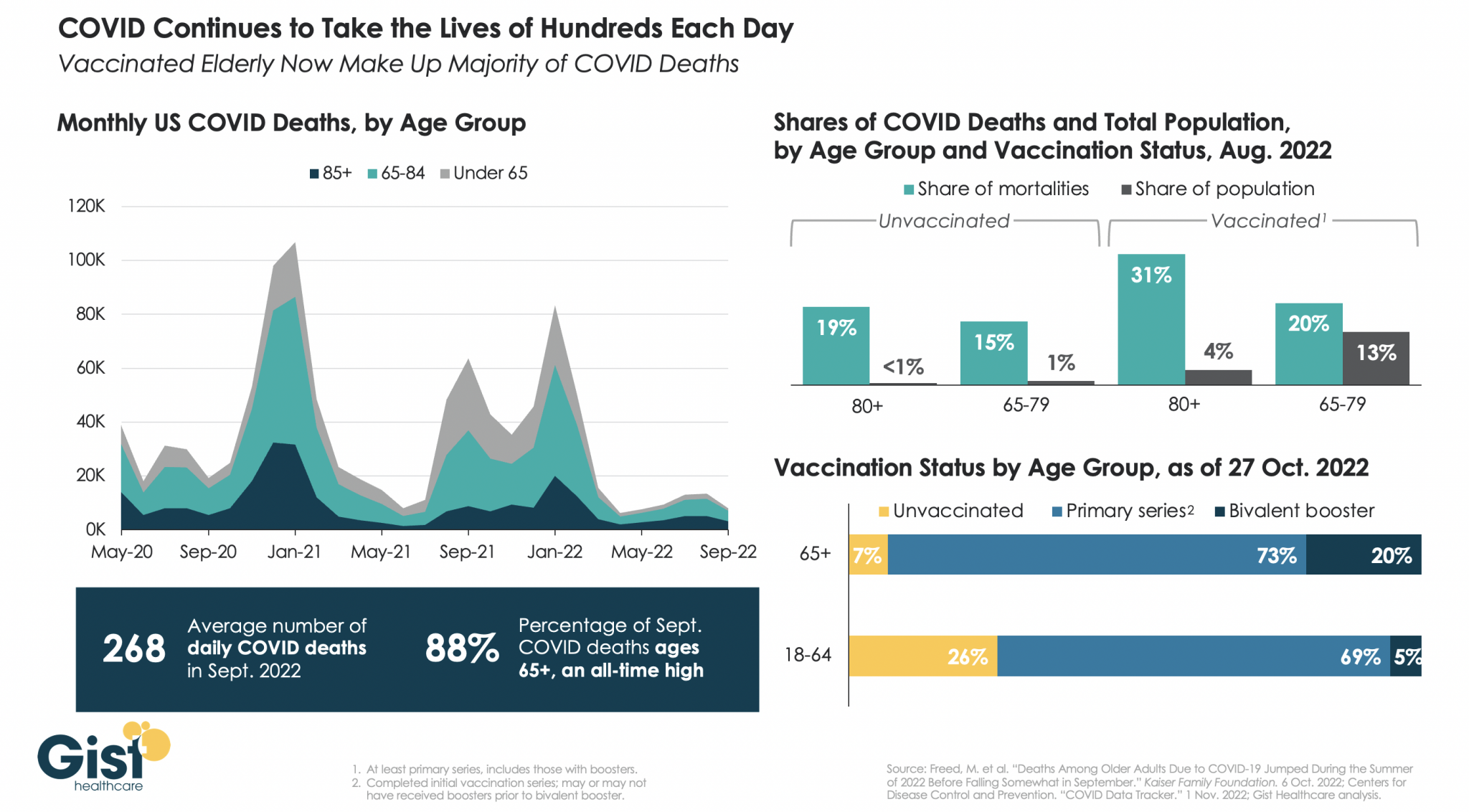
While we have mercifully moved beyond the crisis phase of the pandemic, COVID remains a leading cause of US deaths, taking the lives of hundreds of Americans each day.

In the graphic above, we analyzed COVID mortality data, finding the defining characteristic of Americans still dying of COVID is age. As death rates have dropped, the percentage of COVID deaths accounted for by individuals 65 years or older has risen to an all-time high of 88 percent. 

Notably, a majority of people dying of COVID today are vaccinated, due to the high rate of vaccination in the 65+ population. While the near-universal vaccination of seniors, including the fact that one in five have received the most recent bivalent booster, is not sufficient to save all of their lives, unvaccinated seniors are still dying at higher rates than vaccinated ones.

In August 2022, vaccinated individuals over age 80, who represent about four percent of the total US population, made up 31 percent of COVID deaths, while unvaccinated individuals in the same age group, who represent less than one percent of the total population, made up 19 percent of COVID deaths. 

We entered 2020 with about 55M Americans ages 65 and older, and have since lost 790K, or nearly 1.5 percent of the senior population, to COVID. Meanwhile, reports of the new, immune-evasive BQ variant sweeping New York and California remind us that COVID’s not done with us yet, even if we think we’re done with it. 

Covid-19 is surging in Europe. Is America next?

https://www.advisory.com/daily-briefing/2022/10/10/covid-resurgence

While infections, hospitalizations, and deaths from Covid-19 have been steadily declining in the United States in recent months, experts warn that rising cases in Europe may be “a harbinger for what’s about to happen in the United States,” Rob Stein writes for NPR’s “Shots.”

Will the US see a ‘winter resurgence’ of Covid-19?

Currently, several models project that U.S. Covid-19 infections will continue to decline at least until the end of 2022. However, researchers caution that there are multiple variables that could change current projections, including whether more infectious strains start circulating around the nation.

According to Stein, “[t]he first hint of what could be in store is what’s happening in Europe.” Recently, many European countries, including the U.K., France, and Italy, have seen an increase in Covid-19 infections.

“In the past, what’s happened in Europe often has been a harbinger for what’s about to happen in the United States,” said Michael Osterholm, director of the Center for Infectious Disease Research and Policy at the University of Minnesota. “So I think the bottom line message for us in this country is: We have to be prepared for what they are beginning to see in Europe.”

“We look around the world and see countries such as Germany and France are seeing increases as we speak,” said Lauren Ancel Meyers, director of the UT COVID-19 Modeling Consortium at the University of Texas at Austin. “That gives me pause. It adds uncertainty about what we can expect in the coming weeks and the coming months.”

However, Justin Lessler, an epidemiologist at the University of North Carolina who helps run the COVID-19 Scenario Modeling Hub, noted that the United States may not have the same experience as Europe, largely because it is unclear whether Europe’s increase is related to individuals’ vulnerability to new strains.

“If it is mostly just behavioral changes and climate, we might be able to avoid similar upticks if there is broad uptake of the bivalent vaccine,” Lessler added. “If it is immune escape across several variants with convergent evolution, the outlook for the U.S. may be more concerning.”

Some researchers believe the United States is already experiencing early signs of this. “For example, the levels of virus being detected in wastewater is up in some parts of the country, such in Pennsylvania, Connecticut, Vermont and other parts of Northeast,” Stein writes. “That could an early-warning sign of what’s coming, though overall the virus is declining nationally.”

It’s really too early to say something big is happening, but it’s something that we’re keeping an eye on,” said Amy Kirby, national wastewater surveillance program lead at CDC.

According to David Rubin, the director of the PolicyLab at Children’s Hospital of Philadelphia, which tracks the pandemic, Covid-19 infections and hospitalizations are already rising in some parts of New England, and other northern regions, including the Pacific Northwest.

“We’re seeing the northern rim of the country beginning to show some evidence of increasing transmission,” Rubin said. “The winter resurgence is beginning.”

How likely is a severe Covid-19 surge?

Unless a “dramatically different new variant emerges,” it is “highly unlikely this year’s surge would get as severe as the last two years in terms of severe disease and deaths,” Stein writes.

“We have a lot more immunity in the population than we did last winter,” said Jennifer Nuzzo, who leads the Pandemic Center at the Brown University School of Public Health.

“Not only have people gotten vaccinated, but a lot of people have now gotten this virus. In fact, some people have gotten it multiple times. And that does build up [immunity] in the population and reduce overall over risk of severe illness,” Nuzzo said.

Another factor that could affect the severity of the impact of rising infections is the number of people who receive updated Covid-19 vaccines, which help boost waning immunity from previous infections or shots.

However, the United States’ booster uptake has been slow. “Nearly 50% of people who are eligible for a booster have not gotten one,” said William Hanage, an associate professor of epidemiology at the Harvard T.H. Chan School of Public Health. “It’s wild. It’s really crazy.”

Since updated boosters became available in September, less than 8 million of the over 200 million people who are eligible have received one.

According to Nuzzo, it is critical for people to stay up to date on their vaccines, especially with the high likelihood of another Covid-19 surge. “The most important thing that we could do is to take off the table that this virus can cause severe illness and death,” Nuzzo said.

“There are a lot of people who could really benefit from getting boosted but have not done so,” she added.

The strategic importance of finding a place to park

https://mailchi.mp/6a3812741768/the-weekly-gist-september-9-2022?e=d1e747d2d8

We’re fortunate to be privy to many of the big, complex strategic issues being discussed in health system boardrooms and executive meetings these days: care model innovations, new investments in technology, the digital revolution in care, market-shaping partnerships, the future of the healthcare workforce, and on and on. It’s a precarious and strategically critical moment for incumbent systems in many ways. But we’re often reminded that the nuts and bolts of running hospital facilities still demands attention, even at a board level. 

Case in point: the perennial discussion about what otherwise seems like a minor issue—parking. You’d be shocked how often parking comes up in board-level discussions (partly because many board members are older, active users of hospital services, who spend significant time looking for a place to park). We’ve been witness to knock-down, drag-out arguments about whether to charge for parking, and why more parking isn’t available for patients, physicians, and others.

At first it seems like a trivial issue, but of course it isn’t. In reality, it’s a tangible example of how much patient experience matters in the design and operation of healthcare delivery. We’ve also found it’s a useful analogy in explaining to leaders why “frictionless access” should be at the heart of digital patient experience as well—a poorly-designed digital “front door” can be just as frustrating as not being able to find an inexpensive and convenient place to park before a medical appointment. 

Delivering reliable, affordable, high-quality care is critical, but getting the small experiential details (like parking) right can be incredibly impactful. Next time you visit a medical facility, think about what the parking experience is telling you about how “patient-centered” your provider really is.

How Long Has Polio Been Circulating in the U.S.?

 The virus has likely been circulating in U.S. cities intermittently for years, experts say.

The fact that poliovirus was detected in New York City wastewater samples as far back as April of this year shouldn’t be surprising, as the virus likely has been circulating for longer and more widely than previously believed, several experts told MedPage Today.

“I think you’re gonna see over the next weeks more and more reports of poliovirus in wastewater elsewhere,” said Vincent Racaniello, PhD, a virologist at Columbia University in New York City.

Poliovirus probably still circulated in the U.S. after 2000, when officials stopped giving the oral polio vaccine, he said. That version protects against paralysis and provides short-term protection against intestinal infection from poliovirus.

The transition to injectable polio vaccine, which is equally as effective against paralysis but not against intestinal infection, meant that the U.S. population was more susceptible to transmitting vaccine-associated poliovirus, he explained.

This circulation is likely occasional and sporadic, he said, but the threat to vulnerable populations is still high.

“Here’s the thing: polio is here in the U.S. It’s not gone,” Racaniello said. “It’s in the wastewater. It could contaminate you, so if you’re not vaccinated, that could be a problem.”

Calls for Nationwide Surveillance

Racaniello said there’s value in learning more about the circulation of the virus, especially for communities with low vaccination rates.

The first step to understanding how long and how broadly poliovirus is circulating, he said, is to start testing wastewater everywhere. The CDC used stored wastewater from April to confirm that the virus had been circulating then, but it is just as possible to conduct nationwide surveillance for poliovirus now, he noted.

In fact, Racaniello said, he has long believed that this kind of surveillance should be done routinely to provide an early detection system for poliovirus.

“Ten years ago, I said to the CDC, you should really be looking in the sewage for poliovirus because of this issue where it could come in from overseas and be in our sewage,” he said. “If someone is unvaccinated, that would be a threat to them, but [the CDC] never did it.”

Davida Smyth, PhD, of Texas A&M University-San Antonio, pointed out that the National Wastewater Surveillance System (NWSS) was established to detect COVID-19 in 2020, so the infrastructure to conduct a wide search for the spread of polio is available.

The primary issue, she said, is that the collaboration that academic researchers have enjoyed with the CDC in surveillance of COVID-19 is so far absent with poliovirus.

“I imagine the CDC is testing those samples for polio, even as we speak, given the nature of what has happened,” Smyth said.

Better coordination with academia and better surveillance, she said, is crucial for finding any potential pockets of poliovirus circulating in other communities around the U.S.

In fact, she said, she is “absolutely convinced” that more polio will be found in the coming weeks.

MedPage Today contacted the CDC to ask whether there are plans to use the NWSS to look for polio around the U.S., but as of press time had not received a response.

Smyth noted that most areas in the country have high rates of polio vaccination, but she is concerned about pockets of rural America where vaccination has dipped in recent years. Most states boast polio vaccination rates over 90%, but Smyth said in some regions, the percentages may be as low as the mid-30s.

“[In] the vast majority of the United States, the vaccination rates are quite high, but the COVID pandemic has led to a decrease in vaccination rates,” Smyth told MedPage Today. “The rates are going down. They’re dipping below 90%, which is shocking, frankly.”

Smyth said the decline is largely due to a lack of opportunity or access to healthcare in some areas, but vaccine hesitancy around the COVID-19 vaccine might be affecting polio vaccinations as well.

“There’s a variety of reasons why people don’t get vaccinated,” she said. “The problem is children are very vulnerable. So if you have a population where the vaccination rates drop, those are exactly the kinds of areas where we need to do this surveillance.”

Racaniello echoed the importance of polio vaccination in adults as well. If patients don’t have a record of their shot, “just vaccinate them,” he said, “because there’s no downside to getting vaccinated again.”

Re-evaluating the Polio Endgame

The recent case of paralytic polio infection and concerns over the wider circulation of poliovirus have also altered some of the thinking around the goal of polio eradication.

In fact, William Schaffner, MD, of Vanderbilt University Medical Center in Nashville, highlighted the unique difficulty of preventing the spread of poliovirus.

“As you can imagine, we’ve gotten into polio endgame,” he told MedPage Today. “I think the notion has now been modified. Eradication isn’t going to be as neat and clean and quick as we once thought. Once we get rid of all paralytic disease, we will have to keep vaccinating for a long time, because there will still be circulating vaccine-associated viruses — some of which will mutate back.”

Schaffner compared the final push to eradicate polio with the successful eradication of smallpox. When the last case of smallpox ended, he explained, public health officials were able to end smallpox vaccination campaigns. For polio, however, he said, it will likely not be that simple, and it will be necessary “to keep vaccinating for quite a long time.”

He said that as public health officials in the U.S. and globally continue to grapple with the nuances of eradicating poliovirus, healthcare providers and their patients will have to come to terms with the simple fact that polio is a real health concern.

“[It’s] the reverse of the old saying, ‘it’s gone, but not forgotten,'” Schaffner said. “Polio is forgotten, but it’s not gone.”

U.S. declares public health emergency over monkeypox

The Biden administration has declared the monkeypox outbreak a public health emergency — a move that gives officials more flexibility to tackle the virus’ spread.

Why it matters: New YorkCalifornia and Illinois all declared public health emergencies related to monkeypox in the last two weeks. The World Health Organization has already declared monkeypox a global emergency.

Details: Department of Health and Human Services secretary Xavier Becerra made the announcement Thursday in a briefing on monkeypox.

  • Federal health officials can now expedite preventative measures to treat monkeypox without going through a full federal review, the Washington Post reports.

What they’re saying: “We’re prepared to take our response to the next level in addressing this virus,” Becerra said Thursday. “We urge every American to take monkeypox seriously and to take responsibility to help us tackle this virus.”

  • Dr. Rochelle Walensky, the director of the Centers for Disease Control and Prevention, said the declaration will help “exploit the outbreak” and potentially increase access to care for those at risk.
  • Dr. Demetre Daskalakis, the White House national monkeypox response deputy coordinator, said “today’s actions will allow us to meet the needs of communities impacted by the virus … and aggressively work to stop this outbreak.”

State of play: Dr. Robert Califf, the commissioner of the Food and Drug Administration, said the U.S. is “at a critical inflection point” in the monkeypox outbreak, requiring “additional solutions to address the rise in infection rates.”

  • There are 6,600 cases of monkeypox in the U.S. as of Thursday, Becerra said.
  • There were less than 5,000 cases of monkeypox last week, he added.

The big picture: Biden’s decision to declare monkeypox a public emergency allows him to raise awareness of the virus and unlock more flexibility for spending on ways to treat and tackle the virus.

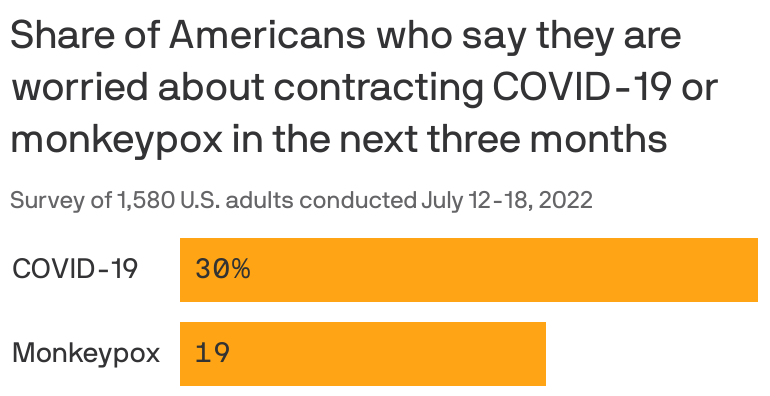
  • About 20% of Americans are worried they’ll contract monkeypox, Axios previously reported. But there are still some gaps in Americans’ knowledge of the virus and how it impacts our population.

What’s next: U.S. health officials said that 800,000 monkeypox vaccine doses will be made available for distribution. But in hotspot states for the monkeypox outbreak, there’s a drastic disconnect between the number of doses that local health officials say they need versus what they have been allotted.

  • The U.S. will receive another 150,000 monkeypox vaccine doses in the strategic national stockpile in September, Dawn O’Connell, administrator at HHS’ Administration for Strategic Preparedness & Response, told reporters Thursday. These were previously scheduled to arrive in October.

1 in 5 Americans fear they’ll get monkeypox

https://www.axios.com/2022/07/29/monkeypox-cases-virus-vaccine-us

About 20% of Americans are afraid they’ll soon contract monkeypox, but there are still some significant holes in the public’s understanding of the virus, according to a new survey from the Annenberg Public Policy Center.

The big picture: These early stages of monkeypox outbreaks aren’t nearly as dangerous as early COVID outbreaks were, but some of the challenges for public health officials — like educating people about a virus they’re not familiar with, and mobilizing vaccination efforts — are similar.

By the numbers: One in five Americans are worried about getting monkeypox in the next three months, the Annenberg survey found.

  • Nearly half are unsure whether monkeypox is less contagious than COVID, although 69% correctly identified the way it usually spreads (through close contact with an infected person).
  • Two-thirds said they either don’t think there’s a vaccine for monkeypox, or aren’t sure. (There is a vaccine. The Biden administration said Thursday that it’s allocating another 786,000 doses, on top of the more than 340,000 it distributed this month.)
  • Women were more worried about contracting monkeypox than men, even though the overwhelming majority of cases in the U.S. have been among men.

Between the lines: Memories of false assurances and mixed messaging about the coronavirus in the early days of the pandemic are factoring into public sentiment on monkeypox, said Kathleen Hall Jamieson, director of the Annenberg center.

  • “There is some suspicion scientists don’t know what they know, so that translates to higher worry,” Jamieson told Axios.

Misinformation and conspiracy theories are also a problem.

  • 12% of respondents in the Annenberg survey said they believe the monkeypox virus was probably or definitely created in a lab; 21% said they were not sure whether it was caused by exposure to a 5G signal.
  • The fact that the virus has so far spread primarily among men who have sex with men has also fueled widespread perceptions that it’s a sexually transmitted infection, which it is not.

What we’re watching: Perceptions of risk remain fluid and could shift if monkeypox finds new modes of transmission, or if it continues to affect children.

  • “If kids get it and there’s been no contact with individuals at risk, then you have a completely different situation than you have now,” Jamieson said.

The summer of subvariants

As this summer heats up, so has the spread of the hot new version of COVID-19.

Why it matters: This subvariant of Omicron called BA.5 — the most transmissible subvariant yet — quickly overtook previous strains to become the dominant version circulating the U.S. and much of the world.

BA.5 is so transmissible — and different enough from previous versions — that even those with immunity from prior Omicron infections may not have to wait long before falling ill again.

What they’re saying: “I had plenty of friends and family who said: ‘I didn’t want to get it but I’m sort of glad I got it because it’s out of the way and I won’t get it again’,” Bob Wachter, chairman of the University of California, San Francisco Department of Medicine told Axios. “Unfortunately that doesn’t hold the way it once did.”

  • “Even this one bit of good news people found in the gloom, it’s like, ‘Sorry’,” Wachter said.

State of play: This week, the CDC reported BA.5 became the dominant variant in the U.S., accounting for nearly 54% of total COVID cases. Studies show extra mutations in the spike protein make the strain three or four times more resistant to antibodies, though it doesn’t appear to cause more serious illness.

  • Hospital admissions are starting to trend upward again, CDC data shows, though they’re still well below what was seen during the initial spread of Omicron.
  • It’s unclear whether that could be indicating an increase in patients in for COVID, or patients who happen to have COVID, Wachter said. “We’re up in hospitalizations around 20% but with a relatively small number of ICU patients,” Wachter said about COVID cases at UCSF.
  • In South Africa, the variant had no impact on hospitalizations while Portugal saw hospitalizations rise dramatically, Megan Ranney, academic dean at the Brown University School of Public Health told Axios.
  • “So the big unknown is what effect it’s going to have on the health care system and the numbers of folks living with long COVID,” she said.

Yes, but: “I’m certainly hearing about more reinfections and more fairly quick reinfections than at any other time in the last two and a half years,” Wachter said.

Zoom in: That is also largely the experience of the surge seen firsthand in New York City by Henry Chen, president of SOMOS Community Care, who serves as a primary care physician across three boroughs of the city.

  • With this particular variant, he said: “The symptoms are pretty much the same but a little bit more severe than the last wave. It’s more high fever, body ache, sore throat and coughing,” Chen said, adding his patient roster is mostly vaccinated.
  • But it is occurring among patients who’d gotten the virus only three or four months ago, he said.

The big picture: Another summertime wave of cases could prolong the pandemic, coming after many public health precautions were lifted and with available vaccines losing their efficacy against the ever-evolving virus.

The bottom line: The messaging isn’t to panic, but to understand the virus is likely spreading in local communities much more than individuals realize due to shrinking testing programs  and without the level of protection they might assume they have.

  • “If you don’t want to get sick, you still need to be taking at least some precautions,” Ranney said. “[COVID] is still very much among us.”

Podcast: All Healthcare Is Politics?

Does Your Vote Affect Your Healthcare?

What role should the federal government play in addressing major healthcare issues? And does the way you vote affect your prospects for a long and healthy life? We talked about it on today’s episode of the 4sight Friday Roundup podcast.

  • David Johnson is CEO of 4sight Health.
  • Julie Vaughan Murchinson is Partner of Transformation Capital and former CEO of Health Evolution.
  • David Burda is News Editor and Columnist of 4sight Health.

Subscribe on Apple PodcastsSpotify, and other services.

Speaking up about the unspeakable

The right to bear arms has existed since we became a nation. So, too, has the risk of violence that extensive gun ownership creates in our society. 

Unfortunately, recent mass shooting incidents, fueled by hatred or mental illness, have sparked a great deal of fear and confusion among Americans.  

As healthcare leaders, our concern centers on the treatment of those who are victims of senseless gun violence. And not just those who are shot, but the other victims as well.

Healthcare providers must care for all victims — the ones who are traumatized because a loved one has been hurt or lost, the ones who were at the chaotic scene of the violence, or who are haunted by the endless media stories they cannot seem to tune out. The emotional toll of this violence is incomprehensible.

Healthcare facilities attempt to provide refuge from violence and seek to provide healing and hope to all victims of violence. 

And yet, sadly, we are not immune to being another venue for violence

Unstable individuals with guns and other weapons of harm find their way into our buildings and hallways as well. Earlier this month, a man who blamed his physician for ongoing pain after a recent back surgery shot and killed his surgeon and three other people before fatally shooting himself in a Tulsa, Okla., medical facility. Also this month, a hospital security officer was shot and killed by a prison inmate who was receiving care in a Dayton, Ohio, emergency room.

These incidents are the latest horrifying tragedies in a wave of deadly gun violence occurring across our country, including two heart-breaking mass shootings in Buffalo, N.Y., and Uvalde, Texas. We mention these tragedies not to make a political statement, but to raise awareness of the consequences of this violence on healthcare providers and the public health. 

As healthcare workers, healers, and caregivers, we work to fix what is broken and put people back together. We bring solutions. We engage with our hearts to stand together in the fear and vulnerabilities of those who need us so that we can help them through difficult challenges. We look to bring light to dark situations. We seek to be beacons of hope. 

The escalation of recent shootings, suicides and other violent behaviors underscores the urgency for a national conversation on what has become a serious public health crisis. We believe health systems have a credible voice and can play a critical role beyond being places to physically and emotionally care for the victims of violence.

It’s easy to allow ourselves to become numb to the frequency of these unconscionable, violent acts. But we owe it to present and future generations not to let that happen. We recognize there are no easy answers to this national problem. After all, we are dealing with abnormal behavior — the decision to seriously harm or kill other people. That this behavior is increasing calls for something to be done to effect positive change.

People across our country and the communities we serve are hurting and vulnerable. Many people are weary from the pandemic that has impacted our hearts and our health. Violence and death, and particularly mass shootings, hit adults hard. Now consider what the prevalence and threat of school shootings have done to an entire generation of children, who are growing up with the fear of being shot and killed in a place they should feel safe.

We all can play a role. Recently, our two organizations decided to do something to reduce gun violence by sponsoring a law enforcement gun buyback program to help get guns off the street. This effort was part of the largest single-day gun buyback in New Jersey state history. It successfully removed over 2,800 guns statewide. Private organizations, companies, and individuals must think of additional creative ways beyond criticizing politicians, to bring about the change we need. 

We encourage organizations and communities to come together, to pool their minds and their resources to address gun violence in society as the urgent public health crisis that it is. We must create meaningful public health campaigns around the safe storage and handling of firearms, and sensible and innovative ways to prevent gun violence in schools, healthcare settings and public places. Individuals should educate themselves on the issues surrounding gun violence so they may contribute to the effort to bring about necessary and meaningful change.  

And yes, we need to accelerate efforts around our nation’s mental health crisis. We know from the data and what we are all experiencing that the COVID-19 pandemic has exacerbated what was already a growing nationwide mental health crisis. 

Violence against any person in any venue is unspeakable. Yet just because it is unspeakable does not mean we should not speak up about it. Let us put our anger, shock and heartbreak into positive change. With the same unstoppable resolution that we seek to cure cancer or slow heart disease, let us advocate, educate and take meaningful action to end gun violence and all senseless violence that is taking such a tragic toll on our nation and our wellbeing.  

Mr. Pullin is president and CEO of Virtua Health. Mr. O’Dowd is co-president and CEO of Cooper University Health Care.

About Virtua Health
Virtua Health is an academic health system committed to helping the people of South Jersey be well, get well, and stay well by providing the complete spectrum of advanced, accessible, and trusted healthcare services. Virtua’s 14,000 colleagues provide tertiary care, including renowned cardiology and transplant programs, complemented by a community-based care portfolio. In addition to five hospitals, two satellite emergency departments, 30 ambulatory surgery centers, and more than 300 other locations, Virtua brings health services directly into communities through Hospital at Home, physical therapy and rehabilitation, mobile screenings, and its paramedic program. Virtua has 2,850 affiliated doctors and other clinicians, and its specialties include orthopedics, advanced surgery, and maternity. Virtua is academically affiliated with Rowan University, leading research, innovation, and immersive education at the Virtua Health College of Medicine & Health Sciences of Rowan University. Virtua is also affiliated with Penn Medicine for cancer and neuroscience, and the Children’s Hospital of Philadelphia for pediatrics. As a not-for-profit, Virtua is committed to the well-being of the community and provides innovative outreach programs that address social challenges affecting health, most notably the “Eat Well” food access initiative, which includes the unparalleled Eat Well Mobile Grocery Store. A Magnet-recognized health system ranked by U.S. News and World Report, Virtua has received many awards for quality, safety, and its outstanding work environment. For more information, visit Virtua.org. To help Virtua make a difference, visit GiveToVirtua.org.

About Cooper University Health Care
Cooper University Health Care is a leading academic health system with more 8,500 employees and more than 800 employed physicians. Cooper University Hospital is the only Level 1 Trauma Center in South Jersey and the busiest in the region.  Annually, nearly two million patients are served at Cooper’s 635-bed flagship hospital, outpatient surgery center, three urgent care centers, and more than 105 ambulatory offices throughout the community. The Cooper Health Sciences campus is home to Cooper University Hospital, MD Anderson Cancer Center at Cooper, Children’s Regional Hospital at Cooper, and Cooper Medical School of Rowan University. Visit CooperHealth.org to learn more.