Health officials say omicron variant likely to cause record-high coronavirus cases, hospitalizations in U.S.

Top government health officials on Sunday warned that the United States will probably see record numbers of coronavirus cases and hospitalizations as the omicron variant spreads rapidly and forces Americans to again grapple with the dangers of a pandemic that has upended life around the globe.

“Unfortunately, I think that that is going to happen. We are going to see a significant stress in some regions of the country on the hospital system, particularly in those areas where you have a low level of vaccination,” Anthony S. Fauci, the nation’s leading infectious-disease specialist, said on CNN’s “State of the Union” when asked whether the United States could see record numbers of cases, hospitalizations and deaths.

Fauci described the variant as “extraordinary” in its transmissibility, with a doubling time of two to three days. It accounts for 50 percent of coronavirus cases in parts of the country, which meant it would almost certainly take over as the dominant variant in the United States, he added.

“It is going to be a tough few weeks, months, as we get deeper into the winter,” Fauci said.

On CBS News’s “Face the Nation,” Francis Collins, director of the National Institutes of Health, said that cases will rise steeply over the next couple of weeks and that the country could soon see 1 million new cases a day tied to the omicron variant, dramatically exceeding the record of about 250,000 new cases per day set in January.

“The big question is, are those million cases going to be sick enough to need health care and especially hospitalization?” Collins said. “We’re just holding our breath to see how severe this will be.”

Fauci and Collins painted a stark but realistic picture of the winter ahead, on the heels of a week of coronavirus-related setbacks. Coronavirus cases, hospitalizations and deaths rose across much of the country last week, with officials warning of a surge just as millions of Americans — already weary after nearly two years of the pandemic — are expected to travel for Christmas and New Year’s. On Friday, Pfizer and BioNTech announced that coronavirus vaccines for children younger than 5 would be pushed back further into 2022, as the companies modified their trials to include a third dose. On Sunday, New York, one of the country’s early epicenters in the pandemic, reported 22,478 cases.

Health officials have continued to urge the unvaccinated to get their shots and those who have received only two doses of either the Pfizer or Moderna mRNA vaccines to get booster doses. Vaccines cannot be the only layer of protection against the omicron variant, Fauci said, but defeating the pandemic would not be possible without them.

There are still safe ways for vaccinated people to get together for the holidays, including wearing a mask while traveling, testing beforehand and knowing the vaccination status of everyone present at indoor celebrations, Fauci said on “Face the Nation.”

“If you do these things, I do believe that you can feel quite comfortable with a family setting,” he said. “Nothing is 100 percent risk-free, but I think if you do the things that I just mentioned, you’d actually mitigate that risk enough to feel comfortable about being able to enjoy the holiday.”

Collins stopped short of urging people to cancel holiday plans but said travel will be risky even for vaccinated people.

“This virus is going to be all around us,” he said. “I’m not going to say you shouldn’t travel, but you should do so very carefully. … People are going, ‘I’m so sick of hearing this,’ and I am, too. But the virus is not sick of us, and it is still out there looking for us, and we’ve got to double down on these things if we’re going to get through the next few months.”

Doctors, nurses and others are warning that the nation’s health system continues to be strained by an unending stream of coronavirus cases. Confirmed U.S. coronavirus infections have surpassed more than 128,000 per day and confirmed virus deaths are near 1,300 per day, according to The Washington Post’s rolling seven-day average.

“For people trained to save lives, this moment is frustrating, exhausting and heartbreaking,” the American Hospital Association, the American Medical Association and the American Nurses Association said in a joint statement on Friday, urging more Americans to get booster shots.

Public health experts are bracing for a winter surge of cases driven by the omicron variant, which can evade some protection conferred by vaccinations and prior infections, as well as cases linked to the delta variant. Officials caution that they are still relying on preliminary data about the omicron variant’s severity compared with earlier forms of the virus.

President Biden plans to address the nation Tuesday on the status of the country’s fight against the virus, the White House said Saturday.

“We are prepared for the rising case levels,” White House press secretary Jen Psaki wrote on Twitter, adding that Biden “will detail how we will respond to this challenge. He will remind Americans that they can protect themselves from severe illness from COVID-19 by getting vaccinated and getting their booster shot when they are eligible.”

The speech, coming just before Christmas and New Year’s Day, underlines Biden’s struggle to contain the pandemic nearly a year into office. On top of the emergence of new variants and attendant challenges, the administration has at times faced criticism for what some have described as mixed signals.

Biden won high marks from the public during the first half of the year as cases declined, the country opened up from shutdowns and vaccines became widely available. But the past few months have been more difficult. After he gave a speech on July 4 saying the country was “closer than ever to declaring our independence from a deadly virus,” the situation started changing. Case rates increased as the delta variant gained a foothold and many Americans refused to get vaccinated.

And despite Biden’s promise that at-home rapid tests would become a widely available tool to fight the coronavirus, the tests remain hard to find in many parts of the country and are more expensive than in some other places across the globe.

Fauci conceded Sunday that the administration needed to do better on increasing the availability of at-home coronavirus rapid tests, though he emphasized that the country was in a much better place than it was a year ago, with 200 million to 500 million tests available per month, many of them free.

“We’re going in the right direction,” he said on CNN. “We really need to flood the system with testing. We need to have tests available for anyone who wants them, particularly when we’re in a situation right now where people are going to be gathering.”

The omicron variant also has challenged the nation’s coronavirus medicine cabinet, with evidence that mutations will wipe out or weaken the effectiveness of treatments that can reduce the virus’s severity and keep people out of hospitals. As a result, the Biden administration around Thanksgiving paused distribution of sotrovimab, the one monoclonal antibody that remains effective against the omicron variant, with senior officials such as David Kessler calculating that the drug should be maximally deployed when the variant becomes more prevalent.

By Thursday, administration officials decided to resume shipments of the drug, amid indicators that the omicron variant was spreading faster in states such as New York and Washington than data published by the Centers for Disease Control and Preventionearlier in the week indicated, said two officials with knowledge of the deliberations.

“Shipment of product will begin soon, and jurisdictions will see product arrive as early as Tuesday, December 21, 2021,” the federal health agency said in a statement on Friday, announcing that about 55,000 doses of sotrovimab would soon go out.

Doctors said they were desperate for treatments like sotrovimab as emergency rooms begin to crowd and case numbers soar.

“Too slow! We are already seeing widespread omicron,” texted one infectious-disease doctor at a large New York City hospital, who estimated that at least 50 percent of patients had contracted the variant and requested confidentiality to discuss patient care. “It’s a lot of hospitalizations that could have potentially [been] averted because of slow response.”

Fauci said Sunday that he expected it to be months before antiviral drugs can be mass-produced and available to anyone who needs them. While he did not foresee the kind of shutdowns that were put in place in the early days of the pandemic, Fauci also noted that it would be difficult to keep the virus under control when there remained “about 50 million people in the country who are eligible to be vaccinated who are not vaccinated.”

Similarly, several governors on Sunday shied away from the possibility of implementing more shutdowns to fight the spread of the new variant. Maryland Gov. Larry Hogan (R) said on “Fox News Sunday” that his state, which has seen a 150 percent increase in hospitalizations over the past two weeks, was not considering shutdowns and instead was putting more resources into testing and encouraging vaccinations and boosters. New Jersey Gov. Phil Murphy (D) said on the same show that shutdowns remained “on the table” but that he didn’t think such a move was likely because a high percentage of the state’s population was vaccinated.

Colorado Gov. Jared Polis (D) emphasized that people in his state should keep themselves safe with “individual freedom and local control.” He also said Colorado officials were looking to change the definition of “fully vaccinated” to include three shots, as health officials in the country and around the world have signaled in recent days they are also considering.

“That’s certainly where it’s headed,” Polis said on NBC News’s “Meet the Press.” “I wish they’d stop talking about [the third shot] as a booster. It really is a three-dose vaccine.”

CDC: Omicron accounted for 73% of recent COVID-19 cases

COVID testing in NYC

The Omicron variant accounted for more than 73% of recent COVID-19 cases in the U.S., according to Centers for Disease Control and Prevention’s updated data released on Monday.

The big picture: The data showed nearly a six-fold increase in Omicron’s share of COVID-19 infections in just one week.

What they’re saying: “These numbers are stark, but they’re not surprising,” said Rochelle Walensky, the CDC’s director, adding that the growing infections reflect what has been seen in other countries.

  • While the Delta variant still drives up a lot of new infections, Walensky told AP she anticipates “that over time that Delta will be crowded out by Omicron.”

What’s next: President Biden on Tuesday will deliver a speech outlining new steps the administration will take to address the rapid spread of the new variant.

30% of hospital healthcare workers remained unvaccinated as of September

Dive Brief:

  • Some 30% of U.S. healthcare workers employed at hospitals remained unvaccinated as of Sept. 15, according to an analysis of Centers for Disease Control and Prevention data published Thursday by the Association for Professionals in Infection Control and Epidemiology.
  • The findings include data from 3.3 million healthcare workers at more than 2,000 hospitals, collected between Jan. 20 and Sept. 15.
  • Healthcare personnel working in children’s hospitals had the highest vaccination rates, along with those working in metropolitan counties.

Dive Insight:

The vaccination rate for healthcare workers is roughly in line with that of the general population, though the risk of exposure and transmission can be higher in settings where infected COVID-19 patients are treated, Hannah Reses, CDC epidemiologist and lead author of the analysis, said.

When the shots were initially rolled out, vaccination rates climbed among healthcare workers, rising from 36% to 60% between January and April of 2021, the analysis found. But a major slowdown occurred shortly after.

From April to August, vaccination rates rose just 5%. They then rose 5% again in just one month — from August to September — likely due to the delta variant and more systems implementing their own mandates, the report said.

Researchers also found discrepancies in vaccination rates based on the type of hospitals and their geographic locations.

By September, workers at children’s hospitals had the highest vaccination rates (77%), followed by those at short-term acute care hospitals (70%), long-term care facilities (68.8%), and critical access hospitals (64%).

Among healthcare workers at facilities in metropolitan areas, about 71% were vaccinated by September, compared to 65% of workers at rural facilities.

The findings come as health systems work to comply with new vaccination mandates from the Biden administration.

Healthcare facilities must follow the CMS rule, which stipulates employees must be fully vaccinated by Jan. 4 or risk losing Medicare and Medicaid funding. Unlike the Occupational Safety and Health Administration’s rule that applies to businesses with 100 employees or more but excludes healthcare providers, the CMS rule does not allow for a testing exception.

Both agencies’ rules were met with pushback. The attorneys general of 10 mostly rural states — Missouri, Nebraska, Arkansas, Kansas, Iowa, Wyoming, Alaska, South Dakota, North Dakota and New Hampshire — filed a lawsuit on Oct. 10 against CMS for its rule and said the mandates would exacerbate existing staffing shortages.

“Requiring healthcare workers to get a vaccination or face termination is unconstitutional and unlawful, and could exacerbate healthcare staffing shortages to the point of collapse, especially in Missouri’s rural areas,” the state’s attorney general, Eric Schmitt, said in a statement.

But some regional systems that implemented their own mandates have seen positive results.

After UNC Health and Novant Health in North Carolina required the shots, staff vaccination rates rose to 97% and 99%, respectively, according to a White House report.

Among Novant Health’s 35,000 employees, about 375 were suspended for not complying, and about 200 of those suspended employees did end up getting vaccinated so they could return to work, according to the report.

And some major hospital chains across the country are joining suit with the looming deadline, including HCA with its 183 hospitals and more than 275,000 employees.

The chain is requiring employees be fully vaccinated by the CMS deadline on Jan. 4, a spokesperson said in an email statement.

At the same time, this year’s flu season is difficult to predict, though, “the number of influenza virus detection reported by public health labs has increased in recent weeks,” Reses said.

“The CDC is preparing for flu and COVID to circulate along with other respiratory viruses, and so flu vaccination therefore will be really important to reduce the risk of flu and potentially serious complications, particularly in combination with COVID-19 circulating,” Reses said.

Austria orders nationwide lockdown for the unvaccinated

https://www.yahoo.com/news/austria-orders-nationwide-lockdown-unvaccinated-120902629.html

FILE - The patient Kurt Switil, left, receives a Pfizer vaccination against the COVID-19 disease by a doctor in the vaccination center ‚Am Schoepfwerk' in Vienna, Austria, April 10, 2021. The Austrian government ordered a nationwide lockdown for unvaccinated people starting midnight Sunday, Nov. 14, 2021, to slow the fast spread of the coronavirus in the country. (AP Photo/Lisa Leutner, File)

The Austrian government has ordered a nationwide lockdown for unvaccinated people starting at midnight Sunday to combat rising coronavirus infections and deaths.

The move prohibits unvaccinated people 12 and older from leaving their homes except for basic activities such as working, grocery shopping, going for a walk — or getting vaccinated.

Authorities are concerned about rising infections and deaths and that soon hospital staff will no longer be able to handle the growing influx of COVID-19 patients.

“It’s our job as the government of Austria to protect the people,” Chancellor Alexander Schallenberg told reporters in Vienna on Sunday. “Therefore we decided that starting Monday … there will be a lockdown for the unvaccinated.”

The lockdown affects about 2 million people in the Alpine country of 8.9 million, the APA news agency reported. It doesn’t apply to children under 12 because they cannot yet officially get vaccinated.

The lockdown will initially last for 10 days and police will go on patrol to check people outside to make sure they are vaccinated, Schallenberg said, adding that additional forces will be assigned to the patrols.

Unvaccinated people can be fined up to 1,450 euros ($1,660) if they violate the lockdown.

Austria has one of the lowest vaccination rates in Western Europe: only around 65% of the total population is fully vaccinated. In recent weeks, Austria has faced a worrying rise in infections. Authorities reported 11,552 new cases on Sunday; a week ago there were 8,554 new daily infections.

Deaths have also been increasing in recent weeks. On Sunday, 17 new deaths were reported. Overall, Austria’s pandemic death toll stands at 11,706, APA reported.

The seven-day infection rate stands at 775.5 new cases per 100,000 inhabitants. In comparison, the rate is at 289 in neighboring Germany, which has already also sounded the alarm over the rising numbers.

Schallenberg pointed out that while the seven-day infection rate for vaccinated people has been falling in recent days, the rate is rising quickly for the unvaccinated.

“The rate for the unvaccinated is at over 1,700, while for the vaccinated it is at 383,” the chancellor said.

Schallenberg also called on people who have been vaccinated to get their booster shot, saying that otherwise “we will never get out of this vicious circle.”

Pfizer vaccine 91% effective in kids 5-11, study says

Pfizer says Covid vaccine more than 90% effective in kids

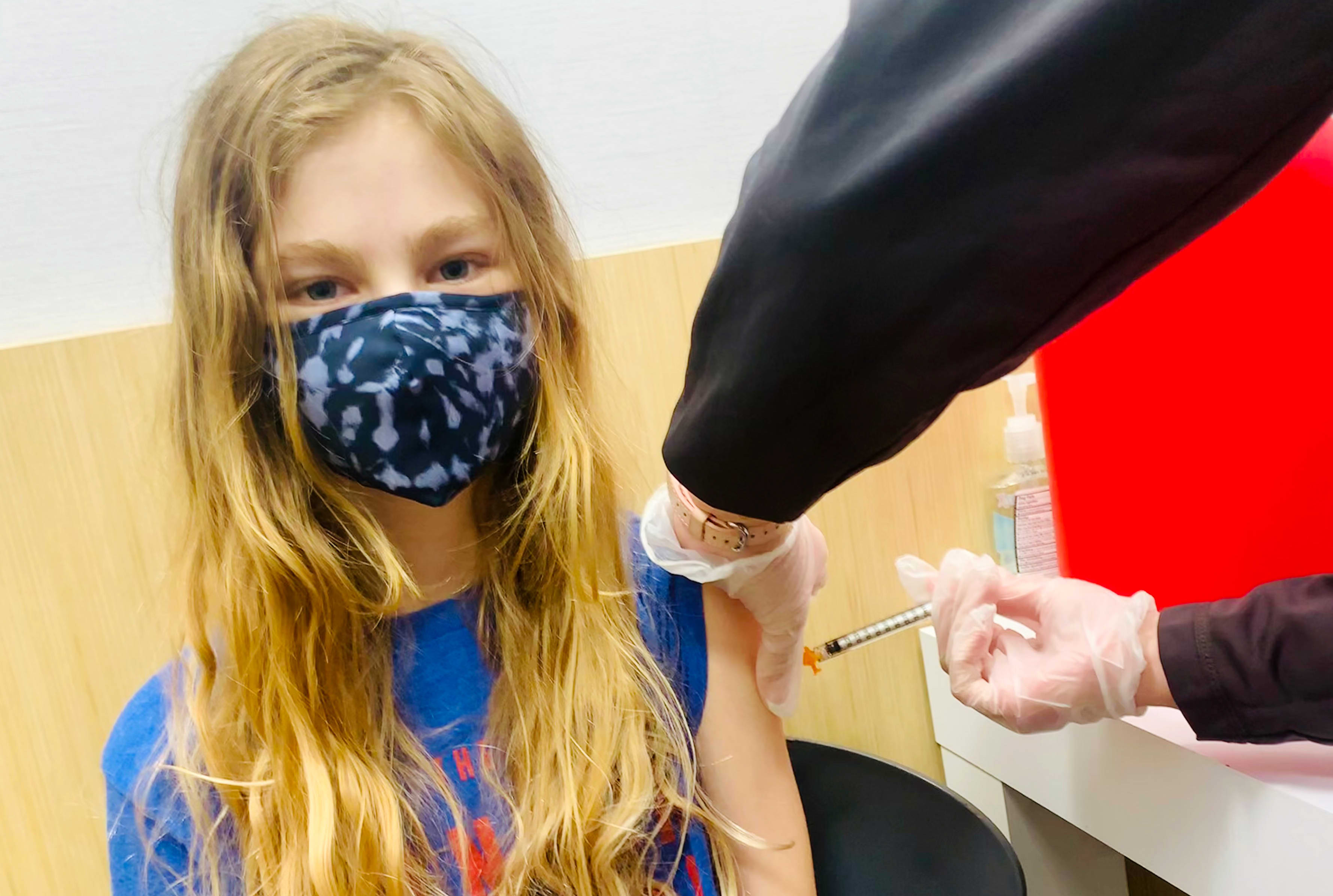
Pfizer’s COVID-19 vaccine is nearly 91 percent effective at preventing symptomatic infections in children between ages 5 and 11, according to a study released by the FDA Oct. 22. 

The study involved 2,268 children given COVID-19 vaccines that are one-third the dosage of the vaccines given to people ages 12 and up. They were given two doses spaced three weeks apart, the same as the adult version of the vaccine. It found that the children developed antibody levels just as strong as older children and adults given the full dosage.

The FDA’s Vaccines and Related Biological Products Advisory Committee is set to meet Oct. 26 to discuss the evidence and vote on whether to recommend FDA authorization for the shots in kids ages 5 to 11. 

The CDC’s vaccine advisory panel is set to meet the first week of November to discuss recommending the shots for the age group. That means shots for kids ages 5 to 11 could be authorized in the first week of November. There are about 28 million children in the age group in the U.S.

The vaccines will come in orange capped vials to make them easily distinguishable from adult doses, according to ABC News.

Find the full study results here

What to Know About the New Delta Sublineage

https://www.medpagetoday.com/special-reports/exclusives/95166?fbclid=IwAR2R-mSr-LHmqBo4mnO8HL542LlFsF1vi38PiW8mrohiYNjPu-O55qQk33c

As the now ubiquitous Delta variant continues to mutate, it’s spawned a new descendant that’s spread in the U.K. and made its way to the U.S.

The Delta sublineage, known as AY.4.2, is characterized by two “S-gene mutations” on A222V and Y145H, both located on the gene that encodes the spike glycoprotein of SARS-CoV-2.

CDC Director Rochelle Walensky, MD, acknowledged during the White House’s latest COVID-19 Response Team press briefing that the AY.4.2 sublineage has been identified “on occasion” in the U.S. without increased frequency or clustering to date.

Since August, AY.4.2 with these mutations has appeared in a total of three cases in the U.S.: in California, North Carolina, and Washington, D.C., according to Outbreak.info, which collects COVID-19 sequencing data from GISAID, a global genomic data-sharing initiative.

“At this time, there is no evidence that the sub-lineage AY.4.2 impacts the effectiveness of our current vaccines or therapeutics, and we will continue to follow up,” Walensky said.

Experts think the new Delta sublineage is slightly more transmissible, but say it’s likely less worrisome than its predecessor Alpha or Delta variants, which made bigger jumps in transmissibility. There’s a level of uncertainty over its exact advantage in spreading, however.

“There was a bit of a hope that Delta had, ideally, reached a kind of bound in transmissivity, so that will be a bit of a disappointment,” said Francois Balloux, PhD, computational biologist at University College London and director of the UCL Genetics Institute, in an interview.

Balloux predicted that at some point, almost everyone will be exposed to the “already so bloody transmissible” Delta variant, which makes up around 80% of sequenced cases in the U.K. He said AY.4.2 could be up to 15% more transmissible.

A lower estimate comes from Christina Pagel, PhD, the director of University College of London’s Clinical Operational Research Unit. On Twitter, she said that AY.4.2 could be up to 10% more transmissible: “We don’t know if it’s (a bit) more transmissible than other Delta strains *or* if it just got caught up in some superspreader events that seeded it.” That is, a large gathering of people could have amplified the effect of a strain that wasn’t intrinsically better at spreading.

“No reason to think it’s more immune evasive & might well be nothing. Something to keep an eye on but not panic over,” Pagel added.

The CDC lists AY.1 and AY.2 in its COVID Data tracker, and AY lineages generally under its “Variants of Concern” classification, but does not list AY.4 or AY.4.2 specifically. Balloux said that in the U.K., unlike the U.S., the genetic sequencing effort is nationally centralized. This makes it easier to track variants more quickly and accurately.

AY.4.2 was first spotted this spring in the U.K., where it represents 14,247 cases for a cumulative prevalence of 1% there at the time of publication, according to Outbreak.info.

The U.K. Health Security Agency reported on October 15 that AY.4.2 “is currently increasing in frequency” and that it made up 6% of the sequences analyzed. Balloux estimated that a more up-to-date number would be 7% to 8% because of a week-long lag in sequencing.

Notably, AY.4.2 spreads despite being characterized by S-gene mutations that are not known to make the virus intrinsically more transmissible. “Fundamentally, these are two very boring mutations,” Balloux said.

He clarified that this strain of SARS-CoV-2 is not “Delta plus” because it lacks a different mutation that defined that sublineage.

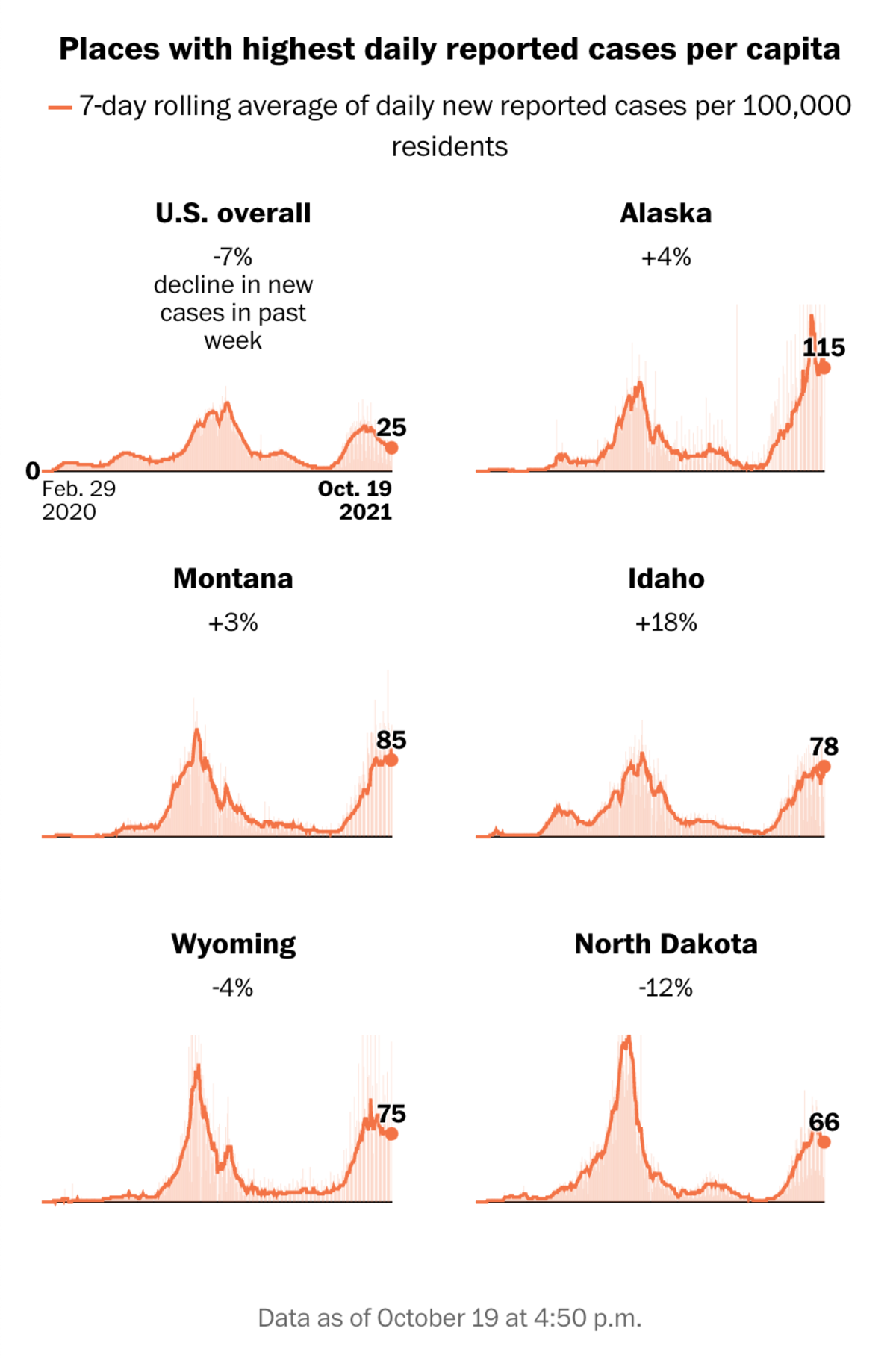
U.S. Places with Highest Reported Coronavirus Cases per Capita

US COVID-19 cases fall for 4th consecutive week: 9 CDC stats to know

17 Downward trend Synonyms. Similar words for Downward trend.

COVID-19 cases have declined nationwide for the fourth consecutive week, according to the CDC’s COVID data tracker weekly review published Oct. 15.

Nine numbers to know:

Reported cases

1. The nation’s current seven-day case average is 84,555, a 12.5 percent decrease from the previous week’s average.

Hospitalizations 

2. The current seven-day hospitalization average for Oct. 6-12 is 6,659, an 8.8 percent drop from the previous week’s average.

Vaccinations

3. About 218 million people — 65.6 percent of the total U.S. population — have received at least one dose of the COVID-19 vaccine, and more than 188.3 million people, or 56.7 percent of the population, have gotten both doses. 

4. About 9.3 million booster doses in fully vaccinated people have been reported.

5. The seven-day average number of vaccines administered daily was 841,731 as of Oct. 14, a  11.3 percent decrease from the previous week.

Variants

6. Based on projections for the week ending Oct. 9, the CDC estimates the delta variant accounts for more than 99 percent of all U.S. COVID-19 cases.

Deaths 

7. The current seven-day death average is 1,241, down 13.4 percent from the previous week’s average. Some historical deaths have been excluded from these counts, the CDC said.

Testing

8. The seven-day average for percent positivity from tests is 5.7 percent, down 4.1 percent from the previous week.  

9. The nation’s seven-day average test volume for the week of Oct. 1-7 was about 1.49 million, down 5.4 percent from the prior week’s average.

‘A triple whammy’: Why hospitals are struggling financially amid the delta surge

Hospitals were struggling before the pandemic. Now they face financial  disaster (opinion) - CNN

n addition to treating an influx of Covid-19 patients, many hospitals are struggling with what one administrator calls a “triple whammy” of financial burdens—stemming from plummeting revenue, higher labor costs, and reduced relief funds, Christopher Rowland reports for the Washington Post.

Hospitals in less-vaccinated areas face spiking labor costs

In areas with low vaccination rates, particularly in southern and rural communities, hospitals have been overwhelmed with Covid-19 patients, exacerbating labor shortages as workers burn out or leave for more lucrative positions, Rowland reports.

“The workforce issue is just dire,” Stacey Hughes, EVP of government relations and policy for the American Hospital Association (AHA), said. “The delta variant has wreaked significant havoc on hospitals and health systems.”

In Louisiana, Mary Ellen Pratt, CEO of St. James Parish Hospital, said many nurses quit due to the grueling conditions as Covid-19 cases spiked. “I didn’t have any extra money to incentivize my staff to pick up additional shifts,” she said. “This is coming out of bottom-line money I don’t have.”

Separately, Lisa Smithgall, SVP and chief nursing executive at Ballad Health, said the health system—which has 21 hospitals in eastern Tennessee and southwestern Virginia—has faced similar problems retaining staff amid Covid-19 surges.

“We knew we were at risk in our region because of where we live and because of our vaccination rate being so poor,” Smithgall said. “At one point, we were seeing four or five nurse resignations per week. They couldn’t do it again; they emotionally didn’t have it. They were so upset with our community.”

To fill in these growing gaps in their workforce, many hospitals have had to turn to costly contract workers, Rowland reports—a significant financial burden that further strains hospitals’ resources.

For example, Ballad Health went from hiring fewer than 75 contract nurses before the pandemic to 150 in August 2020 and 450 in August 2021. Moreover, according to Smithgall, contract nurses previously made double or triple what permanent staff nurses made, but now Ballad sometimes has to pay up to seven times as much for contract nurses as hospitals compete for workers to fill shifts.

Delayed elective surgeries deepen hospitals’ financial struggles

Many hospitals, including those in areas with high vaccination rates, have delayed elective surgeries, a crucial source of revenue, amid nationwide surges in Covid-19 cases, Rowland reports—further compounding financial struggles for many organizations.

On Aug. 26, Ballad Health postponed a long list of elective surgeries—including hernia repair, cardiac and interventional radiology procedures, joint replacements, and nonessential spine surgery—to preserve space in its hospitals and conserve workers. Ballad is now allowing elective surgeries again, but only for a limited number of procedures that do not require overnight stays.

Similarly, St. Charles Health System in Oregon postponed elective surgeries in August “while we responded to a surge that was significantly greater and much more sudden than the surge in 2020,” Matt Swafford, the health system’s VP and CFO, said.

According to Swafford, the health system lost $5 million a week through August and September, around $1 million of which was repayment of emergency advances on Medicare reimbursements from last year.

“I don’t think anybody saw this level of surge coming in 2021 after what we saw in 2020,” he said. “We’re just not equipped to be able to simultaneously respond to the urgent needs of the community [for more typical surgeries and care] at the same time that a third of our beds are occupied by highly infective Covid patients.”

Many hospitals likely to end the year at a deficit

Further compounding the issue, according to Moody’s Investors Service, is that the provider relief funds that previously made up 43% of operating cash flow at nonprofit and government-run hospitals in the United States are now dwindling down.

In addition, the latest portion of provider relief funds to be distributed must be based on expenses incurred by hospitals before March 31, 2021, which don’t account for months of the delta surge, Rowland reports.

Premier, a group purchasing and technology company serving more than 4,000 hospitals and health systems, analyzed payroll data of 650 hospitals and found that U.S. hospitals have spent a total of $24 billion a year during the pandemic to cover excess labor costs, primarily for overtime and contract nurses. This was an increase of 63% from October 2019 to July 2021, Rowland reports, with hospitals in the Upper Midwest and across the South seeing the largest increases.

“It’s going to leave them huge deficits that they are going to have to work out of for years to come,” Michael Alkire, Premier’s CEO, said.

How much worse will the ‘delta surge’ get? Watch these 7 factors.

https://www.advisory.com/daily-briefing/2021/08/09/delta-surge

Last spring, my Advisory Board colleagues and I were optimistic that the United States could be trending toward a “good” outcome in the Covid-19 pandemic. But now, the delta variant is coursing through the country. And if you’re anything like me, you’re probably asking yourself just how worried we should be. When will we hit a peak and see hospitalizations—which are on the rise in many parts of the country—decline? Amid the constant headlines of case numbers, vaccine efficacy, mask mandates, and other Covid-19 news, I think it’s crucial to step back and ask: What factors really matter?

Let’s be very specific about which factors we should be following—and which we should deprioritize. Below, I’ve identified seven factors to pay close attention to and two factors that may be more distracting than helpful.

Your top resources for Covid-19 readiness

7 factors to watch amid the delta surge

1. The transmissibility of the delta variant in the United States

One of the most striking factors underlying the delta surge is its heightened transmissibility—this is the most transmissible Covid-19 variant we have seen yet. The delta variant, B.1.617.2, now accounts for over 83% of new infections in the United States. And unlike past variants, this one is spreading among both vaccinated and unvaccinated individuals. In fact, CDC documents recently revealed that vaccinated individuals may spread the virus just as easily as unvaccinated people, given similar levels of viral load between the two groups.
The 6 biggest Covid-related myths we’ve seen, busted

There is also a third group of people that we know even less about in the context of the variant’s transmissibility: people who are unvaccinated but potentially have some degree of natural immunity from previous coronavirus infection. Nobody knows exactly how long their immunity will last and what levels of protection they have against the delta variant. But early research has indicated that natural immunity may not supply sufficient protection against the delta variant.

Understandably, this is all worrisome. But it is important to consider the effect of infection on different populations. And that brings us to our next factor.

2.Vaccine effectiveness against serious illness from delta—and uptake among unvaccinated individuals

No vaccine can provide 100% protection—and it’s important to remember that most vaccines are designed to prevent serious illness and death, NOT to prevent infection. That is why media reports about fully vaccinated individuals getting infected with the delta variant can be misleading. The important indicator to watch for is not necessarily the infection rate, but how many of those infections lead to serious illness or death. If a breakthrough infection is usually asymptomatic or mildly symptomatic, the main concern is spreading the variant to at-risk populations—namely, unvaccinated people and those with weakened immune systems or underlying medical conditions.

The bad news is, we don’t currently have great data on this. The latest CDC data showed that less than 0.004% of fully vaccinated individuals had a breakthrough case that led to hospitalization and less than 0.001% died from a breakthrough case of Covid-19. But CDC Director Rochelle Walensky later clarified that those numbers are based on data from January through June, meaning they do not take into account the worst of the delta variant surge, which picked up in earnest in late June and early July.

But there is some reason to be optimistic: Among the 469 breakthrough cases tracked from the Provincetown outbreak in early July, only four led to hospitalization—and there were zero deaths. And preliminary studies from around the globe suggest that all three vaccines available in the United States still offer protection from the delta variant: two doses of Pfizer-BioNTech is 88% effective at preventing symptomatic Covid-19 and 96% effective against hospitalization, a single dose of Moderna’s two-dose vaccine is 72% effective at preventing symptomatic Covid-19, and Johnson & Johnson’s single-dose vaccine is 85% effective at preventing severe disease. Even among those vaccinated individuals who do end up in the hospital, we can look at new data from Singapore showing that patients hospitalized due to the delta variant are less likely to require supplemental oxygen and clear the virus faster relative to unvaccinated patients. All of this is reassuring as the data suggests vaccines are largely keeping their promise to stave off serious disease, hospitalizations, and death.
Radio Advisory episode: Vaccinating the globe, the ultimate systemness challenge

This early research suggests that vaccine uptake will remain one of the most crucial factors in determining how worrisome the current surge is—and how it will impact the health care delivery system. After several months of decline, the national vaccination rate is now at its highest level in over a month, and we are observing the most notable increases in vaccine uptake in states with the highest case rates.

3. Vaccine immunity duration

The delta variant has not only prompted a renewed push to increase vaccinations among the previously unvaccinated, but it has also raised questions about the duration of immunity among those who may have been vaccinated several months ago. While the latest data on vaccine duration is not specific to the delta variant, it does suggest that overall efficacy may begin to decline around the six-month mark.

That information, coupled with the increase in breakthrough infections since the delta variant emerged, has accelerated the debate over whether booster shots are needed. Federal regulators are currently researching whether a booster shot is required, and recently announced plans to accelerate extra vaccine doses to immunocompromised individuals. We expect that this is an area where the research will continue to evolve quickly—researchers are learning more on a week-by-week basis. We’ll be keeping a close eye on what the latest research says and how the federal government responds in developing a plan for potential booster shots.

4. Severe Covid-19 cases among children under 12

Rates of Covid-19 infection and severe illness have been relatively low among children. However, it’s worth noting that small numbers of children have been hospitalized from the virus, and it can cause long-term side effects like MIS-C and “long Covid-19.” CDC has not yet released data showing delta variant symptoms among children, but some children’s hospitals have reported increases in hospitalizations related to the delta variant.
Webinar series: ‘Stay Up to Date’ on the latest with Covid-19

Pfizer and Moderna are in the process of clinical trials testing the safety of their vaccines for children under 12. But it may be months before those trials lead to decisions, and children in some parts of the country have already begun to return to school in person. Without a vaccine, a child’s only practical defense against spreading and getting the virus is following public health guidelines like hand washing and mask wearing. But some states—Iowa, Florida, Montana, Arizona, and North Dakota—have passed laws that prevent local governments from mandating masks. Many more states have passed laws making mask mandates harder to implement, like the Kansas law allowing citizens to sue their local government over Covid-19 restrictions.

As school resumes in the United States, we will have to pay close attention to the transmissibility Covid-19 among unvaccinated children, the severity of such cases among children, and the potential long-term effects.

5. Hospitalization rates, particularly at the local level

Plain and simple—the higher the number of hospitalizations, the more worried we should be. Hospitalizations tell us how many people have more severe cases of Covid-19. But they also tell us what level of strain the U.S. health care system is under.

So, what are we seeing right now? CDC’s latest 7-day average shows nearly 50,000 people hospitalized across the United States, which is similar to rates seen last summer. Unsurprisingly, there is regional variation, with some states experiencing worse flareups than others. Most of the highly impacted regions have low vaccination rates: On Monday, there were more Covid-19 hospitalizations in Florida than at any other time in the pandemic. In Louisiana, hospitalizations have spiked to “never-before-seen levels,” breaking the previous record set in January—and leading to expectations that facilities will be overwhelmed again. As we move forward, we may see “hyperlocal outbreaks,” where low-vaccination regions surrounded by high vaccination areas could end up with concentrated outbreaks.
Toolkit: Covid-19 vaccine communications readiness assessment

It’s important to keep an eye on local vaccination rates because it’s clear that unvaccinated individuals and communities are more vulnerable. But that doesn’t mean communities with higher vaccination rates are immune. Given the fact that there is more interconnectedness than ever between communities today, and the fact that we haven’t achieved true herd immunity even in areas with relatively high vaccination rates, even “highly” vaccinated communities could see outbreaks. For example, intensive care units are filling up with Covid-19 patients in Santa Monica, California, where roughly 80% of residents are vaccinated.

At this point, it seems clear that there will be a heightened strain on hospitals relative to the previous few months of “calm”—and data from abroad suggests it may get worse before it gets better.

6. Covid-19 trends in ‘bellwether countries’

Recent decreases of Covid-19 cases in India and the U.K. are a heartening sign that recovery from a delta surge is possible. In India, cases peaked at over 400,000 a day in May. Last week, they experienced roughly 39,000 daily cases with a 48% decrease in the daily death count—a stark reduction. In the U.K., cases have dropped from roughly 47,000 in mid-July to nearly 27,000 the first week of August, even after their government lifted nearly all Covid-19 restrictions.

Sudden spikes may have been fueled by mass congregations of people: the EuroCup in England, April election rallies in India, and fourth of July celebrations in the United States. The subsequent declines in India and the UK suggest that delta could move through a crowd quickly and limiting large crowd gatherings could help stem the spread. It’s also possible that herd immunity is behind the rapid decrease, due to the combination of vaccination rates and infection levels. That could be a hopeful sign for regions of the U.S. that are struggling with high infection rates now but seeing increases in vaccinations.

But we’ll want to continue watching the research closely. Scientists aren’t yet sure exactly what lead to the rapid declines, meaning we can’t be entirely confident that the United States. will follow the same trajectory as the U.K. and India.

7. Global vaccination rates—and the emergence of new variants

The United States is just one part of an interconnected world. It impacts (and is impacted by) global trends in health. It’s overwhelmingly clear—everything we do is a collaboration, and moving through this pandemic is no exception.
Should you mandate a Covid-19 vaccine for your staff? Ask these 5 questions first.

To date, about 27% of the global population has been vaccinated. The latest vaccination rate is roughly 42.5 million doses per day, which means it will take at least another five months to cover 75% of the world’s population. Just a few short months ago, the global vaccination rate had us estimating we’d need more than 4.6 years to achieve global herd immunity with two-dose vaccine regimens.

Five months is better than 4.6 years, but that assumes the vaccination rate will remain the same. With ongoing vaccine hesitancy and inequitable access in low-resource countries, we shouldn’t just assume this will be the case. If we see a drop in global vaccination rates, we will see an extension in the time it takes to reach a semblance of global herd immunity. The more time we spend in this phase, the more opportunities the coronavirus has to mutate into the next variant. And the next variant could be even more transmissible and deadlier than the delta.

Even with President Biden’s pledge to donate half a billion Pfizer vaccines to 92 low- and lower middle-income countries by June 2022, stronger efforts are needed to see a faster global impact. And efforts to increase the global vaccination rates could mean trade-offs elsewhere. For example, the World Health Organization has pled for a moratorium on booster shots until September to allow lower-resourced nations ability to receive initial vaccinations.

2 factors that may be distracting your response to the delta surge

Knowing what not to focus on is just as important as knowing what to focus on. And there are two factors in particular that have grabbed a lot of the headlines—but that actually tell us very little without additional context.

1. Covid-19 case counts

Case counts alone are no longer sufficient for tracking the severity of any variant, or the virus as a whole. But with the advent of the vaccine and better understanding of how to treat the virus, the calculus has changed, and so too should the metrics we give our attention to. It’s been clear for some time that the goal is not necessarily to eliminate Covid-19 (in fact, research increasingly suggests it’s highly likely to become endemic). Instead, we should aim to protect against severe illness and ensure our system has enough capacity to treat sick patients. Severity of illness—and corresponding hospitalization rates—are far more important metrics to track at this point.
‘The Never Again Plan’: Moderna CEO Stéphane Bancel wants to stop the next Covid-19—before it happens

As detailed above, the latest research continues to suggest that vaccines are highly protective in preventing severe illness, even against the delta variant. So as more people get vaccinated, case count numbers are likely to become less accurate. They run the risk of either overestimating the problem (if most cases are only mildly symptomatic) or underestimating the problem (if we miss a lot of asymptomatic people who can still spread the virus to the more vulnerable).

2. The percentage of total infections and hospitalizations that are breakthrough cases

We’ve all seen the recent headlines highlighting the large numbers and percentage of breakthrough infections. Here’s the thing to remember: This is exactly what we would expect to see as vaccination rates increase. The number of breakthrough infections and hospitalizations will increase as more people get vaccinated. The outbreak in Provincetown highlights this well. Yes, roughly 75% of cases were among vaccinated individuals, but most individuals there were vaccinated. Naturally, a high percentage of the cases would be “breakthrough.” And remember, very few were hospitalized and no one died from a breakthrough case as a result of that outbreak.

Breakthrough infections alone are not a bad thing. Breakthrough illness, on the other hand, is more worrisome. If we see the rates of breakthrough illness increase, then it’s time to worry a bit more.

Parting thoughts

It’s easy to feel overwhelmed with the constant updates related to Covid-19. While there are more than seven factors you could follow, I believe these are the most important right now. And the clear thread that runs through all of these is that vaccines remain one of the key solutions to move through this pandemic. It’s becoming clearer that Covid-19 is unlikely to go away—new variants will arise and so will respective public health measures. But if there is one thing I can confidently say right now, it is that the more vaccinations that are administered in the United States and around the world, the less worried we can all be.