US hits grim milestone: 50,000 coronavirus deaths

US hits grim milestone: 50,000 coronavirus deaths

US hits grim milestone: 50,000 coronavirus deaths | TheHill

More than 50,000 people in the United States have died of the COVID-19 disease, a grim milestone in a global pandemic that shows few signs of slowing even as pressure mounts to reopen parts of the U.S. economy.

The death toll is 16 times greater than the number of Americans who died in the 9/11 terrorist attacks and about one-and-a-half times larger than the number of U.S. soldiers who died in the Korean War. At the current pace, the number of coronavirus deaths is likely to surpass the number of Americans who died in the Vietnam War by the middle of next week.

The true number of deaths is likely higher than official figures. Coroners in California this week reclassified the death of a woman in Santa Clara on Feb. 6 as a coronavirus victim, the first known death from the disease in the United States and one that occurred three weeks before what had previously been thought to be the first known death.

About 900,000 people in the United States have tested positive for the virus that causes the disease, according to the most recent figures. That number has doubled in the past two weeks, climbing by 25,000 or more cases per day.

The richest nation in the world now accounts for about one-third of the planet’s 2.7 million cases.

The number of U.S. deaths has increased at a rate of about 2,000 per day in recent weeks as scientists race to understand the new pathogen and health systems in hard-hit areas like New York, Boston, New Orleans and Detroit struggle under the strain placed on hospitals and frontline health care workers.

More than a quarter of a million New Yorkers have tested positive for the virus, as have more than 100,000 residents of New Jersey. There are at least 35,000 cases in California, Illinois, Massachusetts, Michigan and Pennsylvania, and at least 20,000 cases in Connecticut, Florida, Georgia, Louisiana and Texas.

Though the virus was first detected in China, where the authoritarian government locked down entire cities in January, the United States is now home to the largest number of known cases in the world. The number of cases on American soil is nearly four times as high as the second-worst hit country, Spain, and higher than the total case counts in Spain, Italy, France, Germany and the United Kingdom combined, according to data compiled by Johns Hopkins University.

America’s disastrously slow response has stumbled over a number of hurdles other countries cleared easily. President Trump and his administration routinely claimed the virus was under control — he claimed the coronavirus would have “a very good ending for us” on Jan. 30, the same day the World Health Organization declared the virus a public health emergency of international concern.

Scientists now believe the virus began circulating in the United States in early to mid-January, a period when the country had little capacity to test its residents. An early test created by the Centers for Disease Control and Prevention and sent to public health laboratories across the country turned out to have a fatal flaw, setting back crucial testing capacity that could have uncovered the extent of the virus’s spread even as other countries deployed their own tests.

Companies that could have filled that backlog were also slow to develop their own diagnostic tests, and several ran into roadblocks at the Food and Drug Administration, which did not move to approve tests on an emergency basis until late February.

The United States only seemed to begin to take the threat of the outbreak seriously in early March. Almost two weeks later, the first state — California — announced stay-at-home orders.

As a consequence, the slow response has meant the United States has not bent its case curve downward as fast as other nations. The hardest-hit European nations have all seen daily case and death counts bending downward; the United States has, at best, reached a daunting plateau. And though countries like Italy, Spain and France have suffered more deaths per capita, their trajectories are down, while figures in the United States trend up.

There is still no known medicinal treatment for those suffering from COVID-19. And while dozens of laboratories across the globe race to develop a vaccine, experts warn that a finished product will not be available on a mass scale for more than a year — a schedule that would mark the fastest such development in human history. Until those vaccines are ready and widely available, the virus will remain in control.

Left leaderless at the federal level, state governments responded to the mounting crisis in their own ways. A bipartisan roster of governors in New York, California, Washington, Massachusetts, Maryland, Ohio and elsewhere have won praise for quick, decisive action and informative briefings that stand in stark contrast to Trump’s daily appearances at White House press conferences.

California Gov. Gavin Newsom‘s (D) order was followed by most other states, though eight states have yet to require residents to avoid nonessential activities. Even as some states took unprecedented steps to lock down their economies, banning residents from beaches and public parks and shuttering non-essential businesses, others were slow to act.

There is now mounting evidence that dozens of coronavirus cases are tied to an April election in Wisconsin, and to packed beaches during Spring Break in Florida the previous month. At least one man who attended what was dubbed a coronavirus party in Kentucky came down with the disease. Several pastors who defied recommendations against holding church services have died.

Now, as a few hundred protesters in several states demand a reopened economy, some governors are beginning to loosen restrictions. Georgia Gov. Brian Kemp (R) will allow some businesses to begin opening on Friday, even as the number of COVID-19 cases jumped to 21,883 on Thursday. Nearly 900 Georgians, about 4 percent of confirmed cases, have died.

Some nonessential businesses will begin opening in the coming days in Alaska, Indiana, Tennessee and Texas. Beaches have reopened in parts of Florida and South Carolina, even as public health officials have warned of the consequences of reopening too quickly.

“We have to proceed in a very careful, measured way,” Anthony Fauci, head of the National Institute of Allergy and Infectious Diseases, said at a White House press briefing Wednesday. “The one way not to reopen the economy is to have a rebound that we can’t take care of.”

But there remain signs of strain even within the highest ranks of government. Fauci contradicted Trump’s claim Wednesday that the virus would not return in the fall.

“We will have coronavirus in the fall. I am convinced of that because of the degree of transmissibility that it has, the global nature,” Fauci said.

Fauci did not appear at the White House briefing Thursday, when Trump said he did not agree with the nation’s leading infectious disease expert that the country’s testing capacity had risen to the level required to stamp out the virus.

“No, I don’t agree with him on that. No, I think we’re doing a great job in testing. I don’t agree. If he said that, I don’t agree with him,” Trump said.


Melinda Gates: This is not a once-in-a-century pandemic.

https://www.businessinsider.com/melinda-gates-coronavirus-interview-vaccine-timeline-2020-4?linkId=87026774

Melinda Gates

‘We will absolutely have more of these.’ The billionaire philanthropist predicts a timeline for going back to normal.

  • Business Insider spoke with Melinda Gates about COVID-19, the prospect and timeline of making an effective vaccine, and how the world will be permanently changed by the coronavirus.
  • Gates said it would likely take about 18 months for a vaccine to become widely available, and that it should first go to healthcare workers to help them keep others safe.
  • She said this pandemic was not a once-in-a-century situation, like the Spanish flu. Because the world is now a global community, we’re likely to see other pandemics in our lifetimes, Gates said.
  • Even after things get back to normal, “our psyches are going to permanently changed … I hope we change to realize that we’re a global community.”

Melinda Gates is the cochair of the Bill & Melinda Gates Foundation, which has donated more than $45 billion to tackle some of the world’s toughest problems, including vaccination research and combating pandemics, from coronavirus to Ebola.

Gates and her husband have long been concerned about a pandemic and have warned that we need to be more prepared at a global level.

In a wide-ranging interview with Gates on Thursday afternoon, she gave her thoughts on the coronavirus pandemic, the inequality of it all, and how the world can go back to semi-normal. The highlights:

  • The world needs a vaccine delivered at mass scale to go back to “normal.” A realistic timeline is about 18 months, the same time it took to create an Ebola vaccine.
  • It is possible we won’t be able to find an effective vaccine for coronavirus, although Gates thinks that is highly unlikely.
  • The idea of herd immunity solving coronavirus is far-fetched. Gates said that would require more than half the population to get coronavirus (which isn’t anywhere close to happening) and a lot of death along the way.
  • To effectively roll out a vaccine, Gates believes you need to first give it to health workers, then to high-risk groups, then distribute it equitably to different countries and communities. The vaccine also has to cost very little with a fund to cover it for everyone. What the US is doing right now, pitting states against each other for supplies and allowing wealthy individuals to access tests first, would be disastrous for a vaccine rollout.
  • To prepare for the second wave of coronavirus this fall, or even a next pandemic, we need mass testing from the get-go, voluntary data sharing from people so that we can trace who has been tested and where they have been, and vaccine stockpiles so that you can distribute those as soon as you see signs of an outbreak.
  • Gates said there would “absolutely” be more pandemics in our lifetime. Coronavirus is not a once-in-a-century occurrence like the Spanish flu.
  • If you want to help vulnerable, poor communities survive coronavirus, Gates recommends giving to the WHO COVID Solidarity FundUnited Way, or America’s Food Fund.

We need a vaccine to be widely distributed before the world will start to feel normal again. Gates says we won’t get that for at least 18 months.

Alyson Shontell: How is it going in the Gates household?

Melinda Gates: Like all other families, it’s been a complete change of life for all of us. But we are also incredibly privileged, and we know that, and our kids know that. But yes, life has changed drastically. The kids are studying online. Bill and I are doing all of our meetings via video teleconference. I’m a terrible cook, so I’m heating things up a lot more, and everybody’s trying to pitch in to do what needs to get done in terms of things around the house.

And the other thing I would just say is every night, we’ve had this tradition for a long time of saying grace before meals. And what that looks like is that we all go around and say something we’re thankful for. Pretty much every night what comes up from the kids and us is we’re thankful for our health and for the fact that we’re not going hungry and the fact that we can still do our work and the kids can still learn. It’s kind of amazing.

Shontell: We heard Dr. Fauci say earlier this week that things probably won’t return to normal until we have a vaccine. What do you think is a realistic timeline for a wide distribution of a vaccine? Is anything faster than 18 months really safe?

Gates: I think it’s likely 18 months. Just from everything we know from working with our partners for many, many years on vaccines, you have to test the compounds. Then, you have to go into preclinical trials, then full-scale trials. And even though I’m sure the FDA will fast-track some of these vaccine trials like they did with Ebola, still by the time you get it through the trials safety- and efficacy-wise, then you have to manufacture the vaccine and manufacture at scale. I think it really is 18 months.

The good news that I’m seeing on that front, though, is so many scientists are coming forward, and I’m seeing CEOs come forward and say, “I have this platform we can use.” Pharmaceutical companies are coming together already to say, “How do we build up the manufacturing capacity so it’s there when we get a vaccine and we can basically just run it through the manufacturing process?” I’m seeing lots of good things come forward, but it’s a process that needs to run its full course, because you don’t want to put something in someone’s body that is harmful.

Shontell: Right. It seems like, in addition to creating something we’ve never had before, you do really have to do these human tests in a way that’s safe so that you’re not creating a vaccine that maybe cures coronavirus but gives you something else.

Gates: I’d add also that we need to know who it’s safe to give the vaccine to and in what dosages. We know COVID-19 is affecting people who are particularly vulnerable health-wise if they have diabetes, or a heart condition, or they have asthma. You have to make sure that, safety-wise, you’re not giving somebody a vaccine that’s going to affect their heart. So yeah, there are lots of issues there that have to be tested.

It’s possible we won’t be able to create a coronavirus vaccine, although Gates thinks that’s highly unlikely. Also, herd immunity is not the solution.

Shontell: If at the end of this 18-month period, or however long it is, we do feel like we’ve got a vaccine, what do you think that vaccine will actually look like? Is it possible that we actually won’t be able to create a vaccine at all? Could that be one scenario?

Gates: Well, it’s possible. We have to look at how far science has come even in the last five years. And the number of compounds we have, there’s something like 14,000 compounds that we, with our partners alone, have. And there are many, many, many others testing compounds that we’re looking at to see, “Is this promising?” Could that one be promising? And we have high throughput screening now of compounds. I really think we’re going to find a vaccine.

We found a vaccine for Ebola, right? And we did that in about an 18-month time frame, and that was hard. When I see the scientific community all coming together the way they are around the globe and sharing data and sharing information, we’re going to get a vaccine.

Shontell: OK, so you’d say that it’s a high likelihood.

Gates: High likelihood.

Shontell: That’s very, very good to know.

Gates: The other thing to think about is, in the meantime, there’s another whole strand of work going on, which is the therapeutics accelerator. Through the accelerator, we’re trying to find medicines so that if you get COVID-19, hopefully we can boost your immune system or tamp down the effect of the disease on you. So again, hopefully, we’ll come up with some medicines that will also help so people don’t get as sick as they’re getting and landing in the ICU, which is what’s truly tragic.

Shontell: Is there anything to this idea of herd immunity? Could we be closer than we think on that, or is that far-fetched thinking?

Gates: That’s still very far-fetched today. You don’t get herd immunity until you have a huge percent of your population that has had the disease. We know that from all the diseases in the past that humans have had. So no, we’re still a long way from herd immunity. And you can’t count on that because a lot of people are going to die in the meantime if you let the experiment run and you just let the disease run its course in communities. Sure, we could get herd immunity and we will get so much death. That’s why it’s so important to remind people the only tools we have today are physical distancing, handwashing, and wearing masks in public. We have to go with what we know works.

How to distribute a coronavirus vaccine to the masses: 1. Make it cheap and buy it for everyone. 2. Give it to healthcare workers. 3. Give it to the highest-risk people. 4. Come up with an equitable way for everyone else to get it (the US is screwing that up right now).

Shontell: Once we have a vaccine, what do you think is the best way to distribute it to the masses? Who should get it first? How would we do it on such a big scale?

Gates: We have to make sure that the vaccine is very low priced and that there’s a fund for buying it for everyone, whether you’re in a low-, middle-, or a high-income country. And that’s doable. We’ve done that with the Vaccine Alliance that exists today. That’s been in existence since 1990, so we know how to do that piece.

But we also have to distribute very carefully. The very first people that need to get this vaccine are healthcare workers, because if you can keep them safe, they can help keep others safe. Then you need to distribute it to the people who are the very most vulnerable. That is, they have underlying health conditions, some of the ones that we’ve talked about before. And from there, you then make it distributed completely equitably across society.

And even the United States is going to have to really work at that. COVID-19 is exposing all the inequities we have in our healthcare system. And so we need to look at, OK, does Mississippi get this vaccine at the same time California gets it and New York gets it? We can’t do this game that we’re playing right now where you have 50 different states competing for resources for masks and PPE, that makes zero sense. You need a national strategy that will equitably distribute this vaccine and we first look at the vulnerable populations.

Shontell: To touch on that point, as you mentioned, there are so many inequalities coming to light with this pandemic, from who has been able to get initial testing on to how it’s affecting different genders in different ways, to more African Americans in the US dying of this than other races. When you think about it, social distancing, stocking up on food, and handwashing are all privileges that some of the poorest communities don’t have.

You’ve done a lot of work on equality efforts, and you’ve said it’s the best way to fix everything in society is to level the playing field. How do we start leveling the playing field so the next time it’s better for everybody? How do we help the people who are in the poorest, most vulnerable communities right now?

Gates: We have to start by remembering that COVID-19 anywhere is COVID-19 everywhere. And if we keep that front and center in our minds, then we will start to think really deeply about these most vulnerable populations.

The thing that keeps me up at night — because I’ve traveled to Africa so many times and been in so many townships and slums — is if you are a person living in those conditions, you can’t begin to handwashing or social distance. In those situations, we need to start with food. People need to be able to feed themselves. And then if they feel like they have COVID symptoms, then they don’t have to go out of the house looking for food.

When I think forward about how we would do this, right now, we have to focus on the pandemic today right in front of us. We have to take the tools we have and try and distribute them as equitably as we possibly can. That means a national response that is thought out and strategic. So you start there.

When you plan for the future, you start to plan it out the way we did for other diseases that came into the world. You would create a vaccine stockpile. We’ve actually been quite involved with that for cholera, which we don’t get much in the United States anymore, but you get in a lot of places in the developing world or in refugee camps. And when there’s a stockpile of vaccine, then when you see an outbreak or a vulnerable population get it, it’s already basically paid for and you ship the vaccines out.

We have to have not a national stockpile of vaccines but an international stockpile of vaccines for something like COVID. We can predict some of these types of disease outbreaks; we just haven’t been planning it. We plan for things like an earthquake or a fire. We need to plan for disease. We are a global community. People travel. We’ve just learned that New York mostly got infected from people coming back from Europe. We have to plan for these things as a global community in the future.

How to be ready for the 2nd wave to hit this fall: Are you ready to give up your personal data and get tracked?

Shontell: Clearly, we were caught flat-footed and unprepared here in the US especially. There’s talk of a second wave of coronavirus potentially hitting in the fall. What are the things we need to do to plan for it? What has to be done by the end of the summer to put us all in a much better shape for it? And then I’m curious what we need to have in place to prevent something like this moving forward, if that’s even possible.

Gates: In terms of what we need to do to prepare ourselves this fall, first of all, all the way through this, we need to listen to the medical experts and the science experts. They know what’s real. We need to do the disease modeling to see where the outbreaks are going. We need to plan resources appropriately and share them in the United States with all the states in an equitable way.

And then we need to do massive testing. We have to have testing at wide scale so that you can get a test and you can know if you’re positive. And if you’re positive, then you self-isolate. Unless you get further disease, you then get telemedicine. You figure out if you need to go to the health system. And you have different tiers of the health system, places people can go for oxygen versus people who go to the ICU.

We can do that, kind of. You can do that triage of people if you have a test. To be frank, we also need to be able to share all that testing data so that eventually the US would be a place like South Korea, where I can literally prove on my phone “I took a test this morning — I’m COVID-free” or “Guess what? I had COVID before and I tested for antibodies in my system. I can be out in society working maybe now.” You could literally have a code on your phone that says, “Tested this morning” or “See? I have a COVID antibody.”

And so we can start to see who can be in society versus who needs to self-isolate. But without testing and contact tracing and some way of being able to prove to one another we’re safe, you can’t plan for a full eventual reopening of society. We need to do get that up and running at scale at a national level.

Preparing for the next epidemic is a whole different conversation. You’d have tests available from the get-go. You would have fought through the civil-liberties issues of people sharing their health information willingly or not willingly. Am I willing to share my health data so that you know if I got it?

Early on, people with COVID had symptoms we didn’t know to track. If we had known that from the get-go because they were able to share their information into a national database voluntarily, we would have known to tell people, “Look for these symptoms. Self-isolate just in case you have it.” We have to be able to start thinking through those types of systems as a country so that we’re prepared for whatever comes next.

Whose job is it to solve a pandemic, the elite’s or the government’s?

Shontell: Yes to all of that. Edelman put out on their annual Trust Barometer in January. They found that trust in media is really low right now. Trust in the government is really low too. But trust in business leaders is the highest group, and people seem to put the most faith in business leaders to solve some of society’s biggest problems.

You and Bill have done a tremendous amount with the foundation. You’re seeing Mark Zuckerberg giving a ton of money toward this. Sheryl Sandberg is doing the same. Jack Dorsey just pledged a big chunk of net worth to help fight COVID. Lots of people are stepping up. Bezos as well.

Is it the responsibility of business leaders to do this versus the government? Is this something we should come to expect? How do you kind of view the responsibility of the people who are in positions of the most privilege as we tackle something as wide-scale is this?

Gates: What I’m seeing is people stepping up. I sometimes wish people could see the number of emails we’re receiving daily at the foundation, not just Bill and me, but our scientists and our head of global health. We’re seeing CEOs come forward. We’re seeing philanthropists come forward. We’re seeing people who have knowledge and data saying, “Should we look at this? What should we do?” I am seeing the best of humanity come out right now in some of these leaders who are stepping forward and doing the right thing.

“Is this the responsibility of business?” was your question. It’s the responsibility of all of us. Business won’t be able to solve this. There’s no way business or philanthropy can solve this alone. It takes the government. It’s government who puts out huge amounts of money into our healthcare system to take care of everybody, to take care of the most vulnerable. It’s philanthropy and business and nonprofits coming together with government to have a national response. That is the only way we’re going to be able to care for all Americans.

But what I see is amazing scientists like Dr. Fauci stepping up and giving all the right messages. Those are the people we should be listening to, and I am seeing so many people come together behind the scenes to try and do the right thing. While the vulnerable is what keeps me up at night, one of the things that keeps me encouraged when I wake up in the morning is seeing so many people doing the right thing.

This is not just a once-in-a-century pandemic. ‘We are absolutely going to have more of these.’

Shontell: Is this a once-in-a-century pandemic like the Spanish flu, or do we need to expect to face more pandemics like this moving forward?

Gates: This is not a once-in-a-century pandemic. We are absolutely going to have more of these. This thing is highly infectious, COVID-19. But it is not nearly as infectious as measles. And we dealt with measles in the world. We know how to deal with measles. We’re going to see more, so we need to plan for them. And we haven’t planned for them as a global community.

Shontell: Why do you think we’ll see more pandemics?

Gates: We’ll see more because of all kinds of reasons, but mainly because we’re a global community and we travel and we spread disease.

Alyson: To end on a positive note, we are going to get through this, right? It will be hard, but we will get through this. I’m curious from your estimation: What timeline are we looking at for life to feel normal again? Or are we in a new normal, and are there things that we should expect to be permanently changed?

No one really knows when things will feel normal again. But be prepared for some permanent changes, including to your psyche.

Gates: I definitely think there are going to be things that are permanently changed. Our psyches are going to be permanently changed. We are learning some things about how to do more meetings online. We’re learning how to take care of each other online. People are reaching out to the elderly in their homes and doing video calls and sending emails or dropping a meal off. What’s going to change is our psyche, and I hope we change to realize that we’re a global community.

To the question of when does society reopen in what we think of as our normal form, nobody really knows the answer to that. It really is when we get a vaccine at scale.

Will we get, over time, probably some partial reopenings of society where you can do certain smaller group things or be out walking with one friend or two friends? I think we will start to see some partial reopenings.

We have to follow the data, though, of how is that working in Wuhan right now? How did it work in South Korea? How does it work in Germany? The places that are kind of ahead of us on both their response and when they got the disease? And then, we’ll start to be able to see, OK, where can we open up pockets of society over time? For right now, we need to be physically distant from one another.

Shontell: If the average person wants to give to help a vulnerable person or community, what’s the best way to do that other than social distancing? Is there some cause to give to or something that’s most helpful?

Gates: Yes. You could go globally. You could go to the WHO COVID Solidarity Fund. Locally, you could go to United Way. America’s Food Fund is another place you can go. I would give also to local domestic-violence organizations. We see domestic violence on the rise for many, many people, particularly women. Any of those would be amazing places to go and to give, even if you only give $10 — $10 or $100, it all makes a difference.

Shontell: I’m leaving this conversation very hopeful. Thank you for all efforts you and Bill and the foundation are doing in helping fight this. You were early to realizing the problems of pandemics, and we are grateful that you’re on it.

Gates: Thanks, Alyson. Be safe. Be well.


In front of White House, nurses read names of colleagues killed by coronavirus

https://www.washingtonpost.com/local/nurses-read-names-of-colleagues-who-died-of-the-coronavirus-in-front-of-the-white-house/2020/04/21/fc93184c-83e6-11ea-878a-86477a724bdb_story.html?fbclid=IwAR3uHwtfPR-JqZaeFCfIrwmVEzDRSN574QocAt932Pa2pyUt6oL9KC3Kka8&fbclid=IwAR2VQF-oNTrPWkrGFODp9d_WMPOzIUW-imvhPWPGZlU2SN32I6W7trHrjEA&fbclid=IwAR2vXZ6AGvzXd9kZp1naBhLYA8Z2MzWVpYi2zbfXUNM9ybmRZ6FhW1hASEU&utm_campaign=wp_main&utm_medium=social&utm_source=facebook

Coronavirus deaths: Nurses read names at White House of colleagues ...

Registered nurses gathered Tuesday in front of the White House to read the names of health-care workers who have died fighting the coronavirus pandemic.

Wearing masks and standing six feet apart, the nurses held up photographs of the deceased as Melody Jones, a member of the National Nurses United union, addressed the news media in an otherwise empty Lafayette Square.

The names came from all over the country — New York and Alabama, Puerto Rico and Nevada, California and Michigan, Florida and Maryland, New Jersey and the District.

A man in blue scrubs stood behind Jones as she read, holding a metallic gold sign painted with the message: “20 seconds won’t scrub ‘hero’ blood off your hands.”

“Let us remember and honor the ultimate sacrifice these nurses paid,” Jones said. “We commit ourselves to fight like hell for the living.”

The protest stood in stark contrast to demonstrations in recent days in some parts of the country in which protesters have demanded the reopening of nonessential businesses. Nurses have been spotted at those gatherings, too, standing arms crossed, in opposition to demonstrators, many of whom are unmasked and milling in crowds.

More than 9,000 health-care workers in the United States have tested positive for the novel coronavirus, according to figures from the Centers for Disease Control and Prevention. Those numbers are believed to be an undercount of infections due to a lack of tests in many areas.

The nurses said Tuesday that they wanted to bring their demands for more personal protective equipment directly to President Trump’s doorstep.

Health-care providers in hospitals, clinics, nursing homes, assisted-living facilities and rehabilitation centers have for weeks asked lawmakers and government agencies for more protective equipment to shield themselves and their vulnerable patients from the spread of covid-19.

National Nurses United last month petitioned the Occupational Safety and Health Administration to institute an emergency safety standard that would provide nurses with more protective gear, including N95 respirator masks, face shields, gowns, gloves and shoe coverings.

Health-care workers, governors and other officials have for weeks demanded that Trump enforce the Defense Production Act to order mass production of those materials. Many have also petitioned Congress to mandate Trump use his authority to help boost the production of such gear.

Last week, a protest in the shadow of the Capitol displayed the faces of health-care workers demanding better protection on 1,000 signs. The sign represented protesters that organizers said would not have been safe if gathered together on the Capitol lawn.


Standing Up to a Tidal Wave of Ignorance, Fear and Abuse

Image may contain: one or more people, people standing, sky, tree and outdoor

Today I stood with some of my fellow nurses and faced a tidal wave of ignorance, fear, and abuse.

I was mocked. I was called more names than I can remember. I was told I was ignorant, unintelligent, and compassionless. I was accused of being a fake nurse, a paid protester, a fraud. I was told I was nothing. I had cigarette smoke blown in my face. I was sexually harassed. A few times, I was surrounded on all sides by multiple people yelling at me.

Desperation and fear bring out the worst in people. I will admit, I cried a bit. How could I not in the face of so much hate?

But I when I did, I was crying for my fellow healthcare workers on the front lines, who are working their asses off fighting this illness, who are being put at worse risk because of the lack of essential protective equipment in this country. I cried for those who have left their families behind to go help where the situation is most dire. I cried for those who have died and will continue to die, after working their hardest to help those who needed them.

I cried for every protester who doesn’t know how they are going to make ends meet, that are afraid for their businesses, their jobs, their homes, and their lives. I cried for every American who has received less than adequate help from the government, who felt like this is the only way for them to get the resources they need, and who have been failed by our president who has not implemented the measures required to help and protect our most vulnerable people.

I cried for every person at this protest that will inevitably get sick, and increase the spread in our state when we had been doing a pretty good job of flattening the curve and delaying the spread of covid-19 in Arizona. I cried for every person who will be infected by those that contracted the disease today.

But more important than the few tears I shed today, was that I stood strong for what is right.

I stood for using science, not feelings, to make important decisions in a pandemic. I stood for the healthcare workers who are going to keep working our hardest to help heal the sick, whether they appreciate it or not. I stood for those who couldn’t. I stood for the lives we have lost, many unnecessarily, to this virus. I stood strong and looked every protester fighting to open Arizona in the eye, so they would have to stare into the face of some of the individuals they are hurting with their ignorance. My hands cramped up from standing in this position so long, but I kept standing until everything died down.

And I will keep standing.


The Inside Story Of How The Bay Area Got Ahead Of The COVID-19 Crisis

https://khn.org/news/the-inside-story-of-how-the-bay-area-got-ahead-of-the-covid-19-crisis/

The Inside Story Of How The Bay Area Got Ahead Of The COVID-19 ...

Sunday was supposed to be a rare day off for Dr. Tomás Aragón after weeks of working around-the-clock.

Instead, the San Francisco public health officer was jolted awake by an urgent 7:39 a.m. text message from his boss.

“Can you set up a call with San Mateo and Santa Clara health officers this a.m., so we can discuss us all getting on the same page this week with aggressive actions, thanks,” said the message from Dr. Grant Colfax, director of San Francisco’s Department of Public Health.

“Will do, getting up now,” Aragón responded.

It was March 15, two days before St. Patrick’s Day, a heavy partying holiday and nightmare scenario for public health officials.

The novel coronavirus was spreading stealthily across the San Francisco Bay Area and public health officials were alarmed by the explosion of deaths in Italy and elsewhere around the globe. Silicon Valley would be next, case counts indicated.

Until then, they had primarily focused on banning mass gatherings. But they knew more had to be done — and wanted to present a united front.

Within a few hours of the text, Bay Area public health leaders jumped on a series of calls to debate options, including the most dramatic — a lockdown order that would shutter businesses, isolate families and force millions of residents to stay home.

They decided they had no choice. And they were able to move swiftly because they had a secret weapon: a decades-long alliance seeded in the early days of the AIDS epidemic that shields them from political blowback when they need to make difficult decisions.

Together, they would issue the nation’s first stay-at-home order, likely saving thousands of lives and charting the course for much of the country. Three days later, Gov. Gavin Newsom followed with his own order for California. New York came next, as have dozens of states since.

“This was one exhausting and difficult day for all of us,” Aragón later wrote in his journal. “We all wish we did not have to do this.”

Now, officials nationwide are weighing how to lift isolation orders as the rate of COVID-19 transmission slows — and protests against the orders mount. The Bay Area is again poised to lead, but with a warning: All of this could be for naught if it isn’t done right.

The coalition of county public health officers didn’t set out to lock down the Bay Area that fateful Sunday morning in mid-March. But as they discussed the exponential increase in Santa Clara County cases, where the hospitals were becoming overwhelmed by infected patients falling ever sicker, what they needed to do “started to crystalize,” said Dr. Sara Cody, the county’s public health officer.

“It felt huge to me,” she recalled, “because I knew how disruptive it would be.”

Elsewhere in the region, diagnosed cases were sparse. But decades of experience had shown the health officers that while they represent different jurisdictions, they are one region when it comes to infectious diseases. “We knew that it would be a matter of time before that was our experience,” said Dr. Matt Willis, Marin County’s public health officer, who contracted COVID-19 days later.

Cody told her colleagues that Italy was under siege, and her county was just two weeks away from a similar fate. If she could have locked down sooner, she told them, she would have.

“That was compelling,” said Dr. Lisa Hernandez, the public health officer for the city of Berkeley, which had not yet recorded any cases of community transmission. “We knew there was going to be St. Patrick’s Day parades and celebrations, so the timing was critical.”

Dr. Scott Morrow, California’s longest-serving public health officer, who heads operations in San Mateo County, said he also felt the urgency. “We thought, ‘Yes, the clock is ticking,’” he recalled.

County health officers in California have immense power to act independently in the interest of public health, including the authority to issue legally binding directives. They don’t need permission from the governor or mayors or county supervisors to act.

Even for this group, though, with all its collective strength, telling millions of Californians to shelter in place seemed risky at first. But the health officers involved had grown to trust one another, even if they don’t always see eye to eye.

For instance, they currently disagree on whether to require residents to wear face coverings. Some counties, including San Francisco and Marin, are requiring them in public, while others, like Santa Clara, are not.

On the first Sunday morning call, Aragón floated the idea of developing a coordinated recommendation that Bay Area residents stay at home. By the next confab, Cody, Santa Clara County’s health official, made the case that for social distancing to work, it had to be an order.

“Sara Cody was the courageous leader!” Aragón later wrote in his journal.

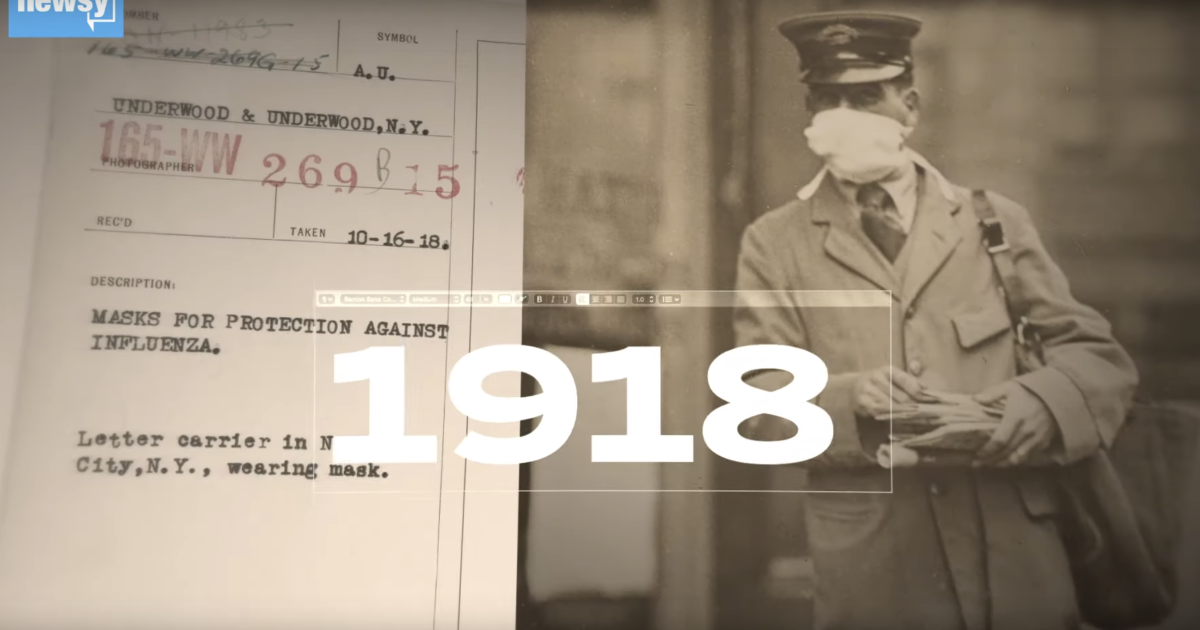
So forceful a move can be unpopular, but evidence shows it can also be the most effective, in the absence of treatment or a vaccine. “Here’s the rub on these methods — they only work if you do it really early,” said Dr. Howard Markel, a medical historian at the University of Michigan and an expert on the 1918 flu pandemic.

“When you do a quarantine, you stop the commerce, you stop the flow of money,” he said. “But on the other side of that are those whose lives are saved.”

This isn’t the group’s first pandemic. The alliance, formally called the Association of Bay Area Health Officials, was born in 1985 in the early days of the AIDS epidemic.

Dr. David Werdegar, who became health officer for San Francisco that year, was analyzing AIDS data for surrounding counties and asked their health officers to join him for dinner at Jack’s, an old bordello-turned-political hangout in the city that has since shuttered.

Most of the infectious disease research was happening in San Francisco at the time, but HIV was spreading, and one city couldn’t fight it alone.

“It was important that we share all the information we had,” said Werdegar, now in his 80s and retired.

Dr. Robert Melton, a former Monterey County health officer, said that working for nearly two decades with Bay Area public health giants taught him tremendous lessons. “Camaraderie is important in maintaining the energy to be able to focus on the common good, through good and bad,” he said.

That close-knit relationship among the 13 health officers — representing counties stretching across a large swath of Northern California from Napa to Monterey — continues to this day. Collectively, their public health actions touch about 8.5 million people.

They meet monthly and communicate regularly on Slack, a messaging app. Their diverse backgrounds and expertise, especially in an era of funding cuts, provide a deep well of public health knowledge from which to draw. Together, the group has joined forces to combat youth vaping, air pollution and measles outbreaks.

And they have also tackled various influenza scares, which is why they had an emergency response blueprint at the ready when cases of what would later be called COVID-19 first cropped up in Wuhan, China.

“We spent a couple years as a region thinking about pandemic planning, and that really helped us come a long way thinking about these policies for COVID-19,” said Dr. Erica Pan, the interim health officer for Alameda County.

So when they jumped on the call that Sunday, they were already in mid-conversation about how to respond. They brought their lawyers and, working into the predawn hours, translated their lockdown plan into legalese, one that would be enforceable with fines and misdemeanor charges.

They would make prime-time announcements across the region the next day, alongside elected officials. “This is not the moment for half-measures,” said San Jose Mayor Sam Liccardo. “History won’t forgive us for waiting an hour more.”

At first, the stay-at-home order applied just to the “Big Seven” counties surrounding the San Francisco Bay, whose officers peeled off from the larger group to issue it first. They shared their model ordinance with the others, who quickly followed.

Dr. Gail Newel, an OB-GYN and Santa Cruz County’s health officer, is not an infectious disease expert. She has relied heavily on the group’s expertise throughout her career, and especially now.

“It’s this incredible bank of knowledge and wisdom and experience that’s freely shared among the members,” she said. “And the whole Bay Area benefits by that shared knowledge bank.”

Roughly one month after they made the unprecedented decision to close the local economy, the risk seems to have paid off. It will be years before researchers have fully analyzed its impact, but officials across the Bay Area are cautiously optimistic. Others haven’t been so lucky.

Though there are important differences between the two regions, New York City, which issued a stay-at-home order four days after the Bay Area, saw its hospitals completely overwhelmed and had recorded more than 14,600 deaths as of Monday.

By comparison, the counties represented by the alliance have documented more than 215 deaths and hospitals haven’t been overtaken by a surge. In fact, hospitals brought online specifically to accommodate an overflow of patients are sitting largely empty.

Even within California, communities that waited to issue lockdown orders have emerged as COVID-19 hot spots, including Los Angeles, where Mayor Eric Garcetti followed suit three days after the Bay Area.

Internally, some of the Bay Area health officials have wondered if they made the right call. But “anytime I have any doubt, I just read another news report from New York or Detroit or New Orleans,” said Dr. Chris Farnitano, Contra Costa County’s health officer.

And the close-knit band is already undertaking its next task: reopening the economy without causing another spike in cases.

Before the orders are lifted, the officials say there must be rapid, widespread testing across the population. They want to hire disease investigators by the hundreds, if not the thousands, to trace the virus and quarantine those who have been infected. And until there is a vaccine, they may ask people to wear masks in public and continue social distancing, even in bars, restaurants and schools when they reopen.

“I was concerned that we might get a lot of resistance and it might get interpreted as alarmist and overreach,” said Marin County’s Willis. “Time has shown that it was really a vital step to take when we took it.”


Health Care Workers Stand Up To People Protesting Stay-At-Home Orders

https://nowthisnews.com/news/health-care-workers-stand-up-to-people-protesting-stay-at-home-orders

View image on Twitter

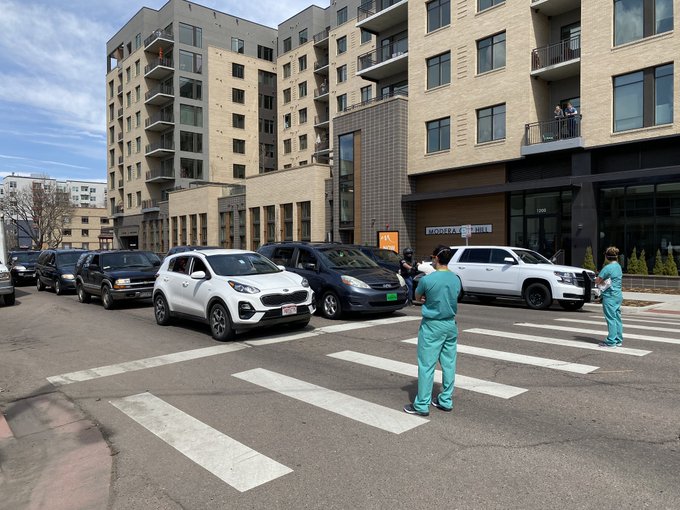
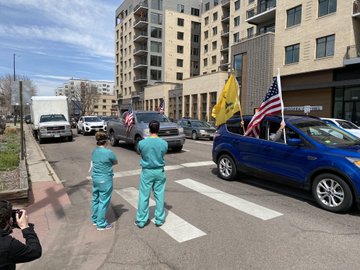
Remarkable scene at 12th and Grant, where two healthcare workers from a Denver-area hospital — they declined to say which or give their names — are standing in the crosswalk during red lights as a “reminder,” they say, of why shutdown measures are in place.

Two health care workers blocked a parade of protesters in Denver, Colorado on Sunday, who were storming the capitol to protest the state’s stay-at-home order.

Powerful images and videos of the standoff were widely shared on social media of the two unidentified people wearing scrubs and N95 masks, standing in a crosswalk blocking protesters’ vehicles. The two were identified as health care workers by photographers on the scene. 

One video shared by Twitter user Marc Zenn, captured cars lined up and beeping their horns at the two medical workers, with a woman hanging out of her vehicle’s window shouting “Go to China if you want communism. Go to China,” and “You get to go to work, why can’t we?”

View image on Twitter

They say they’ve been treating COVID patients for weeks. Today most of the people driving by have been “very aggressive,” they say. I’ve been standing here for a few minutes and already seen two people get in their faces.

Hundreds of people showed up on foot and in their vehicles for two separate protests in Colorado’s capitol on Sunday. The protests were reportedly planned by ReOpen Colorado and “various Libertarian parties,” according to a local Denver news outlet. People attending the march were shown carrying American flags, “Don’t Tread on Me” flags, and signs about reopening businesses and schools.

“Coloradans have a first amendment right to protest and to free speech, and the Governor hopes that they are using social distancing and staying safe,” Colorado Gov. Jared Polis’ office said in a statement. “No one wants to reopen Colorado businesses and lift these restrictions more than the Governor, but in order to do that, Coloradans have to stay home as much as possible during this critical period, wear masks and wash their hands regularly to slow the spread of this deadly virus.”

As of Monday morning, Colorado has more than 9,700 cases of COVID-19, leading to at least 420 deaths, according to the Johns Hopkins coronavirus tracker. The state of Colorado is set to continue its stay-at-home order until at least April 26, to slow the transmission of the virus.  

Colorado isn’t the only state where protesters are demonstrating against their government’s stay-at-home orders—Several other states held protests over the weekend including Utah, Idaho, and Washington state. Last week, parts of Michigan, New York, Ohio, Virginia, North Carolina, and others also saw a wave of demonstrators

President Trump encouraged the protesters last week during his Friday press briefing and in tweets which said to “liberate” multiple states holding protests.

In a Politico poll, 81% of Americans agreed we “should continue to social distance for as long as is needed to curb the spread of coronavirus, even if it means continued damage to the economy.” An NBC News poll found that 60% of responders agreed with keeping at-home restrictions.


Cartoon – The Wisdom of Pandemic Protests

Kevin it's Necessary everyone stay home on Twitter: "Looks like ...

The Grim Truth About the “Swedish Model”

https://www.project-syndicate.org/commentary/swedish-coronavirus-no-lockdown-model-proves-lethal-by-hans-bergstrom-2020-04?utm_source=Project+Syndicate+Newsletter&utm_campaign=5b31132e51-sunday_newsletter_19_04_2020&utm_medium=email&utm_term=0_73bad5b7d8-5b31132e51-105592221&mc_cid=5b31132e51&mc_eid=5f214075f8

QOSHE - The Grim Truth About the “Swedish Model” - Hans Bergstrom

As the coronavirus pandemic has swept the planet, Sweden has stood out among Western democracies by pursuing a “low-scale” lockdown. Whether this approach speaks to a unique strength of Swedish society, as opposed to bad judgment, can be determined by comparing Sweden’s COVID-19 rate with its neighbors’.

STOCKHOLM – Does Sweden’s decision to spurn a national lockdown offer a distinct way to fight COVID-19 while maintaining an open society? The country’s unorthodox response to the coronavirus is popular at home and has won praise in some quarters abroad. But it also has contributed to one of the world’s highest COVID-19 death rates, exceeding that of the United States.

In Stockholm, bars and restaurants are filled with people enjoying the spring sun after a long, dark winter. Schools and gyms are open. Swedish officials have offered public-health advice but have imposed few sanctions. No official guidelines recommend that people wear masks.

During the pandemic’s early stages, the government and most commentators proudly embraced this “Swedish model,” claiming that it was built on Swedes’ uniquely high levels of “trust” in institutions and in one another. Prime Minister Stefan Löfven made a point of appealing to Swedes’ self-discipline, expecting them to act responsibly without requiring orders from authorities.

According to the World Values Survey, Swedes do tend to display a unique combination of trust in public institutions and extreme individualism. As sociologist Lars Trägårdh has put it, every Swede carries his own policeman on his shoulder.

But let’s not turn causality on its head. The government did not consciously design a Swedish model for confronting the pandemic based on trust in the population’s ingrained sense of civic responsibility. Rather, actions were shaped by bureaucrats and then defended after the fact as a testament to Swedish virtue.

In practice, the core task of managing the outbreak fell to a single man: state epidemiologist Anders Tegnell at the National Institute of Public Health. Tegnell approached the crisis with his own set of strong convictions about the virus, believing that it would not spread from China, and later, that it would be enough to trace individual cases coming from abroad. Hence, the thousands of Swedish families returning from late-February skiing in the Italian Alps were strongly advised to return to work and school if not visibly sick, even if family members were infected. Tegnell argued that there were no signs of community transmission in Sweden, and therefore no need for more general mitigation measures. Despite Italy’s experience, Swedish ski resorts remained open for vacationing and partying Stockholmers.

Between the lines, Tegnell indicated that eschewing draconian policies to stop the spread of the virus would enable Sweden gradually to achieve herd immunity. This strategy, he stressed, would be more sustainable for society.

Through it all, Sweden’s government remained passive. That partly reflects a unique feature of the country’s political system: a strong separation of powers between central government ministries and independent agencies. And, in “the fog of war,” it was also convenient for Löfven to let Tegnell’s agency take charge. Its seeming confidence in what it was doing enabled the government to offload responsibility during weeks of uncertainty. Moreover, Löfven likely wanted to demonstrate his trust in “science and facts,” by not – like US President Donald Trump – challenging his experts.

It should be noted, though, that the state epidemiologist’s policy choice has been strongly criticized by independent experts in Sweden. Some 22 of the country’s most prominent professors in infectious diseases and epidemiology published a commentary in Dagens Nyheter calling on Tegnell to resign and appealing to the government to take a different course of action.

By mid-March, and with wide community spread, Löfven was forced to take a more active role. Since then, the government has been playing catch-up. From March 29, it prohibited public gatherings of more than 50 people, down from 500, and added sanctions for noncompliance. Then, from April 1, it barred visits to nursing homes, after it had become clear that the virus had hit around half of Stockholm’s facilities for the elderly.

Sweden’s approach turned out to be misguided for at least three reasons. However virtuous Swedes may be, there will always be free riders in any society, and when it comes to a highly contagious disease, it doesn’t take many to cause major harm. Moreover, Swedish authorities only gradually became aware of the possibility of asymptomatic transmission, and that infected individuals are most contagious before they start showing symptoms. And, third, the composition of the Swedish population has changed.

After years of extremely high immigration from Africa and the Middle East, 25% of Sweden’s population – 2.6 million of a total population of 10.2 million – is of recent non-Swedish descent. The share is even higher in the Stockholm region. Immigrants from Somalia, Iraq, Syria, and Afghanistan are highly overrepresented among COVID-19 deaths. This has been attributed partly to a lack of information in immigrants’ languages. But a more important factor seems to be the housing density in some immigrant-heavy suburbs, enhanced by closer physical proximity between generations.

It is too soon for a full reckoning of the effects of the “Swedish model.” The COVID-19 death rate is nine times higher than in Finland, nearly five times higher than in Norway, and more than twice as high as in Denmark. To some degree, the numbers might reflect Sweden’s much larger immigrant population, but the stark disparities with its Nordic neighbors are nonetheless striking. Denmark, Norway, and Finland all imposed rigid lockdown policies early on, with strong, active political leadership.

Now that COVID-19 is running rampant through nursing homes and other communities, the Swedish government has had to backpedal. Others who may be tempted by the “Swedish model” should understand that a defining feature of it is a higher death toll.


How some cities ‘flattened the curve’ during the 1918 flu pandemic

https://www.nationalgeographic.com/history/2020/03/how-cities-flattened-curve-1918-spanish-flu-pandemic-coronavirus/#close

A Pandemic And A Parade: What 1918 tells us about flattening the curve

Social distancing isn’t a new idea—it saved thousands of American lives during the last great pandemic. Here’s how it worked.

PHILADELPHIA DETECTED ITS first case of a deadly, fast-spreading strain of influenza on September 17, 1918. The next day, in an attempt to halt the virus’ spread, city officials launched a campaign against coughing, spitting, and sneezing in public. Yet 10 days later—despite the prospect of an epidemic at its doorstep—the city hosted a parade that 200,000 people attended.

How they flattened the curve during the 1918 Spanish Flu

Flu cases continued to mount until finally, on October 3, schools, churches, theaters, and public gathering spaces were shut down. Just two weeks after the first reported case, there were at least 20,000 more.

The 1918 flu, also known as the Spanish Flu, lasted until 1920 and is considered the deadliest pandemic in modern history. Today, as the world grinds to a halt in response to the coronavirus, scientists and historians are studying the 1918 outbreak for clues to the most effective way to stop a global pandemic. The efforts implemented then to stem the flu’s spread in cities across America—and the outcomes—may offer lessons for battling today’s crisis. (Get the latest facts and information about COVID-19.)

How they flattened the curve during the 1918 Spanish Flu

From its first known U.S. case, at a Kansas military base in March 1918, the flu spread across the country. Shortly after health measures were put in place in Philadelphia, a case popped up in St. Louis. Two days later, the city shut down most public gatherings and quarantined victims in their homes. The cases slowed. By the end of the pandemic, between 50 and 100 million people were dead worldwide, including more than 500,000 Americans—but the death rate in St. Louis was less than half of the rate in Philadelphia. The deaths due to the virus were estimated to be about 358 people per 100,000 in St Louis, compared to 748 per 100,000 in Philadelphia during the first six months—the deadliest period—of the pandemic.

Dramatic demographic shifts in the past century have made containing a pandemic increasingly hard. The rise of globalization, urbanization, and larger, more densely populated cities can facilitate a virus’ spread across a continent in a few hours—while the tools available to respond have remained nearly the same. Now as then, public health interventions are the first line of defense against an epidemic in the absence of a vaccine. These measures include closing schools, shops, and restaurants; placing restrictions on transportation; mandating social distancing, and banning public gatherings. (This is how small groups can save lives during a pandemic.)

Of course, getting citizens to comply with such orders is another story: In 1918, a San Francisco health officer shot three people when one refused to wear a mandatory face mask. In Arizona, police handed out $10 fines for those caught without the protective gear. But eventually, the most drastic and sweeping measures paid off. After implementing a multitude of strict closures and controls on public gatherings, St. Louis, San Francisco, Milwaukee, and Kansas City responded fastest and most effectively: Interventions there were credited with cutting transmission rates by 30 to 50 percent. New York City, which reacted earliest to the crisis with mandatory quarantines and staggered business hours, experienced the lowest death rate on the Eastern seaboard.

In 2007, a study in the Journal of the American Medial Association analyzed health data from the U.S. census that experienced the 1918 pandemic, and charted the death rates of 43 U.S. cities. That same year, two studies published in the Proceedings of the National Academy of Sciences sought to understand how responses influenced the disease’s spread in different cities. By comparing fatality rates, timing, and public health interventions, they found death rates were around 50 percent lower in cities that implemented preventative measures early on, versus those that did so late or not at all. The most effective efforts had simultaneously closed schools, churches, and theaters, and banned public gatherings. This would allow time for vaccine development (though a flu vaccine was not used until the 1940s) and lessened the strain on health care systems.

The studies reached another important conclusion: That relaxing intervention measures too early could cause an otherwise stabilized city to relapse. St. Louis, for example, was so emboldened by its low death rate that the city lifted restrictions on public gatherings less than two months after the outbreak began. A rash of new cases soon followed. Of the cities that kept interventions in place, none experienced a second wave of high death rates. (See photos that capture a world paused by coronavirus.)

In 1918, the studies found, the key to flattening the curve was social distancing. And that likely remains true a century later, in the current battle against coronavirus. “[T]here is an invaluable treasure trove of useful historical data that has only just begun to be used to inform our actions,” Columbia University epidemiologist Stephen S. Morse wrote in an analysis of the data. “The lessons of 1918, if well heeded, might help us to avoid repeating the same history today.”