The changing face of the nursing workforce

https://mailchi.mp/377fb3b9ea0c/the-weekly-gist-august-4-2023?e=d1e747d2d8
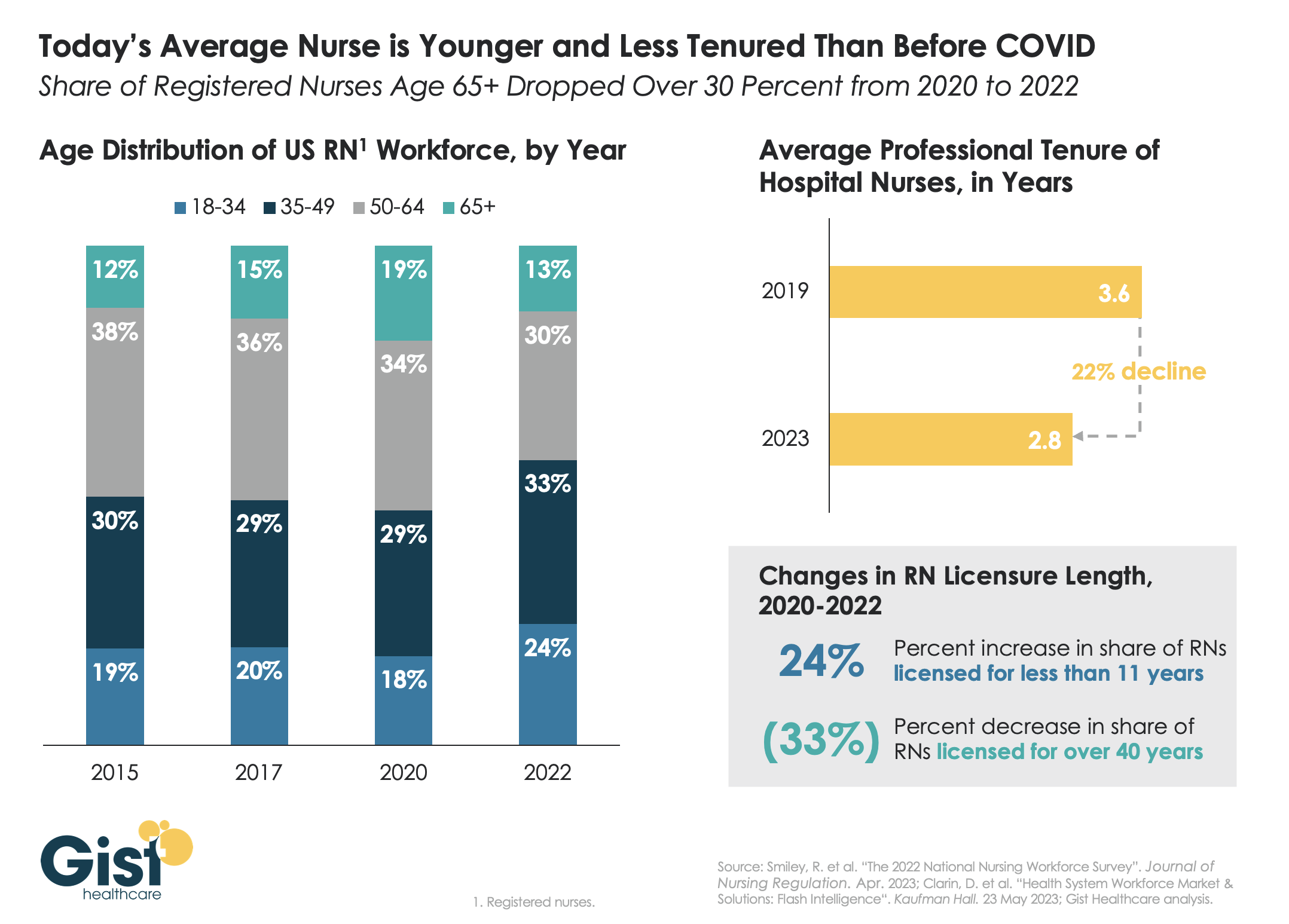
Last week we discussed how hospitals are still struggling to retain talent. This week’s graphic offers one explanation for this trend: 

a significant share of older nurses, who continued to work during the height of the pandemic, have now exited the workforce, and health systems are even more reliant on younger nurses. 

Between 2020 and 2022, the number of nurses ages 65 and older decreased by 200K, resulting in a reduction of that age cohort from 19 percent to 13 percent of the total nursing workforce. While the total number of nurses in the workforce still increased, the younger nurses filling these roles are both earlier in their nursing careers (thus less experienced), and more likely to change jobs. 

Case in point:

From 2019 to 2023, the average tenure of a hospital nurse dropped by 22 percent. The wave of Baby Boomer nurse retirements has also resulted in a 33 percent decrease from 2020 to 2022 in the number of registered nurses who have been licensed for over 40 years. 

Given these shifts, hospitals must adjust their current recruitment, retention, training, and mentorship initiatives to match the needs of younger, early-career nurses.

Hospitals still struggling to retain talent

https://mailchi.mp/c02a553c7cf6/the-weekly-gist-july-28-2023?e=d1e747d2d8

Of all the pandemic’s impacts still felt today, disruptions to the healthcare workforce and rising labor costs may be most impactful to current health system operations.

Over the next three editions of the Weekly Gist, we’ll be exploring the lingering effects of this workforce crisis, with a focus on nurse staffing and recruitment.


In this week’s graphic, we use data from the 2023 NSI National Health Care Retention Report to show how hospital turnover and vacancy rates have changed over the past several years. 

While wage increases helped reduce hospital registered nurse (RN) turnover rates from 27 percent in 2021 to 23 percent in 2022, nurses—along with hospital employees in general—are still changing jobs at higher rates than before the pandemic.

Over half of all hospitals still face nurse vacancy rates above 15 percent, a slight improvement from 2022 but still far more than before the pandemic.

While the worst of nursing turnover appears to have passed, the “rebasing” of wages (for nursing, 27 percent higher compared to 2019) will provide ongoing pressure to strained hospital margins.

Worsening $7 trillion retirement savings shortfall stirs second thoughts

U.S. market volatility erased $3.4 trillion from 401(k)s and IRAs in the first half of 2022, making for an anxious time for many workers trying to plan their retirements. 

The 2022 losses suggest the retirement savings shortfall among U.S. households is worsening from its $7.1 trillion valuation in 2019, an estimate that came out of Boston College. At that time, half of working families faced were at risk of not being able to maintain their standard of living once they retired. 

This proportion likely hasn’t changed much since, Alicia Munnell, director of Boston College’s Center for Retirement Research, told Bloomberg. The people who profited from gains to stock and housing prices over the past three years “were people who weren’t at risk in the first place,” she said.

“Living standards are going to decline for a large portion of the population who are in retirement — that’s the concern,” Richard Johnson, a retirement expert at the Urban Institute, told Bloomberg. “For people who are not in that age group, it’s still concerning because it could strain the social safety net.”

Boston College’s 2019 report on the national retirement risk index concluded that “the only way to make a dramatic dent in the retirement risk problem is to combine saving more with working two years longer.” 

The average age for retirement is the highest it has been for the past 30 years, sitting at 61. Nonretirees’ target retirement age has increased from 60 in 1995 to 66 today, meaning the average retirement age will increase even further in coming years if active workers retire when they plan to.

CEO resignations hit record high

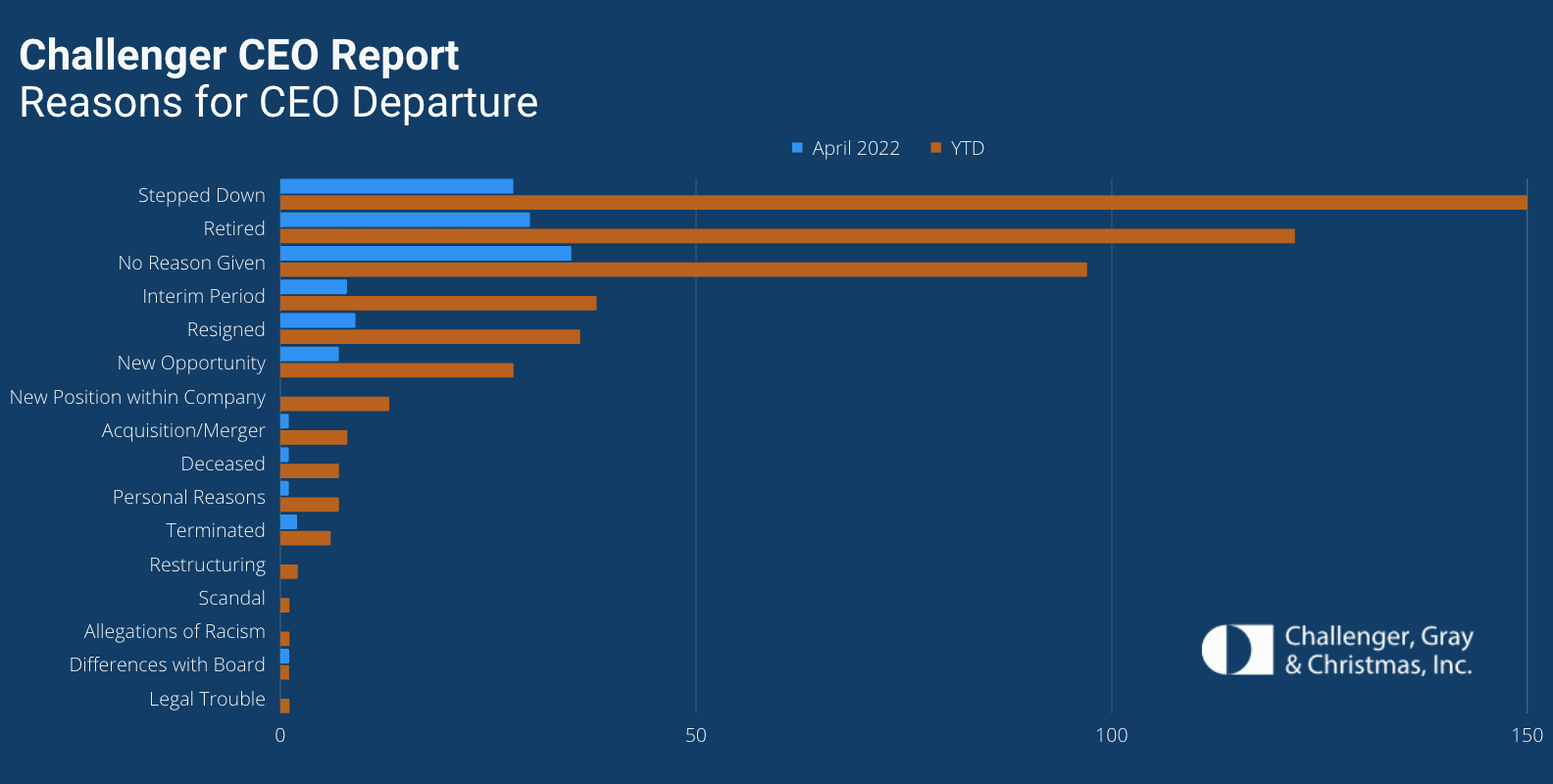
Dozens of hospital CEOs have resigned this year as a record number of chiefs across all industries have exited their roles, according to a May 18 Challenger, Gray & Christmas report. 

Nearly 520 CEOs left their posts between Jan. 1 and the end of April, the highest total since the executive outplacement and coaching firm began tracking CEO changes in 2002. The total is up 18 percent from the 440 CEO exits announced in the same period of 2021. 

Thirty-six hospital CEOs exited their roles in the first four months of this year. That’s up from the 20 hospital chiefs who resigned in the same period last year, according to the report. 

CEOs are leaving their positions and businesses are making changes at the top for several reasons, Challenger, Gray & Christmas Senior Vice President Andrew Challenger said. 

“Inflation, staffing shortages, and possible recession concerns are giving more cause for companies to reevaluate leadership,” Mr. Challenger said. “This, after years of companies trying to figure out the right formula to attract and retain talent and create a culture of inclusion, issues that often start at the top.”

Will baby boomers unretire?

Economists are curious as to whether baby boomers who accelerated their retirement during the pandemic will return to the workforce, and if so, at what rate. 

About 2.6 million older workers retired above ordinary trends since the start of the pandemic two years ago, according to a Bloomberg report citing estimates from the Federal Reserve Bank of St. Louis. Despite this boom, applications for Social Security benefits have remained fairly flat, based on calculations by the Boston College Center for Retirement Research. About 0.1 percent of the U.S. population 55 and older have applied each month, which is in line with pre-pandemic applications.

Pandemic surges in stock and real estate values made this an “opportune time for some workers to step out of the labor force and stay out of the labor force,” Lowell Ricketts, data scientist for the Institute for Economic Equity at the St. Louis Fed, told Bloomberg. “But we’re still expecting a steady, steady trend that some might want to come back,” he noted, citing remote and hybrid work as attractors for seniors eyeing a return to the job market, particularly amid high inflation. 

Bureau of Labor Statistics data on labor participation shows that some baby boomers have come back, while many remain on the sidelines. Pre-pandemic, “unretirement” was not uncommon in the United States, due to financial hardship or personal choice. It’s still too soon to say whether the pandemic has challenged this dynamic.

Some “retirees” may have only one foot out the door, too. The Social Security Administration’s Office of the Chief Actuary suggested older people may have “retired” from one job and continued working in another, which explains why they haven’t applied for benefits, Bloomberg reports. 

Early retirements have stood to further disrupt the healthcare labor force throughout the pandemic. For instance, census microdata from the Current Population Survey provided by the University of Minnesota shows 14,500 nurses had recently retired as of March 2021, an increase of 140 percent over that figure in March 2019, according to a Pew report. The figure represents people who worked in the profession the past year but said they were now retired and not looking for work.

Read the Bloomberg report in full here