Justice Department sues Anthem, alleging Medicare fraud

https://www.axios.com/doj-anthem-lawsuit-medicare-advantage-fraud-11cdba13-eacd-4847-9bb0-20aa993235f9.html?utm_source=newsletter&utm_medium=email&utm_campaign=newsletter_axiosvitals&stream=top

Justice Department sues Anthem alleging Medicare Advantage fraud ...

The Department of Justice has sued Anthem, alleging that the health insurance company knowingly submitted inaccurate medical codes to the federal government from 2014 to 2018 as a way to get higher payments for its Medicare Advantage plans and turned “a blind eye” to coding problems.

Why it matters: This is one of the largest Medicare Advantage fraud lawsuits to date, and federal prosecutors believe they have more than enough to evidence to claim that Anthem bilked millions of dollars from taxpayers.

Background: DOJ has been probing the “risk adjustment” practices of all the major Medicare Advantage insurers for years, but hadn’t pulled the trigger on a lawsuit against a major player.

  • Risk adjustment is the process by which Medicare Advantage companies assign scores to their members based on the health conditions they have. Patients who have higher risk scores lead to higher payments from the federal government to the companies that insure them.
  • Insurers are required to review patients’ medical charts to verify the health conditions, and if insurers find any inaccurate diagnoses, they have to be deleted — which also would require the companies to pay back money to the federal government.

The Department of Justice is alleging that Anthem reviewed medical records, but only focused on finding “all possible new revenue-generating codes” while purposefully ignoring all erroneous diagnoses.

  • For example, according to the DOJ’s lawsuit, Anthem coded one member in 2015 as having active lung cancer.
  • “Anthem’s chart review program did not substantiate the active lung cancer diagnosis,” the DOJ alleges. Instead of deleting that diagnosis, Anthem allegedly added another three codes — leading to a $7,000 overpayment just for that member that year.

The other side: Anthem said in a statement that it intends “to vigorously defend our Medicare risk adjustment practices” and that “the government is trying to hold Anthem and other Medicare Advantage plans to payment standards that CMS does not apply to original Medicare.”

The big picture: Medicare Advantage continues to enroll seniors and people with disabilities at high rates, even as more allegations of fraud come out against the insurers that run the program.

Read the lawsuit.


Aetna draws criticism for automatic down-codes for office visits

https://www.beckershospitalreview.com/finance/aetna-draws-criticism-for-automatic-down-codes-for-office-visits.html?utm_medium=email

Image result for health insurance downcoding

Providers are concerned a new national policy from Aetna involving evaluation and management services will result in inappropriate down-codes.

Under the policy, Aetna will automatically down-code claims submitted for office visits or certain modifiers when the the insurer finds an “apparent overcode rate of 50 percent or higher.” The policy concerns office visits with the 99000 series of evaluation and management codes and the 92000 series of ophthalmologic examination codes, as well as modifiers 25 and 59, the American Optometric Association said in an advocacy post.

AOA said Aetna didn’t explain how an overcoding determination is made under the insurer’s algorithm, whether with or without medical record reviews.

“The AOA believes it is inappropriate to downcode such claims without first reviewing actual medical records and questions whether it complies with HIPAA; a variety of state laws related to fair, accurate and timely processing of claims; and Aetna’s contracts with patients and physicians alike,” the association said on its advocacy page.

Physicians can appeal down-coded claims through Aetna’s internal process.

In a statement to Becker’s Hospital Review, Aetna explained why it implemented the policy:

“We periodically review our claims data for correct coding and to implement programs that support nationally recognized and accepted coding policies and practices. Through a recent review, we identified healthcare providers across several specialties who are significant outliers with respect to coding practices. While we recognize that healthcare providers undoubtedly may have complex medical cases that are unique to their practice, this result is much higher than the average for physicians across most specialties.

“For this small, targeted group of healthcare providers, we will review their claims against [American Medical Association] and CMS coding guidelines. Based on that review, we may potentially adjust their payments if the information on the claim is not supported by the level of service documented in the medical record.”


Miami man with ‘junk plan’ owes thousands after hospital visit for coronavirus symptoms

https://www.beckershospitalreview.com/finance/miami-man-with-junk-plan-owes-thousands-after-hospital-visit-for-coronavirus-symptoms.html?utm_medium=email

Image result for skinny health plans

A man in Miami went to Jackson Memorial Hospital last month to receive a test for coronavirus after developing flu-like symptoms. He didn’t have the virus, but he was hit with a $3,270 medical bill, according to the Miami Herald.   

Osmel Martinez Azcue said he normally would have used over-the-counter medicine to fight his flu-like symptoms. However, since he had recently visited China, he followed the advice of public health experts and went to the hospital to get tested for coronavirus, known as COVID-19. 

Mr. Azcue said hospital staff told him a CT scan would be necessary to screen for coronavirus. He asked to receive a flu test first. The flu test came back positive.

A few weeks after leaving Jackson Memorial Hospital, Mr. Azcue received a $3,270 medical bill. Though he was insured, Mr. Azcue had a so-called “junk plan,” which offered limited benefits and didn’t cover pre-existing conditions.

Based on his insurance plan, Mr. Azcue is responsible for $1,400 of the bill, hospital officials told the Miami Herald. However, to get the claim covered, Mr. Azcue said his insurance company requested three years of medical records to show that his flu didn’t relate to pre-existing conditions.

The sale of “junk plans,” like the one Mr. Azcue pays $180 per month for, expanded after President Donald Trump’s administration rolled back ACA regulations in 2018.

Access the full Miami Herald article here.


Financial updates from UnitedHealth, Anthem + 5 other for-profit payers

https://www.beckershospitalreview.com/payer-issues/financial-updates-from-unitedhealth-anthem-5-other-for-profit-payers.html?utm_medium=email

The following seven health insurers recently released their financial statements for the fourth quarter of fiscal year 2019:

1. Anthem saw its revenues and profits grow in the fourth quarter, but the insurer missed analysts’ earnings expectations.

2. Cigna continued to realize higher revenues and profits in the fourth quarter, thanks to its subsidiary Express Scripts.

3. Molina Healthcare ended the fourth quarter with lower net income than a year prior as premium revenues declined.

4. Humana saw total revenue and net income grow in the fourth quarter, thanks in part to growth in its Medicare Advantage business and health services segment.

5. Centene Corp. saw its revenues grow in the fourth quarter, but experienced higher-than-expected flu costs.

6. UnitedHealth Group saw its revenues just miss analysts’ expectations in the fourth quarter, but the health insurance giant’s Optum unit boosted profits.

7. Aetna‘s parent company, CVS Health, exceeded Wall Street’s expectations with its fourth-quarter results, boosted largely by its pharmacy benefit management business.


It’s Not Just Hospitals That Are Quick To Sue Patients Who Can’t Pay

https://www.npr.org/sections/health-shots/2020/02/19/798894062/its-not-just-hospitals-that-are-quick-to-sue-patients-who-cant-pay?utm_source=The+Fiscal+Times&utm_campaign=59b997dc59-EMAIL_CAMPAIGN_2020_02_19_10_03&utm_medium=email&utm_term=0_714147a9cf-59b997dc59-390702969

Social worker Sonya Johnson received a civil warrant to appear in court when the company that runs Nashville General Hospital’s emergency room threatened to sue her over a $2,700 ER bill — long after she’d already negotiated a reduced payment schedule for the rest of her hospital stay.

Nashville General Hospital is a safety net facility funded by the city. For a patient without insurance, this is supposed to be the best place to go in a city with many hospitals. But for those who are uninsured, it may have been the worst choice in 2019.

Its emergency room was taking more patients to court for unpaid medical bills than any other hospital or practice in town. A WPLN investigation finds the physician-staffing firm that runs the ER sued 700 patients in Davidson County during 2019.

They include patients such as Sonya Johnson, a 52-year-old social worker and single mother.

By juggling her care between a nonprofit clinic and Nashville General, Johnson had figured out how to manage her health problems, even though she was, until recently, uninsured. In 2018, she went in to see her doctor, who charges patients on a sliding scale. Her tongue was swollen and she was feeling weak. The diagnosis? She was severely anemic.

“He called me back that Halloween day and said, ‘I need you to get to the emergency [room], stat — and they’re waiting on you when you get there,’ ” she recalls.

Nashville General kept her overnight and gave her a blood transfusion. They wanted to keep her a second night — but she was worried about the mounting cost, so asked to be sent home.

Staying overnight even the one night meant she was admitted to the hospital itself, and the bill for that part of her care wasn’t so bad, Johnson says. The institution’s financial counselors offered a 75% discount, because of her strained finances and because her job didn’t offer health insurance at the time.

But emergency rooms are often run by an entirely separate entity. In Nashville General’s case, the proprietor was a company called Southeastern Emergency Physicians. And that’s the name on a bill that showed up in Johnson’s mailbox months later for $2,700.

“How in the world can I pay this company, when I couldn’t even pay for health care [insurance]?” Johnson asks.

Johnson didn’t recognize the name of the physician practice. A Google search doesn’t help much. There’s no particular website, though a list of Web pages that do turn up in such a search suggest the company staffs a number of emergency departments in the region.

Johnson says she tried calling the number listed on her bill to see if she could get the same charity-care discount the hospital gave her, but she could only leave messages.

And then came a knock at her apartment door over the summer. It was a Davidson County sheriff’s deputy with a summons requiring Johnson to appear in court.

“It’s very scary,” she says. “I mean, [I’m] thinking, what have I done? And for a medical bill?”

Nashville General Hospital was no longer suing patients

Being sued over medical debt can be a big deal because it means the business can get a court-ordered judgment to garnish the patient’s wages, taking money directly from their paycheck. The strategy is meant to make sure patients don’t blow off their medical debts. But this is not good for the health of people who are uninsured, says Bruce Naremore, the chief financial officer at Nashville General.

“When patients owe money, and they feel like they’re being dunned all the time, they don’t come back to the hospital to get what they might need,” he says.

Under Naremore’s direction in the past few years, Nashville General had stopped suing patients for hospital fees. He says it was rarely worth the court costs.

But Southeastern Emergency Physicians — which, since 2016, has been contracted by the hospital to run and staff its emergency department — went the other way, filing more lawsuits against patients than ever in 2019.

Naremore says the decision on whether to sue over emergency care falls to the company that staffs the ER, not Nashville General Hospital.

“It’s a private entity that runs the emergency room, and it’s the cost of doing business,” he says. “If I restrict them from collecting dollars, then my cost is going to very likely go up, or I’m going to have to find another provider to do it.”

This is a common refrain, says Robert Goff. He’s a retired hospital executive and board member of RIP Medical Debt. The nonprofit helps patients who are trapped under a mountain of medical bills, which are the No. 1 cause of personal bankruptcy.

“So the hospital sits there and says, ‘Not my problem.’ That’s irresponsible in every sense of the word,” Goff says.

The practice of suing patients isn’t new for Southeastern Emergency Physicians or its parent company, Knoxville-based TeamHealth. But such lawsuits have picked up in recent years, even as the company has stopped its practice of balance billing patients.

TeamHealth is one of the two dominant ER staffing firms in the nation, running nearly 1 in 10 emergency departments in the United States. And its strategy of taking patients to court ramped up after it was purchased by the private equity giant Blackstone, according to an investigation by the journalism project MLK50 in Memphis.

Under pressure from journalists, TeamHealth ultimately pledged to stop suing patients and to offer generous discounts to uninsured patients.

Officials from TeamHealth declined WPLN’s request for an interview to answer questions about how widespread its practice of suing patients for ER doctors’ services and fees has been.

“We will work with patients on a case by case basis to reach a resolution,” TeamHealth said in an email.

According to court records obtained by WPLN, the firm filed about 700 lawsuits against patients in Nashville in 2019. That’s up from 120 in 2018 and just seven in 2017. Its only contract in the city is with Nashville General’s ER, and the patients reached by WPLN say they were uninsured when they were sued.

What’s surprising to Mandy Pellegrinwho has been researching medical billing in Tennessee at the nonpartisan Sycamore Institute, is that it was all happening at Nashville General — where treating uninsured patients is part of the hospital’s mission.

“It is curious that a company that works for a hospital like that might resort to those sorts of actions,” Pellegrin says.

TeamHealth halts suits, pledges to drop cases

As for Sonya Johnson — she eventually went to court and worked out a payment plan of $70 a month over three years.

And now TeamHealth tells WPLN that its intent is to drop pending cases.

“We will not file additional cases naming patients as defendants and will not seek further judgments,” a TeamHealth spokesperson says in an emailed statement. “Our intent is not to have these pending cases proceed. We’re working as expeditiously as possible on resolving individual outstanding cases.”

Johnson says she’s been told that the lawsuit Southeastern Emergency Physicians filed against her will be dropped — but that she still owes the $2,700 bill.


Bipartisan Ways and Means leaders unveil measure to stop surprise medical bills

https://thehill.com/policy/healthcare/481985-bipartisan-ways-and-means-leaders-unveil-measure-to-stop-surprise-medical?utm_source=&utm_medium=email&utm_campaign=27536

Image result for surprise medical bills

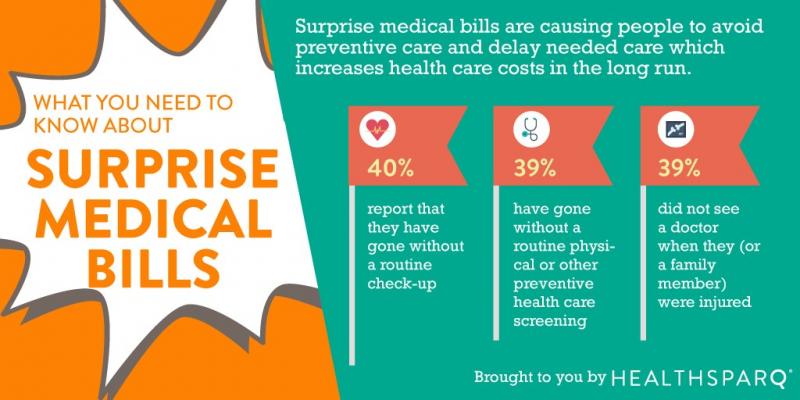
The bipartisan leaders of the House Ways and Means Committee on Friday released their legislation to protect patients from getting massive, surprise medical bills as congressional action on the subject intensifies.

The legislation is backed by the panel’s chairman, Rep. Richard Neal (D-Mass.), and its top Republican, Rep. Kevin Brady (Texas). It would protect patients from getting bills for thousands of dollars when they go to the emergency room and one of their doctors happens to be outside their insurance network.

Surprise billing is seen as a rare area of possible bipartisan action this year and has support from President Trump.

But the effort has been slowed by varying approaches and intense lobbying from doctor and hospital groups.

The Ways and Means bill is a rival approach to the bipartisan bill passed out of committee last year by the House Energy and Commerce Committee.

The divide between those two committees will have to be overcome for any bill to move forward.

Neal and Brady said in a statement Friday that their approach “differs” from others because “we create a more balanced negotiation process.”

“Our priority throughout the painstaking process of crafting our legislation has been to get the policy right for patients, and we firmly believe that we have done that,” Neal and Brady said. “We look forward to working with our Democratic and Republican colleagues in Congress, as well as the Administration, to advance this measure swiftly.”

The Ways and Means Committee is planning to vote on the legislation next week.

While all sides in the surprise billing fight agree the patient should be protected, the main dispute has been how much the insurer will pay the doctor once the patient is taken out of the middle. 

Doctors and hospitals have lobbied hard against the Energy and Commerce approach, which they fear would lead to damaging cuts to their payments. That approach sets the payment based on the median rate in that geographic area, with the option of going to arbitration for some high-cost bills.

The Ways and Means approach has generally been seen as more favorable to doctors and hospitals, but industry groups have not yet responded to the details on Friday morning.

The Ways and Means bill gives the decision on how much the insurer should pay the doctor to an outside arbiter, although that arbiter will have to consider the median rate usually paid for that service in making its decision.

The House Education and Labor Committee is also planning to vote on legislation next week, and released a bill on Friday that closely reflects the Energy and Commerce and Senate Health Committee legislation, isolating Ways and Means.

Shawn Gremminger, senior director of federal relations at the liberal health care advocacy group Families USA, said it is “disappointing” that Ways and Means is using an approach that will not lower health costs as much, but he said it is good the process is moving forward.

The Energy and Commerce leaders, along with leaders of the Senate Health Committee, who also back their bill, released a conciliatory statement on Friday about the Ways and Means bill.

“Protecting innocent patients has been our top goal throughout this effort, and we appreciate that the other two House committees share this priority,” said Reps. Frank Pallone Jr. (D-N.J.) and Greg Walden (R-Ore.) and Sens. Lamar Alexnader (R-Tenn.) and Patty Murray (D-Wash.). “We look forward to working together to deliver a bill to the president’s desk that protects patients and lowers health care costs for American consumers.”


CVS long-term care pharmacy sued by DOJ over fraudulent prescribing practices

https://www.healthcaredive.com/news/cvs-long-term-pharmacy-sued-by-doj-over-fraudulent-prescribing-practices/569268/

Dive Brief:

  • CVS Health and its Omnicare business are being sued by the Department of Justice over alleged fraudulent billing of Medicare and other government programs for outdated prescriptions for elderly and disabled people.
  • The DOJ suit, filed Tuesday in New York, joins whistleblower ligitation accusing Omnicare of billing federal healthcare programs for hundreds of thousands of drugs based on out-of-date prescriptions for individuals in assisted living facilities, group homes, independent living communities and other long-term care facilities between 2010 and 2018. The lawsuit seeks civil penalties and other damages.
  • “We do not believe there is merit to these claims and we intend to vigorously defend the matter in court,” CVS spokesperson Joe Goode told Healthcare Dive. “We are confident that Omnicare’s dispensing practices will be found to be consistent with state requirements and industry-accepted practices.”

Dive Insight:

The suit alleges Omnicare, the nation’s largest long-term care pharmacy, kept dispensing antipsychotics, anticonvulsants, antidepressants and other drugs based off invalid prescriptions for months, and sometimes years, without obtaining fresh scripts from patients’ doctors.

Managers at the long-term care business allegedly ignored prescription refill limitations and expiration dates and forced staff to fill prescriptions quickly, pressuring some facilities to process and dispense thousands of orders daily. When prescriptions expired, Omnicare “rolled over” the scripts, assigning them a new number, allowing the pharmacy to dispense the drug indefinitely without need for doctor involvement.

This practice allowed Omnicare to continually dispenses drugs for seniors and disabled occupants in more than 3,000 residential long-term care facilities, at an ongoing risk to their health, according to DOJ. Many of the prescription drugs were meant to treat serious conditions like dementia, depression or heart disease and have side effects when not closely monitored by a physician — particularly when taken in tandem with other medications.

The pharmacy then submitted knowingly false claims to Medicare, Medicaid and TRICARE, which serves military personnel, for the illegally dispensed drugs over an eight-year period; and lied to the government about the status of the prescriptions. CVS Health senior management was also aware of the scheme, according to DOJ.

“A pharmacy’s fundamental obligation is to ensure that drugs are dispensed only under the supervision of treating doctors who monitor patients’ drug therapies,” Manhattan U.S. Attorney Geoffrey Berman said in a statement. “Omnicare blatantly ignored this obligation in favor drugs out the door as quickly as possible to make more money.”

The government joined the lawsuit originally brought by Uri Bassan, an Albuquerque, New Mexico pharmacist for Omnicare, filed in June 2015. The original whistleblower suit said Omnicare’s compliance department was aware of the “rolling over” process, but did nothing to stop it.

This is by no means the first time the CVS subsidiary, established in 1981 and acquired in 2015 for about $12.7 billion, has been under the federal microscope for fraud.

Omnicare has a history of friction with the DOJ
  • 2006Omnicare pays almost $50 million over improper Medicaid claims

  • 2009Omnicare shells out $98 million to settle kickback allegations

  • 2012Omnicare enters into a $50 million settlement following a DOJ investigation finding its pharmacies dispensed drugs to long-term care facility residents without valid prescriptions

  • Feb. 2014Omnicare pays the government more than $4 million to settle kickback allegations

In the May 16, 2017 suit, the government accused Omnicare of designing an automated label verification system that purposefully inflated profits by submitting claims for generic drugs different than those given to patients. CVS said that all happened before it acquired Omnicare.

​Omnicare provides pharmacy benefits for post-acute care and senior living care, including in skilled nursing facilities, hospitals and health systems and assisted living communities.

Despite the lucrative market in an aging U.S. population with complicated drug needs, Omnicare is an underperforming business in otherwise healthy times for CVS. The unit triggered a $2.2 billion goodwill impairment charge following a late 2018 test, according to CVS’ fourth quarter filing last year.

Omnicare operates 160 pharmacies in 47 states. During the eight years under investigation, Omnicare submitted more than 35 million claims for drugs dispensed to Medicare beneficiaries in assisted living facilities alone, DOJ says.


NEW COVENANT HEALTH CFO AIMS TO LEAD ORGANIZATION’S FINANCIAL TURNAROUND

https://www.healthleadersmedia.com/finance/new-covenant-health-cfo-aims-lead-organizations-financial-turnaround

Image result for turnaround


The Tewksbury, Massachusetts–based health system strives to post its first positive balance sheet in more than five years.

Stephen Forney, MBA, CPA, FACHE, excels in fixing “broken” organizations and he has built a track record of achieving financial turnarounds at seven healthcare facilities, he tells HealthLeaders in a recent interview.

Forney has over three decades of experience as a healthcare executive, with a primary focus on problem-solving. He began his career fixing problems in areas such as information technology and supply chain, an approach and skill he has carried over into financial operations in the C-suite.

“In finance, it wound up being the same thing. Pretty much every organization I’ve gone to has been broken in some way, shape, or form,” Forney says. “I’ve developed a specialty doing turnarounds and this will be my eighth.”

Forney speaks about his new CFO role at the Tewksbury, Massachusetts–based Catholic nonprofit health system Covenant Health, which he joined in mid-September, and how driving revenue and reducing expenses must go hand-in-hand to achieve financial balance.

This transcript has been lightly edited for brevity and clarity.

HealthLeaders: Covenant is coming off its fifth straight year of operating losses. What is contributing to those losses and how do you plan to address those financial challenges?

Forney: The thing is, most turnarounds—to a greater or lesser extent—look a lot alike. With organizations that have [financial] issues, there are obviously always unique aspects to every situation, but virtually every healthcare organization that’s not doing well is because of the same relatively small handful of issues.

[For example,] revenue cycle is probably No. 1. Productivity has not been well attended to; expenses haven’t had a lot of discipline around them in a broad sense. That’s not to say that all decisions are bad, but in a systematic fashion, things haven’t been looked at. Frequently, driving volume and growing the business needs a better focus. 

In the case of Covenant … there has been a plan developed to address all those areas and we are addressing them already, even though we will be posting another operating loss in fiscal [year] 2019. But the trajectory is good and some of the things that we’re now looking at are what I would consider to be phase two–type initiatives. How do we accelerate and move them to the next level?

On October 1, we outsourced our revenue cycle. I’m pleased that we were able to get that accomplished. Obviously, it’s early but, at least anecdotally, initial trends look good.

HL: Where do you fall on the dynamic between focusing on expense control measures or revenue generation?

Forney: I always feel like you need to do both. Expense management and working towards expense strategies is easier, quicker, and more straightforward.

[Revenue growth strategies] take time, take effort, and tend to [have] a much higher degree of uncertainty around the volume projection. Those are necessary and they’re things that we need to invest in because, at some point, you can’t cut any more from your organization, you’ve got to grow the top line. To me, it’s sort of like step one is stabilize your revenue cycle and stabilize your expenses. Then while you’re doing that, work on growth that’s going to take place 12 to 18 months down the road.

HL: Are you optimistic about the federal government’s efforts to move the industry toward value-based care?

Forney: Going back about a decade, I thought the ACE program, which was [the federal government’s] bundled payment program, was a solid step in the right direction. It gave organizations a chance to collaborate in compliant fashion with physicians to bend the cost curve and have beneficiaries participate in the bending of the cost curve as well. I was with one of the pilot health systems that [participated], and it was a remarkable success.

Everybody got to win; CMS, patients, physicians, and systems won by creating value. Yes, I think that the government has a good role to play in [value-based care] because they have such a large group of patients that they’re willing to experiment like that. [The federal government] can come up with potentially novel ways to get people to buy into this.

HL: What is it like to be at the helm of a Catholic nonprofit system and how does it affect your leadership style?

Forney: From a philosophical standpoint, the principle of creating shareholder wealth and good stewardship are not significantly different. You’ve got an end goal in mind, which is, you’re taking care of the patients and a community. In one case, whatever excess is left goes to a private equity fund or shareholders. In the other case, [the excess] stays in your balance sheet and gets reinvested in the community.

HL: Given your three decades of healthcare experience, do you have advice for your fellow provider CFOs, especially some of the younger ones?

Forney: Focus on being that strategic right-hand person to the CEO. In my experience, that has been one of the things that marks a successful CFO from one that isn’t as successful.

CEOs are going to get ideas from everywhere. They’re outward and inward facing. They deal with the doctors and the community, and they’re going to get all sorts of great ideas.

The CFO needs to be that person [who is] grounded and says, ‘Well, what about this?’ That doesn’t mean saying no. The whole idea is how do you make it [sound] like a yes. To me, the CFO role just grounds all the discussions, from working with physicians to working with the community. 

CFOs over the last couple of decades have been operationally oriented. Now they need to start becoming clinically oriented.

There’s a real benefit in being able to sit down and talk with a physician and understand [what] they’re doing. … It winds up becoming a way to help ground the clinicians in the hospital operations because now you’re having a dialogue with them instead of them just saying, ‘You don’t understand. You’re not a clinician.’ That would be something that I would have a young CFO try to stay focused on, even though it’s dramatically outside the comfort zone for people that typically go into accounting.


Physician staffing firm suing patients

https://www.axios.com/newsletters/axios-vitals-bd00103b-e940-45bb-ad9a-a4576971fc39.html?utm_source=newsletter&utm_medium=email&utm_campaign=newsletter_axiosvitals&stream=top

Image result for team health billing lawsuits

An emergency room staffing firm owned by TeamHealth has filed thousands of lawsuits against patients in Memphis in the last few years, ProPublica and MLK50 report.

This is a collision of two storylines: the aggressive billing practices of private equity-backed health care companies, and providers’ decision to take patients to court to collect their medical debts.

  • Media reports have, until now, mostly focused on hospitals’ lawsuits, but ProPublica and MLK50’s reporting suggest the practice could be more widespread.

Between the lines: TeamHealth has already been in hot water for its role in surprise billing.

  • Emergency room physicians send patients surprise medical bills more often than other specialties, especially physicians employed by TeamHealth.
  • These doctors then have leverage to obtain higher in-network payment rates, making the practice lucrative.
  • The group is also one of the main funders of the dark-money group that has run millions in ads against what was Congress’ leading solution to surprise medical bills.
  • The company was acquired by the Blackstone Group in 2017.

By the numbers: The Memphis subsidiary Southeastern Emergency Physicians has filed more than 4,800 lawsuits against patients in Shelby County General Sessions Court since 2017, per ProPublica and MLK50.

  • TeamHealth said last week, after receiving questions from reporters, that it will no longer sue patients and won’t pursue the lawsuits it’s already filed.


Healthcare joins Black Friday frenzy

https://www.beckershospitalreview.com/consumerism/healthcare-joins-black-friday-frenzy.html

Image result for Black Friday

Black Friday arrives Nov. 29, and it could be a good time to save on medical supplies or healthcare services.

GE Healthcare Life Sciences has a webpage dedicated to its Black Friday offers. The company has cut prices on hundreds of items, including protein analysis equipment supplies and chromatography products. Though the discounts are promoted as Black Friday deals, the offers are available until Dec. 8.

A hospital in Mississippi is also offering holiday discounts for accounts paid in full. Corinth, Miss.-based Magnolia Regional Medical Center is offering a 20 percent discount on balances of up to $1,000, and the discounts increase with the balances. Patients who pay off balances of $6,001 and more will receive a 50 percent discount. The hospital’s website says the discounts are available “for a limited time, and just in time for the holidays.”

Magnolia Regional Medical Center isn’t the first hospital to offer these types of discounts. Last year, Gooding, Idaho-based North Canyon Medical Center offered Black-Friday-style deals on some outpatient services to celebrate its 100th anniversary.