Modern finance team makeovers: Controllers

https://www.cfodive.com/news/controllers-unsung-finance-heroes/704643

As finance departments undergo seismic tech-driven changes, controllers are poised to play a crucial role as the CFOs’ right hand.

Today’s finance chiefs are making strategic decisions and driving digital transformation, but to execute their changing roles successfully, they need to be supported by an equally resilient, adaptive team.

New technologies, ways of working and shifting business needs are impacting the day-to-day roles not just of the CFO, but of other crucial financial executives as “at the highest level, the entire finance organization is [undergoing] a seismic shift in ways that they haven’t seen ever,” said Sanjay Sehgal, advisory head of markets for Big Four accounting firm KPMG.

Taking a look at the evolving new responsibilities that controllers — as well as other staff in finance departments  — must embrace will be crucial for finance chiefs who must build modern finance teams capable of tackling the upcoming challenges of 2024.

Trusted advisor

The controller “is really becoming and has become the trusted advisor to the CFO,” Sehgal said in an interview.

As with many jobs, the role can vary depending on the company. But generally controllers oversee their company’s daily accounting operationsalong with payroll and the accounts payable and receivable departments, according to human resource consulting firm Robert Half. It can also entail preparing internal and external records, handling the firm’s general ledger and taxes as well as reconciling accounts, coordinating audits and managing budgets. 

Already, the importance of the controller position is reflected in compensation trends: the role ranks among the most well-paid members of the finance team, with corporate controllers in the 75th percentile — meaning they take home salaries greater than three-quarter of financial professionals — in compensation earning annual average salaries around $210,750, according to data from human resource consulting firm Robert Half.

Controllers rank among top paid financial professionals

Starting salaries for corporate accounting executives in the 75th percentile

Central to the role too is the responsibility controllers take for their company’s close activities, ensuring the business is “producing information in a controlled fashion, to report to the street and to the Securities and Exchange Commission for a public company,” said Kevin McBride, corporate controller and chief accounting officer for software-as-a-service company ServiceNow.

In his capacity as controller for the Santa Clara, California-based SaaS company, McBride oversees global payroll, accounts payable, travel, collections, and credit, he said in an interview. The role of controller and chief accounting officer can also have some overlap, but don’t need to be combined; a CAO can be another name for a principal accounting officer as required under the Sarbanes-Oxley Act, for example, McBride said. A CAO typically focuses on more broad corporate governance, therefore, while a controller’s focus is more narrowly on processes such as the close and ensuring financial statements are compliant with GAAP.

Controllership is “really getting to the numbers and the descriptors and the story behind financial performance and ensuring that process is well-controlled,” McBride said. Joining ServiceNow in November 2021, he previously logged a 21-year tenure at tech giant Intel, where he served in a variety of key financial roles including as its vice president of finance and corporate controller as well as its global accounting and financial services controller. He also spent time at the Financial Accounting Standards Board as an industry fellow before joining Intel.

Opening a path to the touchless close

In recent years, however, controllers have also found themselves branching out from a pure numbers function as part of the ongoing “seismic shift” taking place in the whole of finance — driven partly by the advent of generative AI, machine learning, cloud technologies and other digital tools which have captivated the attention of finance leaders in recent months, Sehgal said.

New technologies such as GenAI could fundamentally change how controllers operate and the purpose of the role — for example, “I can see a future where we have a touchless close process,” Sehgal said.

This would mean the entire financial close process would no longer need routine manual intervention by such people as the controller, according to a 2022 report by Gartner which noted 55% of finance executives were targeting a touchless close by 2025.

Finance teams could inch closer to making such a process a reality in 2024 as companies continue to experiment with the applications of generative AI, something that could rapidly shift where today’s controllers are directing their time and focus.

The new technologies that have filtered into accounting over the past few decades have enabled their own improvements in quality, efficiency and cost, McBride said, allowing business leaders to get the information they need to run the business at a lower cost. When it comes to the controllership, “it also gives us capacity to invest in other ways to help drive business impact,” he said.

However, it’s also important to remember that technology is “nothing new in accounting,” McBride — who started his career working on paper spreadsheets — said and that in “each one of these technology introductions, there’s the hype and then there’s the reality,” he said. Generative AI and the promise it brings remains in its early stages, he said.

As automation seeps into finance, technology opens up more time by removing routine tasks, in turn enabling the controller and the CFO to deepen their relationship. “With the CFO, we’re spending more time talking about strategic matters and how to best position not just the controllership but finance,” McBride said.

The evolution of the relationship comes as CFOs are likewise pivoting to a role more focused on driving strategy and controllers are finding themselves responsible for processes that may previously have been under the remit of the finance chief.

“As the CFO elevates himself or herself, I think the controller plays a bigger role in the organization,” Sehgal said.

Finance chiefs are serving more and more often as the “right hand” of the CEO and spending less time poring over day-to-day numbers, said Claire Bramley, CFO of San Diego, California-based AI cloud analytics and data platform Teradata. The controller and the CFO work closely together to drive an effective, innovative and forward-looking finance function, but that focus on day-to-day operations is what separates the two positions, Bramley said in an interview.

As a finance chief, “you need to make sure that you’ve got the processes in place, you understand what’s going on,” she said. However, the finance chief is now spending more time figuring out how to drive things forward at the company, she said.

Adding free cash flow forecasts 

Bramley pointed to something like free cash flow as an example: because she’s now spending more time conducting strategy transformation work on part of Teradata, she’s now relying on her controller to take on free cash flow management forecasting, she said.

Controllers, critically, still serve as “the owners of the financial data, from a protocols perspective, from a reporting perspective, and the CFO and the executive teams depend on that,” Sehgal said. Indeed, taking responsibility for the numbers is still the core of the controller’s role, McBride agreed.

However, controllers are not immune to the job creep plaguing the financial function amid a lack of qualified accounting talent, emerging technologies and new business needs. As the CFO’s role evolves into a more strategic position, the rest of finance could potentially be pulled along in their wake.  

“It’s very easy for a controller to be kind of put off to one side … and not be pulled into, I’ll say some of the business and strategic decisions,” Bramley said. “But if you decide as a controller that you want to be more involved in that, I think many companies give you the opportunity to build your business acumen, to build your business relationships and to be able to be an important part of managing the business.”

For example, the controller today has a huge opportunity to take point on digital transformation at a business — the controller organization tends to be the biggest team in the finance function, “so if they can drive [digital transformation], and they can be leading edge, then the rest of finance can adopt that moving forward,” Bramley said.

This can also provide a pathway to controllers to the CFO seat — Bramley spent two years serving as the global controller for HP, where she logged a 14-year tenure before making the jump to Teradata.

“The modern-day controller who is involved in strategic decision making, who is helping add business value, who is having an impact from a technology standpoint, I think, is an obvious candidate for a CFO,” she said.

Interim CFO requests skyrocket 46%: BTG

Companies are turning to interim financial leadership more frequently as they struggle to fill widening gaps in their accounting and finance functions.

Dive Brief:

  • Demand for interim financial leadership skyrocketed last year, with requests for interim CFOs jumping by 46%, according to a report by Business Talent Group, a Heidrick & Struggles company.  
  • As well as interim CFO leadership, requests for on-demand talent with skills in key areas of finance also jumped; requests for talent that’s skilled in audit, accounting and financial controls have increased 33%, while those for FP&A and modeling skills increased 28%, the report found.
  • The rise in demand for audit, accounting and similar skills is “a logical consequence of the declining pipeline of accounting majors and CPA candidates,” Jack Castonguay, an assistant professor of accounting at New York’s Hofstra University, said in an email.

Dive Insight:

Competition to nab skilled accounting talent has only become fiercer in recent years amid a worsening shortage of accounting professionals, leaving companies with critical gaps in their financial leadership and function.

In addition to surging demand for interim CFOs, requests for senior vice president or vice president-level financial professionals — such as controllers and the heads of financial planning & analysis — rose by 114%, according to BTG.

When it comes to roles such as the head of FP&A or controllers, for example, “I think as you have shortages on one end, you’re going to have demand with organizations, whether it be full time or on-demand, for talent coming in,” Sunny Ackerman, global managing partner for on-demand talent at Heidrick & Struggles said in an interview. Ackerman does believe there is a link between the shortage in talent and the spike in requests for on-demand employees in these areas, she said. “So I think there is definitely a correlation for that.”

Historically, many companies have looked to fill roles in FP&A, audit, financial reporting and up to the CFO or controller chair with employees that have previously worked for an accounting firm, but dynamics have changed in recent years where many roles in accounting are now outsourced, Castonguay said.

“With accounting firm dynamics, largely insufficient salaries and work-life balance leaving firms struggling to attract people to the profession, the companies needing these people are now logically also struggling,” he said in an email. “You cannot disconnect the two.”

The narrower pipeline of new accounting graduates plus a high rate of retirement in the industry can leave the employees that are left overworked, increasing the likelihood of mistakes, according to a report by Fortune.

“Significant attrition” in the accounting department for retail brand Tupperware contributed to a delay in the company’s ability to file its annual 10-K form on time with the Securities and Exchange Commission, for example, the second consecutive year the brand will be filing late.  

“Fewer grads lead to fewer public accountants which leads to fewer qualified and experienced hires for companies to place in their internal accounting-focused roles,” Castonguay said. “The dynamic makes me wonder how the temporary or outsourced staffing firms are finding candidates at their staffing firms. It’s possible that will be the next shoe to drop.”

On the labor side, changing ways of working may also be impacting how employees want to work; while there may be shortages in certain areas, the company is not necessarily seeing a slowdown of new candidates joining their platform, Ackerman said. 

“So I think, even though there’s shortages in certain areas, I think talent is looking at this way of working differently than they did five years ago, and more companies are engaging with it,” she said. 

Companies may also be more motivated to try out on-demand talent as they look to plug critical skill gaps in their workforces. Ninety-five percent of executives said they anticipate difficulty finding the “ideal combination of skills, capacity and expertise” inside their teams, BTG’s report said.

Today’s companies “now are starting to really open up and look at how they can blend full time talent with more independent talent and tapping into those capabilities at the desired time,” Ackerman said.

That includes how they might be approaching interim leadership; many firms are looking for on-demand talent to help provide critical support for larger-scale projects or initiatives, according to BTG, a category that makes up 27% of all talent requests.

Interim leadership can provide benefits to companies who are in transition or who are undertaking major changes, according to a 2023 CFO Dive report citing BTG data from that year.

An interim controller, for example, could take point on business process optimization for the business to successfully execute such a project; “the CFO or that finance function is quite a bit of a right hand, I would say to the executive suite,” Ackerman said.

Targeting the accounting shortage: 2024 tactics

CFOs and finance department recruiters have faced a workforce problem for years now, labor experts say: a shrinking pool of U.S. accounting professionals needed to close the books every quarter, complete audits, and make sure the company’s financials comply with GAAP and other regulations. 

The hits that have chipped away at accounting labor health are myriad and the statistics stark. While the number of practicing accountants and auditors in the U.S. spiked in 2019, across the past decade since 2013 the total declined by about 10% to 1.62 million last year, with roughly 190,000 jobs disappearing from the work rolls, according to the Bureau of Labor Statistics.

Meanwhile, the total number of test takers who passed the CPA Exam fell to 18,847 in 2022 from 19,544 the year earlier, and the lowest level since 2007, according to the latest numbers available from the Association of International Certified Professional Accountants. 

Studies and those analyzing the trend point to a variety of likely culprits: the onerous 150 hours of course credit — equivalent to a fifth year of college — students typically need to become a CPA, generally lower starting salaries compared to other areas of finance, and the demanding hours and rising regulations that lead some practicing accountants to look for the exits once they’re in the field. At the same time, the launch of the generative AI tool ChatGPT in late 2022 led to a new wave of questions about the industry’s future.

Tom Hood, executive vice president of business engagement and growth at the AICPA, is in the optimistic camp of those who believe the pipeline decline is poised to turn around, noting that he has seen other cycles when disruptive shocks such as Microsoft’s Excel in the 1980s damped interest and sparked doomsday talk around the possible “end of accounting.”  

“We’ve had ebbs and flows, we’ve had these shortages before and every time that’s happened we as a profession have rallied together,” said Hood, a CPA, adding that AI will automate certain tasks in accounting but will not replace accountants. “We’ve moved this needle before and I think we’re already starting to see it move now.” 

In 2024 professional associations and lawmakers are working on numerous initiatives as well as legislation to close the cracks that have leaked talent from the field. In the meantime, companies have found ways to get the staff needed to get their finance work done. CFO Dive talked to experts about some notable tactics that are likely to shape the accounting workforce this year. 

States, CPAs and the 150-hour credit question  

Currently state regulatory bodies that set the rules require those who want to to become a Certified Public Accountant to have 150 credit hours of education in accounting or related subjects to become a licensed CPA. But amid the growing shortage, there has been a controversial push by states to create another pathway to licensure which include cutting the college credit hour requirement back to 120 hours.

For example, this year Minnesota lawmakers are expected to consider new legislation introduced in the state’s Senate and House in 2023 that would allow candidates to earn a CPA certificate with only 120 hours of college credit, along with passing the CPA exam and some additional work experience or professional education. This alternative would be in addition to the current system that requires 150 hours and one year of work experience, plus passing the CPA exam.

Geno Fragnito, director of government relations for the Minnesota Society of CPAs that supports the change, notes that the current national shift to the 150 rule gained steam in the 1980s after Florida made the change amid a surplus of accountants due to many wanting to move to the state. Florida started the ball rolling by increasing the credit hour requirement to 150 hours in 1983, according to a Journal of Accountancy report.

But in recent years, the MNCPA’s members have consistently pinpointed the credit requirement as one of the main contributors to the drop in CPAs.

“I don’t think there was a meeting that either our CEO or I attended where it was not brought up organically. It was never on our agenda to discuss but it always came up,” Fragnito said. Looking ahead, Fragnito said that other states that are seeking to tweak the credit hour formula include South Carolina and Washington state. 

A “volatile year” for CPA exam takers 

Two exam-related changes are impacting accounting candidates this year in very different ways. “It’s an exciting time but I think 2024 will be a very volatile year,” Mike Decker, vice president of the CPA Examination & Pipeline Extension for AICPA, said in a recent interview. One of the changes is student-friendly: it’s designed to ease deadline pressures and address pandemic-related delays that might have affected some test takers. In a move announced last spring, the National Association of State Boards of Accountancy extended the window that a candidate has to complete the exam once they pass the first section from 18 months to 30 monthsThe move grew out of the AICPA’s effort to address the accounting shortage, known as its pipeline acceleration plan. 

Meanwhile, this month marked the launch of a revamped CPA Exam called the CPA Evolution. The test has both new content and structure and a greater focus on technology in an effort to combat research that found that accounting firms were hiring fewer accountants in favor of non-accountants with tech backgrounds, according to a Nov. 7 report by Michael Potenza of Becker. “It’s not that CPA Evolution is meant to be harder than the previous version of the exam, it’s simply meant to better prepare you for the skills and competencies needed in modern accounting,” Potenza, a CPA, wrote. 

Raises and remote work 

Tactics that CFOs themselves are using to meet their staff needs include sweetened offers and going offshore or considering remote workers to gain talent. With most small and medium-size CPA firms unable to find enough qualified U.S. accountants, this summer a study found that over half of firms planned to hike starting salaries by 14%, CFO Dive previously reported. Lisa Simpson, vice president of firm services at AICPA, is hearing about similar approaches taken by firm leaders she’s spoken with. In the past few years, she said, firm leaders indicated they were providing several high percentage salary increases for new hires and existing employees. Last year firms gave raises at rates above inflation as well as continuing bonuses, and business leaders said they expect to continue raises into 2024.

Meanwhile, many firms are outsourcing U.S. accounting work to professionals in India, the Philippines, and Eastern European countries like Poland, according to Matt Wood, head of global FAO Services at Austin, Texas-based Personiv, a global outsourcing provider which serves those needs. While outsourcing to other companies was previously the domain of larger firms, the pandemic has led to more companies being comfortable with remote accounting staff, he said.

The shift to hiring accounting staff outside the U.S. “has been happening for a while now, but it really accelerated in 2020. The accounting talent pool was already shrinking, and businesses were feeling the impact of that pre-pandemic. Then, all of these other pieces fell into place; teams were working remotely and protecting cashflow took priority,” Wood said in an emailed response to questions from CFO Dive.

More Americans over 65 are working — here’s why

https://www.axios.com/2023/12/14/older-american-adults-working-wages-economy

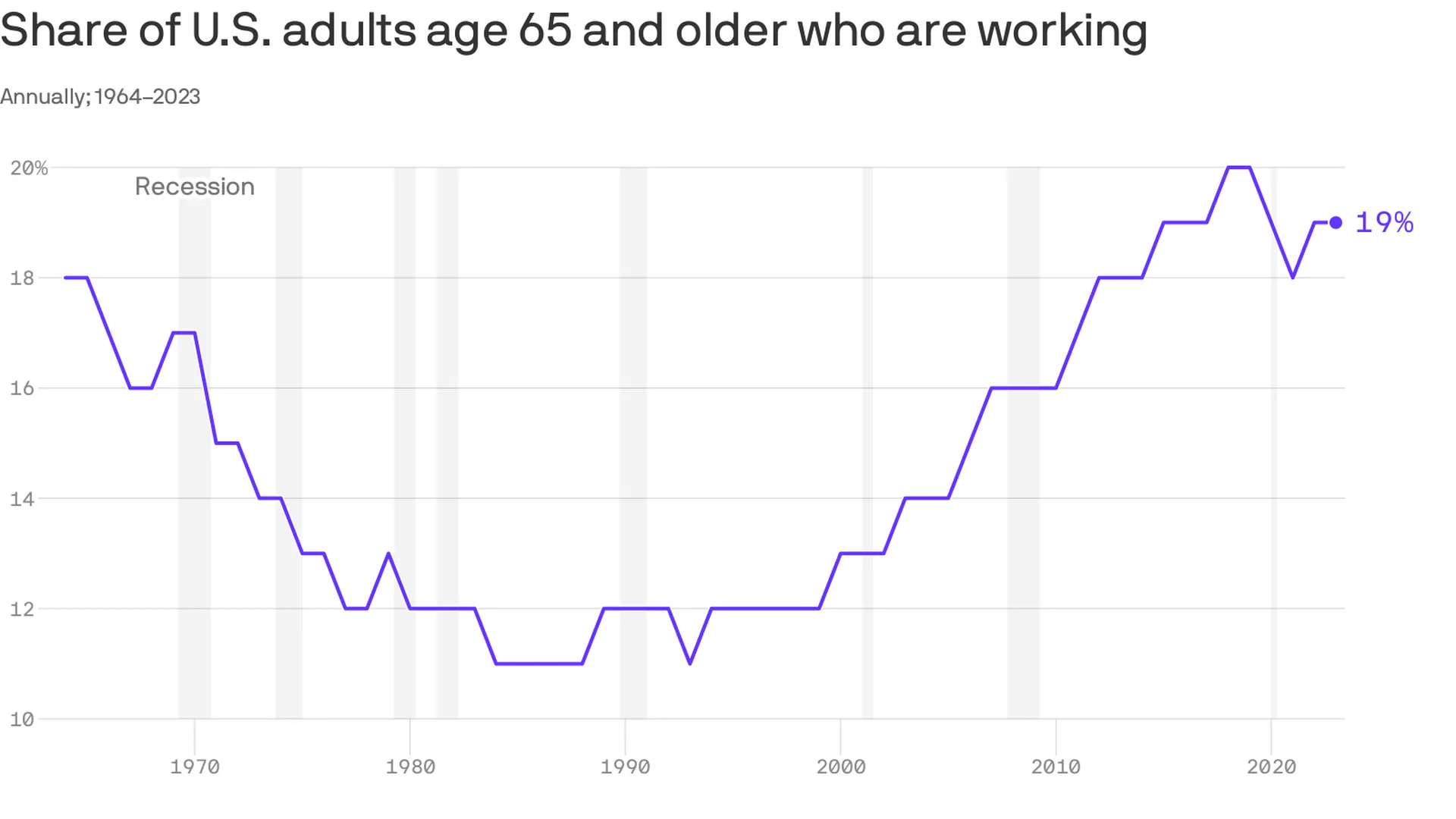
An increasing number of Americans age 65 and older are working — and earning higher wages, per a study from the Pew Research Center out Thursday.

Why it matters: 

This is good for the economy, especially as the U.S. population ages — but whether or not it’s good for older Americans is a bit more subjective.

Zoom in: 

The share of older adults working has been steadily increasing since the late 1980s, with a detour during the pandemic as older folks retired in greater numbers. Several forces are driving the shift:

  • Older workers are increasingly likely to have a four-year degree, and typically workers with more education are more likely to be employed.
  • Technology has made many jobs less physically taxing, so older workers are more likely to take them.
  • Meanwhile, changes in the Social Security law pushed many to continue working past 65 to get their full retirement benefits.
  • At the same time, there’s been a shift away from pension plans, which typically force people out of a job at a certain age, into 401(k) style plans that are less restrictive (and less generous, critics say).

By the numbers: 

Last year, the typical 65+ worker earned $22 an hour, up from $13 (in 2022 dollars) in 1987. That’s about $3 less than the average for those age 25-64, and the number includes wages of full- and part-time workers.

Be smart: 

Before Social Security existed, older people worked — a lot. In the 1880s, about three-fourths of older men were employed, said Richard Fry, senior researcher at Pew. They also didn’t live as long.

  • Meanwhile, the 65+ age group is a fast-growing one — by 2032 all the baby boomers will be in this category, per the BLS’s projections, and their increased workforce participation is good for an economy that is struggling with long-term labor shortages.

The big picture: 

“If people are working longer because they find purpose in their jobs and want to stay engaged, that’s good for them individually,” said Nick Bunker, head of economic research at Indeed Hiring Lab.

  • It’s also good for the productive capacity of the economy, and the firms where they work. “Older folks have lots of experience and knowledge to pass down,” he said.
  • Yes, but: If there are people who want to retire, but can’t because of financial constraints, “that’s bad,” he added.

What to watch: 

The share of older adults working peaked before the pandemic — will it surpass those levels?

  • The number hasn’t bounced back as much as anticipated partly because older Americans benefited hugely from the stock market surge and real estate gains of the past few years — and didn’t need to work anymore.

Executive Intelligence and Its Relationship to Management Competence

These days I have been reading From Strength to Strength: Finding Success, Happiness, and Deep Purpose in the Second Half of Life by Arthur C. Brooks. Brooks is the former President of the American Enterprise Institute and is currently a professor at both the Harvard Kennedy School and the Harvard Business School. 

From Strength to Strength is a book about intelligence and aging and the relationship of those aspects to personal happiness. The book is part sociology, part psychology, and part self-help. But if you read carefully, the book also offers important lessons in contemporary management.

The central theme of From Strength to Strength is how our intelligence changes over time and how individuals must change to make the best use of this changing intelligence. To make this point, Brooks cites Raymond Cattell, a British-American psychologist, who in 1971 suggested that there are two types of intelligence: “fluid intelligence” and “crystallized intelligence.”

Cattell and Brooks define fluid intelligence as the ability to “reason, think flexibly, and solve novel problems.” This is the kind of smarts and intelligence that is associated with young Nobel Prize winners and the tech titans of Silicon Valley. Crystallized intelligence is different. Brooks defines crystallized intelligence as the ability to use a stock of knowledge accumulated and learned in the past. Fluid intelligence is a characteristic of the young while crystallized intelligence is more closely associated with our aging process.

At its best, fluid intelligence is “raw smarts” or what I might term “mental athleticism.” Crystallized intelligence at its best is what we recognize as “wisdom.”

Extrapolating from Brooks’ observations and analysis, one can conclude that complex organizations, both not-for-profit and for-profit, require both kinds of executive intelligence. Fluid intelligence generates new ideas, top-shelf innovation, and executive solutions to the most difficult business problems. But crystallized intelligence provides organizations with “the wisdom and experience of people who have seen a lot.”

To further paraphrase Brooks, crystallized intelligence can teach the organization how not to make flagrant, self-defeating, and avoidable errors.

Reading Brooks and thinking about Cattell’s research led me to two observations. First, in our general corporate environment, including hospitals, we very much de-emphasize the value of crystallized intelligence. Just at the moment when many “older” executives are at the highest point of institutional wisdom, our modern corporate structure tends to react in two ways:

  • In general, we no longer give these so-called older executives jobs of responsibility and/or importance. These jobs are reserved for younger executives whose critical qualification is powerful levels of fluid intelligence.
  • Also, many corporate organizations demand what I would characterize as “early retirement.” This is especially true in many prominent American companies when long-tenured executives are required to retire in their late fifties or early sixties. If you place these retirements in the context of crystallized intelligence, then such retirements inevitably lead to a significant loss of human capital to our overall national economy. This includes the loss of long-term accumulated smarts, and most importantly, a loss of organizational wisdom.

Turning this discussion more specifically to hospital management leads to my second observation. Since Covid, the number of hospital CEO resignations has significantly increased when compared to previous years. Additionally, not only has CEO turnover increased but a number of important, influential, and highly capable CEOs—who previously might have been expected to work into their mid-sixties or, perhaps, even into their early seventies—have also decided to leave hospital leadership.

If we come back then to the central observations of Brooks and Cattell, we can see that hospital leadership and management, which is already challenged by so many external and difficult factors, is now losing critically required crystallized intelligence and wisdom.

Having said all this, it is still patently obvious that your organization requires the fluid intelligence of the next generation and the generation after that. That kind of intelligence is necessary and essential to solve today’s and tomorrow’s hardest healthcare problems. And, of course, to innovate and then to innovate some more.

But at the same time, your hospital or health system must also preserve a prominent place for older executives who possess the crystallized intelligence that assures your hospital will prioritize caring, thoughtfulness, and an essential level of managerial balance—all things that come along with executive wisdom.

From Strength to Strength signals a new way of looking at your executive team. This includes understanding that executives of differing tenures bring very different types of intelligence to the organization. And, it requires finding the proper balance between fluid and crystallized intelligence to give your hospital the very best opportunity to re-find its way to a much-needed new vision of hospital success.

2023 State of Healthcare Performance Improvement Report: Signs of Stabilization Emerge

Executive Summary

Hospitals and health systems are seeing some signs of stabilization in 2023 following an extremely difficult year in 2022. Workforce-related challenges persist, however, keeping costs high and contributing to issues with patient access to care. The percentage of respondents who report that they have run at less than full capacity at some time over the past year because of staffing shortages, for example, remains at 66%, unchanged from last year’s State of Healthcare Performance Improvement report. A solid majority of respondents (63%) are struggling to meet demand within their physician enterprise, with patient concerns or complaints about access to physician clinics increasing at approximately one-third (32%) of respondent organizations.

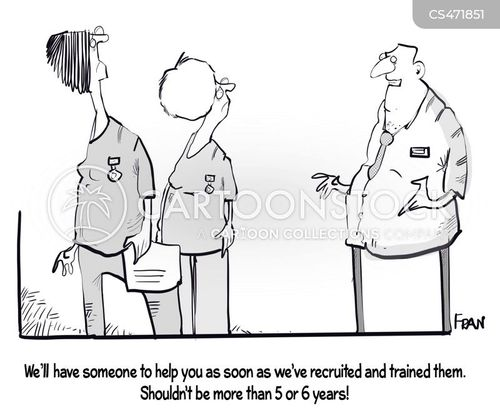
Most organizations are pursuing multiple strategies to recruit and retain staff. They recognize, however, that this is an issue that will take years to resolve—especially with respect to nursing staff—as an older generation of talent moves toward retirement and current educational pipelines fail to generate an adequate flow of new talent. One bright spot is utilization of contract labor, which is decreasing at almost two-thirds (60%) of respondent organizations.

Many of the organizations we interviewed have recovered from a year of negative or breakeven operating margins. But most foresee a slow climb back to the 3% to 4% operating margins that help ensure long-term sustainability, with adequate resources to make needed investments for the future. Difficulties with financial performance are reflected in the relatively high percentage of respondents (24%) who report that their organization has faced challenges with respect to debt covenants over the past year, and the even higher percentage (34%) who foresee challenges over the coming year. Interviews confirmed that some of these challenges were “near misses,” not an actual breach of covenants, but hitting key metrics such as days cash on hand and debt service coverage ratios remains a concern.

As in last year’s survey, an increased rate of claims denials has had the most significant impact on revenue cycle over the past year. Interviewees confirm that this is an issue across health plans, but it seems particularly acute in markets with a higher penetration of Medicare Advantage plans. A significant percentage of respondents also report a lower percentage of commercially insured patients (52%), an increase in bad debt and uncompensated care (50%), and a higher percentage of Medicaid patients (47%).

Supply chain issues are concentrated largely in distribution delays and raw product and sourcing availability. These issues are sometimes connected when difficulties sourcing raw materials result in distribution delays. The most common measures organizations are taking to mitigate these issues are defining approved vendor product substitutes (82%) and increasing inventory levels (57%). Also, as care delivery continues to migrate to outpatient settings, organizations are working to standardize supplies across their non-acute settings and align acute and non-acute ordering to the extent possible to secure volume discounts.

Survey Highlights

98% of respondents are pursuing one or more recruitment and retention strategies
90% have raised starting salaries or the minimum wage
73% report an increased rate of claims denials
71% are encountering distribution delays in their supply chain
70% are boarding patients in the emergency department or post-anesthesia care unit because of a lack of staffing or bed capacity
66% report that staffing shortages have required their organization to run at less than full capacity at some time over the past year
63% are struggling to meet demand for patient access to their physician enterprise
60% see decreasing utilization of contract labor at their organization
44% report that inpatient volumes remain below pre-pandemic levels
32% say that patients concerns or complaints about access to their physician enterprise are increasing
24% have encountered debt covenant challenges during the past 12 months
None of our respondents believe that their organization has fully optimized its use of the automation technologies in which it has already invested

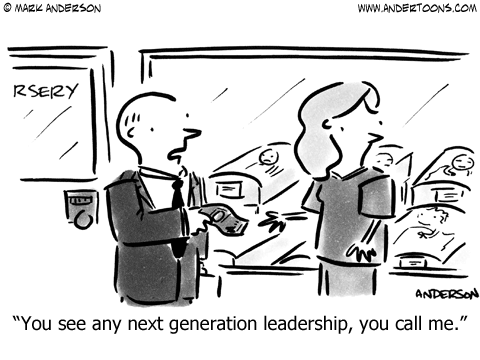
Cartoon – Next Generation Leadership

Health systems bulk up C-suites ahead of transformation

https://www.beckershospitalreview.com/hospital-management-administration/health-systems-bulk-up-c-suites-ahead-of-transformation.html

Faced with tighter margins and continued rising costs, many health system C-suites are restructuring. At least 17 health systems have reorganized executive teams and some eliminated C-suite roles.

 The chief operating officer role in particular has been on the chopping block for health systems but not everyone is slimming down.

Some are bulking up amid organizational transformation with an eye on the future.

In June, Sutter Health in Sacramento, Calif., named Todd Smith, MD, its inaugural senior vice president and chief physician executive, responsible for supporting the health system through clinical transformation. Dr. Smith will focus on service line standards, reducing variation and strengthening the system’s relationship with medical group and community physicians.

Sutter isn’t the only system adding clinical leaders to the C-suite. Mass General Brigham in Somerville, Mass., named Erica Shenoy, MD, PhD, its first chief of infection control in June. Her expanded role is accountable for leading the integration of infection control at the system and developing and implementing infection control standards, policies and measurements. She was also appointed to the National Infection Control Advisory Committee to guide HHS earlier this year.

Meritus Health in Hagerstown, Md., added physician leadership to its executive team. Adrian Park, MD, became the system’s first chief surgical officer with responsibility for building a surgical program with advanced technology and minimally invasive procedures to the system. He is known for surgical innovation in laparoscopic techniques, and holds more than 20 patents.

MaineHealth in Portland recently added Chris Thompson, MD, to the C-suite as the system’s first chief medical transformation officer. He is responsible for chief medical officer duties as well as innovating in care delivery.

Richmond, Va.-based VCU Health and OU Health in Oklahoma City named their first chief nursing executives as well earlier this year.

Health systems are also adding strategic experts with expertise in patient experience, transformation and data analytics.

Atlanta-based Emory Healthcare created a new role for Amaka Eneanya, MD, to serve as chief transformation officer, accountable for enhancing patient and clinician experiences. She took on the role in July and is tasked with developing systemwide strategies to boost patient experience, improve access to care, increase community engagement and enrich clinician experience. Dr. Eneanya works with the system’s diversity, equity and inclusion office to prioritize strategies for health equity, diversity and inclusion in care delivery as well.

“Amaka is a forward-thinking leader who is well versed in transformational strategy and operational structure and will help us move Emory Healthcare to the next level,” said Joon S. Lee, MD, CEO of Emory Healthcare. “We look forward to working with her in our continued pursuit to transform and strengthen patient access and the patient experience.”

Last year, Centura Health in Centennial, Colo., also added a chief transformation officer, Scott Lichtenberger, MD, as a new position to balance short-term improvements and long-term value. He is responsible for ensuring the system delivers results quickly.

Finally, Cleveland Clinic has elevated another IT leader into the C-suite in recent weeks. Albert Marinez was named the system’s first chief analytics officer, set to begin his new role Aug. 28. He previously served as chief analytics officer of Intermountain Health in Salt Lake City, and will be responsible for overseeing data strategies for better patient care and lower costs at Cleveland Clinic. He will also have accountability for boosting the system’s growth alongside chief digital officer Rohit Chandra, PhD.

Spotting a “skills mismatch” in the nursing pipeline

https://mailchi.mp/27e58978fc54/the-weekly-gist-august-11-2023?e=d1e747d2d8

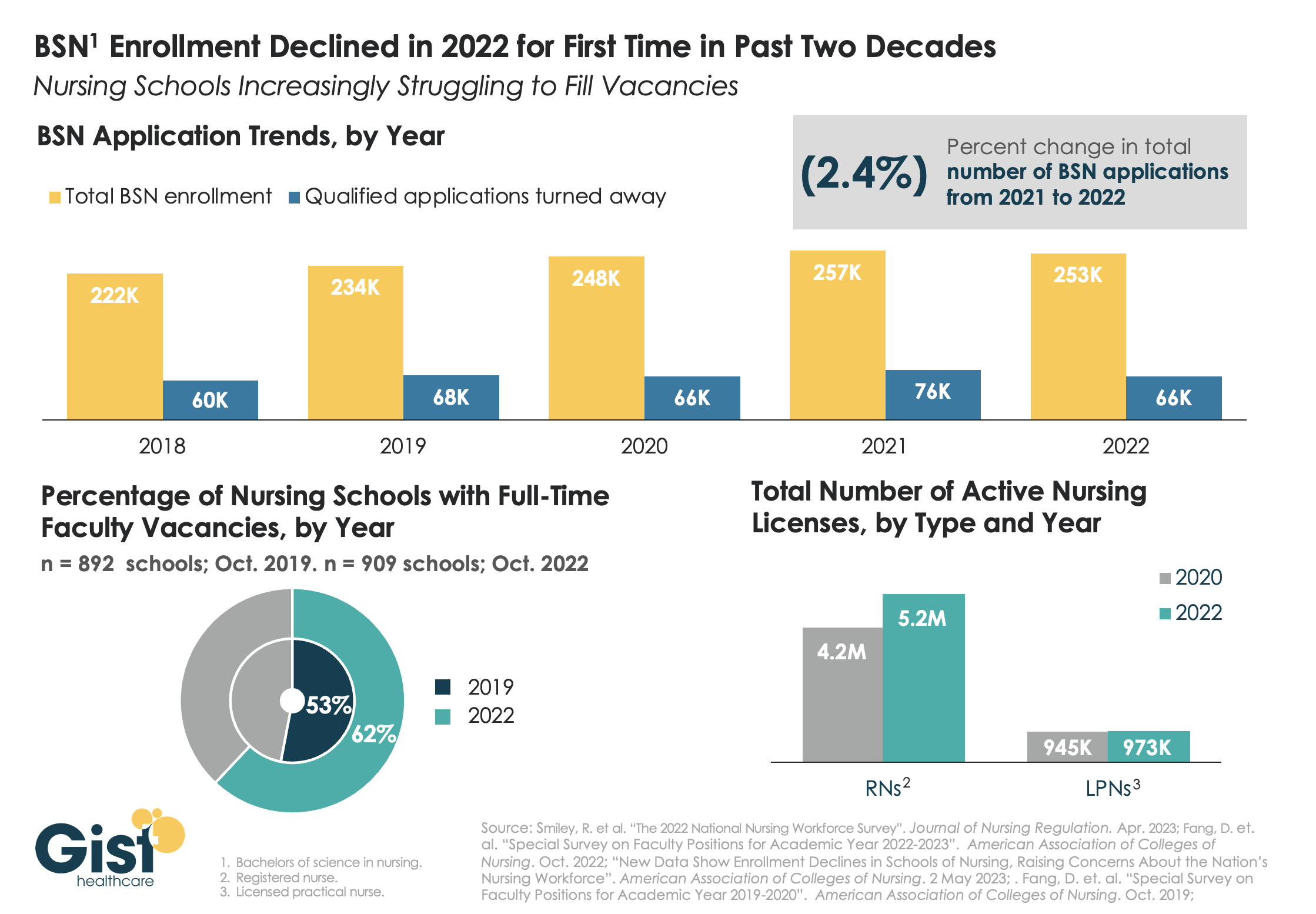
While last week’s graphic looked at how a wave of retirements has hit the nursing workforce, this week we take a look at the pipeline of nurses in training to fill that gap. In recent years, there has been a consistent stream of qualified applicants who want to become BSN nurses, but schools don’t have the capacity to admit them.

One reason: an ongoing shortage of nursing faculty, which recent retirements have exacerbated. The percentage of nursing schools with at least one full-time faculty vacancy grew from 53 percent in 2019 to 62 percent in 2022. 

Looking at registered nurses (RNs), the number with active licenses has continued to grow at a much higher rate than the supply of licensed practice nurses (LPNs) with active licenses. 

The relatively small LPN workforce is especially significant, given rising interest in team-based nursing care, which aims to utilize a higher number of LPNs, supervised by RNs and BSNs.

Expanding training programs with an eye toward the skills and mix needed to deliver team-based care will be critical to ensuring a stable, efficient nursing workforce for future decades.