


https://mailchi.mp/9f24c0f1da9a/the-weekly-gist-june-5-2020?e=d1e747d2d8

Continuing our series of Gist member convenings to discuss the “Brave New World” that awaits in the post-pandemic era, we brought together a group of senior human resources and nursing executives this week for a Zoom roundtable.
Several themes emerged from the discussion. First, there was general consensus that the COVID crisis exposed a workforce that had become over-specialized and inflexible. Said one chief nursing officer, “Our workforce is much more brittle than we thought.” A key lesson learned is the need for increased cross-training—especially for nurses, and especially in critical care. Systems should work now to increase the supply of nurses comfortable in an ICU environment to enable hospitals to flex staff across settings and roles to deal with future waves of the virus.
Not surprisingly, layoffs were top-of-mind for many. Executives were of one mind on the need to safeguard clinical staff as much as possible, and many systems are now considering deep cuts to management and administrative ranks: “It’s easier to stand in front of your clinical staff and be able to say you’ve stripped millions from administration before turning to clinical cuts.”
There was broad consensus for the potential for artificial intelligence and robotic process automation to enable greater reliability and productivity at lower cost in areas such as billing, coding, and even some clinical functions—and that the pandemic will accelerate plans to implement these solutions.
On a more optimistic note, one executive shared that “relationships between clinicians and administrators have never been stronger. The pandemic has forced us to have difficult and constructive conversations we would have never had the courage to have before.”
Another noted the pandemic has spotlighted new leadership talent who might otherwise have been overlooked, and plans are now in place to formally recognize and retain newly crisis-tested talent for the work of restructuring the system.
On the whole, the discussion was far more upbeat that we had expected—as difficult as the crisis has been for many teams, the opportunity to rethink old ways of doing business seems to have created renewed enthusiasm even in the face of daunting financial and operational challenges ahead.

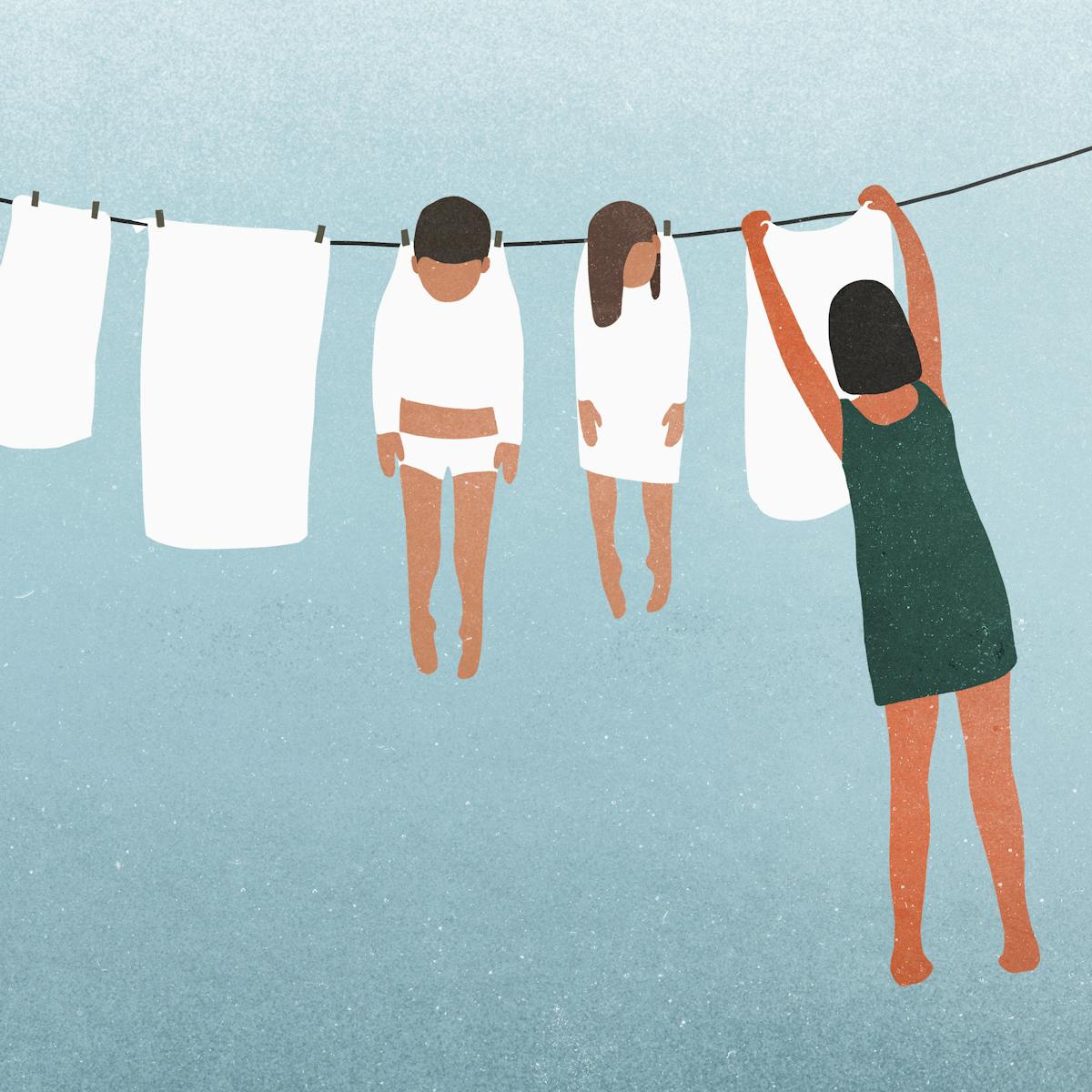
I have a Ph.D. from Harvard and a 20-month-old child.
Without child care, life revolves around the toddler.
I am a political science professor and researcher, but lacking child care, I count myself lucky to work a few hours each day.
I am increasingly aware there is no such thing as the so-called work/family conflict. This is not only a personal observation. Scholars have found that good jobs – full-time, with benefits – and family, without help, are simply incompatible.
The concept is also wrong. If three-quarters of American women become mothers, and also most women do paid work, then doing both is, well, life; it’s not some existential, context-free choice.
Work and family are both full-time pursuits. If the problem is framed as a choice between them, the battle is lost, since family will usually win. Telecommuting and “workplace flexibility” are important but do not make up for a lack of time and space to think and work.
Those who need care, especially little children, are needy and adorable, and mothers are evolutionarily disposed to focus on them.
(Whoops, excuse me, the toddler is trying to kill herself again … OK, child saved, with minimal screaming on both of our parts. Now what was I thinking? Did I reorder all our prescriptions? Hold on, I’ll be back.)
The national shift to home-based work and schooling has had challenging consequences for parents, especially mothers. Sometimes these effects are lovely, like giving us more time with family, but if your goal is getting work done, good luck to you.

Working at home these days without child care is incredibly difficult unless I can escape to another room and close a door. This inevitably triggers screaming, but oh well.
She’s worse than a cat; she climbs on me, presses things on the computer, sucks its edges and screams for attention, in addition to the normal baby bodily functions that comprise a disproportionate section of my thinking – when did she last poop? Is that a rash?
It’s not just me.
Submissions from women to academic journals have plummeted since COVID-19 hit.
One geography professor tweeted, “It’s hard enough to keep my head barely above the water with the kids at home and interruptions every 2 min … I can’t imagine writing a paper now.”
Another scholar said the data on diminished submissions from women made her cry because it wasn’t just her.
It turns out that someone has to supervise – and sometimes force – children’s learning, even if online, and this takes actual work. With parks, museums, sports, pools and movie theaters closed, and with kids mostly unable to hang out with friends, someone also has to do the physical and emotional labor of keeping children busy, engaged and upbeat. This too is work.
Then there is the simple fact that family members are eating, working and playing in houses most of the time, which means more cooking, more cleaning, more grocery shopping and, yes, more toilet paper.
(OMG the baby took a two-hour nap. I got to exercise and even shower. No time for leg-shaving but I’m still a new woman. Now what was I thinking…)
Because it is not just time, you see. Sometimes the child is playing quietly, and theoretically I could sit down and bang out a research article, but my brain is fuzzy as hell.
I used to wonder what cows thought, standing there chewing their cud in a field. Now I know. They are thinking nothing. Especially with the nursing, I have great sympathy with cows lately.
Before the baby, and before COVID-19, I had great plans for composing scholarly articles in my head during all that nursing downtime. But I forgot that hormones can change your brain and behavior.

Feminist theory and research finds that much of what people think of as “biological sex” – female or male – is socially constructed, as in, strongly based on culturally contingent assumptions about women and men as groups. I firmly believe, and teach, this as evidence-based truth.
Hormones, though, have undeniable physical and mental effects. If they are turning your body into a milk-production and child-protection facility, there can be some side effects on brain function. Many of these changes (increased empathy and vigilance) are useful evolutionarily, and the physical alterations appear to be short-lived. But there can also be negative effects on memory and focus. If your brain is your job, as mine is, this can cause some serious work disruption.
Pat Schroeder had two young children when first elected to Congress as a Democrat from Colorado in the 1970s. When asked how she could do both jobs, she famously replied, “I have a brain and a uterus, and I use them both.”
I try to live up to Schroeder’s standard, but lately I’ve found I have to qualify it; I tell myself she meant sequentially, not simultaneously.
Sequential is fine, as long as I have time and space to switch gears – I’m a first-time mom at 40 and the gears sometimes stick or stall out – and the peace of mind to focus beyond the child and the never-ending housework. We don’t call this “women’s work” anymore, and men do more than they used to, but it’s essential work and still mostly done by women.
With luck and science, COVID-19 will recede soon, and we can trickle back to offices, for which I have a newfound respect.
Will the U.S. take something positive from this crisis by learning an enduring lesson about the power of child care?
Americans tend to think of having children as an expensive, private choice. The alternative is to think of it as a public good.
Other countries offer far more generous parental leave and low-cost, high-quality daycare, knowing that “work versus family” is a false formulation. The U.S. is losing serious talent and promoting gender inequality by continuing to misunderstand the problem.
There are many potential options when child care is made a priority in a society.
Government subsidies for child care centers would help low-income workers have access to good care. The U.S. almost managed this in 1971, when Congress passed, on a bipartisan vote, a bill to establish child care centers across the country, funded in part by the federal government. President Richard Nixon vetoed the bill.
Universal pre-K starting at age 3, as in New York City, is another option to advance the interests of working parents and children.
And because working parents are drowning in high child-care costs, the government could offer subsidies and tax relief for curriculum-based care – which encourages child development and learning as well as safety – for those early years. I make a pretty good salary, but still, an extra US$1,000 a month or more to ensure my child is safe and well cared for while I work is painful.
It’s not a work-family conflict; it is a lack of high-quality, low-cost child care. Framing the problem otherwise damages the ability to enact good solutions.
It also makes a lot of good, hardworking parents feel enduring guilt over a problem that isn’t theirs alone to solve.


https://mailchi.mp/f4f55b3dcfb3/the-weekly-gist-may-15-2020?e=d1e747d2d8

As health systems take tentative steps to resume non-emergent procedures and office visits, it’s increasingly clear that volume will not quickly return to pre-COVID levels. According to a health system chief physician executive we spoke with this week, this has forced medical group leadership to reevaluate physician compensation, at least for the rest of 2020.
“We’ve kept our doctors pretty much whole for the past three months,” she said, “but given the losses we’re facing for the rest of the year, we can’t keep it up much longer.” We’ve had a flurry of calls in the past two weeks with systems in the same position. Most of their doctors are primarily paid based on their productivity. “We all loved the upside opportunity,” mused one physician leader, “but we never thought something could happen that would completely wipe us out.”
This point got us wondering whether we might be seeing the beginning of the end of RVU-based physician compensation, as physicians seek greater stability and safety. But moving to a salary-driven model is far from easy. How much upside are doctors willing to trade off for security? The survey data used to benchmark compensation, based on last year’s business model, is essentially irrelevant—and likely will be for next year as well. According to one consultant, “Given that there’s no consistency in volume or compensation strategy, the 2020 data will be garbage, too.” Not to mention, dramatically shifting the way doctors are paid has huge cultural and operational ramifications.
There are no easy answers, but we think this conversation about the future of compensation, and the larger issues it raises about doctors’ relationship to, and role in, the health system, is long overdue. One executive shared his system’s plan to pay their doctors 85 percent of their 2019 compensation through the summer. He’s not sure yet what the other side of August looks like. “Maybe we’ll have physicians who want to continue to be paid on productivity like a car salesman. But if you want that kind of upside now, the safety net likely won’t be there the next time.” However, he hopes this experience “provides a reset point that gets us to a more sustainable—and professional—way of working together for the future.”
 HENRY KOTULA