Axios-Ipsos poll: The skeptics are growing

https://www.axios.com/axios-ipsos-poll-gop-skeptics-growing-deaths-e6ad6be5-c78f-43bb-9230-c39a20c8beb5.html

Axios-Ipsos poll: The skeptics are growing - Axios

A rising number of Americans — now nearly one in three — don’t believe the virus’ death toll is as high as the official count, despite surging new infections and hospitalizations, per this week’s installment of the Axios-Ipsos Coronavirus Index.

Between the lines: Republicans, Fox News watchers and people who say they have no main source of news are driving this trend.

Why it matters: It shows President Trump’s enduring influence on his base, even as Americans overall say they are increasingly dissatisfied with his handling of the virus and political support is shifting toward Joe Biden.

What they’re saying: “We live in highly tribal and partisan times, and people are more likely to believe cues and signals from their political leaders than the scientists or the experts,” says Cliff Young, president of Ipsos U.S. Public Affairs.

  • And that’s just the purest form of populism, the demonization of experts to further political ends. But to what end? Fantasy is meeting reality head-on right now.”
  • “People can see the world around them, they know it’s different, but they still can think that the media and politicos are using it to go after Trump.”

By the numbers: Overall, 31% of Americans say they believe the number of Americans dying is lower than the number reported, up sizably from 23% when we asked the same question in May.

Here’s what’s driving the shift in Week 17 of our national survey:

  • Republicans who say the death count is overinflated rose from 40% to 59%.
  • Among independents, that share rose from 24% to 32%.
  • The small share of Democrats with that view was effectively flat, ticking up from 7% to 9%.
  • Most Americans still believe the actual number of deaths is either higher (37%) or on par with (31%) the official count.

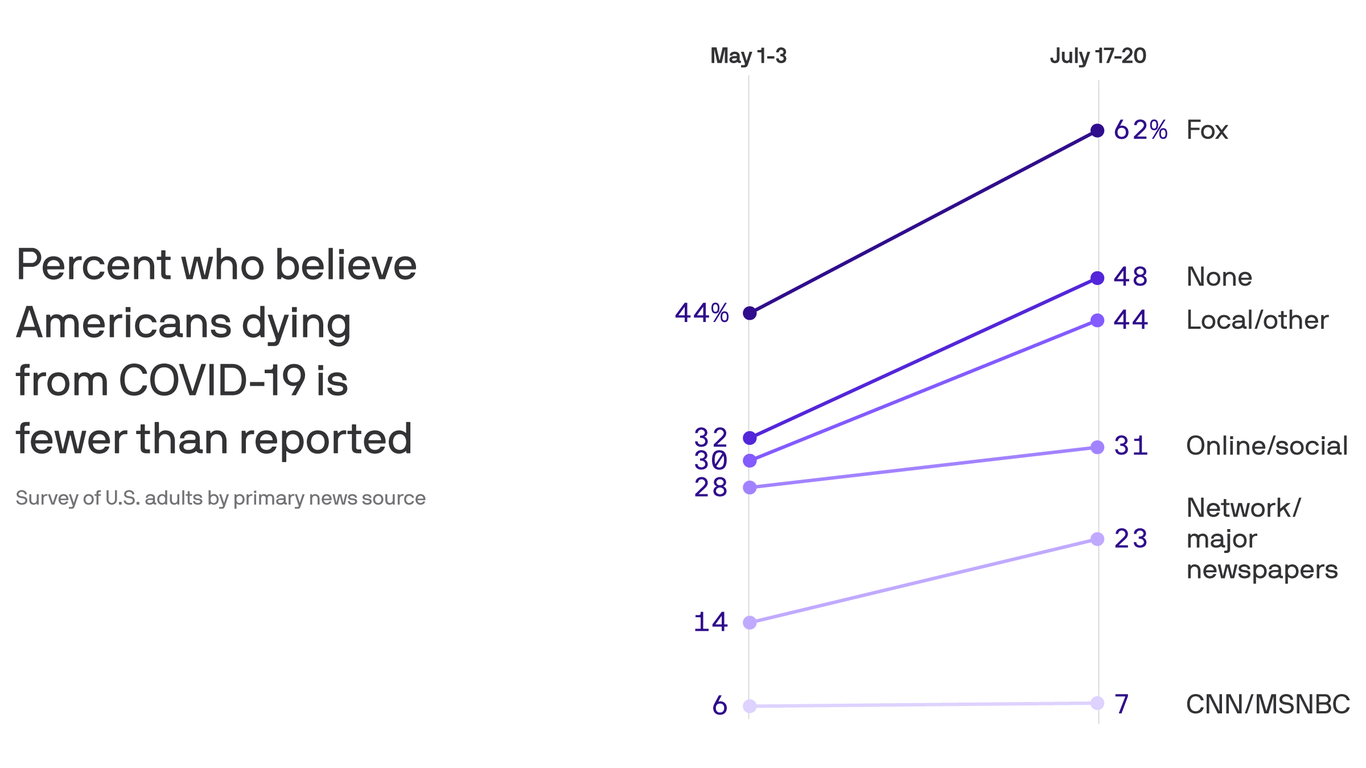
Where you get your news has a strong correlation to your faith in the numbers.

  • Fox News watchers who say deaths are being over-counted shot up from 44% to 62%, even higher than Republicans overall.
  • Other big gains came from those who say they have no primary news source, from 32% to 48%; and those whose primary sources include local news, from 30% to 44%.
  • There was a smaller increase among people whose primary news source is one of the networks or major U.S. newspapers, while views of those who primarily watch CNN and MSNBC remained about the same.

The big picture: The survey shows most Americans are digging in for a long fight against the virus, even if they have conflicting views about what to believe.

  • 72% say they’re prepared to maintain social distancing or self-quarantining for as long as it takes — up from 49% in May — as people realize the end is more than a couple of months off.

This survey finds the highest overall use of face masks since the pandemic began — with 99% of Democrats and 75% of Republicans now saying they’re wearing a mask sometimes or all of the time when they go out.

  • But there’s enough inconsistency in people’s precautions to undercut much of the gains.
  • Only 40% say they wore masks sometimes or all the time when visiting family and friends. And parents are less likely to make their children wear masks outside the home than to do so themselves.

1 big finger wag: Most Americans blame someone other than themselves for the crisis.

  • Three-fourths of respondents say most other Americans are behaving in ways that are making the country’s recovery from the COVID-19 pandemic worse, while one-fourth said they’re making it better.
  • Democrats were more likely (83%) than other groups to say others are making things worse.


Covid-19 data is a public good. The US government must start treating it like one.

https://www.technologyreview.com/2020/07/17/1005391/covid-coronavirus-hospitalizations-data-access-cdc/

Data for the public good - O'Reilly Radar

The US has failed to prioritize a highly effective and economical intervention—providing quick and easy access to coronavirus data.

Earlier this week as a pandemic raged across the United States, residents were cut off from the only publicly available source of aggregated data on the nation’s intensive care and hospital bed capacity. When the Trump administration stripped the Centers for Disease Control and Prevention (CDC) of control over coronavirus data, it also took that information away from the public.


I run a nonpartisan project called covidexitstrategy.org, which tracks how well states are fighting this virus. Our team is made up of public health and crisis experts with previous experience in the Trump and Obama administrations. We grade states on such critical measures as disease spread, hospital load, and the robustness of their testing. 


Why does this work matter? In a crisis, data informs good decision-making. Along with businesses, federal, state, and local public health officials and other agencies rely on us to help them decide which interventions to deploy and when workplaces and public spaces can safely reopen. Almost a million people have used our dashboards, with thousands coming back more than 200 times each.

To create our dashboards, we rely on multiple sources. One is the National Healthcare Safety Network (NHSN), run by the CDC. Prior to July 14, hospitals reported the utilization and availability of intensive care and inpatient beds to the NHSN. This information, updated three times a week, was the only publicly available source of aggregated state-level hospital capacity data in the US.

With 31 states currently reporting increases in the number of hospitalized covid-19 patients, these utilization rates show how well their health systems will handle the surge of cases.


Having this information in real time is essential; the administration said the CDC’s system was insufficiently responsive and data collection needed to be streamlined. The US Department of Health and Human Services (HHS) directed hospitals (pdf) to report their data to a new system called HHS Protect.

Unfortunately, by redirecting hospitals to a new system, it left everyone else in the dark. On July 14, the CDC removed the most recent data from its website. As we made our nightly update, we found it was missing. After significant public pressure, the existing maps and data are back—but the agency has added a disclaimer that the data will not be updated going forward.


This is unacceptable. This critical indicator was being shared multiple times a week, and now updates have been halted. US residents need a federal commitment that this data will continue to be refreshed and shared.

The public is being told that a lot of effort is going into the new system. An HHS spokesman told CNBC that the new database will deliver “more powerful insights” on the coronavirus. But the switch has rightly been criticized because this new data source is not yet available to the public. Our concerns are amplified by the fact that responsibility for the data has shifted from a known entity in the CDC to a new, as-yet-unnamed team within HHS.

I was part of the team that helped fix Healthcare.gov after the failed launch in 2013. One thing I learned was that the people who make their careers in the federal government—and especially those working at the center of a crisis—are almost universally well intentioned. They seek to do the right thing for the public they serve.


In the same spirit, and to build trust with the American people, this is an opportunity for HHS to make the same data it’s sharing with federal and state agencies available to the public. The system that HHS is using helps inform the vital work of the White House Coronavirus Task Force. From leaked documents, we know that reports for the task force are painstakingly detailed. They include county-level maps, indicators on testing robustness, and specific recommendations. All of this information belongs in the public domain.

This is also an opportunity for HHS to make this data machine readable and thereby more accessible to data scientists and data journalists. The Open Government Data Act, signed into law by President Trump, treats data as a strategic asset and makes it open by default. This act builds upon the Open Data Executive Order, which recognized that the data sets collected by the government are paid for by taxpayers and must be made available to them. 

As a country, the United States has lagged behind in so many dimensions of response to this crisis, from the availability of PPE to testing to statewide mask orders. Its treatment of data has lagged as well. On March 7, as this crisis was unfolding, there was no national testing data. Alexis Madrigal, Jeff Hammerbacher, and a group of volunteers started the COVID Tracking Project to aggregate coronavirus information from all 50 state websites into a single Google spreadsheet. For two months, until the CDC began to share data through its own dashboard, this volunteer project was the sole national public source of information on cases and testing.

With more than 150 volunteers contributing to the effort, the COVID Tracking Project sets the bar for how to treat data as an asset. I serve on the advisory board and am awed by what this group has accomplished. With daily updates, an API, and multiple download formats, they’ve made their data extraordinarily useful. Where the CDC’s data is cited 30 times in Google Scholar and approximately 10,000 times in Google search results, the COVID Tracking Project data is cited 299 times in Google Scholar and roughly 2 million times in Google search results.


Sharing reliable data is one of the most economical and effective interventions the United States has to confront this pandemic. With the Coronavirus Task Force daily briefings a thing of the past, it’s more necessary than ever for all covid-related data to be shared with the public. The effort required to defeat the pandemic is not just a federal response. It is a federal, state, local, and community response. Everyone needs to work from the same trusted source of facts about the situation on the ground.

Data is not a partisan affair or a bureaucratic preserve. It is a public trust—and a public resource.


U.S. blows past coronavirus record with more than 70,000 new cases in one day

https://www.washingtonpost.com/nation/2020/07/17/coronavirus-live-updates-us/?utm_campaign=wp_post_most&utm_medium=email&utm_source=newsletter&wpisrc=nl_most

FirstFT: Today's top stories | Financial Times

There was a time in the United States when 40,000 coronavirus cases in a day seemed like an alarming milestone. That was less than three weeks ago.

Now, the number of new infections reported each day is reaching dizzying new heights. On Thursday, the daily U.S. caseload topped 70,000 for the first time, according to data tracked by The Washington Post.

Record numbers of covid-19 fatalities were reported in Florida, Texas and South Carolina on Thursday, and officials throughout the Sun Belt are worried that hospitals could soon reach a breaking point.

Here are some significant developments:

  • Masks are now mandatory in more than half of U.S. states — with the governors of Arkansas and Colorado the latest to issue face-covering orders. Major retailers phased in new mask policies, and Maryland Gov. Larry Hogan (R), chairman of the National Governors Association, said that masks should be mandated in states across the country.
  • Larry Fink, the chief executive of investment firm BlackRock, said that if states moving forward with reopening plans required masks, the economy would recover much sooner.
  • Atlanta Mayor Keisha Lance Bottoms (D) blasted Georgia’s Republican governor, Brian Kemp (R), for suing to stop block her city’s mask ordinance, accusing him of “putting politics over people.”
  • An unpublished report from the White House Coronavirus Task Force suggests that nearly 20 hard-hit states should enact tougher public health measures.
  • Real-time coronavirus tracking data temporarily disappeared from the Centers for Disease Control and Prevention’s website, sparking an outcry.
  • President Trump faces rising disapproval and widespread distrust on coronavirusaccording to a new Post-ABC poll.
  • India on Friday surpassed 1 million confirmed coronavirus cases, becoming the third country to cross that threshold, behind the United States and Brazil..


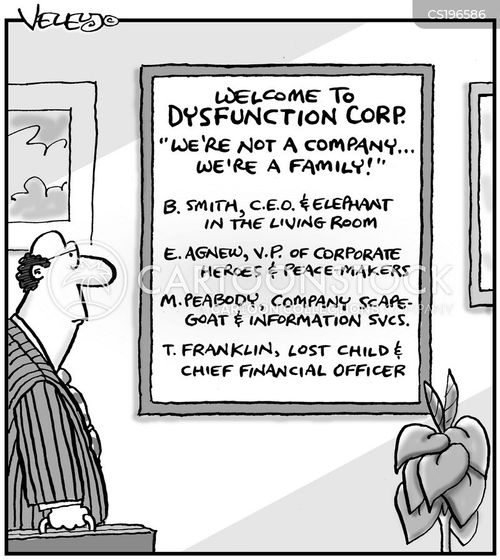
Cartoon – Welcome to Dysfunctional Corp.

Cartoon – Welcome to Dysfunction Corp | HENRY KOTULA

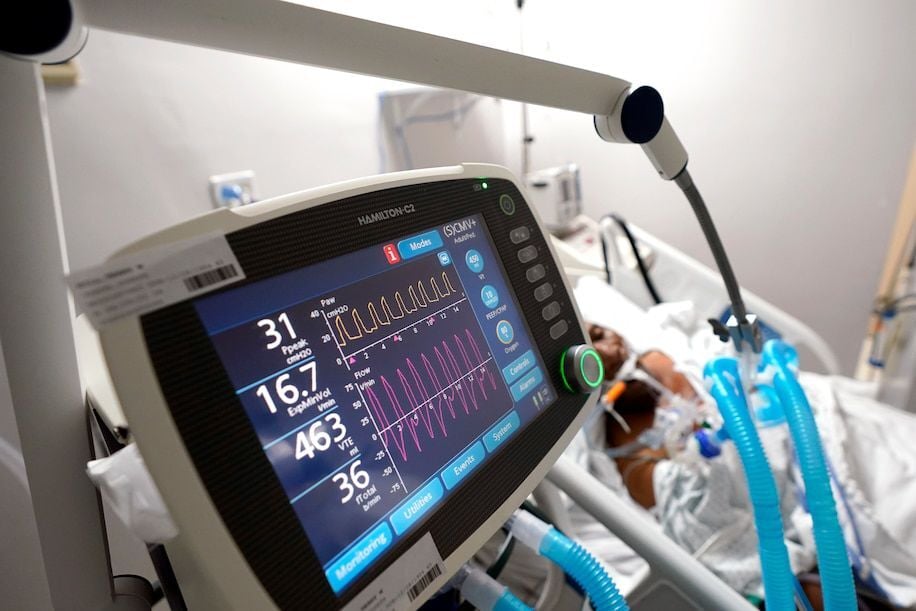
Disappearance of covid-19 data from CDC website spurs outcry

https://www.washingtonpost.com/health/2020/07/16/coronavirus-hospitalization-data-outcry/?utm_campaign=wp_main&utm_medium=social&utm_source=facebook&fbclid=IwAR2ONMOtMxy2LFUw0qKhDZwb1n5yFRv2oCTZlrr49_YpdO8WTzkSC90JjY0

Disappearance of covid-19 data from CDC website spurs outcry ...

Governors join calls for delay of administration plan to shift control from the CDC as Trump administration pledges to make data available to the public.

On the eve of a new coronavirus reporting system this week, data disappeared from a Centers for Disease Control and Prevention website as hospitals began filing information to a private contractor or their states instead. A day later, an outcry — including from other federal health officials — prompted the Trump administration to reinstate that dashboard and another daily CDC report on the pandemic.

And on Thursday, the nation’s governors joined the chorus of objections over the abruptness of the change to the reporting protocols for hospitals, asking the administration to delay the shift for 30 days. In a statement, the National Governors Association said hospitals need the time to learn a new system, as they continue to deal with this pandemic.

The governors also urged the administration to keep the information publicly available.

The disappearance of the real-time data from the CDC dashboard, which was taken down Tuesday night before resurfacing Thursday morning, was a ripple effect of the administration’s new hospital reporting protocol that took effect Wednesday, according to a federal health official who spoke on the condition of anonymity to discuss internal deliberations.

Without receiving the data firsthand, CDC officials were reluctant to maintain the dashboard — which shows the number of patients with covid-19, the disease caused by the virus, and hospital bed capacity — and took it down, the federal health official said. The CDC dashboard states that its information comes directly from hospitals and does not include data submitted to “other entities contracted by or within the federal government.” It also says the dashboard will not be updated after July 14.

The dashboard “was taken down in a fit of pique,” said Michael R. Caputo, the assistant secretary for public affairs at the Department of Health and Human Services. “The idea CDC scientists cannot rely upon their colleagues in the same department for data collection, or any other scientific work, is preposterous.”

This week, the CDC, the government’s premier public health agency whose medical epidemiologists analyze the hospital data, also stopped producing reports about trends in the pandemic that had gone twice a week to states, and six days a week to officials at multiple federal agencies. Adm. Brett Giroir, an assistant secretary in the HHS who oversees coronavirus testing, was unhappy that the CDC hospital report stopped Wednesday and Thursday mornings, according to the federal health official.

Caputo said that the administration’s goal is to maintain transparency, adding that conversations were still taking place between HHS officials and the CDC on a plan to keep producing the dashboard updates and the reports. “We expect a resolution,” he said.

Another HHS spokesperson said the CDC might create a new dashboard, based on a wider set of information.

During a conference call for journalists Thursday on coronavirus testing, Giroir did not acknowledge his displeasure with the reports’ discontinuation. But he said: “Those data are really critical to all of us. … I wake up in the morning and first thing I do, I look at the data. I look at midday. I look at it at night before I go to bed. … We drive the response based on that.”

The CDC site had been one of the few public sources of granular information about hospitalizations and ICU bed capacity. About 3,000 hospitals, or about 60 percent of U.S. hospitals, reported their data to the CDC’s system.

The president of the American Medical Association, Susan R. Bailey, spoke out Thursday on the uncertainties about access to data. “[W]e urge and expect that the scientists at the CDC will continue to have timely, comprehensive access to data critical to inform response efforts,” she said.

Governors, hospital officials and state health officers were given scant notice of the change in the reporting system. Two top administration health officials said in a letter to governors early this week that some hospitals were not complying with the previous protocols, suggesting that states might want to consider bringing in the National Guard to help gather the information. Hospital industry leaders vehemently protested that characterization, as well as the idea that they should be assisted by the National Guard in the midst of a pandemic.

HHS and CDC officials have said the protocol was changed to streamline reporting of data that is used, among other things, to determine the federal allocation of therapeutics, testing supplies and protective gear. Instead of reporting to the long-standing CDC system, hospitals must send data about covid-19 patients and other metrics to a recently hired federal contractor, called TeleTracking, or to their state health departments.

At least some state health departments that have been collecting data for their hospitals and sending it to Washington have already said the switch will make it impossible for them to continue, at least for now. The changed protocol includes a requirement that hospitals send several additional types of data that some state systems are not equipped to handle, state health officials said.

The Pennsylvania Department of Health sent a notice to hospitals Tuesday night saying that its platform was not ready to accommodate the new federal requirements, so that hospitals needed to report every day to both the state and to TeleTracking.

Charles L. Gischlar, spokesman for the Maryland Department of Health, said the reporting change “is a heavy lift for hospitals.”

The new system “exceeds the capacity of the current statewide system” to which hospitals had been reporting, he said, so the state no longer can send consolidated information to the federal government. As a result, he said in a statement, hospitals must provide data individually to the government.


Unpublished White House Coronavirus Task Force Report – 18 States in Red Zone

https://mailchi.mp/publicintegrity/exclusive-white-house-docs-shows-18-states-in-coronavirus-red-zone?e=4539e77864

An unpublished document prepared for the White House Coronavirus Task Force and obtained by the Center for Public Integrity suggests more than a dozen states should revert to more stringent protective measures, limiting social gatherings to 10 people or fewer, closing bars and gyms and asking residents to wear masks at all times.

The document, dated July 14, says 18 states are in the “red zone” for COVID-19 cases, meaning they had more than 100 new cases per 100,000 population last week. Eleven states are in the “red zone” for test positivity, meaning more than 10 percent of diagnostic test results came back positive. 

It includes county-level data and reflects the insistence of the Trump administration that states and counties should take the lead in responding to the coronavirus. The document has been shared within the federal government but does not appear to be posted publicly.

It’s clear some states are not following the task force’s advice. For instance, the document recommends that Georgia, in the red zone for both cases and test positivity, “mandate statewide wearing of cloth face coverings outside the home.” But Gov. Brian Kemp signed an order Wednesday banning localities from requiring masks.


The U.S. is way behind on coronavirus contact tracing. Here’s how we can catch up.

The U.S. is way behind on coronavirus contact tracing. Here’s how we can catch up.

The US is amassing an army of contact tracers to contain the covid ...

Get this: Vietnam, a country of 97 million people, has reported zero deaths from only 372 cases of coronavirus.

Theories abound about how they pulled it off. But public health experts chalk it up to swift action by the Vietnamese government, including contact tracing, mass testing, lockdowns, and compulsory wearing of masks.

Here, masks have become a political landmine. And despite President Trump claiming, “We have the greatest testing program anywhere in the world,” some states with surging infections have testing shortages—like Arizona.

But what about contact tracing, the process of calling potentially exposed people and persuading them to quarantine?

“I don’t think we’re doing very well,” said Dr. Anthony Fauci, director of the National Institute of Allergy and Infectious Diseases, when asked in June about contact tracing nationwide. Most states haven’t even made public how fast or well they’re implementing the process, if at all.

Florida, the nation’s current No. 1 hotspot for the virus, is often failing to trace positive cases. This, despite the state spending over $27 million on a contract with Maximus, a company notorious for underbidding, understaffing, and performing poorly on government services contracts in multiple states.

Yet, there are bright spots elsewhere. California allocated 5 percent of staff across 90 state government departments to contact trace. North Carolina’s Wake County trained 110 librarians. In Massachusetts, counties have used state pandemic funds to hire more nurses.

There are three reasons why state and local governments should reassign public employees or hire new staff outright as the country—finally—ramps up contact tracing.

One, outsourcing what should be a public job to for-profit companies like Maximus reduces transparencylimits democratic decision-makinglowers service quality, and increases inequality, all while rarely saving public dollars. Public control is particularly important when it comes to contact tracing, which involves personal health data.

Two, this is a chance to begin to reverse decades of cuts to public health budgets, which have made the worst public health crisis in a century even worse. Almost a quarter of the local public health workforce has been let go since 2008. Federal spending on nondefense discretionary programs like public health is now at a historic low.

The Trump administration, as expected, is headed in the wrong direction. On Tuesday, it stripped the Centers for Disease Control and Prevention (CDC) of control over coronavirus data. State and local governments must do all they can to right the ship.

And three, contact tracing is an opportunity to chip away at systemic racism. Since World War II, public sector employment has helped equalize American society by offering workers of color stable, well-paid employment. The median wage earned by Black employees is significantly higher in the public sector than in private industries.

Privatizing public work like contact tracing contributes to racial and gender income disparities. Workers at federal call centers operated by Maximus, for example, are predominately women and people of color paid poverty wages as low as $10.80 an hour with unaffordable health care.

If #BlackLivesMatter—as many governors and mayors across the country have proclaimed in recent weeks—then contact tracing should be treated as what it is: a public good.

To catch up to other countries like Vietnam, the U.S. needs to get contact tracing right—and that means doing it with public workers.


Administration’s war on the public health experts

https://www.axios.com/trump-public-health-experts-cdc-fauci-e1509d14-0cf1-4b1c-b107-7753bf95395d.html

Trump's war on the public health experts - Axios

A pandemic would normally be a time when public health expertise and data are in urgent demand — yet President Trump and his administration have been going all out to undermine them.

Why it matters: There’s a new example almost every day of this administration trying to marginalize the experts and data that most administrations lean on and defer to in the middle of a global crisis.

Here’s how it has been happening just in the past few weeks:

  • The administration has repeatedly undermined the Centers for Disease Control and Prevention. Most recently, Trump has criticized the CDC’s school reopening guidelines, Education Secretary Betsy DeVos declared that “kids need to be in school,” and the administration has reportedly ordered hospitals to bypass the CDC in reporting coronavirus patient information.
  • It has repeatedly undermined Anthony Fauci. Trump distanced himself on Wednesday from an op-ed attack by White House trade adviser Peter Navarro, but longtime Trump aide Dan Scavino also called the infectious diseases specialist “Dr. Faucet” in a Facebook post accusing him of leaking his disagreements. And the White House gave a opposition research-style list of the times Fauci “has been wrong” to the Washington Post and other media outlets.
  • Trump himself undermined public health experts generally with his retweet of former game show host Chuck Woolery’s “everyone is lying” tweet — which blamed “The CDC, Media, Democrats, our Doctors, not all but most, that we are told to trust.”
  • Trump has made numerous statements suggesting, over and over again, that we wouldn’t have as many COVID cases if we just tested less. (From his Tuesday press conference at the White House: “If we did half the testing we would have half the cases.”)

The impact: The result is that the CDC — which is supposed to be the go-to agency in a public health crisis — is distracted by constant public critiques from the highest levels. And Fauci, “America’s Doctor,” is the subject of yet another round of stories about whether Trump is freezing him out.

  • “The way to make Americans safer is to build on, not bypass, our public health system,” Tom Frieden, a former CDC director under Barack Obama, said in a statement to Axios about the efforts to sideline the agency.
  • “Unfortunately, as with mask-up recommendations and schools reopening guidance, the administration has chosen to sideline and undermine our nation’s premier disease fighting agency in the middle of the worst pandemic in 100 years,” Frieden said.
  • And Fauci, in an interview with The Atlantic, said of the efforts to discredit him: “Ultimately, it hurts the president to do that … It doesn’t do anything but reflect poorly on them.”

The other side: The White House insists there’s no problem. “President Trump has always acted on the science and valued the input of public health experts throughout this crisis,” said White House deputy press secretary Sarah Matthews.

  • Trump campaign communications director Tim Murtaugh closed ranks with the experts as well. “President Trump has said repeatedly that he has a strong relationship with Dr. Fauci, and Dr. Fauci has always said that the President listens to his advice,” he said.
  • And Department of Health and Human Services spokesman Michael Caputo declared that “the scientists and doctors speak openly, they are listened to closely, and their advice and counsel helps guide the response.”
  • “Frankly, when it comes to this tempest in a teapot over Dr. Fauci, I blame the media and their unending search for a ‘Resistance’ hero, for turning half a century of a brilliant scientist’s hard work into a clickbait headline that helps reporters undermine the president’s coronavirus response,” Caputo said.

Between the lines: Murtaugh deflected several times when asked whether there was a deliberate strategy to marginalize the CDC and the experts: “The President and the White House have consistently advised Americans to follow CDC guidelines. The President also believes we can open schools safely on time and that we must do so.”

  • However, one administration official said there were parts of the CDC school reopening guidelines that were impractical, and noted that kids can also suffer long-term harm by staying out of school too long.

Our thought bubble, by Axios White House reporter Alayna Treene: The responses make it clear that the White House and the Trump campaign don’t want to advance the narrative that they’re deliberately battling with America’s health experts, or that there’s any kind of strategy behind it.

The bottom line: When the history of this pandemic is written, it will show that the public health experts who were trying to fight it also had to deal with political fights that made their jobs harder.