There’s one Obamacare repeal bill left standing. Here’s what’s in it.

https://www.washingtonpost.com/graphics/2017/politics/cassidy-graham-explainer/?utm_term=.c90e0ce41aa2

Image result for cartoon dilbert beating a dead horse

After a dramatic series of failed Senate votes in July, there’s one repeal-and-replace plan for the Affordable Care Act left standing. Trump is pushing for a vote, per Politico, and John McCain has announced his support, but the bill has yet to gain significant traction.

The proposal, crafted by Sens. Bill Cassidy (R-La.), Lindsey O. Graham (R-S.C.) and Dean Heller (R-Nev.), essentially turns control of the health-care markets over to the states. Rather than funding Medicaid and subsidies directly, that money would be put into a block grant that a state could use to develop any health-care system it wants. It also allows states to opt out of many ACA regulations. “If you like Obamacare, you can keep it,” Graham has said, using a common nickname for the health-care law. “If you want to replace it, you can.”

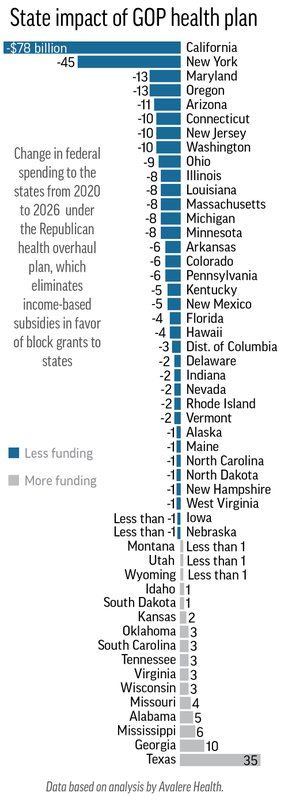
In reality, that may not be true. The Medicaid expansion and subsidy funding would be cut sharply compared to current spending, going to zero in a decade.

 “You can’t actually keep the same program if your federal funding is being cut by a third in 2026,” said Aviva Aron-Dine, a senior fellow at the left-leaning Center on Budget and Policy Priorities. And even putting aside the cuts, she said, the block grant structure would fundamentally change the health-care landscape. “[Funding] is capped, so it wouldn’t  go up and down with the economy,” when fewer or more people become eligible for subsidies.

Republicans contest this. The drop in funding “gives strong incentives for the states to be more efficient with their program,” said Ed Haislmaier, a senior fellow at the conservative Heritage Foundation. That is, states may be able to maintain the ACA structure and regulations as long as they streamline operations.

If the streamlining turns out to be insufficient, the cuts would hit liberal states the hardest, according to a report by the Center for Budget and Policy Priorities. This is largely because they tend to be the biggest spenders on health care: They’ve expanded Medicaid and aggressively signed people up for marketplace coverage. They have the most to lose.

 On the whole, Aron-Dine says, “This is a lot more similar to the [Senate repeal bill] than different. All of them end with devastating cuts to marketplace subsidies, Medicaid, and weakening of consumer protections.”

Haislmaier agreed, pointing out the Cassidy-Graham plan was originally intended as an amendment to the Senate bill.

Here’s the nitty gritty of what would change, compared to the ACA and the Senate plan that failed in July:

Who would need to be covered

Under the Cassidy-Graham plan, the mandates would be eliminated at the federal level. States could choose to keep the measure, replace it or get rid of it completely.

How they would pay for coverage

The federal health insurance subsidies that help most people with ACA marketplace plans afford their coverage would change. This bill would shift those subsidies to the state-level, so people in some states may see their subsidy scaled back or eliminated.

Proposed changes to Medicaid

The bill would restructure Medicaid and decrease its funding. That would make it very difficult for states to maintain the Medicaid expansion.


Trump wants one last Senate push on Obamacare repeal

http://www.politico.com/story/2017/09/05/trump-obamacare-repeal-senate-242346

Image result for beating a dead horse

The odds are slim, but the White House still hopes for action on a bill drafted by Lindsey Graham and Bill Cassidy.

President Donald Trump and some Senate Republicans are refusing to give up on Obamacare repeal, even after this summer’s spectacular failure and with less than a month before a key deadline.

The president and White House staff have continued to work with Republican Sens. Lindsey Graham of South Carolijna and Bill Cassidy of Louisiana over the summer on their proposal to block grant federal health care funding to the states. And though the bill is being rewritten and Congress faces a brutal September agenda, Trump and his allies on health care are making a last-gasp effort.

“He wants to do it, the president does. He loves the block grants. But we’ve got to have political support outside Washington,” Graham said in an interview. He said the bill needs to have a “majority of the Republican governors behind the idea” to gain momentum in the Senate.

But there’s far more work to do even than that. Senate Majority Leader Mitch McConnell would need to find room on the packed calendar this month to hold another uncertain push to repeal Obamacare on party lines. The Senate has only until the end of the month to pass the measure using powerful budget reconciliation procedures, but is also planning to fund the government, raise the debt ceiling, write a new defense policy bill and extend a host of expiring programs.

Cassidy said he hopes to have the bill text finalized by this week and has declined to reveal details about what changed in the bill during August.

“We are still refining the legislative language — just things you got to clear up,” he said. “We think we have good legislation, good policy.”

The Congressional Budget Office would also still need time to analyze the cost of the bill, a process that could take several weeks.

Trump berated McConnell and the Senate GOP over the summer for falling one vote short of sending repeal into conference with the House in July, when Sen. John McCain of Arizona voted down the GOP’s “skinny” repeal bill. So the White House has continued to work on the Graham-Cassidy bill behind the scenes, seeing it as the best option to make progress, according to several administration officials.

The bill would keep most of Obamacare’s taxes and devolve many spending decisions to the states. It was submitted as an amendment to the repeal bill in July but did not receive a vote; aides say it could not pass the Senate in its current form.

Trump has intermittently told aides he wants progress on health care and is still frustrated that the bill failed. The White House’s legislative team has talked with Republican governors in recent weeks and is planning to bring more to the White House, according to one of the officials. Internally, White House officials say they have listened to concerns from governors and tried to tweak the state block grant formulas.

Hill leadership hasn’t played a central role in the effort.

McConnell said in Kentucky last month that the path forward is “somewhat murky” and pointed to efforts by Sen. Lamar Alexander (R-Tenn.) to stabilize insurance markets as one avenue forward, though he doubted Democrats’ resolve on the bipartisan effort.

“We’re going to see what Sen. Alexander and his team can do on a bipartisan basis. The Democrats have been pretty uninterested in any reforms. They’re really interested in sending money to insurance companies but not very interested in reforms,” McConnell said then.

Inside the White House, there is little hope that a health care bill can happen quickly, with a stacked legislative agenda. And some close to the president prefer he would focus on tax reform and other immediate fiscal issues.

The Senate parliamentarian has ruled that the chamber’s reconciliation instructions, which allow the GOP to evade a Democratic filibuster and the chamber’s 60-vote requirement, expire at the end of the month. Republicans are planning to use their next budget measure to pass tax reform via a simple majority. But Graham insisted there’s a short window to fulfill the party’s seven-year promise if the GOP goes into overdrive, starting this week.

“It’s possible, yes. But you’ve got to do it quickly … introduce it this week, have a hearing soon about the bill, then the process is set to actually take it to floor and vote,” Graham said. “Everything has to fall in place.”

California’s Health Care Workforce

http://www.chcf.org/publications/2017/08/california-workforce

Image result for California's Health Care Workforce

California’s health care industry employed more than 1.4 million people in 2015. Five Almanac guides provide data on wages, education, and workplaces for selected health professions.

California’s health care industry employed more than 1.4 million people in 2015. Among these workers, nearly 55% were employed in ambulatory settings, about 25% in hospitals, and 20% in nursing or residential care facilities. An aging population, population growth, and federal health reform will likely contribute to increased demand.

This series of Quick Reference Guides from the CHCF California Health Care Almanac examines specific segments of the state’s health care workforce, focusing on pharmacists and pharmacy technicians, physician assistants, health diagnostic and treatment therapists, clinical laboratory scientists and technicians, and imaging professionals.

Among the trends:

  • California’s supply of pharmacists grew 17% between 2012 and 2015, while the supply of pharmacy technicians increased by 8%. About half of the state’s pharmacists were trained in California.
  • The number of physician assistants (PAs) in California grew 37% between 2012 and 2015. The Northern and Sierra region had more licensed PAs per capita than the rest of the state.
  • The supply of occupational and physical therapists increased between 2012 and 2015, while the supply of speech-language pathologists decreased slightly.
  • Between 2012 and 2015, California’s supply of clinical laboratory scientists remained stable while the number of medical/clinical lab technicians rose 11%.

The complete guides, as well as the 2014 editions, are available as Document Downloads.

California Nurses: Taking the Pulse

http://www.chcf.org/publications/2017/08/california-nurses

Image result for California Nurses: Taking the Pulse

In 2015, 330,000 registered nurses made up the largest health profession in California. This overview of the nursing workforce looks at supply, demographics, education, distribution, and pay.

California is home to more than 330,000 actively licensed registered nurses (RNs), making nursing the single largest health profession in the state.

Key findings include:

  • The nursing workforce has grown more diverse. Non-white RNs accounted for almost half (48%) of employed nurses in 2015. However, compared to the state’s population, Latinos were significantly underrepresented in the RN workforce, while Filipinos and whites were significantly overrepresented.
  • The pre-licensure programs for RNs produced 11,119 graduates in 2015, slightly down from a high of 11,512 in 2010.
  • California’s RN workforce relies on foreign-educated nurses. In 2015, about one in five employed RNs were trained outside the US.
  • 64% of employed RNs worked in a hospital in 2014. Another 15% were in ambulatory care.
  • Nurses’ average income was $100,000 in 2015.
  • In 2015, more than two-thirds (71%) of LVN graduates came from for-profit schools.

Quick reference guides, as well as a full report from 2010, are available under Document Downloads.

Judge weighs in on whether Jahi McMath is brain dead

Judge weighs in on whether Jahi McMath is brain dead

In this Oct. 2, 2014 file photo Sandra Chatman, left, and Nailah Winkfield look on as a photo of their granddaughter and daughter, respectively, Jahi McMath, 13, is shown during a press conference at Dolan Law Firm in San Francisco, Calif. Christopher Dolan, attorney for Jahi McMath’s family, showed photos and a pair of videos where McMath moves her foot and arm in response to the voice of her mother Nailah Winkfield in a home in New Jersey. She was declared brain-dead in California after tonsil, throat and nose surgeries to relieve her sleep apnea. (Ray Chavez/Bay Area News Group)

Jahi McMath, the Oakland teenager whose brain death case has sparked national debate, may not currently fit the criteria of death as defined by a state law written in conjunction with the medical establishment, a judge wrote in an order Tuesday.

In his ruling, Alameda County Superior Court Judge Stephen Pulido wrote that while the brain death determination in 2013 was made in accordance with medical standards, there remains a question of whether the teenager “satisfies the statutory definition of ‘dead’ under the Uniform Determination of Death Act.”

His ruling comes in the years-long medical malpractice suit against UCSF Benioff Children’s Hospital Oakland and its doctors, which also challenges the hospital’s 2013 brain death diagnosis of the Oakland teenager following a complex nose, throat and mouth surgery.

The judge’s order pertains to the personal injury claim in the lawsuit, which the hospital sought to dismiss, and could result in a trial on whether Jahi is alive. An attorney for the family is arguing Jahi is alive and therefore entitled to more than the cap of $250,000 on medical malpractice lawsuits involving children who die as a result of surgery.

Pulido heavily cited Dr. Alan Shewmon, who concluded in a court declaration that Jahi doesn’t currently fit the criteria for brain death after reviewing 49 videos of her moving specific fingers and other extremities when given commands to do so. Shewmon, a professor emeritus of pediatrics and neurology at UCLA, wrote that Jahi “is a living, severely disabled young lady, who currently fulfills neither the standard diagnostic guidelines for brain death nor California’s statutory definition of death.” Shewmon also reviewed an MRI.

The girl’s family released some of the videos in 2014.

Reached Wednesday, hospital spokeswoman Melinda Krigel referred to a statement issued in July in which Children’s Hospital stood by its position that Jahi “fulfills the legal diagnostic criteria for brain death.” After her December 2013 surgery ended tragically, two doctors declared the teenager dead. An independent and court-appointed doctor from Stanford University later affirmed the diagnosis.

“The videotapes do not meet the criteria set forth in the guidelines” for determining brain death, the hospital said in the statement.

Bruce Brusavich, an attorney for Jahi’s family, did not return a call for comment Wednesday. The family has also filed a federal lawsuit.

Jahi’s story and her family’s fight to remove her from Children’s Hospital captured worldwide attention and inspired other families to question brain death determination of their loved ones.

In late December 2013, then-family attorney Christopher Dolan was successful in convincing a judge to order Jahi released from the Oakland facility, allowing the family to take her cross-country to a hospital in New Jersey. Unlike California, the Garden State has a law allowing guardians to reject a brain death diagnosis on religious grounds.

After leaving the New Jersey hospital, Jahi has been hooked up to breathing and feeding machines in a nearby apartment she shares with her mother, Nailah Winkfield, and other family members. She has used the machines to breathe and eat for nearly four years, a duration that is believed to be longer than any other U.S. patient declared brain dead.

Talk over Coffee into a Data Revolution for northern Nevada’s largest hospital system

http://www.beckershospitalreview.com/hospital-management-administration/steal-this-idea-how-renown-ceo-dr-tony-slonim-turned-a-talk-over-coffee-into-a-data-revolution-for-northern-nevada-s-largest-hospital-system.html

Image result for starbucks coffee for meetings

In May 2016, Tony Slonim, MD, DrPH, met fellow New Jersey native Joe Grzymski, PhD, at a Starbucks for coffee. Dr. Slonim, CEO of Reno, Nev.-based Renown Health, said he expected to trade stories about their home state, but they soon found their professional interests as compatible as their personal ones.

“Like all good things, it started at Starbucks over a coffee on a Saturday morning,” Dr. Slonim said, “As we let our minds expand and started thinking about complementary ways we could collaborate, this idea came up.”

This idea is a partnership between Renown and the Desert Research Institute, where Dr. Grzymski is senior director of applied research.

The duo began to think of ways they could combine the clinical data 946-bed Renown had on hand with the DRI’s environmental data to better understand the ways outside factors affect health outcomes in their community.

But the idea didn’t stop there. The pair also recognized that social determinants play an equally influential role in shaping a person’s health, so they made sure to include social data from the Governor’s Office of Economic Development in their new project, which did not yet have a name, but more importantly had a purpose.

“If we believe in population health, and the vision for population health, we’ve got to do a better job of understanding the health and the wellbeing of the people we’re serving,” said Dr. Slonim. “As an organization that’s got a large market share, it’s incumbent upon me as the CEO to think about how to use the most efficient resources for the most benefit for people that need it.”

At first, the collaboration was seen as a data-sharing project that would connect skilled researchers and analysts at the DRI with a wealth of combined information that had been inaccessible to a single provider in the past. However, it was only once Dr. Slonim and Dr. Grzymski took their idea to the 2016 BIO International Convention in San Francisco that they were able to find a third partner to provide them with yet another data set that would help them fully see the big picture of a person’s health.

Representatives from retail genetics firm 23andMe approached Dr. Grzymski following his talk at BIO. The company offered to provide genetic testing and sequencing for the project. Dr. Grzymski jumped at the opportunity, which would enrich the already robust data collection he and Dr. Slonim had begun to compile.

With genetic information as a fourth pillar of their potential data set, Renown and the DRI founded the Renown Institute for Health Innovation. The IHI’s most important initiative would go on to be named the Healthy Nevada Project.

At a September 2016 press conference, Dr. Slonim and other IHI leaders teamed up with Nevada Gov. Brian Sandoval to announce that the first 5,000 Reno residents who signed up to submit genetic samples would receive free access to the test results. Dr. Slonim believes offering this access to community members is what encouraged 5,000 people to sign up in only the first 24 hours of the enrollment period. With such an enthusiastic response, the leaders at the IHI decided to open up 5,000 more slots, which took one more day to fill. In only 48 hours, the Healthy Nevada Project had succeeded in enrolling 10,000 local residents to submit samples for genetic testing.

The project was off and running — quickly. And Dr. Slonim’s work was only just beginning.

Once 23andMe completed genetic sequencing of all 10,000 study participants in December, the Healthy Nevada Project still faced a looming question: What to do with all the data they’d collected?

“One-hundred more people per 100,000 die of cardiovascular disease in northern Nevada than national estimates. Our cancer rates are significantly higher and nobody knows why. So [we’re] trying to understand what the backdrop and the context is,” Dr, Slonim said. “Is it the mines that we have here? Is it the weather patterns that change because we’re in a valley? Our air pollution is higher, our particulate matter is higher — is that what causes lung cancer? We’re trying to figure this out, but you can’t do anything without data, so we started there.”

Dr. Slonim understands epidemiologists and analysts will have to spend many careful hours with the data to come to any concrete conclusions, but he believes the Healthy Nevada Project represents an essential first step for the future of the healthcare industry. If he and his colleagues could begin to harness the power of data in EHRs, then he sees a world of untapped potential that can help his community improve their health while also improving Renown’s organizational efficiency.

“This is the ultimate in strategic planning. If I figure out that our community is more at risk for cardiovascular disease 10 years from now, I can be thoughtful about how I go about recruiting cardiologists. If I know that the population is growing in pediatrics, I can start a program for pediatric residents at the medical school and grow my own pediatricians,” Dr. Slonim says. “The horizon for planning can be kept in view because we’re learning about our population’s health and disease. The second reason why I did this is because it’s the best way to engage consumers in their own healthcare to modify their behaviors.”

Dr. Slonim’s advice to hospital leaders looking to improve their capacity for innovative data concepts is simple: Take the first step. For the most part, the benefits of the Healthy Nevada project still lay ahead, as it has been only 15 months since that coffee meeting, but the game-changing potential cannot be understated. Dr. Slonim is confident that putting in the work to collect and analyze this comprehensive data will revolutionize the way Renown cares for its patients, and he believes other providers can follow suit.

“If you’re a large contributor to your market in healthcare with full range of integrated services across the continuum, get the environmental data. Get partnerships with the social data,” Dr. Slonim says. “Figure out how you can exercise your clinical EMRs and the great repository of data that are in there and put them in a big data warehouse and figure out how to analyze them. We’re not using predictive analytics in healthcare the way that other industries are, and we need to be better at that.”