

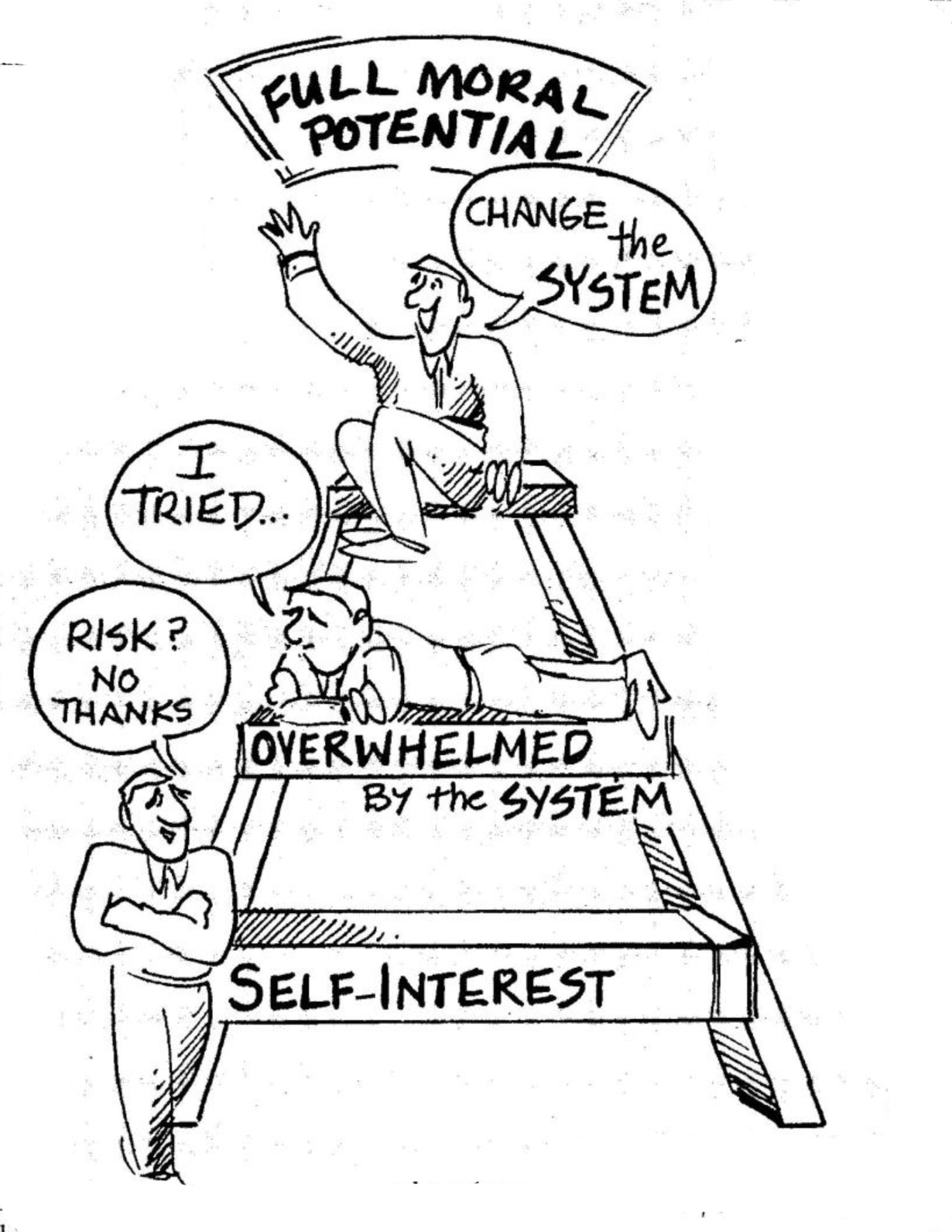
Cartoon – Full Moral Potential


https://www.healthleadersmedia.com/strategy/civica-rx-adds-12-health-systems-founding-members

Health system executives and policymakers alike are looking for ways to get drug prices under control.
The consortium of major health systems aims to tackle cost and shortage challenges by producing its own generics.
The number of participating hospitals has grown to about 750 in the U.S., with more expected to join.
A nonprofit alliance of health systems seeking to rein in drug costs and alleviate shortages has grown significantly in the four months since its launch.
Civica Rx announced Monday that 12 additional health systems, representing about 250 hospitals, have joined the venture as founding members, bringing the total number of participating U.S. hospitals to about 750.
The organization described its growth as momentum, with future growth expected, as policymakers and health system executives nationwide look for ways to wrangle escalating drug costs.
Three philanthropic organizations and seven major health systems—including Trinity Health, Catholic Health Initiatives, HCA Healthcare, Intermountain Healthcare, Mayo Clinic, Providence St. Joseph Health, and SSM Health—founded Civica Rx last September, with a plan to produce generic drugs to stabilize supply and challenge manufacturers that have hiked prices sharply.
With its launch, the organization identified 14 hospital-administered generics as its initial focus. The plan is for members to drive the selection of additional drugs.
The 12 new founding members announced Monday are as follows:
In a statement, Civica Rx CEO Martin VanTrieste expressed excitement and gratitude for the additions.
“Drug shortages have become a national crisis where patient treatments and surgeries are canceled, delayed or suboptimal,” VanTrieste. “We thank these organizations for joining us to make essential generic medicines accessible and affordable in hospitals across the country.”
The three philanthropic organizations that helped found Civica Rx are the Gary and Mary West Foundation, Laura & John Arnold Foundation, and the Peterson Center on Healthcare. The organization is collaborating also with the American Hospital Association’s Center for Health Innovation.

What happens when record increases in health insurance premiums and deductibles put too much stress on patients’ pocketbooks? They delay needed care out of fear they’ll be unable to shoulder an unexpected medical expense for themselves or their families.
Now more than ever, patients worry about their ability to cover out-of-pocket healthcare costs, a recent Commonwealth Fund survey shows. The percentage of patients who believe they could afford the care they need is falling, and many say satisfying their financial obligations for care has become more difficult.
But these data only tell part of the story. Our own research shows that while 68% of patients want to discuss financing options that could ease their minds about mounting healthcare expenses, providers are falling short—and families, especially, are feeling the pinch.
According to our survey, 27% of households with children are likely to delay care because they can’t afford to pay for it. Families are also less likely to pay their out-of-pocket costs for care in full—and their chances of having their account sent to collections are twice as high.
It’s not that families and individuals don’t want to cover their out-of-pocket costs. In fact, half of the patients surveyed were willing to select providers based on the availability of financing plans that stretch out their obligation into more manageable monthly payments. The trouble is, providers have been slow to adopt flexible payment plans. They are even slower to discuss financing options with patients or publicize them more broadly.
It’s time for a new approach to patient billing—one that takes into account patients’ desire to fulfill their financial obligations for care, addresses their concerns from the point of service, and demonstrates a willingness to meet them where they are.
The experience of one new mother in Florida illustrates the gains hospitals can make when they take a compassionate approach to patient collections. As she prepared to give birth to her daughter, she found herself facing a financial dilemma. The hospital required her to “reserve” her spot in its labor and delivery unit—for a $1,000 deposit. With no money in reserve and a baby on the way, she feared she wouldn’t be able to deliver her baby at the hospital.
She asked hospital representatives whether the hospital might consider a payment plan instead of a lump-sum payment. To her relief, the hospital allowed her to extend the payment over 12 months—interest-free. It’s an option that relieved the stress of the financial burden of care during what should be a joyous time for her family.
Offsetting the impact of out-of-pocket medical costs for individuals and families doesn’t require an overhaul of a hospital’s patient financial services program. Instead, hospitals can take simple steps to help patients more easily fulfill their financial obligations for care—and reduce their costs to collect as well as bad debt in the process.
Consider offering a variety of options for payment, such as low-interest and no-interest loans that all patients qualify for, without the fear of credit reporting or negative consequences. Setting the program up so that patients have a choice and opt into the program significantly helps the patient experience. Discuss their estimated out-of-pocket expense with patients before or at the point of care, and share information on payment plans widely, both onsite and online. Lastly, a program that is consumer friendly with easy ways to pay their bills and manage their accounts will go a long way to increase patient satisfaction.
Taking a more proactive approach to affordability is not only the right thing to do for patients but also the smart choice in protecting an organization’s long-term financial health.

Specialty drugs made up about 3% of prescriptions in California in 2017 but accounted for more than half of the prescription drug spending that year, according to new report that compiled drug spending from nine insurers in that state.
According to the first Prescription Drug Cost Transparency Report released by the California Department of Insurance, there were about 270,000 specialty prescriptions compared to about 1.4 million brand-name prescriptions and about 8.9 million generic prescriptions in 2017.
Insurers—including Aetna, Anthem, Cigna, Kaiser Permanente and UnitedHealthcare—reported spending upwards of $606 million on specialty drugs, $271.3 million on brand-name drugs and $172.6 million on generics in 2017.
Among other findings, the report said:
The most frequently prescribed specialty drugs included HIV drug Truvada, immunosuppressant Humira, insulin therapeutic Humalog, diabetes drug Victoza and hormonal agent Androgel.
The most costly specialty drugs by total annual prescription drug spending included Humira, arthritis drug Enbrel, Truvada, psoriasis and psoriatic arthritis drug Stelara and multiple sclerosis drug Copaxone.

https://www.npr.org/player/embed/673851375/681125070
Sen. Orrin Hatch, the Utah Republican retiring from 42 years in the Senate as a new generation is sworn in, leaves a long list of achievements in health care. Some were more controversial than others.
Hatch played key roles in shepherding the 1983 Orphan Drug Act to promote drug development for rare diseases, and the 1984 National Organ Transplant Act, which helped create a national transplant registry. And in 1995, when many people with AIDS were still feeling marginalized by society and elected leaders, he testified before the Senate about reauthorizing funding for his Ryan White CARE Act to treat uninsured people who have HIV.
“AIDS does not play favorites,” Hatch told other senators. “It affects rich and poor, adults and children, men and women, rural communities and the inner cities. We know much, but the fear remains.”
Hatch, now 84, co-sponsored a number of bills with Democrats over the years, often with Sen. Ted Kennedy of Massachusetts. The two men were sometimes called “the odd couple,” for their politically mismatched friendship.
In 1997, the two proposed a broad new health safety net for kids —the Children’s Health Insurance Program.
“This is an area the country has made enormous progress on, and it’s something we should all feel proud of — and Senator Hatch should too,” said Joan Alker, executive director of Georgetown University’s Center for Children and Families.
Before CHIP was enacted, the number of uninsured children in America was around 10 million. Today, it’s under half that.
Hatch’s influence on American health care partly came from the sheer number of bills he sponsored — more than any other living lawmaker — and because he was chairman of several powerful Senate committees.
“History was on his side because the Republicans were in charge,” said Dr. David Sundwall, an emeritus professor in public health at the University of Utah and Hatch’s health director in the 1980s.
When Ronald Reagan was elected president in 1981, the Senate became Republican-controlled for the first time in decades. Hatch was appointed chairman of what is now known as the Health, Education, Labor and Pensions Committee. The powerful legislative group has oversight of the Food and Drug Administration, Centers for Disease Control and Prevention and the National Institutes of Health.
“He was virtually catapulted into this chairmanship role,” Sundwall said. “This is astonishing that he had chairmanship of an umbrella committee in his first term in the Senate.”
In 2011, Hatch was appointed to the influential Senate Finance Committee, where he later became chairman. There he helped oversee the national health programs Medicare, Medicaid and CHIP.
Hatch’s growing influence in Congress did not go unnoticed by health care lobbyists. According to the watchdog organization Center for Responsive Politics, in the past 25 years of political campaign funding, Hatch ranks third of all members of Congress for contributions from the pharmaceutical and health sector. (That’s behind Democratic senators who ran for higher office — President Barack Obama and presidential nominee Hillary Clinton).
“Clearly, he was PhRMA’s man on the Hill,” said Dr. Jeremy Greene, referring to the trade group that represents pharmaceutical companies. Green is a professor of the history of medicine at Johns Hopkins University School of Medicine. Though Hatch did work to lower drug prices, Greene said, the senator’s record was mixed on the regulation of drug companies.
For example, an important piece of Hatch’s legislative legacy is the 1984 Hatch-Waxman Act, drafted with then-Rep. Henry Waxman, an influential Democrat from California. While the law promoted the development of cheaper, generic drugs, it also rewarded brand-name drug companies by extending their patents on valuable medicines.
The law did spur sales of cheaper generics, Greene said. But drugmakers soon learned how to exploit the law’s weaknesses.
“The makers of brand-name drugs began to craft larger and larger webs of multiple patents around their drugs,” aiming to preserve their monopolies after the initial patent expired, Greene said.
Other brand-name drugmakers preserved their monopolies by paying makers of generics not to compete.
“These pay-for-delay deals effectively hinged on a part of the Hatch-Waxman Act,” Greene said.
Hatch also worked closely with the dietary supplement industry. The multibillion-dollar industry specializing in vitamins, minerals, herbs and other “natural” health products, is concentrated in his home state of Utah.
“There was really no place for these natural health products,” said Loren Israelsen, president of the United Natural Products Alliance and a Hatch staffer in the late 1970s.
As the industry grew, there was a debate over how to regulate it: Should it be more like food or like drugs? In 1994, Hatch sponsored the Dietary Supplement Health and Education Act, known as DSHEA, which treats supplements more like food.
“It was necessary to have someone who was a champion who would say, ‘All right, if we need to change the law, what does it look like,’ and ‘Let’s go,'” Israelsen said.
Some legislators and consumer advocacy groups wanted vitamins and other supplements to go through a tight approval process, akin to the testing the Food and Drug Administration requires of drugs. But DSHEA reined in the FDA, determining that supplements do not have to meet the same safety and efficacy standards as prescription drugs.
That legislative clamp on regulation has led to ongoing questions about whether dietary supplements actually work and concerns about how they interact with other medications patients may be taking.
DSHEA was co-sponsored by Democrat Tom Harkin, then a senator from Iowa.
While that kind of bipartisanship defined much of Hatch’s career, it has been less evident in recent years. He was strongly opposed to the Affordable Care Act, and in 2018 called supporters of the heath law among the “stupidest, dumb-ass people” he had ever met. (Hatch later characterized the remark as “a poorly worded joke.”)
In his farewell speech on the Senate floor in December, Hatch lamented the polarization that has overtaken Congress.
“Gridlock is the new norm,” he said. “Like the humidity here, partisanship permeates everything we do.”
https://www.healthleadersmedia.com/strategy/now-its-adventhealth

Starting today, nearly 50 hospitals and 1,200 care venues will fall under the AdventHealth brand.
The name-change is part of a system-wide effort to become more consumer-centric, with an emphasis on patient convenience and ease of access.
AdventHealth brand launch accompanied by “feel whole” ad campaign.
Adventist Health System on Wednesday changed its name to AdventHealth.
The Altamonte Springs, Florida-based health system announced the name change in August, and said its nearly 50 hospitals and more than 1,200 care venues in 10 states adopt the AdventHealth name and logo beginning Jan. 2.
The name change is part of a system-wide brand transformation to become what AdventHealth called “a more consumer-centric, connected and identifiable national system of care, enabling consumers to easily distinguish locations and services across its vast care network, which serves more than 5 million patients annually.”
“This is a historic day for our organization, and I can’t be more excited about the direction we are heading,” Terry Shaw, president/CEO for AdventHealth, said in a media release.
“Our facilities and team members are galvanized around one name, brand and mission, and in doing this, we will deliver on our promise of wholeness and make the health journey easier for consumers,” Shaw said.
In addition to the name change, AdventHealth launched a consumer-centric website with a user-friendly interface for system searches, appointment scheduling, and self-service payment options.
“Historically, we have consisted of about 30 brands,” Shaw said. “Now, united as AdventHealth under one brand promise, we are striving to provide preeminent whole-person care, focused on helping consumers seamlessly navigate from one care setting to the next and committed to never discharging anyone from our care.”
The new AdventHealth signage is being put on hospitals and other facilities, and a national advertising campaign featuring the “feel whole” message is also underway.

I am intentionally breaking into my series on Body Language to write about my core material on trust because a new Podcast Interview has just been released that contains some vital information about trust. The interview is with Andrew Brady, CEO of the XLR8 Team and author of an upcoming book, “For the ƎVO⅃ution of Business.”
In my leadership classes, I often like to pose 3 challenging questions about the nature of trust.
As people grapple with the questions, it helps them sort out for themselves a deeper meaning of the words and how they might be applied in their own world. The three questions are:
• What is the relationship between trust and vulnerability?
• Can you trust someone you fear?
• Can you respect someone you do not trust, and can you trust someone you do not respect?
I have spent a lot of time bouncing these questions around in my head. I am not convinced that I have found the correct answers (or even that correct answers exist). I have had to clarify in my own mind the exact meanings of the words trust, vulnerability, fear, and respect.
Before you read this article further, stop here and ponder the three questions for yourself. See if you can come to some answers that might be operational for you.
Thinking about these concepts, makes them become more powerful for us. I urge you to pose the three questions (without giving your own answers) to people in your work group. Then have a quality discussion about the possible answers. You will find it is a refreshing and deep conversation to have.
Here are my answers (subject to change in the future as I grow in understanding):
1. What is the relationship between trust and vulnerability?
Trust implies vulnerability. When you trust another person, there is always a chance that the person will disappoint you. Ironically, it is the extension of your trust that drives a reciprocal enhancement of the other person’s trust in you. If you are a leader and you want people in your organization to trust you more, one way to achieve that is to show more trust in them.
That is a very challenging concept for many managers and leaders. They sincerely want to gain more trust, but find it hard to extend higher trust to others. As Abraham Lincoln once said, “It is better to trust and be disappointed every once in a while than to not trust and be miserable all the time.”
2. Can you trust someone you fear?
Fear and trust are nearly opposites. I believe trust cannot kindle in an organization when there is fear, so one way to gain more trust is to create an environment with less fear. In the vast majority of cases, trust and lack of fear go together.
The question I posed is whether trust and fear can ever exist at the same time. I think it is possible to trust someone you fear. That thought is derived from how I define trust.
My favorite definition is that if I trust you, I believe you will always do what you believe is in my best interest – even if I don’t appreciate it at the time. Based on that logic, I can trust someone even if I am afraid of what she might do as long as I believe she is acting in my best interest.
For example, I may be afraid of my boss because I believe she is going to give me a demotion and suggest I get some training on how to get along with people better. I am afraid of her because of the action she will take, while on some level I am trusting her to do what she believes is right for me.
Let’s look at another example. Suppose your supervisor is a bully who yells at people when they do not do things to his standards. You do not appreciate the abuse and are fearful every time you interact with him. You do trust him because he has kept the company afloat during some difficult times and has never missed a payroll, but you do not like his tactics.
3. Can you respect someone you do not trust & can you trust someone you do not respect?
This one gets pretty complicated. In most situations trust and respect go hand in hand. That is easy to explain and understand. But is it possible to conjure up a situation where you can respect someone you do not yet trust? Sure, we do this all the time.
We respect people for the things they have achieved or the position they have reached. We respect many people we have not even met. For example, I respect Nelson Mandela, but I have no basis yet to trust him, even though I have a predisposition to trust him based on his reputation.
Another example is a new boss. I respect her for the position and the ability to hold a job that has the power to offer me employment. I probably do not trust her immediately. I will wait to see if my respect forms the foundation on which trust grows based on her actions over time.
If someone has let me down in the past, and I have lost respect for that person, then there is no basis for trust at all. This goes to the second part of the question: Can you trust someone you do not respect?
I find it difficult to think of a single example where I can trust someone that I do not respect. That is because respect is the basis on which trust is built. If I do not respect an individual, I believe it is impossible for me to trust her. Therefore, respect becomes an enabler of trust, and trust is the higher order phenomenon. You first have to respect a person, then go to work on building trust.
People use the words trust, fear, respect, and vulnerability freely every day. It is rare that they stop and think about the relationships between the concepts. Thinking about and discussing these ideas ensures that communication has a common ground for understanding, so take some time in your work group to wrestle with these questions.
 HENRY KOTULA