A covid surge in Western Europe has U.S. bracing for another wave

https://www.washingtonpost.com/health/2022/03/16/covid-ba2-omicron-surge/?utm_campaign=wp_post_most&utm_medium=email&utm_source=newsletter&wpisrc=nl_most&carta-url=https%3A%2F%2Fs2.washingtonpost.com%2Fcar-ln-tr%2F36559b9%2F62320b1e9d2fda34e7d4e992%2F5b63a342ade4e2779550ca1b%2F9%2F73%2F62320b1e9d2fda34e7d4e992

A surge in coronavirus infections in Western Europe has experts and health authorities on alert for another wave of the pandemic in the United States, even as most of the country has done away with restrictions after a sharp decline in cases.

Infectious-disease experts are closely watching the subvariant of omicron known as BA.2, which appears to be more transmissible than the original strain, BA.1, and is fueling the outbreak overseas.

Germany, a nation of 83 million people, saw more than 250,000 new cases and 249 deaths Friday, when Health Minister Karl Lauterbach called the nation’s situation “critical.” The country is allowing most coronavirus restrictions to end Sunday, despite the increase. The United Kingdom had a seven-day average of 65,894 cases and 79 deaths as of Sunday, according to the Johns Hopkins University Coronavirus Research Center. The Netherlands, home to fewer than 18 million people, was averaging more than 60,000 cases the same day.

In all, about a dozen nations are seeing spikes in coronavirus infections caused by BA.2, a cousin of the BA.1 form of the virus that tore through the United States over the past three months.

In the past two years, a widespread outbreak like the one now being seen in Europe has been followed by a similar surge in the United States some weeks later. Many, but not all, experts interviewed for this story predicted that is likely to happen. China and Hong Kong, on the other hand, are experiencing rapid and severe outbreaks, but the strict “zero covid” policies they have enforced make them less similar to the United States than Western Europe.

A number of variables — including relaxed precautions against viral transmission, vaccination rates, the availability of antiviral medications and natural immunity acquired by previous infection — may affect the course of any surge in the United States, experts said.

Most importantly, it is unclear at this point how many people will become severely ill, stressing hospitals and the health-care system as BA.1 did.

Another surge also may test the public’s appetite for returning to widespread mask-wearing, mandates and other measures that many have eagerly abandoned as the latest surge fades and spring approaches, experts said.

“It’s picking up steam. It’s across at least 12 countries … from Finland to Greece,” said Eric Topol, director of the Scripps Research Translational Institute in San Diego, who recently posted charts of the outbreak on Twitter. “There’s no question there’s a significant wave there.”

Topol noted that hospitalizations for covid-19, the disease caused by the virus, are rising in some places as well, despite the superior vaccination rates of many Western European countries.

At a briefing Monday, White House press secretary Jen Psaki said about 35,000 cases of BA.2 have been reported in the United States to date. But she offered confidence that “the tools we have — including mRNA vaccines, therapeutics and tests — are all effective tools against the virus. And we know because it’s been in the country.”

Kristen Nordlund, a spokeswoman for the Centers for Disease Control and Prevention, said in an email Tuesday that “although the BA.2 variant has increased in the United States over the past several weeks, it is not the dominant variant, and we are not seeing an increase in the severity of disease.”

The seven-day average of cases in the United States fell 17.9 percent in the past week, according to data tracked by The Washington Post, while the number of deaths dropped 17.2 percent and hospitalizations declined 23.2 percent.

Predicting the future course of the virus has proved difficult throughout the pandemic, and the current circumstances in Europe elicited a range of opinions from people who have closely tracked the pathogen and the disease it causes.

In the United States, just 65.3 percent of the population, 216.8 million people, are fully vaccinated, and only 96.1 million have received a booster shot, according to data tracked by The Post. In Germany, nearly 76 percent are fully vaccinated, according to the Johns Hopkins data, and the United Kingdom has fully vaccinated 73.6 percent.

That lower vaccination rate is very likely to matter as BA.2 spreads further in the United States, especially in regions where it is significantly lower than the national rate, several experts said. And even for people who are fully vaccinated and have received a booster shot, research data is showing that immunity to the virus fades over time. Vaccine-makers Pfizer and BioNTech asked the Food and Drug Administration on Tuesday for emergency authorization to offer a fourth shot to people 65 and older.

Any place you have relatively lower vaccination rates, especially among the elderly, is where you’re going to see a bump in hospitalizations and deaths from this,” said Céline Gounder, an infectious-diseases physician and editor at large for public health at Kaiser Health News.

Similarly, as the public sheds masks — every state has dropped its mask mandate or announced plans to do so — another layer of protection is disappearing, several people tracking the situation said.

“Why wouldn’t it come here? Are we vaccinated enough? I don’t know,” said Kimberly Prather, a professor of atmospheric chemistry and an expert on aerosol transmission at the University of California at San Diego.

“So I’m wearing my mask still. … I am the only person indoors, and people look at me funny, and I don’t care.”

Yet BA.2 appears to be spreading more slowly in the United States than it has overseas, for reasons that aren’t entirely clear, Debbie Dowell, chief medical officer for the CDC’s covid-19 response, said in a briefing Saturday for clinicians sponsored by the Infectious Diseases Society of America.

“The speculation I’ve seen is that it may extend the curve going down, case rates from omicron, but is unlikely to cause another surge that we saw initially with omicron,” Dowell said.

One reason for that may be the immunity that millions of people acquired recently when they were infected with the BA.1 variant, which generally caused less-severe illness than previous variants. Yet no one really knows whether infection with BA.1 offers protection from BA.2.

“That’s the question,” said Jeffrey Shaman, an epidemiologist at the Columbia University Mailman School of Public Health. “Better yet, how long does it provide protection?

Topol said the United States needs to improve its vaccination and booster rates immediately to protect more of the population against any coming surge.

“We have got to get the United States protected better. We have an abundance of these shots. We have to get them into people,” he said.

Biden administration officials said that whatever the further spread of BA.2 brings to the United States, the next critical step is to provide the $15.6 billion in emergency funding that Congress stripped from a deal to fund the government last week. That money was slated to pay for coronavirus tests, more vaccines and antiviral medications.

“That means that some programs, if we don’t get funding, could abruptly end or need to be pared back, Psaki said at Monday’s briefing. “And that could impact how we are able to respond to any variant.”

Why is America’s Covid-19 death rate so high?

Death Rates In The U.S. During Pandemic Far Higher Than Other Countries :  Shots - Health News : NPR

Covid-19 death rates in the United States are “eye-wateringly” high compared with other wealthy nations—a problem that several health experts say underscores the shortfalls of the country’s pandemic response.

U.S. Covid-19 death rates exceed those of other wealthy nations

According to CDC data, over 880,000 Americans have died from Covid-19 since the beginning of the pandemic—a death toll greater than that of any other country. And during the current omicron wave, Covid-19 deaths are now greater than the peak number seen during the delta wave and more than two-thirds as high as record numbers seen last winter before vaccines were available, the New York Times reports.

Moreover, since Dec. 1, when omicron was first detected in the United States, the proportion of Americans who have died from Covid-19 has been at least 63% higher than other large, wealthy countries, including Britain, Canada, France, and Germany, according to a Times analysis of mortality figures.

Currently, the daily Covid-19 death rate in the United States is nearly double that of Britain and four times that of Germany. The only large European countries to surpass the United States’ Covid-19 death rates have been the Czech Republic, Greece, Poland, Russian, and Ukraine—all of which are less wealthy nations where the most effective treatments may be limited.

“Death rates are so high in the States—eye-wateringly high,” said Devi Sridhar, head of the global public health program at the University of Edinburgh. “The United States is lagging.”

Similarly, Joseph Dieleman, an associate professor at the University of Washington, said the United States “stands out” with its high Covid-19 death rate. “There’s been more loss than anyone wanted or anticipated,” he said. 

Vaccination shortfalls plague the U.S.

Lagging Covid-19 vaccination rates among Americans likely contributed to the country’s outsized death toll compared with other nations, several health experts said.

Currently, around 64% of the U.S. population has been fully vaccinated. However, several peer countries, including Australia (80%), Canada (80%), and France (77%), have achieved higher vaccination rates.

Unvaccinated people make up the majority of hospitalized Covid-19 patients, according to the Times, but lagging vaccination and booster rates among vulnerable groups, such as older Americans, has also led to increased hospitalizations.

Around 12% of Americans ages 65 and older are not fully vaccinated, and among those who are fully vaccinated, 43% still have not received a booster shot, leaving them with waning immunity against the omicron variant. In comparison, only 4% of Britons ages 65 and older are not fully vaccinated, and only 9% have not had a booster shot.

“It’s not just vaccination—it’s the recency of vaccines, it’s whether or not people have been boosted, and also whether or not people have been infected in the past,” said Lauren Ancel Meyers, director of the University of Texas at Austin’s Covid-19 modeling consortium.

Similarly, former FDA Commissioner Scott Gottlieb said that the United States‘ lagging vaccination rates compared to the U.K.’s, particularly for boosters, may be due to “protracted wrangling” that “may have sowed confusion, sapping consumer interest.”

How the U.S. could fare in future Covid-19 waves

According to some scientists, the gap between the United States and other wealthy nations may soon begin to narrow. Although U.S. vaccination rates have been slow, the delta and omicron waves have infected so many people that overall immunity against the coronavirus has increased—which could potentially help blunt the effect of future waves.

“We’ve finally started getting to a stage where most of the population has been exposed either to a vaccine or the virus multiple times by now,” said David Dowdy, an epidemiologist at the Johns Hopkins Bloomberg School of Public Health. “I think we’re now likely to start seeing [American and European Covid-19 death rates] be more synchronized going forward.”

However, other experts noted that the United States has other disadvantages that could make future Covid-19 waves difficult. For example, many Americans have chronic health problems, such as diabetes and obesity, that increase the risk of severe Covid-19 outcomes.

Overall, health experts said the impact of future Covid-19 waves will depend on what new variants emerge, as well as what level of death people decide is tolerable.

“We’ve normalized a very high death toll in the U.S.,” said Anne Sosin, who studies health equity at Dartmouth University. “If we want to declare the end of the pandemic right now, what we’re doing is normalizing a very high rate of death.”

Quote of the Day: On Understanding

“I can give you an argument, but I can’t give you an understanding.”

Samuel Johnson

Pregnancy and The Covid Vaccine

Pregnancy and The Covid Vaccine | The Incidental Economist

Pregnancy can be a scary time for many reasons, one of which is having so many things feel off-limits for the safety of the fetus. But what about vaccines? Especially the Covid-19 vaccine? To understand the answer to this question you need data about the vaccine in pregnancy, but you also need data about lacking protection from Covid-19 in pregnancy. Fortunately, we discuss both in this episode!

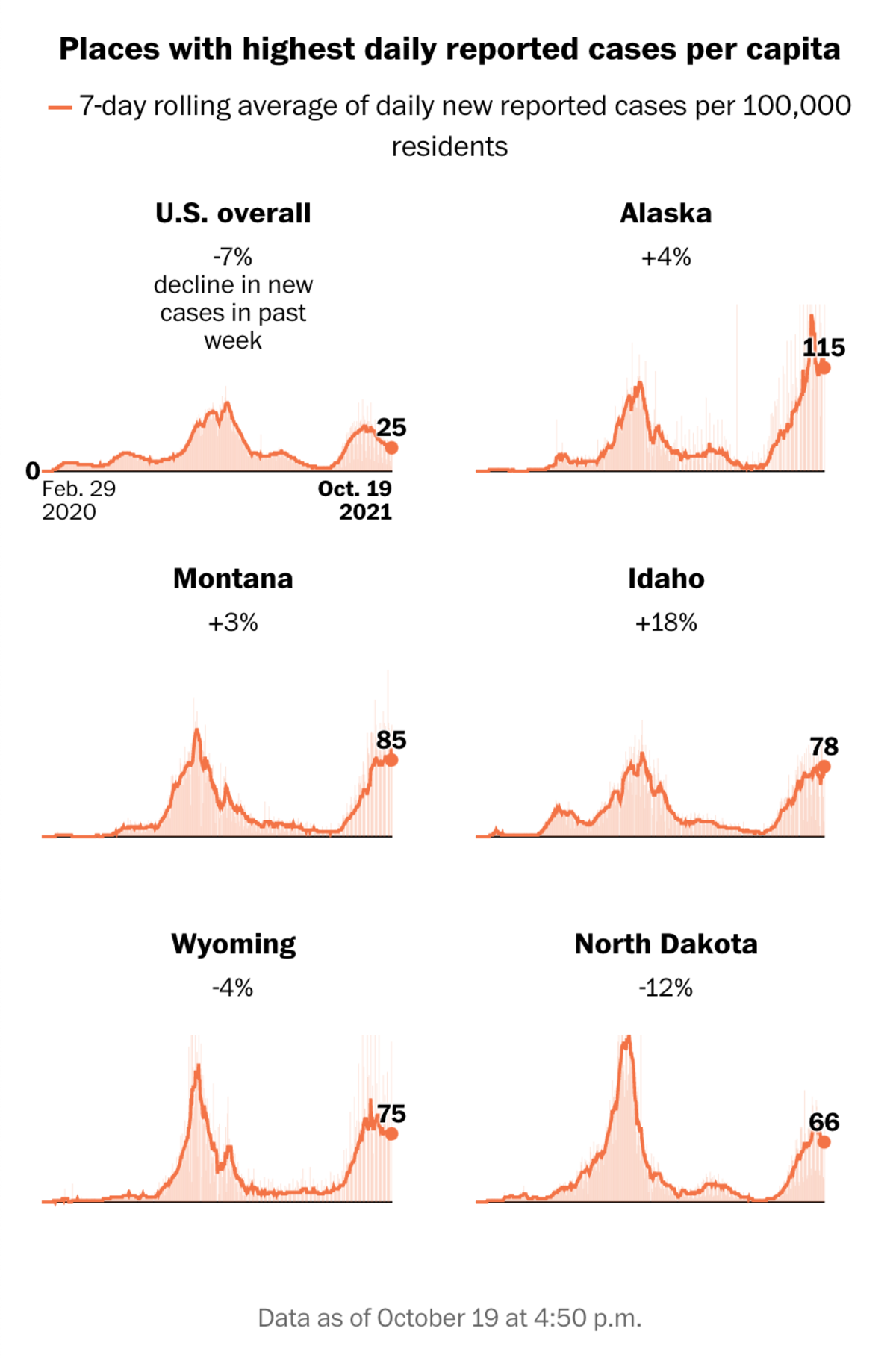
U.S. Places with Highest Reported Coronavirus Cases per Capita

US COVID-19 cases fall for 4th consecutive week: 9 CDC stats to know

17 Downward trend Synonyms. Similar words for Downward trend.

COVID-19 cases have declined nationwide for the fourth consecutive week, according to the CDC’s COVID data tracker weekly review published Oct. 15.

Nine numbers to know:

Reported cases

1. The nation’s current seven-day case average is 84,555, a 12.5 percent decrease from the previous week’s average.

Hospitalizations 

2. The current seven-day hospitalization average for Oct. 6-12 is 6,659, an 8.8 percent drop from the previous week’s average.

Vaccinations

3. About 218 million people — 65.6 percent of the total U.S. population — have received at least one dose of the COVID-19 vaccine, and more than 188.3 million people, or 56.7 percent of the population, have gotten both doses. 

4. About 9.3 million booster doses in fully vaccinated people have been reported.

5. The seven-day average number of vaccines administered daily was 841,731 as of Oct. 14, a  11.3 percent decrease from the previous week.

Variants

6. Based on projections for the week ending Oct. 9, the CDC estimates the delta variant accounts for more than 99 percent of all U.S. COVID-19 cases.

Deaths 

7. The current seven-day death average is 1,241, down 13.4 percent from the previous week’s average. Some historical deaths have been excluded from these counts, the CDC said.

Testing

8. The seven-day average for percent positivity from tests is 5.7 percent, down 4.1 percent from the previous week.  

9. The nation’s seven-day average test volume for the week of Oct. 1-7 was about 1.49 million, down 5.4 percent from the prior week’s average.

‘A triple whammy’: Why hospitals are struggling financially amid the delta surge

Hospitals were struggling before the pandemic. Now they face financial  disaster (opinion) - CNN

n addition to treating an influx of Covid-19 patients, many hospitals are struggling with what one administrator calls a “triple whammy” of financial burdens—stemming from plummeting revenue, higher labor costs, and reduced relief funds, Christopher Rowland reports for the Washington Post.

Hospitals in less-vaccinated areas face spiking labor costs

In areas with low vaccination rates, particularly in southern and rural communities, hospitals have been overwhelmed with Covid-19 patients, exacerbating labor shortages as workers burn out or leave for more lucrative positions, Rowland reports.

“The workforce issue is just dire,” Stacey Hughes, EVP of government relations and policy for the American Hospital Association (AHA), said. “The delta variant has wreaked significant havoc on hospitals and health systems.”

In Louisiana, Mary Ellen Pratt, CEO of St. James Parish Hospital, said many nurses quit due to the grueling conditions as Covid-19 cases spiked. “I didn’t have any extra money to incentivize my staff to pick up additional shifts,” she said. “This is coming out of bottom-line money I don’t have.”

Separately, Lisa Smithgall, SVP and chief nursing executive at Ballad Health, said the health system—which has 21 hospitals in eastern Tennessee and southwestern Virginia—has faced similar problems retaining staff amid Covid-19 surges.

“We knew we were at risk in our region because of where we live and because of our vaccination rate being so poor,” Smithgall said. “At one point, we were seeing four or five nurse resignations per week. They couldn’t do it again; they emotionally didn’t have it. They were so upset with our community.”

To fill in these growing gaps in their workforce, many hospitals have had to turn to costly contract workers, Rowland reports—a significant financial burden that further strains hospitals’ resources.

For example, Ballad Health went from hiring fewer than 75 contract nurses before the pandemic to 150 in August 2020 and 450 in August 2021. Moreover, according to Smithgall, contract nurses previously made double or triple what permanent staff nurses made, but now Ballad sometimes has to pay up to seven times as much for contract nurses as hospitals compete for workers to fill shifts.

Delayed elective surgeries deepen hospitals’ financial struggles

Many hospitals, including those in areas with high vaccination rates, have delayed elective surgeries, a crucial source of revenue, amid nationwide surges in Covid-19 cases, Rowland reports—further compounding financial struggles for many organizations.

On Aug. 26, Ballad Health postponed a long list of elective surgeries—including hernia repair, cardiac and interventional radiology procedures, joint replacements, and nonessential spine surgery—to preserve space in its hospitals and conserve workers. Ballad is now allowing elective surgeries again, but only for a limited number of procedures that do not require overnight stays.

Similarly, St. Charles Health System in Oregon postponed elective surgeries in August “while we responded to a surge that was significantly greater and much more sudden than the surge in 2020,” Matt Swafford, the health system’s VP and CFO, said.

According to Swafford, the health system lost $5 million a week through August and September, around $1 million of which was repayment of emergency advances on Medicare reimbursements from last year.

“I don’t think anybody saw this level of surge coming in 2021 after what we saw in 2020,” he said. “We’re just not equipped to be able to simultaneously respond to the urgent needs of the community [for more typical surgeries and care] at the same time that a third of our beds are occupied by highly infective Covid patients.”

Many hospitals likely to end the year at a deficit

Further compounding the issue, according to Moody’s Investors Service, is that the provider relief funds that previously made up 43% of operating cash flow at nonprofit and government-run hospitals in the United States are now dwindling down.

In addition, the latest portion of provider relief funds to be distributed must be based on expenses incurred by hospitals before March 31, 2021, which don’t account for months of the delta surge, Rowland reports.

Premier, a group purchasing and technology company serving more than 4,000 hospitals and health systems, analyzed payroll data of 650 hospitals and found that U.S. hospitals have spent a total of $24 billion a year during the pandemic to cover excess labor costs, primarily for overtime and contract nurses. This was an increase of 63% from October 2019 to July 2021, Rowland reports, with hospitals in the Upper Midwest and across the South seeing the largest increases.

“It’s going to leave them huge deficits that they are going to have to work out of for years to come,” Michael Alkire, Premier’s CEO, said.

How much worse will the ‘delta surge’ get? Watch these 7 factors.

https://www.advisory.com/daily-briefing/2021/08/09/delta-surge

Last spring, my Advisory Board colleagues and I were optimistic that the United States could be trending toward a “good” outcome in the Covid-19 pandemic. But now, the delta variant is coursing through the country. And if you’re anything like me, you’re probably asking yourself just how worried we should be. When will we hit a peak and see hospitalizations—which are on the rise in many parts of the country—decline? Amid the constant headlines of case numbers, vaccine efficacy, mask mandates, and other Covid-19 news, I think it’s crucial to step back and ask: What factors really matter?

Let’s be very specific about which factors we should be following—and which we should deprioritize. Below, I’ve identified seven factors to pay close attention to and two factors that may be more distracting than helpful.

Your top resources for Covid-19 readiness

7 factors to watch amid the delta surge

1. The transmissibility of the delta variant in the United States

One of the most striking factors underlying the delta surge is its heightened transmissibility—this is the most transmissible Covid-19 variant we have seen yet. The delta variant, B.1.617.2, now accounts for over 83% of new infections in the United States. And unlike past variants, this one is spreading among both vaccinated and unvaccinated individuals. In fact, CDC documents recently revealed that vaccinated individuals may spread the virus just as easily as unvaccinated people, given similar levels of viral load between the two groups.
The 6 biggest Covid-related myths we’ve seen, busted

There is also a third group of people that we know even less about in the context of the variant’s transmissibility: people who are unvaccinated but potentially have some degree of natural immunity from previous coronavirus infection. Nobody knows exactly how long their immunity will last and what levels of protection they have against the delta variant. But early research has indicated that natural immunity may not supply sufficient protection against the delta variant.

Understandably, this is all worrisome. But it is important to consider the effect of infection on different populations. And that brings us to our next factor.

2.Vaccine effectiveness against serious illness from delta—and uptake among unvaccinated individuals

No vaccine can provide 100% protection—and it’s important to remember that most vaccines are designed to prevent serious illness and death, NOT to prevent infection. That is why media reports about fully vaccinated individuals getting infected with the delta variant can be misleading. The important indicator to watch for is not necessarily the infection rate, but how many of those infections lead to serious illness or death. If a breakthrough infection is usually asymptomatic or mildly symptomatic, the main concern is spreading the variant to at-risk populations—namely, unvaccinated people and those with weakened immune systems or underlying medical conditions.

The bad news is, we don’t currently have great data on this. The latest CDC data showed that less than 0.004% of fully vaccinated individuals had a breakthrough case that led to hospitalization and less than 0.001% died from a breakthrough case of Covid-19. But CDC Director Rochelle Walensky later clarified that those numbers are based on data from January through June, meaning they do not take into account the worst of the delta variant surge, which picked up in earnest in late June and early July.

But there is some reason to be optimistic: Among the 469 breakthrough cases tracked from the Provincetown outbreak in early July, only four led to hospitalization—and there were zero deaths. And preliminary studies from around the globe suggest that all three vaccines available in the United States still offer protection from the delta variant: two doses of Pfizer-BioNTech is 88% effective at preventing symptomatic Covid-19 and 96% effective against hospitalization, a single dose of Moderna’s two-dose vaccine is 72% effective at preventing symptomatic Covid-19, and Johnson & Johnson’s single-dose vaccine is 85% effective at preventing severe disease. Even among those vaccinated individuals who do end up in the hospital, we can look at new data from Singapore showing that patients hospitalized due to the delta variant are less likely to require supplemental oxygen and clear the virus faster relative to unvaccinated patients. All of this is reassuring as the data suggests vaccines are largely keeping their promise to stave off serious disease, hospitalizations, and death.
Radio Advisory episode: Vaccinating the globe, the ultimate systemness challenge

This early research suggests that vaccine uptake will remain one of the most crucial factors in determining how worrisome the current surge is—and how it will impact the health care delivery system. After several months of decline, the national vaccination rate is now at its highest level in over a month, and we are observing the most notable increases in vaccine uptake in states with the highest case rates.

3. Vaccine immunity duration

The delta variant has not only prompted a renewed push to increase vaccinations among the previously unvaccinated, but it has also raised questions about the duration of immunity among those who may have been vaccinated several months ago. While the latest data on vaccine duration is not specific to the delta variant, it does suggest that overall efficacy may begin to decline around the six-month mark.

That information, coupled with the increase in breakthrough infections since the delta variant emerged, has accelerated the debate over whether booster shots are needed. Federal regulators are currently researching whether a booster shot is required, and recently announced plans to accelerate extra vaccine doses to immunocompromised individuals. We expect that this is an area where the research will continue to evolve quickly—researchers are learning more on a week-by-week basis. We’ll be keeping a close eye on what the latest research says and how the federal government responds in developing a plan for potential booster shots.

4. Severe Covid-19 cases among children under 12

Rates of Covid-19 infection and severe illness have been relatively low among children. However, it’s worth noting that small numbers of children have been hospitalized from the virus, and it can cause long-term side effects like MIS-C and “long Covid-19.” CDC has not yet released data showing delta variant symptoms among children, but some children’s hospitals have reported increases in hospitalizations related to the delta variant.
Webinar series: ‘Stay Up to Date’ on the latest with Covid-19

Pfizer and Moderna are in the process of clinical trials testing the safety of their vaccines for children under 12. But it may be months before those trials lead to decisions, and children in some parts of the country have already begun to return to school in person. Without a vaccine, a child’s only practical defense against spreading and getting the virus is following public health guidelines like hand washing and mask wearing. But some states—Iowa, Florida, Montana, Arizona, and North Dakota—have passed laws that prevent local governments from mandating masks. Many more states have passed laws making mask mandates harder to implement, like the Kansas law allowing citizens to sue their local government over Covid-19 restrictions.

As school resumes in the United States, we will have to pay close attention to the transmissibility Covid-19 among unvaccinated children, the severity of such cases among children, and the potential long-term effects.

5. Hospitalization rates, particularly at the local level

Plain and simple—the higher the number of hospitalizations, the more worried we should be. Hospitalizations tell us how many people have more severe cases of Covid-19. But they also tell us what level of strain the U.S. health care system is under.

So, what are we seeing right now? CDC’s latest 7-day average shows nearly 50,000 people hospitalized across the United States, which is similar to rates seen last summer. Unsurprisingly, there is regional variation, with some states experiencing worse flareups than others. Most of the highly impacted regions have low vaccination rates: On Monday, there were more Covid-19 hospitalizations in Florida than at any other time in the pandemic. In Louisiana, hospitalizations have spiked to “never-before-seen levels,” breaking the previous record set in January—and leading to expectations that facilities will be overwhelmed again. As we move forward, we may see “hyperlocal outbreaks,” where low-vaccination regions surrounded by high vaccination areas could end up with concentrated outbreaks.
Toolkit: Covid-19 vaccine communications readiness assessment

It’s important to keep an eye on local vaccination rates because it’s clear that unvaccinated individuals and communities are more vulnerable. But that doesn’t mean communities with higher vaccination rates are immune. Given the fact that there is more interconnectedness than ever between communities today, and the fact that we haven’t achieved true herd immunity even in areas with relatively high vaccination rates, even “highly” vaccinated communities could see outbreaks. For example, intensive care units are filling up with Covid-19 patients in Santa Monica, California, where roughly 80% of residents are vaccinated.

At this point, it seems clear that there will be a heightened strain on hospitals relative to the previous few months of “calm”—and data from abroad suggests it may get worse before it gets better.

6. Covid-19 trends in ‘bellwether countries’

Recent decreases of Covid-19 cases in India and the U.K. are a heartening sign that recovery from a delta surge is possible. In India, cases peaked at over 400,000 a day in May. Last week, they experienced roughly 39,000 daily cases with a 48% decrease in the daily death count—a stark reduction. In the U.K., cases have dropped from roughly 47,000 in mid-July to nearly 27,000 the first week of August, even after their government lifted nearly all Covid-19 restrictions.

Sudden spikes may have been fueled by mass congregations of people: the EuroCup in England, April election rallies in India, and fourth of July celebrations in the United States. The subsequent declines in India and the UK suggest that delta could move through a crowd quickly and limiting large crowd gatherings could help stem the spread. It’s also possible that herd immunity is behind the rapid decrease, due to the combination of vaccination rates and infection levels. That could be a hopeful sign for regions of the U.S. that are struggling with high infection rates now but seeing increases in vaccinations.

But we’ll want to continue watching the research closely. Scientists aren’t yet sure exactly what lead to the rapid declines, meaning we can’t be entirely confident that the United States. will follow the same trajectory as the U.K. and India.

7. Global vaccination rates—and the emergence of new variants

The United States is just one part of an interconnected world. It impacts (and is impacted by) global trends in health. It’s overwhelmingly clear—everything we do is a collaboration, and moving through this pandemic is no exception.
Should you mandate a Covid-19 vaccine for your staff? Ask these 5 questions first.

To date, about 27% of the global population has been vaccinated. The latest vaccination rate is roughly 42.5 million doses per day, which means it will take at least another five months to cover 75% of the world’s population. Just a few short months ago, the global vaccination rate had us estimating we’d need more than 4.6 years to achieve global herd immunity with two-dose vaccine regimens.

Five months is better than 4.6 years, but that assumes the vaccination rate will remain the same. With ongoing vaccine hesitancy and inequitable access in low-resource countries, we shouldn’t just assume this will be the case. If we see a drop in global vaccination rates, we will see an extension in the time it takes to reach a semblance of global herd immunity. The more time we spend in this phase, the more opportunities the coronavirus has to mutate into the next variant. And the next variant could be even more transmissible and deadlier than the delta.

Even with President Biden’s pledge to donate half a billion Pfizer vaccines to 92 low- and lower middle-income countries by June 2022, stronger efforts are needed to see a faster global impact. And efforts to increase the global vaccination rates could mean trade-offs elsewhere. For example, the World Health Organization has pled for a moratorium on booster shots until September to allow lower-resourced nations ability to receive initial vaccinations.

2 factors that may be distracting your response to the delta surge

Knowing what not to focus on is just as important as knowing what to focus on. And there are two factors in particular that have grabbed a lot of the headlines—but that actually tell us very little without additional context.

1. Covid-19 case counts

Case counts alone are no longer sufficient for tracking the severity of any variant, or the virus as a whole. But with the advent of the vaccine and better understanding of how to treat the virus, the calculus has changed, and so too should the metrics we give our attention to. It’s been clear for some time that the goal is not necessarily to eliminate Covid-19 (in fact, research increasingly suggests it’s highly likely to become endemic). Instead, we should aim to protect against severe illness and ensure our system has enough capacity to treat sick patients. Severity of illness—and corresponding hospitalization rates—are far more important metrics to track at this point.
‘The Never Again Plan’: Moderna CEO Stéphane Bancel wants to stop the next Covid-19—before it happens

As detailed above, the latest research continues to suggest that vaccines are highly protective in preventing severe illness, even against the delta variant. So as more people get vaccinated, case count numbers are likely to become less accurate. They run the risk of either overestimating the problem (if most cases are only mildly symptomatic) or underestimating the problem (if we miss a lot of asymptomatic people who can still spread the virus to the more vulnerable).

2. The percentage of total infections and hospitalizations that are breakthrough cases

We’ve all seen the recent headlines highlighting the large numbers and percentage of breakthrough infections. Here’s the thing to remember: This is exactly what we would expect to see as vaccination rates increase. The number of breakthrough infections and hospitalizations will increase as more people get vaccinated. The outbreak in Provincetown highlights this well. Yes, roughly 75% of cases were among vaccinated individuals, but most individuals there were vaccinated. Naturally, a high percentage of the cases would be “breakthrough.” And remember, very few were hospitalized and no one died from a breakthrough case as a result of that outbreak.

Breakthrough infections alone are not a bad thing. Breakthrough illness, on the other hand, is more worrisome. If we see the rates of breakthrough illness increase, then it’s time to worry a bit more.

Parting thoughts

It’s easy to feel overwhelmed with the constant updates related to Covid-19. While there are more than seven factors you could follow, I believe these are the most important right now. And the clear thread that runs through all of these is that vaccines remain one of the key solutions to move through this pandemic. It’s becoming clearer that Covid-19 is unlikely to go away—new variants will arise and so will respective public health measures. But if there is one thing I can confidently say right now, it is that the more vaccinations that are administered in the United States and around the world, the less worried we can all be.

Is the delta surge truly ending? Here’s why some experts aren’t so sure.

The Delta Surge May Collapse Faster Than You Think | MedPage Today

With Covid-19 cases, hospitalizations, and deaths declining across the country, some people are hopeful about a potential end to the delta surge. However, public health experts continue to encourage safety measures and vaccinations to mitigate another potential winter surge.

Is the delta surge declining?

According to the New York Times, delta-driven coronavirus cases, hospitalizations, and deaths are declining. Since Sept. 1, the number of daily new Covid-19 cases in the United States has decreased by 35%. In the past two weeks alone, the number of new daily cases has fallen by 24% to around 101,000.

In addition, new Covid-19 deaths have decreased by 12% to 1,829 a day, and hospitalizations have decreased 20% to fewer than 75,000 a day—a first since early August, the Times reports.

“Barring something unexpected,” Scott Gottlieb, a former FDA commissioner, said, “I’m of the opinion that this is the last major wave of infection.”

Edwin Michael, a professor of epidemiology at the University of South Florida, agreed with Gottlieb’s assessment, saying, “[T]his might be the last wave, pending any new variants that arrive, and the boosters will help with that.”

According to STAT News, some experts suggest that the United States has reached an “inflection point,” in which the coronavirus is gradually transitioning from an epidemic phase to an endemic phase. As an endemic virus, the coronavirus will still cause infection, disease, and death, but it will be more manageable.

When asked whether Covid-19 could be endemic, Stephen Kissler, an epidemiologist at Harvard University‘s T.H. Chan School of Public Health, said, “We’ve still got a little work left to do, but my hope is that we’re approaching something ever closer to normalcy.”

Health experts continue to urge caution

However, even with the delta surge on an apparent decline, many public health experts continue to urge caution, saying that the pandemic is still a threat, the Times reports.

“We don’t want to celebrate even though we feel like we’re on the back end of this surge—we learned our lesson from doing that,” said Kirsten Bibbins, an epidemiologist and physician at the University of California, San Francisco. “[I]n this pandemic, you’re always waiting for the other shoe to drop.”

Ali Mokdad, an epidemiologist at the University of Washington, agreed. “We’re not out of danger,” he said. “This virus is too opportunistic and has taught us one lesson after another.”

Mokdad said he was worried people would disregard public safety precautions by wearing masks less often and traveling more, just as they did when earlier surges declined—potentially fueling a jump in cases in December and January.

Some experts are also concerned about the potential emergence of a new coronavirus variant that could kick-start another surge, much like the delta variant did at the beginning of the summer.

“There were similar conjectures [about the pandemic ending] before the delta variant appeared and knocked all our assumptions for a loop,” said Stephen Morse, an epidemiologist at Columbia University Medical Center. “We don’t know whether [a new variant will emerge], but we weren’t expecting delta either.”

In addition, there is still the possibility of a surge in cases during the winter months, STAT News reports.

According to Sen Pei, who studies the transmission dynamics of infectious disease at the University of Columbia‘s Mailman School of Public Health, viruses survive better in cooler, drier weather, and people will gather indoors more frequently in the fall and winter. Holiday gatherings could also lead to more close social contact, further increasing the risk of spreading the virus.

Vaccination remains a necessity to combat surges

Most Covid-19 deaths during the latest surge were among the unvaccinated, the Times reports. Today, around 68 million eligible Americans remain unvaccinated—leaving the United States vulnerable to future surges.

In particular, areas with low vaccination rates, along with a lack of public safety precautions, may be more likely to experience Covid-19 surges in the future, STAT News reports. According to data from the University of Iowa, rural Americans are already twice as likely to die from Covid-19 than urban Americans.

“It is becoming clearer that any challenge to hospital capacity this fall and winter is likely to be dictated by regional vaccination rates,” modelers at the Children’s Hospital of Philadelphia’s PolicyLab said.

Currently, vaccination rates in the United States have slowed to fewer than 700,000 doses a day, the Commonwealth Fund reports.

However, a simulation model of 10 states by the Commonwealth Fund found that increasing daily vaccination rates by 50% over the pace they were at in the last week of August would lead to 344,341 fewer Covid-19 cases; 19,500 fewer hospitalizations; and 6,900 fewer deaths across the next six months. These potential reductions were largely concentrated in the Southern states included in the model, such as Texas and Florida.

Vaccination works best as prevention,” the Commonwealth Fund said. “Quickly increasing population immunity now can prevent needless Covid-19 hospitalizations and deaths while keeping hospital beds open and staffed for people with other serious health problems.”

A $200 surcharge for unvaccinated spouses? It’s coming to one Louisiana health system.

Louisiana Health System to Charge Fee to Employees with Unvaccinated Spouses  - The New York Times

As more companies consider implementing insurance surcharges for their unvaccinated employees, Ochsner Health plans to add a $200 monthly surcharge for employees with unvaccinated spouses and domestic partners covered by the organization’s health plan.

Unvaccinated employees face potential insurance surcharges

While many companies have relied on incentives to encourage employee Covid-19 vaccination, some have recently opted to implement penalties, such as premium surcharges, for those who remain unvaccinated instead.

Recent polling suggests that these surcharges could spur a significant portion of unvaccinated employees to get the Covid-19 vaccine. According to an Affordable Health Insurance poll of 1,000  unvaccinated individuals with employer-based health plans, nearly 75% said a health insurance surcharge could motivate them to get vaccinated, with 43% saying a surcharge would definitely motivate them to get vaccinated.

“As they say, the vaccine is not mandatory, but if people have extra charges with their insurance due to not being vaccinated, people will surely push themselves to be vaccinated,” Nick Schrader, insurance agent at Texas General Insurance, said.

So far, Delta Airlines is the largest employer to implement an insurance surcharge for unvaccinated employees, and it has already seen significant increases in employee vaccination.

In August, Delta announced unvaccinated employees would have to pay a $200 monthly health insurance surcharge to remain on the company’s health insurance plan beginning Nov. 1.

According to Delta, the surcharge will protect the company from lost revenue due to unvaccinated employees being hospitalized with Covid-19—which costs the company an average of $50,000 for each case.

Henry Ting, Delta’s chief health officer, said almost 20% of the company’s unvaccinated employees received the Covid-19 vaccine in the two weeks after the surcharge was announced. In addition, the company did not see any employee turnover or resignation due to the announcement, Ting said.

Ochsner Health’s ‘spousal Covid vaccine fee’

Ochsner Health, Louisiana’s largest health system with nearly 32,000 employees and more than 4,500 physicians, plans to implement a $200 monthly surcharge for employees with unvaccinated domestic partners and spouses on the organization’s health insurance plan, the Associated Press reports.

Ochsner is the first health system to apply insurance surcharges to unvaccinated family members, not just employees. Other Louisiana health care organizations, such as Our Lady of the Lake Regional Medical Center and LCMC Health, said they would ask families of employees to be vaccinated, but did not plan on implementing a surcharge for unvaccinated spouses or partners, the Times-Picayune/New Orleans Advocate reports.

According to a letter sent from Ochsner leaders to employees, the surcharge, called the “spousal Covid vaccine fee,” will begin in 2022 and could deduct up to $2,400 a year from an employee’s paycheck. The surcharge will only apply to domestic partners or spouses, not other dependents covered by an employee’s health plan like children.

Warner Thomas, Ochsner’s president and CEO, said the surcharge for unvaccinated spouses and partners is similar to a surcharge for tobacco users and will be used to help keep health premiums low for employees. As a self-insured organization, Ochsner is responsible for the cost of Covid-19 treatment for patients on its health insurance plan, the Associated Press reports.

The reality is the cost of treating Covid-19, particularly for patients requiring intensive inpatient care, is expensive, and we spent more than $9 million on Covid care for those who are covered on our health plans over the last year,” Thomas said.

“We know that Covid-19 vaccination dramatically reduces transmission, severity of symptoms, hospitalizations, and death. Approximately 90% of those hospitalized with Covid in our facilities have been unvaccinated since vaccines were approved in December 2020,” he added. “Widespread vaccination is critical to stopping the spread of Covid-19, and we hope this change will encourage even more community members to get vaccinated.”

Thomas also clarified that unvaccinated spouses and partners are not required to be vaccinated because of the surcharge. “This is not a mandate as non-employed spouses and domestic partners can choose to select a health plan outside of Ochsner Health offerings,” he said.

Unvaccinated spouses and partners can also apply for medical or religious exemptions for the Covid-19 vaccine, Thomas said. Currently, around 300 Ochsner employees have applied for medical or religious exemptions, the Times-Picayune/New Orleans Advocate reports.