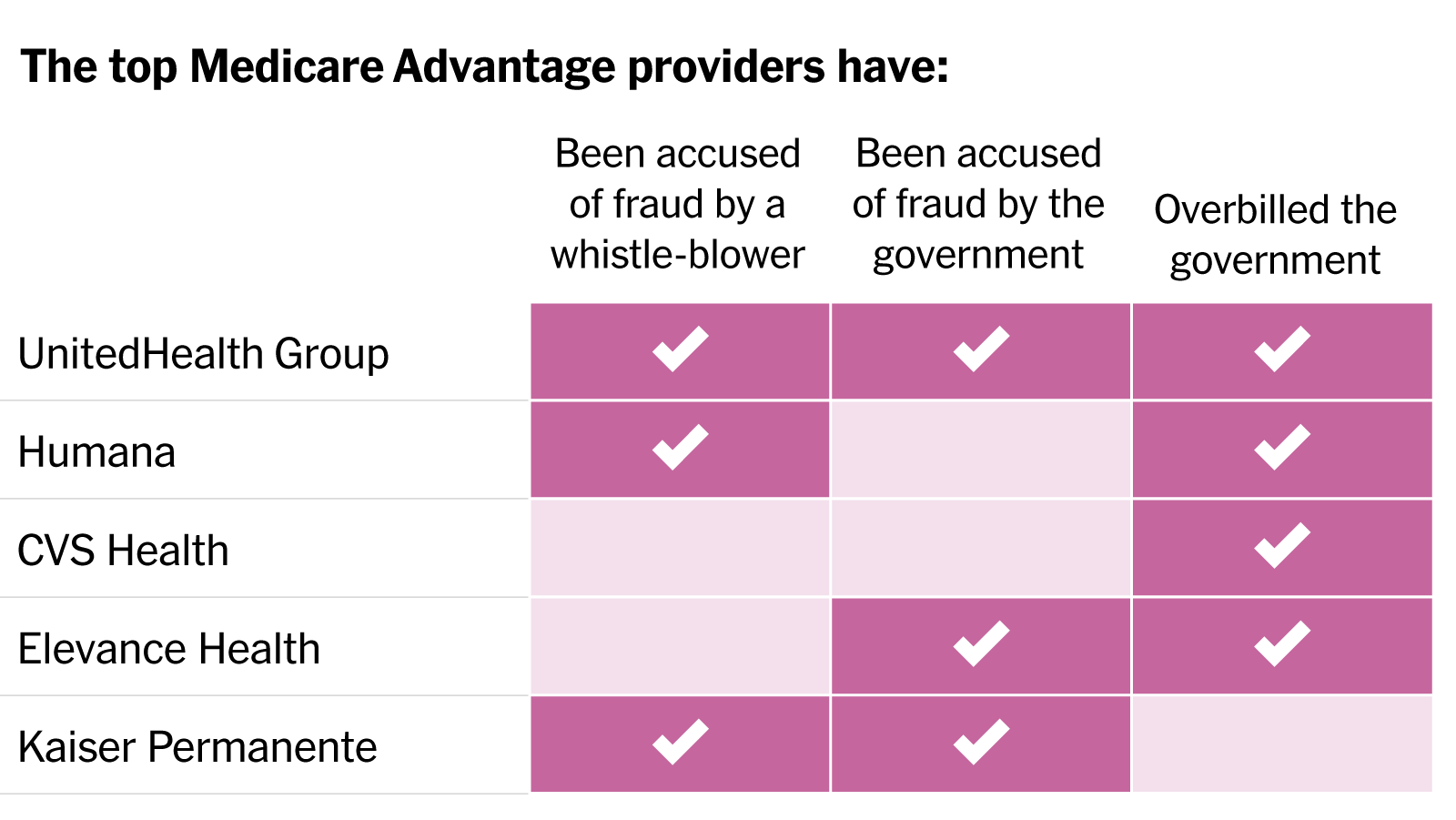
In a blistering article published in the New York Times, reporters Reed Abelson and Margot Sanger-Katz detail widespread fraud allegations involving the nation’s largest MA insurers. Nine of the ten largest plans have been accused by the government of fraud or overbilling, generally for upcoding practices that exaggerate the disease burden among their beneficiaries, without providing them more care. Insurers have disputed most allegations, and regulators have been slow to punish known infractions. As a growing steam of seniors continue the enter the program, aggressive risk adjustment has significantly increased the government’s costs. The Centers for Medicare and Medicaid Services has yet to reduce payments in response to overbilling, despite having the power to do so.
The Gist: While these practices were well known to many in the healthcare industry, MA’s growth—set to overtake traditional Medicare enrollment next year—has added a spotlight worthy of national attention. While many beneficiaries report being satisfied with their MA benefits, the program was also intended to improve the cost efficiency of senior care.
With payers gaming the system to garner record profits, the government has seen higher per-enrollee spending in MA compared to traditional Medicare. There are some signs that the strings are starting to tighten for insurers, as many of the largest are losing Medicare star bonuses in 2023, impacting both plan revenue and ability to market throughout the year. However, reduced quality bonuses change nothing about the underlying MA payment structure, and could even drive insurers to more profit-seeking behavior.
Coming off a $1.2B net loss in 2021, Minneapolis-based insurtech Bright Health announced this week it will stop offering commercial and Medicare Advantage (MA) plans in all states except Florida and California, where it will solely offer MA plans. In its remaining markets, the company plans to focus on its care delivery and provider support business, NeueHealth. Bright has reportedly struggled to contain its medical spend, due to rapid growth and COVID-related costs; its claims processing backlog also earned a $1M fine from the Colorado Department of Insurance last April. Once valued at over $11B, Bright’s stock has lost 95 percent of its value since going public in June 2021.
The Gist: The largest digital health IPO to date is now rapidly shrinking, not even two years later—and Bright is not alone amongst its peers. After years of hype, most insurtechs still have minimal market share, and most have yet to turn a profit. With a market cap now under $1B—and dropping by the day—Bright could be an easy pickup for an established health plan interested in its consumer-centric technology, though given reports of dissatisfied beneficiaries, the value of that technology is still unclear.
In a randomized controlled trial (RCT) study of 85K Europeans, published this week in the New England Journal of Medicine, colonoscopies were found to reduce incidence of colorectal cancer by only 18 percent—much less than earlier large studies—and have no impact on ten-year colorectal cancer mortality rates. This is the first study to directly compare individuals invited to receive colonoscopies with a control group receiving no cancer screening.
While the study’s findings surprised many researchers, an important caveat to the headline takeaways is that a secondary analysis of study participants who actually completed their colonoscopies found a 50 percent reduction in death, though the decision to accept the invitation likely correlates with other factors that improve mortality outcomes.
The Gist: We were surprised to learn this was the first RCT to assess the effectiveness of colonoscopies—15M of which are performed in the US each year—and which comprise a $36B market. While the study’s results need careful interpretation, it reminds us that much of established medical consensus has yet to be “proven” by rigorous scientific research.
While we don’t expect this study’s results to significantly change colonoscopy recommendations, it does place greater emphasis on the question of value generated by widespread preventative screenings. Colonoscopy will almost certainly remain the gold standard for colon cancer screening in the US, but if these results bear out, other less invasive types of screening, like home-based fecal immunochemical testing, could be viewed as equivalent options and receive more traction.
The fourth-largest US hospital system, Chicago-based CommonSpirit Health, is struggling with the impact of a major cyberattack, more than a week after it began disrupting electronic health record access and delaying care in multiple regions across the country. Beyond confirming the attack, the system has not provided many details, other than that it took immediate steps to protect its systems and has begun an investigation.
The Gist: Healthcare hacking is on the rise—our industry experienced the largest increase in cyberattacks of any in 2021. Sitting on troves of valuable patient data, health systems must ready themselves for the reality that hacking attempts are no longer a question of “if,” but “when.” Now is the time not only to ensure proper safeguards are in place to prevent such attacks, but also to prepare response plans for once a hack is confirmed, to be able to continue patient care amid disruption when time is of the essence and patient lives are at stake.
In an Oct. 5, 2022, commentary, Ken Kaufman offers a full-throated and heartfelt defense of non-profit healthcare during a time of significant financial hardship. Ken describes 2022 as “the worst financial year for hospitals in memory.” His concern is legitimate. The foundations of the nonprofit healthcare business model appear to be collapsing. I’ve known and worked with Ken Kaufman for decades. He is the life force behind Kaufman Hall, a premier financial and strategic advisor to nonprofit hospitals and health systems. The American Hospital Association uses Kaufman Hall’s analysis of hospitals’ underlying financial trends to support its plea for Congressional funding. Beyond the red ink, Ken laments the “media free-for-all challenging the tax-exempt status, financial practices, and ostensible market power of not-for-profit hospitals and health systems.” He is referring to three recent investigative reports on nonprofits’ skimpy levels of charity care (Wall Street Journal), aggressive collection tactics (New York Times) and 340B drug purchasing program abuses (New York Times). Ken has never been timid about expressing his opinions. He’s passionate, partisan and proud. His defense of nonprofit healthcare chronicles their selfless care of critically ill patients, the 24/7 demands on their resources and their commitment to treating the uninsured. These “must have clinical services…don’t just magically appear.” Nonprofit healthcare needs “our support and validation in the face of extreme economic conditions and organizational headwinds. ”Given his personality, it’s not surprising that Ken’s strident rhetoric in defending nonprofit healthcare reminds me of the famous “You can’t handle the truth” exchange between Lieutenant Kaffee (Tom Cruise) and Colonel Jessup (Jack Nicholson) from the 1992 movie “A Few Good Men.” Kaffee presses Jessup on whether he ordered a “code red” that led to the death of a soldier under his command. When Kaffee declares he’s entitled to the truth, Jessup erupts,… I have neither the time nor the inclination to explain myself to a man that rises and sleeps under the blanket of the very freedom I provide and then questions the manner in which I provide it. I would rather you say, “thank you” and be on your way. Should American society just say “thank you” to nonprofit healthcare and provide the massive incremental funding required to sustain their current operations?
Truth and Consequences (Download PDF here)The social theorist Thomas Sowell astutely observed, “If you want to help someone, tell them the truth. If you want to help yourself, tell them what they want to hear.” In this commentary, Ken Kaufman is telling nonprofit healthcare exactly what they want to hear. The truth is more nuanced, troubling and inconvenient. Healthcare now consumes 20 percent of the national economy and the American people are sicker than ever. Despite the high healthcare funding levels, the CDC recently reported in U.S. life expectancy dropped almost a full year in 2021. Other wealthy nations experienced increases in life expectancy. Combining 2020 and 2021, the 2.7-year drop in U.S. life expectancy is the largest since the early 1920s. During an interview regarding the September 28, 2022, White House Conference on Hunger, Nutrition and Health, Senator Cory Booker highlighted two facts that capture America’s healthcare dilemma. One in three government dollars funds healthcare expenditure. Half of Americans suffer from diabetes or pre-diabetes.As a nation, we’re chasing our tail by prioritizing treatment over prevention. Particularly in low-income rural and urban communities, there is a breathtaking lack of vital primary care, disease management and mental health services. Instead of preventing disease, our healthcare system has become adept at keeping sick people alive with a diminished life quality. There is plenty of money in the system to amputate a foot but little to manage the diabetes that necessitates the amputation. Despite mission statements to the contrary, nonprofit healthcare follows the money. The only meaningful difference between nonprofit and for-profit healthcare is tax status. Each seeks to maximize treatment revenues by manipulating complex payment formularies and using market leverage to negotiate higher commercial payment rates. According to Grandview Research, the market for revenue cycle management in 2022 is $140.4 billion and forecasted to grow at a 10% annual rate through 2030. By contrast, Ibis World forecasts the U.S. automobile market to grow 2.6% in 2022 to reach $100.9 billion. Unbelievably, in today’s America, processing medical claims is far more lucrative than manufacturing and selling cars and trucks. According to CMS’s National Expenditure Report for 2020, hospitals (31%) and physicians and clinical services (20%) accounted for over half of national healthcare expenditures. This included $175 billion allocated to providers through the CARES Act. Despite the massive waste embedded within healthcare delivery, the CARES Act funding gave providers the illusion that America would continue to fund its profligate and often ineffective operations. It’s not at all surprising that healthcare providers now want, even expect, more emergency funding. Change is hard. Not even during COVID did providers give up their insistence on volume-based payment. Providers did not embrace proven virtual care and hospital-at-home business practices until CMS guaranteed equivalent payment to existing in-hospital/clinic service provision. Even with parity payment and the massive CARES Act funding, there was uneven care access for COVID patients. Particularly in low-income communities, tens of thousands died because they did not receive appropriate care. More of the same approach to healthcare delivery will yield more of the same dismal results. Healthcare providers have had over a decade to advance value-based care (VBC). I define VBC as the right care at the right time in the right place at the right price. Instead of pursuing VBC, providers have doubled-down on volume-driven business models that attract higher-paying commercially-insured patients. Despite the relative ease of migrating service provision to lower-cost settings, providers insist on operating high-cost, centralized delivery models (think hospitals). They want society, writ large, to continue paying premium prices for routine care. It’s time to stop. As a country, we need less healthcare and more health.
When I give speeches to healthcare audiences, I typically begin with three yes-or-no questions about U.S. healthcare to establish the foundation for my subsequent observations. Here they are. Question #1: The U.S. spends 20% of its economy on healthcare. The big country with the next highest percentage spend is France at 12%. How many believe we need to spend more than 20% of our economy to provide great healthcare to everyone in the country? No one ever raises their hand. Question #2: The CDC estimates that 90% of healthcare expenditure goes to treat individuals with chronic disease and mental health conditions. How many believe we’re winning the war against chronic disease and mental health conditions? No one ever raises their hand. Question #3: Given the answer to the previous two questions, how many believe the system needs to shift resources from acute and specialty care into health promotion, primary care, chronic disease management and behavioral health? Everyone raises their hands. This short exercise is quite revealing. It demonstrates that healthcare doesn’t have a funding problem. It has a distribution problem. It also demonstrates that providers aren’t adequately addressing our most critical healthcare challenge, exploding chronic disease and mental health conditions. Finally, the industry needs major restructuring.
The real questions about reforming healthcare are less about what to reform and more about how to undertake reform. The increasing media scrutiny that Ken Kaufman references as well as growing consumer frustrations with healthcare service provision, demonstrate that healthcare is losing the battle for America’s hearts and minds.
Markets are unforgiving. The operating losses most nonprofit providers are experiencing reflect a harsh reality. Their current business models are not sustainable. An economic reckoning is underway. The long arc of economics points toward value. As healthcare deconstructs, the nation’s acute care footprint will shrink, hospitals will close and value-based care delivery will advance. The process will be messy.
The devolving healthcare marketplace led me to ask a fourth question recently in Nashville during a keynote speech to the Council of Pharmacy Executives and Suppliers. Here it is. Question #4: As the healthcare system reforms, will that process be evolutionary (reflecting incremental change) or revolutionary (reflecting fundamental change). Two-thirds voted that the change would be revolutionary. That response is just one data point but it reflects why post-COVID healthcare reform is different than the reform efforts that have preceded it. The costs of maintaining status-quo healthcare are simply too high. From a policy perspective, either market-driven healthcare reforms will drive better outcomes at lower costs (that’s my hope) or America will shift to a government-managed healthcare system like those in Germany, France and Japan.
Like Ken Kaufman, I admire frontline healthcare workers and believe we need to make their vital work less burdensome. I also sympathize with health system executives who are struggling to overcome legacy business practices and massive operating deficits. Unfortunately, most are relying on revenue-maximizing playbooks rather than reconfiguring their operations to advance consumerism and value-based care delivery.
Unlike Ken Kaufman, I believe it’s time for some tough love with nonprofit healthcare providers. Payers must tie new incremental funding to concrete movement into value-based care delivery. This was the argument Zeke Emanuel, Merrill Goozner and I made in a two-part commentary (part 1; part 2) in Health Affairs earlier this year. It’s also why the HFMA, where I serve on the Board, has made “cost effectiveness of health (CEoH)” its new operating mantra.
While this truth may be hard, it also is liberating. Freeing nonprofit organizations from their attachment to perverse payment incentives can create the impetus to embrace consumerism and value. Kinder, smarter and affordable care for all Americans will follow.
While infections, hospitalizations, and deaths from Covid-19 have been steadily declining in the United States in recent months, experts warn that rising cases in Europe may be “a harbinger for what’s about to happen in the United States,” Rob Stein writes for NPR’s “Shots.”
Will the US see a ‘winter resurgence’ of Covid-19?
Currently, several models project that U.S. Covid-19 infections will continue to decline at least until the end of 2022. However, researchers caution that there are multiple variables that could change current projections, including whether more infectious strains start circulating around the nation.
According to Stein, “[t]he first hint of what could be in store is what’s happening in Europe.” Recently, many European countries, including the U.K., France, and Italy, have seen an increase in Covid-19 infections.
“In the past, what’s happened in Europe often has been a harbinger for what’s about to happen in the United States,” said Michael Osterholm, director of the Center for Infectious Disease Research and Policy at the University of Minnesota. “So I think the bottom line message for us in this country is: We have to be prepared for what they are beginning to see in Europe.”
“We look around the world and see countries such as Germany and France are seeing increases as we speak,” said Lauren Ancel Meyers, director of the UT COVID-19 Modeling Consortium at the University of Texas at Austin. “That gives me pause. It adds uncertainty about what we can expect in the coming weeks and the coming months.”
However, Justin Lessler, an epidemiologist at the University of North Carolina who helps run the COVID-19 Scenario Modeling Hub, noted that the United States may not have the same experience as Europe, largely because it is unclear whether Europe’s increase is related to individuals’ vulnerability to new strains.
“If it is mostly just behavioral changes and climate, we might be able to avoid similar upticks if there is broad uptake of the bivalent vaccine,” Lessler added. “If it is immune escape across several variants with convergent evolution, the outlook for the U.S. may be more concerning.”
Some researchers believe the United States is already experiencing early signs of this. “For example, the levels of virus being detected in wastewater is up in some parts of the country, such in Pennsylvania, Connecticut, Vermont and other parts of Northeast,” Stein writes. “That could an early-warning sign of what’s coming, though overall the virus is declining nationally.”
“It’s really too early to say something big is happening, but it’s something that we’re keeping an eye on,” said Amy Kirby, national wastewater surveillance program lead at CDC.
According to David Rubin, the director of the PolicyLab at Children’s Hospital of Philadelphia, which tracks the pandemic, Covid-19 infections and hospitalizations are already rising in some parts of New England, and other northern regions, including the Pacific Northwest.
“We’re seeing the northern rim of the country beginning to show some evidence of increasing transmission,” Rubin said. “The winter resurgence is beginning.”
How likely is a severe Covid-19 surge?
Unless a “dramatically different new variant emerges,” it is “highly unlikely this year’s surge would get as severe as the last two years in terms of severe disease and deaths,” Stein writes.
“We have a lot more immunity in the population than we did last winter,” said Jennifer Nuzzo, who leads the Pandemic Center at the Brown University School of Public Health.
“Not only have people gotten vaccinated, but a lot of people have now gotten this virus. In fact, some people have gotten it multiple times. And that does build up [immunity] in the population and reduce overall over risk of severe illness,” Nuzzo said.
Another factor that could affect the severity of the impact of rising infections is the number of people who receive updated Covid-19 vaccines, which help boost waning immunity from previous infections or shots.
However, the United States’ booster uptake has been slow. “Nearly 50% of people who are eligible for a booster have not gotten one,” said William Hanage, an associate professor of epidemiology at the Harvard T.H. Chan School of Public Health. “It’s wild. It’s really crazy.”
Since updated boosters became available in September, less than 8 million of the over 200 million people who are eligible have received one.
According to Nuzzo, it is critical for people to stay up to date on their vaccines, especially with the high likelihood of another Covid-19 surge. “The most important thing that we could do is to take off the table that this virus can cause severe illness and death,” Nuzzo said.
“There are a lot of people who could really benefit from getting boosted but have not done so,” she added.











 HENRY KOTULA