

Cartoon – Today’s Meeting






Optum spent the last decade investing in significant growth, adding thousands of physicians to its network and purchasing ASC company Surgical Care Affiliates in 2017. Now the company is focusing more on its primary care network, data offerings and $115 billion pharmacy and medical care business line.
Optum, owned by UnitedHealth Group, has three divisions:
Each division has a unique growth strategy focused on the patient and provider experience.
Provider growth
Optum Health now has 60,000 employed or aligned physicians and partners with 100 payers. Optum as a whole now works with 80 percent of health plans and 90 percent of hospitals and 90 percent of Fortune 100 companies.
Wyatt Decker, CEO of Optum Health, said in the 2021 earnings call in January that Optum Health is still a growth platform and the company will make investments to more deeply penetrate established markets. He expects Optum Health to deliver 8 percent to 10 percent margins annually going forward.
“Our approach strengthens the critical provider-patient relationship by empowering our primary care physicians with the latest information, insights and best practices to help them efficiently coordinate all patient care, manage referrals and identify higher-quality, lower-cost options,” the company said in its 2021 yearend highlights report.
ASCs certainly fit the high quality, low-cost care description, but Optum’s executives fell shy of mentioning whether the company would focus on growth in that sector during the 2021 earnings call.
Optum is also expanding its virtual care capabilities, focused on chronic care patients, and its behavioral health services. The company said it needs to add physicians, clinicians and technology to support patient care in those areas. Optum said it has its sights set on providing more whole-person, value-based care, scaling in new markets and having the key data insights to do it better than anyone else.
Value-based care
Last year, Optum and UnitedHealth Group’s health insurance business, UnitedHealthcare, worked together with external partners to grow in commercial and government payer markets, innovate and add 500,000 patients to their value-based contracts. Optum served 100 million patients, and 2 million of the patients were under fully accountable arrangements. Both companies also had a sharpened focus on the consumer experience.
“Taken together, these efforts helped us add more than $30 billion in revenue for the year, about $10 billion above our initial outlook,” said Andrew Witty, CEO of UnitedHealth Group, during the earnings call, as transcribed by The Motley Fool. “And you should expect similar growth in the year ahead. We see an even greater demand for integration to bring together the fragmented pieces of the health system, to harness the tremendous innovation occurring in the marketplace, to help better align the incentives for providers, payers and consumers, and to organize the system around value.”
Data and information
Optum Insights aims to continue growing by acquiring Change Healthcare, a healthcare data and technology company.
“The combination will advance our ability to create products and services that improve the delivery of healthcare and reduce the high costs and inefficiencies that plague the health system,” Optum claimed on its fact sheet about the transaction. “We will share these innovations broadly to benefit those who engage with the health system today and well into the future.”
The acquisition could make the episode of care more seamless for patients and reduce administrative burden for providers, as well as give payers a comprehensive view of the patient’s health outcomes with the potential to reduce cost. But it could also give Optum and UnitedHealth Group an unfair advantage over competitors, the Justice Department argued in a lawsuit filed in February.
“Across Optum, we operate with the highest ethical standards in protecting confidential data and information of our clients and adhere to the safeguards we have had in place for more than a decade to ensure data is accessed and used only for permissible purposes,” according to a statement on Optum’s website responding to the Justice Department’s lawsuit. “We will not be distracted by the DOJ’s complaint and will continue to honorably serve our clients and consumers and those that engage in the health system.”
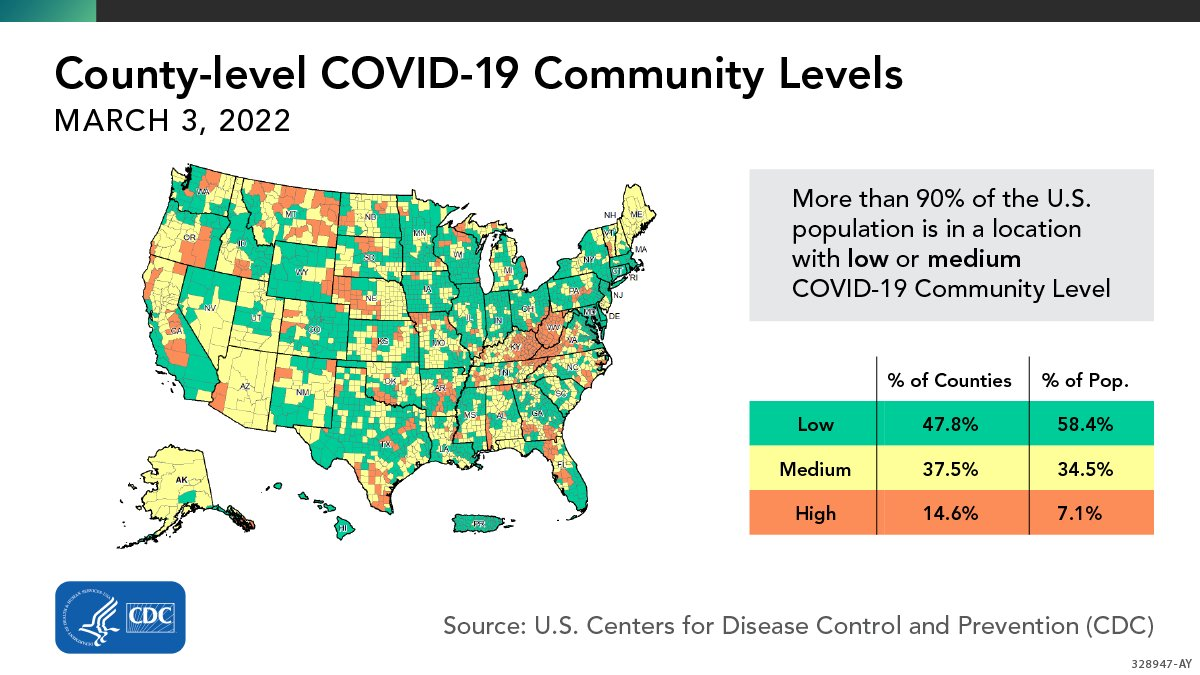
More than 90% of the U.S. population lives in an area with a “low” or “medium” risk of COVID-19, the U.S. Centers for Disease Control and Prevention (CDC) announced yesterday. Last week, the CDC changed the way it assesses county-level COVID-19 risk, using data on hospitalizations and health care capacity in addition to case counts. The CDC now recommends universal indoor masking only for counties that are at “high” risk under this system—which means that the vast majority of Americans are not currently advised to wear masks inside.

In May 2020, a 33-year-old mother of three in North Carolina started experiencing symptoms of COVID-19. Four days later, a different set of symptoms set in. She stopped sleeping well and started having paranoid delusions that people were tracking her through her cell phone—culminating in a frantic scene at a fast-food restaurant, in which she tried to pass her children through the drive-through window, where they’d be safe from the phones and other dangers.
A restaurant employee called 911, and emergency medical services workers arrived, gathered up the family, and hurried to the nearby emergency department of the Duke University Medical Center in Durham, where the mother was quickly attended to by physicians. “She was physically in the room, but she wasn’t making consistent eye contact,” says Dr. Colin Smith, who is now chief resident of the hospital’s internal medicine psychiatry program but was a second-year resident when he took care of the patient. “She was not really engaging all that much. Her thought processes were disorganized.”
Despite that, the patient acknowledged two things to Smith and the other doctors: She knew her behavior was out of character, and the changes all happened quickly after she was diagnosed with COVID-19.
There’s growing evidence that COVID-19 and new psychotic episodes are connected. The North Carolina case, reported in the British Medical Journal in August 2020, joins a slew of case reports published in medical journals during the pandemic that detail psychotic episodes following a COVID-19 diagnosis. In the July 2020 issue of BJPsyh Open, researchers reported that a 55-year old woman in the U.K., with no history of mental illness, arrived at a hospital days after recovering from a severe case of COVID-19 with delusions and hallucinations, convinced that the nurses were devils in disguise and that monkeys were jumping out of the doctors’ medical bags. In April 2021, other researchers wrote in BMJ Case Reports of a middle-aged British man, also with no prior mental health disorders, who had appeared at a London hospital experiencing auditory and visual hallucinations and banging his head against walls until he bruised his skin. (Weeks before, he had recovered from a bout with COVID-19 that had landed him in the intensive care unit.) In yet another case, published in the Journal of Psychiatric Practice in March 2021, a 57-year-old-man turned up at Columbia University’s New York Presbyterian Hospital insisting that his wife was poisoning him, that cameras had been planted throughout his apartment, and that the patients in the hospital’s emergency department were being secretly murdered.
“The situation was strikingly similar to one we’d expect from someone who had a schizophrenia spectrum illness,” says Dr. Aaron Slan, now a fourth-year psychiatry resident at Columbia University, who cared for the patient and co-authored the report. But this patient too had no history of mental health disorders and was too old for a first-onset case of schizophrenia, which typically occurs between ages 20 and 30 for men, Slan notes. What the patient did have, as a test in the hospital revealed, was COVID-19.
COVID-19-related psychotic breaks are rare—though researchers say that it’s too early to say exactly how rare—and plenty of experts believe that the connection between the two conditions, if any, is not causal. In a review published in 2021 in Neurological Letters, a group of researchers in the U.K. casts doubt on the emerging body of work on the COVID-19-psychosis link as “beset by both small sample size, and inadequate attention to potential confounding factors,” such as heightened stress, substance abuse, and socioeconomic hardship.
Still, researchers are investigating the link. One U.K. study published in the Lancet in October 2020 found that of 153 people who were diagnosed with COVID-19 early in the pandemic, 10 suffered new-onset psychotic episodes following their COVID-19 diagnosis, and seven exhibited the onset of psychiatric disorders, including catatonia and mania.
A study published last August in General Hospital Psychiatry took a broad view of the phenomenon, analyzing 40 scientific articles, which included 48 adults from 17 different countries who suffered psychotic episodes associated with COVID-19 infection, and tried to find commonalities among them. As with the Neurological Letters paper, the authors of this study found plenty of other variables that might muddy the link between COVID-19 and psychosis—like stress, substance use, and medications—but the relationship still held.
“We see post-infectious neuroinflammatory disorders associated with a variety of different viral illnesses,” says Dr. Samuel Pleasure, a neurology professor at the University of California, San Francisco (UCSF). “Normally we see it in very small numbers, but here we have [COVID-19] infecting tens of millions of people at the same time.” Even rare cases of psychiatric conditions will start to show themselves when the sample group of infected people is so large.
There are more questions than answers at this point. It’s still unclear whether the severity of COVID-19 symptoms plays any role in the likelihood of a psychotic break. “There seem to be clearly cases of neuropsychiatric consequences of COVID that are linked to cases that are not severe,” Pleasure says. “I believe that the quality of the studies at this point are so preliminary, and the ability to really capture these patients to study is really at early stages, so it’s hard to be definitive.” Similarly, Pleasure says, it’s impossible to say whether people suffering from Long COVID—symptoms that last for months after the infection is over—are more susceptible to psychotic symptoms.
There are multiple possible mechanisms at work, any one of which—or a combination—could be contributing to the neuropsychiatric symptoms associated with COVID-19. The most straightforward would be direct infection of brain tissue itself, according to Pleasure. If that’s so, the number of COVID-19 patients who suffer loss of the sense of taste and smell would suggest that the brain’s olfactory bulb may be struck by the virus first.
“There are documented cases where people have done MRIs early in the [COVID-19 disease] process and have seen some local inflammation in the olfactory bulb,” Pleasure says. “That has contributed further to the idea that maybe that’s the portal of entry.” Once that portal has been breached, the brain at large could be exposed.
Just how the COVID-19 infection reaches the brain is unclear, but Pleasure and his colleague Dr. Michael Wilson, associate professor of neurology at UCSF, conducted lumbar punctures of three teens with COVID-19 who had developed neuropsychiatric symptoms to examine their cerebrospinal fluid. In two cases, they found antibodies in the fluid that target neural antigens. That presented an apparent puzzle: the patients had SARS-CoV-2; if anything, they should be exhibiting antibodies to the virus, not to their own neural tissue. But Pleasure cites one study he conducted with a group from Yale University showing that antibodies specific to the coronavirus spike protein could also cross-react with nerve cells, attacking them as well.
“There was molecular mimicry between the spike protein and a neural antigen,” he says. “One of the main hypotheses is that if there’s an antibody that targets the virus, then, out of bad luck, you also see damage to the host.” In other words, he says, you start with an immune response adaptive to fighting the virus, and that turns into an autoimmune response.
That’s just one theory. There are still other routes by which COVID-19 can affect the brain. Upper respiratory infections can, on occasion, cause the immune system to go awry and develop antibodies against parts of the brain known as NMDA (N-methyl-D-aspartate) receptors, which are the main excitatory receptors that react to neurotransmitters. A broad attack on receptors spread throughout the brain can lead to quick and severe symptoms, says Dr. Mudasir Firdosi, a Consultant Psychiatrist at the Kent and Medway NHS and Social Care Partnership Trust and a co-author of the 2021 BMJ paper.
“[NMDA involvement] presents a very, very florid way to be psychotic,” Firdosi says. Slan agrees: “When someone has an abrupt onset of psychosis following a viral illness, NMDA antibodies are frequently invoked,” he says.
Yet another suspect in the development of neuropsychiatric symptoms is the so-called cytokine storm that often follows infection with SARS-CoV-2. Cytokines are proteins critical for cell signaling that are produced by the immune system and give rise to inflammation that in turn can fight infection. But if cytokine production spins out of control, extreme body-wide inflammation can follow, and brain tissue would not be spared the impact.
“The neurons themselves are not being invaded,” says Slan, “but what happens is that the systemic inflammatory response causes both stress and changes in signaling throughout the body. That includes the brain, and can precipitate these types of [psychotic] symptoms.”
One other bit of evidence that COVID-19 is linked to psychotic breaks comes not from the current scientific literature, but from history. Following the influenza pandemic of 1918 and 1919, there was a spike in what was called encephalitis lethargica, which was essentially a form of early-onset Parkinson’s disease that often didn’t appear for a number of years after the infection—but left patients in what was effectively a state of catatonia.
“That flu virus caused a post-infection inflammation that killed brain cells that in turn led to the Parkinson’s,” says Pleasure. The book and movie Awakenings, about patients who temporarily recovered consciousness and lucidity after treatment with l-dopa—a precursor of the neurotransmitter dopamine—was based on cases of people suffering from that form of Parkinson’s.
The good news is that unlike more chronic forms of psychosis, most cases seemingly related to COVID-19 do not appear to last. The symptoms can respond to antipsychotic medications like Risperdal (risperidone) and Zyprexa (olanzapine), say Smith and Slan. Intravenous immunoglobulin infusions—which reduce the overall load of abnormal cells and inflammatory agents—and steroids, which also reduce inflammation, can be effective as well.
By no means is the case for virus-triggered psychosis closed. Even Slan, who has first-hand experience treating a patient suffering from a seemingly virus-linked psychotic break believes that there is more work to be done—and acknowledges the doubts of the researchers who believe other psychological factors might be at play.
“Given the stress of COVID,” he says, “given the concerns about mortality, seclusion, all of these things represent huge psychosocial stressors, and they have the potential to precipitate oftentimes short-lived psychotic symptoms.”
Of course, even a transitory psychosis is still a psychosis—something no one wants to experience even fleetingly. That puts a premium on avoiding infection in the first place. “The best way to treat COVID-19 and the risk of psychosis is to prevent it,” says Smith. “Even if neurological complications are rare, getting vaccinated remains the smartest choice.”

A bill introduced in Congress would require the government to warn adults 60 and older of penalties associated with late Medicare enrollment, according to a March 2 CNBC report.
The move targets adults before they reach the Medicare-eligible age of 65, especially those who are not auto-enrolled in coverage through Social Security. The number of beneficiaries who must manually enroll in coverage at age 65 has increased 32 percentage points to 40 percent since 2008, according to CNBC.
The bill specifically targets Medicare Part B, which hits enrollees with a penalty equal to 10 percent of the standard premium for each 12 months they should have been enrolled in. The penalties last a lifetime and adjust with premiums.
Roughly 776,200 enrollees face penalties in 2020. Based on current premiums, monthly penalties would be about $46.
Medicare Part D also has a penalty, but its rate is 1 percent of premiums paid, or about 33 cents based on current rates.

