

Amazon takes another big step into healthcare
https://mailchi.mp/4422fbf9de8c/the-weekly-gist-november-20-2020?e=d1e747d2d8

In a move first telegraphed by its billion-dollar acquisition of online pharmacy PillPack in 2018, Amazon announced the launch of Amazon Pharmacy, putting the online giant in head-to-head competition with retail pharmacies CVS and Walgreens, and its big-box nemesis Walmart.
The new service will give customers access to home delivery of prescription medications, in addition to free delivery and a new drug discount card for members of Amazon Prime. Customers can have their physicians send prescriptions directly to Amazon Pharmacy and use their insurance to pay for the drugs, or they can choose to pay Amazon’s cash prices, which in many cases will be less expensive than insurance-based prices.
Rather than fully disrupt the traditional pharmacy business model, Amazon has partnered with pharmacy benefit manager (PBM) Evernorth (a subsidiary of Cigna) for drug discounts, and with AmerisourceBergen as a drug supplier. Nevertheless, the new offering will surely shake up the mail-order pharmacy segment, which has been declining in recent years as brick-and-mortar retailers have expanded their in-person clinic offerings, often tied to in-store pharmacies.
Given changes in consumer shopping patterns caused by COVID, Amazon may have chosen a propitious moment to try to move its customers—especially its loyal Prime members—to a mail-order model that offers the “frictionless” convenience of the broader Amazon service approach.
Also behind the timing of Amazon’s pharmacy launch may have been the recent success of drug discounter GoodRx, which recently went public with a massive valuation based on the profitability of its business, and has been engaged in an aggressive marketing push.
Amazon’s announcement of a competing discount card for Amazon Prime members, with up to 80 percent off the price of generic drugs and 40 percent off for branded medications, poses a significant threat to GoodRx. Amazon’s installed base of more than 125M Prime users dwarfs the nearly 5M customers who use GoodRx, and over time its scale should attract partnerships with other PBMs beyond Cigna’s, allowing it to offer the same or better savings to Prime members.
Users of Amazon’s new benefit card will be able to purchase drugs through Amazon Pharmacy, as well as at over 50,000 brick-and-mortar pharmacies including CVS, Walmart, Walgreens, and Rite Aid, without using their insurance. While this week’s launch is not as immediately disruptive to incumbents as some had feared, it will surely allow Amazon to broaden its foothold in healthcare, and to explore new avenues to leverage its massive online presence as it moves further into the $3.6T healthcare industry. Expect (much) more to come.

Striving to maintain normal operations in the third wave
https://mailchi.mp/4422fbf9de8c/the-weekly-gist-november-20-2020?e=d1e747d2d8

In talking to our health system members from across the country in the past few weeks, we’ve heard that the COVID surge is happening everywhere. Nearly everyone we’ve talked to has told us that their inpatient census of COVID patients is as high or higher now than during the initial wave of the pandemic in March and April. And nearly everyone is expecting it to get much worse over the next few weeks, as hospitalizations increase in the wake of the explosion of cases we’re seeing now.
But there is something striking in our conversations in comparison to eight months ago: no one seems to be panicking. Crisis management processes that were developed and honed early in the pandemic are proving very helpful now. Normal patient care services are continuing despite the uptick in COVID volume, and protections are in place to keep the care environment segregated and COVID-free as possible.
While dozens of health systems, many in the hardest hit states in the Midwest and Great Plains, have announced plans to curtail elective care during this third wave, the decisions are based on individual hospital capacity and staffing, instead of being mandated by states. Having largely worked through the “COVID backlog” across the summer and early fall, system leaders want to avoid canceling surgeries again, and few are expecting state governments to force them to.
Many of our members have drawn up plans for selective cancellations depending on capacity, but we’re not likely to see sweeping shutdowns again—unless the workforce becomes so overstretched that it impacts operations.
That’s good news, and will likely lead to less interrupted patient care. And it’s good news for hospitals’ and doctors’ economic survival, as many would not be able to absorb the body blow of another widespread shutdown. Fingers crossed.
The AMA declares racism a public health threat
https://mailchi.mp/4422fbf9de8c/the-weekly-gist-november-20-2020?e=d1e747d2d8
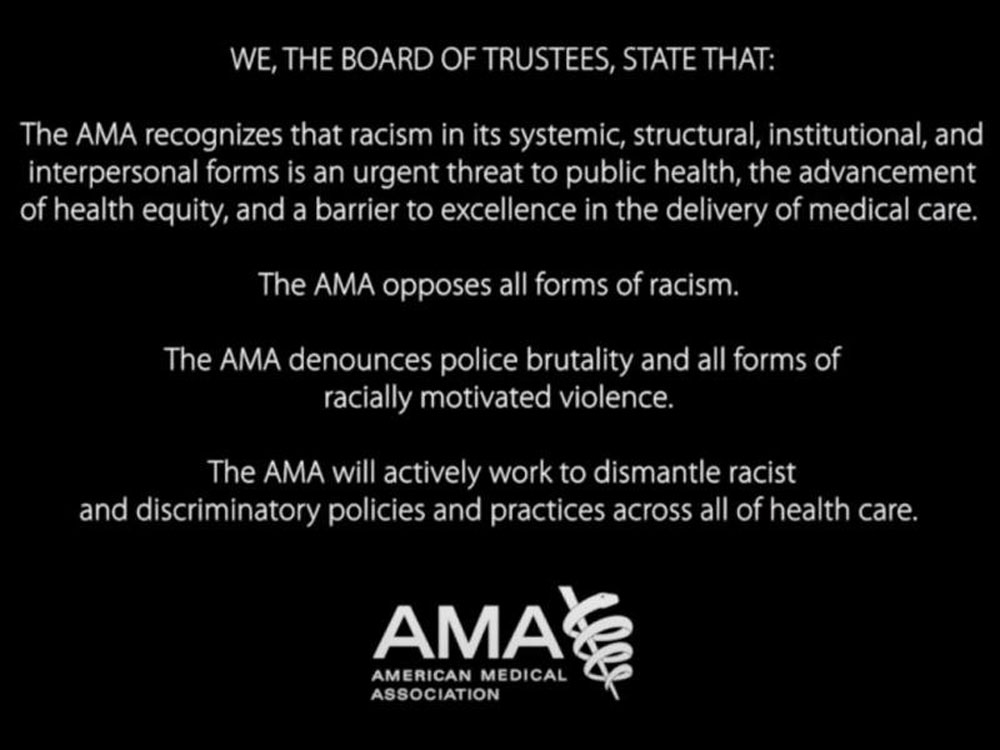
On Monday, the American Medical Association (AMA) voted to recognize racism as an “urgent threat to public health”. At its annual meeting, the organization’s House of Delegates voted to take actions to confront systemic, cultural and interpersonal racism, including acknowledging harm and bias in medical research and healthcare delivery, funding research to identify risks of racial bias to health, and encouraging medical schools to teach students about the causes and effects of racism, and strategies to prevent adverse health outcomes.
The resolution was one of several proposed items aimed at addressing racial diversity and equity in medical education and care delivery. Over the past two years, the AMA has been moving toward a more progressive stance on health and social policy; in June the AMA Board of Trustees also pledged action against racism and police brutality in response to the murder of George Floyd.
A generational divide between older and younger doctors was also apparent during last year’s debates on Medicare for All, when the organization narrowly voted to maintain its opposition to single-payer healthcare in a close vote that would have been unimaginable a decade ago.
At this week’s meeting, however, the group gave its stamp of approval to proposals for a more limited “public option” coverage expansion. As more young physicians enter the field of medicine, we’d expect the AMA to become a stronger voice on a range of social and policy issues.
Missouri’s COVID-19 data reports send ‘dangerous message to the community,’ say health systems

A group of health system leaders in Missouri challenged state-reported hospital bed data, saying it could lead to a misunderstanding about hospital capacity, according to a Nov. 19 report in the St. Louis Business Journal.
A consortium of health systems, including St. Louis-based BJC HealthCare, Mercy, SSM Health and St. Luke’s Hospital, released urgent reports warning that hospital and ICU beds are nearing capacity while state data reports show a much different story.
The state reports, based on data from TeleTracking and the CDC-managed National Healthcare Safety Network, show inpatient hospital bed capacity at 35 percent and remaining ICU bed capacity at 29 percent on Nov. 19. However, the consortium reported hospitals are fuller, at 84 percent capacity as of Nov. 18, and ICUs at 90 percent capacity based on staffed bed availability. The consortium says it is using staffed bed data while the state’s numbers are based on licensed bed counts; the state contends it does take staffing into account, according to the report.
Stephanie Zoller Mueller, a spokesperson for the consortium, said the discrepancy between the state’s data and consortium’s data could create a “gross misunderstanding on the part of some and can be a dangerous message to the community.”

Cartoon – Strategic Options in a Recession

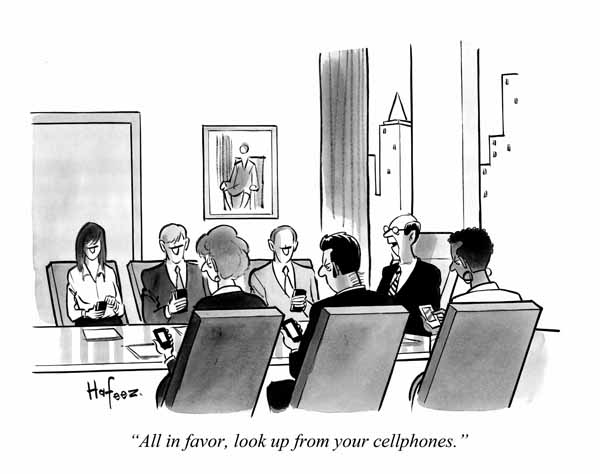
Cartoon – All in Favor
Cartoon – Nauseously Optimistic

 HENRY KOTULA