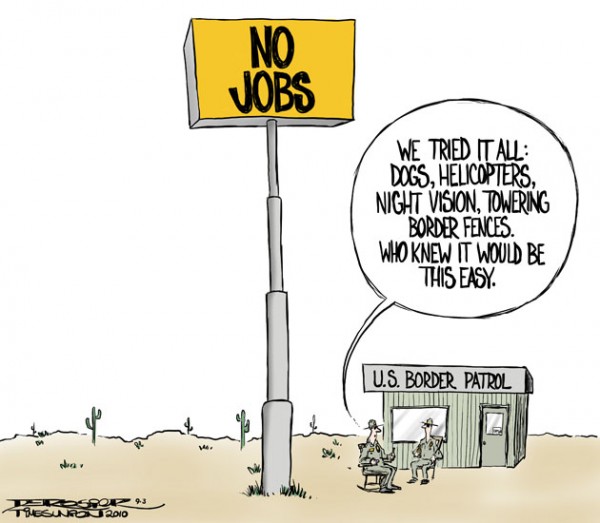
Cartoon – Gilligan’s Island

Editorial cartoon (2): June 6, 2020 | The Daily Courier | Prescott, AZ

Cartoon – Containing Your Hot Spot?

Editorial cartoons for Sunday, June 21 | HeraldNet.com

Another 884,000 Americans filed new unemployment claims last week

https://finance.yahoo.com/news/jobless-claims-coronavirus-unemployment-week-ended-september-5-2020-165121299.html?.tsrc=fin-notif

Another 884,000 Americans filed for first-time unemployment insurance benefits last week, matching the previous week’s level.

The U.S. Department of Labor (DOL) released its weekly jobless claims report at 8:30 a.m. ET Thursday. Here were the main metrics from the report, compared to consensus estimates compiled by Bloomberg:

  • Initial jobless claims, week ended Sept. 5: 884,000 vs. 850,000 expected and 884,000 during the prior week
  • Continuing claims, week ended Aug. 29: 13.385 million vs. 12.904 million expected and 13.292 million during the prior week

Last week’s new jobless claims were upwardly revised slightly to 884,000, from the 881,000 previously reported. This marked the first time since March that jobless claims came in below 1 million for back-to-back weeks, as claims remained stubbornly elevated but off their peak from the worst point of the pandemic.

The past couple weeks of jobless claims appeared to improve considerably from the more than 1 million new weekly claims reported in mid-August. However, this was due to a technical change in the way the Labor Department made its seasonal adjustments, which applied for the first time to claims counted during the week ended August 28. Previous weeks’ claims were not revised to reflect the new counting method.

The change was made to account for the fact that the pandemic generated a far greater level of new claims per week than would typically occur over the course of a year, throwing off the Labor Department’s usual system of making adjustments for seasonal hiring trends.

Most economists agreed that the new methodology would produce a more accurate dataset on jobless claims during the pandemic period. It also produced a lower reported number of seasonally adjusted jobless claims than would have been generated under the previous method. Under the old method of seasonally adjusting claims, new jobless claims for the week ended August 29 would have risen to 1.02 million, according to an analysis by Ian Shepherdson, chief economist for Pantheon Macroeconomics.

“Interpreting the seasonally adjusted figures is complicated by a recent change in methodology, but in both an SA [seasonally adjusted] sense and an NSA [non-seasonally adjusted] sense, it looks like the trends for both initial and continuing claims filings have flattened out lately after a period with more notable declines,” JPMorgan economist Daniel Silver said in a note Thursday. “This flattening out has been evident in the initial claims data for a few months and in the continuing claims data for a few weeks and it is broadly consistent with the idea that the labor market recovery has lost momentum lately.”

Unadjusted claims have shown a clearer picture of the stalling recovery in the labor market. Last week, unadjusted new weekly jobless claims totaled 857,148, for an increase of 20,140 over the prior week. This was the fourth straight week of increases in unadjusted new claims.

Other economic indicators offered a more upbeat picture of the U.S. labor market. The Labor Department’s monthly jobs report released last Friday showed the U.S. economy added a greater-than-expected 1.371 million payrolls in August, and that the unemployment rate dipped more than anticipated to 8.4%. Wednesday morning, the JOLTS jobs report showed employers had more than 6.6 million job openings in July, topping expectations by over 600,000.


High numbers of Los Angeles patients complained about coughs as early as December, study says

https://www.washingtonpost.com/science/2020/09/10/los-angeles-patients-covid-coughing/?utm_campaign=wp_main&utm_medium=social&utm_source=facebook&fbclid=IwAR35fvTDN4Tq476ktGM0O8aIT3cvjVP1wP7I104tEQU3bRRgiLZs_nk6PYE

The number of patients complaining of coughs and respiratory illnesses surged at a sprawling Los Angeles medical system from late December through February, raising questions about whether the novel coronavirus was spreading earlier than thought, according to a study of electronic medical records.

The authors of the report, published Thursday in the Journal of Medical Internet Research, suggested that coronavirus infections may have caused this rise weeks before U.S. officials began warning the public about an outbreak. But the researchers cautioned that the results cannot prove that the pathogen reached California so soon, and other disease trackers expressed skepticism that the findings signaled an early arrival.

The debate about the findings underscores just how much remains to be known about the coronavirus, which has killed at least 187,000 people in the United States, according to a Washington Post analysis.

“This is consistent with the growing body of data that suggests that there’s been community spread much earlier than we had anticipated,” said study author Joann G. Elmore, a doctor and epidemiologist at the David Geffen School of Medicine at the University of California at Los Angeles.

The researchers examined six years of electronic health records, representing nearly 10 million patients, at the UCLA health system from July 2014 through February. That included patient visits to three UCLA hospitals and to nearly 200 associated outpatient clinics.

Health agencies have surveillance systems in place to detect the early signals of disease outbreaks, such as a rise in patients with fever checking into hospitals. But medical records were an under-tapped resource, Elmore said. “People weren’t paying attention to the outpatient setting,” she said.

The study authors searched outpatient and emergency department reports that used the word “cough,” and tallied the number of people hospitalized for acute respiratory failure.

That approach revealed an uptick in patients that began the week of Dec. 22 and remained elevated for 10 weeks. The number of extra people exceeded the researchers’ predictions by 50 percent, totaling about 1,000 more patients compared with the previous five flu seasons.

Influenza cannot be ruled out as a cause of the increase, Elmore said. “And, you know, we did see a bad bout of flu this year,” she said. But what gave her pause was the consistent, weeks-long trend found only in this most recent season and not others.

Some experts said they doubted that coronavirus infections were the likely cause of respiratory problems in California so far back in time. “The data countywide would suggest that it really began to spread in March,” said Brad Spellberg, chief medical officer at the Los Angeles County+USC Medical Center, who was not involved with the new research.

Although the virus may have infected a small number of people sooner than previously reported, Spellberg said he doubted that “meaningful transmission” occurred in December or January.

Using data from emergency departments that reported patients with flu-like illnesses, Spellberg and his colleagues observed two peaks in patients in December and February, as they reported in JAMA this spring.

Those increases were consistent with a severe flu season, Spellberg said. Los Angeles’s third spike in flu-like illnesses, this time caused by the coronavirus, came later.

What’s more, between March 2 and March 18, only 5 percent of 131 patients with flu-like illnesses tested positive for the coronavirus in the JAMA study. Spellberg said that if the virus had an earlier foothold in California, he would have expected that percentage to be higher. “You would have seen an explosion of cases,” he said.

Understanding how long the virus circulated within a population helps refine epidemiological models of transmission. Infectious-disease scientists and doctors in many pockets of the world are eager to uncover when the coronavirus first spread outside of China.

In late December 2019, Chinese health officials identified clusters of viral pneumonia in Wuhan. Researchers sequenced the culprit’s genome, describing the new coronavirus strain, in early January. The first officially reported U.S. case of coronavirus, a man who traveled home from Wuhan, occurred two weeks later.

A few observations indicate that the virus may have traveled farther, earlier, before it flared into a global pandemic. A study of Italian sewage revealed traces of the virus in December. When researchers retested a nasal swab from a man hospitalized near Paris dating to Dec. 27, they detected the coronavirus.

Genetic sequencing of coronavirus samples in New York suggests that the virus was spreading there by the end of January. In April, two autopsies in Santa Clara County, Calif., pushed back the first U.S. covid-19 deaths from late to early February.

Study author Judith Currier, a UCLA infectious-disease physician, said that when it comes to people who wonder whether they were exposed to the virus many months ago, she does not recommend “antibody testing for people who never had a symptomatic illness,” citing guidelines from the Centers for Disease Control and Prevention.

“If someone had a compatible clinical illness but never had testing for covid during that time, antibody testing could help to confirm,” she said. “Although we don’t know how long the antibodies last, so it would not be definitive.”