West Reading, Pa.-based Tower Health and Drexel University completed the $50 million acquisition of St. Christopher’s Hospital for Children in Philadelphia on Dec. 15.
St. Christopher’s was put up for sale after it and Philadelphia-based Hahnemann University Hospital filed for Chapter 11 bankruptcy at the end of June. Hahnemann closed in September, the same month Tower Health and Drexel University entered into a $50 million agreement to acquire St. Christopher’s.
With the sale complete, 188-bed St. Christopher’s will return to nonprofit status.
“We are grateful for the continuing dedication and hard work of the physicians and employees at St. Christopher’s,” Tower Health President and CEO Clint Matthews said in a press release. “We are excited about a bright future for St. Christopher’s as it continues to serve as a center for healthcare, medical education and research, and innovation.”
The Trump administration is losing the legal battle over Medicaid work requirements — one of its most impactful and controversial health care policies — but it is leaning into that fight even more aggressively.
Driving the news: The Centers for Medicare & Medicaid Services formally signed off yesterday on South Carolina’s work requirements. Medicaid recipients in the state will have to perform 80 hours per month of work or community service, unless they receive an exemption.
Why it matters: Other states have primarily sought work requirements as a condition of their Medicaid expansions, but South Carolina will impose its new rules without expanding.
Where it stands: A federal judge has already ruled against work requirements in Arkansas, Kentucky and New Hampshire, arguing that they’re inconsistent with Medicaid’s statutory goals.
Judge James Boasberg has leaned heavily on the fact that work requirements would cause thousands of people to lose their Medicaid coverage.
That will also happen in South Carolina, and those coverage losses will be a factor in the inevitable lawsuits over these rules.
Yes, but: Those rulings are working their way through the appeals process, and rather than change course or slow down in the face of legal setbacks, the administration is getting work requirements on the books wherever it can and hoping for an eventual win in the courts.
The Trump administration is backtracking on a major policy that cut payments to hospitals while the policy is stuck in the courts.
The big picture: The hospital industry is getting back almost $800 million, and the Trump administration has failed to implement another regulation — one that most experts support, too.
Details: Any hospital that was paid a lower amount for a routine clinic visit in 2019 will automatically be paid the difference from the older, higher amount, the Centers for Medicare & Medicaid Services said in a bulletin on Thursday.
CMS wanted to create a level playing field, arguing that hospitals should not be paid more for these standard checkups when they could be done for far less in an independent doctor’s office.
Hospitals naturally hated the idea, took the government to court, won, and are now fighting to eliminate the policy from future years.
Congress is expected to soon announce a deal to repeal the Affordable Care Act’s health insurance, medical device and “Cadillac” employer health plan taxes — and to raise the smoking age to 21, according to a senior House Democratic aide familiar with talks.
Why it matters: The decision is a colossal win for the health care industry.
If this wasn’t good enough news for the industry, the deal won’t address surprise medical bills — and it avoids prescription drug prices except for the CREATES Act, which helps generics get to market faster.
The taxes have been repeatedly delayed. And while the industry has pushed for their repeal for years, it hasn’t yet been successful.
Between the lines: Voters are decidedly not asking Washington to lift industry taxes while avoiding dealing with two of the most popular health care issues, but if that’s how this plays out, it’s a great indicator that the industry’s lobbying strength is as good as ever.
It’s also a good sign that cost control — the intention of the Cadillac tax, a 40% excise tax on the most generous employer plans — is still not very popular with lawmakers, even as health care costs continue to rise.
The tax was expected to raise $200 billion over 10 years.
The other side: The industry says that the ACA taxes end up getting passed along to patients.
The cost of private health insurance is out of control, compared to Medicare and Medicaid. You see that clearly if you take a long-term view of recently released federal data on health spending.
Why it matters: This is why the health care industry — not just insurers, but also hospitals and drug companies — is so opposed to proposals that would expand the government’s purchasing power. And it’s why some progressives are so determined to curb, or even eliminate, private coverage.
By the numbers: Per capita spending for private insurance has grown by 52.6% over the last 10 years.
Per-capita spending for Medicare grew by 21.5% over the same period, and Medicaid 12.5%.
Private insurance generally pays higher prices for care than Medicare, which generally pays more than Medicaid.
There’s a long-running debate about whether public programs deliver efficiency because of their purchasing power, or simply underpay.
Democrats have proposed a variety of steps to curb health care costs, including cutting payments for out-of-network care, competition from a public insurance plan, and steep payment cuts through Medicare for All.
Industry opposes most of them.
The bottom line: The industry knows cutting government spending can only go so far. Any effort to rein in health care costs will have to confront the growth in the cost of private insurance.
54% prefer private system; 42% support government-run system
Two-thirds of Democrats favor a government-run system
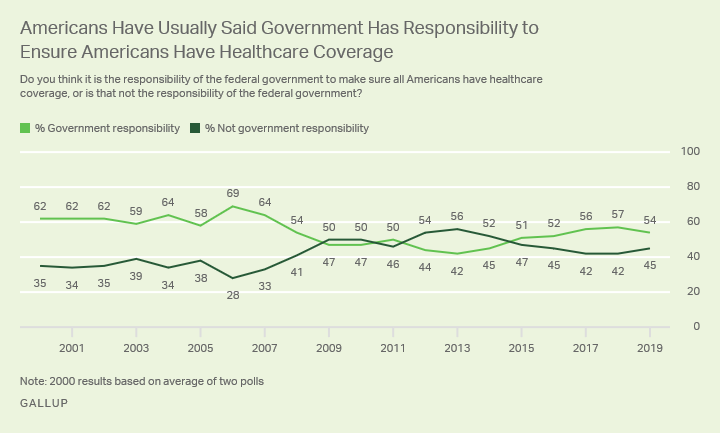
Majority continue to see government responsibility for ensuring coverage
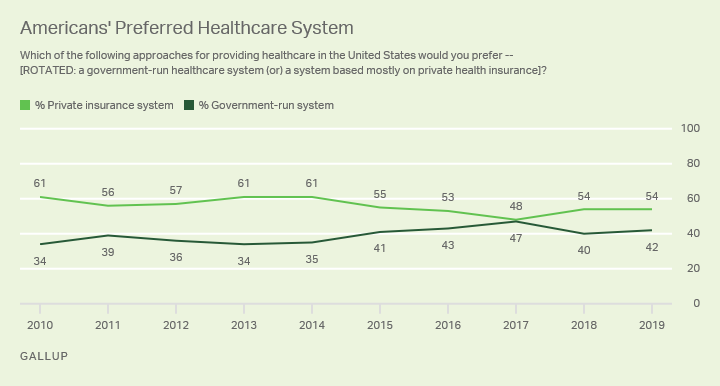
Americans continue to prefer a healthcare system based on private insurance (54%) over a government-run healthcare system (42%). Support for a government-run system averaged 36% from 2010 to 2014 but has been 40% or higher each of the past five years.
These results are based on Gallup’s annual Health and Healthcare poll, conducted Nov. 1-14. Although more Americans have warmed to the idea of a greater government role in paying for healthcare, it remains the minority view in the U.S. This could create a challenge in a general election campaign for a Democratic presidential nominee advocating a “Medicare for All” or other healthcare plan that would greatly expand the government’s role in the healthcare system.
Democratic candidates’ plans for greater government involvement in healthcare are, however, consistent with the views of their party’s base. Since 2015, after most of the Affordable Care Act’s provisions had gone into effect, an average of 65% of Democrats have favored a government-run system.
Over the same period, Republicans have been overwhelmingly opposed to a government-run system, with an average of 13% preferring that approach while 84% have wanted to retain a private system.
Independents have been closely divided in recent years, but in 2019 tilt more toward a private (50%) than a government-run (45%) system.
Compared with the five-year period spanning the ACA’s passage and implementation from 2010 to 2014, support for a government-run system has increased among all party groups, with larger increases among independents (10 percentage points) and Democrats (seven points) than among Republicans (four points).
Changes in Preferences for Private vs. Government-Run Healthcare System, by Political Party
Figures are the average percentage holding each view in the five-year period
2010-2014
2015-2019
%
%
Democrats
System based on private insurance
36
31
Government-run system
58
65
Independents
System based on private insurance
58
49
Government-run system
36
46
Republicans
System based on private insurance
88
84
Government-run system
9
13
GALLUP
Majority in U.S. Say Government Has Responsibility to Ensure Healthcare
While Americans tend not to favor government-run healthcare, they do believe the federal government has a responsibility to ensure that all Americans have healthcare coverage. In the current survey, 54% hold this view, while 45% say it is not the government’s responsibility.
Recent support for the government having responsibility for ensuring healthcare coverage is not as high as it was from 2001 to 2007, when more than six in 10 Americans commonly expressed that opinion.
By contrast, from 2009 to 2014 — when the Obama administration and congressional Democrats developed, passed and implemented the Affordable Care Act — fewer Americans thought the government should ensure everyone has healthcare coverage. During that period, between 42% and 50% thought the government had that responsibility, the lowest measures in Gallup’s trend.
Between 2009 and 2014, the percentages of Republicans and independents who thought the government should be responsible for ensuring healthcare coverage dropped at least 20 points, with a smaller eight-point drop among Democrats.
Democrats’ views are now back to where they were before 2009, while independents and especially Republicans have yet to return to prior levels, though independents are back above the majority level.
Changes in Belief That the Federal Government Has a Responsibility to Ensure All Americans Have Healthcare Coverage, by Political Party
Figures are the average percentage in each period
2001-2008
2009-2014
2015-2019
%
%
%
Democrats
80
72
80
Independents
64
44
56
Republicans
38
16
21
U.S. adults
62
46
54
GALLUP
Bottom Line
Americans have complex views on healthcare, with a majority saying the government should make sure everyone has coverage — but not necessarily pay for it through a government-run system. The Affordable Care Act was essentially an attempt to bridge these preferences by making coverage available to all through government-backed health insurance exchanges, but allowing those with insurance through an employer or other means to keep it.
Still, the law itself has been controversial, and Americans are currently as likely to disapprove of it as to approve. As such, it is fair to question to what extent Americans would embrace Democratic attempts to move to a healthcare system that goes further than the ACA does, or to support further Republican attempts to dismantle the law.
Healthcare is an issue that directly affects all Americans. Republican and Democratic political leaders have very different ideas about what healthcare policy should be. Additionally, the Democratic presidential campaign has revealed that even candidates in the same party can disagree on the best ways to address the U.S. healthcare system. With little consensus on the best way to approach healthcare policy, it promises to remain a key issue in U.S. politics and elections for the foreseeable future.