The job market’s soft underbelly

For an economy that’s rapidly expanding, the usual drivers of job creation sure aren’t carrying their weight.

Why it matters: 

Anemic job growth in key sectors is a sign that there is more underlying weakness in worker demand than the low unemployment rate might suggest.

  • It makes for a weaker starting point, as companies see new opportunities around the corner to use AI to automate their work.
  • It’s not a new trend: These sectors showed weak job creation or outright job losses for the last couple of years of the Biden administration.
  • But it is striking that a GDP surge fueled by data center and AI investment hasn’t been enough to generate more robust hiring.

By the numbers: 

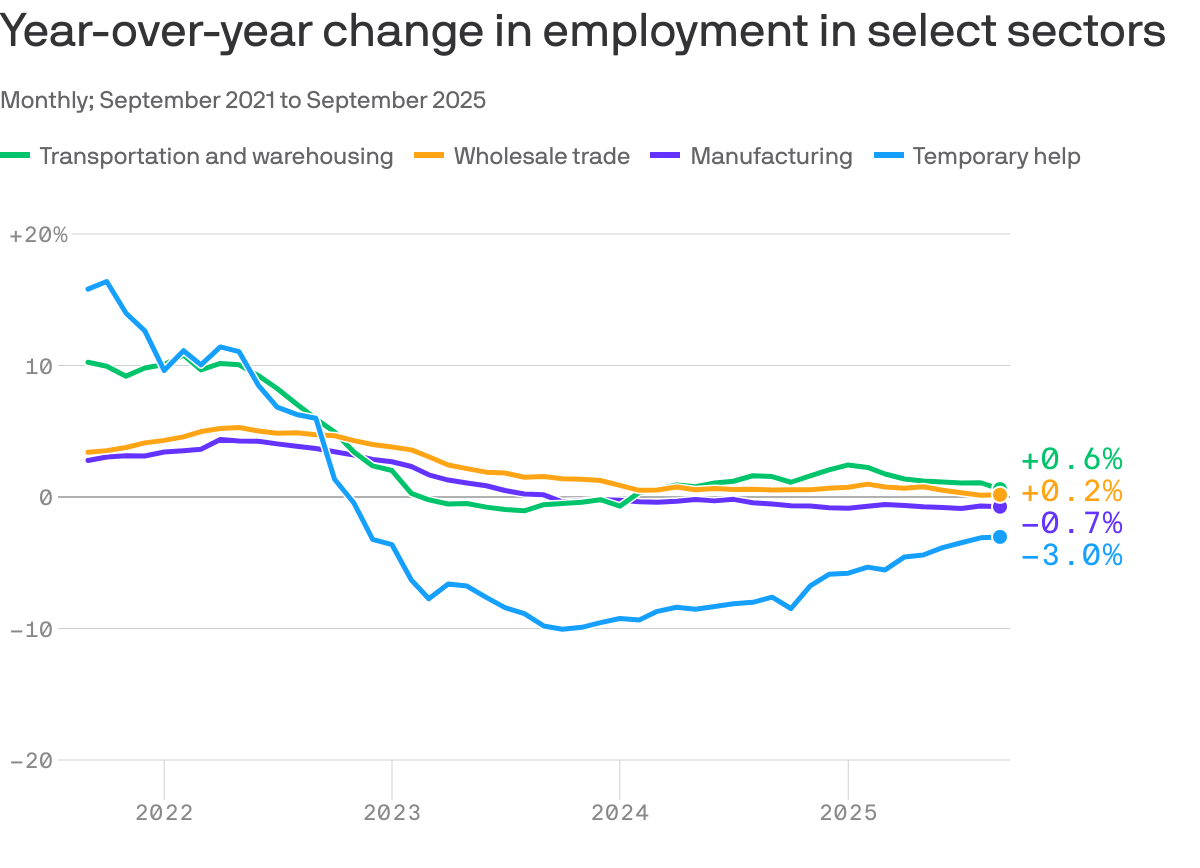
Overall employment is up 0.8% over the 12 months ended in September, but the hiring has been driven in significant part by health care, state and local government, and other less cyclical sectors.

  • Manufacturing employment is down 0.7% over the last 12 months. Tariffs are weighing on the sector, but its job losses long predate the Trump trade wars, with year-over-year job losses for more than two years.
  • Temporary help employment, which tends to be a volatile indicator underlying growth trends, is down 3%. It has been losing jobs for three consecutive years.
  • Two other sectors that tend to correlate with overall economic momentum, transportation and warehousing and wholesale trade, are also adding jobs at rates below that of overall job growth (0.6% and 0.2%, respectively).

Stunning stat: 

As Bloomberg flagged, two sectors — health care and social assistance, and leisure and hospitality — accounted for more than 100% of net job gains so far in 2025.

  • Excluding those sectors, employment dropped by 6,000 jobs in the first nine months of the year.

Zoom out: 

There’s not much reason to think these numbers are driven by AI-related opportunities for companies to increase productivity and rely on fewer human workers, particularly given that the phenomenon isn’t new.

  • But it is more plausible that seeing such opportunities on the horizon has made companies more reluctant to hire in the absence of overwhelming need.
  • BlackRock chief investment officer for global fixed income Rick Rieder wrote in a note after last week’s jobs report that “what we think we are seeing now is … essentially a hiring pause in anticipation of AI.”

Of note: 

report out this morning from the McKinsey Global Institute finds that AI and robotics technologies could, in theory, automate 57% of U.S. work hours.

  • “AI will not make most human skills obsolete, but it will change how they are used,” the authors find. “As AI takes on common tasks, people will apply their skills in new contexts,” they write, such as less time researching and preparing documents and more time framing questions and interpreting results.

The bottom line: 

Beneath the headline numbers, there is some good reason that attitudes toward the job market are glum.

Layoff Trends

Layoff trends in 2025 indicate an increase in job cuts compared to 2024, with US employers announcing nearly 950,000 cuts through September, the highest number since 2020. Key drivers include cost-cutting measures, the strategic implementation of artificial intelligence (AI), and a cooling labor market. 

Key Trends

  • Elevated Numbers: Total US job cuts through October 2025 were over one million, a 65% increase from the same period in 2024. October 2025 had the highest number of layoffs for that month in 22 years.
  • AI as a Primary Driver: AI adoption is a leading cause for job cuts as companies restructure for efficiency and reallocate resources. Companies like Amazon and Intel have cited AI as a reason for significant workforce reductions.
  • “Forever Layoffs”: A new trend involves smaller, more regular rounds of layoffs (fewer than 50 people) that create ongoing worker anxiety and impact company culture. These rolling cuts often stay out of headlines but contribute significantly to the overall job cuts.
  • Method of Notification: The process is becoming more impersonal, with many employees being notified of their termination via email or phone call rather than in-person meetings.
  • Hiring Slowdown: Alongside the layoffs, there has been a sharp drop in hiring plans, with planned hires for the year at their lowest level since 2011. 

Affected Industries

While tech has been significantly impacted since late 2022, other industries are also facing substantial cuts in 2025: 

  • Technology: Remains a leading sector for cuts as companies continue to restructure after pandemic-era overhiring and focus on AI.
  • Retail and Warehousing: Companies like Target and UPS are cutting thousands of jobs due to changing consumer demands, automation, and a push for efficiency.
  • Energy and Manufacturing: Oil giants such as Chevron and BP are making cuts as part of cost-reduction strategies and market consolidation.
  • Finance and Consulting: Firms like PwC and Morgan Stanley are trimming staff, citing factors like low attrition rates and the need to realign resources.
  • Media and Communications: Companies like CNN and the Washington Post have made cuts to pivot toward digital services and reduce costs. 

Economic Context

The overall U.S. labor market remains relatively healthy despite the uptick in layoffs, though it is showing signs of cooling. The unemployment rate has inched up, and consumer sentiment has declined. The Federal Reserve is monitoring the situation and has implemented interest rate cuts to help stabilize the job market. 

For detailed lists and trackers of layoffs, you can consult resources such as the Challenger, Gray & Christmas, Inc. reports, the TrueUp Layoffs Tracker, and Layoffs.

Talk Is Cheap: Now Trump Must Deliver On His Healthcare Promises

https://www.forbes.com/sites/robertpearl/2025/06/09/talk-is-cheap-now-trump-must-deliver-on-his-healthcare-promises/

President Donald Trump has made big promises about fixing American healthcare. Now comes the moment that separates talk from action.

With the 2026 midterms fast approaching and congressional attention soon shifting to electoral strategy, the window for legislative results is closing quickly. This summer will determine whether the administration turns promises into policy or lets the opportunity slip away.

Trump and his handpicked healthcare leaders — HHS Secretary Robert F. Kennedy Jr. and FDA Commissioner Dr. Marty Makary — have identified three major priorities: lowering drug prices, reversing chronic disease and unleashing generative AI. Each one, if achieved, would save tens of thousands of lives and reduce costs.

But promises are easy. Real change requires political will and congressional action. Here are three tests that Americans can use to gauge whether the Trump administration succeeds or fails in delivering on its healthcare agenda.

Test No. 1: Have Drug Prices Come Down?

Americans pay two to four times more for prescription drugs than citizens in other wealthy nations. This price gap has persisted for more than 20 years and continues to widen as pharmaceutical companies launch new medications with average list prices exceeding $370,000 per year.

One key reason for the disparity is a 2003 law that prohibits Medicare from negotiating prices directly with drug manufacturers. Although the Inflation Reduction Act of 2022 granted limited negotiation rights, the initial round of price reductions did little to close the gap with other high-income nations.

President Trump has repeatedly promised to change that. In his first term, and again in May 2025, he condemned foreign “free riders,” promising, “The United States will no longer subsidize the healthcare of foreign countries and will no longer tolerate profiteering and price gouging.”

To support these commitments, the president signed an executive order titled “Delivering Most-Favored-Nation (MFN) Prescription Drug Pricing to American Patients.” The order directs HHS to develop and communicate MFN price targets to pharmaceutical manufacturers, with the hope that they will voluntarily align U.S. drug prices with those in other developed nations. Should manufacturers fail to make significant progress toward these targets, the administration said it plans to pursue additional measures, such as facilitating drug importation and imposing tariffs. However, implementing these measures will most likely require congressional legislation and will encounter substantial legal and political challenges.

The pharmaceutical industry knows that without congressional action, there is no way for the president to force them to lower prices. And they are likely to continue to appeal to Americans by arguing that lower prices will restrict innovation and lifesaving drug development.

But the truth about drug “innovation” is in the numbers: According to a study by America’s Health Insurance Plans, seven out of 10 of the largest pharmaceutical companies spend more on sales and marketing than on research and development. And if drugmakers want to invest more in R&D, they can start by requiring peer nations to pay their fair share — rather than depending so heavily on U.S. patients to foot the bill.

If Congress fails to act, the president has other tools at his disposal. One effective step would be for the FDA to redefine “drug shortages” to include medications priced beyond the reach of most Americans. That change would enable compounding pharmacies to produce lower-cost alternatives just as they did recently with GLP-1 weight-loss injections.

If no action is taken, however, and Americans continue paying more than twice as much as citizens in other wealthy nations, the administration will fail this crucial test.

Test No. 2: Did Food Health, Quality Improve?

Obesity has become a leading health threat in the United States, surpassing smoking and opioid addiction as a cause of death.

Since 1980, adult obesity rates have surged from 15% to over 40%, contributing significantly to chronic diseases, including type 2 diabetes, heart disease and multiple types of cancers.

A major driver of this epidemic is the widespread consumption of ultra-processed foods: products high in added sugar, unhealthy fats and artificial additives. These foods are engineered to be hyper-palatable and calorie-dense, promoting overconsumption and, in some cases, addictive eating behaviors.

RFK Jr. has publicly condemned artificial additives as “poison” and spotlighted their impact on children’s health. In May 2025, he led the release of the White House’s Make America Healthy Again (MAHA) report, which identifies ultra-processed foods, chemical exposures, lack of exercise and excessive prescription drug use as primary contributors to America’s chronic disease epidemic.

But while the report raises valid concerns, it has yet to produce concrete reforms.

To move from rhetoric to results, the administration will need to implement tangible policies.

Here are three approaches (from least difficult to most) that, if enacted, would signify meaningful progress:

  • Front-of-package labeling. Implement clear and aggressive labeling to inform consumers about the nutritional content of food products, using symbols to indicate healthy versus unhealthy options.
  • Taxation and subsidization. Impose taxes on unhealthy food items and use the revenue to subsidize healthier food options, especially for socio-economically disadvantaged populations.
  • Regulation of food composition. Restrict the use of harmful additives and limit the total amount of fat and sugar included, particularly for foods aimed at kids.

These measures will doubtlessly face fierce opposition from the food and agriculture industries. But if the Trump administration and Congress manage to enact even one of these options — or an equivalent reform — they can claim success.

If, instead, they preserve the status quo, leaving Americans to decipher nutritional fine print on the back of the box, obesity will continue to rise, and the administration will have failed.

Test No. 3: Are Patients Using Generative AI To Improve Health?

The Trump administration has signaled a strong commitment to using generative AI across various industries, including healthcare. At the AI Action Summit in Paris, Vice President JD Vance made the administration’s agenda clear: “I’m not here this morning to talk about AI safety … I’m here to talk about AI opportunity.”

FDA Commissioner Dr. Marty Makary has echoed that message with internal action. After an AI-assisted scientific review pilot program, he announced plans to integrate generative AI across all FDA centers by June 30.

But internal efficiency alone won’t improve the nation’s health. The real test is whether the administration will help develop and approve GenAI tools that expand clinical access, improve outcomes and reduce costs.

To these ends, generative AI holds enormous promise:

  • Managing chronic disease: By analyzing real-time data from wearables, GenAI can empower patients to better control their blood pressure, blood sugar and heart failure. Instead of waiting months between doctor visits for a checkup, patients could receive personalized analyzes of their data, recommendations for medication adjustments and warnings about potential risk in real time.
  • Improving diagnoses: AI can identify clinical patterns missed by humans, reducing the 400,000 deaths each year caused by misdiagnoses.
  • Personalizing treatment: Using patient history and genetics, GenAI can help physicians tailor care to individual needs, improving outcomes and reducing side effects.

These breakthroughs aren’t theoretical. They’re achievable. But they won’t happen unless federal leaders facilitate broad adoption.

That will require investing in innovation. The NIH must provide funding for next-generation GenAI tools designed for patient empowerment, and the FDA will need to facilitate approval for broad implementation. That will require modernizing current regulations. The FDA’s approval process wasn’t built for probabilistic AI models that rely on continuous application training and include patient-provided prompts. Americans need a new, fit-for-purpose framework that protects patients without paralyzing progress.

Most important, federal leaders must abandon the illusion of zero risk. If American healthcare were delivering superior clinical outcomes, managing chronic disease effectively and keeping patients safe, that would be one thing. But medical care in the United States is far from that reality. Hundreds of thousands of Americans die annually from poorly controlled chronic diseases, medical errors and misdiagnoses.

If generative AI technology remains confined to billing support and back-office automation, the opportunity to transform American healthcare will be lost. And the administration will have failed to deliver on this promise.

When I teach strategy at Stanford’s Graduate School of Business, I tell students that the best leaders focus on a few high-priority goals with clear definitions of success — and a refusal to accept failure. Based on the administration’s own words, grading the administration on these three healthcare tests will fulfill those criteria.

However, with Labor Day just months away, the window for action will soon close. The time for presidential action is now.

Poll results: AGI and the future of medicine

Artificial general intelligence (AGI) refers to AI systems that can match or exceed human cognitive abilities across a wide range of tasks, including complex medical decision-making.

With tech leaders predicting AGI-level capabilities within just a few years, clinicians and patients alike may soon face a historic inflection point: How should these tools be used in healthcare, and what benefits or risks might they bring? Last month’s survey asked your thoughts on these pressing questions. Here are the results:

My thoughts: 

I continue to be impressed by the expertise of readers. Your views on artificial general intelligence (AGI) closely align with those of leading technology experts. A clear majority believes that AGI will reach clinical parity within five years. A sizable minority expect it will take longer, and only a small number doubt it will ever happen.

Your answers also highlight where GenAI could have the greatest impact. Most respondents pointed to diagnosis (helping clinicians solve complex or uncertain medical problems) as the No. 1 opportunity. But many also recognized the potential to empower patients: from improving chronic disease management to personalizing care. And unlike the electronic health record, which adds to clinicians’ workloads (and contributes to burnout), GenAI is widely seen by readers as a tool that could relieve some of that burden.

Ultimately, the biggest concern may lie not with the technology, itself, but in who controls it. Like many of you, I worry that if clinicians don’t lead the way, private equity and for-profit companies will. And if they do, they will put revenue above the interests of patients and providers.

Thanks to those who voted. To participate in future surveys, and for access to timely news and opinion on American healthcare, sign up for my free (and ad-free) newsletter Monthly Musings on American Healthcare.

* * *

Dr. Robert Pearl is the former CEO of The Permanente Medical Group, the nation’s largest physician group. He’s a Forbes contributor, bestselling author, Stanford University professor, and host of two healthcare podcasts. Check out Pearl’s newest book, ChatGPT, MD: How AI-Empowered Patients & Doctors Can Take Back Control of American Medicine with all profits going to Doctors Without Borders.

Key Principles for Proactive Management of Patient Denials

https://www.kaufmanhall.com/insights/article/key-principles-proactive-management-patient-denials

The proliferation of claims denials, especially by Medicare Advantage payers, has become a pressing issue for health system operations. In 2023, Medicare Advantage insurers fully or partially denied 3.2 million prior authorization requests—or 6.4% of all requests, according to a Kaiser Family Foundation (KFF) report.

The growth in denials can be partially explained by the increasing popularity of managed Medicare and Medicaid plans, but evolving payer practices, including the adoption of AI for algorithmic denials, have also contributed. Claims denials have emerged as one of the key points of payer-provider tension, and an effective claims denials management and prevention program is a powerful way for health systems to rebalance their payer relationships.

Denied claims result in reduced reimbursement, added administrative burdens, and patient and provider frustrations. Even when denials are successfully appealed and reversed—the KFF report found that in 2023, 82% of Medicare Advantage denials were partially or fully overturned—the time and resources devoted to the appeals process add to the costs of providing healthcare services. Optimizing pre-billing activities to reduce avoidable denials and improve and streamline the patient experience of care is as essential for health systems as a robust appeals strategy. This article addresses critical success factors for both preventing and appealing denials.

Preventing Claims Denials During Pre-Bill Period

Successfully preventing denials requires a centralized program across the workforce, from frontline providers to clinical and revenue cycle staff, to manage pre-bill activities by focusing on identifying the correct patient insurance information, obtaining accurate authorizations, and preventing concurrent denials while the patient is still in the facility. Utilization review nurses, attending providers, and Physician Advisors should be attentive to documenting the full state of patient acuity, while collaborating with the revenue cycle team. This team should focus on the collection and reporting of medically necessary data and documentation, which serves as the evidence payers use to evaluate prior authorization requests. When information about a patient’s condition isn’t recorded, or acknowledged in an authorization request, unnecessary denials can result.

A successful denials prevention program expands beyond the utilization management (UM) team and includes revenue cycle, and provider collaboration. Revenue cycle pre-service procedures should focus on confirming insurance benefits and securing payer authorization for planned services while collaborating with UM and referral sources. A comprehensive and proactive denials prevention program helps conveys to payers the full extent of inpatient clinical work, thanks to a collaborative effort to improve documentation.

The following list can help organize denials prevention programs across all locations, clinics and practices:

  • Establish an enterprise-wide denials prevention strategy which includes a multi-disciplinary denials management committee focused on identifying denials trends, conducting root cause analyses, developing proactive denials mitigation plans, creating enhanced reporting, monitoring improvement, and communicating risk
  • Establish proactive revenue cycle, UM, pre-certification, and peer-to peer workflows procedures to confirm completion of payer requirements prior to scheduled services and discharge
  • Ensure patients are financially cleared through implementation of pre-service protocols, including enhanced medical necessity process for outpatient services, authorization defer and delay procedures to reduce rework and avoidable denials
  • Identify pre-bill edits to increase “clean claim” efficiency, reducing initial denials and expediting reimbursement
  • Deliver education to providers, care management, and nursing teams on key observation concepts, such as clinical documentation improvement, patient status documentation, medical necessity documentation and orders for the Two Midnights rule, and payer reimbursement methodologies

Pursuing Post-Bill Appeals, Reversals and Payer Escalation

A strong denials management and prevention program should include a robust post-bill appeals program with skilled coding, clinical and technical resources. A targeted and strategic appeal process can result in improved overturn rates and increased reimbursement. Appeal letters which are supported by clinical facts, payer policies, and a summary of key components relevant to each case and the associated denial increase the likelihood of success.

Components of the appeal program should include the following:

  • Guidelines for when to appeal based on potential success by payer and appeal level
  • Reviews of upheld appeals for second and third level appeals based on strategy by payer
  • Trends for all upheld appeals by reason and by payer
  • Dashboard for tracking denials activities
  • Appeal letter writing guidelines and tips to support
  • Evaluation process for existing payer escalation workflows, tools and payer communication strategies with consideration for payer
  • Process to measure and monitor overturn rates and improvement opportunities

The collaboration with managed care is vital to the success of the denials management/prevention program. A formal payer escalation process which facilitates transparency between the payer and provider can result in improved relations and a reduction in initial denials. Successful denials management/prevention payer escalation programs are strategic and focus on addressing unfair/incorrect denials and establishing clear bi-directional reporting and communications. These programs can result in improved contract negotiations and reduce incorrect denials.

Artificial Intelligence (AI) can support the post-bill appeals process and can be especially relevant when developing a strategy to combat denials. Not only are payers increasingly using AI to trigger denials, but health systems can also deploy AI to write appeal letters, analyze denial trends, and summarize medically necessary documentation. Although algorithmic denials have become a source of frustration for providers and patients, health systems can also deploy AI to their defense. While payers are often better positioned to devote AI resources to claims, a little bit of investment from health systems, deployed effectively, can go a long way toward evening the playing field.

Closing Thoughts and Seven Questions to Consider

A formal denials management and prevention program is essential to obtaining proper reimbursement for the care provided and reducing rework across the enterprise. A strong program should also improve the patient’s experience of care: ideally, a patient should not need to interact with or hear from their provider between scheduling an appointment and checking in.

Denials management and prevention programs should be led by multi-disciplinary committees and focus on reducing avoidable denials and rework. Reducing denials requires the implementation of a multi-disciplinary program and collaboration between UM, revenue cycle, clinical documentation improvement, managed care, clinical operation and providers. 

Health systems reassessing their claims denials program should consider these questions:

  1. Do you have a reactive or proactive denials management strategy in place?
  2. Does your denials strategy include multi-disciplinary team representation?
  3. What reporting/tools are currently being used to track and manage denials?
  4. What are your top five denial categories and what is being done to address the root cause of these denials?
  5. How are avoidable denial risks managed, communicated and monitored?
  6. Have you implemented a comprehensive denials management strategy with a multi-disciplinary committee?
  7. Are the system’s internal resources and expertise sufficient for addressing identified challenges, or should the system seek external partners to implement changes?

Are healthcare jobs safe from AI? More so than many might think

https://www.healthcarefinancenews.com/news/are-healthcare-jobs-safe-ai-more-so-many-might-think?mkt_tok=eyJpIjoiT0RJNU16UTNOakl4WlRFNCIsInQiOiJ1WHRTRHREbE5rM1hkZmc1QnRcL3JCSjdxMWdtXC9weGE1OE4yT0tMZ2d0eGVCYnlXbkVDSmVtU09UTzZDaUVSTmE2aVRpT1YzSklCVmVsZ3VaMWVyMDlNa1Z2b25DbXZ2QnpxSUpySWluXC8zSDRoTmkya2JCMU53b1h5YkRQUDlNcyJ9

No occupation will be unaffected by the technology, but healthcare will be affected less than other industries, owing much to its inherent complexity

Across the country and across industries, workers are nervous that automation and artificial intelligence will eventually take over their jobs. For some, those fears may be grounded in reality.

Healthcare, however, looks like it will be largely safe from that trend, a new report from the Brookings Metropolitan Policy Program finds.

Examining a chunk of time from the 1980s to 2016, the piece tracks the historical evolution of the technology and uses those findings to project forward to 2030.

The verdict? AI will replace jobs in various industries, but not so much in healthcare.

IMPACT

AI is projected to be an increasingly common form of automation, and the report claims the effects should be manageable in the aggregate labor market. Uncertainty remains, of course, and the effects will vary greatly — across geography, demographics and occupations.

Overall, though, only about 25 percent of U.S. jobs are at a high risk of replacement by automation. That translates to about 36 million jobs, based on 2016 data.

A higher percentage, 36 percent, are at medium risk (52 million jobs) while the largest group is the low-risk group, at 39 percent (57 million jobs).

Most of healthcare belongs in the medium-to-low categories, largely driven by the complexity of healthcare jobs. Still, the risk varies wildly. Medical assistants have what the report calls “automation potential” of 54 percent, but home health aids have just an 8 percent automation potential. Registered nurses sit somewhere in between, at 54 percent.

For healthcare support occupations, the number is closer to 49 percent; healthcare practitioners and technical jobs have 33 percent automation potential.

TREND

The report emphasizes that while some occupations will be safer from automation than others, no industry will be unaffected totally. Mundane tasks will be the most vulnerable.

Fortunately for those in the industry, there’s little in healthcare that’s mundane. AI and machine learning algorithms tend to rely on large quantities of data to be effective, and that data needs human hands to collect it and human eyes to analyze it.

And since AI in healthcare is currently utilized mainly to aggregate and organize data — looking for trends and patterns and making recommendations — a human component is very much needed, an opinion shared by several experts, who point out that empathy are reasoning skills are required in the field.


PwC names 6 healthcare issues to watch in 2019

https://www.beckershospitalreview.com/hospital-management-administration/pwc-names-6-healthcare-issues-to-watch-in-2019.html?origin=ceoe&utm_source=ceoe

Image result for 2019 healthcare trends

PwC’s Health Research Institute believes 2019 is the year the “New Health Economy” will finally become a reality.

The past year marked record interest in the healthcare industry, especially from outside forces like venture capitalists and business giants like Amazon, Berkshire Hathaway and JP Morgan Chase. PwC believes forces like these mean healthcare will no longer be an “outlier” industry that operates in its own world outside the greater U.S. economy.

In its 13th annual report, PwC’s HRI identified the following six healthcare trends to watch in 2019:

1. With an injection of $12.5 billion from investors over the past two years, PwC expects connected health devices and digital therapies to become integrated into care delivery and the regulatory process for drug and device approvals. PwC expects several new products to come to market in this category in 2019. What does this mean for providers? They will need to find a way to integrate this data into the EHR so it can be used to maximize the patient visit.  

2. Artificial intelligence and automation will require healthcare organizations to invest in and train their workforce to succeed in a digital economy. Almost half (45 percent) of executives surveyed by PwC’s HRI said skill deficiencies among their workforce are holding their organization back, yet few employers are offering training in AI, robotics and automation or data analytics.

3. The 2017 Tax Cuts and Jobs Act will continue to create tax savings for healthcare organizations while creating new challenges. Providers are likely to feel the biggest challenges via changes to unrelated business taxable income, which could create new expenses. Academic medical centers may also feel minor negative pressure from the net investment excise tax on educational foundations.

4. The healthcare industry is ready for its own budget airline provider. It needs a disruptor that is low-cost, transparent, informed by technology and “laser-focused on the consumer” like Southwest Airlines, according to PwC. Organizations that answer this call are starting to emerge — like a profitable, Medicaid-focused, walk-in-only family medicine practice in Denver — but progress is slow and there isn’t one simple formula to follow. PwC advises healthcare organizations to look for patient segments that need a “budget airline” and determine how to meet those needs.

5. The pace of private equity investment is expected to accelerate as healthcare companies continue to divest noncore business units to investors next year. It also expects PE-healthcare partnerships to evolve, with some healthcare companies co-investing in their own spinoffs. PwC suggested healthcare organizations pursue PE partnerships not only for financing, but also for PE firms’ ability to provide strategic views of trends across their portfolio of investments.

6. Republican changes to the ACA will shift the law’s winners and losers. Providers are on the losing end of most of these changes, including softened insurance mandates, short-term health insurance plans, less federal support for ACA exchanges and reduced federal Medicaid spending, according to the report.

Download the report here.


What goes into a CFO’s dashboard for artificial intelligence and machine learning

https://www.healthcarefinancenews.com/news/what-goes-cfos-dashboard-artificial-intelligence-and-machine-learning?mkt_tok=eyJpIjoiWVdZeU9ETTJaR1ZqWWpJNSIsInQiOiJZYWlKXC9DcnN5YitocXRMMXIxb1VJdXdLVGNoRWgwXC83cm15ZzlGbmR5SGNRZ3A5MHRaVHl4OXZCbUVRWHdLcXhUOU45bU5KVXhzMVFTV3Qyd3RkS1pZWGFRNzFlbVEzaFNvVHZHQ2I2VmhUY0NQeWdUR0dHZTBjbkpMZm9nQ05HIn0%3D

Artificial intelligence and machine learning can be leveraged to improve healthcare outcomes and costs — here’s how to monitor AI.

The use of artificial intelligence in healthcare is still nascent in some respects. Machine learning shows potential to leverage AI algorithms in a way that can improve clinical quality and even financial performance, but the data picture in healthcare is pretty complex. Crafting an effective AI dashboard can be daunting for the uninitiated.

A balance needs to be struck: Harnessing myriad and complex data sets while keeping your goals, inputs and outputs as simple and focused as possible. It’s about more than just having the right software in place. It’s about knowing what to do with it, and knowing what to feed into it in order to achieve the desired result.

In other words, you can have the best, most detailed map in the world, but it doesn’t matter if you don’t have a compass.

AI DASHBOARD MUST HAVES

Jvion Chief Product Officer John Showalter, MD, said the most important thing an AI dashboard can do is drive action. That means simplifying the outputs, so perhaps two of the components involved are AI components, and the rest is information an organization would need to make a decision.

He’s also a proponent of color coding or iconography to simplify large amounts of information — basic measures that allow people to understand the information very quickly.

“And then to get to actionability, you need to integrate data into the workflow, and you should probably have single sign-on activity to reduce the login burden, so you can quickly look up the information when you need it without going through 40 steps.”

According to Eldon Richards, chief technology officer at Recondo Technology, there have been a number of breakthroughs in AI over the years, such that machine learning and deep learning are often matching, and sometimes exceeding, human capability for certain tasks.

What that means is that dashboards and related software are able to automate things that, as of a few years ago, weren’t feasible with a machine — things like radiology, or diagnosing certain types of cancer.

“When dealing with AI today, that mostly means machine learning. The data vendor trains the model on your needs to match the data you’re going to feed into the system in order to get a correct answer,” Richards said. “An example would be if the vendor trained the model on hospitals that are not like my hospital, and payers unlike who I deal with. They could produce very inaccurate numbers. It won’t work for me.”

A health system would also want to pay close attention to the ways in which AI can fail. The technology can still be a bit fuzzy at times.

“Sometimes it’s not going to be 100 percent accurate,” said Richards. “Humans wouldn’t be either, but it’s the way they fail. AI can fail in ways that are more problematic — for example, if I’m trying to predict cancer, and the algorithm says the patient is clean when they’re not, or it might be cancer when it’s not. In terms of the dashboard, you want to categorize those types of values on data up front, and track those very closely.”

KEY PERFORMANCE INDICATORS FOR AI AND ML

Generally speaking, you want a key performance indicator based around effectiveness. You want a KPI around usage. And you want some kind of KPI that tracks efficiency — Is this saving us time? Are we getting the most bang for the buck?

The revenue cycle offers a relevant example, where the dashboard can be trained to look at something like denials. KPIs that track the efficiency of denials, and the total denials resolved with a positive outcome, can help health systems determine what percentage of the denials were fixed, and how many they got paid for. This essentially tracks the time, effort, and ultimately the efficacy of the AI.

“You start with your biggest needs,” said Showalter. “You talk about sharing outcomes — what are we all working toward, what can we all agree on?”

“Take falls as an example,” Showalter added. “The physician maybe will care about the biggest number of falls, and the revenue cycle guy will care about that and the cost associated with those falls. And maybe the doctors and nurses are less concerned about the costs, but everybody’s concerned about the falls, so that becomes your starting point. Everyone’s focused on the main outcome, and then the sub-outcomes depend on the role.”

It’s that focus on specific outcomes that can truly drive the efficacy of AI and machine learning. Dr. Clemens Suter-Crazzolara, vice president of product management for health and precision medicine at SAP, said it’s helpful to parse data into what he called limited-scope “chunks” — distinct processes a provider would like to tackle with the help of artificial intelligence.

Say a hospital’s focus is preventing antibiotic resistance. “What you then start doing,” said Suter-Crazzolara, “is you say, ‘I have these patients in the hospital. Let’s say there’s a small-scale epidemic. Can I start collecting that data and put that in an AI methodology to make a prediction for the future?’ And then you determine, ‘What is my KPI to measure this?’

“By working on a very distinct scenario, you then have to put in the KPIs,” he said.

PeriGen CEO Matthew Sappern said a good litmus test for whether a health system is integrating AI an an effective way is whether it can be proven that its outcomes are as good as those of an expert. Studies that show the system can generate the same answers as a panel of experts can go a long way toward helping adoption.

The reason that’s so important, he said, is that the accuracy of the tools can be all over the place. The engine is only as good as the data you put into it, and the more data, the better. That’s where electronic health records have been a boon; they’ve generated a huge amount of data.

Even then, though, there can be inconsistencies, and so some kind of human touch is always needed.

“At any given time, something is going on,” said Sappern. “To assume people are going to document in 30-second increments is kind of crazy. So a lot of times nurses and doctors go back and try to recreate what’s on the charts as best they can.

“The problem is that when you go back and do chart reviews, you see things that are impossible. As you curate this data, you really need to have an expert. You need one or two very well-seasoned physicians or radiologists to look for these things that are obviously not possible. You’d be surprised at the amount of unlikely information that exists in EMRs these days.”

Having the right team in place is essential, all the more so because of one of the big misunderstandings around AI: That you can simply dump a bunch of data into a dashboard, press a button, and come back later to see all of its findings. In reality, data curation is painstaking work.

“Machine learning is really well suited to specific challenges,” said Sappern. “It’s got great pattern recognition, but as you are trying to perform tasks that require a lot of reasoning or a lot of empathy, currently AI is not really great at that.

“Whenever we walk into a clinical setting, a nurse or a number of nurses will raise their hands and say, ‘Are you telling me this machine can predict the risk of stroke better than I can?’ And the immediate answer is absolutely not. Every single second the patient is in bed, we will persistently look out for those patterns.”

Another area in which a human touch is needed is in the area of radiological image interpretation. The holy grail, said Suter-Crazzolara, would be to have a supercomputer into which one could feed an x-ray from a cancer patient, and which would then identify the type of cancer present and what the next steps should be.

“The trouble is,” said Suter-Crazzolara, “there’s often a lack of annotated data. You need training sets with thousands of prostate cancer types on these images. The doctor has to sit down with the images and identify exactly what the tumors look like in those pictures. That is very, very hard to achieve.

“Once you have that well-defined, then you can use machine learning and create an algorithm that can do the work. You have to be very, very secure in the experimental setup.”

HOW TO TELL IF THE DASHBOARD IS WORKING

It’s possible for machine learning to continue to learn the more an organization uses the system, said Richards. Typically, the AI dashboard would provide an answer back to the user, and the user would note anything that’s not quite accurate and correct it, which provides feedback for the software to improve going forward. Richards recommends a dashboard that shows failure rate trends; if it’s doing its job, the failure rate should improve over time.

“AI is a means to an end,” he said. “Stepping back a little bit, if I’m designing a dashboard I might also map out what functions I would apply AI to, and what the coverage looks like. Maybe a heat map showing how I’m doing in cost per transaction.”

Suter-Crazzolara sees these dashboards as the key to creating an intelligent enterprise because it allows providers to innovate and look at data in new ways, which can aid everything from the diagnosis of dementia to detecting fraud and cutting down on supply chain waste.

“AI is at a stage that is very opportune,” he said, “because artificial intelligence and machine learning have been around for a long time, but at the moment we are in this era of big data, so every patient is associated with a huge amount of data. We can unlock this big data much better than in the past because we can create a digital platform that makes it possible to connect and unlock the data, and collaborate on the data. At the moment, you can build very exciting algorithms on top of the data to make sense of that information.”

MARKETPLACE

If a health system decides to tap a vendor to handle its AI and machine learning needs, there are certain things to keep in mind. Typically, vendors will already have models created from certain data sets, which allows the software to perform a function that was learned from that data. If a vendor trained a model with a hospital whose characteristic differ from your own, there can be big differences in the efficacy of those models.

Richards suggested reviewing what data the vendor used to train its model, and to discuss with them how much data they need in order to construct a model with the utmost accuracy. He suggests talking to vendor to understand how well they know your particular space.

“In most cases I think they’ve got a good handle on the technology itself, but they need to know the space and the nuances of it,” said Richards. He would interview them to make sure he was comfortable with their depth of knowledge.

That will ensure the technology works as effectively as possible — an important consideration, since AI likely isn’t going away anytime soon.

“We’re seeing not just the hype, but we’re definitely seeing some valuable results coming,” said Richards. “We’re still somewhat at the beginning of that. Breakthroughs in the space are happening every day.”