The Slow Death of Epic Systems

The software monopoly that powers American hospitals wasn’t built for the data, speed, or intelligence the future of medicine demands.

Epic Systems is an American privately held healthcare software company, founded by Judy Faulkner in 1979, and has grown into the largest electronic health record (EHR) vendor by market share, covering over half of all hospital patients in the U.S.

Epic dominates American healthcare today. But so did Kodak in photography and GE in industry. Its software runs the country’s hospitals, determines the workflows clinicians, nurses and clinical support staff use, and shapes what data gets captured (or more often, what gets lost). It also serves as the front door for healthcare data for the patients it serves. Dominance has never guaranteed a future. Epic’s position reflects the architecture of the past, not the one emerging now.

More importantly, the sheer volume of activity occurring in these hospitals means they are collectively running thousands of experiments, mini clinical trials, and critical observations daily. The stakes are enormous: billions of dollars in drug discovery, the efficiency of clinical trials (currently plagued by poor recruitment and high costs), and the potential for better, personalized care. The data generated in these environments is the single most valuable, untapped resource in all of medicine.

However, this monumental source of value is being throttled by outdated infrastructure, and it shows. It’s hard to imagine a world where AI is used to its full potential in healthcare while Epic is still running the show. The ideas are oppositional at their core.


The Massive Data Problem

Technology is accelerating faster than any legacy system can keep up with. AI is reshaping every major industry, and healthcare will be forced to catch up. However, this essential transformation is structurally incompatible with the dominant system of record.

To put it bluntly: Epic has a data problem. A massive data problem. Not just imperfect data — structurally flawed data. What Epic captures is fragmented, delayed, and riddled with inconsistencies. Diagnoses become billing codes that distort reality. Interventions like intubations, pressor starts, and ventilator changes appear hours late, if at all. Outcomes are incomplete or missing. What remains isn’t a clinical record in any meaningful sense but a billing ledger dressed up as documentation. No model can learn reliably from that.

But the deeper problem is the data Epic never sees. Some of the most valuable information in modern medicine: continuous monitoring streams, ventilator logs, infusion pump data… never enters the EHR in a structured or analyzable form. In many cases, it isn’t captured at all.

I recently brought Roon (a well-known engineer at OpenAI) and Richard Hanania (a public intellectual/cultural critic)—both advisors in my new venture, in full disclosure—to one of the largest academic medical centers in the country. Both watched torrents of millisecond-scale data spill off monitors. Streams that could reveal what’s happening in the brain, heart, and vasculature. Valuable data… all vanished instantly. None of it logged. None of it stored. None of it correlated with outcomes. Roon captured this shock in a viral post on X/Twitteressentially describing how hospitals are filled with catastrophic events like sudden cardiac death, yet we save none of the time-series data that could teach us how to prevent the next one. His shock distilled what people in technology grasp immediately and what healthcare has normalized: industries where human life isn’t exactly top of mind record everything; hospitals, where the stakes are life and death, learn almost nothing from themselves.

In Silicon Valley, losing data like this is unthinkable. In healthcare, it barely registers.

Epic was never built to ingest or learn from this scale of data. It was built to satisfy billing requirements, regulatory checklists, and documentation workflows. That is the beginning and end of its architecture. It is not a learning system, much less an AI system. It is not even a modern data system. And that is the root of Epic’s downfall.


The Cultural and Financial Moat

Epic is famous for its internal commandments — principles Judy Faulkner wrote decades ago:

  • Do not acquire.
  • Do not be acquired.
  • Do not raise outside capital.

(If you haven’t heard it, the latest Acquired podcast episode on Epic is essential listening)

But the same rules that built its empire now limit what it can become. What was once a strategic strength is now its ceiling.

The next era of healthcare software demands investments that were unnecessary when the EHR was the center of gravity. Building AI-native infrastructure: real-time data pipelines, device integrations, large-scale compute, continuous model training, semantic normalization — requires not millions but tens of billions of dollars. Most companies facing that kind of leap can raise capital, acquire talent, or merge with partners. Epic has ruled all of those options out.

Epic’s formidable market share is anchored by a massive customer sunk cost. With implementation fees often exceeding a billion dollars for large systems, the financial and political inertia makes replacing the EHR functionally unthinkable. However, this commitment only forces customers to defend an obsolete data architecture. By preventing them from adopting novel solutions, this inertia doesn’t protect Epic’s long-term viability, it simply guarantees a widening technical gap between the EHR and the transformative potential of AI.

A company optimized for slow, controlled expansion cannot transform itself into an AI-scale enterprise without violating the principles that define it. The culture that kept Epic dominant is the culture that prevents it from catching the next wave. Epic will continue to excel at documentation, billing, and compliance — but those strengths are anchored in the past. The future belongs to systems that learn, and Epic was never designed to learn.


The Shift to Middleware

Meanwhile, the broader economy is being held up by AI. The world’s largest tech companies are pouring staggering sums into compute, data centers, and model training. And all that compute needs rich, complex, high-value data to train on.

Healthcare is the only remaining frontier of that scale.

No other industry generates so much information while analyzing so little of it. No other sector represents nearly 20% of U.S. GDP yet still runs on fragmented workflows and manual processes. And the incentives here are unmatched: improving patient outcomes, reducing costs, eliminating inefficiency, accelerating drug development, modeling disease trajectories, and eventually automating the more repetitive layers of care. There’s even an irony: the very infrastructure needed to enable learning health systems would also finally make billing more accurate.

I’m not writing this to showcase some utopian vision of AI curing all disease. It’s the practical use of technology we already possess. Our limitation isn’t the models; it’s the missing data.

A handful of companies have bet their trillion-dollar valuations on this: OpenAI, Google, Amazon, Nvidia, Apple, Oracle. They are spending hundreds of billions a year on AI infrastructure and need high-volume, high-quality datasets to justify that investment. Healthcare produces oceans of exactly that kind of data, and most of it evaporates. The companies that learn to capture and structure it will define the next layer of healthcare infrastructure. Whether they integrate with Epic, build around it, or replace it is almost secondary.

What matters is that none of them are waiting for Epic.

Clinicians won’t either. Once tools exist that unify the data hospitals already generate, reduce workload, eliminate administrative drag, and answer the questions clinicians actually ask — What happened? Why did it happen? What should we do now? — the center of gravity will shift. Clinicians will live inside those tools, not inside an interface built for billing.

Epic can still exist, but it doesn’t need to function as healthcare’s operating system. There’s precedent for this in every major industry: the core orchestration/data layer eventually recedes into the background while workflow and data intelligence move up the stack. At that point, the EHR becomes background infrastructure or middleware. The intelligence/workflow layer becomes the real operating system. Epic will undoubtedly resist this shift, yet its attempts to maintain total control of the clinician interface will ultimately collide with the utility and data gravity of AI-native systems.

Epic becomes the backend: essential, invisible, and no longer the place where the practice of medicine occurs.

Regulatory modernization around HIPAA, interoperability, and data liquidity will be essential, but that is a conversation for another essay.

Epic isn’t vanishing tomorrow. Large institutions rarely do. But its relevance is eroding in the only domain that will matter over the next decade: the ability to harness data at a scale and fidelity that makes AI transformative. It can keep its commandments, preserve its culture, and reject outside capital — it just can’t do all that and remain the central platform of hospital data in an AI-native future.

The job market’s soft underbelly

For an economy that’s rapidly expanding, the usual drivers of job creation sure aren’t carrying their weight.

Why it matters: 

Anemic job growth in key sectors is a sign that there is more underlying weakness in worker demand than the low unemployment rate might suggest.

  • It makes for a weaker starting point, as companies see new opportunities around the corner to use AI to automate their work.
  • It’s not a new trend: These sectors showed weak job creation or outright job losses for the last couple of years of the Biden administration.
  • But it is striking that a GDP surge fueled by data center and AI investment hasn’t been enough to generate more robust hiring.

By the numbers: 

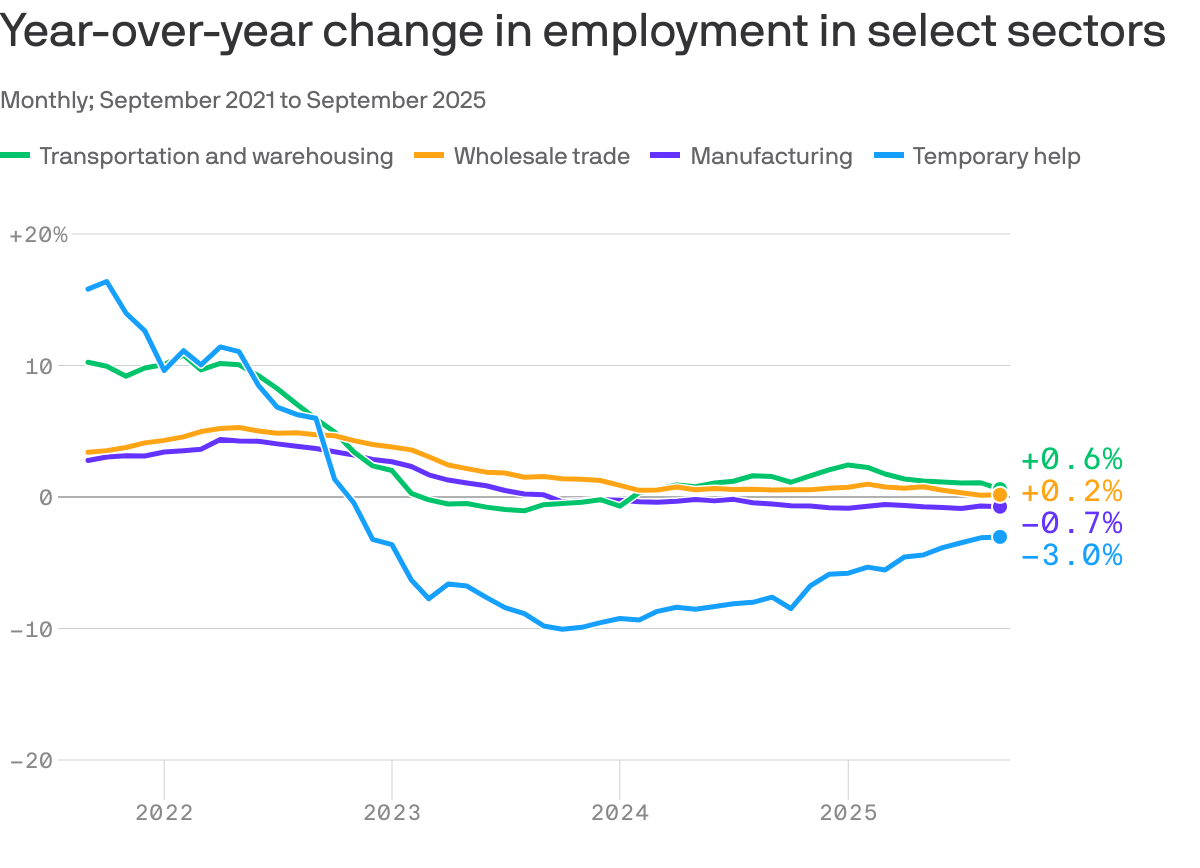
Overall employment is up 0.8% over the 12 months ended in September, but the hiring has been driven in significant part by health care, state and local government, and other less cyclical sectors.

  • Manufacturing employment is down 0.7% over the last 12 months. Tariffs are weighing on the sector, but its job losses long predate the Trump trade wars, with year-over-year job losses for more than two years.
  • Temporary help employment, which tends to be a volatile indicator underlying growth trends, is down 3%. It has been losing jobs for three consecutive years.
  • Two other sectors that tend to correlate with overall economic momentum, transportation and warehousing and wholesale trade, are also adding jobs at rates below that of overall job growth (0.6% and 0.2%, respectively).

Stunning stat: 

As Bloomberg flagged, two sectors — health care and social assistance, and leisure and hospitality — accounted for more than 100% of net job gains so far in 2025.

  • Excluding those sectors, employment dropped by 6,000 jobs in the first nine months of the year.

Zoom out: 

There’s not much reason to think these numbers are driven by AI-related opportunities for companies to increase productivity and rely on fewer human workers, particularly given that the phenomenon isn’t new.

  • But it is more plausible that seeing such opportunities on the horizon has made companies more reluctant to hire in the absence of overwhelming need.
  • BlackRock chief investment officer for global fixed income Rick Rieder wrote in a note after last week’s jobs report that “what we think we are seeing now is … essentially a hiring pause in anticipation of AI.”

Of note: 

report out this morning from the McKinsey Global Institute finds that AI and robotics technologies could, in theory, automate 57% of U.S. work hours.

  • “AI will not make most human skills obsolete, but it will change how they are used,” the authors find. “As AI takes on common tasks, people will apply their skills in new contexts,” they write, such as less time researching and preparing documents and more time framing questions and interpreting results.

The bottom line: 

Beneath the headline numbers, there is some good reason that attitudes toward the job market are glum.

Layoff Trends

Layoff trends in 2025 indicate an increase in job cuts compared to 2024, with US employers announcing nearly 950,000 cuts through September, the highest number since 2020. Key drivers include cost-cutting measures, the strategic implementation of artificial intelligence (AI), and a cooling labor market. 

Key Trends

  • Elevated Numbers: Total US job cuts through October 2025 were over one million, a 65% increase from the same period in 2024. October 2025 had the highest number of layoffs for that month in 22 years.
  • AI as a Primary Driver: AI adoption is a leading cause for job cuts as companies restructure for efficiency and reallocate resources. Companies like Amazon and Intel have cited AI as a reason for significant workforce reductions.
  • “Forever Layoffs”: A new trend involves smaller, more regular rounds of layoffs (fewer than 50 people) that create ongoing worker anxiety and impact company culture. These rolling cuts often stay out of headlines but contribute significantly to the overall job cuts.
  • Method of Notification: The process is becoming more impersonal, with many employees being notified of their termination via email or phone call rather than in-person meetings.
  • Hiring Slowdown: Alongside the layoffs, there has been a sharp drop in hiring plans, with planned hires for the year at their lowest level since 2011. 

Affected Industries

While tech has been significantly impacted since late 2022, other industries are also facing substantial cuts in 2025: 

  • Technology: Remains a leading sector for cuts as companies continue to restructure after pandemic-era overhiring and focus on AI.
  • Retail and Warehousing: Companies like Target and UPS are cutting thousands of jobs due to changing consumer demands, automation, and a push for efficiency.
  • Energy and Manufacturing: Oil giants such as Chevron and BP are making cuts as part of cost-reduction strategies and market consolidation.
  • Finance and Consulting: Firms like PwC and Morgan Stanley are trimming staff, citing factors like low attrition rates and the need to realign resources.
  • Media and Communications: Companies like CNN and the Washington Post have made cuts to pivot toward digital services and reduce costs. 

Economic Context

The overall U.S. labor market remains relatively healthy despite the uptick in layoffs, though it is showing signs of cooling. The unemployment rate has inched up, and consumer sentiment has declined. The Federal Reserve is monitoring the situation and has implemented interest rate cuts to help stabilize the job market. 

For detailed lists and trackers of layoffs, you can consult resources such as the Challenger, Gray & Christmas, Inc. reports, the TrueUp Layoffs Tracker, and Layoffs.

Talk Is Cheap: Now Trump Must Deliver On His Healthcare Promises

https://www.forbes.com/sites/robertpearl/2025/06/09/talk-is-cheap-now-trump-must-deliver-on-his-healthcare-promises/

President Donald Trump has made big promises about fixing American healthcare. Now comes the moment that separates talk from action.

With the 2026 midterms fast approaching and congressional attention soon shifting to electoral strategy, the window for legislative results is closing quickly. This summer will determine whether the administration turns promises into policy or lets the opportunity slip away.

Trump and his handpicked healthcare leaders — HHS Secretary Robert F. Kennedy Jr. and FDA Commissioner Dr. Marty Makary — have identified three major priorities: lowering drug prices, reversing chronic disease and unleashing generative AI. Each one, if achieved, would save tens of thousands of lives and reduce costs.

But promises are easy. Real change requires political will and congressional action. Here are three tests that Americans can use to gauge whether the Trump administration succeeds or fails in delivering on its healthcare agenda.

Test No. 1: Have Drug Prices Come Down?

Americans pay two to four times more for prescription drugs than citizens in other wealthy nations. This price gap has persisted for more than 20 years and continues to widen as pharmaceutical companies launch new medications with average list prices exceeding $370,000 per year.

One key reason for the disparity is a 2003 law that prohibits Medicare from negotiating prices directly with drug manufacturers. Although the Inflation Reduction Act of 2022 granted limited negotiation rights, the initial round of price reductions did little to close the gap with other high-income nations.

President Trump has repeatedly promised to change that. In his first term, and again in May 2025, he condemned foreign “free riders,” promising, “The United States will no longer subsidize the healthcare of foreign countries and will no longer tolerate profiteering and price gouging.”

To support these commitments, the president signed an executive order titled “Delivering Most-Favored-Nation (MFN) Prescription Drug Pricing to American Patients.” The order directs HHS to develop and communicate MFN price targets to pharmaceutical manufacturers, with the hope that they will voluntarily align U.S. drug prices with those in other developed nations. Should manufacturers fail to make significant progress toward these targets, the administration said it plans to pursue additional measures, such as facilitating drug importation and imposing tariffs. However, implementing these measures will most likely require congressional legislation and will encounter substantial legal and political challenges.

The pharmaceutical industry knows that without congressional action, there is no way for the president to force them to lower prices. And they are likely to continue to appeal to Americans by arguing that lower prices will restrict innovation and lifesaving drug development.

But the truth about drug “innovation” is in the numbers: According to a study by America’s Health Insurance Plans, seven out of 10 of the largest pharmaceutical companies spend more on sales and marketing than on research and development. And if drugmakers want to invest more in R&D, they can start by requiring peer nations to pay their fair share — rather than depending so heavily on U.S. patients to foot the bill.

If Congress fails to act, the president has other tools at his disposal. One effective step would be for the FDA to redefine “drug shortages” to include medications priced beyond the reach of most Americans. That change would enable compounding pharmacies to produce lower-cost alternatives just as they did recently with GLP-1 weight-loss injections.

If no action is taken, however, and Americans continue paying more than twice as much as citizens in other wealthy nations, the administration will fail this crucial test.

Test No. 2: Did Food Health, Quality Improve?

Obesity has become a leading health threat in the United States, surpassing smoking and opioid addiction as a cause of death.

Since 1980, adult obesity rates have surged from 15% to over 40%, contributing significantly to chronic diseases, including type 2 diabetes, heart disease and multiple types of cancers.

A major driver of this epidemic is the widespread consumption of ultra-processed foods: products high in added sugar, unhealthy fats and artificial additives. These foods are engineered to be hyper-palatable and calorie-dense, promoting overconsumption and, in some cases, addictive eating behaviors.

RFK Jr. has publicly condemned artificial additives as “poison” and spotlighted their impact on children’s health. In May 2025, he led the release of the White House’s Make America Healthy Again (MAHA) report, which identifies ultra-processed foods, chemical exposures, lack of exercise and excessive prescription drug use as primary contributors to America’s chronic disease epidemic.

But while the report raises valid concerns, it has yet to produce concrete reforms.

To move from rhetoric to results, the administration will need to implement tangible policies.

Here are three approaches (from least difficult to most) that, if enacted, would signify meaningful progress:

  • Front-of-package labeling. Implement clear and aggressive labeling to inform consumers about the nutritional content of food products, using symbols to indicate healthy versus unhealthy options.
  • Taxation and subsidization. Impose taxes on unhealthy food items and use the revenue to subsidize healthier food options, especially for socio-economically disadvantaged populations.
  • Regulation of food composition. Restrict the use of harmful additives and limit the total amount of fat and sugar included, particularly for foods aimed at kids.

These measures will doubtlessly face fierce opposition from the food and agriculture industries. But if the Trump administration and Congress manage to enact even one of these options — or an equivalent reform — they can claim success.

If, instead, they preserve the status quo, leaving Americans to decipher nutritional fine print on the back of the box, obesity will continue to rise, and the administration will have failed.

Test No. 3: Are Patients Using Generative AI To Improve Health?

The Trump administration has signaled a strong commitment to using generative AI across various industries, including healthcare. At the AI Action Summit in Paris, Vice President JD Vance made the administration’s agenda clear: “I’m not here this morning to talk about AI safety … I’m here to talk about AI opportunity.”

FDA Commissioner Dr. Marty Makary has echoed that message with internal action. After an AI-assisted scientific review pilot program, he announced plans to integrate generative AI across all FDA centers by June 30.

But internal efficiency alone won’t improve the nation’s health. The real test is whether the administration will help develop and approve GenAI tools that expand clinical access, improve outcomes and reduce costs.

To these ends, generative AI holds enormous promise:

  • Managing chronic disease: By analyzing real-time data from wearables, GenAI can empower patients to better control their blood pressure, blood sugar and heart failure. Instead of waiting months between doctor visits for a checkup, patients could receive personalized analyzes of their data, recommendations for medication adjustments and warnings about potential risk in real time.
  • Improving diagnoses: AI can identify clinical patterns missed by humans, reducing the 400,000 deaths each year caused by misdiagnoses.
  • Personalizing treatment: Using patient history and genetics, GenAI can help physicians tailor care to individual needs, improving outcomes and reducing side effects.

These breakthroughs aren’t theoretical. They’re achievable. But they won’t happen unless federal leaders facilitate broad adoption.

That will require investing in innovation. The NIH must provide funding for next-generation GenAI tools designed for patient empowerment, and the FDA will need to facilitate approval for broad implementation. That will require modernizing current regulations. The FDA’s approval process wasn’t built for probabilistic AI models that rely on continuous application training and include patient-provided prompts. Americans need a new, fit-for-purpose framework that protects patients without paralyzing progress.

Most important, federal leaders must abandon the illusion of zero risk. If American healthcare were delivering superior clinical outcomes, managing chronic disease effectively and keeping patients safe, that would be one thing. But medical care in the United States is far from that reality. Hundreds of thousands of Americans die annually from poorly controlled chronic diseases, medical errors and misdiagnoses.

If generative AI technology remains confined to billing support and back-office automation, the opportunity to transform American healthcare will be lost. And the administration will have failed to deliver on this promise.

When I teach strategy at Stanford’s Graduate School of Business, I tell students that the best leaders focus on a few high-priority goals with clear definitions of success — and a refusal to accept failure. Based on the administration’s own words, grading the administration on these three healthcare tests will fulfill those criteria.

However, with Labor Day just months away, the window for action will soon close. The time for presidential action is now.

Poll results: AGI and the future of medicine

Artificial general intelligence (AGI) refers to AI systems that can match or exceed human cognitive abilities across a wide range of tasks, including complex medical decision-making.

With tech leaders predicting AGI-level capabilities within just a few years, clinicians and patients alike may soon face a historic inflection point: How should these tools be used in healthcare, and what benefits or risks might they bring? Last month’s survey asked your thoughts on these pressing questions. Here are the results:

My thoughts: 

I continue to be impressed by the expertise of readers. Your views on artificial general intelligence (AGI) closely align with those of leading technology experts. A clear majority believes that AGI will reach clinical parity within five years. A sizable minority expect it will take longer, and only a small number doubt it will ever happen.

Your answers also highlight where GenAI could have the greatest impact. Most respondents pointed to diagnosis (helping clinicians solve complex or uncertain medical problems) as the No. 1 opportunity. But many also recognized the potential to empower patients: from improving chronic disease management to personalizing care. And unlike the electronic health record, which adds to clinicians’ workloads (and contributes to burnout), GenAI is widely seen by readers as a tool that could relieve some of that burden.

Ultimately, the biggest concern may lie not with the technology, itself, but in who controls it. Like many of you, I worry that if clinicians don’t lead the way, private equity and for-profit companies will. And if they do, they will put revenue above the interests of patients and providers.

Thanks to those who voted. To participate in future surveys, and for access to timely news and opinion on American healthcare, sign up for my free (and ad-free) newsletter Monthly Musings on American Healthcare.

* * *

Dr. Robert Pearl is the former CEO of The Permanente Medical Group, the nation’s largest physician group. He’s a Forbes contributor, bestselling author, Stanford University professor, and host of two healthcare podcasts. Check out Pearl’s newest book, ChatGPT, MD: How AI-Empowered Patients & Doctors Can Take Back Control of American Medicine with all profits going to Doctors Without Borders.

Key Principles for Proactive Management of Patient Denials

https://www.kaufmanhall.com/insights/article/key-principles-proactive-management-patient-denials

The proliferation of claims denials, especially by Medicare Advantage payers, has become a pressing issue for health system operations. In 2023, Medicare Advantage insurers fully or partially denied 3.2 million prior authorization requests—or 6.4% of all requests, according to a Kaiser Family Foundation (KFF) report.

The growth in denials can be partially explained by the increasing popularity of managed Medicare and Medicaid plans, but evolving payer practices, including the adoption of AI for algorithmic denials, have also contributed. Claims denials have emerged as one of the key points of payer-provider tension, and an effective claims denials management and prevention program is a powerful way for health systems to rebalance their payer relationships.

Denied claims result in reduced reimbursement, added administrative burdens, and patient and provider frustrations. Even when denials are successfully appealed and reversed—the KFF report found that in 2023, 82% of Medicare Advantage denials were partially or fully overturned—the time and resources devoted to the appeals process add to the costs of providing healthcare services. Optimizing pre-billing activities to reduce avoidable denials and improve and streamline the patient experience of care is as essential for health systems as a robust appeals strategy. This article addresses critical success factors for both preventing and appealing denials.

Preventing Claims Denials During Pre-Bill Period

Successfully preventing denials requires a centralized program across the workforce, from frontline providers to clinical and revenue cycle staff, to manage pre-bill activities by focusing on identifying the correct patient insurance information, obtaining accurate authorizations, and preventing concurrent denials while the patient is still in the facility. Utilization review nurses, attending providers, and Physician Advisors should be attentive to documenting the full state of patient acuity, while collaborating with the revenue cycle team. This team should focus on the collection and reporting of medically necessary data and documentation, which serves as the evidence payers use to evaluate prior authorization requests. When information about a patient’s condition isn’t recorded, or acknowledged in an authorization request, unnecessary denials can result.

A successful denials prevention program expands beyond the utilization management (UM) team and includes revenue cycle, and provider collaboration. Revenue cycle pre-service procedures should focus on confirming insurance benefits and securing payer authorization for planned services while collaborating with UM and referral sources. A comprehensive and proactive denials prevention program helps conveys to payers the full extent of inpatient clinical work, thanks to a collaborative effort to improve documentation.

The following list can help organize denials prevention programs across all locations, clinics and practices:

  • Establish an enterprise-wide denials prevention strategy which includes a multi-disciplinary denials management committee focused on identifying denials trends, conducting root cause analyses, developing proactive denials mitigation plans, creating enhanced reporting, monitoring improvement, and communicating risk
  • Establish proactive revenue cycle, UM, pre-certification, and peer-to peer workflows procedures to confirm completion of payer requirements prior to scheduled services and discharge
  • Ensure patients are financially cleared through implementation of pre-service protocols, including enhanced medical necessity process for outpatient services, authorization defer and delay procedures to reduce rework and avoidable denials
  • Identify pre-bill edits to increase “clean claim” efficiency, reducing initial denials and expediting reimbursement
  • Deliver education to providers, care management, and nursing teams on key observation concepts, such as clinical documentation improvement, patient status documentation, medical necessity documentation and orders for the Two Midnights rule, and payer reimbursement methodologies

Pursuing Post-Bill Appeals, Reversals and Payer Escalation

A strong denials management and prevention program should include a robust post-bill appeals program with skilled coding, clinical and technical resources. A targeted and strategic appeal process can result in improved overturn rates and increased reimbursement. Appeal letters which are supported by clinical facts, payer policies, and a summary of key components relevant to each case and the associated denial increase the likelihood of success.

Components of the appeal program should include the following:

  • Guidelines for when to appeal based on potential success by payer and appeal level
  • Reviews of upheld appeals for second and third level appeals based on strategy by payer
  • Trends for all upheld appeals by reason and by payer
  • Dashboard for tracking denials activities
  • Appeal letter writing guidelines and tips to support
  • Evaluation process for existing payer escalation workflows, tools and payer communication strategies with consideration for payer
  • Process to measure and monitor overturn rates and improvement opportunities

The collaboration with managed care is vital to the success of the denials management/prevention program. A formal payer escalation process which facilitates transparency between the payer and provider can result in improved relations and a reduction in initial denials. Successful denials management/prevention payer escalation programs are strategic and focus on addressing unfair/incorrect denials and establishing clear bi-directional reporting and communications. These programs can result in improved contract negotiations and reduce incorrect denials.

Artificial Intelligence (AI) can support the post-bill appeals process and can be especially relevant when developing a strategy to combat denials. Not only are payers increasingly using AI to trigger denials, but health systems can also deploy AI to write appeal letters, analyze denial trends, and summarize medically necessary documentation. Although algorithmic denials have become a source of frustration for providers and patients, health systems can also deploy AI to their defense. While payers are often better positioned to devote AI resources to claims, a little bit of investment from health systems, deployed effectively, can go a long way toward evening the playing field.

Closing Thoughts and Seven Questions to Consider

A formal denials management and prevention program is essential to obtaining proper reimbursement for the care provided and reducing rework across the enterprise. A strong program should also improve the patient’s experience of care: ideally, a patient should not need to interact with or hear from their provider between scheduling an appointment and checking in.

Denials management and prevention programs should be led by multi-disciplinary committees and focus on reducing avoidable denials and rework. Reducing denials requires the implementation of a multi-disciplinary program and collaboration between UM, revenue cycle, clinical documentation improvement, managed care, clinical operation and providers. 

Health systems reassessing their claims denials program should consider these questions:

  1. Do you have a reactive or proactive denials management strategy in place?
  2. Does your denials strategy include multi-disciplinary team representation?
  3. What reporting/tools are currently being used to track and manage denials?
  4. What are your top five denial categories and what is being done to address the root cause of these denials?
  5. How are avoidable denial risks managed, communicated and monitored?
  6. Have you implemented a comprehensive denials management strategy with a multi-disciplinary committee?
  7. Are the system’s internal resources and expertise sufficient for addressing identified challenges, or should the system seek external partners to implement changes?

HEALTHCARE INDUSTRY MOST FOCUSED ON CONSOLIDATION, CONSUMERISM IN 2019

https://www.healthleadersmedia.com/finance/healthcare-industry-most-focused-consolidation-consumerism-2019?spMailingID=15535559&spUserID=MTg2ODM1MDE3NTU1S0&spJobID=1621654766&spReportId=MTYyMTY1NDc2NgS2

A new Definitive Healthcare survey polled healthcare leaders on the most important trends of the year.


KEY TAKEAWAYS

Industry consolidation was listed as the most important trend of the year, leading the way with 25.2% of the votes, followed by consumerism at 14.4%.

Definitive tracked 803 mergers and acquisitions along with 858 affiliation and partnership announcements last year, a trend that is not expected to slow in 2019.

Thirty-five percent of healthcare M&A activity occurred in the long-term care field, according to CEO Jason Krantz.

Widespread industry consolidation as well as the growing influence of consumerism registered as the most important trends healthcare leaders are paying attention to in 2019, according to a Definitive Healthcare survey released Monday morning.

Industry consolidation was listed as the most important trend of the year, leading the way with 25.2% of the votes, followed by consumerism at 14.4%.

Other topics that received double-digit percentages of the vote were telehealth at 13.8%, AI and machine learning at 11.4%, and staffing shortages at 11.1%. Cybersecurity, EHR optimization, and wearables rounded out the list.

The top results are generally in-line with some of the top storylines from the past year in healthcare, including focus on several vertical megamergers and longstanding business models being redefined by consumer behavior.

Jason Krantz, CEO of Definitive Healthcare, told HealthLeaders that healthcare is becoming increasingly more complicated and leaders are looking at a host of business strategies to navigate industry challenges or emerging market conditions.

“Something that’s on the mind of all of the people that [Definitive Healthcare] has been talking to, whether they are pharma leaders, healthcare IT companies, or providers, is that they’re constantly grappling with all of these new regulations, consolidation, and new technologies,” Krantz said. “[They’re asking] ‘What does that mean for my business and how do I address my strategy as a result?'”

In 2018, Definitive tracked 803 mergers and acquisitions along with 858 affiliation and partnership announcements, a trend Krantz does not expect to slow in 2019.

While Krantz cited some of the major health system mergers from last year as examples, he said another area that is experiencing widespread M&A activity is the post-acute care side.

Thirty-five percent of healthcare M&A activity occurred in the long-term care field, according to Krantz, and this is indicative of hospitals seeking to control costs and drive down rising readmission rates.

It also relates to another issue likely to accelerate in the coming years, which are the staffing shortages facing providers.

The sector currently suffering the most are long-term care facilities, which struggle to maintain an adequate nursing workforce due to the advanced age of most doctors and nurses in the face of the rapidly aging baby boomer generation. Krantz warns that all providers are likely to face these issues going forward.

Krantz also expects consumerism to hold steady as a top issue facing healthcare, citing the growing popularity of urgent care centers and the interconnection of telehealth services to provide patients with care outside of the traditional delivery sites.

However, the growth of these are reliable business options are all dependent on figuring out an adequate reimbursement rates for telehealth services rendered, Krantz said, which has not been fully addressed.

“I think until [telehealth reimbursement rates] get completely figured out, it’s hard for the providers to invest heavily in it,” Krantz said. “This is why you see a lot of non-traditional providers getting into telehealth, but I think it is something that people are thinking about and they know they need to adjust to, though nobody’s stepping up and being first in [telehealth] right now.”

For AI, machine learning, wearables, and cybersecurity, though the responses are split into smaller amounts, Krantz emphasized their combined score, which encompasses more than 25% of total votes, as a sign that healthcare leaders are paying attention to the area despite market complexity.

He added that they are all interconnected issues that deal with technological changes health systems are aware they will have to address in the coming years.

One issue related to harnessing technological change is EHR optimization, which Krantz believes leaders on the provider side are finally starting to gain excitement around. He said most leaders who have waited years to set up a comprehensive EHR system and input data are in-line to now utilize the data in their respective system.

“There’s a lot of great data in there and people are starting to figure out how to utilize that and improve patient outcomes based on the sharing of data,” Krantz said. 


The Biggest Growth Opportunities in Healthcare

https://www.managedhealthcareexecutive.com/healthcare-leadership/biggest-growth-opportunities-healthcare?rememberme=1&elq_mid=5658&elq_cid=876742&GUID=A13E56ED-9529-4BD1-98E9-318F5373C18F

Healthcare growth opportunities for 2019 should pivot around the three big themes: digital transformation, value-based care, and patient-centricity, according to a new report.

According to Frost & Sullivan’s report, “Global Healthcare Market Outlook, 2019,” digitization of products, services, and commerce models are democratizing current healthcare systems, manifesting a new era of healthcare consumerism.

“Now the new vision for healthcare is not just about access, quality, and affordability but also about predictive, preventive, and outcomes-based care models promoting social and financial inclusion,” says Kamaljit Behera, transformational health industry analyst at Frost & Sullivan, and author of the report. “This makes digital transformation and realization of long-pending policies reform a key growth priority for healthcare executives and major health systems during 2019 globally.”

According to Behera, increasing pricing pressure and shifting the focus of the healthcare industry from a volume- to value-based care model demands that drug and device manufacturers elevate their business models beyond products to customer-centric intelligent platforms and solutions.

“In 2019, the healthcare market will continue to transit and stick into the value-based model,” Behera says. “More sophisticated outcomes-based models will get deployed in developed markets, and emerging nations will start following the best practices suited to their local needs.”

Despite the promise of digital transformation, the potential promise and actual commercial application still remain the poles apart from some of the most touted technologies like AI and blockchain, according to Behera.

“Current technology is often perceived to increase the barriers between patient and providers,” he says. “In order to bridge these gaps, healthcare executives need to change the debate around digital transformation and start look beyond the mirage of technology novelty and really focus on the outcomes.”

Behera predicts that these five areas will be the biggest areas of growth for healthcare in 2019:

1. Meaningful small data

Healthcare data analytics focus will shift from ‘big data’ to ‘meaningful small data’ by hospital specialty, according to Behera. “Increasing digitization of healthcare workflows is leading us to a data explosion along the care cycle, globally,” he says. “This makes insights generation from existing healthcare data for targeted use cases a relatively low-hanging opportunity relative to other emerging technologies. Additionally, health data being the ‘holy grail,’ the analytics solutions are considered the first foundational step to catalyze complementing technology promises leveraging healthcare data (e.g., artificial intelligence, cloud computing, and blockchain).”

Entailing this, Frost & Sullivan research projects the healthcare analytics market revenue to cross $7.4 billion in the United States by the end of 2020.

 “The key pivotal theme driving this growth opportunity includes population health management, financial performance improvement, and operational automation by patients, payers, physicians, and procedures,” Behera says. “Also, the rise of value-based care and outcomes-based reimbursement programs will continue to boost the demand for specialized analytics solutions.”

In 2019, payers and providers will continue to prioritize and leverage the potential of specialty-specific analytics solutions to investigate drug utilization, treatment variability, clinical trial eligibility, billing discrepancy, and self-care program attribution specific to major chronic conditions, according to Beherea.

2. Digital health coming of age with increased focus on individual care

“During 2019, we project application of digital health will continue to go far beyond the traditional systems and empower individuals to be able to manage their own health,” Behera says.

Favorable reimbursement policies (e.g., toward clinically relevant digital health applications) will expand care delivery models beyond physical medicine to include behavioral health, digital wellness therapies, dentistry, nutrition, and prescription management, according to Behera.

“For example, major insurance bodies are already using digital health services to communicate with patients,” he says. “Traditionally, lack of formal reimbursement processes is actually a deterrent to the uptake of these—wearables, telehealth etc. The next 12 months will see a relaxation of reimbursement rules for digital health solutions.”

The global aging population and an expanding middle class are major contributors to the chronic disease epidemic and surging healthcare costs, Behera says. “This year will be a pivotal year for defining value for healthcare innovation and technology for digital health solutions catering to aged care and chronic conditions management to bending healthcare cost curve,” he says.

“Telemedicine in emerging markets will become more mainstream and will aim to become a managed services provider [rather] than being just a telemedicine platform,” he says. “Telemedicine will move into the public health space as well, with countries like Singapore is testing the platforms in a regulatory sandbox. Finally, as the lines between retail, IT, and healthcare continue to blur, non-traditional players such as Amazon, Apple, Google, Ali Health, Microsoft, and IBM, among others, will continue to make further headway into the individual care space— providing the required impetus to public health systems to ensure accessibility and affordability of care-leveraging, patient-centric digital health tools and solutions.”

Healthcare executives should prioritize their roadmap for growing IoMT and connected health ecosystems (device-, wearables-, and mHealth-generated individual health data) in order to monetize these new sources of innovation and service-oriented future revenue streams, according to Behera. “The future focus should shift from drug and device mind-set to intelligent solutions/services, demonstrating outcomes-based health benefits to individuals and their caregivers,” he says.

3. AI

In next 12 to 18 months, the priority will be to bring AI/cognitive platform technology use cases closer to clinical care to augment the physicians and even patients with actionable decision-making ability, according to Behera. “In next two to three years, AI will become a common theme across all digital initiative and platforms.”

AI-based work flow optimization use cases will represent more than 80% of the workflow market contribution. These include:

  • The elimination of unnecessary procedures and costs
  • In-patient care and hospital management
  • Patient data and risk analytics
  • Claim processing
  • Optimizing the drug discovery process

“For example, Google is already at work to use machine learning for predicting patients’ deaths, and the results boast a flattering figure of 95% accuracy, which is better than hospitals’ in-house warning systems,” says Behera. “AI application across clinical and non-clinical use cases will continue to show hard results and further bolster the growth in the healthcare space in 2019.”

AI-powered IT tools that manage payers’ and providers’ business risks (including clinical, operational, financial, and regulatory) continue to be important for the market, according to Behera. “Across all regions in the world, AI-based cognitive technologies are proving to be the most useful for medical imaging and clinical diagnostics—as a decision-support tool—followed by AI application to derive intelligence on remote patient monitoring data to promote outcomes-based personalized care.”

4. Regenerative medicine

Cell-gene therapy combinations are rapidly gaining momentum, which make use of gene-editing tools and vector delivery systems to devise innovative curative therapies, according to Behera.

“There is also a pipeline of induced pluripotent stem cells (IPSCs), mesenchymal stem cells (MSCs), and adipose-derived stem cells (ADSCs) for novel therapeutic treatments for neurological, musculoskeletal, and dermatological conditions, among others,” he says.

These are poised for growth because rising pressures to decrease healthcare cost globally, the emergence of value-based reimbursement models, and healthcare digitization trends are transitioning the treatment model from “one-size-fits-all” to stratified and outcomes-based targeted therapies, according to Behera.

“Many factors determine the rate at which the stem cell therapy market advances,” he says. “It is driven by the success of stem cell treatments in curing life-threatening diseases such as cancer, heart diseases and neuromuscular diseases in the world’s aging populations. Emerging gene-editing techniques such as CRISPR/Cas9 that offer high precision, accessibility, and scalability, compared to other genome editing methods, such as ZFNs and TALENs for cell and gene therapy applications will continue to attract high investment both from venture capital and pharma companies.”

As regenerative medicine is redefining medical technology synergies by combining stem cell technology with tissue engineering, market participants should be investing in innovative models such as risk sharing, in-licensing/out-licensing deals, fast-to-market models, and in-house expansions, according to Behera.

“With cell-therapy manufacturing being time sensitive, biopharma companies should implement IT-based solutions for improved manufacturing capabilities,” he says. “Despite the promises with novel cell and gene therapies such as CRISPR/Cas9, questions around ethical application challenge its future potential. This makes it necessary for the life science research executives to work closely with regulators in developing guidelines and regulations [that will] guide ethical and real-word unmet needs of the healthcare industry.”

5. Digital therapeutics

“Digital therapeutics are about to become a true medical alternative that will utilize communication-based technologies, apps, and software to improve patient outcomes and help to lower the cost of healthcare,” Behera says. “Digital therapeutics offer the benefit to improve patient outcomes and reduce treatment cost by replacing the need for a drug or augmenting a standard of care, but they are not endorsed by a regulatory body, such as the FDA.”

Frost & Sullivan projects that the overall digital therapeutics market is to grow at a CAGR of 30.7% from 2017 to 2023.

“Digital therapeutics will become an exciting healthcare option that adds a curative dimension to technology,” he says. “As care for these chronic diseases expands in scope, prevention and recovery are becoming the new focus areas—apart from diagnosis and treatment. This demands a holistic view of individual health, lifestyle, and environmental data beyond the clinical health records to efficiently stratify at-risk patients for a preventive and targeted treatment paradigm.” 

Defining digital therapeutics appears at first glance to be a simple task, but challenges develop when attempting to define digital therapeutics as a market opportunity, according to Behera.

“Healthcare executives exploring the growth opportunities should prioritize their market positioning, which is often dictated by focused use cases (e.g., condition management vs. behavior management) rather than the technology novelty,” he says. “At present, many companies are either claiming to be or cited in the media as digital therapeutics, but only a small number of early-stage participants are seeking FDA certification based on randomized clinical trials. They make it critical for healthcare executives to keep a close watch on progressing regulatory developments, such as the FDA precertification program.”


Anticipating the future promise of AI in medicine

He went hunting for gold-standard research on artificial intelligence in medicine — and didn’t find much

Image result for artificial intelligence in healthcare

A group of American and Chinese researchers published data this week showing that artificial intelligence (AI) is as accurate as physicians in diagnosing common clinical conditions in children. Scientists built an AI model using neural networks to process patient history, physical exam and lab data, clinical symptoms and other information to automatically generate a diagnosis. Using that model to evaluate the records of over 600,000 Chinese pediatric patients, the diagnostic accuracy of the AI-driven model was largely equivalent to that of physicians. Looser privacy standards in China make it easier to aggregate the data for AI-driven diagnosis, presenting a potential roadblock for replicating the results in the US. However, researchers cite the potential for AI to complement physician diagnosis, as algorithms recognize patterns that are often missed by doctors.

The scale of this study is impressive, but it’s hardly the first to illustrate the promise of AI in improving diagnosis and even substituting for high-cost clinical labor. However, few AI technologies have been able to make the leap from promising algorithm to real clinical application. Writing in Nature Medicine, digital-medicine guru Dr. Eric Topol recently reviewed the science and application of AI across clinical care, and found that while he “couldn’t find one discipline in medicine that doesn’t have significant AI potential impact”, there is an “AI chasm” between the developing science and real clinical impact. Most AI research is retrospective, and Topol identifies the need for true gold-standard, prospective studies. But he says that real impact, likely in visual diagnosis, could be imminent, with studies demonstrating AI analysis of radiographic images, retinal scans and skin lesions that is equal to or better than a doctor’s read. Topol doesn’t cite one key barrier of AI implementation: professional guilds, who have vested interest in keeping the diagnostic business in the hands of their members. Regardless, AI represents a promising path to reducing reliance on expensive human labor, one that is sure to be adopted as cost pressures mount. While we’d predict the first impact will come from automating “back-office” functions, doctors who resist AI are fighting a losing battle. 

Successful physicians will ascertain how to use AI to augment their practice—and the ones who blindly resist its use may be most in danger of being rendered obsolete.


Here’s How Microsoft Plans To Modernize Healthcare

http://fortune.com/2019/02/07/microsoft-healthcare-artificial-intelligence/

Image result for microsoft healthcare bot service

Microsoft announced its new service to help healthcare companies store patient data in the cloud and a Healthcare Bot service that will be integrated with Electronic Health Records.

The tool will be based on Microsoft’s Azure cloud platform, which it describes as a secure end-to-end platform that organizations can use to store and analyze sensitive data.

“Healthcare leaders are thinking about how they bring their data into the cloud while increasing opportunities to use and learn from that data,” Microsoft wrote in a blog.

With its new healthcare push, Microsoft aims to create a system that makes health records more easily accessible and sharable between clinicians, researchers, and patients, Bloomberg reports.The corporation also sees its integrated healthcare storage as a way to attract companies to Microsoft, over its competitor Amazon Web Services.