
Excess Administrative Costs Burden the U.S. Health Care System

https://www.americanprogress.org/issues/healthcare/reports/2019/04/08/468302/excess-administrative-costs-burden-u-s-health-care-system/?utm_source=newsletter&utm_medium=email&utm_campaign=newsletter_axiosvitals&stream=top

A clinical nurse checks patients' vital signs at a hospital in Washington, D.C., June 2013.

Anyone interacting with the U.S. health care system is bound to encounter examples of unnecessary administrative complexity—from filling out duplicative intake forms to transferring medical records between providers to sorting out insurance bills. This administrative complexity, with its associated high costs, is often cited as one reason the United States spends double the amount per capita on health care compared with other high-income countries even though utilization rates are similar.1

Each year, health care payers and providers in the United States spend about $496 billion on billing and insurance-related (BIR) costs, according to Center for American Progress estimates presented in this issue brief. As health care costs continue to rise, a logical starting point for potential savings is addressing waste. A 2010 report by the National Academy of Medicine (NAM) estimated that the United States spends about twice as much as necessary on BIR costs.2 That administrative excess currently amounts to $248 billion annually, according to CAP’s calculations.

This issue brief provides an overview of administrative expenditures in the U.S. health care system. It first explains the components of administrative costs and then presents estimates of the administrative costs borne by payers and providers. Finally, the issue brief describes how the United States can lower administrative costs through comprehensive reforms and incremental changes to its health care system. Many of the universal health care plans being discussed to expand coverage and lower costs would lower administrative costs through rate regulation, global budgeting, or simplifying the number of payers.3 Each of these financing changes deserves consideration—even in the absence of major systemwide reform.

Components of administrative costs

The main components of administrative costs in the U.S. health care system include BIR costs and hospital or physician practice administration.4 The first category, BIR costs, is part of the administrative overhead that is baked into consumers’ insurance premiums and providers’ reimbursements. It includes the overhead costs for the health insurance industry and providers’ costs for claims submission, claims reconciliation, and payment processing. The health care system also requires administration beyond BIR activities, including medical record-keeping; hospital management; initiatives that monitor and improve care quality; and programs to combat fraud and abuse.

To date, few studies have estimated the systemwide cost of health care administration extending beyond BIR activities. In a 2003 article in The New England Journal of Medicine, researchers Steffie Woolhandler, Terry Campbell, and David Himmelstein concluded that overall administrative costs in 1999 amounted to 31 percent of total health care expenditures or $294 billion5—roughly $569 billion today when adjusted for medical care inflation.6 A more recent paper by Woolhandler and Himmelstein, which looked at 2017 spending levels, placed the total cost of administration at $1.1 trillion.7

Billing and insurance-related costs

Many studies of administrative costs limit their scope to BIR costs. The BIR component of administration is most relevant to systemwide reforms that seek to reduce the expenses related to claims processing, billing rates, or health insurance. The largest share of BIR costs is attributable to insurance companies’ profits and overhead and to providers8where BIR costs include tasks such as record-keeping for claims submission and billing.

The costs associated with BIR administration can extend beyond the chief parties involved in receiving and submitting claims. The process of claims denials has become an industry unto itself, with private firms squeezing dollars out of Medicaid programs.9 One study estimated that the aggregate value of challenged claims ranges from $11 billion to $54 billion annually.10 Claims can also be manipulated to boost providers’ or insurers’ profits by recording services rendered in maximum detail and exaggerating the severity of patients’ conditions—a practice known as upcoding.11 Upcoding costs Medicare Advantage billions of dollars in excess expenditures,12 and in many cases the practice constitutes fraud.13

The NAM published one of the most thorough reports on U.S. administrative costs related to billing and insurance in 2010. In a synthesis of the literature on administrative costs, the NAM report concluded that BIR costs totaled $361 billion in 2009—about $466 billion in current dollars—among private insurers, public programs, and providers, amounting to 14.4 percent of U.S. health care spending at the time. The NAM estimated that BIR costs account for 13 percent of physician care spending; 8.5 percent of hospital care spending; 10 percent of spending on other providers; 12.3 percent of spending on private insurance; and 3.5 percent of public program spending, including Medicare and Medicaid.14

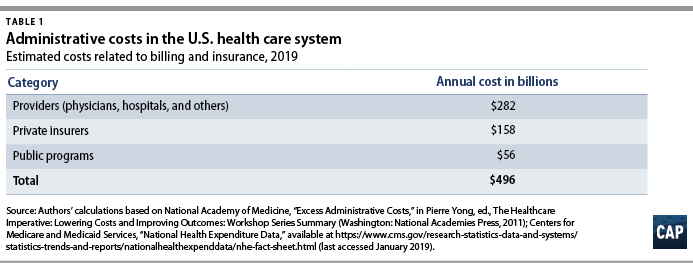
Applying the NAM’s percentages of BIR costs to recent projections of national health expenditures from the Centers for Medicare and Medicaid Services (CMS), CAP estimates that BIR costs will amount to $496 billion for 2019.15 (see Table 1) According to CAP’s calculations, this includes $158 billion in overhead for private insurance; $56 billion for administration of public insurance programs; and $282 billion for the BIR costs of hospitals, physicians, and other care providers. CAP’s estimate does not include the administrative costs associated with retail sales of medical products, including prescription drugs and durable medical equipment.
Even the most inclusive studies of administrative costs have not included at least one key piece of the U.S. health care system, namely, patients.16 The administrative complexity of the U.S. system also burdens patients, whether they are deciphering bewildering bills or shuttling records between providers. Three-quarters of consumers report being confused by medical bills and explanations of benefits.17 A Kaiser Family Foundation survey of people newly enrolled in the health insurance marketplace found that many were not confident in their understanding of the definitions of basic terms and concepts such as “premium,” “deductible,” or “provider network.”18 Insurers and employers spend an estimated $4.8 billion annually to assist consumers with low health insurance literacy, according to the consulting firm Accenture.19

Excess administrative costs

While U.S. administrative care spending is indisputably higher than that of other comparable countries, it’s unclear how much of the difference is excess and how much of that excess could be trimmed. The NAM report estimated that excess BIR costs amount to $190 billion—$245 billion in current dollars—or roughly half of total BIR expenditures in a year.20 The NAM report estimated that 66 percent of BIR costs for private insurers and 50 percent of BIR costs among providers are excess.21 Based on these percentages, $248 billion of the total $496 billion BIR costs in CAP’s updated estimate are excess administrative costs.

Most studies that have attempted to identify excess costs in the American health care system rely on comparisons between the United States and Canada.22 In their 2010 review of the literature on the difference between the two countries’ health expenditures, economists Alexis Pozen and David M. Cutler looked at the sources of the gap between U.S. and Canadian health spending. They found that 62 percent of the difference between the two countries was attributable to prices and intensity of care, and 38 percent was linked to administrative costs.23 Compared with Canada, the United States has 44 percent more administrative staff, and U.S. physicians dedicate about 50 percent more time on administrative tasks.24 Inflated to current dollars and today’s population, Pozen and Cutler’s estimate of per capita administrative excess in the United States, when compared with Canada, translates into a gap of $340 billion.25

Woolhandler and Himmelstein estimate that the United States currently spends $1.1 trillion on health care administration, and of that amount, $504 billion is excess.26Woolhandler and Himmelstein rely on surveys of physicians’ time use and utilized physician income data to translate the share of time physicians spend on administrative tasks into monetary value; their estimate of excess costs is the difference between U.S. and Canadian administrative spending27 Woolhandler and Himmelstein’s original 2003 article estimated that Canada spent $307 per capita on health system administration, compared with $1,059 per capita in the United States. Assuming this difference is excess requires an assumption that a Canadian-style health care system would achieve an identical level of administrative costs in the United States.

A separate criticism of the original 2003 Woolhandler and Himmelstein estimates, as articulated by Henry J. Aaron, an economist at the Brookings Institution, is that their methodology failed to account for differences in prices.28 Woolhandler and Himmelstein arrive at their national total administrative costs by tallying up costs in each country for items such as rent and salaries. As a consequence, the U.S.-Canada comparison captures not just the differences in the quantity of resources devoted to administration—such as physician time or office space—but also the differences in office rates, wages, and salaries. Taking Woolhandler and Himmelstein’s estimate of total administrative costs as a given and then making standard adjustments for price differences, Aaron argues that the two researchers exaggerated U.S. administrative spending in their 2003 report and that the true portion of excess would be about one-quarter less than what they estimated.

All estimates of administrative costs are inherently sensitive to what portion of health care spending one considers administrative.29 For example, time spent recording diagnosis or prescription information used in billing may also be vital for patient care, allowing medical teams to share up-to-date information or avoid harmful drug interactions. A recent study of an electronic health records (EHR) system estimated that on average, half of a primary care physician’s day is spent on EHR interaction, including billing, coding, ordering, and communication.30 Such tasks, however, can fall into a gray area between administrative and clinical. In a separate study, economist Julie Sakowski and her fellow researchers reported finding varying attitudes among physicians about whether interaction with electronic medical records—a subset of EHR—represented administrative or clinical time. As Sakowski and co-authors wrote, “Some felt they spent extra effort adding documentation that was needed only for billing. Others seemed to feel that nearly all of that information was needed for accurate clinical records.”31

Administrative costs for payers

Within the U.S. system, the share of expenditures that are attributable to administrative costs varies greatly by payer. The BIR costs for traditional Medicare and Medicaid hover around 2 percent to 5 percent, while those for private insurance is about 17 percent.32Some public finance experts, including Robert Book, have argued that the low levels of Medicare overhead are deceptive. Because seniors have relatively high health expenditures, the argument goes, administrative costs make up a relatively small share of their total health care spending. However, Medicare’s per capita administrative expenditures are higher than those in other forms of insurance.33 Even if one compares higher-end estimates of Medicare administrative costs to low-end estimates of costs for private insurance, the gulf between administrative costs for Medicare and private coverage is large.34 Organisation for Economic Co-operation and Development (OECD) data also show that other nations are able to achieve low levels of administrative costs while maintaining universal coverage across all ages of the population.35

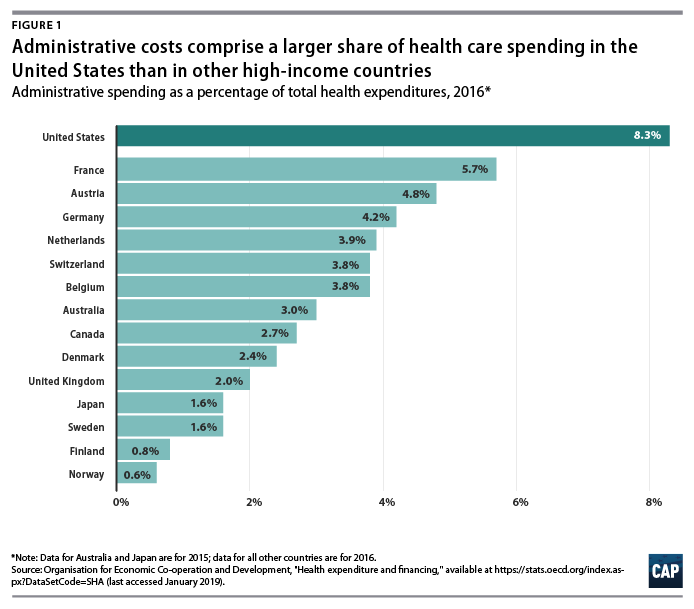
International health system data demonstrate that the United States is a clear outlier on administrative spending. And while the OECD’s definition includes administrative costs to government, public insurance funds, and private insurance, but not those borne by hospitals, physicians, and other providers, the stark difference is still informative. In 2016, administration accounted for 8.3 percent of total health care expenditures in the United States—the largest share among comparable nations. (see Figure 1) Countries with single-payer systems are among those with the lowest administrative costs. For example, administrative spending accounts for just 2.7 percent of total health care expenditures in Canada.36 OECD data also show that within a country, administrative costs are higher in private insurance than in government-run programs.37

Countries that have multipayer systems with stricter rate regulation also achieve much lower administrative costs than the United States. Administrative expenditures account for 4.8 percent of total health care expenditures in Germany, 3.9 percent in the Netherlands, 3.8 percent in Switzerland, and 1.6 percent in Japan, according to the OECD. If the United States could reduce administrative costs down to Canadian levels, it would save 68 percent of current administrative expenditures; reducing to German-level administrative costs would save 42 percent of current administrative expenditures. However, to assume that by simply adapting another country’s health care system—whether it is Canada’s single-payer Medicare, Germany’s sickness funds, or Switzerland’s heavily regulated private plans—the United States would automatically achieve the same level of administrative costs may ignore other fundamental differences between countries, including the market power of health care providers, political systems, and attitudes toward health care.  Nevertheless, the experience of other multipayer systems such as those in Germany and Switzerland suggests that the United States could substantially reduce both administrative expenditures and overall health care spending by bringing down reimbursement rates and regulating insurance—even while continuing to allow multiple payers and private health care providers.
The lowest possible level of administrative spending for the U.S. health care system is not necessarily the optimal level of spending. As researchers Robert A. Berenson and Bryan E. Dowd have noted, administrative spending in Medicare may in fact be too low; the program would be more efficient with greater investment in initiatives to lower costs and improve quality.38 Many reforms that could generate overall savings require administrative resources to design and implement. Innovations such as bundled payments—the practice of paying providers a lump sum for an episode of care such as a knee replacement or childbirth rather than reimbursing each individual component—involve upfront investment in development. Increasing resources to combat fraud and abuse would also lower overall spending. While the U.S. Department of Health and Human Services (HHS) boasts that it sees a $5 return on every $1 it puts toward fraud and abuse investigations, that number indicates that the government may be underinvesting in those efforts.39

Administrative costs for health care providers

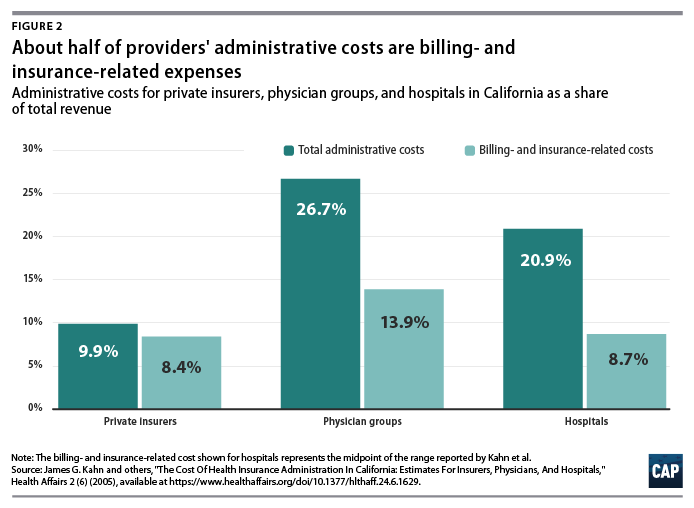
A number of studies have focused on the administrative costs borne by providers. Beyond BIR expenses, hospitals, physician practices, and other health care institutions house departments that are complementary to clinical services such as medical libraries, public relations, and accounting.40 A study of administrative costs in California found that administrative costs represented about one-quarter of physician revenue and one-fifth of hospital revenue, and BIR costs accounted for roughly half of administrative expenditures for physician and hospital services covered by private insurance.41 (see Figure 2) In a separate study, Himmelstein and others reported that one-quarter of U.S. hospital spending went toward administration; they found little difference between nonprofit hospitals and for-profit institutions, where administrative spending was 25 percent and 27.2 percent of total spending, respectively.42
On a per-encounter basis, BIR costs vary as a proportion of overall cost depending on the type of visit. In a 2018 study of an academic health care system, Phillip Tseng and others found that professional billing costs amounted to $20.49 for a primary care visit, $61.54 for an emergency department visit, and $124.26 for a general inpatient stay.43 Relative to the professional revenue associated with each encounter studied, the emergency department visit ranked the highest, with billing costs equal to 25.2 percent of revenue. Inpatient visits were the lowest, at 8 percent of a general inpatient stay and 3.1 percent for inpatient surgery.44 Encounters involving hospital care incurred additional facility-level billing costs. (see Figure 3)

In addition to the dollar cost of BIR activity, the study also reported the time spent on administration for typical encounters. The average processing time was 13 minutes for a primary care visit, 32 minutes for an emergency department visit, and 73 minutes for a general inpatient stay.45

Among other research on provider BIR costs, a 2009 study by Larry Casalino and others estimated that the cost of the time physicians spend on interactions with health plans is about $23 billion to $31 billion per year.46 A 2011 study by Dante Morra of the University of Toronto and others estimated that interaction with payers costs the equivalent of $22,205 per physician annually in Canada and $82,975 per physician annually in the United States, suggesting that the United States would save $27.6 billion annually if U.S. administrative costs could be brought down to Canadian levels.47

As with BIR costs, provider administrative costs in the United States are higher than those in other comparable countries. Hospital administrative costs in the United States far exceed those of other nations. In their comparison of hospital administrative costs among eight Western nations, Himmelstein and co-authors found that the United States had the highest levels, at 25.3 percent of total hospital expenditures.48 They conclude that in nations where hospital administrators have minimal responsibilities for procuring financing and where the hospital reimbursement system is least complex, administrative costs can be reduced to 12 percent of expenditures.49 These findings suggest that reforms that introduce global budgeting or limit the need to bargain with multiple payers could potentially bring down excess hospital administrative costs in the United States.

Lower administrative costs in single-payer and multipayer systems

Although administrative costs contribute to the high expenditures in the United States, they are not the primary reason for the health care spending gap. As economist Uwe Reinhardt and others candidly put it, “It’s the prices, stupid.”50 The United States pays more for care than other countries do—both for administrative services and for other components of health care.

Policies that target administrative costs alone would not necessarily bring overall U.S. health care expenditures in line with other countries. As economists Sherry Glied and Adam Sacarny observed, “there are very substantial variations in administrative costs among countries with universal health insurance, which do not translate directly into variations in overall costs.”51 Comparative evidence from U.S. states also suggests that America’s multipayer system explains some, but by no means all, of the discrepancy between the United States and other developed nations. Harvard University researchers Joseph P. Newhouse and Anna Sinaiko observe that “there is considerable variation across the states in spending levels, with the lowest quintile of states spending approximately the same percentage as the higher spending OECD countries other than the U.S. This implies that the [United States’] pluralistic financing system may not be an important cause of the large percentage of GDP that the U.S. devotes to health care.”52

Systemwide reforms to lower administrative costs

Health care financing experts believe that changes to how Americans pay for coverage could dramatically reduce administrative costs. Researchers simulating the effects of single-payer programs have assumed that administrative costs would be brought down substantially. The Urban Institute set administrative costs at a “plausible” 6 percent of health care claims for their simulation of the single-payer plan proposed by Sen. Bernie Sanders (I-VT), noting that they “do not believe that administrative costs can fall far below this level; far too many administrative functions must be conducted.”53 In its analysis of a single-payer system for New York state, the RAND Corporation assumed administrative costs at 6 percent of total health expenditures in its base case, representing a reduction from 18 percent among commercial insurers and 7 percent in New York’s Medicaid program. RAND specified administrative costs at 13 percent and 3 percent in its alternative scenarios. 54 In a separate column, however, RAND researcher Jodi Liu cautioned that achieving the administrative expenditure levels of other countries “may be aspirational and is not guaranteed” under a single-payer system.55

Exactly how such lower costs could be achieved is another question. Reducing BIR costs requires simplifying the billing and payment process, which could be accomplished in a number of ways. Two avenues for reducing administrative costs as well as overall health costs are global budgeting and uniform rate-setting.56 These two concepts are central to health systems around the world and are also responsible for keeping administrative costs lower, whether a country has a multipayer or single-payer system. Another paperwork-reducing option would be a centralized claims clearinghouse to allow providers to submit all claims to a single entity, as they do in Germany and Japan. 57

All-payer rates and global budgeting

Setting all-payer reimbursement rates would eliminate the need for providers to negotiate rates with individual private insurers, while also giving policymakers better leverage for controlling overall health care cost growth. In the current U.S. system, providers charge different rates to different payers, and the billing process is complicated and opaque. The list prices that hospitals are now required to publish bear little connection to what individual patients—or those patients’ insurers—actually pay.58 Setting all-payer rates would simplify billing and improve transparency by establishing a single set of rates for each provider, while also giving regulators a tool to protect consumers from exorbitant rates.59

Global budgeting—the practice of paying providers revenue based on their expected costs—also holds promise for both lowering administrative spending and overall costs. As opposed to traditional fee-for-service payments, which reward providers for doing more, global budgeting incentivizes providers to deliver care more efficiently.60 Global budgeting is a feature of many countries with much lower health care administrative costs, including Scotland, Wales, and Germany.61 As Woolhandler, Campbell, and  Himmelstein point out in their 2003 article, “The existence of global budgets in Canada has eliminated most billing and minimized internal cost accounting, since charges do not need to be attributed to individual patients and insurers.”62 As Germany shows, both single-payer and multipayer systems can use global budgets.

A system combining all-payer rates and global budgeting is already partially in place in the state of Maryland, where each hospital has a single set of rates it bills to Medicare, Medicaid, commercial insurers, and other payers. Maryland’s system is keeping overall cost growth lower than the national trend.63 According to RAND analysis of hospital costs, Maryland hospitals have administrative costs that are 9 percent lower than the national average and not far off from the 13 percent savings RAND assumed providers would achieve under a single-payer system. 64

Centralized claims processing

Germany and Japan both have multiple payers but centralized claims processing.65Despite having more than 3,000 health plans,66 Japan’s administrative expenditures were a stunningly low 1.6 percent of overall health care costs in 2015, one of the lowest among OECD member nations.67

In their analysis of three universal health care options for Vermont, including single payer, researchers William C. Hsiao, Steven Kappel, and Jonathan Gruber estimated substantial savings from administrative simplicity from each option. The two single-payer options they examined would result in even greater administrative savings of between 7.3 percent and 7.8 percent, depending on the rate-setting mechanism.68 The group estimated that a third scenario, which would establish a centralized claims clearinghouse while allowing multiple payers, could generate savings equal to 3.6 percent of total expenditures.69 This suggests that about half of the total administrative savings from a single-payer system could be obtained within a regulated multipayer system.

Policy proposals directed at administrative costs

While major changes to the U.S. health care system have the greatest potential to bring down costs, more incremental changes could reduce administrative waste. A recent bill proposed by Sens. Bill Cassidy (R-LA) and Tina Smith (D-MN) would direct the HHS secretary to set goals to cut “unnecessary costs and administrative burdens” throughout the health care system by 50 percent over the next 10 years. It would also provide grant money for state-based efforts to bring down administrative costs.70 Some possible avenues for achieving those kinds of reductions include changes to payment rules, improvements to facilitate electronic record-keeping and information exchange, and simplification of public insurance programs.

In their 2009 article in The New England Journal of Medicine, David Cutler, Elizabeth Wikler, and Peter Basch proposed one such package of reforms. The authors estimated that providers could save $17.9 billion to $23 billion annually with several, more incremental changes to the system, including greater adoption of EHR systems; integrated administrative and clinical systems; national and standardized reporting requirements and credentialing of providers; streamlined enrollment in public insurance programs; and greater automation.71 In a separate report, the same authors proposed additional reforms that they estimated could reduce excess administrative costs by $40 billion, or 25 percent of total health care expenditures.72

In a 2010 study published in Health Affairs, Bonnie B. Blanchfield and other Massachusetts researchers concluded that the administrative burden on physician organizations could be reduced by a “single transparent set of payment rules for a system with multiple payers.” The authors recommended that the United States adopt “a standard set of payment requirements, increased payment-rule transparency, standardized forms, and a standard set of data exchange requirements.” Doing so could save $7 billion in billing costs for physician and other clinical services, according to the authors’ estimates.73

Conclusion

Although estimates vary, a large body of evidence shows that the United States is spending about twice as much as needed on the administration of health care. Other nations enjoy world-class health care systems while spending a fraction of what the United States does on governance, billing, and insurance.

A structural overhaul of how health care is financed and priced that includes key features of other countries’ systems—whether one payer or many—would go a long way toward eliminating excess administrative costs. Simplifying the payment system should be an essential part of future health reform and would make the U.S. system work better for taxpayers and patients alike.




9 hospitals with strong finances

https://www.beckershospitalreview.com/finance/9-hospitals-with-strong-finances-040819.html?origin=cfoe&utm_source=cfoe

Here are nine hospitals and health systems with strong operational metrics and solid financial positions, according to recent reports from Moody’s Investors Service and Fitch Ratings.

1. South Bend, Ind.-based Beacon Health System has an “AA-” rating and stable outlook with Fitch. The health system has a strong financial profile, and is the acute care leader in its market, according to Fitch.

2. Los Angeles-based Cedars Sinai Medical Center has an “AA-” rating and stable outlook with Fitch. The hospital has a solid market presence in a competitive service area and strong profitability and liquidity, according to Fitch.

3. St. Cloud, Minn.-based CentraCare Health has an “AA-” rating and stable outlook with Fitch. The health system has a strong operating risk profile and a leading market position over a broad service area, according to Fitch.

4. Wauwatosa, Wis.-based Children’s Hospital and Health System has an “Aa3” rating and stable outlook with Moody’s. The health system has a strong financial profile and is the dominant provider of tertiary and quaternary pediatric services in southeastern Wisconsin, according to Moody’s.

5. Children’s Hospital of Philadelphia has an “Aa2” rating and stable outlook with Moody’s. The hospital has a strong market position and exceptional financial resources to support high capital needs, according to Moody’s.

6. Concord (N.H.) Hospital has an “AA-” rating and stable outlook with Fitch. The hospital has a strong financial profile and a leading market share position, according to Fitch.

7. Portland-based Oregon Health and Sciences University has an “Aa3” rating and stable outlook with Moody’s. The health system has solid operating performance, strong clinical offerings and includes the only academic medical center in Oregon, according to Moody’s.

8. Clermont, Fla.-based South Lake Hospital has an “AA-” rating and stable outlook with Fitch. The hospital’s operating performance has improved in recent years due to its partnership with Orlando (Fla.) Health, according to Fitch.

9. Iowa City-based University of Iowa Hospitals & Clinics has an “Aa2” rating and stable outlook with Moody’s. The system’s strong brand and position as the only academic medical center in Iowa will continue to translate into strong market share and high patient demand, according to Moody’s.


Ex-Florida hospital director gets prison time for role in $1B fraud scheme

https://www.beckershospitalreview.com/legal-regulatory-issues/ex-florida-hospital-director-gets-prison-time-for-role-in-1b-fraud-scheme.html

Image result for hawaii five o book him danno

The former director of outreach programs at Larkin Community Hospital in South Miami, Fla., was sentenced to 15 months in prison April 3 for her role in a $1 billion healthcare fraud scheme.

Four things to know:

1. The judge handed down the sentence just over two months after Odette Barcha pleaded guilty to conspiring to defraud the federal government and paying and receiving healthcare kickbacks.

2. Ms. Barcha was one of three defendants charged in an indictment unsealed in July 2016. She allegedly had physicians at Larkin Community Hospital discharge patients to skilled nursing homes and other facilities owned by Philip Esformes, who allegedly paid kickbacks for those admissions.

3. Prosecutors allege Mr. Esformes, who operated a network of more than 30 skilled nursing homes and assisted living facilities in Florida, admitted Medicare and Medicaid beneficiaries to the facilities even if they did not qualify for skilled nursing home care or for placement in an assisted living facility. Once admitted, the patients received medically unnecessary care that was billed to Medicare and Medicaid.

4. The seven-week trial of Mr. Esformes wrapped up March 29, according to the Miami Herald. On April 5, a federal jury found Mr. Esformes guilty of various counts, including paying and receiving kickbacks, bribery, money laundering and obstruction of justice, according to Law360


The beginnings of a wave of physician secession?

https://mailchi.mp/5a57c9e710d7/the-weekly-gist-april-5-2019?e=d1e747d2d8

Image result for independence

This week I got a message from a physician who is a member of a health system’s employed medical group. He’d come across my quote in a story that aired on Charlotte, NC’s NPR affiliate WFAE discussing the recent exits of large groups of doctors from two health system-sponsored medical groups in that market. When we connected over the phone, he said, “Splitting off from the health system is something that doctors joke about over beers. Is this for real, and how were they able to do it? Where else is this happening?”

From our perspective, the situation in Charlotte is unique—we haven’t seen another market where dozens of doctors have “seceded” from an employed group en masse to return to independent practice. But we wouldn’t be surprised to see others. A general sense of practice fatigue has made some doctors antsy, and more open to exploring other options. And it’s hard for employed doctors to ignore the big dollars being commanded by large, independent physician practices from payers and investors.

Given the depth of integration and shared infrastructure, exiting an employment arrangement today is far more complex compared to twenty years ago, when it was almost as easy as changing the sign on the practice door. But doctors in many markets are watching the fate of their newly-independent peers in Charlotte. Health systems whose medical groups lack an integrated identity, shared values and common culture may be the most susceptible to a possible wave of physician secession.


Sutter Health|Aetna adds Stanford Health Care to network

https://www.healthcarefinancenews.com/news/sutter-healthaetna-adds-stanford-health-care-network?mkt_tok=eyJpIjoiWldGbU16WmxOak00TmprMiIsInQiOiIzeGkycUpwcmtPUk42Z2R0b1k4RHd0NUVoY0k3UmE5TktUSkhMUzVtNVVWOWtWY3BhWkdUbjcrZndNS0tZRnA1cWFSajhWdmlZcUc4VE5DbFB4VEZNNkJyYTkyXC9XK3hxZVMwVzhSaVF2ZjZIdUFjbzZwcnF6aGE0UmowZ2w1eHcifQ%3D%3D

Image result for healthcare market consolidation

The joint venture between provider and payer, which launched last year, has grown to about 50 plan sponsors across 15 counties.

Sutter Health|Aetna has added Stanford Health Care to its network of providers.

Sutter Health|Aetna is the joint venture launched last year between the Sacramento, California-based health system and the national insurer. It offers self-insured preferred provider organization health plans to businesses in the Northern California area.

It has grown to about 50 plan sponsors across 15 counties.

WHY THIS MATTERS

This represents another expanded partnership between a provider and payer, though this is in the commercial space.

Other recent partnerships, such as the one announced between Duke Health and Blue Cross Blue Shield of North Carolina, have capitalized on the Medicare Advantage market.

Stanford Health Care recently launched a Medicare Advantage plan with Lumeris called the Stanford Health Care Advantage, in northern California.

The partnerships allow providers and insurers to expand their reach and get access to population health data to lower costs and improve outcomes.
The addition of Stanford Health Care gives Sutter Health|Aetna’s network members in Northern California access to the network’s more than 1,500 specialists and nearly 200 primary care physicians throughout the San Francisco Bay Area.

THE TREND

With the addition of Stanford Health Care, the Sutter Health|Aetna joint venture features two nationally recognized healthcare systems and access to a Northern California network that includes 33 hospitals, more than 1,700 primary care physicians, more than 9,400 specialists, 74 urgent care locations and 25 walk-in clinics.

ON THE RECORD

“The inclusion of Stanford Health Care, with its physicians from across Stanford Medicine, to our high-quality network will not only expand the provider network for our plan sponsors and members, but also provide access to another highly ranked health care system,” said Steve Wigginton, CEO of Sutter Health|Aetna. “This addition will help us in our goal to create a unique offering for Northern California employers and their employees centered around a superior consumer experience and market-leading value.”


Ex-hospital exec sues DMC for wrongful discharge, retaliation

https://www.detroitnews.com/story/news/local/michigan/2019/04/01/hospital-exec-sues-dmc-wrongful-discharge-retaliation/3337429002/?utm_source=Sailthru&utm_medium=email&utm_campaign=Issue:%202019-04-03%20Healthcare%20Dive%20%5Bissue:20208%5D&utm_term=Healthcare%20Dive

Image result for detroit medical center

The former top Detroit Medical Center cardiologist is suing the health system, arguing he was forced out of his job for complaining about alleged fraud at the health system, including unnecessary surgeries billed to Medicare and Medicaid. 

The wrongful discharge and retaliation lawsuit was filed in Detroit U.S. District Court by Dr. Ted Schreiber, who was recruited by the DMC in 2004 and developed a trademarked process to speed life-saving treatment for heart attack patients.  He also was the founding president of the new DMC Heart Hospital that opened with fanfare in 2014.

Schreiber’s accusations are “unsubstantiated,” a DMC spokeswoman said Monday night, and the health system continues to have a “culture of integrity.”

Heart Hospital shares facilities with Harper University Hospital that is poised to be terminated from the federal Medicare program in less than two weeks after failing inspections in October and December. Since Harper and Heart Hospital are considered a single facility by the Centers for Medicare Medicaid Services, both would be barred from the federal health insurance program for the elderly and disabled if Harper fails to pass an unannounced inspection by the April 15 deadline.

Michigan prohibits hospitals barred from receiving Medicare funding from participating in Medicaid, the health insurance program for mostly low-income people that is jointly funded by the state and federal governments. The two programs combined pay for 85 percent of Harper’s inpatient hospital stays, according to Allan Baumgarten, a Minneapolis-based hospital analyst.

The inspections in October and December were prompted by complaints from Schreiber and three other health system cardiologists who said they were forced from their leadership roles in retaliation for complaining about quality of care issues at the DMC. 

Cardiologists Dr. Mahir Elder and Dr. Amir Kaki filed a similar lawsuit last week in Detroit federal court, saying they were forced from leadership posts for complaining to leaders of the DMC about unnecessary surgeries, dirty surgical instruments and other problems. 

In his lawsuit, Schreiber said he brought concerns about physician competency and unnecessary and/or dangerous procedures to DMC peer review meetings in a bid to ensure that they were investigated. But his concerns were ignored by DMC and its for-profit owner, Tenet Healthcare of Dallas, according to Schreiber’s lawsuit.

“(T)he profitability of physicians was being weighed more heavily by DMC and Tenet executives than the physicians’ ability to provide services to patients within the standard of care,” Schreiber alledged in his lawsuit. “This policy resulted in an increase in unnecessary and/or risky procedures conducted by some physicians leading to bad patient outcomes and even patient deaths.”

The DMC continues to argue that Schreiber and the other cardiologists violated the company’s conduct code. The health system’s top priority is delivering “safe, high quality care to the people of Detroit,” said spokeswoman Tonita Cheatham.

“We have a culture of integrity, which means we don’t look the other way, we don’t condone inappropriate behavior of any kind, and we don’t compromise on our priorities,” Cheatham said in a statement.

“That also means we expect physicians to uphold our Standards of Conduct, including treating fellow physicians, nurses and staff members with respect and dignity.  We welcome the opportunity to present the facts underlying the claims made in the complaint.”

In the lawsuit, Schreiber indicated he also complained to Tenet and DMC leaders that some cardiologists were away from the hospital during times they were required to be on-site as members of Cardio Team One’s 24-hour on-call team. He also said he raised concerns about staffing cuts that resulted in poor nursing care for cardiac patients. 

Tenet Healthcare signed a three-year “corporate integrity agreement” as part of a $513 million settlement with the U.S. Department of Justice over allegations of a kick-back scheme involving involving four Tenet hospital subsidiaries in the South, according to Schreiber’s suit. The agreement required Tenet and all of its hospitals to self-report all complaints to the federal Justice Department.

“Senior management, including these Defendants, failed to do so and blatantly allowed legal violations to occur in order to generate more income by cutting medically necessary support and allowing unnecessary medical procedures, among other things,” the former cardiologist executive said in his lawsuit.

Schreiber referred a request for comment on the lawsuit to his attorney, David Ottenwess of Detroit.

“Tenet Healthcare, the current for-profit owner of the DMC, has been continually cited by the federal government for placing profits over people,” Ottenwess said. “Tenet has continued that course with its retaliation against Dr. Schreiber and others at the Heart Hospital who had the courage to question Tenet’s practices of profits over safety.”


Hospitals look to venture capital as R&D extension

https://www.healthcaredive.com/news/hospitals-look-to-venture-capital-as-rd-extension/549854/

Image result for translational medicine profitability

Academic and nonprofit hospitals are increasingly embracing venture capital as a way to test new technologies, a shift away from the traditional reliance on developing in-house intellectual property.

Since their founding days, providers like Mayo Clinic and Cleveland Clinic have leaned heavily on investing in IP to test new products and services. More recently, players like Tenet, Trinity and Community Health Systems have become comfortable investing in externally-run funds. Now, hospitals of all sizes, types and tax status are giving corporate venture capital funds, where they invest directly in companies, a go.

Hospital fund managers perceive the financial risk in the same light they see other investments, except venture capital can offer hospitals more flexibility. It’s how health systems like Intermountain think of R&D.

Mike Phillips, managing director of Intermountain Ventures, told Healthcare Dive venture funds offer hospitals a chance to “double dip.” If an investment is successful, the outcomes are positive both clinically and financially.

Most don’t take the lead on investments, preferring to take a minority stake. Hospitals see venture as a way to bring in and test out new technologies.

“If they (the startup) can get a champion in the organization that really helps refine it, improve it, augment it, that is much more valuable than the money,” Mary Jo Potter, an investor and consultant in the field, told Healthcare Dive.

Potter cautioned against expecting too much too soon. It typically takes take 10 years to get an exit and even then, returns are most likely to be in the range of twice or triple the investment. Well over half of the health system-linked venture funds are less the five years old, Potter said.

UPMC Enterprises, the venture capital arm of University of Pittsburgh Medical Center, made $243 million when its population health management spinout Evolent Health went public in 2015, according to UPMC Treasurer Tal Heppenstall, and the nonprofit still retains stock.

Heppenstall, who also leads UPMC Enterprises as president, told Healthcare Dive the health system plans on spinning out two companies by the middle of this year. That would bring its count to five as part of its “renewed focus on the translational science space” — finding business applications for medical research.

In February, the fund participated in a $15 million investment in data analytics company Health Catalyst. UPMC will pilot Health Catalyst’s products in-house.

Early entrants

Ascension seeded its first venture fund with $125 million in 1999, making its first investment ($8.4 million in radiation system TomoTherapy) two years later. Eventually, Ascension decided to bring in limited partners to help close the fund.

Ascension Ventures now currently manages $805 million across four funds.

Kaiser Permanente Ventures is an active investor in its own right. The venture arm of the hospital system manages $400 million in assets over four funds, with 28 exits, according to CB Insights.

Early adoption of CVC by health systems like Ascension and Kaiser paved the way for health systems that want to give venture a try, but want to start slow as limited partners. In recent years, deal flow is ramping up at a healthy clip.

Deals involving at least one provider-backed venture fund totaled nearly $1.3 billion in 2018, according to PitchBook, an all-time high — and on track with overall corporate venture capital participation in the healthcare sector, which CB Insights reports having jumped 51% to $10.9 billion last year.

Newly-seeded funds are springing up in health systems across the country. Providence St. Joseph Health, one of the largest health systems in the country and most active in the venture space, announced its second $150 million healthcare venture capital fund in January, managed by its venture arm Providence Ventures. Providence Ventures’ first fund was launched in 2014.

Starting small

Like many smaller health systems establishing themselves as new players in venture capital, Intermountain made its foray into the space as a limited partner in larger funds managed by Heritage Group and Ascension.

Large firms “have a lot of understanding in how to help manage young companies and get them through the business end of growing their company. We can help on the clinical end,” Phillips said. “We definitely rely on the other folks investing … to both learn from and be a good partner to the companies we invest in.”

Intermountain formally launched its first $80 million venture fund this year.

While the health system recognizes the risk, Phillips argued many hospitals have institutional knowledge most investors don’t. That, in theory, allows them to mitigate some of that risk.

Intermountain’s portfolio is comprised partially of the companies the hospital system spun out of R&D. That’s not uncommon for nonprofit and academic health systems that have traditionally focused on developing IP in-house. As of 2017, 90% of Cleveland Clinic Ventures’ portfolio was invested in IP owned by the health system.

IP is the bread and butter investment for most academic and nonprofit health systems, helping to bring in some return while allowing physicians, who often develop those patents themselves, to retain some benefit.

Mayo Clinic, for example, says it has generated $600 million in revenue from licensing its IP since 1986. The health system has recently rolled its venture activity into its R&D arm under the name Mayo Clinic Ventures. Nevro, a device company the system spun out in 2014, has a current market cap of $1.32 billion.

Hospital executives like to say CVC is a complementary tool to R&D, that it’s another way to tinker — that the money doesn’t matter as much as the ability to improve quality and decrease cost does. That may be true, but at the end of the day it’s an investment, and hospitals have to hope it yields a positive return.

If there’s a chance an investment can lower the cost of care, increase quality and improve clinical care, Phillips said, the bigger risk is not giving it a shot.


Philadelphia hospital to lay off 175 employees amid financial troubles

https://www.beckershospitalreview.com/hospital-management-administration/philadelphia-hospital-to-lay-off-175-employees-amid-financial-troubles.html?origin=cfoe&utm_source=cfoe

Related image

Philadelphia-based Hahnemann University Hospital plans to lay off 175 nurses, support staff and managers as it struggles to keep its doors open, hospital officials told philly.com.

“We are in a life-or-death situation here at Hahnemann,” said Joel Freedman, chairman and founder of American Academic Health System, which bought Hahnemann and St. Christopher’s Hospital for Children from Dallas-based Tenet Healthcare in January 2018.

“We’re not Tenet with endless cash. We’re running out of money,” Mr. Freedman added.

He told philly.com Hahnemann won’t stay afloat without help from government, insurers and its academic partner, Philadelphia-based Drexel University.

The layoffs, which represent about 6 percent of Hahnemann’s total workforce of 2,700, reportedly affect 65 nurses, 22 service and technical employees, and 88 nonunion workers and managers.

They come as Hahnemann has struggled financially. The hospital and and St. Christopher’s combined have $600 million to $700 million in annual revenue, compared to $790 million at the time of American Academic Health System’s purchase, according to philly.com.

Mr. Freedman, who is also CEO of healthcare investment firm and American Academic Health System affiliate El Segundo-based Paladin Healthcare, partially attributed the struggles at Hahnemann to a lower volume of patients. He also cited information technology and documentation problems at the hospital.

He expects the layoffs, along with other cost-cutting initiatives, such as the closure of some primary care offices, to save Hahnemann $18 million annually.

Read the full philly.com report here.


Amid labor talks, union unveils billboards highlighting Cedars-Sinai profits, CEO pay

https://www.beckershospitalreview.com/human-capital-and-risk/amid-labor-talks-union-unveils-billboards-highlighting-cedars-sinai-profits-ceo-pay.html

Image result for SEIU-UHW cedar sinai medical center billboards

Healthcare workers at Los Angeles-based Cedars-Sinai Medical Center revealed a series of billboards that highlights profits and CEO pay at the hospital.  

The workers, who are represented by Service Employees International Union-United Healthcare Workers West, announced the billboards April 2 amid contract negotiations. The billboards are scheduled to appear throughout April at seven locations that are all within 1.5 miles of the hospital.

A union news release says the billboards aim to draw attention to “excessive profits and CEO compensation,” as well as the amount of charity care the nonprofit hospital provides.

“The public deserves to know that this elite hospital with huge profits and obscene CEO compensation, isn’t acting in the public’s best interests,” Dave Regan, president of SEIU-UHW, said in the release. “On top of paying no income or property taxes, Cedars-Sinai skimps when it comes time to care for the poorest people in our community.”

The hospital  addressed the union’s claims.

“The Cedars-Sinai Board of Directors believes in providing every one of our employees with compensation that is based upon merit of their individual performance, a rigorous review of each position’s responsibilities, and comparisons with other organizations for positions with similar responsibilities. For the president and CEO, the review process is even more extensive,” the statement said.

“[CEO]Tom Priselac’s compensation appropriately reflects his more than two-decade tenure of successfully presiding over the western United States’ largest nonprofit hospital. Under his leadership, Cedars-Sinai has earned national recognition for delivering the highest quality care to patients and has been ranked among the top medical centers in the country.

“Over the last 10 years alone, Cedars-Sinai has invested nearly $6 billion to benefit the local community by, among other things, providing free or part-pay care for patients who cannot afford treatment; by losses caring for Medicare and Medi-Cal patients; and by providing a wide range of free health programs and clinics in neighborhoods as well as education, health and fitness services in dozens of local schools.”

SEIU-UHW represents more than 1,800 service and technical workers at the hospital. The last contract with Cedars-Sinai expired March 31.


A motley crew in Texas v. Azar

A motley crew in Texas v. Azar

Image result for severability

Together with Jonathan Adler, Abbe Gluck, and Ilya Somin, I’ve filed an amicus brief with the Fifth Circuit in Texas v. Azar. Those of you who’ve been closely following health-reform litigation know that Abbe and I often square up against Jonathan and Ilya. It’s a testament to the outlandishness of the district court’s decision that we’ve joined forces. Like our original district court filing, the brief focuses on severability.

In 2017, Congress zeroed out all the penalties the ACA had imposed for not satisfying the individual mandate. Yet it left everything else undisturbed, including the guaranteed-issue and community-rating provisions. That simple fact should be the beginning and end of the severability analysis. It was Congress, not a court, that made the mandate unenforceable. And when Congress did so, it left the rest of the scheme, including those two insurance reforms, in place. In other words, Congress in 2017 made the judgment that it wanted the insurance reforms and the rest of the ACA to remain even in the absence of an enforceable individual mandate.

Because Congress’s intent was explicitly and duly enacted into statutory law, consideration of whether the remaining parts of the law remain “fully operative”—an inquiry courts often use in severability analysis as a proxy for congressional intent—is unnecessary.

Nor does the district court’s incessant focus on findings that Congress made about a mandate backed by financial penalties hold water.

The 2010 Congress believed that 2010’s penalty-backed mandate was necessary to induce a significant number of healthy people to purchase insurance, and thereby “significantly reduc[e] the number of the uninsured.” 42 U.S.C. § 18091(2)(E). But because the neutered mandate of 2017 lacks a penalty, it could not have been based on those earlier findings. They are thus irrelevant. The earlier findings have been overtaken by Congress’s developing views—based on years of experience under the statute—that the individual marketplaces created by the ACA can operate without penalizing Americans who decline to purchase health insurance.

At bottom, a toothless mandate is essential to nothing. A mandate with no enforcement mechanism cannot somehow be essential to the law as a whole. That is so regardless of the finer points of severability analysis or congressional intent. The district court’s conclusion makes no sense.

There are (at least!) two other notable amicus briefs in the case.

The first is from Sam Bray, Michael McConnell, and Kevin Walsh. In a terse 1,000 words, they argue—correctly, in my view—that “Congress has not vested the federal courts with statutory subject-matter jurisdiction to opine whether an unenforceable statutory provision is unconstitutional.” In this, they sound many of the same themes that Jonathan Adler and yours truly sounded in arguing that plaintiffs lack standing under the Constitution. But Bray, McConnell, and Walsh hitch their argument not to Article III, but to the jurisdictional reach of the Declaratory Judgment Act.

The second is from the Republican attorneys general of Ohio and Montana. They agree that the mandate is unconstitutional, but they have no truck with the argument that all or part of the Affordable Care Act should be struck down. “At the same time that Congress made the mandate inoperative, it left in place the remainder of the Affordable Care Act. As a result, the application of the severability doctrine in this case requires no ‘nebulous inquiry into hypothetical congressional intent.’ … To the contrary, the Court can see for itself what Congress wanted by looking to what it did.” Their participation suggests deep fractures in the down-with-the-ACA-at-all-costs coalition.

So, by my count, the parties and amici have pressed at least four independent reasons for getting rid of this case. First, because plaintiffs lack standing. Second, because the courts lack jurisdiction under the Declaratory Judgment Act. Third, because there is no “mandate” and thus no constitutional problem (as Marty Lederman has rightly argued). And fourth, because even if there is a mandate and it’s unconstitutional, it’s fully severable.

This isn’t a federal case. It’s a choose-your-own-adventure book where all the adventures lead to the end of this misbegotten litigation.