
Doctors Are Fed Up With Being Turned Into Debt Collectors

https://www.bloomberg.com/news/articles/2018-11-15/doctors-are-fed-up-with-being-turned-into-debt-collectors

Highlighting a key implication of the rise in high-deductible health plans, both on the ACA exchanges and in employer-sponsored insurance, the article describes a question now commonly faced by doctors and hospitals—how best to collect their patients’ portion of the fees they charge? As one Texas doctor tells Bloomberg, reflecting the experience of the Maldonados from the other side of the equation, “If [patients] have to decide if they’re going to pay their rent or the rest of our bill, they’re definitely paying their rent.” He reports that the number of people dodging his calls to discuss payment has increased “tremendously” since the passage of the ACA. Another Texas doctor reports that his small practice had to add an additional full-time staff member just to collect money owed by patients, adding further overhead to his practice’s costs and making it more likely that he, like many other doctors, will eventually seek shelter by being employed by a larger delivery organization. That trend, as has been repeatedly shown, further increases the cost of care, exacerbating the increase in insurance costs for families like the Maldonados. This Gordian knot of increasing costs, rising deductibles, and growing premiums has left us with a healthcare system that’s forcing difficult decisions at every turn, for patients and providers.

Physicians, hospitals and medical labs are grappling with the rise in high-deductible insurance.

Doctors, hospitals and medical labs used to be concerned about patients who didn’t have insurance not paying their bills. Now they’re scrambling to get paid by the ones who do have insurance.

For more than a decade, insurers and employers have been shifting the cost of care onto their workers and customers, tamping down premiums by raising patients’ out-of-pocket costs. Last year, almost half of privately insured Americans under age 65 had annual deductibles ranging from $1,300 to as high as $6,550, government data show.

Now, instead of getting paid by insurance companies on a predictable schedule, health-care providers have to engage in an awkward dance. One moment they’re removing a pre-cancerous skin mole. The next, they’re haranguing patients to pay what’s become a growing portion of the total medical bill.

“It’s harder to collect from the patient than it is from the insurance,” said Amy Derick, a doctor who heads a dermatology practice outside Chicago. “If the plans change to a higher deductible, it’s harder to get the patients to pay.”

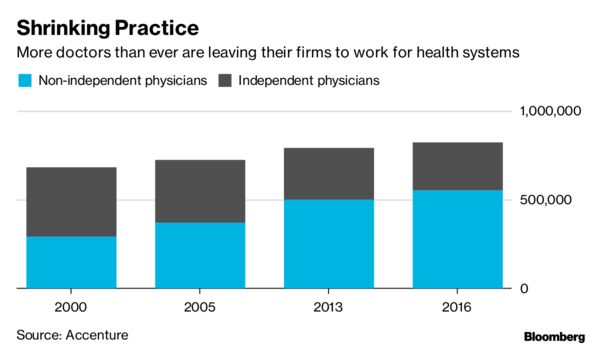
Independent physicians cited reimbursement pressures as their biggest concern for staying in business, according to a report by Accenture Plc in 2015.

“If they have to decide if they’re going to pay their rent or the rest of our bill, they’re definitely paying their rent,” said Gerald “Ray” Callas, president of the Texas Society of Anesthesiologists, whose Beaumont, Texas, practice treats about 40,000 people annually. “We try to work with the patient, but on the other hand, we can’t do it for free because we still maintain a small business.”
Accenture

In 2016, Callas introduced payment options that allow patients with expensive plans to pay a portion of the bill upfront or on a monthly basis over several years. Even so, Callas said the number of people avoiding his calls after surgery has increased “tremendously” each year since the Affordable Care Act passed in 2010.

Derick instituted a “time-out” option a few years back that gives patients the billing codes before a procedure, allowing them to call their insurance companies for estimates. Even with the program, collection rates are slower, especially at the beginning of the year when insurance plan deductibles reset.

Even large medical companies with national operations are facing the problem. Quest Diagnostics Inc., the lab-testing giant, said 20 percent of services billed to patients in the third quarter of this year went unpaid, costing the company about $80 million in lost revenue.

“We certainly have a high bad-debt rate for the uninsured,” Chief Financial Officer Mark Guinan said in a telephone interview. “But really the biggest driver is people with insurance. It’s their coinsurance and their high deductibles, and they don’t always pay their bills.”

Another testing company, Laboratory Corp. of America Holdings, reported its first year-over-year uptick in unpaid bills in the first quarter of 2016. At the time, Chief Executive Officer David King said high-deductible plans, higher copays and greater incidences of non-covered services led to more dollars being shifted to patients. LabCorp declined requests for comment.

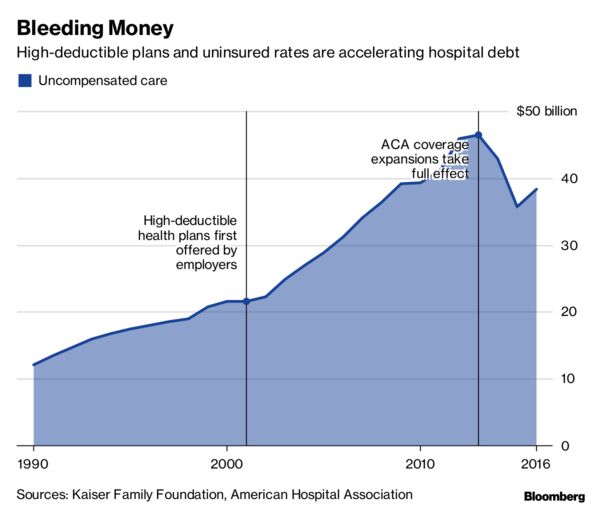
Northwell Healthcare Inc., a network of more than 700 hospitals and outpatient facilities, lost $106.9 million to unpaid services in 2015. Others have reported the same: Acute-care and critical-access hospitals reported$55.9 billion in bad debt for 2015, according to data compiled by the American Hospital Directory Inc. 

“High-deductible plans have had a very big impact,” said Richard Miller, Northwell’s chief business strategy officer.
Kaiser Family Foundation, American Hospital Association

When it comes to reimbursement, a common denominator across the health-care industry is the archaic process through which bills are processed — a web of medical records, billing systems, health insurers and contractors.

High deductibles only add to the red tape. Providers don’t have real-time, fully accurate information on patient deductibles, which fluctuate based on how much has already been paid. That forces providers to constantly reach out to insurance companies for estimates.

Tarek Fakhouri, a Texas surgeon specializing in skin cancer, had to hire an additional staff member just to reason through bills with patients and their insurers, a big expense for an office of six or seven employees. About 10 percent of Fakhouri’s patients need payment plans, delay their skin-cancer surgeries until they’ve met their deductibles, or have to choose an alternative treatment.

According to a study earlier this year by the Journal of American Medical Association, primary-care physicians at academic health-care systems lose about 15 percent of their revenue to billing activities like calling insurance companies for estimates.

“It’s an unnecessary added cost to the health-care system to have to hire staff just to sit there on hold with insurance companies to find out what a patient’s deductible status is,” said Fakhouri.

Callas, Derick, and Fakhouri said they all know physicians who have left private practice altogether, some for the sole purpose of ending their dual roles as bill collectors. According to a study by the American Medical Association, less than half of doctors were self-employed as of 2016 — the lowest total ever. Many left their own practices in favor of hospitals and large physician groups with more resources.

To cope with the challenge, labs and hospitals are investing millions in programs designed to help patients understand what they owe at the point of care. Northwell has been implementing call centers and facilities where patients can ask questions about their bills.

“There’s a burden on both sides,” said Callas. “But health-care providers get caught in the middle.”


What the 2018 Midterm Elections Means for Health Care

https://www.healthaffairs.org/do/%2010.1377/hblog20181107.185087/full/?utm_source=Newsletter&utm_medium=email&utm_content=What+the+Midterms+Mean+For+Health+Care%3B+%22Stairway+To+Hell%22+Of+Health+Care+Costs%3B+Patient+Safety+In+Inpatient+Psychiatry&utm_campaign=HAT%3A+11-07-18

Whatever you want to call the 2018 midterm elections – blue wave, rainbow wave, or purple puddle – one thing is clear: Democrats will control the House.

That fundamental shift in the balance of power in Washington will have substantial implications for health care policymaking over the next two years. Based on a variety of signals they have been sending heading into Tuesday, we can make some safe assumptions about where congressional Democrats will focus in the 116th Congress. As importantly, there were a slew of health care-related decisions made at the state level, perhaps most notably four referenda on Medicaid expansion.

In this post, I’ll take a look at which health care issues will come to the fore of the Federal agenda due to the outcome Tuesday, as well as state expansion decisions. And it should of course be noted that, in addition to positive changes Democrats are likely to pursue over the next two years, House control will allow them to block legislation they oppose, notably further GOP efforts to repeal the Affordable Care Act (ACA).

Drug Pricing

Democrats have long signaled they consider pharmaceutical pricing to be one of their highest priorities, even after then-candidate Trump adopted the issue as part of his campaign platform and maintained his focus there through his tenure as President.

While aiming to use the issue to drive a wedge between President Trump and congressional Republicans, who have historically opposed government action to set or influence prices, Democrats will also strive to distinguish themselves by going further on issues like direct government negotiation of Medicare Part D drug reimbursement.

Relevant House committee chairs, perhaps especially likely Oversight and Investigations chair Elijah Cummings (D-MD), will also take a more aggressive tack in investigating manufacturers and other sector stakeholders for pricing increases and other practices. Democratic leaders believe it will be easier to achieve consensus on this issue than on more contentious issues like single payer (more detail below) among their diverse caucus, which will include dozens more members from “purple” districts as well as members on the left flank of the party

Preexisting Condition Protections

If you live in a contested state or district, you have probably seen political ads relating to protecting patients with preexisting conditions. As long as a Republican-supported lawsuit seeking to repeal the ACA continues, Democrats believe they can leverage this issue to demonstrate the importance of the ACA and their broader health care platform.

A three-legged stool serves under current law to protect patients with chronic conditions: (1) the ban on preexisting condition exclusions; (2) guaranteed issue; and (3) community rating. Democrats will likely seek to bolster these protections with measures to shore up the ACA exchange markets. In the same vein, they will likely strive to rescind Trump Administration proposals to expand association-based and short-term health plans, which put patients with higher medical costs at risk by disaggregating the market.

Opioids

Congressional Democrats believe that there were some stones left unturned in this year’s opioid-related legislation, especially regarding funding for many of the programs it authorized. This is a priority for likely Ways & Means Committee Chair Richie Neal (D-MA) and could potentially be a source of bipartisan compromise.

Medicare for All

While this issue could become a bugaboo for old guard party leaders, the Democratic base will likely escalate its calls for action on Medicare for All now that the party has taken the House. Because the details of what various camps intend by this term are still vague (some believe it is tantamount to single payer, others view it as a gap-fill for existing uninsured, etc.), we will likely see a variety of competing proposals arise in the coming two years. Expect less bona fide committee action and more of a public debate aired via the presidential primary season that will kick off about, oh, right now.

Surprise Bills

The drug industry is not the only health care sector that can expect heightened scrutiny of their pricing practices now that Democrats control the people’s chamber. Most notably, the phenomenon of surprise bills (unexpected charges often stemming from a hospital visit) has risen as a salient issue for the public and thus a political winner for the party. Republicans have shown interest in this issue as well, so it could be another source of bipartisanship next year.

Regulatory Oversight

Democrats believe they are scoring well with the public, and certainly their base, every time they take on President Trump. The wide range of aggressive regulation (and deregulation) the Administration has pursued will be thoroughly investigated and challenged by Democratic committee leaders, especially administration efforts to dismantle the ACA and to test the legal bounds of the hospital site neutrality policy enacted in the Bipartisan Budget Act (BBA) of 2015.

Extenders

While it instituted permanent policies for Medicare physician payments and some other oft-renewed ‘extenders’, the Medicare Access and CHIP Reauthorization Act (MACRA) of 2015 left a variety of policies in the perennial legislative limbo of needing to be repeatedly extended. While the policies in the Medicare space have dwindled to subterranean, though not necessarily cheap, affairs like the floor on geographic adjustments to physician payments, a slew of Medicaid-related and other policies are up for renewal in 2019.

For example, Medicaid Disproportionate Share Hospital (DSH) payments face a (previously delayed) cliff next year. That and the most expensive extender, ACA-initiated funding for community health centers, alone spring the cost of this package into the high single digit billions at least, driving a need for offsetting payment cuts and creating a vehicle for additional policy priorities.

A likely addition to this discussion will be the fact that Medicare physician payments, per MACRA, are scheduled to flatline for 2020-2025 before beginning to increase again, albeit in divergent ways for doctors participating in the Merit-Based Incentive Payment Program (MIPs – 0.25 percent/year) and Advanced Alternative Payment Models (APMs – 0.75 percent/year). The AMA assuredly noticed this little wrinkle in the celebrated legislation but hundreds of thousands of doctors probably did not.

Medicaid Expansion

Of the variety of state-level health policy decisions voters made on Tuesday, perhaps the most significant related to Medicaid expansion. In there states where Republican leaders have blocked expansion under the ACA – Nebraska, Idaho, and Utah – voters endorsed it via public referenda. Increasing the Medicaid eligibility level in those three states to the ACA standard will bring coverage to approximately 300,000 people.

Notably, voters in Montana rejected a proposal to continue funding the Medicaid expansion the state enacted temporarily in 2015 by an increase to the state’s tobacco tax. Their expansion is now scheduled to lapse in July 2019 if the legislature doesn’t act to maintain it. If they do not act, about 129,000 Montanans will lose Medicaid coverage.

Finally, Democratic gubernatorial wins in Maine, Kansas, and Wisconsin will make Medicaid expansion more likely in those states.

As they say, elections have consequences. While the Republican-controlled Senate and White House can block any Democratic priorities they oppose, the 2018 midterm elections assure a busy two years for health care stakeholders.


Health Care Is on Agenda for New Congress

https://www.scripps.org/blogs/front-line-leader/posts/6546-ceo-blog-health-care-is-on-agenda-for-new-congress

After months of polls, mailbox fliers, debates and seemingly endless commercials, the mid-term elections are over and the results are in. As predicted by many, the Democrats have won back the majority in the U.S. House of Representatives, while the Republicans have expanded their majority in the Senate.

This means that for the first time since 2015 we have a divided Congress, which leaves me pondering the possible consequences for Scripps Health and the broader health care sector.

Without a doubt, health care will be on the agenda for both parties over the coming months. That became apparent during pre-election campaigning as voters on both sides of the political spectrum voiced concerns about a wide range of health care-related issues.

Exit polls found that about 41 percent of voters listed health care as the top issue facing the country, easily outpacing other issues such as immigration and the economy.

That’s really no surprise. Health care affects all of us, whether we’re young or old, poor or well off, or identify as more conservative or more liberal. And despite all of the division around the country, most Americans seem to agree on at least a few things – health care costs too much, more needs to be done to rein in those costs, everyone should have access to health insurance, and pre-existing condition shouldn’t be a disqualifier for getting coverage.

When the new Congress convenes on Jan. 3, a wide range of health care issues will be on the agenda.

Here are a few of the issues that I’ll be watching as our lawmakers adjust to the reshuffled political dynamics in Washington.

  • Repealing elements of the Affordable Care Act (ACA) is likely off the table now that Democrats control the House. Previously, House Republicans had voted to change a number of ACA provisions that required health insurance policies to cover prescription drugs, mental health care and other “essential” health benefits. But even before the election, Republicans had reassessed making changes to measures that protect people with pre-existing conditions as that issue gained traction with voters.
  • Efforts to expand insurance coverage and achieve universal health care will likely increase. A number of newly elected Democrats vowed to push for a vote on the single-payer option, but other less politically polarizing options such as lowering the eligibility age for Medicare and expanding Medicaid likely will draw more support.
  • While Republicans used their majority in the House to reduce the burden of government regulations in health care and other industries, Democrats might use their new-found power to initiate investigations on a wide range of matters such as prescription drug costs.

We could see some significant changes take place at a more local level as well. On Tuesday, voters in three states approved the expansion of Medicaid, the government program that provides health care coverage for the poor.

And here in California, we will be watching newly elected Governor Gavin Newsom to see what plans he will put forward for expanding health care coverage in this state.

At Scripps, we believe everyone should have access to the health care services that they need, and we have worked hard in recent years to do all that we can to bring down the costs of delivering that care to our patients.

In this new world of divided government, gridlock likely will prevail and President Trump’s initiatives will struggle in the Democrat-controlled House. Everyone will be focused on positioning themselves and their party for the next presidential and congressional elections in two years.

Compromise and bipartisanship are clearly the best options for addressing the health care challenges we now face in ways that have the best chance to win wide public support.

If Democrats in the House fail to reach across the aisle to Republicans or try to make too many changes too quickly, they surely will face many of the same pitfalls that confronted Republicans over the last two years.


Pre-existing conditions: Does any GOP proposal match the ACA?

https://www.politifact.com/truth-o-meter/article/2018/oct/17/pre-existing-conditions-does-any-gop-proposal-matc/?fbclid=IwAR2QXSwiwRryxaHWJVgO3evTUtJPk6QcV1HkxkaI2qq3iPWqsrXqGA0qPeY

From a routine visit to a critical exam, the stethoscope remains one of the most common physician tools. (Alex Proimos, via Flickr Creative Commons)

In race after race, Democrats have been pummeling Republicans on the most popular piece of Obamacare, protections for pre-existing conditions. No matter how sick someone might be, today’s law says insurance companies must cover them.

Republican efforts to repeal and replace Obamacare have all aimed to retain the guarantee that past health would be no bar to new coverage.

Democrats aren’t buying it.

In campaign ads in NevadaIndianaFloridaNorth Dakota, and more, Democrats charged their opponents with either nixing guaranteed coverage outright or putting those with pre-existing conditions at risk. The claims might exaggerate, but they all have had a dose of truth.

Republican proposals are not as air tight as Obamacare.

We’ll walk you through why.

The current guarantee

In the old days, insurance companies had ways to avoid selling policies to people who were likely to cost more than insurers wanted to spend. They might deny them coverage outright, or exclude coverage for a known condition, or charge so much that insurance became unaffordable.

The Affordable Care Act boxes out the old insurance practices with a package of legal moves. First, it says point-blank that carriers “may not impose any preexisting condition exclusion.” It backs that up with another section that says they “may not establish rules for eligibility” based on health status, medical condition, claims experience or medical history.

Those two provisions apply to all plans. The third –– community rating –– targets insurance sold to individuals and small groups (about 7 percent of the total) and limits the factors that go into setting prices. In particular, while insurers can charge older people more, they can’t charge them more than three times what they charge a 21-year-old policy holder.

Wrapped around all that is a fourth measure that lists the essential health benefits that every plan, except grandfathered ones, must offer. A trip to the emergency room, surgery, maternity care and more all fall under this provision. This prevents insurers from discouraging people who might need expensive services by crafting plans that don’t offer them.

At rally after rally for Republicans, President Donald Trump has been telling voters “pre-existing conditions will always be taken care of by us.” At an event in Mississippi, he faulted Democrats, saying, they have no plan,” which ignores that Democrats already voted for the Obamacare guarantees.

At different times last year, Trump voiced support for Republican bills to replace Obamacare. The White House said the House’s American Health Care Act “protects the most vulnerable Americans, including those with pre-existing conditions.” A fact sheet cited $120 billion for states to keep plans affordable, along with other facets in the bill.

But the protections in the GOP plans are not as strong as Obamacare. One independent analysis found that the bill left over 6 million people exposed to much higher premiums for at least one year. We’ll get to the congressional action next, but as things stand, the latest official move by the administration has been to agree that the guarantees in the Affordable Care Act should go. It said that in a Texas lawsuit tied to the individual mandate.

The individual mandate is the evil twin of guaranteed coverage. If companies were forced to cover everyone, the government would force everyone (with some exceptions) to have insurance, in order to balance out the sick with the healthy. In the 2017 tax cut law, Congress zeroed out the penalty for not having coverage. A few months later, a group of 20 states looked at that change and sued to overturn the entire law.

In particular, they argued that with a toothless mandate, the judge should terminate protections for pre-existing conditions.

The U.S. Justice Department agreed, writing in its filing “the individual mandate is not severable from the ACA’s guaranteed-issue and community-rating requirements.”

So, if the mandate goes, so does guaranteed-issue.

The judge has yet to rule.

Latest Republican plan has holes

In August, a group of 10 Republican senators introduced a bill with a title designed to neutralize criticism that Republicans don’t care about this issue. It’s called Ensuring Coverage for Patients with Pre-Existing Conditions. (A House Republican later introduced a similar bill.)

The legislation borrows words directly from the Affordable Care Act, saying insurers “may not establish rules for eligibility” based on health status, medical condition, claims experience or medical history.

But there’s an out.

The bill adds an option for companies to deny certain coverage if “it will not have the capacity to deliver services adequately.”

To Allison Hoffman, a law professor at the University of Pennsylvania, that’s a big loophole.

“Insurers could exclude someone’s preexisting conditions from coverage, even if they offered her a policy,” Hoffman said. “That fact alone sinks any claims that this law offers pre-existing condition protection.”

The limit here is that insurers must apply such a rule across the board to every employer and individual plan. They couldn’t cherry pick.

But the bill also gives companies broad leeway in setting premiums. While they can’t set rates based on health status, there’s no limit on how much premiums could vary based on other factors.

The Affordable Care Act had an outside limit of 3 to 1 based on age. That’s not in this bill. And Hoffman told us the flexibility doesn’t stop there.

“They could charge people in less healthy communities or occupations way more than others,” Hoffman said. “Just guaranteeing that everyone can get a policy has no meaning if the premiums are unaffordable for people more likely to need medical care.”

Rodney Whitlock, a health policy expert who worked for Republicans in Congress, told us those criticisms are valid.

“Insurers will use the rules available to them to take in more in premiums than they pay out in claims,” Whitlock said. “If you see a loophole and think insurers will use it, that’s probably true.”

Past Republican plans also had holes

Whitlock said more broadly that Republicans have struggled at every point to say they are providing the same level of protection as in the Affordable Care Act.

“And they are not,” Whitlock said. “It is 100 percent true that Republicans are not meeting the Affordable Care Act standard. And they are not trying to.”

The House American Health Care Act and the Senate Better Care Reconciliation Act allowed premiums to vary five fold, compared to the three fold limit in the Affordable Care Act. Both bills, and then later the Graham-Cassidy bill, included waivers or block grants that offered states wide latitude over rates.

Graham-Cassidy also gave states leeway to redefine the core benefits that every plan had to provide. Health law professor Wendy Netter Epstein at DePaul University said that could play out badly.

“It means that insurers could sell very bare-bones plans with low premiums that will be attractive to healthy people, and then the plans that provide the coverage that sicker people need will become very expensive,” Epstein said.

Insurance is always about sharing risk. Whether through premiums or taxes, healthy people cover the costs of taking care of sick people. Right now, Whitlock said, the political process is doing a poor job of resolving how that applies to the people most likely to need care.

“The Affordable Care Act set up a system where people without pre-existing conditions pay more to protect people who have them,” Whitlock said. “Somewhere between the Affordable Care Act standard and no protections at all is a legitimate debate about the right tradeoff. We are not engaged in that debate.”


How Will the Midterm Elections Impact Healthcare?

https://mailchi.mp/burroughshealthcare/pc9ctbv4ft-1586513?e=7d3f834d2f

Image result for 2018 Midterm Elections Impact Healthcare

With the midterms less than a week away,  a new poll published October 18th by the non-partisan Kaiser Family Foundation got a lot of attention. Over seventy percent of voters say health care is a very important issue in deciding who to vote for. 

But exactly what happens to key healthcare initiatives, especially the Affordable Care Act including expansion of Medicaid in many states—which tends to be more popular among Democratic lawmakers than Republicans–depends on whether it’s the Democrats or Republicans who get control of the House, says Eric Feigl-Ding, MPH, Ph.D., a health economist and visiting scientist at the Harvard Chan School of Public Health in Cambridge, Mass.

Based on multiple polls, the New York Times reported on October 23 that a likely outcome is that Democrats will gain the majority in the House of Representatives and the Republicans will keep the majority in the Senate. But the Times and many other news outlets continually point out that many factors including the news of each day make it difficult to predict the outcome.

Feigl-Ding says having opposing parties in the House, Senate and White House could make it harder to pass national legislation. Changes can still happen to the ACA, however, because the President can continue to make certain executive level decision such as ending the penalty for not having health insurance which he did last year. That change takes effect in 2019.

In terms of new legislation, Feigl-Ding says a split Congress and White House means that passing legislation will be difficult because what comes from the House side, if most members are Democrats in the next sessions, could be more liberal and the corresponding bills from the Senate, likely to remain Republican, could be more conservative. So, says Feigl-Ding, either a bill won’t pass at all, or there will have to be much more of a compromise. “And assuming they would get to compromise is a big assumption, that then requires the president to agree to sign that legislation,” adds Feigl-Ding.

A report this week by strategy and policy group Manatt Health, based in Washington, DC lists the health care issues the firm thinks will dominate in states and the federal government after the elections:

  • The role of Medicaid as either a welfare program or health insurance for low-income Americans: While Democrats generally support continued expansion of Medicaid with no cost or work requirements for low-income adults, Republican governors in a number of states—with the approval of the Trump administration– have introduced premiums, work requirements, increased paperwork and penalties for falling off on requirements those that can keep many adults from applying for or remaining on Medicaid.
  • Differences in states about expanding and stabilizing the Affordable Care Act (ACA) Marketplace or promoting non-ACA coverage: The ACA allows states to open their own health insurance marketplaces or simply offer access to the federal marketplace. According to 2017 data from the National Academy for State Health Policy, more consumers sign up for health care coverage in states that run their own marketplaces
  • Drug prices: According to the Organization for Economic Development, an international forum with 36-member countries, consumers in the U.S. spend just over $1,100 on prescription drugs each year, more than consumers in any other country. President Trump has promised to help lower drug prices and on October 25 he released a plan that would tie some drug prices for patients on Medicare to an index based on international prices. Those prices are often far lower than Americans pay. PhRMA, the largest drug trade association announced its opposition to the plan the same day it was announced.

According to the report what states do will depend on the election outcomes for governors in more than a dozen states and many of those races are as impossible to predict as the Congressional races.

Other important health care issues for 2019-20120 include:

Pre-Existing Conditions 

Listening to ads for some Republicans candidates for Congress makes it appears protecting pre-existing conditions will be a top priority for some Republicans, even among some who voted against them previously. But Feigl-Ding says keeping coverage for preexisting conditions in health insurance plans also requires figuring out how to pay for it. Under the original ACA legislation, the hope was that a financial penalty for not having health coverage would keep more healthy people in the plans—along with the prohibition against letting insurers “cherry pick” only healthy consumers. But that penalty is now gone. “Take that away and you probably can’t sustain the preexisting conditions, says Feigl-Ding.

Medicaid Work Requirements and Other Conditions of Eligibility.

Legal challenges in several states could impact the implementation of work requirements. Some governors have said they’ll cut the number of state Medicaid beneficiaries to save money if work requirements are overturned.

ACA Repeal. Twenty states are challenging the constitutionality of the ACA in Texas v. The U.S., a case that could make it to the Supreme Court.

Association Health Plans and Short-Term Plans. Several Democratic state attorneys general have filed a lawsuit against the administration’s rule promoting association health plans that allow individuals and small businesses to join to purchase health care coverage and short-term plans. The suit argues that the new rules for both avoid protection for people with pre-existing conditions, according to Manatt.

No one has a crystal ball for what will happen, but everyone has hindsight. According to the Manatt report, in 2010 Republicans replaced Democratic governors in eleven states, and all but one of those states ended plans to establish a state-based health insurance marketplace (SBM). In five states where Democrats replaced Republicans, all those states set up those marketplaces.

And whatever the outcome of the 2018 elections, their impact on healthcare may only be short lived. At a foundation briefing on the midterm elections earlier this week Mollyann Brody, Executive Director, Public Opinion and Survey Research at the Kaiser Family Foundation reminded the crowd that “the day the 2018 elections are over the 2020 campaign starts.”

Still the end of the week also brought a glimmer of hope. In response to President Trumps remarks on October 25thabout his administration’s plan to test new drug pricing models in Medicare Part B help to lower drug prices Frederick Isasi, executive director of FamiliesUSA, a liberal leaning health insurance advocacy group, released a statement that said, in part, “I hope this is a serious policy that will be formally proposed and finalized by the Trump administration. If so, it is an important step forward for our nation’s seniors and taxpayers.”


The ACA Protects People with Preexisting Conditions; Proposed Replacements Would Not

https://www.commonwealthfund.org/blog/2018/aca-protects-people-preexisting-conditions-proposed-replacements-would-not?omnicid=EALERT%%jobid%%&mid=%%emailaddr%%

Patient with preexisting condition

The Affordable Care Act’s health insurance marketplaces open for enrollment today for the sixth time. But this year the marketplace health plans in many states will face some new competition from insurance products that don’t meet the law’s standards, including the ban on denying coverage or charging more based on a person’s preexisting health conditions.

New Trump administration regulations released earlier this year have undermined the coverage protections in the ACA by making it possible for insurers to renew often skimpy short-term health insurance for up to three years, and for small businesses to form associations that sell substandard health plans. One of the reasons insurers can charge low premiums for these plans is that they generally cover less that ACA-compliant plans and insurers can deny them to people with diabetes or a history of cancer, for example. Only healthy people get these plans. And the more healthy people who buy them, the more expensive coverage becomes for people with a history of illness who buy their own insurance and have incomes too high to qualify for marketplace subsidies. In guidance released last week, the administration will allow states to further encourage the sale of these plans by letting people use federal subsidies to buy them.

As a nation, it is important for us to focus our energy on ways to improve people’s health. We are experiencing an unprecedented decline in life expectancy which will ultimately affect our economic health and the ability of Americans to compete in a global workforce. One of the most basic things we can do is preserve the coverage protections for people with health problems that have been law for more than four years, rather than poke holes in them. Americans say they support this idea. Recent polls have found that majorities of Americans believe that people with health conditions should not be denied affordable health insurance and health care. As a result, House and Senate candidates of both parties are running on their support for protecting coverage for people with preexisting conditions. But some of those very candidates voted to repeal the ACA last year.

The ACA has dramatically improved the ability of people with preexisting conditions to buy coverage. In 2010, before the law passed, we conducted a survey that found 70 percent of people with health problems said it was very difficult or impossible to buy affordable coverage, and just 36 percent said they ended up purchasing a health plan. By 2016, the percentage of people who had trouble buying an affordable plan had dropped down to 42 percent — still high but much improved — and 60 percent ultimately bought a plan.

While the congressional ACA repeal bills failed last year, a Republican Congress could try again next year. And in the meantime, the law’s preexisting conditions protections and other provisions face another threat from a lawsuit brought by Republican governors and attorneys general in 20 states. The U.S Department of Justice has agreed with the plaintiff states in part, and refused to defend the law’s preexisting condition protections. The court decision is pending. Should the states win, an estimated 17 million people could become uninsured.

Some congressional candidates from these states and others are pointing to their support for Republican proposals, such as the “Ensuring Coverage for Patients with Pre-Existing Conditions Act,” as proof they support coverage for preexisting conditions. This bill would prevent insurers from refusing or varying premiums based on preexisting conditions. But, unlike the ACA, this bill would allow insurers to sell plans that entirely exclude coverage for care pertaining to the preexisting conditions themselves. The reality is that this bill would not protect sick Americans, or those who may become ill in the future, from high out-of-pocket health care costs.

Several million people will be going to the marketplaces in the next few weeks to sign up for coverage since they do not have it through an employer. At this time, not one of them who buys a plan in the marketplace has to fear that an insurance company will deny them coverage or charge them a higher premium because of their health. The efforts to undermine the individual market and invalidate the ACA’s consumer protections are real-life threats for people who depend on this insurance for their health care. The nation cannot move forward with tackling our most pressing health care problems if we continue to debate a core protection of the ACA that most Americans support.


Covered CA enrollment expected to drop as penalty ends

https://www.modbee.com/living/health-fitness/article220347880.html

Image result for Covered CA enrollment expected to drop as penalty ends

Covered California’s fall enrollment period will show whether peace of mind is a motivation for people to keep their health insurance next year.

Last year, Congress passed legislation that in 2019 erases the federal tax penalty for people without coverage.

Without the threat of a penalty, Covered California, the state’s health exchange, estimates that 12 percent of its customers, or 162,000 residents, will leave the program and an additional 100,000 who purchase insurance from brokers in the state will discontinue coverage.

Affordable Care Act supporters believe there are sound reasons for the 1.4 million consumers in the program to stay insured — to protect themselves against crushing medical bills at rates subsidized by the federal government.

Almost 70,000 residents in a five-county pricing region, including Stanislaus, San Joaquin, Merced, Mariposa and Tulare counties, are covered on the exchange and 95 percent of them receive help with monthly premiums. About 18,000 are covered in Stanislaus County.

“Certainly it’s possible some will roll the dice and decide to go without coverage,” James Scullary, a Covered California spokesman, said Friday. “People generally want health insurance. They want to have that peace of mind of coverage in case of an injury or illness.”

The anticipated departure of some consumers from the pool accounts for part of an 8.7 percent average rate increase next year for Obamacare plans offered by 11 insurers in California. On average, those insurers tacked an extra 3.5 percent onto next year’s rates due to projected costs of serving a smaller, less healthy customer base when the tax penalty ends.

Individuals and families whose premiums are subsidized will see small increases because higher premiums are triggers for larger federal tax credits. It will serve to pass $250 million in additional costs to the federal government. Individuals earning between $16,754 and $48,560 a year are eligible for subsidized rates and the same applies to a family of four with income between $34,638 and $100,400 a year.

Those not eligible for subsidies will be stung by the rate increases, projected at almost 7 percent in the five-county region. A state bill to help middle-income households buy costly insurance on the individual market failed to pass this year.

The enrollment period for 2019 opened last week and runs through Jan. 15. The enrollment deadline is Dec. 15 for coverage to take effect Jan. 1.

A 40-year-old adult earning $35,000 a year can purchase a standard Silver plan for monthly costs ranging from $187 to $376, according to Covered California’s “shop and compare” online tool. Anthem Blue Cross, Kaiser Permanente, Blue Shield of California and HealthNet are the four insurance carriers offering the metal tier plans (Bronze to Platinum) in this region.

For a family of four with annual income of $62,500, monthly costs for Silver coverage will range from $254 to $625, depending on what plan is chosen. In that scenario, the two children may be eligible for free or low-cost care through the Medi-Cal program and the parents could receive extra help for co-payments.

Some residents not eligible for subsidies settle for the skimpy Bronze coverage through Covered California. A 55-year-old with $60,000 annual income will pay from $535 to $821 a month for Bronze plans next year. The cheapest Bronze HMO requires 40 percent co-pays for primary care visits and generic drugs; the annual out-of-pocket maximum is $6,000.

Citing data from Covered California’s consumer pool, Scullary said that 1.2 million customers have needed some health care and 153,000 have been protected from claims ranging from $5,000 to $50,000. Scullary said 15,000 consumers were shielded from health care costs over $50,000 and 42 people had claims in excess of $1 million.

The state exchange will promote enrollment this fall through an advertising campaign and a bus tour beginning after the November election, the spokesman said. The agency has local partners and certified brokers across the state to assist consumers with choosing suitable plans.

Covered California has a Monday-to-Saturday customer service line at 800-300-1506. Enrollment information is available at www.coveredca.com.


Repeal of ACA on Republican agenda after midterms

https://www.healthcarefinancenews.com/news/repeal-aca-republican-agenda-after-midterms?mkt_tok=eyJpIjoiTldNeU1qQmpOMk14WXpRMyIsInQiOiJDSlRcL25VMHRkNTlLQzZqU1dERHJzWnFlUmR2MCtJcWNaT0VZVUprSWY4ejJ2a1ZlemRaZStIaVA4bWRIM3h6VlphdWJreDRwK1cwbjhNWnZ0WmFCeVQ3b2lTSTQ5Y1krdHFKQTdCQ1dPRDd2a1NOVDFBTG5ESWpNUnhQYzVvdWwifQ%3D%3D

Related image

Repeal would end the ACA’s most popular provision, to cover those with preexisting conditions.

Republicans could try again to repeal the Affordable Care Act if they win enough seats in the midterm election this November, Senate Republican Leader Mitch McConnell said on Wednesday, according to Reuters.

WHY THIS MATTERS

Providers want to keep the ACA to minimize the cost of uncompensated care from treating individuals who have no insurance.

Insurers this year have turned around earlier losses and exits, expanding their footprint in the market and, in many cases, offering lowering premium rates for 2019.

Studies show most consumers like the ACA but remain confused about the healthcare law, with close to 80 percent unaware that open enrollment starts on November 1.

THE TREND

Republicans last year tried and failed to repeal the ACA. In another attempt to get rid of the individual and employer mandates for coverage, the GOP this summer introduced the “skinny” repeal in the Health Care Freedom Act.

On July 28, Senator John McCain cast the deciding vote when he joined two other Republican senators in voting down the skinny repeal of the ACA that the Congressional Budget Office said could result in 16 million more people becoming uninsured. Provider groups such as America’s Essential Hospitals and the American Medical Association, voiced their approval that the skinny repeal failed.

Republicans got rid of the individual and employer mandates in this year’s budget bill.

The Trump Administration also introduced a less expensive alternative to ACA plans in allowing consumers to buy short-term limited duration plans that offer coverage for up to a year and can be extended for three years. The short-term plans are not mandated by law, as are ACA plans, to cover pre-existing conditions and offer essential benefits.

THEIR TAKE

Republicans have long promised to end the ACA because they say it’s not working.

OUR TAKE

Republicans have been chipping away at Obamacare and the government has drastically cut funds to promote it, but at the same time, the Department of Health and Human Services has helped to stabilize the market. Most significantly, it has allowed insurers to silver load plans to apply full premium increases to silver plans in the ACA to make up for the loss of cost-sharing reduction payments that were eliminated by President Trump. Since nine out of 10 consumers get tax subsidies for buying plans, this move was essentially subsidized by the federal government.

Even if the GOP retains its majority this November, repeal of the ACA will be an uphill battle. It would end the ACA’s most popular provision to cover those with preexisting conditions.

President Trump tweeted on Friday his support of protecting those who have preexisting conditioins saying. “All Republicans support people with pre-existing conditions, and if they don’t, they will after I speak to them. I am in total support. Also, Democrats will destroy your Medicare, and I will keep it healthy and well!”


CMS announces new waiver flexibility in ACA market

https://www.healthcarefinancenews.com/news/cms-announces-new-waiver-flexibility-aca-market?mkt_tok=eyJpIjoiTldNeU1qQmpOMk14WXpRMyIsInQiOiJDSlRcL25VMHRkNTlLQzZqU1dERHJzWnFlUmR2MCtJcWNaT0VZVUprSWY4ejJ2a1ZlemRaZStIaVA4bWRIM3h6VlphdWJreDRwK1cwbjhNWnZ0WmFCeVQ3b2lTSTQ5Y1krdHFKQTdCQ1dPRDd2a1NOVDFBTG5ESWpNUnhQYzVvdWwifQ%3D%3D


States will have the ability to allow individuals to use ACA subsidies when buying short-term limited duration plans.

States are getting new flexibility in waivers to the Affordable Care Act, including being able to target ACA subsidies for individuals who want to buy short-term, limited duration plans, Centers for Medicare and Medicaid Services Administrator Seema Verma said today.

What is not flexible is protecting access to coverage to those with pre-existing conditions.

Verma gave no specifics on the types of waivers that will be considered, but said the agency was preparing to release a series of waiver concepts. More specifics are expected to be released in the coming weeks.

The policy goes into effect today but is expected to impact states next year, for the 2020 plan year.

IMPACT

The effect of the waivers will likely not be known until next year.

But the allowance of short-term insurance as an ACA alternative could have a more immediate effect as consumers choose plans during open enrollment starting November 1.

The Trump Administration this year extended the length of short-term plans from three months to one year, with an extension allowed for up to three years. Because these plans would not be obligated to cover the essential benefits mandated under the ACA, premiums are expected to be lower.

Opponents have said this would cause an exodus of healthy consumers from the traditional ACA market and rising prices for those left behind.

THE TREND

CMS has been taking credit for stabilizing the ACA market and lowering premiums through the use of waivers and by easing regulations.

For instance, reinsurance waivers have helped reduce premium costs, CMS said. To date, CMS has approved eight state waivers, and all but one have been a reinsurance waiver for states to develop high-risk pools to help pay the cost of high claims.

The reason for the lack of other approved waivers is due to the previous Administration limiting the types of state waiver proposals that the government would approve, CMS said.

The new Section 1332 waivers, called state relief and empowerment waivers, will allow states to “get out from under onerous rules of Obamacare,” Verma said.

WHAT ELSE YOU NEED TO KNOW

Under Section 1332 of the ACA, states can waive certain provisions of the law as long as the new state waiver plan meets specific criteria, or “guardrails,” that help guarantee people retain access to coverage that is at least as comprehensive and affordable as without the waiver; covers as many individuals; and is deficit neutral to the federal government.

The new waivers should aim to provide increased access to affordable private market coverage; encourage sustainable spending growth; foster state innovation; support and empower those in need; and promote consumer-driven healthcare, CMS said.

ON THE RECORD

“Now, states will have a clearer sense of how they can take the lead on making available more insurance options, within the bounds of the Affordable Care Act, that are fiscally sustainable, private sector-driven, and consumer-friendly,” said Health and Human Services Secretary Alex Azar.

“The Trump Administration inherited a health insurance market with skyrocketing premiums and dwindling choices,” said CMS Administrator Seema Verma. “Under the president’s leadership, the Administration recently announced average premiums will decline on the federal exchange for the first time and more insurers will return to offer increased choices.

“But our work isn’t done. Premiums are still much too high and choice is still too limited. This is a new day — this is a new approach to empower states to provide relief. States know much better than the federal government how their markets work. With today’s announcement, we are making sure that they have the ability to adopt innovative strategies to reduce costs for Americans, while providing higher quality options.”


Why the new ACA waivers matter

https://www.axios.com/newsletters/axios-vitals-0c7471b2-4434-433d-95c2-929297dedf3c.html?utm_source=newsletter&utm_medium=email&utm_campaign=newsletter_axiosvitals&stream=top


As in-the-weeds as a revised waiver process sounds, the practical effects of what the Trump administration announced yesterday could add up to one of its most substantive blows yet against the Affordable Care Act.

The big picture: These changes will likely cause more separation of healthy and sick people, but only in states that avail themselves of these new options — creating another level of segmentation between red and blue states.

How it works: Under the Obama administration, states seeking a waiver from the ACA’s rules had to show that their alternatives would cover just as many people as the ACA, with insurance that’s just as robust, for the same cost. That’s why only 8 waivers have ever been granted.

  • But under the Trump administration’s approach, if the same number of people have access to ACA-level coverage, that’ll count — even if few of them actually choose it.
  • Likewise, “a waiver that makes coverage much more affordable for some people and only slightly more costly for a larger number of people would likely meet” the new standards, the formal policy guidance says.
  • States could, for example, seek a waiver that would let their residents apply the ACA’s premium subsidies to “short-term” insurance plans, even though those plans don’t meet the ACA’s requirements, including the mandate to cover people with pre-existing conditions.

Between the lines: The Trump administration has often treated the ACA’s exchanges as a de facto high-risk pool. And that’s the best prism through which to understand these latest changes.

  • These waivers will let states lean even further into new, non-ACA options for healthy people. That will likely increase premiums for ACA coverage. But because the vast majority of ACA enrollees are subsidized, they’ll be insulated from those costs.

There are limits to how far that dynamic can go, because states’ waivers still can’t add too much to the federal government’s costs. But that’s the basic dynamic at play here — and it’s one that will continue to move the larger individual market further and further away from the ACA.