Any COVID-19 uptick is a tragedy, but the first major U.S. surge since the start of the vaccination rollout has been uniquely painful to watch because it likely could have been prevented. The Delta variant has driven up cases across the country, with the worst outbreaks in southern states where vaccination rates fall far short of that of the country as a whole, which is nearly half vaccinated. A few examples:
In Louisiana, 37.1% of the population is fully vaccinated and the seven-day average of new cases is 4,622, up from 1,426 two weeks ago.
In Arkansas, 36.6% of the population is fully vaccinated and the seven-day average of new cases has nearly doubled over the last two weeks to 1,900 new cases a day.
In Alabama, 34.4% of the population is fully vaccinated and the seven-day average for daily cases has tripled over the last two weeks to 2,400 new cases a day.
In Mississippi—which has the country’s lowest vaccination rate, at 34.5%—the number of new cases has nearly tripled in the last two weeks; it’s now reporting a seven-day average of nearly 1,700 daily cases.
These surges have left many people scrambling to protect themselves, with several hard-hit states reporting an increase in vaccine uptake. In Louisiana, for example, about 52,000 doses were administered during the week ending July 31, compared to about 20,000 the week ending July 10. Unfortunately, people getting vaccinated now won’t be fully protected for another two to four weeks, depending on the shot they receive, meaning the virus will likely continue to spread for some time.
At least some southern governors are taking steps to prevent that, turning to tried and true methods like masking to contain viral spread. Louisiana governor John Bel Edwards (D), for instance, issued an order yesterday mandating face masks in many indoor public settings, including businesses, schools and churches. “I cannot in good conscience sit by while our hospitals lose the capacity to deliver life-saving care to COVID patients and non-COVID patients alike,” Edwards said when announcing the new rules, which begin tomorrow and are currently set to expire Sept. 1.
However, the leaders of other badly hit states are not following suit. Mississippi governor Tate Reeves (R), for instance, has rejected the U.S. Centers for Disease Control and Prevention’s (CDC) updated guidance calling for indoor masking in areas with substantial viral spread, calling it “foolish.” The state may continue to pay the price; Mississippi hospitals are reportedly struggling to find enough nurses to care for patients, even as the state health officer warned last week that new hospitalizations are “skyrocketing” (as of July 27, Mississippi’s seven-day average for new hospitalizations was 126, compared to about 20 on July 1).
The best anyone can do in these states now is get vaccinated, mask up, and socially distance whenever possible. Delta burned hot but fast in India and the United Kingdom, and it’s possible it will do the same in the States as well.
TODAY’S CORONAVIRUS OUTLOOK
Over 400.6 million doses of the COVID-19 vaccine have been shipped to various U.S. states as of this afternoon, of which some 347 million doses had been administered, according to TIME’s vaccine tracker. About 49.7% of Americans had been completely vaccinated.
Nearly 198.9 million people around the world had been diagnosed with COVID-19 as of 1 a.m. E.T. today, and more than 4.2 million people have died. On August 2, there were 556,672 new cases and 7,784 new deaths confirmed globally.
Here’s how the world as a whole is currently trending:
Here’s where daily cases have risen or fallen over the last 14 days, shown in confirmed cases per 100,000 residents:
And here’s every country that has reported over 3 million cases:
The U.S. had recorded more than 35.1 million coronavirus cases as of 1 a.m. E.T. today. Nearly 614,000 people have died. On August 2, there were 127,976 new cases and 451 new deaths confirmed in the U.S.
Here’s how the country as a whole is currently trending:
Here’s where daily cases have risen or fallen over the last 14 days, shown in confirmed cases per 100,000 residents:
BEFORE THE PANDEMIC, Lyth Hishmeh—a 26-year-old living in Camberley, England—was always looking for something to keep himself busy. He was working as a software engineer and doing research into AI on the side while making plans to start a new company. He was juggling four to five textbooks at once. “I could not sit still,” he says.
All that came to a halt on March 13, 2020, when he was sent home from work with a suspected case of Covid-19. His symptoms were mild but familiar: a cough, fever, shortness of breath. Within two weeks, they had subsided, and so Hishmeh went to buy groceries. At the shop, his heart began racing; he felt dizzy and out of breath. “It felt like some sort of heart attack.” He ignored it and boarded the bus home. But the same feeling came back again, this time worse. He stopped the bus, got off, and flagged down a police car before falling to the ground. He was brought to the hospital, where he had an ultrasound, which indicated Covid-19 pneumonia. The consultant said he was fine, and he was discharged.
But Hishmeh wasn’t fine. Over the next few months, he developed all the strange and debilitating symptoms that have come to characterize the condition known as long Covid: brain fog, severe fatigue, heart palpitations. Just going to the bathroom was a struggle. Hishmeh was housebound for months, until October 2020. In the worst days of his long Covid, he couldn’t even watch a film all the way through. He went to the emergency room more than 10 times. “I would cry and beg, ‘Just fix me—do something,’” he says.
Today, 16 months after being infected, Hishmeh can leave the house, but he still isn’t fully recovered. He hasn’t been able to return to work, and he has new food allergies. He also has postural tachycardia syndrome, where his heart races when he stands up. “I’m nowhere near fully recovered,” he says. “It was so awful that where I am now is a huge improvement. But where I am now to a normal person would probably be the end of the world.”
Hishmeh is one of the estimated millions of people around the world who have long Covid. They’re stuck in a life-limiting limbo while scientists scramble to understand the mysterious condition. But as long Covid patients like Hishmeh continue to struggle with their illness, health authorities are struggling with some of the most basic questions about long Covid.
To get a grasp on how big a problem long Covid is, we need to know how many people out there are stuck in situations like Hishmeh’s. That number is surprisingly difficult to pin down. The figures mentioned in the media vary wildly, depending on which study is cited. So what is the real figure?
Some estimates have ranged on the more conservative side.One data set, collected as part of the Covid Symptom Study using the app ZOE Covid from researchers at King’s College London, took a survey of 4 million people between March 25, 2020, and June 30, 2020. The results indicated that 4.5 percent of people with Covid-19 reported symptoms after 8 weeks, and only 2.3 percent of people after 12 weeks—a pretty low estimate. However, the study has faced criticism from long Covid sufferers and researchers alike. There are a few reasons why this estimate might be on the low side. First, the study most likely missed out on a number of long Covid sufferers who were too fatigued to log all their symptoms on the app on a regular basis. Also, if the patient had fewer than five symptoms on the last day they used the app, it counted them as recovered.
This study was deliberately designed to give a conservative estimate, says Claire Steves, one of the authors. Because they wanted to establish without doubt that long Covid existed, they purposefully took a skeptic’s eye, applying stringent criteria; it included only people whose positive test for Covid-19 was confirmed by a PCR test. “I wouldn’t say that the Covid Symptom Study gives you the most accurate definition of everybody who might have this syndrome,” she admits.
Other studies returned much higher numbers. One report from Imperial College London, called React-2, gives a much higher estimate of the prevalence of long Covid. The study surveyed over 500,000 participants between September 2020 and February 2021, asking them whether they thought they had had Covid-19, whether they had any symptoms from a list of 29, and if so, for how long. It estimated that almost 40 percent of people who definitely had or thought they had Covid-19 still had at least one symptom lasting 12 weeks or more. That’s an estimated 2 million people in England living with the condition between those two dates.
Asking people to retrospectively count symptoms isn’t a fool-proof method, however. The study may overestimate the prevalence of long Covid, Steves says, as it doesn’t account for other conditions that can cause similar symptoms, such as diabetes and heart disease, not to mention the stress of living through a global pandemic. And the symptoms that respondents could select range widely, from a blocked nose or a hoarse voice to severe fatigue. But in fact, the varying symptomatology of long Covid is a big problem in itself. Devising diagnostic criteria is complicated by the sheer number and diversity of symptoms that sufferers report. One study into Covid-19 came back with a range of over 200 symptoms, including memory loss, menstrual cycle disruptions, and hallucinations.
To rectify this, a review by the UK’s National Institute for Health Research (NIHR) proposes that long Covid could be subdivided into at least four different syndromes. These included post-intensive-care syndrome, long-term organ damage, post-viral fatigue syndrome, and a novel one: a long-term syndrome caused by a continuation of Covid-19 symptoms. It may also be that some people are suffering from more than one of these syndromes.
Even defining exactly what long Covid is is a tough undertaking. There’s no universally accepted definition; even the name differs from country to country. Health authorities don’t agree on what specific conditions would merit a long Covid diagnosis. According to NICE guidelines, a patient should have symptoms persisting 4 to 12 weeks after the start of acute Covid-19 that can’t be explained by an alternative diagnosis, or symptoms that have not resolved 12 weeks after the start of acute Covid-19. The cutoff point for which week an acute case of Covid-19 becomes a case of long Covid remains controversial. “The time point at which you estimate the prevalence is really important,” says Elaine Maxwell, the lead author of the NIHR review. “I’m not sure it’s particularly helpful to be looking at it before 12 weeks.”
Falling somewhere in between the big figures from the React-2 study and the more modest number from the King’s College London study is the data from the UK’s Office of National Statistics. The ONS estimates that 13.7 percent of a sample of over 20,000 people who had tested positive for Covid-19 still reported symptoms after at least 12 weeks. They then were compared against a control group of a similar size to make sure that this didn’t include people who had symptoms that weren’t related to Covid. This is the number that Maxwell backs most, but the ONS warns that these figures are just experimental and may not be final.
Working out the prevalence of long Covid is also a moving target. New variants and mass vaccination will inevitably have some effect on the condition that could muddle the numbers. “What’s true for the first and second wave may not be true for Delta, and certainly won’t be true in the context of vaccination,” says Steves.
It’s easy to get caught up with the limitations of each study and survey, but we still know so little about the condition that, at this point, the more research we have, the better. “We’re at the stage of understanding long Covid, where it is more important to be open-minded, because we don’t know what we don’t know,” says Maxwell. “We need to keep looking at some of these smaller self-reported studies, because otherwise, we won’t know what to look for in the bigger, more controlled studies.”
Hishmeh just wants some answers, and some relief. “I’m 26—these are supposed to be my golden years. And I feel like I’m 80,” he says. “It really feels like at some point, the pandemic is going to end, and the world is going to move on. And we’re just going to be stuck here.”
The U.S. may have entered into a new phase of the COVID-19 pandemic, but the public health crisis is far from over. The nation’s hospitals and health systems will likely be dealing with its after effects for decades, according to new findings from Fitch Ratings.
Specifically, health implications related to the coronavirus will drive elevated health system utilization long after the acute phase of the pandemic has ended, likely leading to increasing costs and higher insurance premiums for years to come.
These costs will emerge from the necessary addition to outpatient capacity to deal with the ongoing treatment of chronic conditions related to what may be permanent damage caused by the virus.
WHAT’S THE IMPACT?
It’s nigh impossible to determine the magnitude of these effects, said Fitch. It will be dependent on tangential health issues related to deferred diagnostic testing and treatment during the pandemic. Since related conditions are likely to develop over time, Fitch doesn’t anticipate these issues to directly affect the credit profile of issuers in the U.S. healthcare system.
In the near term, health insurers have been able to incorporate expanding COVID-19 claims data, estimates of infection trends and pent-up demand for previously deferred care into 2021 premium rates, which should benefit cost management and pricing this year and next.
However, for healthcare providers, the expansion of the healthcare system over the long term will likely exacerbate traditional pressures on operating performance, such as tight labor and wage markets for experienced staff, rising pharmaceutical expenses and supply costs in general.
Although the U.S. has glimpsed signs of the pandemic’s potential end over the past couple of months, the ultimate story of the pandemic is still being told.
The infection rate is once again trending up, presumably due to a combination of factors, including a dramatic reduction in demand for new vaccinations, the rapid spread of the more infectious Delta variant and the reduction in mitigation measures.
THE LARGER TREND
The rising numbers of COVID-19 infections in the U.S. are occurring mostly in communities with low rates of vaccinations, with Centers for Disease Control and Prevention Director Dr. Rochelle Walensky saying in July that “This is becoming a pandemic of the unvaccinated.”
Data published by USA Today shows that cases are rising in all 50 states, with some startling increases in certain areas. Rhode Island, for example, saw cases almost triple in a one-week period, with Maine and Vermont following closely behind. Massachusetts, Alaska and Kentucky have seen their cases more than double in that time, followed by Minnesota, Florida and Texas.
Cases are rising fastest in Arkansas, Florida, Missouri and Nevada, all of which have low vaccination rates, according to Market Watch. In all four of those states, less than half of residents are fully vaccinated.
Vaccine hesitancy remains a problem, with many Americans reluctant to get their shots or unwilling to do so. In May, a Sermo poll showed that more than 72% of physicians surveyed said that patients continue to voice concerns over vaccine side effects.
Still others have reported ongoing misinformation discouraging people from getting vaccines. And close to 30% of physicians reported encountering patients who have skipped their second dose due to unpleasant side effects from the first dose, or concerns over side effects.
The highly contagious disease dates to ancient times and spread easily in households and classrooms—until the development of a vaccine.
Chickenpox is a highly contagious disease caused by the varicella-zoster virus that leads to itchy skin eruptions, which are sometimes compared to a “dew drop on a rose petal.”
Until the development of a chickenpox vaccine in the late 20th century, the disease was a common childhood illness that could cause serious health problems in people who didn’t contract the disease until adulthood. More than four million people got chickenpox every year in the United States, resulting in more than 10,000 hospitalizations and 100 deaths. Since vaccinations began, those numbers dropped significantly.
The CDC reports that fewer than 350,000 people contract the disease per year, and that there are fewer than 1,700 hospitalizations and 20 deaths annually from chickenpox.
Where Did Chicken Pox Come From?
There’s evidence of chickenpox dating back to ancient times, and the earliest known use of the term “chickenpox” dates to 1691—although it’s not clear how it got this name. It’s believed the disease was brought to the Americas in the 15th century by European explorers and settlers. Once on the continent, it (and other diseases) spread among Native Americans since Indigenous people had not previously been exposed to the virus.
Before the 18th century, diseases that appeared to produce “pox,” or skin eruptions, were commonly lumped together. This included chickenpox, smallpox and syphilis, which was known as “large pox” or the “great pox.” The first scientist to provide a detailed description of chickenpox differentiating it from smallpox was the English physician William Heberden. In 1767, he noted the physical differences between the two diseases, and also recorded that people who’d had chickenpox “were not capable of having it again.”
It wasn’t until later that scientists realized chickenpox was related to shingles. In the late 19th and early 20th centuries, Hungarian pediatrician James von Bokay observed several instances in which younger people seemed to contract chickenpox after being exposed to someone with shingles, a disease that can cause nerve damage if not treated properly. This led him to suggest that there was a link between the two diseases.
Scientists later confirmed this theory by discovering that after a person recovers from chickenpox, the varicella-zoster virusstays in his or her body, and can cause the person to develop shingles later on.
Chicken Pox Virus Is ID’d in the 1950s
In the 1950s, scientists isolated the varicella-zoster virus for the first time, paving the way for efforts to vaccinate against chickenpox and shingles. After that, it took several decades to develop and distribute vaccines for these illnesses. The U.S. Food and Drug Administration approved the first chickenpox vaccine in 1995 and the first shingles vaccine in 2006.
Compared to other childhood vaccines, the chickenpox vaccine was a relatively late development. Maurice Hilleman, who helped develop a measles vaccine in the 1960s, had also tried to push for a chickenpox vaccine around that time. However, diseases ended up receiving higher priority depending on the rate of death and disability associated with them, writes epidemiologist René Najera, editor of The History of Vaccines, an online resource by The College of Physicians of Philadelphia, in an email to HISTORY.
“As a result, chickenpox fell toward the bottom of the list because it is a relatively mild disease in children,” he says. As new vaccines helped control more severe childhood diseases, chickenpox moved higher up on the list.
Contagiousness of Chickenpox
The CDC estimates that a person with chickenpox can spread it to up to 90 percent of the people with whom they come into contact who haven’t previously had chickenpox or the vaccine. In addition, the period in which a person is contagious lasts for several days. It begins one or two days before the chickenpox eruptions begin to show, and lasts until all the fluid-filled skin lesions have scabbed over. Typically, chickenpox lasts for 4 to 7 days.
Before the vaccine, chickenpox spread easily in households and classrooms, and was especially dangerous for adults who had never had it. Both children and adults may experience fever, fatigue and body aches with chickenpox, but in adults these symptoms can be more severe. Adults are 25 percent more likely than children to die from chickenpox, according to the National Foundation for Infectious Diseases. The disease can lead to health complications like bacterial infections, swelling of the brain and pneumonia.
Although the chickenpox vaccine has greatly slowed the spread of the disease in schools, outbreaks occur in some parts of the United States where parents have declined to vaccinate their children. This is similar to the way that childhood diseases like measles, which went from common to uncommon in the late 20th century, began to break out in schools again in the 21st century.
Still, with the widespread adoption of the chickenpox vaccine, the disease “has joined polio and measles in the list of infectious diseases that are candidates for eradication,” Najera says. So far, the only human disease that vaccines have globally eradicated is smallpox, but scientists and doctors hope to one day add more to the list of diseases that have been vanquished by vaccines.
The number of hospitals and health systems requiring COVID-19 vaccination for employees is growing.
Here are the healthcare organizations that have announced mandates:
Sutter Health in Sacramento, Calif., is mandating that its workforce be fully vaccinated against COVID-19 by Sept. 30. The mandate will require employees, volunteers and vendors who enter a Sutter facility or provide patient care off-site to provide documentation of vaccination, unless they have received a medical or religious exemption, the health system said Aug. 4.
Washington Regional Medical System in Fayetteville, Ark., has mandated vaccination for medical staff, as well as its 3,300 employees as of Oct. 1, J. Larry Shackelford, president and CEO, shared with Becker’s Aug. 4. The organization is also requiring prospective new hires to provide proof of having received at least one dose two weeks before beginning work, according to a message sent to staff July 21. Employees may request an exemption based on disability or sincerely held religious belief.
Advocate Aurora Health in Downers Grove, Ill., and Milwaukee is requiring its remote and in-person staff, volunteers, and on-site vendors to be fully vaccinated, the health system said in an Aug. 4 news release shared with Becker’s. With limited exemptions for religious or medical reasons, the entire staff must provide proof of full vaccination by Oct. 15.
Nationwide Children’s Hospital in Columbus, Ohio, is requiring all employees, care providers, volunteers and vendors to be fully vaccinated, the hospital told Becker’s Aug. 4. Workers must be fully vaccinated, effective Oct. 1.
PeaceHealth, a system based in Vancouver, Wash., said Aug. 3 that all caregivers will be required to be vaccinated or submit a qualifying medical exemption. The requirement starts Aug. 31. The health system said those who are unvaccinated must undergo regular COVID-19 testing, as well as additional masking, potential reassignment to non-patient care settings and other safety protocols.
OhioHealth will require the vaccine for its 35,000 associates, providers and volunteers, the Columbus-based health system said Aug. 3. The requirement applies to employed and independent physicians, those in patient-facing and non-patient-facing roles, students and vendors. The compliance deadline is Dec. 1.
Valley Children’s Healthcare in Madera, Calif. is requiring its staff, physicians, vendors and those conducting business in its facilities to be vaccinated against COVID-19, effective Sept. 21. If an employee is granted a medical or religious exemption, they will have to undergo weekly COVID-19 testing. A large percentage of the hospital’s patient population is too young to receive the vaccine, which increases their vulnerability to contracting the virus, the hospital told Becker’s Aug. 3.
Dartmouth-Hitchcock Health in Lebanon, N.H., announced Aug. 3 that it will require employees to get vaccinated as a condition of employment, effective Sept. 30. The health system said employees must submit documentation that they have been fully vaccinated or obtain an approved medical or religious exemption.
Baptist Health in Louisville, Ky., will require its nearly 23,000 employees to be vaccinated, CEO Gerard Colman said in a statement shared with Becker’s Aug. 3. Mr. Colman said details of the plans are still being shared with employees and the Baptist Health Medical Group.
MultiCare Health System in Tacoma, Wash., is requiring all hospital and clinic employees to get vaccinated against COVID-19 this fall. Details are still being worked out, and more information will be released in the coming weeks, The Spokesman-Review reported Aug. 3.
Rochester (N.Y.) Regional Health, the University of Rochester Medical Center and Monroe Community Hospital in Rochester are mandating employees be vaccinated by Sept. 8 or undergo frequent COVID-19 testing, according to an Aug. 2 news release shared with Becker’s.
Norton Healthcare in Louisville, Ky., will require employees, with allowance for religious and medical exemption, to be fully vaccinated, Russell Cox, president and CEO, said Aug. 2. Employees must receive their first dose by Sept. 15.
Kaiser Permanente, an Oakland, Calif.-based organization with more than 216,000 employees and more than 23,000 Permanente Medical Group physicians, said Aug. 2 that it will make vaccines mandatory for workers. Kaiser’s target date to achieve a fully vaccinated workforce is Sept. 30. Unvaccinated employees and physicians must become fully vaccinated or apply for medical or religious exemption.
Hawaii Pacific Health in Honolulu said it will require employees to be vaccinated, the Honolulu Star-Advertiser reported Aug. 2. The health system’s compliance deadline is Oct. 1. According to the newspaper, employees who obtain medical or religious exemptions must get tested regularly.
Queen’s Health System in Honolulu said it will require employees to be vaccinated, the Honolulu Star-Advertiser reported Aug. 2. The health system’s compliance deadline is Oct. 1.
Memorial Hermann Health System in Houston announced its mandatory COVID-19 vaccine policy Aug. 2. Uner the policy, managers and above must be compliant by Sept. 11, the health system said. The deadline for all other employees, in addition to the system’s affiliated providers and volunteers, is Oct. 9. Memorial Hermann will provide exemptions for medical or religious reasons.
Northwell Health in New Hyde Park, N.Y. is mandating vaccines for its employees after vaccine rates stagnated at 77 percent, the health system told Becker’s Aug. 2. Health system employees will have to be fully vaccinated by Aug. 16 or will be required to be tested for COVID-19 on a weekly basis. Unvaccinated employees could also face adverse actions, which could progress to include termination.
All New Jersey hospitals will require their staff to get vaccinated under a new mandate by New Jersey Gov. Phil Murphy. Healthcare staff will have until Sept. 7 to get vaccinated or will have to get a COVID-19 test up to twice a week. However, if vaccination rates don’t increase significantly, the governor will consider requiring vaccinations for healthcare staff as a condition of employment, he said Aug. 2.
Arkansas Heart Hospital in Little Rock said July 30 its directors, executives, managers, advanced practice nurses, physicians and physician assistants will be required to be fully vaccinated for COVID-19 by Sept. 30. On Aug. 1, new employees will be required to receive their first dose within 30 days of employment. Phoenix Children’s is mandating vaccines for all staff, effective Oct. 1. The hospital told Becker’s July 30 that most of its staff is already fully vaccinated, but it will support the remaining employees as they work toward getting inoculated.
Michigan Medicine in Ann Arbor is mandating its staff be vaccinated against COVID-19, it said July 30. All staff, remote or in-person, must submit proof of vaccination by Aug. 30. Employees who are approved for a religious or medical exemption will be required to complete weekly testing and wear a mask indoors. Ultimately, noncompliant staff will be subject to disciplinary action. As of July 30, 76 percent of hospital employees have reported receiving their COVID-19 vaccines.
Texas Health Resources in Arlington said July 30 that it will require vaccination as a condition of employment. Employees will need to have received either both shots of the Pfizer or Moderna vaccine or one Johnson and Johnson shot, effective Sept. 10. The policy also applies to physicians and advanced practice providers on the medical staffs, students, vendors and contractors.
Conway (Ark.) Regional Health System said July 29 that it will require new hires and leaders, including executive leadership, directors and managers, to get vaccinated. The requirement is effective Aug. 8. Leaders receiving two vaccine doses will be required to receive the second dose by the end of August, the health system said. New hires receiving two vaccine doses will be required to get the second dose within 30 days of employment.
Millinocket (Maine) Regional Hospital will require employees to receive the Pfizer or Moderna shots when they receive final FDA approval, the Press Herald reported July 29. Staff will be able to request exemptions.
Methodist Health System in Dallas said July 29 that it will require its workforce to be vaccinated by Oct. 1. The health system said once it achieves its workforce vaccination goal, full-time employees will receive a $500 bonus, and part-time employees will receive $250.
Self Regional Healthcare in Greenwood, S.C., is requiring team members to get vaccinated, Fox Carolina reported July 29. The organization said it aims to have unvaccinated employees inoculated by Sept. 30, according to the report.
ChristianaCare said July 29 that it will require employees, medical-dental staff, residents, students, contracted employees, temporary labor, volunteers and vendors to be vaccinated. Caregivers at the Newark, Del.-based health system must receive their first vaccine dose of a two-dose vaccine or their single Johnson & Johnson shot by Sept. 21.
Children’s Hospital of Philadelphia will require workforce members at any location to get inoculated, the hospital said July 29. A deadline has not been announced.
Mary Washington Healthcare in Fredericksburg, Va., will require its workforce to get vaccinated by Oct. 31, the health system said July 29. The requirement will apply to employees, medical staff and volunteers.
UCHealth, an Aurora, Colo.-based health system with 26,000 employees, said July 28 that it will require employees, providers, volunteers and partners to be vaccinated by Oct. 1. UCHealth’s employees may receive the vaccine of their choice or obtain an exemption for medical or religious reasons. Those who obtain an exemption must wear a mask at all times in UCHealth facilities and be tested weekly, the health system said.
Pullman (Wash.) Regional Hospital will require employees to be fully vaccinated or complete the exemption process, by Oct. 27, the hospital said July 28. Employees can request a medical exemption, religious belief exemption or personal belief exemption. The personal belief exemption will expire on June 1, 2022, or within two months of full FDA approval of a vaccine.
Baylor Scott & White Health, a 52-hospital health system based in Dallas, is requiring employees, providers, volunteers, vendors, students and contract staff to receive both doses of the Moderna or Pfizer COVID-19 vaccine, or the single-dose Johnson & Johnson shot, unless granted an exemption, the health system said in a statement shared with Becker’s July 28. The deadline for the requirement is Oct. 1.
State-run New York hospitals will need patient-facing healthcare workers to get vaccinated by Labor Day, Gov. Andrew Cuomo said July 28. Employees who are not patient-facing and do not get vaccinated will be required to get tested weekly. The requirement will be instated at 10 hospitals and healthcare facilities.
Spectrum Health in Grand Rapids, Mich., said July 28 that it will require the COVID-19 vaccine for team members, medical staff, students, volunteers and contractors. The 14-hospital health system plans to require vaccination within eight weeks of the FDA approving the first vaccine, or sooner depending on pandemic circumstances. Spectrum will consider exemptions.
Ascension, a 149-hospital health system based in St. Louis, will require COVID-19 vaccination for its 160,000 employees. Ascension’s requirement will apply to workers who provide direct patient care, as well as those who work in health system sites of care or remotely, the health system said July 27. This includes workers employed by subsidiaries and partners; physicians and advanced practice providers (employed and independent); and volunteers and vendors entering health system locations. Ascension said employees have until Nov. 12 to complete the vaccine series and meet the vaccination requirement.
Care New England is moving forward with mandatory vaccination for all staff, the Providence, R.I.-based health system said July 27. Vaccination has been required for students, volunteers and new hires since July 1, and the next step is to require managers to begin the vaccination series before Labor Day, said Care New England.
Baystate Health said July 26 that employed team members, including those working remotely, clinical staff, contractors, volunteers, students, and those conducting business within the Springfield, Mass.-based health system, will be required to be fully vaccinated by Oct. 1. Employees will be able to request an exemption for religious or medical reasons, and pregnant employees may request a deferral.
California healthcare organizations will be required to have all of their employees fully vaccinated or they will be required to get tested weekly, Gov. Gavin Newsom said July 26. Unvaccinated healthcare employees will also be required to wear appropriate personal protective equipment. The policy will take effect Aug. 9 and employees will have until Aug. 23 to fully comply.
Truman Medical Centers/University Health in Kansas City, Mo., said July 26 that vaccination will be a requirement for staff members, according to KMBC. The deadline to be vaccinated is Sept. 20.
Mayo Clinic in Rochester, Minn., said all health system staff must be fully vaccinated by Sept. 17. Those who do not meet the deadline will be able to keep their jobs. However, they will be required to complete a formal refusal process, which includes watching education modules, wearing face masks and maintaining social distancing while on campus.
The Department of Veterans Affairs is mandating COVID-19 vaccinations for 115,000 of its front-line healthcare workers, the first federal agency to do so. Starting July 28, those workers have eight weeks to get fully vaccinated or face penalties, including possible removal.
Rush University Medical Center in Chicago is requiring its workers, contractors and volunteers to get the shot. They must be fully vaccinated by Oct. 1.
HonorHealth in Scottsdale, Ariz., said July 23 that it will require vaccination as a condition of employment. Employees must submit proof of vaccination by Nov. 1.
Sanford Health in Sioux Falls, S.D., said July 22 that all employees across its 46 hospitals and hundreds of other medical facilities will be required to be vaccinated by Nov. 1. More than 90 percent of clinicians and 70 percent of nurses are already vaccinated, the health system said. Those who do not get vaccinated will not be working, but a final decision on a furlough has not been decided.
Duke University Health System, a three-hospital health system based in Durham, N.C., is requiring vaccination for employees. The deadline for employees is Sept. 21, news station ABC11 reported July 22.
Cone Health in Greensboro, N.C., said July 22 that it will require vaccination for workers, effective July 30. The mandate will apply to employees, medical and dental staff, professional students and volunteers. The deadline for compliance is Oct. 1.
UNC Healthsaid July 22 that it will require teammates at UNC Medical Center, UNC Rex Healthcare, Chatham Hospital, Johnston Health, UNC Health Southeastern, UNC Rockingham Health Care, UNC Physicians Network Practices and UNC Health Shared Services locations to get vaccinated. The deadline for employees at the Chapel Hill, N.C.-based health system is Sept. 21.
Wake Forest Baptist Health said July 22 that the Winston-Salem, N.C.-based organization is requiring teammates to be fully vaccinated or obtain an approved medical or religious exemption. The mandate applies to remote workers, physicians, medical residents, faculty, fellows, trainees, contractors, students/visiting students, members of the medical staff, temporary workers and volunteer staff.
Novant Health is requiring team members to be fully vaccinated, the Winston-Salem, N.C.-based health system said July 22. Workers must be vaccinated by Sept. 15.
Atrium Health is making vaccination mandatory for all teammates, the Charlotte, N.C.-based health system said July 22. Teammates, including remote workers, physicians, medical residents, faculty, fellows, trainees, contractors, students/visiting students, members of the medical staff, temporary workers and volunteer staff, must be fully vaccinated or obtain an approved medical or religious exemption by Oct. 31.
Arkansas Children’s in Little Rock is requiring that its leaders (managers, directors, vice presidents, senior vice presidents and executive vice presidents) receive a first vaccine dose as a condition of employment, according to a message sent July 22 from Marcy Doderer, president and CEO. Leaders must receive their first dose by Aug. 20 and be fully vaccinated by Sept. 30. Beginning Aug. 16, all new Arkansas Children’s new hires will also be required to receive a first shot by their start date and a second one within 30 days of employment, said Ms. Doderer.
OSF HealthCare, a multistate health system based in Peoria, Ill., said July 21 that it will require all employees to be vaccinated against COVID-19 by the end of September. The requirement does not apply to Michigan Nursing Association bargaining unit members. OSF HealthCare has 150 locations in Michigan and Illinois.
Banner Health will require COVID-19 vaccination as a condition of employment for its roughly 52,000 team members, the Phoenix-based health system said July 20. The deadline for employees to be fully vaccinated is Nov. 1, with limited exceptions.
Southcoast Health, a three-hospital health system offering services in southeastern Massachusetts and Rhode Island, said vaccines will be mandated for all employees, staff and providers once at least one of the vaccines receives full FDA approval, The Standard-Times reported July 20. Employees will be able to request exemptions if they have documented medical and religious reasons, or if they are pregnant or intend to become pregnant.
Valley Health, a Winchester, Va.-based health system with 6,300 employees and affiliated physicians, said July 19 that it will add COVID-19 vaccination to its list of required vaccinations for all employees, medical staff members and contractors. Health system officials said the standard is effective immediately for new employees, who must provide evidence of vaccination or complete the vaccination series two weeks before beginning work. Employees who are managers or above and medical staff members must provide evidence of prior completion of the vaccination series or receive their first dose by Aug. 16. Remaining staff have until Nov. 1 to either obtain an exemption or be fully vaccinated.
Tidelands Health in Georgetown, S.C., said July 16 that it will mandate vaccination for employees, employed providers, volunteers, learners and contractors. Employees have until Sept. 7 to comply, and the health system is providing an attestation and declination process for those who cannot get vaccinated for medical or religious reasons. Tidelands Health said employees who have previously tested positive for COVID-19 may also choose to decline the shot.
Hackensack Meridian Health, a 17-hospital system based in Edison, N.J., will require its staff to be fully vaccinated against COVID-19, NorthJersey.com reported July 15. A memo to employees cited by NorthJersey.com gave Nov. 15 as the deadline for the mandate. Workers, including physicians and nurses, must receive at least one dose of the Pfizer, Moderna or Johnson & Johnson shots by Oct. 1 and a second dose of Pfizer or Moderna by Nov. 15. The deadline to request an exemption is Aug. 16.
Beacon Health Systemin South Bend, Ind., said July 15 that it will require employees and others who work regularly at a Beacon facility to be fully vaccinated by Oct. 1. Employees may request an exemption.
Vanderbilt University Medical Center in Nashville, Tenn., will require its entire staff to get the vaccine, according to an employee newsletter distributed July 15. All hospital leaders must get the first dose or achieve a medical exemption by Aug. 15 They must fully be vaccinated by Sept. 15. The deadline for all employees is under consideration.
The University of Mississippi Medical Center in Jackson said July 15 that it will implement a new vaccination policy requiring those who work or learn in a medical center-controlled space to be fully vaccinated against COVID-19, with limited exceptions, or wear an N95 mask while at any medical center facility. Medical center officials said those who are fully vaccinated will only be required to wear a mask of their choosing or as determined according to the clinical situation in patient care areas. The policy will be phased in over three months, with all who work in a medical center-controlled space required to be fully vaccinated or wearing an N95 mask at all times on or by Nov. 1.
Hartford (Conn.) HealthCare said July 14 that it will require COVID-19 vaccination for its employees. Health system officials said employees may apply for an exemption, but those without an approved exemption must show proof of vaccination by the end of September.
St. Jude Children’s Research Hospital said July 14 that the Memphis, Tenn.-based hospital and its foundation partner, ALSAC, are requiring that St. Jude and Memphis-area ALSAC employees be vaccinated against COVID-19 by Sept. 9. In a memo, St. Jude President and CEO James Downing, MD, told employees they must have their final dose scheduled and administered by the deadline, or, if vaccinated outside of St. Jude, have the documentation to the hospital by the deadline date.
University of Chicago Medicine will require its workers to be vaccinated against COVID-19, according to a July 13 memo to students, faculty and staff. The mandate will apply to employees of University of Chicago Medical Center and to medical center volunteers and contractors at both the Hyde Park campus and other medical center sites, health system leaders wrote. They added that the mandate may be subject to discussion with unions representing workers.
Piedmont Healthcare in Atlanta said June 12 it is requiring leaders, physicians, providers and new employees to be fully vaccinated against COVID-19, with plans to eventually extend the mandate to all its more than 23,000 workers. As of Sept. 1, the mandate will apply to that initial group and to the rest of Piedmont’s employees in “the near future,” following Sept. 1.
Virtua Health in Marlton, N.J., will require its more than 14,000 workforce members to be fully vaccinated against COVID-19. Virtua employees must be fully vaccinated by Sept. 15. Virtua said July 12 that all employees, regardless of vaccination status, will continue to maintain COVID-19 safety protocols per CDC guidelines, and it will consider employee requests for exemptions based on religious beliefs or disability/medical condition.
Inova Health System in Falls Church, Va. informed its 18,000 employees that they will have to be vaccinated by Sept. 1.
Trinity Health in Livonia, Mich., will require its 117,000 employees across 22 states to get the COVID-19 vaccine after the number of employees who received at least one shot stagnated at 75 percent.
St. Luke’s Health System in Boise, Idaho, will require its employees to be vaccinated against COVID-19, according to a memo sent to employees July 8 from Chris Roth, president and CEO of the health system. St. Luke’s will require all employees, providers, volunteers and contractors to receive their first vaccine dose by Sept. 1.
Mercy in St. Louis will require its 40,000 employees across 44 hospitals and healthcare facilities to receive the COVID-19 vaccine, health system officials said on July 7. All employees will be required to be vaccinated by Sept. 30.
University Hospital in Newark, N.J. will require all of its employees to be vaccinated, according to a June 30 report.
Yale New Haven (Conn.) Health officials said in a June 30 press conference that all health system employees will be mandated to get the vaccine, however, the deadline is still being determined.
Connecticut Children’s Medical Centerin Hartford will require all employees to be fully vaccinated against COVID-19. The hospitals’ CEO and president, Jim Shmerling, PhD, said hospital employees will have until Sept. 30 to get vaccinated, according to a June 29 letter to employees.
Henry Ford Health System in Detroit, which employs more than 33,000 people, said June 29 it will require its workforce to be vaccinated, effective Sept. 10. The requirement applies to team members, students, volunteers and contractors.
SSM Health in St. Louis said June 28 it will require its nearly 40,000 employees, providers and volunteers to be fully vaccinated by late September. Team members can request a medical or religious exemption.
Medical University of South Carolina Health employees were provided a final deadline of June 30 to be vaccinated, or to obtain a medical or religious exemption, as part of the Charleston-based health system’s mandate. The health system fired five out of about 17,000 employees for noncompliance.
Mass General Brigham will require employees to be vaccinated, the Boston-based health system said June 24. The requirement will apply to Mass General Brigham’s 80,000 employees once one of the three vaccines being distributed in the U.S. is fully approved by the FDA. The health system said employees will be able to request exemption if they are pregnant or intend to become pregnant. Employees may also request an exemption for medical and religious reasons. A deadline for the mandate will be determined after FDA approval.
Beth Israel Lahey Healthin Cambridge, Mass., said June 24 it plans to require all physicians and staff to be vaccinated against COVID-19 and the flu as a condition of employment. Flu vaccination will be required later this year, and COVID-19 vaccination for employees will be required after one of the vaccines is fully approved by the FDA.
Wellforce in Burlington, Mass., which includes Boston-based Tufts Medical Center, will require vaccination for employees, the system said June 24. The requirement takes effect after full FDA approval of one of the vaccines, which is expected later this year.
Dana-Farber Cancer Institute in Boston said it will require employees to be vaccinated, The Boston Globe reported June 24. Dana-Farber will wait until after the FDA fully approves a vaccine.
The Connecticut Hospital Association said June 24 it has adopted a consensus, statewide policy reflecting a commitment by the state’s hospitals and health systems to implement mandatory vaccination for employees and clinical staff. The association will develop best practices for implementation.
Meritus Health in Hagerstown, Md., said June 16 it will require vaccination for employees. The requirement applies to employees, medical staff members, volunteers, contractors and partners. As of Aug. 1, new employees must be vaccinated before starting work, the health system said. And as of Sept. 1, all employees, medical staff, volunteers, contractors and partners must be vaccinated or will need to be tested every 14 days. Meritus Health is providing medical and religious exemptions.
BJC HealthCare in St. Louis will require employees to be fully vaccinated beginning in the fall, according to a June 15 statement from the health system. Employees and those who work in BJC facilities must comply with the mandate by Sept. 15 or receive a medical or religious exception.
San Francisco will require personnel in high-risk settings such as skilled nursing facilities, acute care hospitals, homeless shelters and jails to be vaccinated, the city said June 14. The requirement takes effect once one of the vaccines being distributed in the U.S. receives full FDA approval.
University of California Health will require COVID-19 vaccines for faculty, staff, academic appointees and students accessing University of California campuses this fall, the system said June 14.
NewYork-Presbyterian in New York City said all employees, physicians, students, clinical rotators, volunteers and vendors must have received their first dose no later than Sept. 1. For two-dose vaccines, workers must complete the vaccination process on the prescribed timeline. Newly hired employees also must follow a vaccination or exemption process.
Community Health Network in Indianapolis is requiring employees to be fully vaccinated by Sept. 15 unless they receive exemptions for religious or medical reasons, according to a June 10 news release. The requirement applies to vendors, contractors and volunteers who work at Community’s hospitals and care sites.
The District of Columbia Hospital Association, said June 9 that hospitals in Washington, D.C., signed a consensus statement to mandate vaccination for their workers. Each of the 14 hospitals will set their own vaccination deadline.
University of Maryland Medical System in Baltimore announced June 9 that it will require vaccination for current and new employees. The 13-hospital health system said teammembers and partners who remain unvaccinated will be required to get tested weekly, and health system leaders at the manager level and above will have until Aug. 1 to be vaccinated or comply with weekly testing. Beginning Sept. 1, all teammembers will be required to get inoculated or participate in weekly testing.
The Maryland Hospital Association said June 7 that hospitals and health systems in the state signed a consensus statement to mandate vaccination for their workers. Each organization will set their own vaccination deadline.
Indiana University Healthin Indianapolis is requiring employees to be fully vaccinated, The Indianapolis Star reported June 1. Employees must be vaccinated by Sept. 1 or obtain an exemption.
University of Louisville (Ky.) Health is requiring team members and providers, including residents, fellows and rotating students, to be fully vaccinated by Sept. 1, according to a May 26 news release.
RWJBarnabas Health in West Orange, N.J., is requiring supervisors and employees ranked above them to be vaccinated no later than June 30 and said May 20 that it plans to extend the mandate to all employees.
University of Pennsylvania Health System in Philadelphia said May 19 that it is making the vaccine mandatory for all employees and clinical staff by no later than Sept. 1. New hires must provide proof of at least one dose two weeks before beginning work.
Benefis Health System in Great Falls, Mont., said May 19 it made the vaccine mandatory for about 250 employees working in senior services. Employees who are not exempt are required to get their second doses by July 1.
Houston Methodistrolled out its mandatory vaccination policy March 31, with April 15 as the deadline for managers to receive at least one dose or get an exemption. All employees had a deadline of midnight June 7 to get the COVID-19 vaccine as part of the health system’s mandate. The count as of June 8: Nearly 100 percent compliance with 24,947 workers being fully vaccinated.
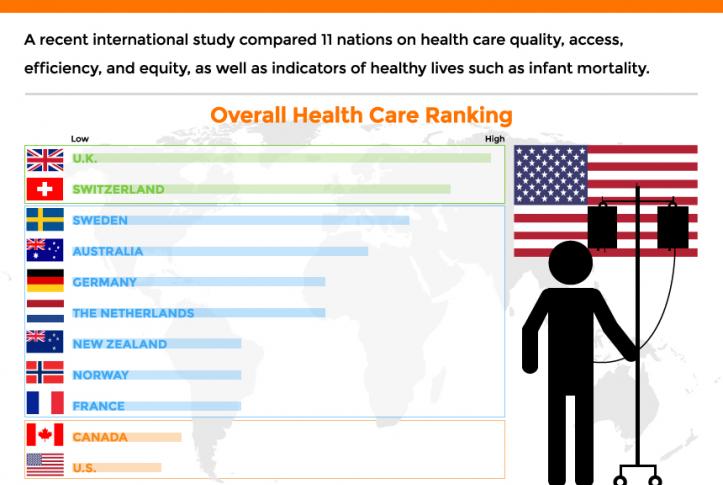
The performance of the U.S. healthcare system ranked last among 11 high-income countries, according to a report released Aug. 4 by the Commonwealth Fund.
To compare the performance of the healthcare systems in 11 high-income countries, the Commonwealth Fund analyzed 71 performance measures across five domains: access to care, care process, administrative efficiency, equity and patient outcomes.
Despite spending far more of its gross domestic product on healthcare than the other nations included in the report, the U.S. ranked last overall, as well as last for access to care, administrative efficiency, equity and patient outcomes. However, the U.S. ranked second on measures of care process, trailing only New Zealand.
Norway, the Netherlands and Australia had the best healthcare system performance, according to the report. In all seven iterations of the study conducted by the Commonwealth Fund since 2004, the U.S. has ranked last. It is the only country included in the study that does not provide its citizens with universal health insurance coverage.
Four features separate the top performing countries from the U.S., according to the report: universal health insurance coverage and removal of cost barriers; investment in primary care systems to ensure equitable healthcare access; reduction of administrative burdens that divert time and spending from health improvement efforts; and investment in social services, particularly for children and working-age adults.
Perhaps the worst way a leader can respond to the current surge of COVID-19 is with an exaggerated sense of familiarity.
Although communities have before experienced growing positivity rates, cases, hospitalizations and deaths from COVID-19, the summer 2021 surge involves some new or evolved factors that are worthy of consideration for leaders to best respond to the needs of their teams, patients and communities.
COVID-19 surges may not be new for hospitals or health systems, but here are seven reasons the one unfolding now differs from those before.
1. COVID-19 vaccinations are available. The fact that acute COVID-19 resulting in hospitalization is largely avoidable is a sticky film coating everything about this surge. Under the direction of President Joe Biden, all adults were eligible for the COVID-19 vaccine by May 1. As of Aug. 2, 49.7 percent of the U.S. population is fully vaccinated and 70 percent of adults have received at least one dose of a COVID-19 vaccine, the latter of which is a milestone the president aimed to meet by July 4. Unvaccinated individuals account for 97 percent of the COVID-19 hospitalizations and deaths in the U.S., Jeff Zients, White House COVID-19 response coordinator, said July 22.
2. Clinicians are experiencing a distinct and deep brand of exhaustion. The term “burnout,” which healthcare recognized long before the pandemic, doesn’t cut it. Many clinicians today are managing competing emotions about patient care, with some feeling resentment slogging through long hours and COVID-19 surges that now feel preventable. “You’re just angry,” Terrence Coulter, MD, critical care medical director at Springfield, Mo.-based CoxHealth, told The Atlantic. “And you feel guilty for getting angry, because they’re sick and dying.”
3. Hospitals are grappling with labor shortages. Nationwide, organizations are experiencing labor and talent deficits, both of which have been exacerbated by the pandemic. COVID-19 has left many professionals exhausted, with nearly 30 percent of physicians, nurses and other healthcare workers reporting that they have considered leaving healthcare altogether because of pandemic-related burnout, according to a survey by The Washington Post and the Kaiser Family Foundation. At the end of July, PeaceHealth St. John Medical Center in Longview, Wash., said it was facing “unprecedented patient volumes,” with its workforce alleging that a staffing crunch is leading to poor working conditions, according to The Daily News. On the other side of the nation, two North Carolina hospitals have at least 700 unfilled nursing positions — each, reported WNCT-TV. In South Carolina, there are more open positions for registered nurses than any other job in the state, with 4,955 openings, according to a May data analysis by WYFF.
4. The delta variant is more contagious. The delta variant, first detected in India, appears to be as contagious as chickenpox and appears to cause more severe illness than earlier strains, according to an internal CDC presentation obtained by The Washington Post. The report says vaccinated people infected with delta have had similar viral loads as unvaccinated people infected with the strain, which suggests vaccinated people may spread the virus just as easily as those who are unvaccinated — findings based on still unpublished data from studies and outbreak analyses. The variant is thought to contain genetic changes that allow it to spread twice as fast as earlier strains.
5. Public health guidance is more nuanced. In the earliest stage of the pandemic, before the vaccines, public health guidance from the CDC was written for every person as our defense against COVID-19 was collectively minimal. Now, as the number of fully vaccinated populations varies from 68 percent in Vermont to 34 percent in Alabama, the CDC has revised indoor masking guidance to a county level, with nearly 70 percent of U.S. counties experiencing a community transmission rate that meets the CDC threshold for an indoor mask recommendation. The CDC released new guidance for fully vaccinated Americans’ COVID-19 testing the same week. These are two examples of how public health guidance that in past surges was largely “one size fits all” is now tailored to specific circumstances. While precision and right-sized solutions are generally a good thing, nuance can also cause confusion.
6. COVID-19 patients are younger and fitter. At the start of 2021, people 65 and older made up 53 percent of COVID-19-related hospitalizations and people 18-49 made up 20.5 percent, according to data from COVID-Net, a CDC surveillance system that draws data from numerous states, representing roughly 10 percent of the population. As of Aug. 2, those numbers shifted where people 65-plus now make up 26 percent of COVID-19-related hospitalizations while people 18-49 make up 41 percent.
7. Non-COVID patients are sicker. Pre-surge, many emergency rooms were already feeling the strain of staffing shortages combined with patients of higher acuity as a result of delayed or deferred care throughout the pandemic. Stanford (Calif.) Healthcare is “outstripping beds everyday,” Dale Beatty, DNP, RN, chief nurse executive and vice president of patient care services, told Becker’s. The hospital is seeing “sicker” patients, reporting higher volumes of critically ill non-COVID-19 patients. COVID-19 long-haulers are also accounting for a significant portion of the patients, Dr. Beatty said. COVID-19 leaves thousands of survivors with health effects that place additional demand on the healthcare system. Nearly one-quarter of people who had COVID-19 still have at least one condition.
The Federal Trade Commission has been hit by a “tidal wave” of merger filings and cannot review them all before required deadlines.
The FTC is now sending letters to merging entities warning them that the agency may deem a combination unlawful even if the companies decide to merge.
“Companies that choose to proceed with transactions that have not been fully investigated are doing so at their own risk,” the regulator said in a statement Tuesday.
The alert may give pause to hospitals merging at a steady clip. Unwinding deals once they’re already consummated can be costly and complex. The premerger filings give regulators a chance to stop anticompetitive mergers before a deals closes, preventing harm to consumers and businesses in the meantime.
The FTC received 343 premerger filings in the month of July, more than three times the amount from July of last year, when 112 transactions were submitted for review.
So far this year, more than 2,000 transactions have been submitted through the month of July, according to figures with the FTC, eclipsing the 815 filings over the same time period last year.
Federal regulators have forced hospital to unwind mergers before.
The FTC forced ProMedica to unwind its buyup of St. Luke’s Hospital in the Toledo area after alleging the deal would severely hinder competition. The FTC later approved a divestiture plan in 2016 after a long battle in court.
It came even as the FTC had signaled it plans to prioritize enforcement in a number of key industries including healthcare.
Plus, last year the FTC said it was expanding a key tool in its arsenal to potentially help police future deals.
Mergers that exceed a certain threshold — currently $92 million — are required to submit a premerger filing with the FTC per the Hart-Scott-Rodino Act.
The filing initiates a review period in which the FTC and Department of Justice investigate the deal.
Typically, the agencies have 30 days to determine whether additional information is needed. If so, the deal is on hold until the companies respond with the needed information, and after that the agencies have a limited number of days to file a challenge if they deem the tie-up unlawful.
The FTC can also terminate the waiting period early, allowing the deal to proceed.
However, the agency maintains the right to challenge any deal regardless of whether it was reviewed or not.