
How the ACA’s Medical Loss Ratio Rule Protects Consumers and Insurers Against Ongoing Uncertainty

https://www.commonwealthfund.org/publications/issue-briefs/2019/jul/how-aca-medical-loss-ratio-rule-protects-consumers-insurers

calculating bills for medical procedures

ABSTRACT

  • Issue: The Affordable Care Act’s rule on minimum medical loss ratios (MLRs) protects consumers by capping insurers’ profits and overhead. In the early years of the law, these caps were rarely used because most insurers in the individual health insurance market experienced substantial losses. More recently, however, insurers are earning substantial profits while the individual market is rattled by regulatory uncertainty and change.
  • Goal: To understand the ongoing role that the medical loss ratio rule plays in the individual health insurance market.
  • Methods: Analysis of insurers’ financial performance 2015–2017, as reported to the federal government.
  • Key Findings and Conclusion: Consumer rebates under the MLR rule increased noticeably in 2017 as insurers raised rates and regained profitability. At the same time, the rule’s calculation of MLRs based on a three-year rolling average allowed insurers in 2017 to recoup a portion of their losses from earlier years. As the individual market continues to experience cycles of profits and losses, the MLR rule dampens the severity of these cycles, thus protecting insurers as well as consumers.

Background

Regulation of insurers’ medical loss ratios (MLRs, or loss ratios) is one of the most notable consumer protections in the Affordable Care Act (ACA). The loss ratio is the percentage of premium dollars that insurers spend on medical claims and quality improvement, rather than dollars retained for administrative overhead and profit.

Under the ACA, insurers that do not incur a loss ratio of at least 80 percent (based on a three-year rolling average) in the individual or small-group market must rebate the difference to consumers.1 Put another way, insurers with average overhead and profits during the past three years that exceed 20 percent must rebate the excess to members. Large-group insurers must do the same for loss ratios less than 85 percent, or when overhead and profits average more than 15 percent of premium dollars based on a three-year average.2

The ACA’s MLR rule took effect in 2011. In its first few years, this rule provided important consumer protection by requiring substantial consumer rebates and inducing insurers to reduce their administrative costs, which likely helped to keep premiums somewhat lower.3 These protections became less visible once insurers adjusted their rates to reflect their lower overhead.4 Following substantial rate increases for individual health insurance in 2017 and 2018, however, the ACA’s loss ratio limits have renewed relevance by helping stabilize a market that has been buffeted by cyclical underpricing and overpricing.

This issue brief explains how the ACA’s MLR rule serves an important buffering function in two ways. The rule protects consumers by limiting how much insurers can attempt to recoup previous losses through higher profits in any one year. At the same time, the rule allows insurers to replenish some of their reserves that deplete during lean times by calculating MLR limits based on a three-year rolling average.

The Changing Relevance of Loss Ratio Limits

As shown in Exhibit 1, rebates in the individual health insurance market declined from almost $400 million in 2011 to slightly more than $100 million annually in 2015 and 2016,5 accounting in those later years for only about 0.14 percent of insurers’ premiums. Rebates also declined in the group markets but less dramatically (in proportionate terms).

To fully understand this pattern, it helps to have a clearer picture of insurance pricing during this period. The individual market had a significant drop in rebates after 2014 because loss ratios in that market increased to an unprofitable level for most insurers in 2015 and 2016. Insurers underpriced those years because of the highly competitive conditions in the newly reformed individual market, coupled with actuarial uncertainty over the full extent of health care needs for the newly insured.6

But since 2017, the ACA’s MLR limits have once again become more relevant for consumers in the individual market.7 To help insurers regain profitability, state regulators allowed them to target the minimum allowable loss ratios, which meant that rates increased more than the anticipated increases in medical claims. As a result, rate increases averaged roughly 25 percent in 2017 and 30 percent in 2018.8

For the most part, these increases were caused by changes in federal rules, such as the planned phasing out of the ACA’s transitional reinsurance program, as well as the unplanned cessation of cost-sharing reduction payments to insurers.9 But these hefty increases were also driven by insurers’ aiming to substantially lower their previous loss ratios.

In fact, many insurers overshot their targeted loss ratios in 2017 and 2018, resulting in greater profitability than they may have anticipated. Accordingly, their rate increases were much more subdued in 2019, averaging only about 3 percent.10

This cyclical pattern of underpricing followed by overpricing (relative to actual medical claims) is driven in large part by insurers’ uncertainty about the ACA’s evolving market conditions. This uncertainty has two causes: actuarial and political.11

When the newly reformed individual market first opened in 2014, insurers lacked the actuarial experience needed to accurately estimate the newly insured’s use of medical services. This actuarial uncertainty carried over into 2016 because insurers must file their rates roughly 18 months prior to the end of the following rating year.12 Also, in 2015 and 2016, there was substantial turnover among insurers in the individual market, as some initial players learned that they were not able to compete effectively under the new market rules.13

The ACA’s drafters anticipated this uncertainty and included several risk-mitigating measures, known as the “three R’s:” reinsurance, risk-adjustment, and risk corridors.14 The first two measures were implemented, but risk corridors were not because of Republican opposition that characterized this market-stabilizing measure as a “bailout for insurers.15 Risk corridors would have substantially dampened the initial cycling between substantial losses and excessive profits in the ACA’s individual market.16

Despite the absence of the ACA’s full complement of stabilizing features, participating insurers began to gain their actuarial footing in 2017. At this point, however, the cause of insurers’ uncertainty shifted from typical actuarial factors to more political factors, including dramatic changes in administrative policies and market rules under the Trump administration. These changes are described in more detail elsewhere, but in brief they include abruptly ceasing cost-sharing reduction payments, repealing the individual mandate penalty, and drastically reducing funding for marketing and consumer navigation during open enrollment.17

This political and regulatory uncertainty continues. Regulators are greatly loosening rules that previously had limited the sale of non-ACA-compliant policies, and the full impact of these changes is still unknown.18 Moreover, the Justice Department has taken the position in court that the ACA should be struck down as unconstitutional, which could have a catastrophic impact on the individual market. However, the fate and timing of that litigation is highly uncertain.

In short, these roller-coaster conditions would probably have leveled out by 2017 if ongoing changes to market rules had not intensified the uncertainty. Against this backdrop, we now consider the role that the ACA’s loss ratio rule might play in stabilizing the market by protecting both consumers and insurers through continuing cycles of losses and excessive profits that result from ongoing market uncertainty.

The following sections examine two key stabilizing features in the ACA’s loss ratio rule. Using a three-year rolling average to calculate excess overhead and profits protects insurers by allowing them to recoup at least a portion of their recent losses through somewhat larger rate increases in a current year. At the same time, requiring insurers to rebate excess overhead and profits protects consumers from unjustified price increases.

In effect, the ACA’s loss ratio rule serendipitously serves a function similar to the ACA’s risk corridor provisions that were undermined by Republican opposition: the MLR rule partially shelters insurers in bad times and keeps them from unduly profiteering in good times.

Protection of Insurers

Viewing the individual market as a whole, Exhibit 2 shows that in 2015 and 2016 (averaged together), insurers had poor financial results. Their collective loss of –7.4 percent was because of a high medical loss ratio — 95 percent. Some insurers were more successful and were required to pay a rebate; however, across the entire market, these rebates averaged only $6 per person per year (50 cents a month), equal to just 0.01 percent of the premium.

Insurers’ financial performance improved dramatically in 2017. By increasing premiums by 11 percent more than the increase in claims (14% vs. 3%),19 insurers reduced their medical loss ratios by nine percentage points overall, from 95 percent to 86 percent. And, by holding steady their administrative costs, their profit margins improved by 11 points, from –7.4 percent to 3.3 percent.

Because of this financial improvement, rebates increased by almost 50 percent in 2017. But rebates still remained much lower than in the ACA’s early years, averaging only $9 a person for 2017 ($0.73 a month) marketwide.

Rebates remained low for two reasons. First, although insurers’ MLRs dropped quite a bit, they remained above the regulatory minimum on average. Second, for insurers with 2017 loss ratios below 80 percent, their earlier losses in 2015–2016 decreased the rebate amount they owed because the rebate is calculated using a three-year rolling average.

This effect can be seen by examining insurers that were in the individual market all three years, 2015–2017. Out of 303 such insurers with at least 1,000 members, there were 74 insurers with loss ratios below the required 80 percent in 2017. Without the three-year rolling average, these more profitable insurers would have owed rebates averaging $258 per member in 2017. Instead, the ACA’s three-year look-back rule required insurers that were in the market that long to pay a rebate of only $21.55 per member for the year. This reduction allowed these insurers to recoup $919 million of prior 2015–2016 losses overall.

Protection of Consumers

At the same time the ACA’s MLR rule helps cushion the extent of insurers’ losses over time, it also continues to protect consumers against overpriced health plans. Although most insurers in 2017 owed no rebates, 29 insurers paid a rebate of $140 per member, amounting to $132 million, or 3.3 percent of their premiums. Not counting these rebates, these insurers had a handsome overall profit margin of 12.6 percent in 2017. As shown in Exhibit 3, these rebates reduced their profit margins by slightly more than 25 percent.

This backstop against excessive profits is expected to have even more importance once full financial reporting is complete for 2018, which included a second round of substantial rate increases.20 Despite owing rebates for 2017, insurers continued to increase rates for 2018 in part because they had to file their 2018 rates in mid-2017 without their complete 2017 financial performance data in hand. Also, insurers had to anticipate possible disruptions to the market caused by changes to the ACA’s market rules.

By building in more cushion than they needed, insurers are expecting substantially lower loss ratios in 2018, which will generate much higher rebates. One recent analysis projects that loss ratios in the individual market will drop to 70 percent for 2018, resulting in close to $1 billion in rebates.21

These consumer protections could have substantially more impact in some states than in others, depending on how much insurers were permitted to increase rates in each state. Across 50 states and the District of Columbia, insurers in 26 jurisdictions had no rebates for 2017 in the individual market, and rebates were less than $5 a person in 11 states. However, in seven states (Arizona, Massachusetts, Minnesota, Mississippi, Missouri, New Hampshire, and New Mexico), rebates exceeded $50 per person in the 2017 individual market.22 Notably, in four of these seven states (Minnesota, Missouri, New Hampshire, and New Mexico), a single insurer with profit margins of 15 percent or greater was solely responsible for the rebate (Exhibit 4).

Conclusion

When the ACA’s medical loss ratio rule first took effect in 2011, its protections were more visible to consumers, who received significant rebates while insurers substantially reduced overhead costs. In subsequent years, these protections became less noticeable, as insurers in the individual market struggled with substantial losses.

Now that the individual market appears to have regained profitability, however, the ACA’s MLR rule has renewed relevance, both for consumers and insurers. The rule has resumed its important role of paying rebates to consumers whose health plans enjoy substantial profits. Additionally, the MLR rule affords insurers that suffer substantial losses an opportunity to recoup some of those losses by averaging a low loss ratio against two prior years of high loss ratios.

By smoothing out oscillations in profits and losses, the ACA’s MLR rebate rule holds the prospect of not only continuing to protect consumers, but also of helping to counter some of the destabilizing effects of ongoing changes in regulatory policy in the individual market.
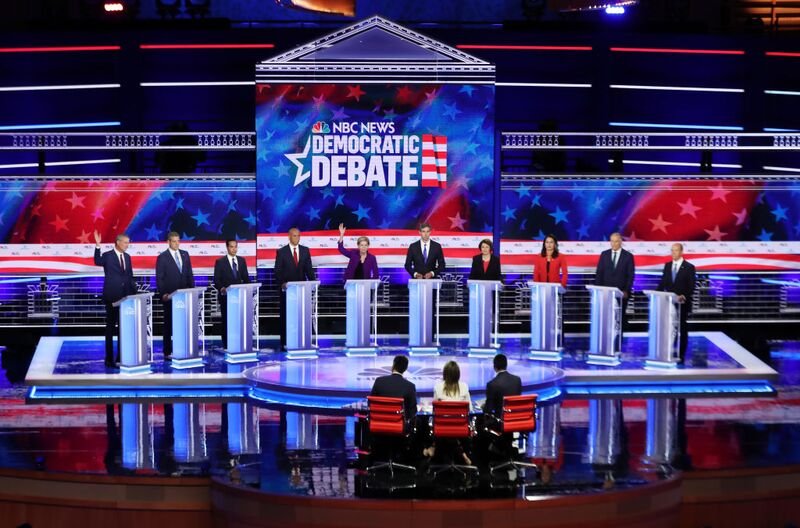


Here’s What’s Missing From the Health-Care Debate

https://www.bloomberg.com/opinion/articles/2019-06-28/democratic-2020-debate-medicare-for-all-and-health-care

Raise your hand if you want to debate health care.

There needs to be more frank talk and better explanations about the costs and trade-offs of plans like Medicare for All.

Health care took up a decent portion of the Democratic presidential debates this week. For all of the verbiage, we didn’t learn much new. Everybody wants universal coverage, but they have different ideas about how to get there. One group, led Vermont Senator Bernie Sanders, want a single-payer system like “Medicare for All”; others, including former Vice President Joe Biden, prefer various flavors of a public option that co-exists with elements of the status quo.

Nonetheless, there were a few moments that drew attention to important issues that could (or should) shape the health-care discussion going forward: 


THE BIG TRADE-OFF: People who have health under Medicare for All will have no premiums, no deductibles, no co-payments, no out-of-pocket expenses,” Sanders said during Wednesday’s debate. “Yes, they will pay more in taxes, but less in health care for what they get.” Sanders was responding to a question about whether his policies would mean higher taxes for middle-class Americans; his answer elucidated an essential truth that’s still lost on many voters.

Medicare for All is at its core a shift in how America finances health care. Right now, people pay big chunks of their health costs themselves – especially when they’re sick. Sanders’s plan would replace that out-of-pocket spending with taxes. There’s an appeal to that. It’s more equitable and would eliminate situations where health crises result in bankruptcy, or costs dissuades people from seeking care. Whether this shift will result in savings for individuals will depend on tax details as well as income and health status. If such a plan can lower costs by cutting prices and eliminating insurer profits, there’s a real possibility that many Americans come out ahead. Right now, polls suggest that broad support for Medicare for All drops when people hear about tax increases. Getting voters to understand what they get in return will be critical. 


RAISE YOUR HAND: On both nights, the debate moderators chose to boil the health-care debate down to one yes-or-no question. Candidates who support eliminating private health insurance in favor of a single-payer system were asked to raise their hands. This is a defining divide in the field, so it was notable that Elizabeth Warren raised hers on Wednesday. She places third in most polls behind Joe Biden and Sanders, and has been vague on health care in the past. If she’s a dogmatic supporter of Sanders’s specific plan, that tilts the race in the direction of Medicare for All. I’m not sure that’s the case, though. She could end up diverging on specifics of how the U.S. should transition to a single-payer system and structure it. As the field shrinks, it will probably benefit her to stake out a place between Sanders and Biden, who supports a milder public option. A lot of candidates want to be in that space, though none have defined it well or made it their own yet. Given ambivalent polling about the details of Medicare for All and the idea of killing private insurance, this feels like an opportunity for the person who seizes it. 


WHAT PRICE IS RIGHT?  America spends far more than other countries on services without getting better results. That might not change without price controls for providers. Former Maryland representative John Delaney claimed on Wednesday that these types of controls would have consequences, saying that many hospitals would be forced to close if they had to accept the rates currently paid by Medicare for all services. While the truth of that statement is a matter of some debate, what isn’t in doubt is that lower reimbursement would be necessary even for milder plans, and that this could put pressure on hospital systems.

Reform-minded candidates don’t like to talk about that, which is why Delaney’s point stood out. Instead, they preferred to focus their ire on insurers and drugmakers. Drug prices and insurer overhead are important issues too, but services eat up a far more significant portion of spending. The field won’t be able to ignore that issue and the potentially disruptive consequences of dealing with it. 

These first debates got the discussion going. The devil will be in the details.


The Justice Department’s New Brief in Texas v. United States

The Justice Department’s New Brief in Texas v. United States

Image result for The Justice Department’s New Brief in Texas v. United States

Last week, the Fifth Circuit asked the parties to Texas v. United States—the broadside challenge to the constitutionality of the Affordable Care Act—to submit letter briefs on whether anyone had standing to appeal. (Jonathan Adler has offered excellent analysis of that order here.)

Though the briefs won’t all be filed until Friday, the Justice Department submitted its brief this afternoon. In a welcome surprise, I agree with most (but not all) of it. It should lay to rest any of the Fifth Circuit’s qualms that the case is not properly before it.

* * *

In its brief, the Department says that it’s got standing to take the appeal, even if no one else does. “[T]he government remains an appellant in this case and, critically, continues to enforce the Affordable Care Act.” Until it stops enforcing the Act, the red states and the Trump administration are at odds over the constitutionality of its continued implementation. That’s enough for a case or controversy.

Confirming the point is the Supreme Court’s decision in United States v. Windsor, the case in which the Obama administration declined to defend the Defense of Marriage Act. As the Department explains:

[H]ere, as in Windsor, the United States has both appealed that judgment and continued to enforce the statute to the detriment of the plaintiffs pending final judicial resolution of the constitutional question, even though the Executive Branch agrees with the district court’s legal conclusion. In both cases, the government’s refusal to acquiesce to the relief entered against it by the district court suffices to preserve an Article III controversy.

Significantly, the Justice Department now says that it will continue to enforce the ACA “pending a final judicial determination of the constitutionality of the individual mandate as well as the severability of the ACA’s other provisions.” Ongoing enforcement means there’s a live dispute.

I think that’s right. Not only is it consistent with Windsor, but it would avoid a very odd result. If no one could appeal, Judge O’Connor’s decision invalidating the ACA would likely remain in place—even as the Trump administration continued to interpret it as allowing for continued enforcement. But that outcome wouldn’t satisfy the red states, which seek to blow up the ACA altogether. And so the parties would still be at loggerheads, their nominal agreement on the legal questions in the case notwithstanding.

The Department also points out that it’s not in total agreement with Judge O’Connor. In a strange portion of its opening brief, it argued that parts of the ACA that didn’t directly give rise to the plaintiffs’ injuries should be sustained. The Department flagged certain anti-fraud statutes as examples, but it’s not at all clear how far that argument goes. Does it apply to the biosimilar program? Calorie-count labels in chain restaurants? The Medicaid expansion? Regardless, the point holds that the red states and the federal government disagree about how much of the ACA should be invalidated if the individual mandate is unconstitutional. That should be enough for standing.

* * *

Because the federal government itself has standing to appeal, the Justice Department thinks it’s “immaterial” whether the House of Representatives or the blue-state coalition—both of which have intervened in the case—can also take an appeal. For now, I think that’s right.

Nonetheless, the Department offered its views, as the Fifth Circuit asked. As to the House of Representatives, the Department says that the Supreme Court’s decision in Virginia House of Delegates v. Bethune-Hill confirms that the House, as one part of a bicameral legislature, can’t sue to vindicate an injury sustained by Congress as a whole. I think that’s right, as I’ve argued before.

But who cares? Unless the blue states also lack standing, it’s irrelevant. And that’s where I think the Justice Department’s brief goes astray.

The Department says that the blue states also lack standing to appeal because nothing in O’Connor’s decision—which was a declaratory judgment, not an injunction—alters their “tangible legal rights.” In essence, the Department argues that O’Connor’s declaration that the ACA is invalid should be understood to bind only the 19 red states that brought the case, not “nonparties like the [blue] state intervenors.” As such, the blue states don’t have an interest in the case and can’t take an appeal.

That’s wrong, however. Intervention makes you a party to a lawsuit. And you’ve got a right to intervene when disposing of the case in your absence would “impair or impede” your interest in the case.

When the red states filed their complaint, they sought complete invalidation of the ACA—not just invalidation in the 19 red states. Whatever the Fifth Circuit says on appeal could determine (or at least influence) whether the red states get the relief they asked for. Indeed, because an appeals court can affirm “on any grounds supported by the record,” it’d probably be within the Fifth Circuit’s authority to interpret O’Connor’s order to apply outside the 19 red states. It’s risible to say that California is a stranger to litigation that could wipe out the ACA within its borders.

Matters might be different if the red-state plaintiffs had dropped their demand for nationwide relief. But they haven’t. (They did at one point ask O’Connor to enter red-state specific reliefif he was unwilling to grant nationwide relief. But that’s not the same thing as abandoning the claim.) Matters might also be different if district courts were prohibited from granting relief that extended beyond the plaintiffs. Though I’m on record in support of such a prohibition, that’s not the world we live in.

So yes, the blue states have standing to appeal. But it shouldn’t matter. We’ve got a live case or controversy between the red states and the Trump administration over whether it should continue enforcing the ACA. That should end the matter of whether this appeal is properly before the Fifth Circuit.


Democrats have lurched leftward on health benefits for undocumented immigrants

https://www.washingtonpost.com/news/powerpost/paloma/the-health-202/2019/07/01/the-health-202-democrats-have-lurched-leftward-on-health-benefits-for-undocumented-immigrants/5d18b0a61ad2e552a21d51bf/?utm_term=.63e054feab31

President Trump could barely hide his glee when every one of his potential Democratic opponents shot up their hands at Thursday night’s debate when asked whether undocumented immigrants should be included in government health plans.

And for a clear reason. Extending public benefits to immigrants who are in the United States illegally has long been a fraught issue, even among Democrats. Nine years ago, the Democratic-led Congress banned such immigrants from the Obamacare marketplaces — even if they use their own money to buy a plan — and even the most liberal states have struggled to expand coverage to the undocumented population. Undocumented immigrants are excluded from the Medicare and Medicaid programs, with some exceptions for children and pregnant women.

It’s hardly the first time a Republican has pounced on a Democrat for appearing to support government health benefits to the undocumented. Many will recall the infamous moment in 2009 when Rep. Joe Wilson (R-S.C.) yelled, “You lie!” in the House chamber as President Obama told them health proposals wouldn’t cover undocumented immigrants.

Wilson was wrong — the eventual ACA did indeed exclude undocumented immigrants from health insurance expansions, as Obama had promised. But this is one of several issues on which the 2020 Democratic contenders are now moving quite a bit further leftward as they seek the presidential nomination. They’re certainly far from where the last Democratic presidential nominee — Hillary Clinton — stood on the issue.

In her 2016 health-care platform, Clinton would have allowed undocumented immigrants to buy marketplace plans, one step further than the ACA’s outright ban. But she would have still excluded them from getting the ACA’s income-based subsidies, increasing the likelihood undocumented immigrants still couldn’t find affordable coverage.

Rewind to two decades before that, to when Clinton as first lady was trying to get a health-care revamp passed from her perch at the White House. At the time, the first lady expressed concern that extending benefits to the undocumented could encourage more people to enter the country illegally.

“We do not think the comprehensive health-care benefits should be extended to those who are undocumented workers and illegal aliens,” Clinton told Congress in 1993. “We know now that too many people come in for medical care, as it is. We certainly don’t want them having the same benefits that American citizens are entitled to have.”

The Democrats onstage last Thursday sounded a lot different.

NBC moderator Savannah Guthrie posed this question to them after an extended discussion about the Medicare-for-all and public option plans they are proposing to offer Americans:

“A lot of you have been talking tonight about these government health care plans that you have proposed in one form or another,” Guthrie said. “Raise your hand if your government plan would provide coverage for undocumented immigrants.”

All the candidates — which included the two front-runners, former vice president Joe Biden and Sen. Bernie Sanders (I-Vt.) — raised their hands in response.

But Biden’s stance was notable, considering where mainstream Democrats used to stand on the issue. “You cannot let people who are sick, no matter where they come from, no matter what their status, go uncovered,” Biden said on the stage. “It’s just going to be taken care of, period … it’s the humane thing to do.”

Both Biden and South Bend, Ind., Mayor Pete Buttigieg noted that undocumented immigrants pay Social Security taxes if they have jobs and sales taxes when they purchase goods and services, arguing that’s another reason they should be included in public health-care programs.

“This is not about a handout,” Buttigieg said. “This is an insurance program. And we do ourselves no favors by having 11 million undocumented people in our country be unable to access health care.”

To Buttigieg’s point, there’s considerable evidence that helping people buy health insurance results in less spending in the long run. When hospital emergency departments care for uninsured patients, the hospitals end up passing along the costs to the insured patients, resulting in higher premiums for everyone.

Julian Castro, former HUD secretary under Obama, reiterated his support yesterday for giving health insurance to undocumented immigrants.

“What I’d like to Americans to know, right now, No. 1, undocumented immigrants already pay a lot of taxes,” Castro said on ABC’s “This Week with George Stephanopoulos.” “Secondly, we already pay for the health care of undocumented immigrants. It’s called the emergency room.”

That’s a reason California — home to about one-fifth of the country’s undocumented immigrants — recently passed a budget extending Medicaid to some of the undocumented. But it’s the only state to do so, and it chose the most limited, least-costly option.

Last week, Gov. Gavin Newsom (D) signed a $214.8 billion budget into law that extends California’s Medi-Cal program to undocumented adults ages 19 to 26. That measure also expands on the federal health-care law in a number of ways, reinstating its individual mandate to buy coverage — which Congress repealed a few years ago — and raising the income threshold for getting marketplace subsidies.

But the Medi-Cal expansion is only a shadow of what many state lawmakers wanted. The state’s Senate passed a bill also opening its door to undocumented immigrants over age 65, while the Assembly’s version would have opened it up to everyone. Newsom insisted on expanding coverage only to young adults, a much less expensive option estimated to cover 138,000 undocumented immigrants.

The political obstacles to such a move were evident back in 2010 when Congress was constructing the ACA and barred people in the country illegally from participating in any part of the law.

California took some steps in 2016 toward asking the federal government for permission to let undocumented immigrants buy marketplace coverage but withdrew its request over fears the young Trump administration might use the request to target immigrants for deportation. New York lawmakers have proposed similar legislation, but it hasn’t gained traction.


These are the judges holding Obamacare’s future in their hands

https://www.washingtonpost.com/news/powerpost/paloma/the-health-202/2019/07/02/the-health-202-these-are-the-judges-holding-obamacare-s-future-in-their-hands/5d1a5add1ad2e552a21d51e8/?utm_term=.a44fbc001f82

Image result for aca in court

The future of Obamacare is at stake next week, when the country’s most conservative appeals court will consider whether to uphold a ruling striking down the whole law. But the politically fraught, high-stakes case is at least likely to get a fair hearing by three judges whose names were announced yesterday, legal experts say.

Two of the judges were GOP-appointed; they include Jennifer Walker Elrod, a George W. Bush appointee, and Kurt Damian Engelhardt, an appointee of President Trump. But they’re known for being some of the more measured and thoughtful members of the U.S. Court of Appeals for the 5th Circuit, distinct from other judges who might be more politically inclined.

“There’s no doubt there are a couple firebrand jurists out there … but none of those judges are on this panel,” New Orleans litigator Harry Morse, who has argued before Engelhardt, told me.

“There’s nothing about these three that strikes me that they’ll be looking for headlines or take a stand on anything other than their fair reading of the law,” he added. “They’re all pretty careful folks.”

A third judge, Carolyn Dineen King, was appointed by former Democratic president Jimmy Carter. She, along with Elrod and Engelhardt, will hear oral arguments on July 9 in the closely watched lawsuit brought by nearly two dozen GOP-led states who are trying to unravel the ACA, even after it survived years of court challenges and repeal attempts in Congress.

It’s a deeply disturbing situation for California and other Democrat-led states defending the health-care law, who fear its consumer protections and insurance expansions could be wiped out in a moment. They’ve stepped up to defend the law because President Trump’s Justice Department is refusing to do so — even though a decision overturning the law would create a logistical and political mess for the administration.

The states, led by Texas, were certainly strategic in where they mounted the challenge. The 5th Circuit — whose 16 active judges include 11 appointed by Republicans — is widely viewed as being more sympathetic to Republican arguments that the ACA must now be struck down because Congress repealed the basis for its constitutionality, the individual mandate to buy coverage.

Because the panels are chosen randomly, it would have been unlikely for the trio hearing next week’s ACA lawsuit to include three or even two judges appointed by Democrats. The Elrod-Engelhardt-King panel is a good reflection of the 5th Circuit’s overall makeup, said Barry Edwards, a lecturer at the University of Central Florida who has written about U.S. appeals courts.

“I’d say the Democratic states were hoping for a better panel, but this is the panel they expected,” Edwards said.

Engelhardt was sent to the 5th Circuit by Trump, who relies heavily on recommendations from the influential Federalist Society. But he was initially made a federal district judge by George W. Bush, indicating he may not be as far to the political right as the judges Trump tends to favor, Edwards told me.

Engelhardt has been on the 5th Circuit for a little more than a year, while Elrod has been on its bench since 2007.

Even those familiar with the 5th Circuit find it hard to predict how the panel will land on last year’s district court ruling striking down the entire ACA, the decision the states are appealing. Its ruling will have bearing on whether the Supreme Court agrees to hear yet another challenge to the ACA, after upholding most of the law in 2012 and then again in 2015.

Edwards guesses the appeals court will upheld the lower-court decision scrapping the health-care law — a scenario in which the Supreme Court would almost certainly take up the case, given how many people the law has touched. But Morse said it’s hard for him to believe the judges would agree to strike down the ACA given how many times it has survived past legal challenges.

“I know it’s two Republican judges and one Democratic judge, but the ACA has been challenged twice in front of the Supreme Court,” Morse said. “The argument being made is the ACA can’t survive without the individual mandate, and Congress has implicitly rejected that.”

Nicholas Bagley, a law professor at the University of Michigan who has watched the case closely, said he’s certain the Supreme Court will hear the case if the 5th Circuit strikes the law. But he doesn’t expect a SCOTUS review if it leaves the law in place.

“If the panel reverses, I’m not at all sure that the Supreme Court will take the case,” Bagley wrote me in an email. “It’s that goofy.”

Last week, before the judges’ names were announced, the appeals court questioned whether the Democratic-led states and the U.S. House have the right to appeal the lower-court decision striking the law. Bagley and some other legal scholars interpreted the request as boding poorly for the law’s future, while others said it was a reasonable request, my Washington Post colleague Yasmeen Abutaleb reported.


Trump craves big action on drug prices to take to the campaign trail

https://www.washingtonpost.com/news/powerpost/paloma/the-health-202/2019/07/03/the-health-202-trump-craves-big-action-on-drug-prices-to-take-to-the-campaign-trail/5d1b9aa21ad2e552a21d5228/?utm_term=.e49cb9f99e60

Image result for high drug prices

There may be a modest slowdown this year in the growth of drug prices, but it’s nowhere near the seismic shift President Trump has called for. And that seems to be irking the president to no end.

Much of the president’s frustration has been borne by Health and Human Services Secretary Alex Azar, a former drug executive who until very recently pushed back on proposals to allow the importation of lower-cost drugs from Canada and give the government the tools to directly negotiate lower drug prices in the Medicare program, my Washington Post colleagues Yasmeen Abutaleb, Josh Dawsey and Laurie McGinley report.

But now, under intense pressure, Azar has reversed his long-standing opposition to at least one of those ideas: drug importation, an idea typically embraced by Democrats and dismissed by Republicans and the drug industry.

“Inspired by the president’s passion, Secretary Azar has been pushing FDA to go even bigger and broader on importation,” a senior administration official told my colleagues, although the official declined to detail specific policy changes.

It’s been a little more than a year since Trump promised Americans, in a speech from the Rose Garden, he would slash the price of prescription drugs in the United States. In that time, his administration has proposed some bold new regulations that could help move the needle, but only one has so far been finalized — a new requirement that went into effect this month for drugmakers to list prices in television ads.

While Azar has championed a proposal to eliminate the secretive rebates drug manufacturers pay to insurers, opposition to the idea from Domestic Policy Council head Joe Grogan is hamstringing the effort, my colleagues report. Grogan dislikes its estimated $180 billion price tag and doesn’t view the measure as central to the administration’s drug-pricing effort, they write.

There’s another proposal under review at the Office of Management and Budget to tie some Medicare drug prices to those paid by other countries, but it’s opposed by key Senate Republicans and the drug industry.

A senior administration official downplayed talk of tension between Azar and Grogan, saying the two, along with White House legislative affairs director Eric Ueland, speak three times a week about what is happening on Capitol Hill.

And on Monday, the New York Post published a joint op-ed by Azar and Grogan praising a recent executive order from Trump aimed at more transparency around the prices negotiated between hospitals and insurers.

“President Trump has promised a better vision: a health care system that treats you like a person, not a number,” Azar and Grogan write. “He wants to hold providers and Big Pharma accountable to transparency and reasonable prices.”

Meanwhile, drugmakers have continued hiking prices, albeit a bit more slowly on average. List prices for branded drugs grew 3.3 percent in this year’s first quarter, compared with 6.3 percent in the first quarter of 2018, according to SSR Health pharmaceutical analysts. Bernstein analysts told Politico that drug prices jumped 10.5 percent over the past six months, less than over the same period last year but still four times the rate of inflation.

Trump has frequently referenced some encouraging data from the consumer price index, where the index for prescription drugs fell by 0.6 percent for the 12 months ending in December, according to the Bureau of Labor Statistics. The index also dropped in January, February, March and May — a string of monthly declines not seen since 1973, my Post fact-checking colleagues recently noted.

Yet these data are a far cry from the drastic price reductions Trump would love to tout on the campaign trail as he seeks reelection in 2020.

“By all accounts, drug prices are a fixation for Trump, who frequently sends advisers news clippings and summons them to the White House to rant about the issue,” Yasmeen, Josh and Laurie write. “The guy likes to make money, and he thinks they make too much money,” said one former senior administration official.

A senior administration official told my colleagues there was frustration at a lack of executive branch tools to lower drug prices and that some of Trump’s ideas were ambitious but unworkable.

“Disagreements over how to proceed have created a policy free-for-all as different advisers — and the president himself — pursue what appear to be ad hoc and sometimes dueling approaches,” they write. “Trump entertains proposals usually pushed by progressive Democrats one moment and free-market GOP ideas the next.”


Out-of-pocket costs rising even as patients transition to lower-cost care settings

https://www.healthcarefinancenews.com/news/out-pocket-costs-rising-even-patients-transition-lower-cost-care-settings?mkt_tok=eyJpIjoiWldZeVlXTm1aVEF6TVdKbSIsInQiOiJjbWFzeVA2TGlWZkNkXC9odGxcLzdLczFZSDYxd1hoYW04b0wxY0ljQ25zblpYN1VWc2FMWFFCQWpmc2tCYmE4d1Z3eVdMd2htY3JiSjZ3N2Urek43SHFJbWFsckdRbUNycFJoQjhzZm5VcGpJUUhKUDlBMWF2eGJzRUhmZGFlUUx0In0%3D

Patients saw increases of up to 12% in their out-of-pocket responsibilities for inpatient, outpatient and ED care in 2018.

A new TransUnion Healthcare analysis has found that most patients likely felt a bigger pinch to their wallets as out-of-pocket costs across all settings of care increased in 2018. The new findings were made public yesterday at the 2019 Healthcare Financial Management Association Annual Conference in Orlando.

The analysis reveals that patients experienced annual increases of up to 12% in their out-of-pocket responsibilities for inpatient, outpatient and emergency department care last year.

In 2017, the average inpatient cost was $4,068; the average outpatient cost was $990; and the average emergency department cost was $577.

In 2018, the average inpatient cost was $4,659; the average outpatient cost was $1,109; and the average emergency department cost was $617.

FUELING THE TREND

There are certain factors that are influencing this trend, according to Jonathan Wiik, principal of healthcare strategy at TransUnion Healthcare.

“Patients are becoming more aware that emergency care is expensive and somewhat inefficient,” Wiik said. “No one wants to go to the emergency room unless we have to, because we don’t want to deal with the time there or the expense. They aren’t the best place to get primary or even urgent care.”

Another factor, he said, is that providers realize the emergency department is a care setting of last resort for many. Providers want to make sure that have room in the ED for cases that are real emergencies, so they’re essentially curating their patients, steering patients to the most cost effective settings possible — often primary care, which is the least expensive setting.

Noting that the biggest annual increases were in inpatient and outpatient care, Wiik said that was largely a function of utilization and just a general wariness, in addition to the fact that most EDs have pretty flat contracts. Financial communication with patients is also an issue.

“Most people can’t afford the average out-of-pocket, so providers are really trying to educate patients as early as they can about those costs,” said Wiik. “Emergency care is a really hard place to educate people on finances, let alone collect on them.”

RISING COSTS

The analysis found that, during a hospital visit, patients are likely experiencing cost increases that continue the trend of higher out-of-pocket costs. About 59% of patients in 2018 had an average out-of-pocket expense between $501 and $1,000 during a healthcare visit. This was a dramatic increase from 39% in 2017. Conversely, the number of patients that had an average out- of-pocket expense of $500 or below decreased from 49% in 2017 to 36% in 2018.

And with out-of-pocket costs increasing, the trend toward consumerism is growing as more patients, payers and providers transition to lower cost settings of care.

One example: Inpatient care, traditionally the most expensive healthcare option, has seen a leveling off with the percentage of price estimates remaining at 8% between 2017 and 2018. The percentage of outpatient services estimates, generally about one-quarter of the cost of inpatient services, rose in that same timeframe from 65% to 73%.

“Patients are likely seeing more providers and payers recommending that they take advantage of cost-effective healthcare options, which brings down costs for all parties,” said Wiik. “This is especially important as costs continue to rise in all areas of healthcare, particularly in inpatient, outpatient and emergency department services.”

This is having an impact on providers, payers and patients, he said.

“Let’s pretend Joanna had an MRI in her head, and that ran $3,200. That might have been paid by Blue Cross Blue Shield, and $100 out of Joanna’s pocket. Now Joanna’s paying $300. Most patients don’t look up how much the MRI’s going to be. They just get the bill later and try to figure it out. I think the patient portion of the bill is going to be in the 35, 40% range very soon. What that means is we’re quickly approaching half of the bill coming from the patient and half from the payer. That’s not insurance anymore, that’s a bank account.”

A recent Kaiser Family Foundation study indicated that 34% of patients are finding it difficult to pay their deductible before insurance kicks in. In addition to patients being challenged to make payments, the trend is that providers are also feeling the pressure of increased denial rates and write-offs, which is increasing bad debt.

Considering these factors together — increased out-of-pocket expenses, a patient’s challenge to make payment, and increased denial rates — collecting payments from all payers is critical for providers. In order for providers to ensure they receive payment for the patient-care services rendered, it is vital that they implement strategies that maximize reimbursements.


The Lessons of Washington State’s Watered Down ‘Public Option’

Jay Inslee, the governor of Washington, signing a measure in May that puts the state on track to create the nation’s first “public option” health insurance.

Jay Inslee, the governor of Washington, signing a measure in May that puts the state on track to create the nation’s first “public option” health insurance.

A big health care experiment for Democrats shows how fiercely doctors and hospitals will fight.

For those who dream of universal health care, Washington State looks like a pioneer. As Gov. Jay Inslee pointed out in the first Democratic presidential debate on Wednesday, his state has created the country’s first “public option” — a government-run health plan that would compete with private insurance.

Ten years ago, the idea of a public option was so contentious that Obamacare became law only after the concept was discarded. Now it’s gaining support again, particularly among Democratic candidates like Joe Biden who see it as a more moderate alternative to a Bernie Sanders-style “Medicare for all.”

New Mexico and Colorado are exploring whether they can move faster than Congress and also introduce state-level, public health coverage open to all residents.

But a closer look at the Washington public option signed into law last month, and how it was watered down for passage, is a reminder of why the idea ultimately failed to make it into the Affordable Care Act and gives a preview of the tricky politics of extending the government’s reach into health care.

On one level, the law is a big milestone. It allows the state to regulate some health care prices, a crucial feature of congressional public option and single-payer plans.

But the law also made big compromises that experts say will make it less powerful. To gain enough political support to pass, health care prices were set significantly higher than drafters originally hoped.

“It started out as a very aggressive effort to push down prices to Medicare levels, and ended up something quite a bit more modest,” said Larry Levitt, senior vice president for health reform at the Kaiser Family Foundation.

So while Washington is on track to have a public option soon, it may not deliver the steep premium cuts that supporters want. The state estimates that individual market premiums will fall 5 percent to 10 percent when the new public plan begins.

“This bill is important, but it’s also relatively modest,” said David Frockt, the state senator who sponsored the bill. “When I see candidates talking about the public option, I don’t think they’re really grasping the level of opposition they’re going to face.”

During the Affordable Care Act debate, more liberal Democrats hoped a public option would reduce the uninsured rate by offering lower premiums and putting competitive pressure on private plans to do the same. President Obama backed it, saying in 2009 that such a policy would “keep the private sector honest.”

The public option came under fierce attack from the health care industry. Private health plans in particular did not look forward to competing against a new public insurer that offered lower rates, and fought against a government-run plan that they said “would significantly disrupt the coverage that people currently rely on.” The policy narrowly fell out of the health care law but never left the policy debate.

Congressional Democrats have started to revisit the idea in the past year, with health care as a top policy issue in the 2018 midterm elections.

“During the midterm elections, Medicare for all was gaining a lot of traction,” said Eileen Cody, the Washington state legislator who introduced the first version of the public option bill. “After the election, we had to decide, what do we want to do about it?”

Ms. Cody introduced a bill in January to create a public option that would pay hospitals and doctors the same prices as Medicare does, which is also how many congressional public option proposals would set fees. The Washington State Health Benefit Exchange, the marketplace that manages individual Affordable Care Act plans, estimates that private plans currently pay 174 percent of Medicare fees, making the proposed rates a steep payment cut.

“I felt that capping the rates was very important,” Ms. Cody said.“If we didn’t start somewhere, then the rates were going to keep going up.”

Doctors and hospitals in Washington lobbied against the rate regulation, arguing that they rely on private insurers’ higher payment rates to keep their doors open while still accepting patients from Medicaid, the public plan that covers lower-income Americans and generally pays lower rates.

“Politically, we were trying to be in every conversation,” says Jennifer Hanscom, executive director of the Washington State Medical Association, which lobbies on behalf of doctors. “We were trying to be in the room, saying rate setting doesn’t work for us — let’s consider some other options. As soon as it was put in the bill, that’s where our opposition started to solidify.”

Legislators were in a policy bind. The whole point of the public option was to reduce premiums by cutting health care prices. But if they cut the prices too much, they risked a revolt. Doctors and hospitals could snub the new plan, declining to participate in the network.

“The whole debate was about the rate mechanism,” said Mr. Frockt, the state senator. “With the original bill, with Medicare rates, there was strong opposition from all quarters. The insurers, the hospitals, the doctors, everybody.”

Mr. Frockt and his colleagues ultimately raised the fees for the public option up to 160 percent of Medicare rates.

“I don’t think the bill would have passed at Medicare rates,” Mr. Frockt said. “I think having the Medicare-plus rates was crucial to getting the final few votes.”

Other elements of the Washington State plan could further weaken the public option. Instead of starting an insurance company from scratch, the state decided to contract with private insurers to run the day-to-day operations of the new plan.

“It would have cost the state hundreds of millions of dollars just to operate the plan,” said Jason McGill, who recently served as a senior health policy adviser to Mr. Inslee. He noted that insurers were required to maintain large financial reserves, to ensure they don’t go bankrupt if a few patients have especially costly medical bills.

“Why would we do that when there are already insurers that do that? It just didn’t make financial sense. It may one day, and we’ll stay on top of this, but we’re not willing to totally mothball the health care system quite yet.”

Hospitals and doctors will also get to decide whether to participate in the new plan, which pays lower prices than private competitors. The state decided to make participation voluntary, although state officials say they will consider revisiting that if they’re unable to build a strong network of health care providers.

Most federal versions of the public option would give patients access to Medicare’s expansive network of doctors and hospitals.

Although Mr. Frockt is proud of the new bill, he’s also measured in describing how it will affect his state’s residents. After going through the process of passing the country’s first public option, he’s cautious in his expectations for what a future president and Democratic Congress might be able to achieve. But he does have a clearer sense of what the debate will be like, and where it will focus.

“This is a core debate in the Democratic Party: Do we build on the current system, or do we move to a universal system and how do we get there?” he said. “I think the rate-setting issue is going to be vital. It’s what this is all about.”


How much does Medicare spend on prescription drugs?

https://usafacts.org/reports/facts-in-focus/medicare-part-d-prescription-drug-cost?utm_source=EM&utm_medium=email&utm_campaign=medicaredive

Image result for drug spending

As of 2017, the government now spends more on prescription drugs than private insurers or individuals out-of-pocket. Medicare payments alone account for 30% of the $333 billion spent on prescription drugs. In 2005, Medicare was responsible for just 2% of prescription spending.

Medicare’s expanding role at the pharmacy came with the 2006 creation of Medicare Part D, a program that offers supplemental prescription drug coverage plans to Medicare enrollees. The federal government tracks all claims paid for through Medicare Part D.

Sifting through the data allows one to see how spending on drug brands and drug types has changed for Medicare.

The graphs below show how spending has changed. Spending per claim, or simply the cost of a prescription, have gone up in drugs used for cancer treatments or diabetes. Meanwhile, prescription costs have gone down for blood pressure drugs, even as total claims for those drugs go up.

During 2017, Medicare Part D beneficiaries took out 1.4 billion prescription drug claims on 2,878 different brands of prescription drugs. The total spend, before rebates and discounts kick in, was $152 billion.

All those figures are up from 2013, when Medicare prescription drug spending stood at $102 billion on 1.2 billion claims on 2,294 different drugs. Between 2013 and 2017, prescription drug spending increased 15%, claims increased 18% and spending per claim increased 29% from $81.02 per claim to $104.56 per claim

The Centers for Medicare & Medicaid Services documents drug spending for three programs: Medicare Part B (drugs administered by health professionals), Medicare Part D (prescription drugs patients generally administer themselves) and Medicaid (prescription drugs).

The interactive graphic below shows Part D total spending (combining out-of-pocket costs with Medicare payments) and claims from 2013 to 2017.