HOSPITAL SPLITS THIS PAYROLL EXPENSE 50/50 WITH LOCAL PAYER TO CURB ER OVERUSE

https://www.healthleadersmedia.com/strategy/hospital-curbs-er-overuse-splitting-payroll-expense-5050-local-payer

Image result for HOSPITAL SPLITS THIS PAYROLL EXPENSE 50/50 WITH LOCAL PAYER TO CURB ER OVERUSE

New Ulm Medical Center struck a deal with a local payer willing to share the cost of a simple intervention. The arrangement has been paying dividends for seven years.


KEY TAKEAWAYS

The intervention slashed PMPM billing by 61% in three years for a small cohort of plan members.

What makes this program atypical is the way the hospital took a broad problem-solving approach while minimizing its expenses.

Patients who use the emergency department at least three times within four months at Allina Health’s New Ulm Medical Center in New Ulm, Minnesota, have their names added to a high-utilization list.

The keeper of that list is Jennifer Eckstein, a licensed social worker who follows up with each patient directly, looking to solve underlying problems that may be driving their frequent ED use. Whether the patients need a primary care physician, a mental healthcare provider, supportive housing, or another solution, Eckstein does her best to address their social determinants of health and steer them away from the ED for non-emergent care.

The intervention is a straightforward concept. Many other hospitals have similarly hired social workers to help meet the needs of these ED frequent flyers. The program at New Ulm Medical Center, in fact, was inspired in part by an earlier and narrower intervention that focused exclusively on mental health needs of ED patients at Allina’s Owatonna Hospital in Owatonna, Minnesota.

But what makes this program a bit different from others is the way New Ulm Medical Center took a broad problem-solving approach while minimizing its expenses. Rather than shouldering the full cost of employing a full-time ED social worker, the hospital partnered with local insurer South Country Health Alliance. They struck a deal and signed a contract agreeing to split the personnel expense 50/50, beginning in 2012.

Allina’s four hospitals in the Twin Cities metro area have regularly staffed social workers in their EDs, too, but none of them fund those positions through cost-sharing arrangements with health plans, according to a spokesperson for the nonprofit health system.

South Country Health Alliance CEO Leota Lind, who has been with the organization since its founding in 2000, says her organization didn’t need much convincing to sign the contract with New Ulm Medical Center. While unmet mental health needs are often a major factor contributing to ED overuse, they are far from the only factor, so the broader approach taken at New Ulm offered a chance to solve a wider range of the challenges that were leading plan members to an ED when they should be seeing a more cost-effective primary care physician instead, Lind says.

“We really just were looking at ways to influence and reduce emergency department visits,” Lind tells HealthLeaders. “By taking that broader scope, it gave us the opportunity to identify what other issues were contributing to that high utilization of the emergency department.”

FEWER DOLLARS, MORE SENSE

South Country Health Alliance and New Ulm Medical Center each contribute about $40,000 per year to cover Eckstein’s salary and benefits—which, at about $80,000 per year, are in line with what other hospital social workers earn in total compensation in the Midwest, says Carisa Buegler, MHA, director of operations for the hospital.

Both the hospital and payer say their shared investment has been paying off.

Before the social worker was introduced, a small cohort of 28 South Country Health Alliance plan members who received care in New Ulm Medical Center’s ED generated $731 per member per month (PMPM) in hospital bills, according to Buegler. A year after Eckstein began her work, in 2012, those bills fell to $416 PMPM, then they kept falling. By the end of the third year, in 2014, the 28-patient cohort generated $286 PMPM in bills, Buegler says.

That 61% reduction means the hospital billed the payer nearly $150,000 less in 2014—just for those 28 patients—than it had before the social worker was introduced. By the end of the third year, the cohort’s overall ED utilization was cut in half, and its inpatient admissions fell 89%, Buegler says.

That’s only part of the impact Eckstein’s labor has produced, since she doesn’t work exclusively with South Country plan members. Eckstein, who was hired into the position when it was created, says she helps roughly 150–200 patients per year, regardless of who’s paying for their care. Some needs are easier to meet than others, so she’s built a sense of rapport with some returning patients over the years.

“The good thing is they utilize me now instead of the ER, so when they get into a pickle or if they’re having trouble with something, they call me,” she says.

Across all payers, the intervention has likely been saving $500,000 or more, Buegler says.

The intervention is about more than just money, of course. It aims also to improve clinical care and patients’ quality of life.

“I don’t think the driver was necessarily just cost but appropriate care at the right place, at the right time, with the right kind of provider,” says South Country Health Alliance Chief Medical Officer Brad Johnson, MD.

But the financial implications of this intervention are especially interesting considering the fact that New Ulm Medical Center is spending $40,000 per year on a program that delivers cost-savings to payers while reducing the hospital’s revenue. The immediate financial benefit goes to the payer, not the provider.

The hospital has seen a 20% reduction in its overall ED volumes in the past five years, and that’s likely the direction in which most hospitals’ EDs are headed, which is generally good news, Buegler says. The situation presents a challenge, though, since value-based payment arrangements haven’t matured and proliferated to a point where they can compensate adequately for the trend, she says.

Why, then, would the hospital keep investing in this intervention?

“It’s the right thing to do,” Buegler says. “It’s providing the best level of care to our patients who are coming in the emergency department seeking help and then providing another level of service to those individuals to help them improve their social conditions, that will then help them to improve their health. … It’s really looking at the patient as a whole person.”

There’s also a longer-term business case to be made for the hospital’s continued investment, Buegler says.

“From a financial perspective, we’re preparing for more value-based payment contracts,” she says.

Although risk-based contracts have been arriving more slowly than many industry stakeholders had expected, leaders remain confident that more value-based models are on the way, so it makes sense for hospitals like New Ulm Medical Center to invest in the future it anticipates, Buegler says.

PLUGGED INTO SUPPORT NETWORK

Eckstein is the sole social worker stationed in the ED, but she’s not running a one-woman show.

New Ulm Medical Center has a social worker assigned to its clinic, too, and South Country Health Alliance employs a physician as a community care connector in each of the 11 counties it serves—so Eckstein has multiple partners just outside the ED’s walls.

“By having that hospital social worker work in partnership with the community care connector at the county, they’re able to effectively make referrals and access some of those other types of community supports that have also helped address the issues that individuals may be experiencing as barriers to managing their healthcare,” Lind says.

This idea of bridging the gap between traditional medical care and broader social services has been central to South Country Health Alliance’s mission since it was founded, Lind says.

“We recognized way back then that those other aspects, those other social, environmental aspects of an individual’s life, impact their ability to manage and maintain their healthcare,” she adds. “That’s been a part of our program since the beginning.”

Johnson says this care coordination is a vital component of the local safety net.

“In rural Minnesota,” he says, “there’s lots of opportunities for people that are not savvy users of the healthcare system to fall through the cracks.”

“THE GOOD THING IS THEY UTILIZE ME NOW INSTEAD OF THE ER, SO WHEN THEY GET INTO A PICKLE OR IF THEY’RE HAVING TROUBLE WITH SOMETHING, THEY CALL ME.”


15 Doctors Fired From Chicago-Area Health System

https://www.medpagetoday.com/publichealthpolicy/workforce/83576?utm_source=Sailthru&utm_medium=email&utm_campaign=Weekly%20Review%202019-12-01&utm_term=NL_DHE_Weekly_Active

Related image

Physicians “broadsided” by their termination.

At least 15 physicians have been fired from Edward-Elmhurst Health as the suburban Chicago-based health system moves to cut costs, sources told MedPage Today.

The doctors, who worked across its seven “Immediate Care” or urgent care sites, will be replaced by advanced practice nurses, according to an email sent by hospital leadership that was shared with MedPage Today. The physicians were informed late last week that they would be terminated as of April 1, 2020.

A physician who spoke on the condition of anonymity said the doctors were “broadsided” by the news. While they harbored some concerns that a few of the slower urgent care sites might be turned over to non-physician clinicians, they weren’t expecting so many of the sites to be impacted and for such a large number of doctors to be let go.

In their email, hospital system CEO Mary Lou Mastro, MS, RN, and Chief Medical Officers Robert Payton, MD, and Daniel Sullivan, MD, pointed to patient cost concerns as the reason for eliminating the jobs: “Patients have made it very clear that they want less costly care and convenient access for lower-acuity issues (sore throats, rashes, earaches), which are the vast majority of cases we treat in our Immediate Cares.”

“Beginning in the spring of 2020, we will move to a delivery model in which care is provided by Advanced Practice Nurses (APNs) at select Immediate Care locations,” they wrote.

Leadership also stated in the email that they are “working closely with these physicians to assist them with finding alternative positions within Edward-Elmhurst Health or outside our system,” but doctors noted that they face a saturated Chicago healthcare market and they’re likely to have to relocate.

When asked to confirm the layoffs, Keith Hartenberger, a spokesperson for Edward-Elmhurst Health, said in a statement: “We continue to assess our care delivery models in the interest of providing cost-effective care to our patients. We shared with physicians that we have plans to change the model next year at some outpatient sites and are working with anyone affected to find alternative placement.”

The move is becoming a more familiar one as some health systems try to save money by relying more heavily on non-physician clinicians.

Last year, 27 pediatricians at a chain of clinics in the Dallas area lost their jobs and were replaced by nurse practitioners — even though the chain subsequently changed its name to MD Kids Pediatrics.

Rebekah Bernard, MD, wrote in Medical Economics that she spoke with three of the pediatricians who were fired: “They told me that they and their physician colleagues were completely shocked by the sudden firing. ‘We thought we were going to retire from this place,’ one told me.”

Also in 2018, Charlotte, North Carolina-based Atrium Health ended a nearly 40-year contract with a 100-member physician group, signing up instead with Scope Anesthesia, which says it’s dedicated to forming partnerships with certified registered nurse anesthetists. Atrium said it too was looking to reduce patient costs.

“This trend of shuttering hospital departments and firing physicians to save money is dangerous and short-sighted,” Bernard wrote.

Purvi Parikh, MD, of NYU Langone Health in New York City, and a board member of Physicians for Patient Protection, which advocates against other healthcare providers replacing doctors, said that although non-physician clinicians “are vital members of the healthcare team, they are not trained to be substitutes of physicians and as a result diagnoses are missed and improper treatments and tests [are] prescribed.”

Parikh said patients “have the right to choose a facility that is physician-only or one with physician-led care. In Chicago, luckily there are other options among competitors.”


Would ‘Medicare for All’ really save money?

https://www.politico.com/news/agenda/2019/11/25/medicare-for-all-save-money-072178?utm_source=The+Fiscal+Times&utm_campaign=ae11965f63-EMAIL_CAMPAIGN_2019_11_26_10_44&utm_medium=email&utm_term=0_714147a9cf-ae11965f63-390702969

Image result for healthcare economics

We invited experts to cut through one of the biggest campaign claims about single-payer health care — and what might really work.

Every year, health care eats up a huge and growing chunk of America’s GDP — soon projected to be $1 in every $5 spent in the U.S. ― and “Medicare for All” supporters love to tout its ability to bring that dizzying price tag down.

Would it? Is that even possible in today’s political reality?

For the answer, we looked past the candidates making lavish promises about their policies and turned instead to the experts who’ve been studying this question for years. To encourage a lively back-and-forth, we opened up a shared file and invited six of America’s smartest health-cost thinkers to weigh in freely on a handful of questions, arguing in real time about how and whether a new system might deliver on this one big promise.

The Lineup


DON BERWICK

  • Institute for Healthcare Improvement. Berwick was the Medicare administrator under President Barack Obama and advised Elizabeth Warren on her Medicare for All plan.

KATE BAICKER

  • Dean of the University of Chicago Harris School of Public Policy.

BRIAN BLASE

  • President of Blase Policy Strategies, a visiting fellow at The Heritage Foundation, and previously special assistant to President Donald Trump for economic policy.

LANHEE CHEN

  • Director of domestic policy studies at Stanford University, and fellow at the Hoover Institution.

SHERRY GLIED

  • Dean of New York University’s Robert F. Wagner Graduate School of Public Service.

HANNAH NEPRASH

  • Assistant professor at University of Minnesota School of Public Health.


1. The Trillion-Dollar Question

Could Medicare for All really rein in health care spending in America?

Key Takeaway

Don Berwick: A single-payer system may be the only plausible way to get a grip on our health care costs without harming patients. Without it, it’s hard to find a route to the administrative simplification, purchasing power, and investments in better quality of care and prevention that can get at the fundamental drivers of cost increases that don’t add value. Whether it’s realistic or not depends on building public confidence in the benefits of that strategy.

Kate Baicker: The potential simplification has to be balanced against the increase in health care use that we should expect when uninsured people gain access to insurance. Insured people use a lot more health care than uninsured people! That’s a very good thing for their health, but it comes with a cost that taxpayers have to finance. Given that, I’m not sure that we can lower overall health spending without restricting access to care in ways that people might not like, such as through denying coverage, or even shortages caused by cutting back on reimbursement rates.

Hannah Neprash: If I’m sure about anything in this world, it’s that expanding health insurance coverage will increase the total quantity of health care consumed, like Kate said! So that means M4A would need to dramatically reduce the price we pay for care, in order to rein in spending. That’s not out of the question; we know there’s tremendous variation within commercial insurance prices that doesn’t necessarily reflect higher quality. But it could raise concerns about access to care.

Brian Blase: No. Economics 101 says that increasing the demand without doing anything about the supply will put upward pressure on prices. The government can force prices below market-clearing levels, but that would lead to access problems for patients and complaints from politically powerful hospitals and providers. Also, Medicare rates are set through a political process with a bureaucracy subject to intense pressure. Unsurprisingly, Medicare overpays for certain services and procedures, and underpays for others. A single-payer program would likely lead to more wasteful health care expenditures, since it would further reduce market signals about what is valuable and what is not. Innovation and disruption represent the best way to lower costs without harming quality of care, and an even bigger Medicare-style bureaucracy would favor the status quo over more innovative ways of delivering care.

Don Berwick: I have some skepticism about claims Medicare for All will unleash major increases in utilization. That’s not the case in some European countries with health care “free at the point of service,” and I believe that the experience in Massachusetts with nearly universal coverage didn’t match the predictions of major utilization increases — at least not persistent increases.

Kate Baicker: I think we actually have a fair amount of evidence that when patients have to pay less for care, they use more. Again, that’s not a bad thing in and of itself, but I think it’s unrealistic to hope that we can insure more people but spend less on health care overall without substantially cutting back on payments or restricting services, both of which would restrict access to care for the insured.

Sherry Glied: This question really comes down to politics, not economics. As Hannah says, prices are the key here, but we already know Congress has had a very hard time reducing hospital prices or physician prices Right now, a Democratic majority in the House can’t even agree on a way to address surprise billing, which benefits only a small minority of physicians. Today, health care is the largest employer in over 55 percent of U.S. congressional districts ― a political reach the defense industry must envy. Under a single-payer system, the entire livelihood of all those health care providers would depend on choices made by federal legislators and regulators. That’s an extraordinarily potent political force, with unparalleled access to members of Congress. Think of those annual checkups! Simply invoking the words “single-payer” isn’t going to change that political reality.

Lanhee Chen: I have to agree with Sherry that the history of entitlement spending in the United States supports the notion that the politics will make it almost impossible for single-payer to be fiscally sustainable. The current proposals from the likes of Elizabeth Warren make dramatically unrealistic assumptions about what will happen to provider reimbursement rates — and the history of how Congress has reacted to the provider lobby makes clear that if it passes some kind of single-payer system, reimbursement rates would steadily rise and costs would rise with them. Of course, single-payer advocates could be honest about their intent to ration care to constrain cost — but here again, it’s unlikely politicians would actually make such a concession.

2. The Hospital Challenge

We know that more money is spent in hospitals than any other setting or service, but hospital costs haven’t gotten much attention from the 2020 candidates — in part because beating up on hospitals isn’t good politics. So what can be done there?

Hannah Neprash: The past decade-plus has seen a tremendous amount of merger and acquisition activity in and across hospital markets. As a result, large hospital systems have the bargaining power to command increasingly high prices from commercial insurers. Antitrust enforcement should certainly play a role. I’m also intrigued by what states like Massachusetts are doing, with agencies like the Health Policy Commission that monitors health care spending growth.

Don Berwick: Moving away from fee-for-service payment to population-based payment would be a powerful way to check needless hospital spending. We’d also benefit from stronger antitrust action to mitigate the price effects of hospital market consolidation. Strengthening community resources for home-based and noninstitutional care is also important.

Brian Blase: The key answer is to increase competition. As a reference, see the Trump administration’s 2018 report, Reforming America’s Health Care System Through Choice and Competition. Beyond putting more resources into antitrust enforcement, Congress should also consider restricting anti-competitive contract terms, like “all-or-nothing” contracts that require that every hospital and provider in a system participate in an insurer’s network if the insurer wants to contract with any hospital or provider in that system. The actual practice of medicine matters, too: If states took steps to allow providers to practice to the “top of their license,” delivering the most advanced care they’re qualified to do, it would let hospitals trim costs by using highly qualified but lower-cost alternatives — such as nurse anesthetists instead of specialist MDs on some procedures.

Sherry Glied: I’m sympathetic to Brian’s emphasis on the role of competition, but unfortunately, only a tiny minority of areas in the U.S. have the population base to support four or more large hospitals, which is the number needed for that kind of competition. Some combination of maximum price regulation in markets where there are few choices and expanded public programs to put downward pressure on prices would help. Interestingly, the share of U.S. health care expenditures that goes to hospitals is the same today as it was in 1960 ― before Medicare and Medicaid. I’m dubious that simply changing methods of payment is going to make much of a dent.

Don BerwickCompetition and transparency may help, but I do not have faith that these will be sufficient to control escalating prices. I suspect we will sooner or later have to turn to some form of direct price controls.

Brian Blase: Of course, we already have price controls throughout the health care sector as a result of Medicare fee-for-service’s prominent role. And just a reminder that the onset of Medicare led to an explosion of health care spending in the United States.

3. Would Transparency Work?

One thing everyone across the ideological spectrum seems to agree on is that we need more transparency in health care pricing, so everyone from patients to regulators can see what things actually cost. But what’s the evidence that this actually helps keep costs down? And what more could policymakers realistically achieve, given pushback from industry groups?

Don Berwick: I’m very much in favor of total transparency in pricing. It’s hard to control costs if we don’t know how the money flows. But the evidence suggests that simple-minded notions of informing patients to create price sensitivity don’t work. The effects of transparency are more subtle and indirect.

Kate Baircke: Information alone goes only so far: It has to be coupled with a system that rewards quality of care and health outcomes, rather than just the quantity of care delivered. And it has to be done in a nuanced way. On the patient side, simply increasing deductibles, for example, is likely to restrict patients’ access to high- as well as low-value care — but cost-sharing that is clearly tied to value, like having lower copayments for highly beneficial services, could create pressure for better use of resources and better outcomes. Similarly, on the provider side, having providers share in the benefits of steering patients toward higher-value care is likely to be much more effective in improving value than just cutting back on payment rates.

Brian Blase: I just wrote a paper on this subject, so I apologize for a somewhat long answer. There’s definitely evidence that consumers who have incentives to care about prices benefit from transparent prices — meaning they shopped and saved money. Consumers who used New Hampshire’s health care price website for medical imaging saved an estimated 36 percent per visit. Safeway linked a reference pricing design with a price transparency tool, and its employees saved 27 percent on laboratory tests and 13 percent on imaging tests. (Reference pricing means that consumers are given a set amount of money for a procedure, and then bear any cost above the reference price.) California used reference pricing for orthopedic procedures for their public employees and retirees, and it led to a 9- to 14-percentage-point increase in the use of low-price facilities, and a 17-percent to 21-percent reduction in prices. Perhaps the neatest finding is that people who didn’t shop also benefited, since providers lowered prices for everyone. In California, about 75 percent of these price reductions benefited people who were not participating in the reference pricing model.

So in my paper, I argue that the primary way price transparency will create benefit is by helping employers drive reforms — by easing their ability to use reference price models, better monitoring insurers, and designing their benefits so employees have an incentive to use lower-cost providers.

Hannah Neprash: I think it really depends on what we mean here. Simply providing price information to patients via price transparency tools hasn’t changed behavior much. Reference pricing is promising — because patients switch providers, and higher-priced providers appear to lower their prices in response. Since patients rely so heavily on the recommendation of their physicians, I’d been hopeful about physician-directed price transparency, but existing evidence doesn’t seem to bear this out. This may very well be another area where aligning financial incentives is crucial, so physicians share in the savings if they steer patients toward more efficient providers.

Sherry GliedSome kinds of price transparency seem to be no-brainers. No one should ever face an unexpected out-of-pocket bill for a scheduled medical service, and everyone should know exactly how much to expect to pay in an emergency. That’s Consumer Protection 101. Things get more complicated from there. If incentives of patients and referring physicians are aligned, there’s some hope of steering patients toward lower-cost providers and encouraging lower prices all-around through structured shopping tools, like reference pricing, but the scope of these programs is very narrow. We actually don’t know — theoretically or empirically — what would happen if all doctors, hospitals and insurers knew what others were paying or charging. And in general, wholesale prices of that type, paid by one business to another, are not transparent in other industries either.

Brian Blase: I think the potential application of reference price models and value-based arrangements is far broader than Sherry does. Only a small amount of health care procedures or services are for emergency care.

Lanhee Chen: The one thing I would add here is that price transparency — however one defines it — should be coupled with better and more thorough information about provider quality. We have long struggled with a way to report quality measures that account for differences in underlying patient health and other factors, but there are a number of private-sector and nonprofit driven efforts that have made good progress on quality reporting in recent years. Whatever efforts there are to drive forward with transparency on the pricing side, we shouldn’t forget that those measures alone may not be enough to help consumers make truly educated decisions.

4. OK, Panel: Now What?

If it were up to you, what’s a politically viable first step you’d take to bring down health care costs right now?

Don Berwick: I’d like to give provider systems the flexibility to invest in care and supports that really help patients, instead of trapping the providers on the fee-for-service hamster wheel of continually increasing activity. So, continue bipartisan efforts to end fee-for-service payment wherever possible. The more we can orient payment toward a population-based system, the faster we can likely make progress. By “population-based” payment, I mean a range of options including capitated payments, global budgets and, generally, paying integrated care systems to take responsibility for the health of groups of enrollees over time.

Kate Baicker: I agree that moving away from fee-for-service and toward value-based payments would be a big step in the right direction. I’d also like to see the Cadillac tax implemented, to limit the regressive subsidy of expensive employer-based plans. This would both make our system both more progressive and more fair, and also promote higher-value health insurance plans.


Brian Blase: I agree with Kate that the Cadillac tax should be implemented, although I recommend a reform that would exempt contributions to health savings accounts from the tax thresholds — so we’re replacing a subsidy for third-party payment with a subsidy for personal accounts that employees own and control. More generally, Regina Herzlinger, the dean of the consumer-directed health reform movement has put it this way: “Choice supports competition, competition fuels innovation, and innovation is the only way to make things better and cheaper.” The Trump administration’s report I mentioned earlier has more than 50 recommendations to maximize choice and competition in health care. For politically possible steps in the near term, we should pursue real price transparency at the federal level, and at the state level we should encourage states to allow providers to practice to the top of their license and eliminate anti-competitive restrictions, like certificate-of-need laws.


Sherry GliedMedicaid for all! Give all Americans access to a low-cost health care option, as is done in Australia. That will put downward pressure on prices across the system, because providers will know that if they charge too much, patients will revert to public insurance.


Kate Baicker: When it comes to Medicare for All, my colleagues Mark Shepard, Jon Skinner and I have some new analysis suggesting that a “one size fits all” Medicare-type program is increasingly unsustainable as medical technology advances, income disparities rise and taxes increase. A workable alternative would be a more basic universal insurance package that people could then choose to “top up” if they wanted — more like “Medicaid for All” (thanks for the setup, Sherry!). That has the potential to make our health care spending more efficient in a way that can benefit both high- and low-income people.


Brian Blase: Without knowing the details, I like Kate’s proposal. I’ve long argued that we should send public subsidies directly to people and let them choose how they want to finance their health care, rather than sending subsidies directly to insurance companies or health care providers.


Lanhee Chen: I think there is bipartisan agreement around the need to move away from fee-for-service arrangements, but the devil is in the details. Similarly, bipartisan thinkers and analysts generally agree on the benefits of limiting the tax subsidy for employer-sponsored health insurance — but politically it’s hard to imagine too many politicians coming out to defend the Cadillac tax or supporting other limits.


Opinion: ‘Medicare for all’ won’t fix soaring healthcare costs

https://www.latimes.com/opinion/story/2019-11-15/medicare-for-all-health-care-costs?fbclid=IwAR0uMTlEMcPuefoVjeuSvyIa69AIRk8v4N0d4ux6f1HMg1k4wMbM_SRElh8

Medical bill

The idea of “Medicare for all” advanced another step with the recent release of Sen. Elizabeth Warren’s more detailed health proposal. It is expansive and bold, and has brought some excitement to the progressive core of the Democratic Party. While policy mavens can delight in the details, the enormity of the proposal is a sign that this debate has clearly gone off the rails.

There is no question that healthcare cost is a pocketbook challenge for all of us. Employer and employee premiums for private health insurance for a household now average $20,576, before deductibles and copayments, and before payroll and state and local taxes to pay for healthcare for the elderly and the poor.

National health expenditures increased 179% between 2000 and 2019 to $3.8 trillion, and 50% of this increase was directly due to increases in unit prices and service intensity by hospital systems and physicians. In the U.S., healthcare is 28% more expensive than the next highest cost system, Switzerland, and 78% more expensive than in Germany. For a primary care doctor in the U.S., submitting invoices to insurers and collecting payments costs almost $100,000 per year.

What we should be debating — instead of the politics around Medicare for all — is how this market evolved in such a malignant direction, and whether anything can be done to change these trends.

Hospital consolidation has been shown to drive up healthcare costs, and yet 90% of U.S. hospital markets are highly consolidated. Physician employment by hospitals and health systems has increased from 26% to 44% of the market from 2012 to 2018, increasing the pricing leverage of consolidated systems even further.

These changes directly result in higher prices for commercial health insurance as hospitals use their exaggerated hospital “charges,” often many multiples of their costs or of the market price, to drive up their reimbursement rates for in-network care and especially for out-of-network care, where there is no price negotiation. Further, even at most not-for-profit healthcare systems, hospital leaders are compensated based on the profits they generate, not premiums they reduce, as is the case with leaders of for-profit hospital systems.

The pharmaceutical market has also come under scrutiny for the enormous prices of newly approved medications, and for price increases of existing medicines such as insulin. Behind the scenes are layers of businesses that further exploit this market. For example, one pharmaceutical benefit manager (a company hired by a health plan or employer to oversee prescription drug benefits) reported profits of $1.8 billion in 2013 that rose to $4.5 billion in 2017 despite a 4% reduction in revenue reported over this period.

It’s easy to see that consumers need relief from this market. One might imagine that politicians from both political parties would band together in a search for actionable solutions. Yet the debate has migrated from a discussion of why costs are spiraling out of control to a simple and unrealistic answer — Medicare for all. Here are some ideas on how to frame a meaningful discussion about costs.

Reducing administrative costs has been a stated policy goal of the federal government since the passage of the Health Insurance Portability and Accountability Act (HIPAA) in 1996, yet these costs continue to increase. To reduce these costs, we have to simplify the complexity of the billing process for hospitals and physicians across the multiple different health plans in the market, and we need to transform the expensive set of public data reporting mandates into a model in which we are assured these data are used by providers internally to improve the quality of care they provide.

We need to rebalance negotiating power between hospitals and physicians and insurers. Hospitals and other providers have been allowed to set their list prices without any relationship to the cost of care they provide. These inflated prices are then imposed on out-of-network patients, most egregiously in the practice of surprise medical billing in which patients encounter deliberately out-of-network air ambulances and independent anesthesiologists. In billing disputes, state law should offer these patients a default of a market price closer to Medicare payments than to hospital charges.

Finally, it’s time to stop the practices that are driving up prescription drug costs for all of us. Secret payments between pharmaceutical manufacturers and pharmaceutical benefit managers and distributors totaled over $100 billion in 2016. This business model needlessly inflates drug prices for the benefit of intermediaries in the market. We need laws requiring price transparency at the pharmacy for brand and generic drugs, and price competition for medications at the retail level.

The problem with focusing on Medicare for all is that rather than developing practical approaches, the debate is heading down a path likely to leave us without any tenable solutions to address healthcare costs — the issue that ignited the public’s interest in the first place.


Healthcare delivery is moving “up and out”

https://mailchi.mp/699634d842fa/the-weekly-gist-november-1-2019?e=d1e747d2d8


Our graphic this week captures a phenomenon that we’ve observed in our strategy work with regional, “super-regional” and national health systems. We call it the “up and out” phenomenon—healthcare delivery is increasingly being pulled up and out from local, siloed hospitals. The traditional hospital enterprise, operating in what we refer to below as the “fee-for-service zone”, has typically pursued a service approach that delivers all things to all people. Commonly, the combination of reimbursement incentives and health system governance structures has encouraged hospital executives to prioritize facility profitability over system performance.

One important source of value creation for regional systems is service line rationalization—essentially, consolidating key services in one facility rather than performing duplicative services in every hospital. Centralizing open heart surgery, for example, in one “center of excellence” in a region often results in both lower cost and higher quality, thanks to clinical and operational scale economies. But the economies of scale don’t necessarily run out at the regional level—for some high-end specialty services (transplants, for example) it makes sense to consolidate at a super-regional or national level. For a better outcome and lower price, consumers will be increasingly willing to travel to receive the best value care.

Meanwhile, many services currently performed in the hospital can be more efficiently performed in non-hospital settings and should be distributed across the market in ways that are more convenient and accessible for patients. Traditional hospital economics make the “inpatient-to-outpatient shift” problematic, but as price and access become important consumer engagement levers, there’s little use fighting that shift. Indeed, the logical setting for much care delivery is in the patient’s home itself. This puts systems in the position of pushing care delivery to the hyper-local level, a strategy that can be powered by digital medicine delivered at a national level. All of this raises an important question for the regional health system: as hands-on care is increasingly pulled “up” to the national level (centers of excellence) and pushed “out” to the community setting (home-based care), and as national providers of digital health services can deliver services to anywhere, from anywhere, what is the value of the regional system? We’re working with a number of members to better understand and prepare for this new operating model.


If there’s a turning point on health costs, it’ll come from employers

https://www.axios.com/health-care-employers-cost-expensive–778f9435-7dd5-4562-8df6-5d252f1c6ff4.html

Illustration of a pill bottle casting a shadow of a businessman

Employers are the linchpin of the U.S. health care system. But they don’t always act like it.

The big picture: Employers play a minor role in the political debate over health care costs, but they have a lot on the line — and a lot more political muscle than they’re choosing to flex. An increasingly bipartisan cadre of policy experts is trying to tell them that staying on the sidelines is both counterproductive and unsustainable.

Collectively, private-sector employers are one of the biggest and most politically powerful stakeholder groups in the health care debate. They cover more people than any other source, and account for about 20% of all health care spending — almost $700 billion in 2017.

  • You would think that employers have a ton to gain by engaging in these discussions” around cost, said Dan Mendelson, the founder of the consulting firm Avalere Health. But they have consistently “failed to realize those expectations.”

The catch: Even though businesses are the core of the health care system, health care typically isn’t the core of what they do. They have similar structural interests, but they’re not necessarily organized around those interests.

  • For years, businesses have responded to rising health care costs primarily by shifting more of those costs onto their workers, through higher deductibles and other cost-sharing. The average deductible is now 212% higher than it was in 2008.
  • If employers ever reach the conclusion that they’ve taken this kind of cost-shifting as far as it can go, they could be powerful voices in the political debate over more aggressive cost-control measures — and they do want to control costs. But for now, they’re still on the sidelines.
  • “The frustration is definitely rising, but I would be hesitant to predict a breaking point,” Mendelson said. “It would be great if they were more engaged, but at the same time it’s rational that they are trying to reduce their exposure.”

There are exceptions. Walmart, for example, has undertaken an especially aggressive effort to overhaul its health benefits, even ditching traditional insurers and bargaining directly with health systems that have reputations for high-quality care.

  • Then there’s Haven, the joint effort from Amazon, Berkshire Hathaway and JPMorgan Chase. But it’s still not clear whether that project will try to affect systemwide change, or simply a better deal for its many employees, more similar to Walmart’s direct-purchasing goals. Those tools are only available to the largest companies.

Most employers still rely on their insurers to negotiate the best prices, preferring to stay out the weeds themselves. But insurers are becoming increasingly vocal about the difficulty of negotiating big discounts on hospital care, as hospitals consolidate, and for new prescription drugs that don’t have any competition.

  • Government-led efforts to directly control those costs run into fierce industry opposition. But if anything could help them break through politically, the most likely inflection point would likely be some kind of “enough is enough” moment from employers.
  • “I think you’re going to see more and more pressure, and even openness to public policy interventions that take advantage of negotiations” — for example, tying some private payment rates to Medicare’s, Democratic health care strategist Chris Jennings said.

It’s not just Democrats.

  • John Bardis, a former Trump administration health care official, said in a speech this week that employers need to take more aggressive stances toward cost containment.
  • Avik Roy, a conservative policy analyst who advised Mitt Romney’s presidential campaign on health care, has also endorsed more direct intervention. In the most concentrated, least competitive markets, the government should cap how much hospitals can charge private insurers, using Medicare rates as a baseline, he says.

The bottom line: If there’s ever going to be a turning point that would make cost containment more politically attainable, employers would probably need to be the ones who drive it.


25% of US healthcare spending is waste, study finds

https://www.beckershospitalreview.com/finance/25-of-us-healthcare-spending-is-waste-study-finds.html?oly_enc_id=2893H2397267F7G

Image result for Journal of the American Medical Association (JAMA) Publishes Humana Study on Health Care Spending


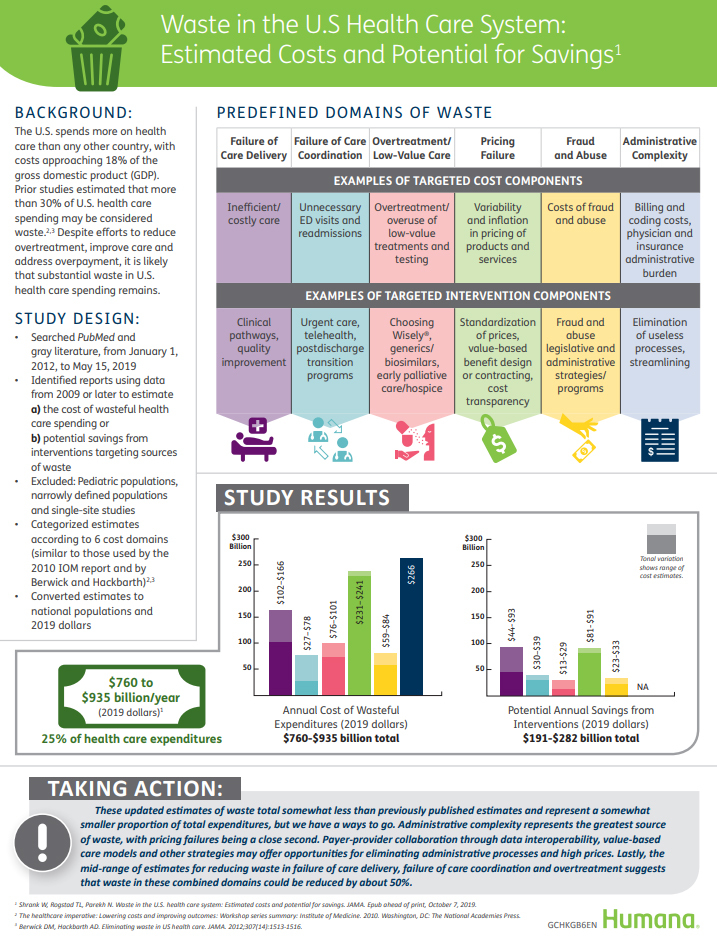
About 25 percent of U.S. healthcare spending can be classified as waste, according to a new study published in JAMA Oct. 7. 

For the study, researchers from Humana and the University of Pittsburgh School of Medicine analyzed 54 peer-reviewed studies, government reports and other medical literature to estimate the levels of waste in the U.S. healthcare system.

Researchers divided waste into six previously developed categories including: failure of care delivery; failure of care coordination; overtreatment or low-value care; pricing failure; fraud and waste; and administrative complexity. 

Administrative complexity accounted for the most waste with $265.6 billion annually, followed by pricing failure or inefficiencies, which accounted for up to $240.6 billion in waste per year.

Approximately $300 billion in waste accrued from failure of care delivery, failure of care coordination and overtreatment. The study estimated that about half of this waste could be avoided.

Overall, the researchers found that the cost of waste in the U.S. healthcare system ranges from $760 billion to $935 billion annually.

Of the $760 billion to $935 billion of waste, researchers estimated that using interventions found to reduce waste could cut between $191 billion and $282.1 billion in healthcare spending.

Access the full report here


Top 5 Differences Between NFPs and For-Profit Hospitals

https://www.healthleadersmedia.com/finance/top-5-differences-between-nfps-and-profit-hospitals

Image result for Non-Profit and For-Profit Hospitals

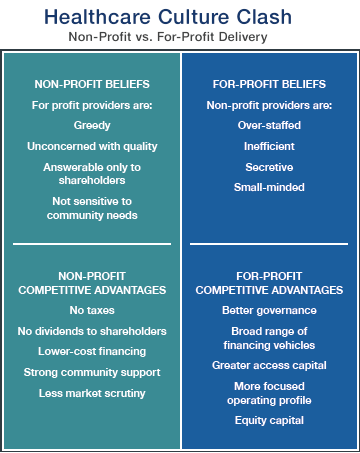
Although nonprofit and for-profit hospitals are fundamentally similar, there are significant cultural and operational differences, such as strategic approaches to scale and operational discipline.

All hospitals serve patients, employ physicians and nurses, and operate in tightly regulated frameworks for clinical services. For-profit hospitals add a unique element to the mix: generating return for investors.

This additional ingredient gives the organizational culture at for-profits a subtly but significantly different flavor than the atmosphere at their nonprofit counterparts, says Yvette Doran, chief operating officer at Saint Thomas Medical Partners in Nashville, TN.

“When I think of the differences, culture is at the top of my list. The culture at for-profits is business-driven. The culture at nonprofits is service-driven,” she says.

Doran says the differences between for-profits and nonprofits reflect cultural nuances rather than cultural divides. “Good hospitals need both. Without the business aspects on one hand, and the service aspects on the other, you can’t function well.”

There are five primary differences between for-profit and nonprofit hospitals.

1. Tax Status

The most obvious difference between nonprofit and for-profit hospitals is tax status, and it has a major impact financially on hospitals and the communities they serve.

Hospital payment of local and state taxes is a significant benefit for municipal and state governments, says Gary D. Willis, CPA, a former for-profit health system CFO who currently serves as CFO at Amedisys Inc., a home health, hospice, and personal care company in Baton Rouge, LA. The taxes that for-profit hospitals pay support “local schools, development of roads, recruitment of business and industry, and other needed services,” he says.

The financial burden of paying taxes influences corporate culture—emphasizing cost consciousness and operational discipline, says Andrew Slusser, senior vice president at Brentwood, TN-based RCCH Healthcare Partners.

“For-profit hospitals generally have to be more cost-efficient because of the financial hurdles they have to clear: sales taxes, property taxes, all the taxes nonprofits don’t have to worry about,” he says.

“One of the initiatives we’ve had success with—in both new and existing hospitals—is to conduct an Operations Assessment Team survey. It’s in essence a deep dive into all operational costs to see where efficiencies may have been missed before. We often discover we’re able to eliminate duplicative costs, stop doing work that’s no longer adding value, or in some cases actually do more with less,” Slusser says.

2. Operational Discipline

With positive financial performance among the primary goals of shareholders and the top executive leadership, operational discipline is one of the distinguishing characteristics of for-profit hospitals, says Neville Zar, senior vice president of revenue operations at Boston-based Steward Health Care System, a for-profit that includes 3,500 physicians and 18 hospital campuses in four states.

At Steward, we believe we’ve done a good job establishing operational discipline. It means accountability. It means predictability. It means responsibility. It’s like hygiene. You wake up, brush your teeth, and this is part of what you do every day.”

A revenue-cycle dashboard report is circulated at Steward every Monday morning at 7 a.m., including point-of-service cash collections, patient coverage eligibility for government programs such as Medicaid, and productivity metrics, he says. “There’s predictability with that.”

A high level of accountability fuels operational discipline at Steward and other for-profits, Zar says.

There is no ignoring the financial numbers at Steward, which installed wide-screen TVs in most business offices four years ago to post financial performance information in real-time. “There are updates every 15 minutes. You can’t hide in your cube,” he says. “There was a 15% to 20% improvement in efficiency after those TVs went up.”

3. Financial Pressure

Accountability for financial performance flows from the top of for-profit health systems and hospitals, says Dick Escue, senior vice president and chief information officer at the Hawaii Medical Service Association in Honolulu.

Escue worked for many years at a rehabilitation services organization that for-profit Kindred Healthcare of Louisville, Kentucky, acquired in 2011. “We were a publicly traded company. At a high level, quarterly, our CEO and CFO were going to New York to report to analysts. You never want to go there and disappoint. … You’re not going to keep your job as the CEO or CFO of a publicly traded company if you produce results that disappoint.”

Finance team members at for-profits must be willing to push themselves to meet performance goals, Zar says.

“Steward is a very driven organization. It’s not 9-to-5 hours. Everybody in healthcare works hard, but we work really hard. We’re driven by each quarter, by each month. People will work the weekend at the end of the month or the end of the quarter to put in the extra hours to make sure we meet our targets. There’s a lot of focus on the financial results, from the senior executives to the worker bees. We’re not ashamed of it.”

“Cash blitzes” are one method Steward’s revenue cycle team uses to boost revenue when financial performance slips, he says. Based on information gathered during team meetings at the hospital level, the revenue cycle staff focuses a cash blitz on efforts that have a high likelihood of generating cash collections, including tackling high-balance accounts and addressing payment delays linked to claims processing such as clinical documentation queries from payers.

For-profit hospitals routinely utilize monetary incentives in the compensation packages of the C-Suite leadership, says Brian B. Sanderson, managing principal of healthcare services at Oak Brook, IL–based Crowe Horwath LLP.

“The compensation structures in the for-profits tend to be much more incentive-based than compensation at not-for-profits,” he says. “Senior executive compensation is tied to similar elements as found in other for-profit environments, including stock price and margin on operations.”

In contrast to offering generous incentives that reward robust financial performance, for-profits do not hesitate to cut costs in lean times, Escue says.

“The rigor around spending, whether it’s capital spending, operating spending, or payroll, is more intense at for-profits. The things that got cut when I worked in the back office of a for-profit were overhead. There was constant pressure to reduce overhead,” he says. “Contractors and consultants are let go, at least temporarily. Hiring is frozen, with budgeted openings going unfilled. Any other budgeted, but not committed, spending is frozen.”

4. Scale

The for-profit hospital sector is highly concentrated.

There are 4,862 community hospitals in the country, according to the American Hospital Association. Nongovernmental not-for-profit hospitals account for the largest number of facilities at 2,845. There are 1,034 for-profit hospitals, and 983 state and local government hospitals.

In 2016, the country’s for-profit hospital trade association, the Washington, DC–based Federation of American Hospitals, represented a dozen health systems that owned about 635 hospitals. Four of the FAH health systems accounted for about 520 hospitals: Franklin, TN-based Community Hospital Systems (CHS); Nashville-based Hospital Corporation of America; Brentwood, TN–based LifePoint Health; and Dallas-based Tenet Healthcare Corporation.

Scale generates several operational benefits at for-profit hospitals.

“Scale is critically important,” says Julie Soekoro, CFO at Grandview Medical Center, a CHS-owned, 372-bed hospital in Birmingham, Alabama. “What we benefit from at Grandview is access to resources and expertise. I really don’t use consultants at Grandview because we have corporate expertise for challenges like ICD-10 coding. That is a tremendous benefit.”

Grandview also benefits from the best practices that have been shared and standardized across the 146 CHS hospitals. “Best practices can have a direct impact on value,” Soekoro says. “The infrastructure is there. For-profits are well-positioned for the consolidated healthcare market of the future… You can add a lot of individual hospitals without having to add expertise at the corporate office.”

The High Reliability and Safety program at CHS is an example of how standardizing best practices across the health system’s hospitals has generated significant performance gains, she says.

“A few years ago, CHS embarked on a journey to institute a culture of high reliability at the hospitals. The hospitals and affiliated organizations have worked to establish safety as a ‘core value.’ At Grandview, we have hard-wired a number of initiatives, including daily safety huddles and multiple evidence-based, best-practice error prevention methods.”

Scale also plays a crucial role in one of the most significant advantages of for-profit hospitals relative to their nonprofit counterparts: access to capital.

Ready access to capital gives for-profits the ability to move faster than their nonprofit counterparts, Sanderson says. “They’re finding that their access to capital is a linchpin for them. … When a for-profit has better access to capital, it can make decisions rapidly and make investments rapidly. Many not-for-profits don’t have that luxury.”

5. Competitive Edge

There are valuable lessons for nonprofits to draw from the for-profit business model as the healthcare industry shifts from volume to value.

When healthcare providers negotiate managed care contracts, for-profits have a bargaining advantage over nonprofits, Doran says. “In managed care contracts, for profits look for leverage and nonprofits look for partnership opportunities. The appetite for aggressive negotiations is much more palatable among for-profits.”


Health care is getting more and more expensive, and low-wage workers are bearing more of the cost

https://www.vox.com/policy-and-politics/2019/9/30/20891305/health-care-employer-sponsored-premiums-cost-voxcare

Is the rapidly rising cost of employer-sponsored health insurance sustainable?

Half of all Americans get their health insurance through work. Trouble is, doing so is becoming less and less affordable — especially for already low-wage workers.

In 2019, the Kaiser Family Foundation Employer Health Benefits Survey — an annual account of roughly 2,000 small and large businesses’ employer-sponsored insurance — found the average annual premium to cover a family through work was a whopping $20,576, and $7,188 for an individual. Employers cover most of that, but families still contributed an average of $6,015 in premiums, and single Americans covered about $1,242 of the annual cost.

The kicker? Over the past 10 years, the cost of the portion of employer-sponsored health insurance premiums that falls on American families has increased by 71 percent. Overall, premiums have gone up 54 percent since 2009. That’s faster than the rate of inflation and faster than the average wage growth.

Nearly half of all Americans get their health insurance through work, a system that covers roughly 153 million people. And for lower-wage workers it’s a system that is increasingly unaffordable.

Workers at companies with a significant number of low-wage employees (which the Kaiser Family survey quantifies as a company in which at least 35 percent of employees are making an annual salary of $25,000 or less) have lower premiums than those who work at companies with fewer low-wage workers, probably because their plans cover less. But at the same time, workers at firms with a significant number of low-wage employees are faced with high-deductible plans, and also pay a larger share of the premium cost than workers at companies with fewer lower-wage employees.

According to the survey, workers at lower-wage companies pay an average of $7,000 a year family plan — $1,000 more than employees at companies with higher salaried workers.

“When workers making $25,000 a year have to shell out $7,000 a year just for their share of family premiums,” Drew Altman, the president of Kaiser Family Foundation, said in a statement, that’s where cost becomes prohibitive. Such employees are putting almost 30 percent of their salaries toward premiums.

The takeaway is clear. Health care is getting more and more expensive, and families and employers are having to bear more of the cost, which research has shown not only has an effect on how much workers are actually getting paid, but how many workers are hired.

As Sarah Kliff reported for Vox, there are a lot of studies spanning decades that show how a rapid rise in health insurance premiums has unfavorable outcomes for workers. This is in large part because employers think of compensation in totality; they lump together an employee’s salary, as well as their benefits as one total cost. So if covering a worker’s health insurance gets more and more expensive, employers see less room to give the worker a raise.

For example, a 2006 study from Katherine Baicker and Amitabh Chandra, both with the National Bureau of Economic Research, found that an overall 10 percent increase in health insurance premiums reduced wages by 2.3 percent and actually reduced the probability of becoming employed by 1.2 percent.

Results such as these, and the high premiums low-wage workers must pay, led the Kaiser survey’s authors to explicitly question the tenability of employer-sponsored insurance: “the national debate about expanding Medicare or creating public program options provides an opportunity to step back and evaluate how well employer­-based coverage is doing in achieving national goals relating to costs and affordability,” the report reads.

The United States is unique in its reliance on employers to provide health insurance. And, as Democratic candidates for president continue to go in circles debating health care, employer-sponsored insurance is often the biggest sticking point.

Several candidates, like Sen. Bernie Sanders, who popularized a plan for Medicare-for-all, a single government-run program, and Sen. Elizabeth Warren, who supports Sanders’s plan, have called for getting rid of the employer-based system, and private insurance, all together.

But their critics always bring up the same talking point: that the people who like their health insurance plans through work, should be able to keep it. The Kaiser survey raises questions as to how affordable those plans really are, and, as Democrats debate ideas like Medicare-for-all, how sustainable the current trajectory is.