DOJ files False Claims Act case against dialysis giant Fresenius alleging unnecessary vascular procedures

Editor’s Note: This story has been updated with the DOJ’s statement regarding its civil fraud complaint. This story was originally filed June 3.

Updated: July 13, 3:30 p.m.

The federal government filed a civil complaint Tuesday in federal court in Brooklyn against the country’s largest dialysis provider alleging that the company performed unnecessary procedures on dialysis patients.

The Department of Justice has formally intervened and joined the False Claims Act whistleblower lawsuit filed against dialysis giant Fresenius Medical Care, according to court documents filed in U.S. District Court in Brooklyn.

The DOJ’s False Claims Act complaint alleges Fresenius Vascular Care, a business unit of Fresenius Medical Care performed these unnecessary procedures at nine centers across New York City, Long Island and Westchester, and billed the procedures to Medicare, Medicaid, the Federal Health Benefits Program and TRICARE. The complaint seeks damages and penalties under the False Claims Act.

The whistleblower complaint alleges that from about January 1, 2012 through June 30, 2018, Fresenius routinely performed certain procedures on patients with end stage renal disease (ESRD) who were receiving dialysis, without sufficient clinical indication that the patients needed the procedures. Fresenius knowingly subjected ESRD patients—who included elderly, disadvantaged minority, and low-income individuals—to these procedures to increase its revenues, the DOJ complaint states.

A Fresenius spokesperson said the company disputes the allegations contained in both the relators’ complaint and the U.S. government’s complaint and “intends to vigorously defend the litigation.”

“Our network of vascular centers is leading efforts to reduce total healthcare costs and improve patient outcomes by expanding access to innovative and less-invasive procedures. Our policies are intended to result in a high standard of care and compliance with government regulations,” the Fresenius spokesperson said in a statement.

Breon Peace, United States Attorney for the Eastern District of New York, called the company’s alleged conduct “egregious,” claiming that Fresenius “not only defrauded federal healthcare programs but also subjected particularly vulnerable people to medically unnecessary procedures.”

“This Office will hold medical providers accountable for practices that needlessly expose patients to harm for financial gain at taxpayer expense,” Peace said in a statement.


Two doctors allege in a lawsuit that the country’s largest dialysis provider performed potentially thousands of unnecessary, invasive vascular procedures on late-stage kidney disease patients and fraudulently charged Medicare and Medicaid for these procedures.  

The lawsuit, originally filed in 2014 in New York, claims Fresenius Medical Care and its business unit, Azura Vascular Care, violated the federal False Claims Act. The case remained under seal until the court lifted the seal May 9. The federal government has 60 days to file its complaint.

Nineteen states also are included in the lawsuit and potentially could join the case.

The U.S. attorney in the Eastern District of New York will be taking over with respect to federal False Claims Act fraud claims against Fresenius, according to law firm Cohen Milstein Sellers & Toll, which is representing the plaintiffs in the case.

The U.S. attorney’s office declined to comment at the time.

The plaintiffs, two practicing nephrologists, charge in the complaint that Fresenius performed thousands of end-stage renal disease-related treatments that were “not medically reasonable and necessary” and that “exposed patients to undue and unnecessary risks.”

In a statement provided by a spokesperson, Fresenius declined to comment on the lawsuit.

Fresenius Medical Care North America is the largest dialysis provider in the U.S., operating over 2,600 dialysis units nationwide and treating over 205,000 patients annually. Its business unit, Azura Vascular Care, operates more than 90 vascular care facilities across the country.


Former hospital executive convicted in $1.4B billing scheme

The former leader of a rural hospital chain has been convicted for his role in an elaborate pass-through billing scheme, the Justice Department announced June 27. 

After a 24-day trial, Jorge Perez, 62, of Miami, was convicted of conspiracy to commit healthcare fraud and wire fraud, healthcare fraud and conspiracy to commit money laundering of proceeds greater than $10,000.

Prosecutors said Mr. Perez conspired with others to bill for $1.4 billion of medically unnecessary laboratory testing services. He used rural hospitals as billing shells to submit claims for services that were mostly performed at outside laboratories. 

The evidence presented at trial showed that Mr. Perez and other defendants targeted and obtained control of financially distressed rural hospitals through management agreements and purchases. They targeted rural hospitals because they often get higher reimbursement rates for laboratory testing from private insurers, according to the Justice Department. 

The defendants promised to save the rural hospitals from closure by turning them into laboratory testing sites, but instead billed for fraudulent laboratory testing. Through the scheme, Mr. Perez and others made it appear the laboratory testing was performed at the rural hospitals when, in most cases, it was done by outside testing laboratories owned by defendants, prosecutors said. 

“After private insurance companies began to question the defendants’ billings, they would move on to another rural hospital, leaving the rural hospitals they took over in the same or worse financial status as before,” the Justice Department said. At least three of the hospitals were forced to close. 

Ricardo Perez, 59, of Miami, was also convicted of conspiracy to commit healthcare fraud and wire fraud, healthcare fraud and conspiracy to commit money laundering of proceeds greater than $10,000 on June 27. He is Jorge Perez’s brother, according to Kaiser Health News

Ex-healthcare CFO sentenced for role in fraud scheme

The former CFO of Pacific Hospital’s physician management arm was sentenced to 15 months in prison June 24 for a tax offense related to a kickback scheme, according to the Justice Department

The sentencing came about four years after George Hammer was charged. In 2018, he pleaded guilty to one count of filing a false tax return. 

Mr. Hammer allegedly supported a kickback scheme that resulted in the submission of more than $500 million in bills for kickbacks for surgeries. He allegedly supported the kickback scheme by facilitating payments to people receiving kickbacks and bribes pursuant to sham contracts that were used to conceal illicit payments, according to the Justice Department. 

The Department of Justice notes that Mr. Hammer was a salaried employee and did not profit directly from the kickbacks and bribes. 

Twenty-two defendants, including the owner of Pacific Hospital in Long Beach, Calif., have been convicted for participating in the scheme.

Hospitals urge Justice Department to probe insurers over routine denials

The American Hospital Association, on behalf of its nearly 5,000 healthcare organizations, is urging the Justice Department to probe routine denials from commercial health insurance companies. 

Specifically, the AHA is asking the Justice Department to establish a task force to conduct False Claims Act investigations into the insurers that routinely deny payments to providers, according to a May 19 letter to the department. 

The request from the AHA comes after HHS’ Office of Inspector General released a report April 27 that found Medicare Advantage Organizations sometimes delayed or denied enrollees’ access to services although the provider’s prior authorization request met Medicare coverage rules. 

“It is time for the Department of Justice to exercise its False Claims Act authority to both punish those MAOs that have denied Medicare beneficiaries and their providers their rightful coverage and to deter future misdeeds,” the AHA said in a letter to the Justice Department. “This problem has grown so large — and has lasted for so long — that only the prospect of civil and criminal penalties can adequately prevent the widespread fraud certain MAOs are perpetrating against sick and elderly patients across the country.”

Read the full letter here.

Fired Mercyhealth exec sentenced for wire fraud, tax evasion

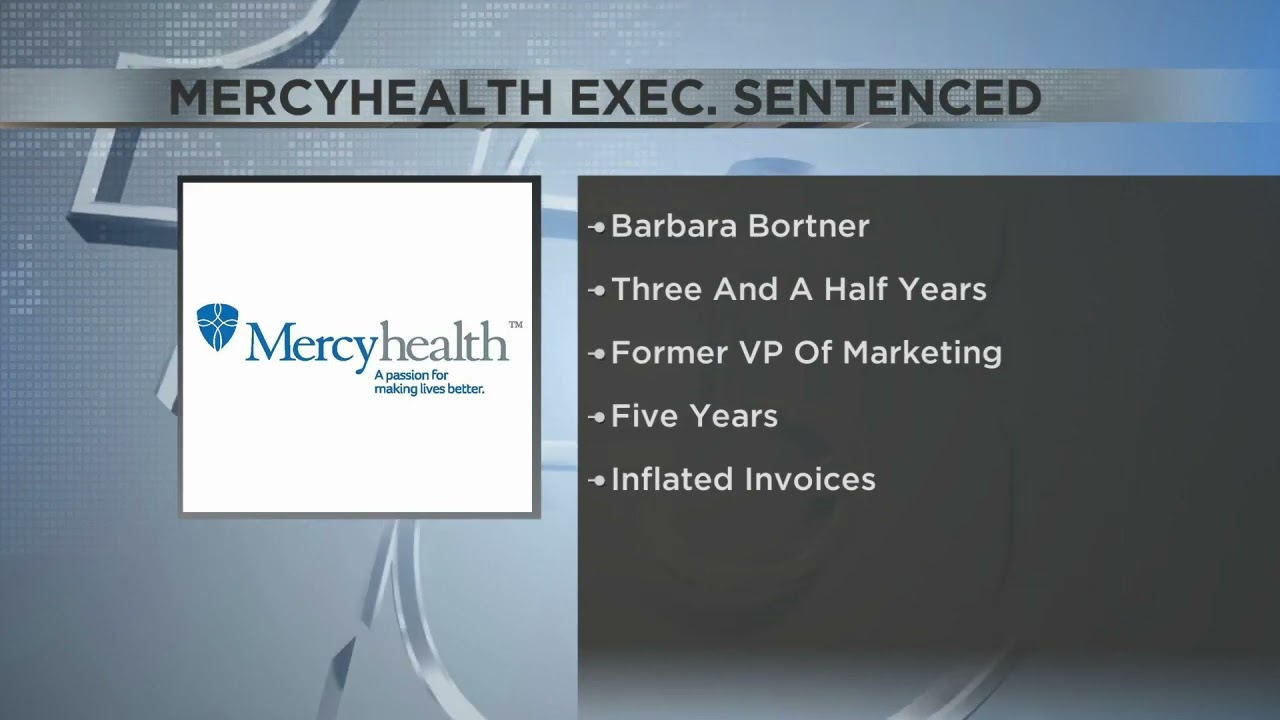
A former vice president of Janesville, Wis.-based Mercyhealth was sentenced to 3 ½ years in prison May 4 for wire fraud and tax evasion in relation to a $3.1 million kickback scheme, according to the U.S Justice Department.

Barbara Bortner, 57, Mercyhealth’s former vice president of marketing and public relations, pleaded guilty to the scheme in October 2021. 

Ms. Bortner was charged in September 2021. She admitted getting kickbacks from Ryan Weckerly, owner of a marketing agency hired by the health system, from 2015 to 2020.

Prosecutors said Ms. Bortner and Mr. Weckerly created a scheme in which Mr. Weckerly’s marketing agency, Morningstar Media Group, inflated invoices sent to Ms. Bortner for marketing work he did for Mercyhealth. In exchange, Ms. Bortner receive kickbacks from the funds received.

Prosecutors also said Ms. Bortner agreed to maintain Morningstar Media as its primary marketing group in exchange for the kickbacks.

Mr. Weckerly pleaded guilty in November 2021 and will be sentenced May 17.

Mercyhealth fired Ms. Bortner in August 2021, weeks before the charges were filed against her. Mercyhealth said the fraud didn’t affect patient care.

Feds poised to fight to preserve mask mandate for travel

The Department of Justice (DOJ) is appealing a Florida judge’s Monday decision to strike down the mask requirement for public transportation. Federal judge Kathryn Mizelle ruled the Centers for Disease Control and Prevention (CDC) exceeded its authority under the Public Health Service Act of 1944. Meanwhile, giddy passengers and flight crew have been discarding their face coverings as airlines, the Transportation Safety Administration, several local transit authorities, Uber and Lyft, all removed their mask requirements.  

The Gist: Despite DOJ’s appeal, which appears to be aimed at preserving its own authority to act during health crises, rather than reinstating the current mask requirement (which was set to expire in two weeks anyway), the tone of the Biden administration is clearly shifting. Earlier this week President Biden told reporters that the decision to wear a mask is “up to them,” meaning individual Americans. 

In the bumpy transition out of the emergency phase of the pandemic, we now have a patchwork of rules for masking. This is even true within healthcare facilities: some, including Houston Methodist and Iowa-based UnityPoint Health, are no longer requiring masks for visitors or employees who are not involved in patient care. 

With COVID cases now rising in 41 states as mask mandates fall, the next month will prove critical in determining whether “endemic” COVID remains manageable, or once again stresses the healthcare system and other critical infrastructure.  

Justice Department adds CEO to $120M Medicare fraud case

The Justice Department has intervened in a whistleblower lawsuit accusing former executives of San Antonio-based Merida Health Care Group of violating the False Claims Act, according to Law360

The Justice Department is intervening in the action, which dates back to 2015, alleging the former executives submitted more than $120 million in false claims to Medicare for medically unnecessary home health services and hospice care. The Justice Department is also adding Merida Health Group’s former CEO Henry McInnis to the complaint, according to the report. 

The Justice Department alleges Mr. McInnis and Rodney Mesquias, the former owner of Merida Health Care Group, violated the False Claims Act, and the government is also seeking damages under the common law and equitable theories of fraud and payment by mistake, according to court documents filed April 7 in the U.S. District Court for the Southern District of Texas. 

Mr. McInnis was sentenced to 15 years in prison in February 2021 for his role in a healthcare fraud and money laundering scheme. Mr. Mesquias was sentenced to 20 years in prison in late 2020. 

Private equity-backed buyouts have physicians concerned

The Federal Trade Commission and the Justice Department are seeking comments on ways merger guidelines should be updated, and physicians are raising concerns about private equity-backed buyouts of provider practices. 

The FTC and the Justice Department announced in January that they’re seeking to revamp merger guidelines for businesses. Comments on how to “modernize the merger guidelines to better detect and prevent anticompetitive deals,” can be submitted to the agencies through April 21. 

Comments are pouring in from physicians. Many of the comments are anonymous, but the commenters self-identify as physicians. 

The physicians’ top concern are private equity-backed buyouts, according to an analysis by Law360. They’re also concerned by the profit-first attitude of healthcare and consolidation in the industry, according to the report. 

The commenters raised many concerns with private equity groups, saying theyput profits over patients” and “stifle the voices of physicians.”

The comments are coming in as private equity firms continue to buy up physician practices. 

Private equity firms acquired 59 physician practices in 2013, and that number increased to 136 practices by 2016, according to a research letter published in JAMA

10 physicians, healthcare CEO to pay $1.68M to settle kickback claims

Ten Texas physicians and a healthcare executive who operates a group of medical practices in Florida agreed to pay a total of $1.68 million to settle kickback allegations, according to a March 22 Justice Department news release.

According to prosecutors, the Texas physicians received thousands of dollars in pay from eight different management service organizations in exchange for ordering laboratory tests from Little River Healthcare, True Health Diagnostics and/or Boston Heart Diagnostics Corp. 

Here are the physicians who reached monetary settlements: 

  • Tamar Brionez, MD, agreed to pay $85,006
  • Gary Goff, MD, and his affiliated practices agreed to pay $454,088
  • John Hierholzer, MD, agreed to pay $24,850
  • Bruce Maniet, DO, agreed to pay $175,43
  • Huy Chi Nguyen, MD, agreed to pay $211,821
  • Dung Chi Nguyen, MD, agreed to pay $211,721
  • Rakesh Patel, DO, agreed to pay $174,539
  • Cuong Trinh, MD, agreed to pay $45,056
  • Randall Walker, MD, agreed to pay $60,898
  • Michael Whiteley, DO, agreed to pay $52,015 

As part of the settlements, the 10 physicians agreed to cooperate in the investigations against other parties involved in the alleged scheme.  

In addition to the physicians, Brett Markowitz, the founder and CEO of Florida Rejuvenation Holdings, which operates medical practices in Tampa, paid $185,000 to resolve allegations of accepting kickbacks from True Health. Prosecutors said True Health paid for each patient that physicians at the medical practices referred for clinical laboratory services. 

What is an insurance company in 2022?

https://mailchi.mp/7788648545f0/the-weekly-gist-february-25-2022?e=d1e747d2d8

The largest health insurers are quickly becoming vertically integrated healthcare organizations that span the care and coverage continuum. While 2021 was a mixed year for these companies as healthcare volumes bounced back, their diversified portfolios helped cushion losses from higher claims.

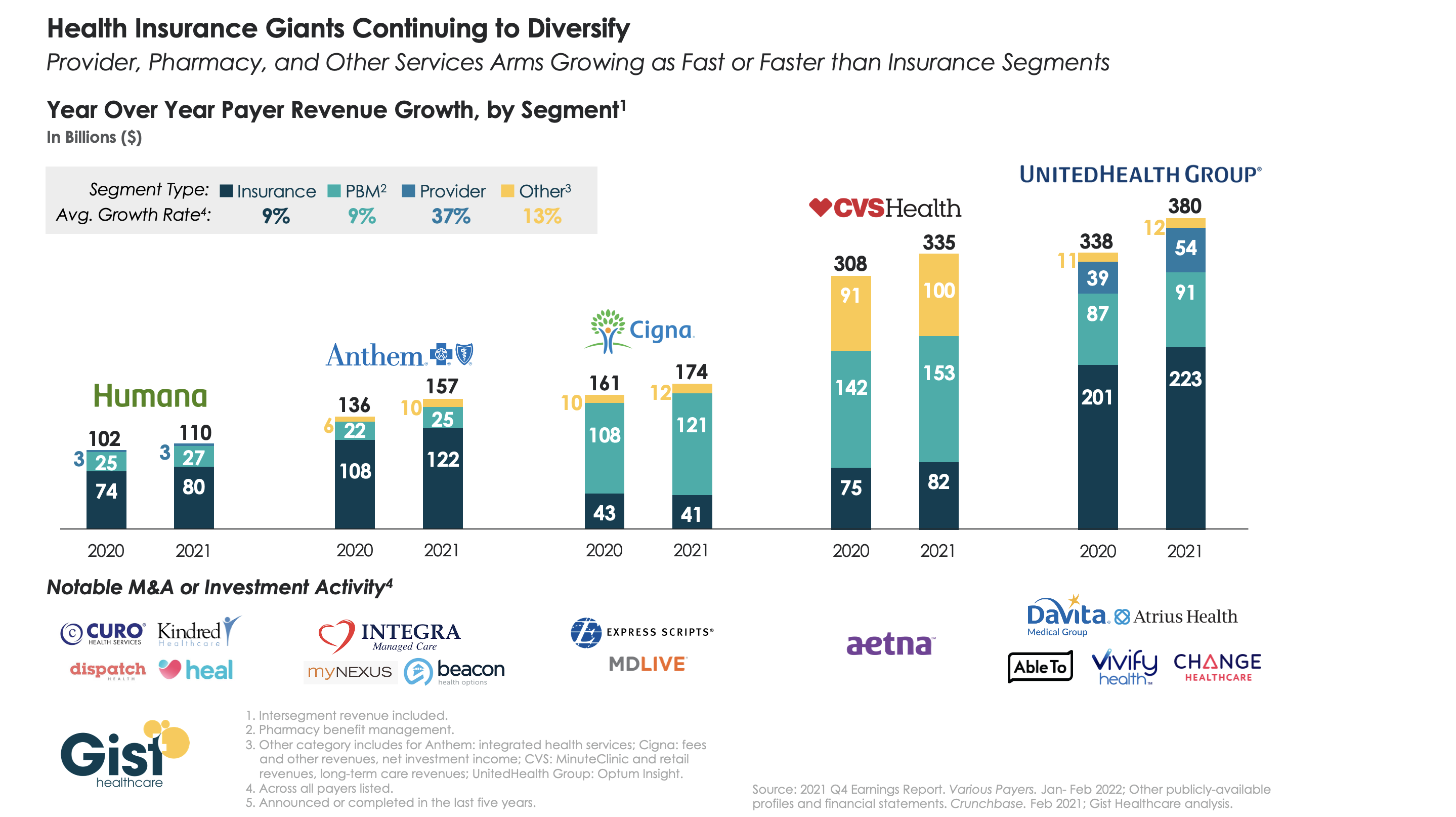
The graphic above analyzes revenue growth by segment for the five largest insurers across the last two years. On average the insurance and pharmacy benefit management components of the companies grew at nine percent, while care delivery and integrated health services grew at much higher rates. UnitedHealth Group (UHG) and Anthem boasted the highest year-over-year revenue growth, driven by UHG’s Optum subsidiary and Anthem’s integrated health services.

Cigna and CVS Health each earned less than a quarter of their total revenue from their insurance arms last year. While Humana lags the others in topline revenue, it has assembled a robust portfolio of care delivery investments and partnerships, surpassed only by UHG. 

As antitrust scrutiny on vertical integration increases (case in point: the DOJ is now challenging UHG’s acquisition of Change Healthcare), insurers will face the hard task of integrating their portfolio of service—and demonstrating that they deliver value to consumers and patients.