Europe’s lessons on reopening schools

https://www.axios.com/europe-lessons-reopening-schools-b713801e-26d6-4ba1-bb9e-c0b0b5809a11.html

Europe's lessons for the U.S. on reopening schools - Axios

American parents and policymakers hoping for a safe return to schools in the fall have been looking to Europe, where several countries reopened as early as April without a subsequent spike in cases.

Why it matters: There’s a growing body of evidence suggesting that schools can operate safely, at least under certain circumstances. But no country that closed schools has attempted to reopen them with outbreaks still raging as they are across much of America.

  • The first countries to bring students back, as Denmark did in April, didn’t detect much spread in schools — but the virus was also under control in the broader communities.
  • Harder-hit countries, like France or Belgium, contained the spread through lockdowns before bringing students back — something the U.S. has largely failed to do.
  • America’s unenviable position as a global epicenter complicates matters, but the challenge is similar: adapting schools to our pandemic reality.

Social distancing: Danish class sizes were initially limited to around 12, and arrival times were staggered to avoid crowding.

  • As they plan for the fall, though, countries like Belgium are dropping distancing mandates for younger students, while France is trimming its spacing requirements from 4 meters (about 12 feet) to 1 (3 feet), per the Washington Post.
  • That’s due to space limitations and the difficulties of keeping children apart, as well as indications that young students are unlikely to spread the virus to one another.

Masks: Similarly, countries including Austria initially required masks but loosened those restrictions over time.

  • Masks are optional for both students and teachers in Denmark, Norway, the U.K. and Sweden, per Science. Some German schools force students to wear them in the hallway, but not in class.
  • Masks are required for both students and teachers in several Asian countries, including China. Some experts argue that mask requirements would make reopening safer, particularly for teachers and older students.

“Bubbles”: When the U.K. fully reopens schools in September, smaller subsets of students will spend classes, lunch and recess together — an approach several other countries have experimented with.

  • If a student gets the virus, the logic goes, there are only so many people they could give it to, or who would need to self-isolate.
  • Italy is asking schools to open on Saturdays to allow for lower daily attendance, and schools are encouraged to hold classes outdoors or in larger venues like cinemas, per The Local. Funding has been allocated to update schools and hire more teachers.

Hybrid learning: Several countries have resumed in-person schooling on a more limited basis, supplemented by online education. School districts across the U.S. are designing such approaches now.

  • Belgian students over 12 will attend school four days a week in the fall, with an additional half-day online. If cases increase, so will the proportion of online education.

What to watch: It remains unclear how susceptible children are to the virus, though findings from a hard-hit town in France — which are consistent with other evidence — suggest it spreads significantly less easily among teens than adults, and hardly at all among young children.

The bottom line: The risks to schools remain uncertain, but will almost certainly depend on what’s happening outside their walls.



U.S. Coronavirus Response: We blew it

https://www.axios.com/coronavirus-america-blew-it-b3d84ea3-78b3-4fe0-8dce-1c4ed0ec0a4c.html

We blew it: Why America still hasn't gotten the coronavirus under ...

America spent the spring building a bridge to August, spending trillions and shutting down major parts of society. The expanse was to be a bent coronavirus curve, and the other side some semblance of normal, where kids would go to school and their parents to work.

The bottom line: We blew it, building a pier instead.

There will be books written about America’s lost five months of 2020, but here’s what we know:

We blew testing. President Trump regularly brags and complains about the number of COVID-19 tests conducted in the U.S., but America hasn’t built the infrastructure necessary to process and trace the results.

  • Quest Diagnostics says its average turnaround time for a COVID-19 test has lengthened to “seven or more days” — thus decreasing the chance that asymptomatic or mildly symptomatic carriers will self-quarantine.
  • The testing delays also make it harder for public health officials to understand current conditions, let alone implement effective contact tracing.
  • Speaking of contact tracing, it remains a haphazard and uncoordinated process in many parts of the country.

We blew schools. Congress allocated $150 billion for state and local governments as part of the CARES Act, but that was aimed at maintaining status quo services in the face of plummeting tax revenue.

There was no money earmarked for schools to buy new safety equipment, nor to hire additional teachers who might be needed to staff smaller class sizes and hybrid learning days.

  • U.S. Education Secretary Betsy DeVos was not among the 27 officials included in the White House Coronavirus Task Force.
  • The administration insists that schools should reopen this fall because kids are less likely to get very sick from the virus, but it has not yet offered detailed plans to protect older teachers, at-risk family members, or students with pre-existing respiratory or immune conditions.
  • Silicon Valley provided some free services to schools, but there was no coordinated effort to create a streamlined virtual learning platform. There also continue to be millions of schoolkids without access to broadband and/or Internet-connected devices.

We blew economics. The CARES Act was bold and bipartisan, a massive stimulus to meet the moment.

  • It’s running out, without an extension plan not yet in place.
  • Expanded unemployment benefits expire in days. Many small businesses have already exhausted their Paycheck Protection Program loans, including some that reopened but have been forced to close again.
  • There has been no national effort to pause residential or commercial evictions, nor to give landlords breathing room on their mortgage payments.

We blew public health. There’s obviously a lot here, but just stick with face masks. Had we all been directed to wear them in March — and done so, even makeshift ones while manufacturing ramped up — you might not be reading this post.

We blew goodwill. Millions of Americans sheltered in place, pausing their social lives for the common good.

  • But many millions of other Americans didn’t. Some were essential workers. Some were deemed essential workers but really weren’t. Some just didn’t care, or didn’t believe the threat. Some ultimately decided that protesting centuries of racial injustice was a worthy trade-off.
  • All of this was complicated by mixed messages from federal and state leaders. Top of that list was President Trump, who claimed to adopt a wartime footing without clearly asking Americans to make sacrifices necessary to defeat the enemy.
  • Five months later, many of those who followed the “rules” are furious at what they perceive to be the selfishness of others.

The bottom line: America has gotten many things right since March, including the development of more effective hospital treatments for COVID-19 patients.

  • But we’re hitting daily infection records, daily deaths hover around 900, and many ICUs reports more patients than beds. It didn’t have to be this way.


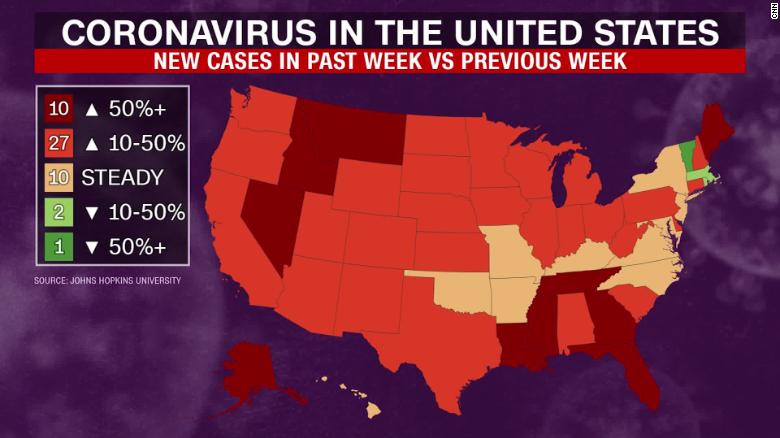
Tracking Our COVID-19 Response. Each state’s progress towards a new normal.

https://www.covidexitstrategy.org/

July 10 – Updated Color Scale
As a country we’ve reached a record number of cases. We’ve added a new color to the scale: “Bruised Red”. There were extremes that were not captured in our original scale. Our scale also has been adjusted to put more weight on “new cases per million” and “positivity”.
July 15 – ICU and Bed Occupancy – Not Publicly Reported by CDC Anymore
Unfortunately our data source for ICUs and beds has been removed by the CDC. Our hope is this loss of critical public health information is temporary. HHS is instituting a new process for collecting information from hospitals. The aggregate data from that system should be made public.


Coronavirus updates: U.S. infections top 76,000 in a day as virus’s spread continues unabated

https://www.washingtonpost.com/nation/2020/07/18/coronavirus-updates-us-infections-top-76000-day-virus-spread-continues-unabated/?utm_campaign=wp_main&utm_medium=social&utm_source=facebook&fbclid=IwAR3cnVHnhbmPw7a_og-oZc1Ocgfs-A_y4Qr6Ht8OKDkxpiWv7E7ydb67EqA

Coronavirus in the U.S.: Latest Map and Case Count - The New York ...

The United States on Friday set another record for daily coronavirus infections, with states reporting a combined 76,403 new confirmed cases — more than double the amount the country was reporting daily during the initial surge of cases in the spring.

Coronavirus-related deaths are rising, too, after declining nationally throughout May and June. The country reported 963 fatalities from the virus Friday, the most in a single day since June 3.

Here are some other significant developments:

  • A federal appeals court blocked a lower-court ruling that would have allowed the Republican Party of Texas to proceed with its planned in-person convention in downtown Houston. Mayor Sylvester Turner (D) said the event poses too great a health risk with infections in the area spiraling out of control. “In the middle of a pandemic, the doors remain locked,” Sylvester said of the appeals court’s decision.
  • The nine largest brick-and-mortar retail companies — including Walmart, Lowe’s and CVS — have adopted new policies requiring customers to wear masks inside U.S. stores.
  • President Trump affirmed in a Fox News interview he does not favor requiring face coverings nationwide. “I want people to have a certain freedom,” Trump told Chris Wallace in an interview set to air in full on Sunday.
  • California Gov. Gavin Newsom (D) on Friday announced new guidelines that will bar schools in 32 hotspot counties from reopening in the fall unless they meet strict standards for preventing the spread of the coronavirus. Iowa Gov. Kim Reynolds (R) said Friday the state’s schools must resume in-person instruction.

Infections and deaths are rising in states around the country, led by Texas, California, Florida, Georgia and Arizona. Texas on Friday reported a record 14,916 new cases and 174 new deaths related to the virus. Other states, including Ohio, Utah and the Carolinas, have reported single-day records in the past week.

The sharp increases have prompted many states to adopt new public health measures to prevent the virus spread. California ordered most of its schools to conduct remote instruction in the new academic year unless counties can meet strict benchmarks for reducing community transmission. More than half of all U.S. states have instituted some form of statewide mask requirements, including Alabama and Arkansas, where governors previously balked at mask mandates.


The Unchecked Rise in Cases Turns Deadly: This Week in COVID-19 Data, July 16

https://covidtracking.com/blog/weekly-update-unchecked-new-cases-turn-deadly

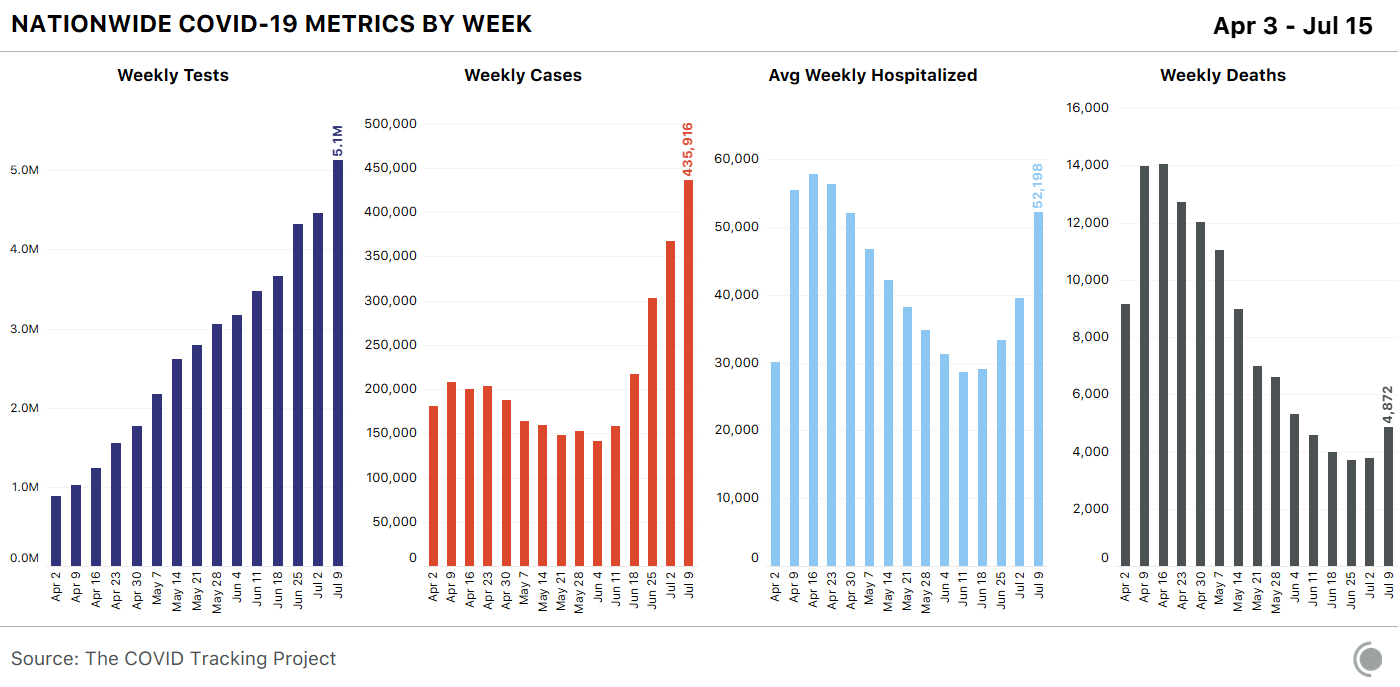
COVID-19 metrics by week, Apr 3 - Jul 15


The US is approaching half a million new cases of COVID-19 each week. States with major outbreaks including Arizona, California, Florida, and Texas all saw record high weekly hospitalizations and deaths. Meanwhile, worsening outbreaks in many other states threaten to increase the pandemic’s death toll in the coming weeks.

This week, about 435,000 Americans were diagnosed with COVID-19. This is our fourth week of big increases in the number of new cases, and the results of this case surge are becoming clear. As of July 15, more than 56,000 people are currently in the hospital with COVID-19 in the United States. This week, states reported that 4,872 more people have died of COVID-19, an increase of nearly 29 percent from the previous week.


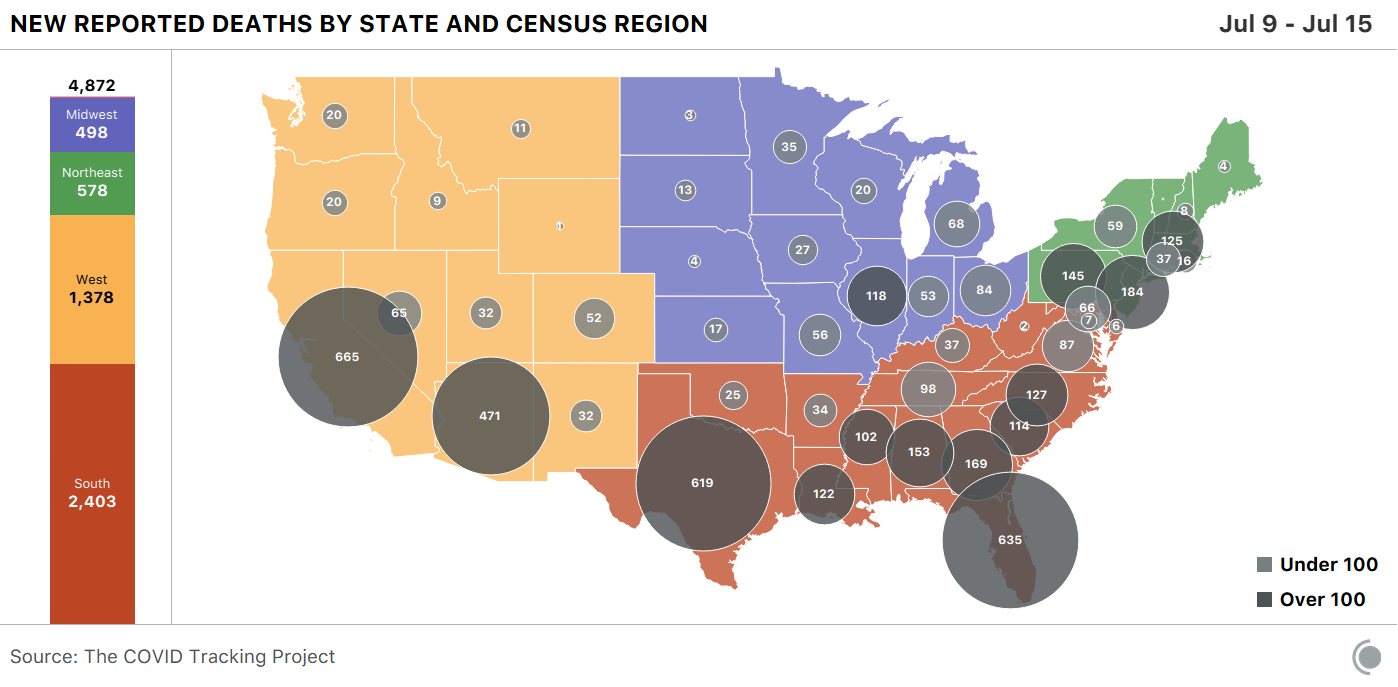
There are no surprises in these new death numbers: people are dying of COVID-19 in the same places where cases have been surging and COVID-19 hospital admissions have spiked. Fourteen states reported more than 100 COVID-19 deaths in the last week, and eight of those states were in the South, the region so far hit hardest in the second surge of cases. Slightly fewer than half the deaths were reported by the four states with the biggest outbreaks—ArizonaCaliforniaFlorida, and Texas—and most of the rest were distributed down the Eastern Seaboard and across the South.

New reported deaths by state and census region, Jul 9- Jul 15


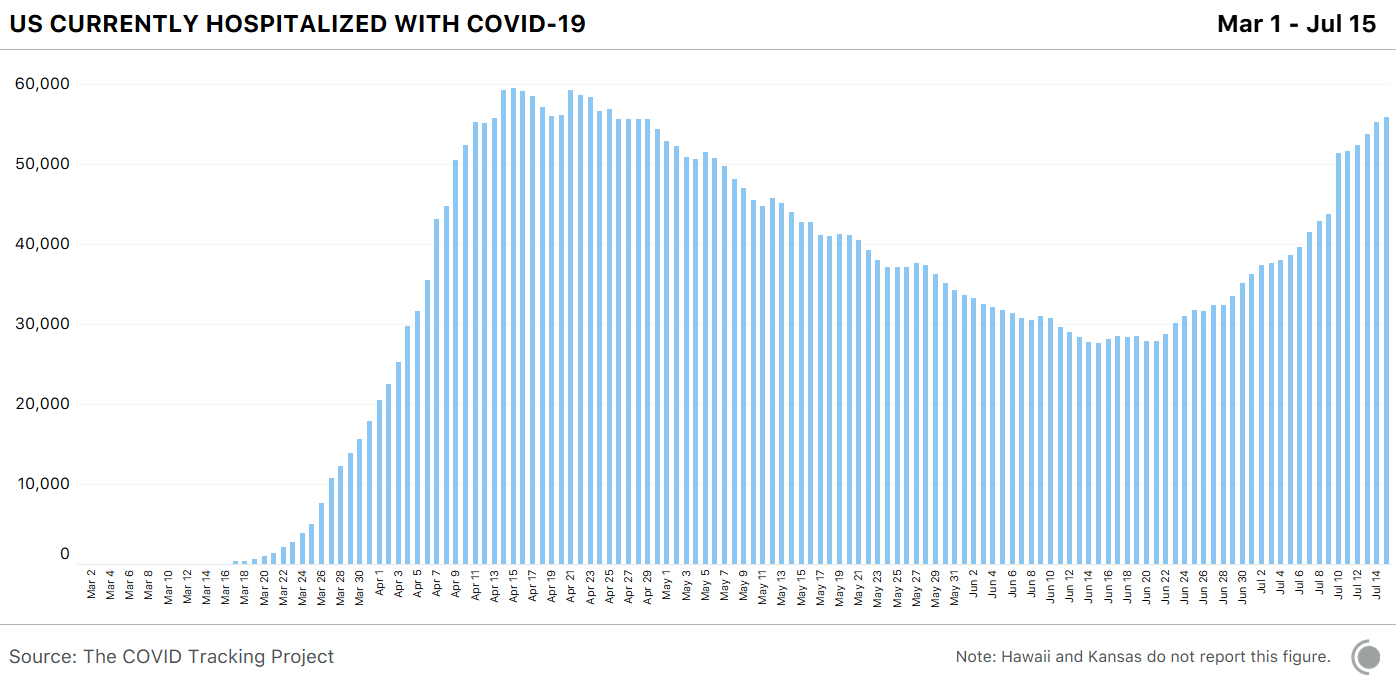
Our national view of how many people are currently hospitalized with COVID-19 is clearer now that Florida has finally released current hospitalization data. With hospitalizations from Florida’s outbreak accounted for, the national hospitalization figures are approaching their previous peak levels from April of this year.

Currently Hospitalized, March 1 - Jul 15

Hospital data has been in the news for other reasons as well. The US Department of Health and Human Services has directed hospitals to report COVID-19 data directly to HHSrather than to the Centers for Disease Control and Prevention. At The COVID Tracking Project, we compile all our data from official state and territorial sources—not from any federal agency. Nevertheless, we have already seen state-level hospital data go dark in at least one state, Idaho, as a result of the new HHS directive. We hope and expect that hospital reporting through many states will continue uninterrupted, and we’ll be reporting what we learn about states’ experience with the new directive.

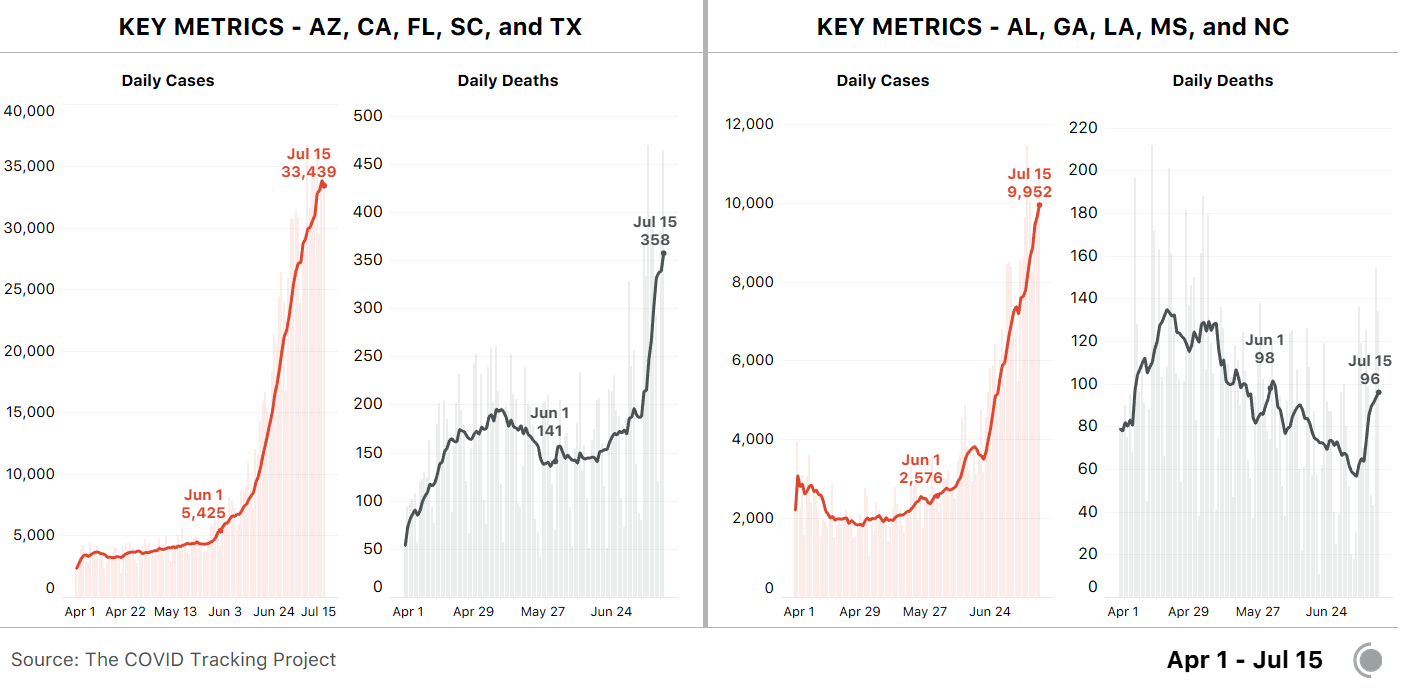
Outside of the five states with the biggest outbreaks, several other states posted alarming data this week. In several states across the South, case growth is smaller in absolute terms, but the trends we see this week mirror those we saw in Arizona and Florida a few weeks ago. We hope not to see those trends continue and result in the huge case spikes—and subsequent large increases in hospitalizations and deaths—that we saw in the states worst hit in the pandemic’s second surge.

Key metrics comparison - top 5 states


Public health interventions in these states have varied widely this week. In AlabamaLouisiana, and Mississippi, new mask orders and other restrictions have gone into effect. North Carolina has been under a mask order since June 25, and has reported a less explosive rise in new case growth than the other four states we’re watching in this group of southern states. In Georgia, the governor has explicitly voided local mask orders in Georgia cities and counties.

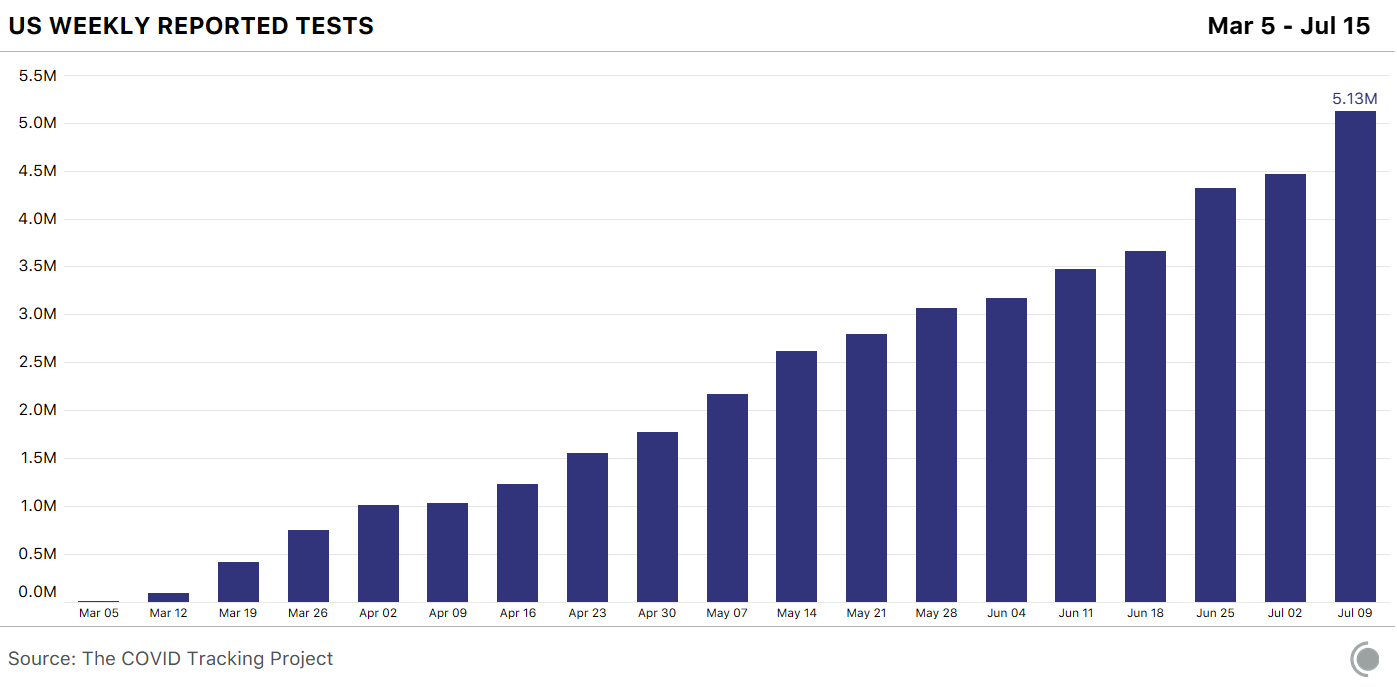
This week, US states and territories reported more than five million COVID-19 tests in a single week—a major achievement amid continuing testing shortages in many areas. For context, the Harvard Global Health Institute estimates that the United States will need to perform at least 8.4 million tests per week to slow the spread of the virus, and 30 million tests per week to suppress the pandemic.

Weekly reported tests, May 5 - Jul 15


You can learn all about our data compilation process, including an overview of our collection and publication process, our data sourcing policy, and exact definitions of the data points we track here on our website and in our API. To keep up to date on our work, follow us on Twitter and join our low-frequency email list.


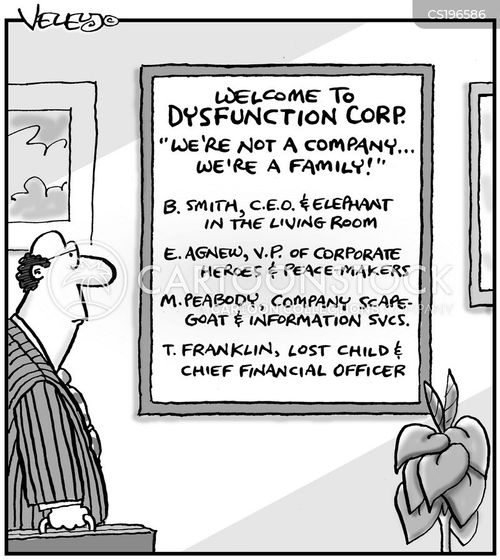
Cartoon – Welcome to Dysfunctional Corp.

Cartoon – Welcome to Dysfunction Corp | HENRY KOTULA

Florida And Texas Both Set Coronavirus Death Records Thursday

https://www.forbes.com/sites/nicholasreimann/2020/07/16/florida-and-texas-both-set-coronavirus-death-records-thursday/?utm_source=newsletter&utm_medium=email&utm_campaign=dailydozen&cdlcid=5d2c97df953109375e4d8b68#226e63bb720a

Florida coronavirus: State marks Covid-19 case record as July ...

TOPLINE

Coronavirus deaths are again on the rise in the U.S., with all three of the nation’s largest states setting new highs for daily death tolls Thursday following weeks of record increases in new cases and hospitalizations, even as President Donald Trump and other conservatives have touted death statistics as a sign the U.S. is handling the pandemic well.

KEY FACTS

California, Texas and Florida all reported new record daily highs for deaths Thursday.

California reported 149 deaths, while Florida reported 120 and Texas set a new record for the third-straight day, with 105.

Deaths are rising rapidly in Texas, with the 105 deaths breaking Wednesday’s record of 98, which shattered the record of 60 that was set on Tuesday.

Coronavirus deaths in the U.S. declined from early May through mid-June, but have picked up recently, and are now pacing at just under 1,000 per day.

The rise is being driven by record new death tolls in the nation’s largest states—the same states that have in large part contributed to the U.S.’s record rise in new cases recently.

Experts have said that deaths lag behind increases in cases and hospitalizations, with former FDA Commissioner Scott Gottlieb saying in an interview Sunday that “the total number of deaths is going to start going up again.”

KEY BACKGROUND

Coronavirus deaths reached a peak nationally in April through early May with over 2,000 a day on many days, largely driven by the severe outbreak in New York. Now the pandemic has eased in the Northeast while states in the South and West are the new national epicenters for coronavirus.

CHIEF CRITICS

Trump and Republican politicians had used the decline in deaths and a decrease in mortality rates to argue that the U.S. response to coronavirus has worked. However, there has also been a massive increase in testing, meaning that many less severe cases are now being identified.

BIG NUMBER

4.3%. According to Johns Hopkins University, that’s what the current mortality rate is among confirmed coronavirus cases in the U.S., a number that’s continually dropped as testing has increased. However, health experts like Dr. Anthony Fauci said early on in the pandemic that they believe the actual mortality rate is around 1%, which is still at least 10 times the lethality of the seasonal flu. And Gottlieb noted that even if the reported death rate continues to drop, if there is an increase in infections, the amount of deaths will ultimately rise, as well.

CRITICAL QUOTE

“It’s a false narrative to take comfort in a lower rate of death,” Fauci said on Tuesday, adding “There’s so many other things that are very dangerous and bad about this virus, don’t get yourself into false complacency.”


Nearly one-third of children tested for COVID in Florida are positive.

https://www.sun-sentinel.com/coronavirus/fl-ne-pbc-health-director-covid-children-20200714-xcdall2tsrd4riim2nwokvmsxm-story.html

Nearly One-Third Of Children Tested For COVID In Florida Are ...

Palm Beach County’s health director warns of risk of long-term damage.

Nearly one-in-three children tested for the new coronavirus in Florida has been positive, and a South Florida health official is concerned the disease could cause lifelong damage even for children with mild illness.

Dr. Alina Alonso, Palm Beach County’s health department director, warned county commissioners Tuesday that much is unknown about the long-term health consequences for children who catch COVID-19.

X-rays have revealed the virus can cause lung damage even in people without severe symptoms, she said.

“They are seeing there is damage to the lungs in these asymptomatic children. … We don’t know how that is going to manifest a year from now or two years from now,” Alonso said. “Is that child going to have chronic pulmonary problems or not?”

Her comments stand in contrast to Gov. Ron DeSantis’ messaging that children are at low risk, and classrooms need to be reopened in the fall. DeSantis has said he would be comfortable sending his children to school if they were old enough to attend.

Some studies suggest that children are less likely to catch COVID-19 than adults. Children are also far less likely to die of the disease. About 17,000 of Florida’s roughly 287,800 cases have been people younger than 18. Of the 4,514 COVID-19 deaths reported by Florida as of Tuesday, four have been younger than 18.

Still, it’s possible COVID-19 could have long-term consequences that will take time to understand, Alonso said.

“This is not the virus you bring everybody together to make sure you catch it and get it over with,” she said. “This is something serious, and we are learning new information about this virus every day.”

State statistics also show the percentage of children testing positive is much higher than the population as a whole. Statewide, about 31% of 54,022 children tested have been positive. The state’s positivity rate for the entire population is about 11%.

Researchers have linked a serious and potentially deadly inflammatory condition with COVID-19 in children. The condition, called pediatric multisystem inflammatory syndrome, doesn’t appear to be widespread. The Florida Department of Health lists 13 confirmed cases of the syndrome.

Dr. Jorge Perez, co-founder of Kidz Medical Services, said it’s too early to say how common and severe long-term damage could be from COVID-19, but early evidence suggests some children infected with the virus could have lasting damage.

“We are learning something every day,” said Perez, who operates pediatric offices throughout South Florida. “We have to be knowledgeable about this and continue to monitor to see what effects it has in children.”

DeSantis told talk radio host Rush Limbaugh last week that the risk to children is “very low.”

“I’ve got a 3-year-old daughter, 2-year-old son, and a newborn daughter,” DeSantis said in the radio interview. “And I can tell you if they were school age, I would have zero concern sending them.”


Unpublished White House Coronavirus Task Force Report – 18 States in Red Zone

https://mailchi.mp/publicintegrity/exclusive-white-house-docs-shows-18-states-in-coronavirus-red-zone?e=4539e77864

An unpublished document prepared for the White House Coronavirus Task Force and obtained by the Center for Public Integrity suggests more than a dozen states should revert to more stringent protective measures, limiting social gatherings to 10 people or fewer, closing bars and gyms and asking residents to wear masks at all times.

The document, dated July 14, says 18 states are in the “red zone” for COVID-19 cases, meaning they had more than 100 new cases per 100,000 population last week. Eleven states are in the “red zone” for test positivity, meaning more than 10 percent of diagnostic test results came back positive. 

It includes county-level data and reflects the insistence of the Trump administration that states and counties should take the lead in responding to the coronavirus. The document has been shared within the federal government but does not appear to be posted publicly.

It’s clear some states are not following the task force’s advice. For instance, the document recommends that Georgia, in the red zone for both cases and test positivity, “mandate statewide wearing of cloth face coverings outside the home.” But Gov. Brian Kemp signed an order Wednesday banning localities from requiring masks.


The U.S. is way behind on coronavirus contact tracing. Here’s how we can catch up.

The U.S. is way behind on coronavirus contact tracing. Here’s how we can catch up.

The US is amassing an army of contact tracers to contain the covid ...

Get this: Vietnam, a country of 97 million people, has reported zero deaths from only 372 cases of coronavirus.

Theories abound about how they pulled it off. But public health experts chalk it up to swift action by the Vietnamese government, including contact tracing, mass testing, lockdowns, and compulsory wearing of masks.

Here, masks have become a political landmine. And despite President Trump claiming, “We have the greatest testing program anywhere in the world,” some states with surging infections have testing shortages—like Arizona.

But what about contact tracing, the process of calling potentially exposed people and persuading them to quarantine?

“I don’t think we’re doing very well,” said Dr. Anthony Fauci, director of the National Institute of Allergy and Infectious Diseases, when asked in June about contact tracing nationwide. Most states haven’t even made public how fast or well they’re implementing the process, if at all.

Florida, the nation’s current No. 1 hotspot for the virus, is often failing to trace positive cases. This, despite the state spending over $27 million on a contract with Maximus, a company notorious for underbidding, understaffing, and performing poorly on government services contracts in multiple states.

Yet, there are bright spots elsewhere. California allocated 5 percent of staff across 90 state government departments to contact trace. North Carolina’s Wake County trained 110 librarians. In Massachusetts, counties have used state pandemic funds to hire more nurses.

There are three reasons why state and local governments should reassign public employees or hire new staff outright as the country—finally—ramps up contact tracing.

One, outsourcing what should be a public job to for-profit companies like Maximus reduces transparencylimits democratic decision-makinglowers service quality, and increases inequality, all while rarely saving public dollars. Public control is particularly important when it comes to contact tracing, which involves personal health data.

Two, this is a chance to begin to reverse decades of cuts to public health budgets, which have made the worst public health crisis in a century even worse. Almost a quarter of the local public health workforce has been let go since 2008. Federal spending on nondefense discretionary programs like public health is now at a historic low.

The Trump administration, as expected, is headed in the wrong direction. On Tuesday, it stripped the Centers for Disease Control and Prevention (CDC) of control over coronavirus data. State and local governments must do all they can to right the ship.

And three, contact tracing is an opportunity to chip away at systemic racism. Since World War II, public sector employment has helped equalize American society by offering workers of color stable, well-paid employment. The median wage earned by Black employees is significantly higher in the public sector than in private industries.

Privatizing public work like contact tracing contributes to racial and gender income disparities. Workers at federal call centers operated by Maximus, for example, are predominately women and people of color paid poverty wages as low as $10.80 an hour with unaffordable health care.

If #BlackLivesMatter—as many governors and mayors across the country have proclaimed in recent weeks—then contact tracing should be treated as what it is: a public good.

To catch up to other countries like Vietnam, the U.S. needs to get contact tracing right—and that means doing it with public workers.